Volume 1 · pp. 134–136
Chapter VII. On the commonalities and differences of genus and accident.
A marker with ≈ is an approximate page boundary, placed by measure of the text; the page photographs remain the authority. In the paired views, clicking a page marker brings that page into view.
CAPUT VII.
De communitatibus et differentiis generis et accidentis.
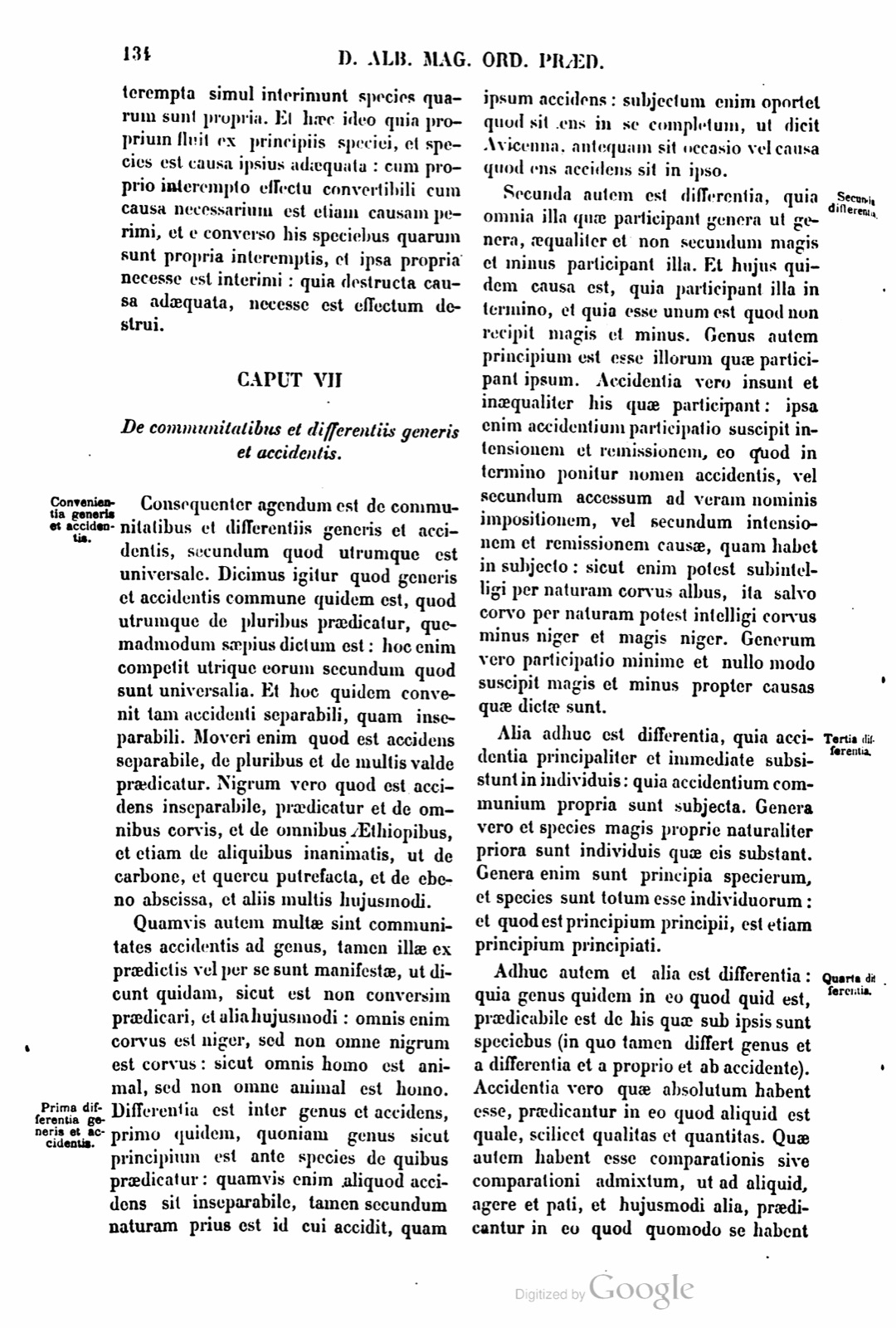
Consequenter agendum est de communitatibus et differentiis generis et accidentis, secundum quod utrumque est universale. Dicimus igitur quod generis et accidentis commune quidem est, quod utrumque pluribus praedicatur, quemadmodum saepius dictum est: hoc enim competit utrique eorum secundum quod sunt universalia. Et hoc quidem convenit tam accidenti separabili, quam inseparabili. Moveri enim quod est accidens separabile, de pluribus et de multis valde praedicatur. Nigrum vero quod est accidens inseparabile, praedicatur et de omnibus corvis, et de omnibus Ethiopibus, et etiam de aliquibus inanimatis, ut de carbone, et quercu putrefacta, et de ebeno abscissa, et aliis multis hujusmodi.
Quamvis autem multae sint communitates accidentis ad genus, tamen illae ex praedictis vel per se sunt manifestae, ut dicunt quidam, sicut est non conversim praedicari, et alia hujusmodi: omnis enim corvus est niger, sed non omne nigrum est corvus: sicut omnis homo est animal, sed non omne animal est homo.
Differentia est inter genus et accidens, primo quidem, quoniam genus sicut principium est ante species de quibus praedicatur: quamvis enim aliquod accidens sit inseparabile, tamen secundum naturam prius est id cui accidit, quam ipsum accidens: subjectum enim oportet quod sit ens in se completum, ut dicit Avicenna, antequam sit occasio vel causa quod ens accidens sit in ipso.
Secunda autem est differentia, quia omnia illa quae participant genera ut genera, aequaliter et non secundum magis et minus participant illa. Et hujus quidem causa est, quia participant illa in termino, et quia esse unum est quod non recipit magis et minus. Genus autem principium est esse illorum quae participant ipsum. Accidentia vero insunt et inaequaliter his quae participant: ipsa enim accidentium participatio suscipit intensionem et remissionem, eo quod in termino ponitur nomen accidentis, vel secundum accessum ad veram nominis impositionem, vel secundum intensionem et remissionem causae, quam habet in subjecto: sicut enim potest subintelligi per naturam corvus albus, ita salvo corvo per naturam potest intelligi corvus minus niger et magis niger. Generum vero participatio minime et nullo modo suscipit magis et minus propter causas quae dictae sunt.
Alia adhuc est differentia, quia accidentia principaliter et immediate subsistunt in individuis: quia accidentium communium propria sunt subjecta. Genera vero et species magis proprie naturaliter priora sunt individuis quae eis substant. Genera enim sunt principia specierum, et species sunt totum esse individuorum: et quod est principium principii, est etiam principium principiati.
Adhuc autem et alia est differentia: quia genus quidem in eo quod quid est, praedicabile est de his quae sub ipsis sunt speciebus, in quo tamen differt genus et a differentia et a proprio et ab accidente. Accidentia vero quae absolutum habent esse, praedicantur in eo quod aliquid est quale, scilicet qualitas et quantitas. Quae autem habent esse comparationis sive comparationi admixtum, ut ad aliquid, agere et pati, et hujusmodi alia, praedicantur in eo quod quomodo se habent unumquodque eorum de quibus praedicatur. Si quis enim interrogatus fuerit, qualis est Ethiops? congrue respondet quia niger est. Si autem interrogatus fuerit, quomodo Socrates se habet in corporis dispositione? congrue respondet quia sedet vel stat. Si quaeratur quomodo se habet agendo, dicet quod ambulat vel aliquid aliud agit.
CHAPTER VII.
On the commonalities and differences of genus and accident.
Consequently one must deal with the commonalities and differences of genus and accident, according as each is a universal. Therefore we say that it is common to genus and accident that each is predicated of several, as has often been said; for this belongs to each of them according as they are universals. And this indeed belongs both to separable and inseparable accident. For to be moved, which is a separable accident, is predicated of several and of very many. But black, which is an inseparable accident, is predicated of all ravens, all Ethiopians, and also of some inanimate things, as of coal, rotten oak, cut ebony, and many other things of this sort.
Although there are many commonalities of accident with genus, nevertheless those are manifest from the foregoing or through themselves, as some say, such as not being predicated conversely and other things of this sort; for every raven is black, but not every black thing is a raven, just as every man is an animal, but not every animal is man.
There is a difference between genus and accident first because genus, as a principle, is before the species of which it is predicated. For although some accident is inseparable, nevertheless according to nature that to which it happens is prior to the accident itself; for the subject must be a being completed in itself, as Avicenna says, before it is the occasion or cause that accidental being is in it.
But the second difference is that all those things which participate genera as genera participate them equally and not according to more and less. The cause of this is that they participate them at the term, and because being is one, which does not receive more and less. But genus is the principle of the being of those things which participate it. Accidents, however, are in those that participate them unequally; for the very participation of accidents receives intension and remission, because the name of accident is placed at the term, either according to approach to the true imposition of the name, or according to the intension and remission of the cause which it has in the subject. For just as by nature a white raven can be understood beneath, so while the raven is preserved by nature, a raven less black and more black can be understood. But participation of genera least of all and in no way receives more and less, for the causes that have been stated.
There is still another difference, because accidents subsist principally and immediately in individuals, because the proper subjects of common accidents are individuals. But genera and species are more properly naturally prior to the individuals that stand under them. For genera are principles of species, and species are the whole being of individuals; and what is the principle of a principle is also the principle of the thing principled.
Further there is also another difference: because genus is predicable in what it is of the species which are under it, in which however genus differs both from difference, proper, and accident. But accidents which have absolute being are predicated in that something is what-sort-of, namely quality and quantity. Those which have being of comparison or being mixed with comparison, as toward something, to act and to be acted upon, and other such things, are predicated in how each one of the things of which they are predicated is disposed. For if someone is asked, what-sort-of is the Ethiopian, he fittingly answers that he is black. But if he is asked how Socrates is disposed in bodily disposition, he fittingly answers that he sits or stands. If it is asked how he is disposed in acting, he will say that he walks or does something else.
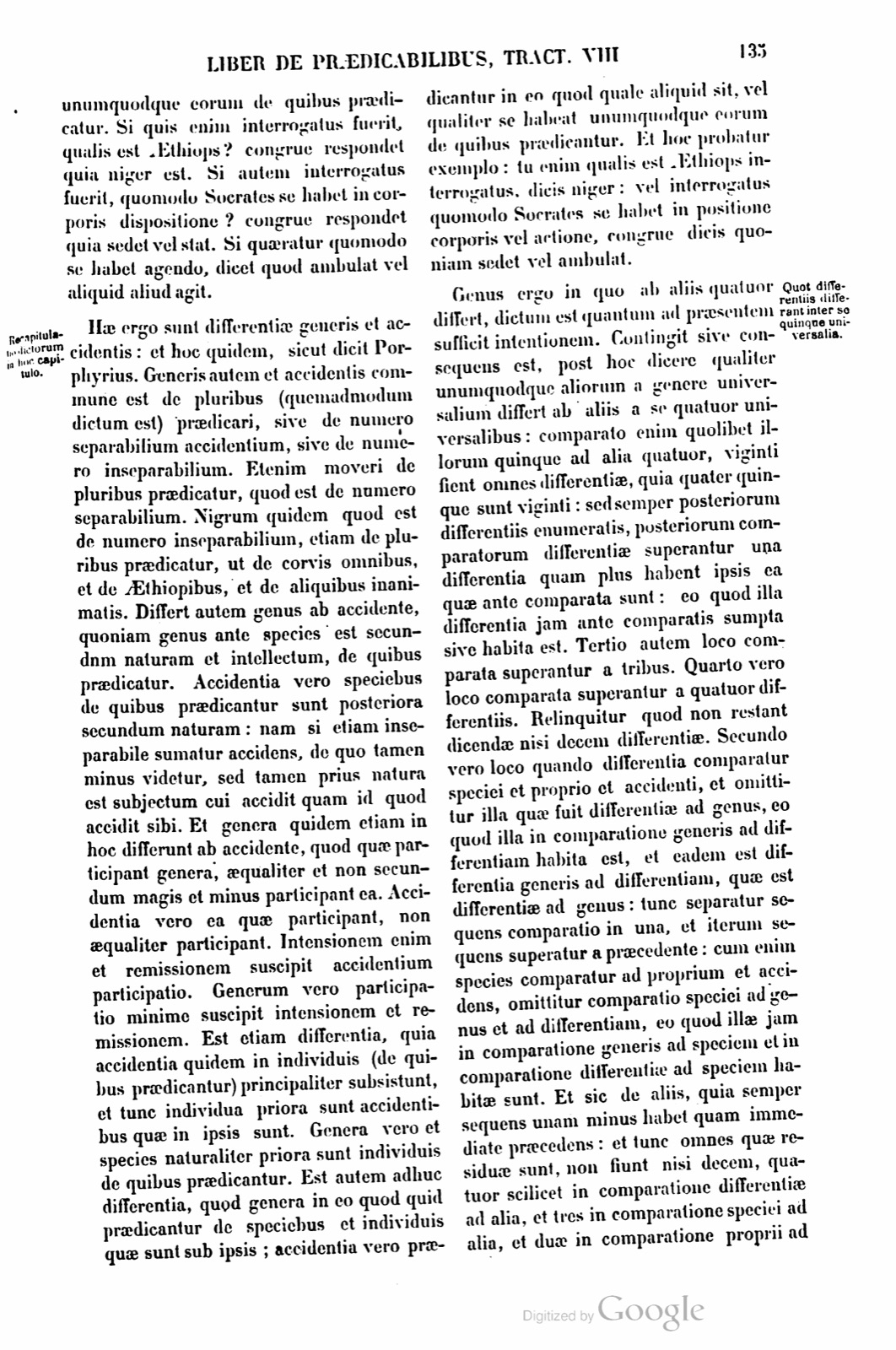
Hae ergo sunt differentiae generis et accidentis: et hoc quidem, sicut dicit Porphyrius. Generis autem et accidentis commune est de pluribus, quemadmodum dictum est, praedicari, sive de numero separabilium accidentium, sive de numero inseparabilium. Etenim moveri de pluribus praedicatur, quod est de numero separabilium. Nigrum quidem quod est de numero inseparabilium, etiam de pluribus praedicatur, ut de corvis omnibus, et de Aethiopibus, et de aliquibus inanimatis. Differt autem genus ab accidente, quoniam genus ante species est secundum naturam et intellectum, de quibus praedicatur. Accidentia vero speciebus de quibus praedicantur sunt posteriora secundum naturam: nam si etiam inseparabile sumatur accidens, de quo tamen minus videtur, sed tamen prius natura est subjectum cui accidit quam id quod accidit sibi. Et genera quidem etiam in hoc differunt ab accidente, quod quae participant genera, aequaliter et non secundum magis et minus participant ea. Accidentia vero ea quae participant, non aequaliter participant. Intensionem enim et remissionem suscipit accidentium participatio. Generum vero participatio minime suscipit intensionem et remissionem. Est etiam differentia, quia accidentia quidem in individuis, de quibus praedicantur, principaliter subsistunt, et tunc individua priora sunt accidentibus quae in ipsis sunt. Genera vero et species naturaliter priora sunt individuis de quibus praedicantur. Est autem adhuc differentia, quod genera in eo quod quid praedicantur de speciebus et individuis quae sunt sub ipsis; accidentia vero praedicantur in eo quod quale aliquid sit, vel qualiter se habeat unumquodque eorum de quibus praedicantur. Et hoc probatur exemplo: tu enim qualis est Ethiops interrogatus, dicis niger: vel interrogatus quomodo Socrates se habet in positione corporis vel actione, congrue dicis quoniam sedet vel ambulat.
Genus ergo in quo ab aliis quatuor differt, dictum est quantum ad praesentem sufficit intentionem. Contingit sive consequens est, post hoc dicere qualiter unumquodque aliorum a genere universalium differt ab aliis a se quatuor universalibus: comparato enim quolibet illorum quinque ad alia quatuor, viginti fient omnes differentiae, quia quater quinque sunt viginti: sed semper posteriorum differentiis enumeratis, posteriorum comparatorum differentiae superantur una differentia quam plus habent ipsis ea quae ante comparata sunt: eo quod illa differentia jam ante comparatis sumpta sive habita est. Tertio autem loco comparata superantur a tribus. Quarto vero loco comparata superantur a quatuor differentiis. Relinquitur quod non restant dicendae nisi decem differentiae. Secundo vero loco quando differentia comparatur speciei et proprio et accidenti, et omittitur illa quae fuit differentiae ad genus, eo quod illa in comparatione generis ad differentiam habita est, et eadem est differentia generis ad differentiam, quae est differentiae ad genus: tunc separatur sequens comparatio in una, et iterum sequens superatur a praecedente: cum enim species comparatur ad proprium et accidens, omittitur comparatio speciei ad genus et ad differentiam, eo quod illae jam in comparatione generis ad speciem et in comparatione differentiae ad speciem habitae sunt. Et sic de aliis, quia semper sequens unam minus habet quam immediate praecedens: et tunc omnes quae residuae sunt, non fiunt nisi decem, quatuor scilicet in comparatione differentiae ad alia, et tres in comparatione speciei ad alia, et duae in comparatione proprii ad alia, et una in consideratione universalis ultimi et comparationis.
These therefore are the differences of genus and accident, and this indeed is as Porphyry says. But it is common to genus and accident, as has been said, to be predicated of several, whether of the number of separable accidents or of the number of inseparable accidents. For to be moved is predicated of several, which is of the number of separable accidents. But black, which is of the number of inseparables, is also predicated of several, as of all ravens, of Ethiopians, and of some inanimate things. But genus differs from accident because genus is before the species of which it is predicated according to nature and understanding. Accidents, however, are posterior according to nature to the species of which they are predicated; for even if an inseparable accident is taken, about which this seems less true, nevertheless the subject to which it happens is prior by nature to what happens to it. And genera also differ from accident in this, that those things which participate genera participate them equally and not according to more and less. But the things that participate accidents do not participate them equally. For the participation of accidents receives intension and remission. But participation of genera least of all receives intension and remission. There is also a difference because accidents subsist principally in the individuals of which they are predicated, and then the individuals are prior to the accidents which are in them. But genera and species are naturally prior to the individuals of which they are predicated. There is still another difference, that genera are predicated in what of the species and individuals which are under them; accidents, however, are predicated in what-sort-of something is, or how each of those of which they are predicated is disposed. And this is proved by example: for when you are asked what-sort-of the Ethiopian is, you say black; or when asked how Socrates is disposed in position of body or action, you fittingly say that he sits or walks.
Therefore in what genus differs from the other four has been said sufficiently for the present intention. It happens, or is consequent, after this to say how each one of the other universals differs from the four other universals apart from genus. For when any one of those five is compared to the other four, all the differences will become twenty, because four times five are twenty; but always, once the differences of the posterior things have been enumerated, the differences of the posterior things compared are exceeded by one difference which the things compared before have more than they have, because that difference has already been taken or had in the previous comparisons. But the things compared in the third place are exceeded by three; those compared in the fourth place by four differences. It remains that only ten differences remain to be stated. In the second place, when difference is compared to species, proper, and accident, that difference which was of difference to genus is omitted, because it was already had in the comparison of genus to difference, and the difference of genus to difference is the same as that of difference to genus. Then the following comparison is separated by one, and again the following is exceeded by the preceding. For when species is compared to proper and accident, the comparison of species to genus and to difference is omitted, because those have already been had in the comparison of genus to species and in the comparison of difference to species. And so with the others, because the following always has one less than the immediately preceding; and then all which are remaining become only ten: four, namely, in the comparison of difference to the others, three in the comparison of species to the others, two in the comparison of proper to the others, and one in the consideration and comparison of the final universal.
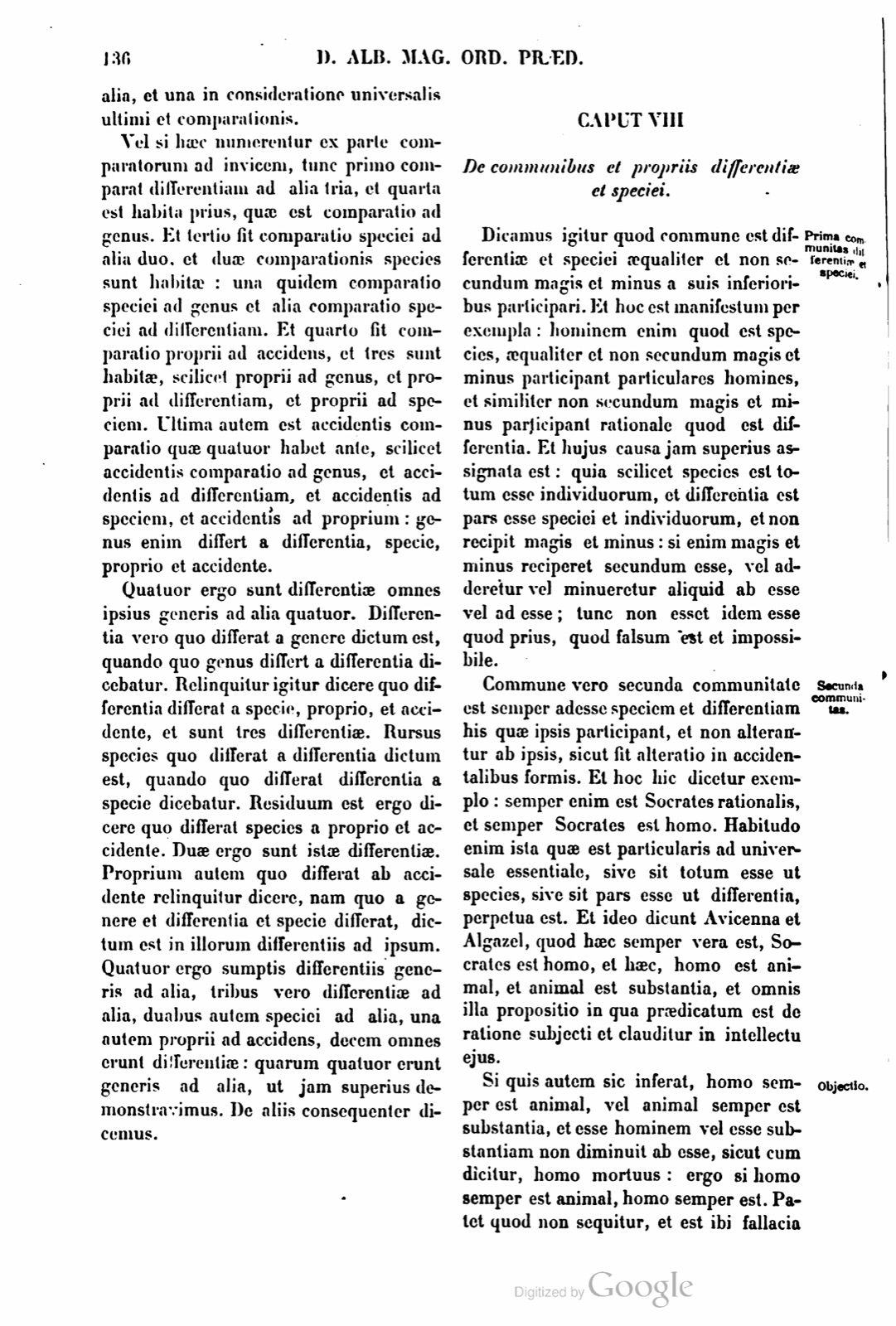
Vel si haec numerentur ex parte comparatorum ad invicem, tunc primo comparat differentiam ad alia tria, et quarta est habita prius, quae est comparatio ad genus. Et tertio fit comparatio speciei ad alia duo, et duae comparationis species sunt habitae: una quidem comparatio speciei ad genus et alia comparatio speciei ad differentiam. Et quarto fit comparatio proprii ad accidens, et tres sunt habitae, scilicet proprii ad genus, et proprii ad differentiam, et proprii ad speciem. Ultima autem est accidentis comparatio quae quatuor habet ante, scilicet accidentis comparatio ad genus, et accidentis ad differentiam, et accidentis ad speciem, et accidentis ad proprium: genus enim differt a differentia, specie, proprio et accidente.
Quatuor ergo sunt differentiae omnes ipsius generis ad alia quatuor. Differentia vero quo differat a genere dictum est, quando quo genus differt a differentia dicebatur. Relinquitur igitur dicere quo differentia differat a specie, proprio, et accidente, et sunt tres differentiae. Rursus species quo differat a differentia dictum est, quando quo differat differentia a specie dicebatur. Residuum est ergo dicere quo differat species a proprio et accidente. Duae ergo sunt istae differentiae. Proprium autem quo differat ab accidente relinquitur dicere, nam quo a genere et differentia et specie differat, dictum est in illorum differentiis ad ipsum. Quatuor ergo sumptis differentiis generis ad alia, tribus vero differentiae ad alia, duabus autem speciei ad alia, una autem proprii ad accidens, decem omnes erunt differentiae: quarum quatuor erunt generis ad alia, ut jam superius demonstravimus. De aliis consequenter dicemus.
Or if these are numbered from the side of things compared to one another, then first he compares difference to the other three, and the fourth has been had before, which is the comparison to genus. And in the third place the comparison of species to two others is made, and two species of comparison have been had: one, the comparison of species to genus, and the other, the comparison of species to difference. And fourth the comparison of proper to accident is made, and three have been had, namely proper to genus, proper to difference, and proper to species. But last is the comparison of accident, which has four before it, namely the comparison of accident to genus, accident to difference, accident to species, and accident to proper; for genus differs from difference, species, proper, and accident.
Therefore all the differences of genus itself to the other four are four. But in what difference differs from genus has been said when it was being said in what genus differs from difference. Therefore it remains to say in what difference differs from species, proper, and accident, and there are three differences. Again, in what species differs from difference was said when it was being said in what difference differs from species. Therefore what remains is to say in what species differs from proper and accident. Therefore there are two of these differences. But it remains to say in what proper differs from accident, for in what it differs from genus, difference, and species was said in their differences toward it. Therefore, with four differences of genus to the others taken, three of difference to the others, two of species to the others, and one of proper to accident, all will be ten differences: of these, four will be of genus to the others, as we have already demonstrated above. We shall speak of the others consequently.
If a page does not appear, its photograph has not been uploaded yet.