Volume 1 · pp. 133–134
Chapter VI. On the agreements and differences of genus and proper.
A marker with ≈ is an approximate page boundary, placed by measure of the text; the page photographs remain the authority. In the paired views, clicking a page marker brings that page into view.
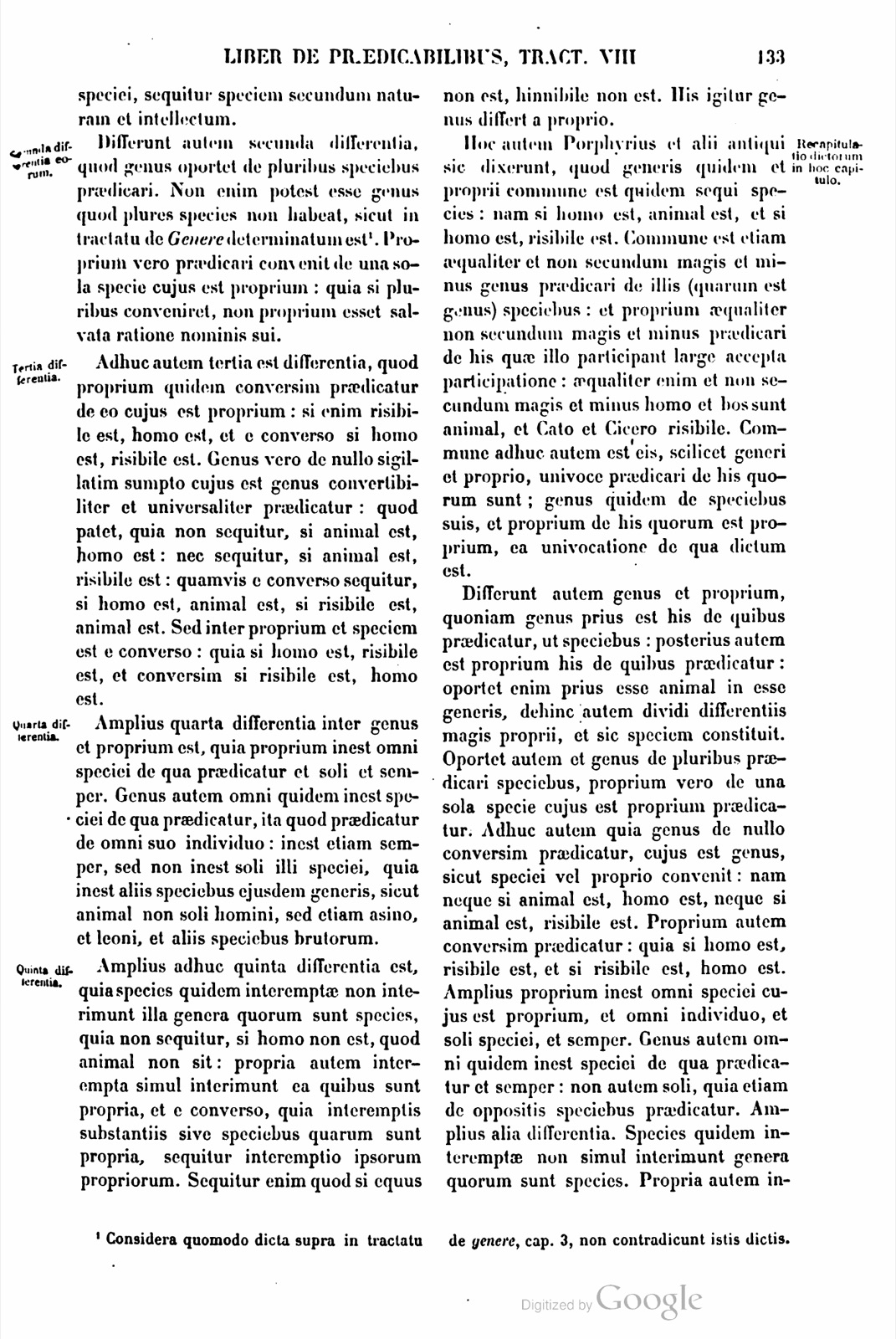
speciei, sequitur speciem secundum naturam et intellectum.
Differunt autem secunda differentia, quod genus oportet de pluribus speciebus praedicari. Non enim potest esse genus quod plures species non habeat, sicut in tractatu de Genere determinatum est1. Proprium vero praedicari convenit de una sola specie cujus est proprium: quia si pluribus conveniret, non proprium esset salvata ratione nominis sui.
Adhuc autem tertia est differentia, quod proprium quidem conversim praedicatur de eo cujus est proprium: si enim risibile est, homo est, et e converso si homo est, risibile est. Genus vero de nullo sigillatim sumpto cujus est genus convertibiliter et universaliter praedicatur: quod patet, quia non sequitur, si animal est, homo est: nec sequitur, si animal est, risibile est: quamvis e converso sequitur, si homo est, animal est, si risibile est, animal est. Sed inter proprium et speciem est e converso: quia si homo est, risibile est, et conversim si risibile est, homo est.
Amplius quarta differentia inter genus et proprium est, quia proprium inest omni speciei de qua praedicatur et soli et semper. Genus autem omni quidem inest speciei de qua praedicatur, ita quod praedicatur de omni suo individuo: inest etiam semper, sed non inest soli illi speciei, quia inest aliis speciebus ejusdem generis, sicut animal non soli homini, sed etiam asino, et leoni, et aliis speciebus brutorum.
Amplius adhuc quinta differentia est, quia species quidem interemptae non interimunt illa genera quorum sunt species, quia non sequitur, si homo non est, quod animal non sit: propria autem interempta simul interimunt ea quibus sunt propria, et e converso, quia interemptis substantiis sive speciebus quarum sunt propria, sequitur interemptio ipsorum propriorum. Sequitur enim quod si equus non est, hinnibile non est. His igitur genus differt a proprio.
Hoc autem Porphyrius et alii antiqui sic dixerunt, quod generis quidem et proprii commune est quidem sequi species: nam si homo est, animal est, et si homo est, risibile est. Commune est etiam aequaliter et non secundum magis et minus genus praedicari de illis quarum est genus speciebus: et proprium aequaliter non secundum magis et minus praedicari de his quae illo participant large accepta participatione: aequaliter enim et non secundum magis et minus homo et bos sunt animal, et Cato et Cicero risibile. Commune adhuc autem est eis, scilicet generi et proprio, univoce praedicari de his quorum sunt; genus quidem de speciebus suis, et proprium de his quorum est proprium, ea univocatione de qua dictum est.
of the species, it follows upon the species according to nature and understanding.
But they differ by a second difference, that genus must be predicated of several species. For there cannot be a genus which does not have several species, as was determined in the tractate on Genus1. Proper, however, is fittingly predicated of one species alone of which it is the proper, because if it belonged to several, it would not be proper while the account of its name was preserved.
Further, the third difference is that proper is indeed predicated conversely of that of which it is proper: for if it is risible, it is man, and conversely, if it is man, it is risible. But genus is predicated convertibly and universally of no one thing taken singly of which it is the genus. This is clear because it does not follow, if animal is, man is; nor does it follow, if animal is, risible is; although conversely it follows, if man is, animal is, and if risible is, animal is. But between proper and species there is a converse relation, because if man is, risible is, and conversely if risible is, man is.
Further, the fourth difference between genus and proper is that proper inheres in every species of which it is predicated, and in it alone, and always. But genus indeed inheres in every species of which it is predicated, so that it is predicated of every one of its individuals; it also inheres always, but it does not inhere in that species alone, because it inheres in other species of the same genus, as animal not only in man but also in ass, lion, and other species of brutes.
Further, still a fifth difference is that species when destroyed do not destroy those genera of which they are species, because it does not follow, if man is not, that animal is not. But propers when destroyed at the same time destroy those things of which they are propers, and conversely, because when substances or species of which they are propers have been destroyed, the destruction of those propers follows. For it follows that if horse is not, neigh-able is not. By these things therefore genus differs from proper.
Porphyry and the other ancients stated this thus: that it is common to genus and proper to follow species, for if man is, animal is, and if man is, risible is. It is also common that genus is predicated equally and not according to more and less of those species whose genus it is, and that proper is predicated equally and not according to more and less of those which participate it, taking participation broadly; for equally and not according to more and less man and ox are animal, and Cato and Cicero are risible. It is further common to them, namely genus and proper, to be predicated univocally of those of which they are: genus indeed of its species, and proper of those of which it is proper, by that univocation of which it has been said.
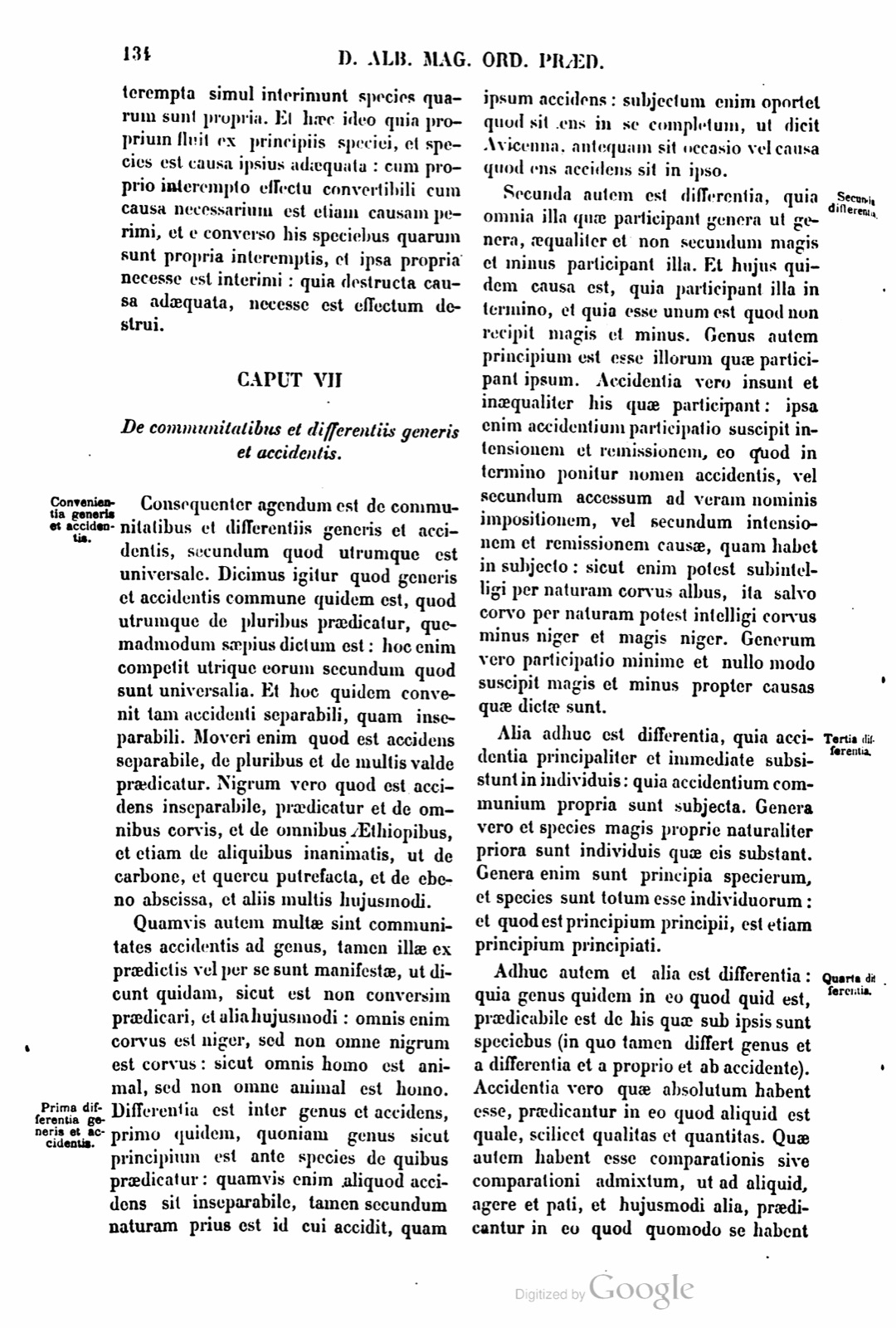
Differunt autem genus et proprium, quoniam genus prius est his de quibus praedicatur, ut speciebus: posterius autem est proprium his de quibus praedicatur: oportet enim prius esse animal in esse generis, dehinc autem dividi differentiis magis proprii, et sic speciem constituit. Oportet autem et genus de pluribus praedicari speciebus, proprium vero de una sola specie cujus est proprium praedicatur. Adhuc autem quia genus de nullo conversim praedicatur, cujus est genus, sicut speciei vel proprio convenit: nam neque si animal est, homo est, neque si animal est, risibile est. Proprium autem conversim praedicatur: quia si homo est, risibile est, et si risibile est, homo est. Amplius proprium inest omni speciei cujus est proprium, et omni individuo, et soli speciei, et semper. Genus autem omni quidem inest speciei de qua praedicatur et semper: non autem soli, quia etiam de oppositis speciebus praedicatur. Amplius alia differentia. Species quidem interemptae non simul interimunt genera quorum sunt species. Propria autem interempta simul interimunt species quarum sunt propria. Et haec ideo quia proprium fluit ex principiis speciei, et species est causa ipsius adaequata: cum proprio interempto effectu convertibili cum causa necessarium est etiam causam perimi, et e converso his speciebus quarum sunt propria interemptis, et ipsa propria necesse est interimi: quia destructa causa adaequata, necesse est effectum destrui.
But genus and proper differ because genus is prior to those of which it is predicated, such as species, while proper is posterior to those of which it is predicated. For animal must first be in the being of genus, and then be divided by differences more proper, and thus it constitutes species. Genus also must be predicated of several species, but proper is predicated of one species alone of which it is the proper. Further, genus is predicated conversely of no thing whose genus it is, as belongs to species or proper; for neither if animal is, man is, nor if animal is, risible is. But proper is predicated conversely, because if man is, risible is, and if risible is, man is. Further, proper inheres in every species of which it is proper, in every individual, in the species alone, and always. But genus indeed inheres in every species of which it is predicated and always, but not in it alone, because it is also predicated of opposite species. Further there is another difference: species when destroyed do not at the same time destroy genera of which they are species. But propers when destroyed at the same time destroy the species of which they are propers. And this is because proper flows from the principles of species, and species is its adequate cause; when the proper, an effect convertible with its cause, has been destroyed, the cause must also be destroyed, and conversely, when those species of which they are propers have been destroyed, the propers themselves must also be destroyed, because when an adequate cause has been destroyed, the effect must be destroyed.
Notes
- Consider how the things said above in the tractate on genus, chapter 3, do not contradict these sayings. (Considera quomodo dicta supra in tractatu de genere, cap. 3, non contradicunt istis dictis.) ↩
If a page does not appear, its photograph has not been uploaded yet.