Volume 1 · p. 132
Chapter VI. On the agreements and differences of genus and proper.
CAPUT VI.
De convenientiis et differentiis generis et proprii.
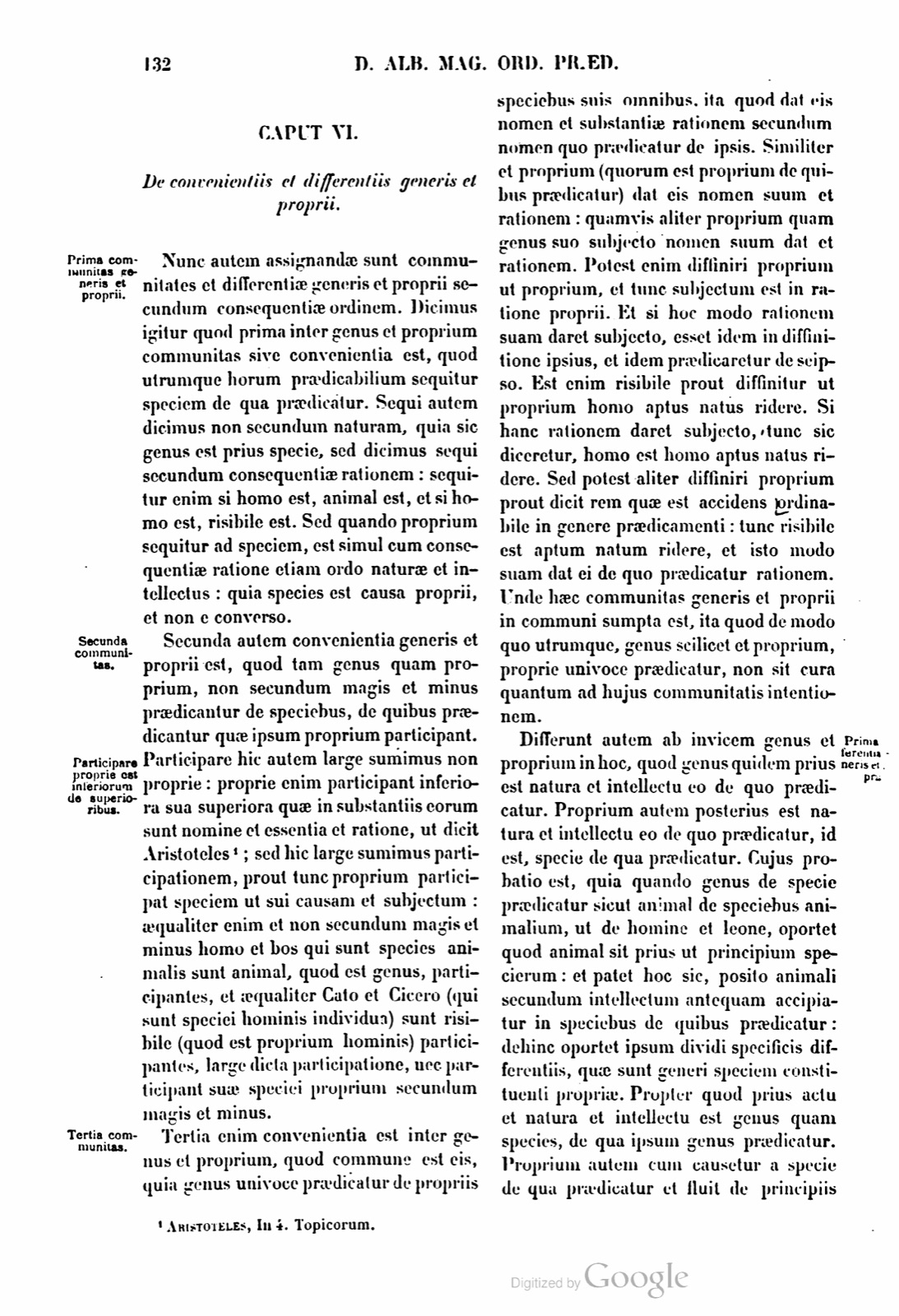
Nunc autem assignandae sunt communitates et differentiae generis et proprii secundum consequentiae ordinem. Dicimus igitur quod prima inter genus et proprium communitas sive convenientia est, quod utrumque horum praedicabilium sequitur speciem de qua praedicatur. Sequi autem dicimus non secundum naturam, quia sic genus est prius specie, sed dicimus sequi secundum consequentiae rationem: sequitur enim si homo est, animal est, et si homo est, risibile est. Sed quando proprium sequitur ad speciem, est simul cum consequentiae ratione etiam ordo naturae et intellectus: quia species est causa proprii, et non e converso.
Secunda autem convenientia generis et proprii est, quod tam genus quam proprium, non secundum magis et minus praedicantur de speciebus, de quibus praedicantur quae ipsum proprium participant. Participare hic autem large sumimus non proprie: proprie enim participant inferiora sua superiora quae in substantiis eorum sunt nomine et essentia et ratione, ut dicit Aristoteles1; sed hic large sumimus participationem, prout tunc proprium participat speciem ut sui causam et subjectum: aequaliter enim et non secundum magis et minus homo et bos qui sunt species animalis sunt animal, quod est genus, participantes, et aequaliter Cato et Cicero qui sunt speciei hominis individua sunt risibile, quod est proprium hominis, participantes, large dicta participatione, nec participant suae speciei proprium secundum magis et minus.
Tertia enim convenientia est inter genus et proprium, quod commune est eis, quia genus univoce praedicatur de propriis speciebus suis omnibus, ita quod dat eis nomen et substantiae rationem secundum nomen quo praedicatur de ipsis. Similiter et proprium, quorum est proprium de quibus praedicatur, dat eis nomen suum et rationem: quamvis aliter proprium quam genus suo subjecto nomen suum dat et rationem. Potest enim diffiniri proprium ut proprium, et tunc subjectum est in ratione proprii. Et si hoc modo rationem suam daret subjecto, esset idem in diffinitione ipsius, et idem praedicaretur de seipso. Est enim risibile prout diffinitur ut proprium homo aptus natus ridere. Si hanc rationem daret subjecto, tunc sic diceretur, homo est homo aptus natus ridere. Sed potest aliter diffiniri proprium prout dicit rem quae est accidens ordinabile in genere praedicamenti: tunc risibile est aptum natum ridere, et isto modo suam dat ei de quo praedicatur rationem. Unde haec communitas generis et proprii in communi sumpta est, ita quod de modo quo utrumque, genus scilicet et proprium, proprie univoce praedicatur, non sit cura quantum ad hujus communitatis intentionem.
Differunt autem ab invicem genus et proprium in hoc, quod genus quidem prius est natura et intellectu eo de quo praedicatur. Proprium autem posterius est natura et intellectu eo de quo praedicatur, id est, specie de qua praedicatur. Cujus probatio est, quia quando genus de specie praedicatur sicut animal de speciebus animalium, ut de homine et leone, oportet quod animal sit prius ut principium specierum: et patet hoc sic, posito animali secundum intellectum antequam accipiatur in speciebus de quibus praedicatur: dehinc oportet ipsum dividi specificis differentiis, quae sunt generi speciem constituenti propriae. Propter quod prius actu et natura et intellectu est genus quam species, de qua ipsum genus praedicatur. Proprium autem cum causetur a specie de qua praedicatur et fluit de principiis
CHAPTER VI.
On the agreements and differences of genus and proper.
Now the commonalities and differences of genus and proper must be assigned according to the order of consequence. Therefore we say that the first commonality or agreement between genus and proper is that each of these predicables follows the species of which it is predicated. But we say follows not according to nature, because in that way genus is prior to species, but we say that it follows according to the account of consequence. For it follows: if man is, animal is; and if man is, risible is. But when proper follows upon species, together with the account of consequence there is also the order of nature and understanding, because species is the cause of proper, and not conversely.
But the second agreement of genus and proper is that both genus and proper are not predicated according to more and less of the species of which they are predicated and which participate that proper. But here we take participate broadly, not properly; for properly inferiors participate their superiors, which are in their substances in name, essence, and account, as Aristotle says1. But here we take participation broadly, insofar as then proper participates species as its cause and subject. For equally and not according to more and less, man and ox, which are species of animal, are animal, participating genus; and equally Cato and Cicero, who are individuals of the species man, are risible, participating that which is the proper of man, by participation broadly so called. Nor do they participate the proper of their species according to more and less.
For the third agreement between genus and proper is this, that it is common to them because genus is predicated univocally of all its proper species, so that it gives them name and the account of substance according to the name by which it is predicated of them. Similarly proper, of those of which it is proper and of which it is predicated, gives them its name and account, although proper gives its name and account to its subject otherwise than genus does. For proper can be defined as proper, and then the subject is in the account of the proper. And if it gave its account to the subject in this mode, the same thing would be in the definition of it, and the same would be predicated of itself. For risible, insofar as it is defined as proper, is man naturally apt to laugh. If it gave this account to the subject, then it would be said thus: man is man naturally apt to laugh. But proper can be defined otherwise, insofar as it says a thing which is an accident orderable in the genus of predicament; then risible is naturally apt to laugh, and in that mode it gives its own account to that of which it is predicated. Hence this commonality of genus and proper is taken in common, so that there is no concern, as to the intention of this commonality, about the mode in which each, namely genus and proper, is properly predicated univocally.
But genus and proper differ from each other in this, that genus is prior by nature and understanding to that of which it is predicated. Proper, however, is posterior by nature and understanding to that of which it is predicated, that is, to the species of which it is predicated. The proof of this is that when genus is predicated of species, as animal of the species of animals, such as man and lion, animal must be prior as the principle of the species. And this is clear thus: animal is posited according to understanding before it is taken in the species of which it is predicated; thereafter it must be divided by specific differences, which are proper to the genus constituting species. On account of this genus is prior in act, nature, and understanding than species, of which the genus itself is predicated. But proper, since it is caused by the species of which it is predicated and flows from the principles
Notes
- Aristotle, in Topics, book 4. (Aristoteles, In 4 Topicorum.) ↩
If a page does not appear, its photograph has not been uploaded yet.