Volume 1 · pp. 130–131
Chapter V. On the common and proper features of genus and species.
A marker with ≈ is an approximate page boundary, placed by measure of the text; the page photographs remain the authority. In the paired views, clicking a page marker brings that page into view.
CAPUT V.
De communibus et propriis generis et speciei.
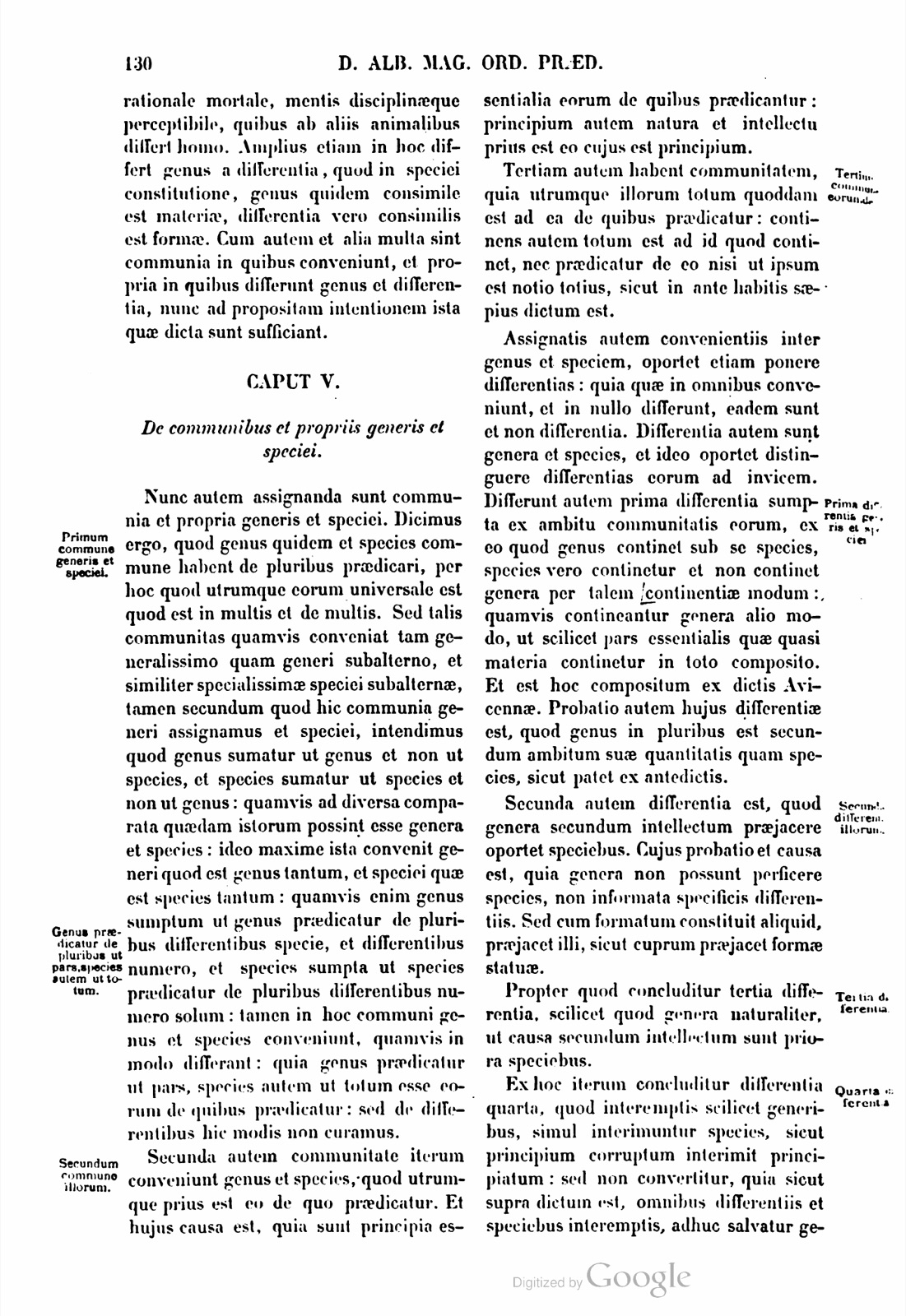
Nunc autem assignanda sunt communia et propria generis et speciei. Dicimus ergo, quod genus quidem et species commune habent de pluribus praedicari, per hoc quod utrumque eorum universale est quod est in multis et de multis. Sed talis communitas quamvis conveniat tam generalissimo quam generi subalterno, et similiter specialissimae speciei subalternae, tamen secundum quod hic communia generi assignamus et speciei, intendimus quod genus sumatur ut genus et non ut species, et species sumatur ut species et non ut genus: quamvis ad diversa comparata quaedam istorum possint esse genera et species: ideo maxime ista convenit generi quod est genus tantum, et speciei quae est species tantum: quamvis enim genus sumptum ut genus praedicatur de pluribus differentibus specie, et differentibus numero, et species sumpta ut species praedicatur de pluribus differentibus numero solum: tamen in hoc communi genus et species conveniunt, quamvis in modo differant: quia genus praedicatur ut pars, species autem ut totum esse eorum de quibus praedicatur: sed de differentibus hic modis non curamus.
Secunda autem communitate iterum conveniunt genus et species, quod utrumque prius est eo de quo praedicatur. Et hujus causa est, quia sunt principia essentialia eorum de quibus praedicantur: principium autem natura et intellectu prius est eo cujus est principium.
Tertiam autem habent communitatem, quia utrumque illorum totum quoddam est ad ea de quibus praedicatur: continens autem totum est ad id quod continet, nec praedicatur de eo nisi ut ipsum est notio totius, sicut in ante habitis saepius dictum est.
Assignatis autem convenientiis inter genus et speciem, oportet etiam ponere differentias: quia quae in omnibus conveniunt, et in nullo differunt, eadem sunt et non differentia. Differentia autem sunt genera et species, et ideo oportet distinguere differentias eorum ad invicem. Differunt autem prima differentia sumpta ex ambitu communitatis eorum, ex eo quod genus continet sub se species, species vero continetur et non continet genera per talem continentiae modum: quamvis contineantur genera alio modo, ut scilicet pars essentialis quae quasi materia continetur in toto composito. Et est hoc compositum ex dictis Avicennae. Probatio autem hujus differentiae est, quod genus in pluribus est secundum ambitum suae quantitatis quam species, sicut patet ex antedictis.
Secunda autem differentia est, quod genera secundum intellectum praejacere oportet speciebus. Cujus probatio et causa est, quia genera non possunt perficere species, non informata specificis differentiis. Sed cum formatum constituit aliquid, praejacet illi, sicut cuprum praejacet formae statuae.
Propter quod concluditur tertia differentia, scilicet quod genera naturaliter, ut causa secundum intellectum sunt priora speciebus.
Ex hoc iterum concluditur differentia quarta, quod interemptis scilicet generibus, simul interimuntur species, sicut principium corruptum interimit principiatum: sed non convertitur, quia sicut supra dictum est, omnibus differentiis et speciebus interemptis, adhuc salvatur genus secundum esse intellectuale: et ideo species quidem cum sit posita, etiam genus de necessitate positum est, eo quod in specie est genus actu et intellectu: genus vero cum sit positum, non sequitur omnino quod sit species, quia species non nisi potentia est in genere, posita autem potentia, non propter hoc actu ponitur ens, quia in potentia ens non est secundum actum.
CHAPTER V.
On the common and proper features of genus and species.
Now the common and proper features of genus and species must be assigned. Therefore we say that genus and species have in common that they are predicated of many, through the fact that each of them is a universal which is in many and of many. But although such commonality belongs both to the most general and to subaltern genus, and similarly to the most special and subaltern species, nevertheless according as here we assign common features to genus and species, we intend that genus be taken as genus and not as species, and species be taken as species and not as genus, although compared to diverse things some of these can be genera and species. Therefore this belongs especially to the genus which is genus only, and to the species which is species only. For although genus taken as genus is predicated of many things differing in species and differing in number, and species taken as species is predicated of many things differing in number only, nevertheless in this common point genus and species agree, although they differ in mode, because genus is predicated as a part, but species as the whole being of those of which it is predicated; but here we do not concern ourselves with the differing modes.
By a second commonality genus and species again agree, that each is prior to that of which it is predicated. And the cause of this is that they are essential principles of those things of which they are predicated; but a principle is prior by nature and understanding to that of which it is a principle.
They have a third commonality because each of them is a certain whole with respect to those things of which it is predicated. But a containing whole is related to that which it contains, and it is not predicated of it except as it is the notion of the whole, as has often been said in the preceding matters.
But when the agreements between genus and species have been assigned, one must also posit the differences, because things which agree in all things and differ in nothing are the same and not different. But genera and species are different, and therefore it is necessary to distinguish their differences from one another. They differ by a first difference taken from the range of their commonness, from the fact that genus contains species under itself, while species is contained and does not contain genera by such a mode of containment; although genera are contained in another mode, namely as an essential part which is contained as matter in the composite whole. And this is composed from the sayings of Avicenna. The proof of this difference is that genus is in more things according to the range of its quantity than species, as is clear from what was said before.
But the second difference is that genera must, according to understanding, lie before species. The proof and cause of this is that genera cannot perfect species unless informed by specific differences. But when something formed constitutes something, it lies before it, as copper lies before the form of a statue.
On account of this the third difference is concluded, namely that genera naturally, as a cause according to understanding, are prior to species.
From this again a fourth difference is concluded, namely that when genera have been destroyed, species are destroyed at the same time, just as a corrupted principle destroys the thing principled. But it is not converted, because as was said above, when all differences and species have been destroyed, genus is still preserved according to intellectual being. And therefore when species has been posited, genus also is necessarily posited, because in species genus is in act and understanding. But when genus has been posited, it does not follow absolutely that species exists, because species is in genus only potentially; but when potency has been posited, for this reason a being is not posited actually, because a being in potency is not according to act.
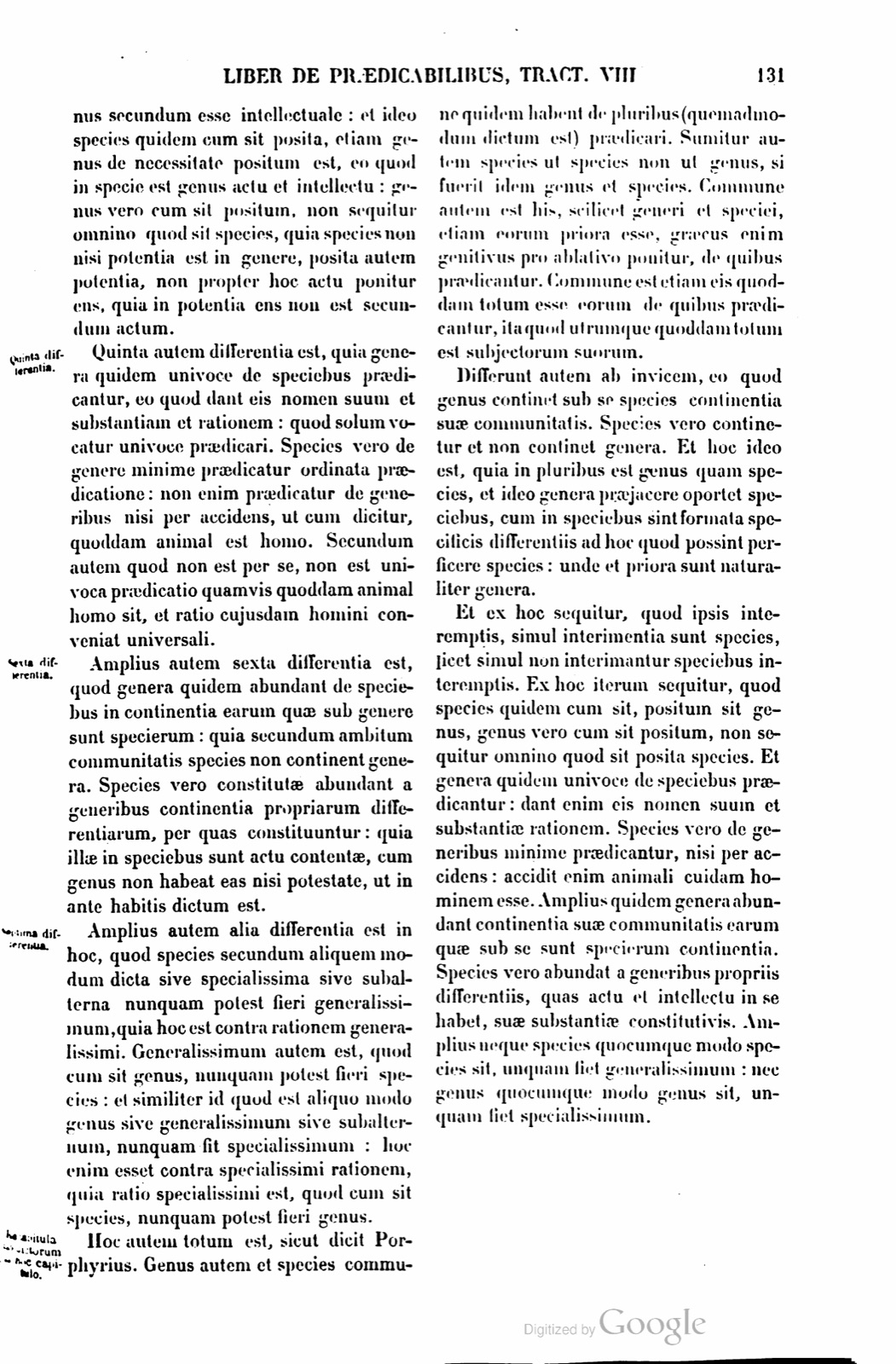
Quinta autem differentia est, quia genera quidem univoce de speciebus praedicantur, eo quod dant eis nomen suum et substantiam et rationem: quod solum vocatur univoce praedicari. Species vero de genere minime praedicatur ordinata praedicatione: non enim praedicatur de generibus nisi per accidens, ut cum dicitur, quoddam animal est homo. Secundum autem quod non est per se, non est univoca praedicatio quamvis quoddam animal homo sit, et ratio cujusdam homini conveniat universali.
Amplius autem sexta differentia est, quod genera quidem abundant de speciebus in continentia earum quae sub genere sunt specierum: quia secundum ambitum communitatis species non continent genera. Species vero constitutae abundant a generibus continentia propriarum differentiarum, per quas constituuntur: quia illae in speciebus sunt actu contentae, cum genus non habeat eas nisi potestate, ut in ante habitis dictum est.
Amplius autem alia differentia est in hoc, quod species secundum aliquem modum dicta sive specialissima sive subalterna nunquam potest fieri generalissimum, quia hoc est contra rationem generalissimi. Generalissimum autem est, quod cum sit genus, nunquam potest fieri species: et similiter id quod est aliquo modo genus sive generalissimum sive subalternum, nunquam fit specialissimum: hoc enim esset contra specialissimi rationem, quia ratio specialissimi est, quod cum sit species, nunquam potest fieri genus.
Hoc autem totum est, sicut dicit Porphyrius. Genus autem et species commune quidem habent de pluribus, quemadmodum dictum est, praedicari. Sumitur autem species ut species non ut genus, si fuerit idem genus et species. Commune autem est his, scilicet generi et speciei, etiam eorum priora esse, Graecus enim genitivus pro ablativo ponitur, de quibus praedicantur. Commune est etiam eis quoddam totum esse eorum de quibus praedicantur, ita quod utrumque quoddam totum est subjectorum suorum.
Differunt autem ab invicem, eo quod genus continet sub se species continentia suae communitatis. Species vero continetur et non continet genera. Et hoc ideo est, quia in pluribus est genus quam species, et ideo genera praejacere oportet speciebus, cum in speciebus sint formata specificis differentiis ad hoc quod possint perficere species: unde et priora sunt naturaliter genera.
Et ex hoc sequitur, quod ipsis interemptis, simul interimentia sunt species, licet simul non interimantur speciebus interemptis. Ex hoc iterum sequitur, quod species quidem cum sit, positum sit genus, genus vero cum sit positum, non sequitur omnino quod sit posita species. Et genera quidem univoce de speciebus praedicantur: dant enim eis nomen suum et substantiae rationem. Species vero de generibus minime praedicantur, nisi per accidens: accidit enim animali cuidam hominem esse. Amplius quidem genera abundant continentia suae communitatis earum quae sub se sunt specierum continentia. Species vero abundat a generibus propriis differentiis, quas actu et intellectu in se habet, suae substantiae constitutivis. Amplius neque species quocumque modo species sit, unquam fiet generalissimum: nec genus quocumque modo genus sit, unquam fiet specialissimum.
But the fifth difference is that genera are predicated univocally of species, because they give them their name and substance and account; this alone is called to be predicated univocally. But species is least of all predicated of genus by ordered predication; for it is not predicated of genera except per accidens, as when it is said, a certain animal is man. But according as it is not per se, the predication is not univocal, although a certain animal is man and the account of a certain thing belongs to the universal man.
Further, the sixth difference is that genera exceed species in the containment of those species which are under the genus, because according to the range of commonality species do not contain genera. But constituted species exceed genera by containment of their proper differences through which they are constituted, because those are contained in species in act, while genus has them only in potency, as was said in the preceding matters.
Further, another difference is in this, that species said in any mode, whether most special or subaltern, can never become most general, because this is contrary to the account of most general. But the most general is that which, since it is genus, can never become species. And similarly that which is in some mode genus, whether most general or subaltern, never becomes most special; for this would be contrary to the account of the most special, because the account of most special is that, since it is species, it can never become genus.
But this whole thing is as Porphyry says. Genus and species indeed have in common, as has been said, being predicated of many. Species, however, is taken as species, not as genus, if the same thing has been genus and species. It is also common to these, namely genus and species, to be prior to those of which they are predicated, for the Greek genitive is put for the ablative. It is also common to them to be a certain whole being of those of which they are predicated, so that each is a certain whole of its subjects.
But they differ from one another in that genus contains species under itself by the containment of its commonness. Species, however, is contained and does not contain genera. And this is because genus is in more things than species, and therefore genera must lie before species, since in species they are formed by specific differences so that they can perfect species; hence genera also are naturally prior.
And from this it follows that when they are destroyed, species are destroyed at the same time, although they are not destroyed at the same time when species are destroyed. From this again it follows that when species exists, genus is posited, but when genus is posited, it does not follow absolutely that species is posited. And genera are predicated univocally of species, for they give them their name and the account of substance. But species are least of all predicated of genera, except per accidens, for it happens to a certain animal to be man. Further, genera exceed by the containment of their commonness the containment of those species which are under them. But species exceeds genera by its proper differences, constitutive of its substance, which it has in itself in act and understanding. Further, neither will species, in whatever mode it is species, ever become most general; nor will genus, in whatever mode it is genus, ever become most special.
If a page does not appear, its photograph has not been uploaded yet.