Volume 1 · pp. 126–127
Chapter II. On the three common features of genus and difference.
A marker with ≈ is an approximate page boundary, placed by measure of the text; the page photographs remain the authority. In the paired views, clicking a page marker brings that page into view.
CAPUT II.
De tribus communibus generi et differentiae.
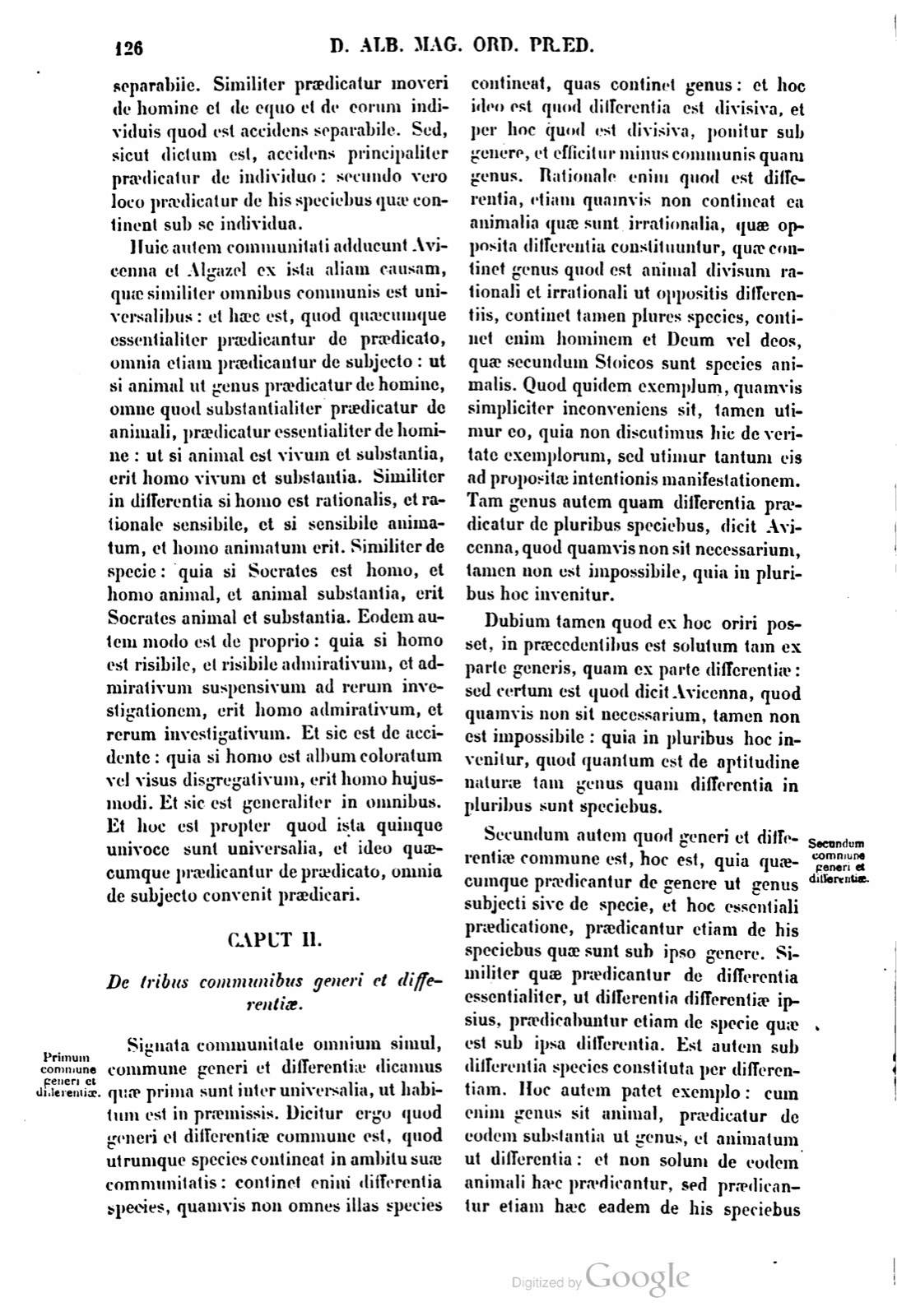
Signata communitate omnium simul, commune generi et differentiae dicamus quae prima sunt inter universalia, ut habitum est in praemissis. Dicitur ergo quod generi et differentiae commune est, quod utrumque species contineat in ambitu suae communitatis: continet enim differentia species, quamvis non omnes illas species contineat, quas continet genus: et hoc ideo est quod differentia est divisiva, et per hoc quod est divisiva, ponitur sub genere, et efficitur minus communis quam genus. Rationale enim quod est differentia, etiam quamvis non contineat ea animalia quae sunt irrationalia, quae opposita differentia constituuntur, quae continet genus quod est animal divisum rationali et irrationali ut oppositis differentiis, continet tamen plures species, continet enim hominem et Deum vel deos, quae secundum Stoicos sunt species animalis. Quod quidem exemplum, quamvis simpliciter inconveniens sit, tamen utimur eo, quia non discutimus hic de veritate exemplorum, sed utimur tantum eis ad propositae intentionis manifestationem. Tam genus autem quam differentia praedicatur de pluribus speciebus, dicit Avicenna, quod quamvis non sit necessarium, tamen non est impossibile, quia in pluribus hoc invenitur.
Dubium tamen quod ex hoc oriri posset, in praecedentibus est solutum tam ex parte generis, quam ex parte differentiae: sed certum est quod dicit Avicenna, quod quamvis non sit necessarium, tamen non est impossibile: quia in pluribus hoc invenitur, quod quantum est de aptitudine naturae tam genus quam differentia in pluribus sunt speciebus.
Secundum autem quod generi et differentiae commune est, hoc est, quia quaecumque praedicantur de genere ut genus subjecti sive de specie, et hoc essentiali praedicatione, praedicantur etiam de his speciebus quae sunt sub ipso genere. Similiter quae praedicantur de differentia essentialiter, ut differentia differentiae ipsius, praedicabuntur etiam de specie quae est sub ipsa differentia. Est autem sub differentia species constituta per differentiam. Hoc autem patet exemplo: cum enim genus sit animal, praedicatur de eodem substantia ut genus, et animatum ut differentia: et non solum de eodem animali haec praedicantur, sed praedicantur etiam haec eadem de his speciebus quae sunt sub animali usque ad individua, de quibus etiam praedicantur, quia illa ultima illarum specierum sunt subjecta. Similiter cum rationale sit differentia, de hac praedicatur ut differentia, quod est ratione uti: quod quidem ratione uti non solum praedicatur de differentia quae est rationalis, sed praedicatur etiam de his speciebus quae sub hac sunt differentia quae est rationale, et de individuis eorum, et de homine, et de diis.
CHAPTER II.
On the three common features of genus and difference.
Once the commonality of all together has been marked out, let us state what is common to genus and difference, which are first among the universals, as was held in the preceding matters. Therefore it is said that this is common to genus and difference, that each contains species within the range of its commonness. For difference contains species, although it does not contain all those species which genus contains; and this is because difference is divisive, and through the fact that it is divisive it is placed under genus and is made less common than genus. For rational, which is a difference, although it does not contain those animals which are irrational and which are constituted by the opposite difference, which the genus animal contains when divided by rational and irrational as opposite differences, nevertheless contains several species; for it contains man and God or gods, which according to the Stoics are species of animal. Although this example is simply unfitting, nevertheless we use it because we are not discussing here the truth of examples, but use them only to manifest the proposed intention. Avicenna says that both genus and difference are predicated of several species, and although this is not necessary, it is nevertheless not impossible, because this is found in many cases.
Yet the doubt which could arise from this has been solved in the preceding matters, both on the part of genus and on the part of difference; but what Avicenna says is certain, that although it is not necessary, nevertheless it is not impossible, because in many cases this is found, that as far as concerns the aptitude of nature both genus and difference are in several species.
But the second thing common to genus and difference is this: whatever things are predicated of genus as genus of a subject or of a species, and this by essential predication, are also predicated of those species which are under that genus. Similarly, things which are predicated essentially of difference, as a difference of that difference itself, will also be predicated of the species which is under that difference. But under difference is the species constituted through difference. This is clear by example: for since the genus is animal, substance is predicated of the same as genus, and animated as difference; and these are predicated not only of the same animal, but these same things are also predicated of those species which are under animal down to the individuals, of which they also are predicated, because those last things of those species are subjects. Similarly, when rational is a difference, there is predicated of it as difference what it is to use reason; and this use of reason is predicated not only of the difference which is rational, but is also predicated of those species which are under this difference, rational, and of their individuals, and of man and of gods.
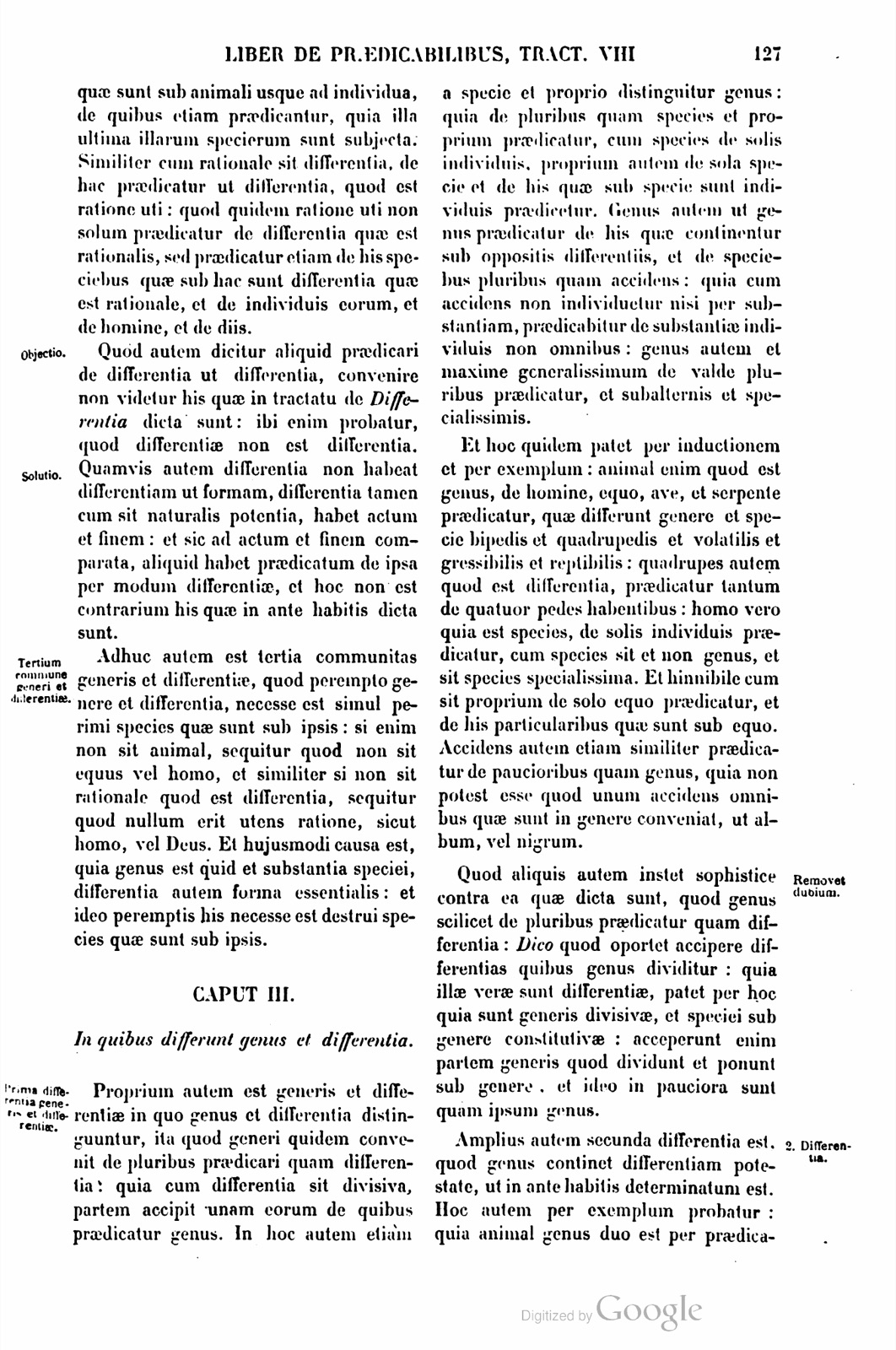
Quod autem dicitur aliquid praedicari de differentia ut differentia, convenire non videtur his quae in tractatu de Differentia dicta sunt: ibi enim probatur, quod differentiae non est differentia. Quamvis autem differentia non habeat differentiam ut formam, differentia tamen cum sit naturalis potentia, habet actum et finem: et sic ad actum et finem comparata, aliquid habet praedicatum de ipsa per modum differentiae, et hoc non est contrarium his quae in ante habitis dicta sunt.
Adhuc autem est tertia communitas generis et differentiae, quod perempto genere et differentia, necesse est simul perimi species quae sunt sub ipsis: si enim non sit animal, sequitur quod non sit equus vel homo, et similiter si non sit rationale quod est differentia, sequitur quod nullum erit utens ratione, sicut homo, vel Deus. Et hujusmodi causa est, quia genus est quid et substantia speciei, differentia autem forma essentialis: et ideo peremptis his necesse est destrui species quae sunt sub ipsis.
But that something is said to be predicated of difference as difference does not seem to agree with the things said in the tractate on Difference; for there it is proved that there is no difference of a difference. Yet although difference does not have difference as form, nevertheless, since difference is a natural potency, it has act and end; and thus, compared to act and end, it has something predicated of it in the mode of difference, and this is not contrary to the things said in the preceding matters.
Further, there is a third commonality of genus and difference, that when genus and difference have been taken away, the species which are under them must be taken away at the same time. For if animal does not exist, it follows that horse or man does not exist; and similarly, if rational, which is a difference, does not exist, it follows that there will be nothing using reason, such as man or God. And the cause of this is that genus is the what and substance of species, while difference is the essential form; and therefore, when these are taken away, the species which are under them must be destroyed.
If a page does not appear, its photograph has not been uploaded yet.