Volume 1 · pp. 125–126
Tractate VIII. On the common features in which the five universals agree and the differences by which they differ. Chapter I. On that in which all five universals communicate.
A marker with ≈ is an approximate page boundary, placed by measure of the text; the page photographs remain the authority. In the paired views, clicking a page marker brings that page into view.
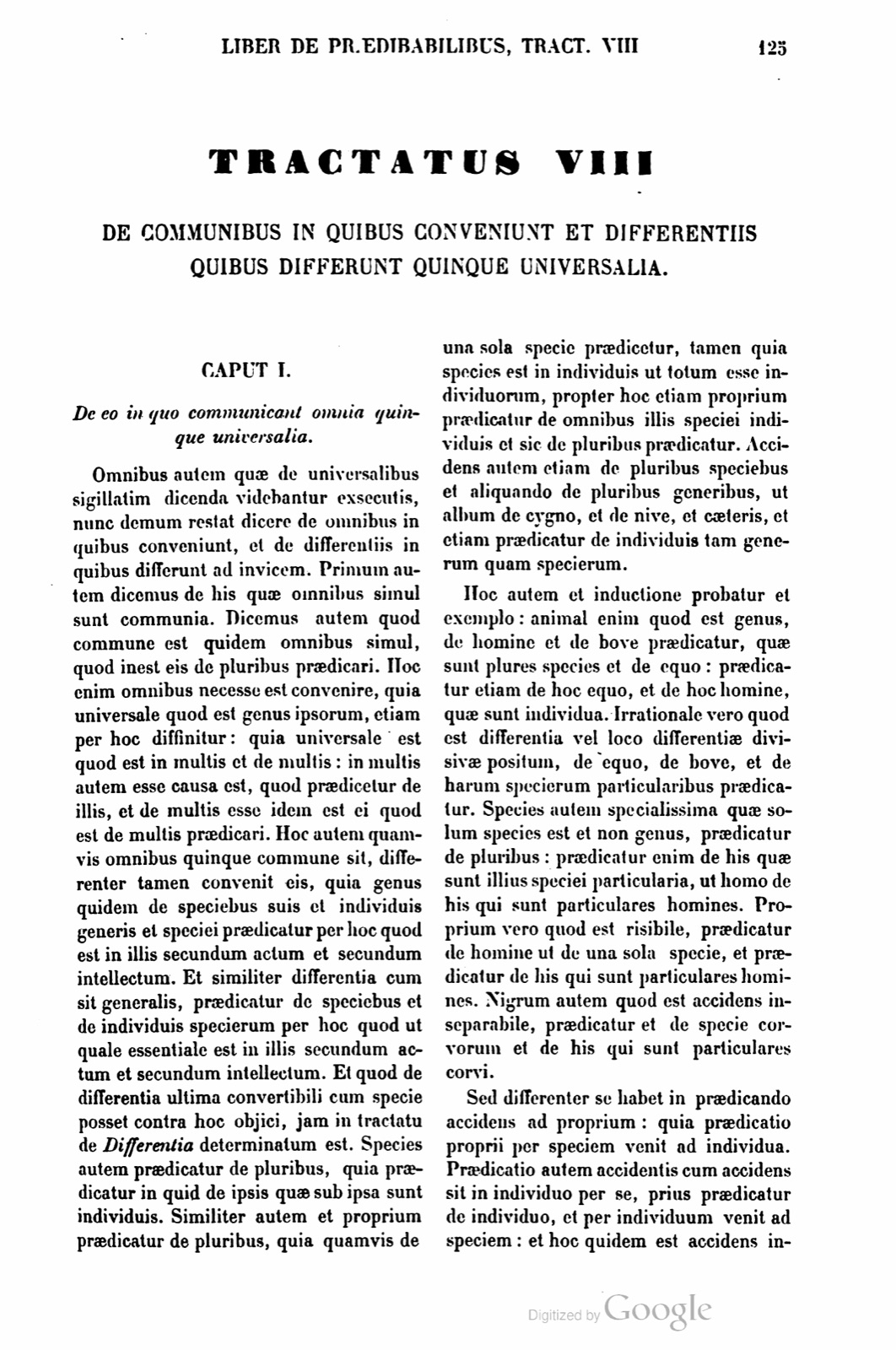
TRACTATUS VIII
DE COMMUNIBUS IN QUIBUS CONVENIUNT ET DIFFERENTIIS QUIBUS DIFFERUNT QUINQUE UNIVERSALIA.
CAPUT I.
De eo in quo communicant omnia quinque universalia.
Omnibus autem quae de universalibus sigillatim dicenda videbantur exsecutis, nunc demum restat dicere de omnibus in quibus conveniunt, et de differentiis in quibus differunt ad invicem. Primum autem dicemus de his quae omnibus simul sunt communia. Dicemus autem quod commune est quidem omnibus simul, quod inest eis de pluribus praedicari. Hoc enim omnibus necesse est convenire, quia universale quod est genus ipsorum, etiam per hoc diffinitur: quia universale est quod est in multis et de multis: in multis autem esse causa est, quod praedicetur de illis, et de multis esse idem est ei quod est de multis praedicari. Hoc autem quamvis omnibus quinque commune sit, differenter tamen convenit eis, quia genus quidem de speciebus suis et individuis generis et speciei praedicatur per hoc quod est in illis secundum actum et secundum intellectum. Et similiter differentia cum sit generalis, praedicatur de speciebus et de individuis specierum per hoc quod ut quale essentiale est in illis secundum actum et secundum intellectum. Et quod de differentia ultima convertibili cum specie posset contra hoc objici, jam in tractatu de Differentia determinatum est. Species autem praedicatur de pluribus, quia praedicatur in quid de ipsis quae sub ipsa sunt individuis. Similiter autem et proprium praedicatur de pluribus, quia quamvis de una sola specie praedicetur, tamen quia species est in individuis ut totum esse individuorum, propter hoc etiam proprium praedicatur de omnibus illis speciei individuis et sic de pluribus praedicatur. Accidens autem etiam de pluribus speciebus et aliquando de pluribus generibus, ut album de cygno, et de nive, et caeteris, et etiam praedicatur de individuis tam generum quam specierum.
Hoc autem et inductione probatur et exemplo: animal enim quod est genus, de homine et de bove praedicatur, quae sunt plures species et de equo: praedicatur etiam de hoc equo, et de hoc homine, quae sunt individua. Irrationale vero quod est differentia vel loco differentiae divisivae positum, de equo, de bove, et de harum specierum particularibus praedicatur. Species autem specialissima quae solum species est et non genus, praedicatur de pluribus: praedicatur enim de his quae sunt illius speciei particularia, ut homo de his qui sunt particulares homines. Proprium vero quod est risibile, praedicatur de homine ut de una sola specie, et praedicatur de his qui sunt particulares homines. Nigrum autem quod est accidens inseparabile, praedicatur et de specie corvorum et de his qui sunt particulares corvi.
TRACTATE VIII
ON THE COMMON FEATURES IN WHICH THE FIVE UNIVERSALS AGREE AND THE DIFFERENCES BY WHICH THEY DIFFER.
CHAPTER I.
On that in which all five universals communicate.
But with all the things carried out which seemed to have to be said one by one about the universals, it now finally remains to speak about all the things in which they agree, and about the differences in which they differ from one another. First, however, we shall speak about those things which are common to all together. And we shall say that what is common to all together is that being predicated of many belongs to them. For this must necessarily belong to all, because universal, which is their genus, is also defined by this: for a universal is what is in many and of many. But being in many is the cause that it is predicated of them, and being of many is the same as being predicated of many. Although this is common to all five, nevertheless it belongs to them differently, because genus is predicated of its species and of the individuals of genus and species through the fact that it is in them according to act and according to understanding. And similarly difference, since it is general, is predicated of species and of individuals of species through the fact that, as an essential what-sort-of, it is in them according to act and according to understanding. And what could be objected against this about the final difference convertible with species has already been determined in the tractate on Difference. Species, however, is predicated of many because it is predicated in what of the individuals themselves which are under it. Similarly proper also is predicated of many, because although it is predicated of one species alone, nevertheless, because species is in individuals as the whole being of individuals, on account of this proper also is predicated of all the individuals of that species, and thus is predicated of many. Accident, however, is also predicated of many species and sometimes of many genera, as white of swan, snow, and the rest, and it is also predicated of individuals both of genera and of species.
This is proved both by induction and by example: for animal, which is a genus, is predicated of man and ox, which are several species, and of horse; it is also predicated of this horse and this man, which are individuals. Irrational, however, which is a difference or is placed in the place of a divisive difference, is predicated of horse, ox, and the particulars of these species. But the most special species, which is only species and not genus, is predicated of many; for it is predicated of those things which are particulars of that species, as man of those who are particular men. Proper, however, which is risible, is predicated of man as of one species alone, and is predicated of those who are particular men. But black, which is an inseparable accident, is predicated both of the species of ravens and of those that are particular ravens.
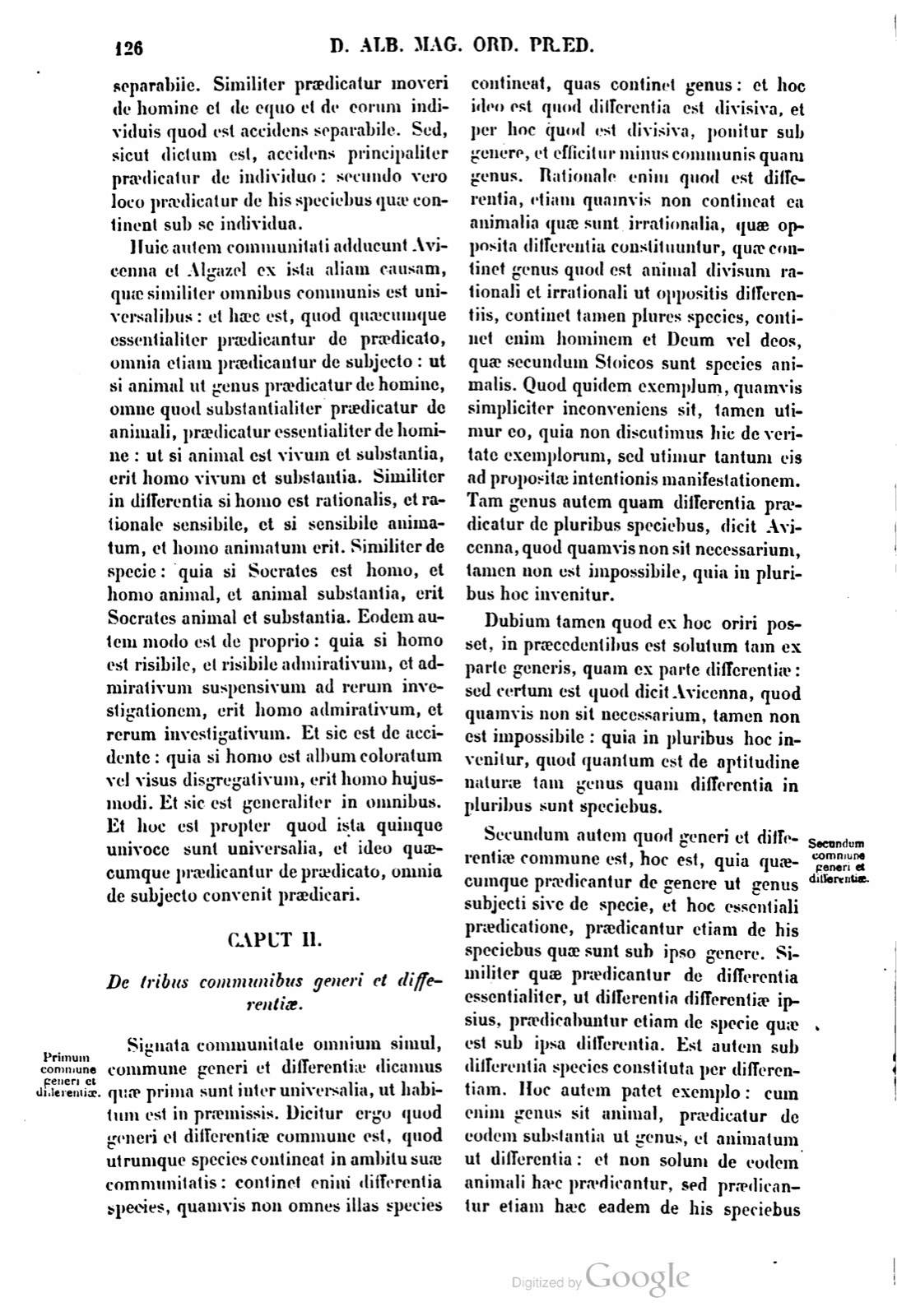
Sed differenter se habet in praedicando accidens ad proprium: quia praedicatio proprii per speciem venit ad individua. Praedicatio autem accidentis cum accidens sit in individuo per se, prius praedicatur de individuo, et per individuum venit ad speciem: et hoc quidem est accidens inseparabile. Similiter praedicatur moveri de homine et de equo et de eorum individuis quod est accidens separabile. Sed, sicut dictum est, accidens principaliter praedicatur de individuo: secundo vero loco praedicatur de his speciebus quae continent sub se individua.
Huic autem communitati adducunt Avicenna et Algazel ex ista aliam causam, quae similiter omnibus communis est universalibus: et haec est, quod quaecumque essentialiter praedicantur de praedicato, omnia etiam praedicantur de subjecto: ut si animal ut genus praedicatur de homine, omne quod substantialiter praedicatur de animali, praedicatur essentialiter de homine: ut si animal est vivum et substantia, erit homo vivum et substantia. Similiter in differentia si homo est rationalis, et rationale sensibile, et si sensibile animatum, et homo animatum erit. Similiter de specie: quia si Socrates est homo, et homo animal, et animal substantia, erit Socrates animal et substantia. Eodem autem modo est de proprio: quia si homo est risibile, et risibile admirativum, et admirativum suspensivum ad rerum investigationem, erit homo admirativum, et rerum investigativum. Et sic est de accidente: quia si homo est album coloratum vel visus disgregativum, erit homo hujusmodi. Et sic est generaliter in omnibus. Et hoc est propter quod ista quinque univoce sunt universalia, et ideo quaecumque praedicantur de praedicato, omnia de subjecto convenit praedicari.
But accident stands differently from proper in predicating, because the predication of proper comes to individuals through species. But the predication of accident, since accident is in the individual per se, is first predicated of the individual, and through the individual comes to the species; and this indeed is inseparable accident. Similarly, to be moved is predicated of man and horse and their individuals, and this is separable accident. But, as has been said, accident is principally predicated of the individual; in the second place, however, it is predicated of those species which contain individuals under themselves.
To this commonality Avicenna and Algazel bring from it another cause, which is similarly common to all universals: and it is this, that whatever things are predicated essentially of the predicate are all also predicated of the subject. Thus if animal as genus is predicated of man, everything that is predicated substantially of animal is predicated essentially of man; so if animal is living and substance, man will be living and substance. Similarly in difference, if man is rational, and rational is sensible, and if sensible is animated, man will also be animated. Similarly concerning species: because if Socrates is man, and man animal, and animal substance, Socrates will be animal and substance. But in the same mode it is so concerning proper: because if man is risible, and risible capable of wonder, and capable of wonder suspensive toward the investigation of things, man will be capable of wonder and investigative of things. And so it is concerning accident: because if man is white, colored, or disgregative of sight, man will be of this sort. And so it is generally in all. And this is why those five are univocally universals, and therefore whatever things are predicated of the predicate, all are fittingly predicated of the subject.
If a page does not appear, its photograph has not been uploaded yet.