Volume 1 · pp. 123–124
Chapter III. On the second and third assignment of accident given by Porphyry.
A marker with ≈ is an approximate page boundary, placed by measure of the text; the page photographs remain the authority. In the paired views, clicking a page marker brings that page into view.
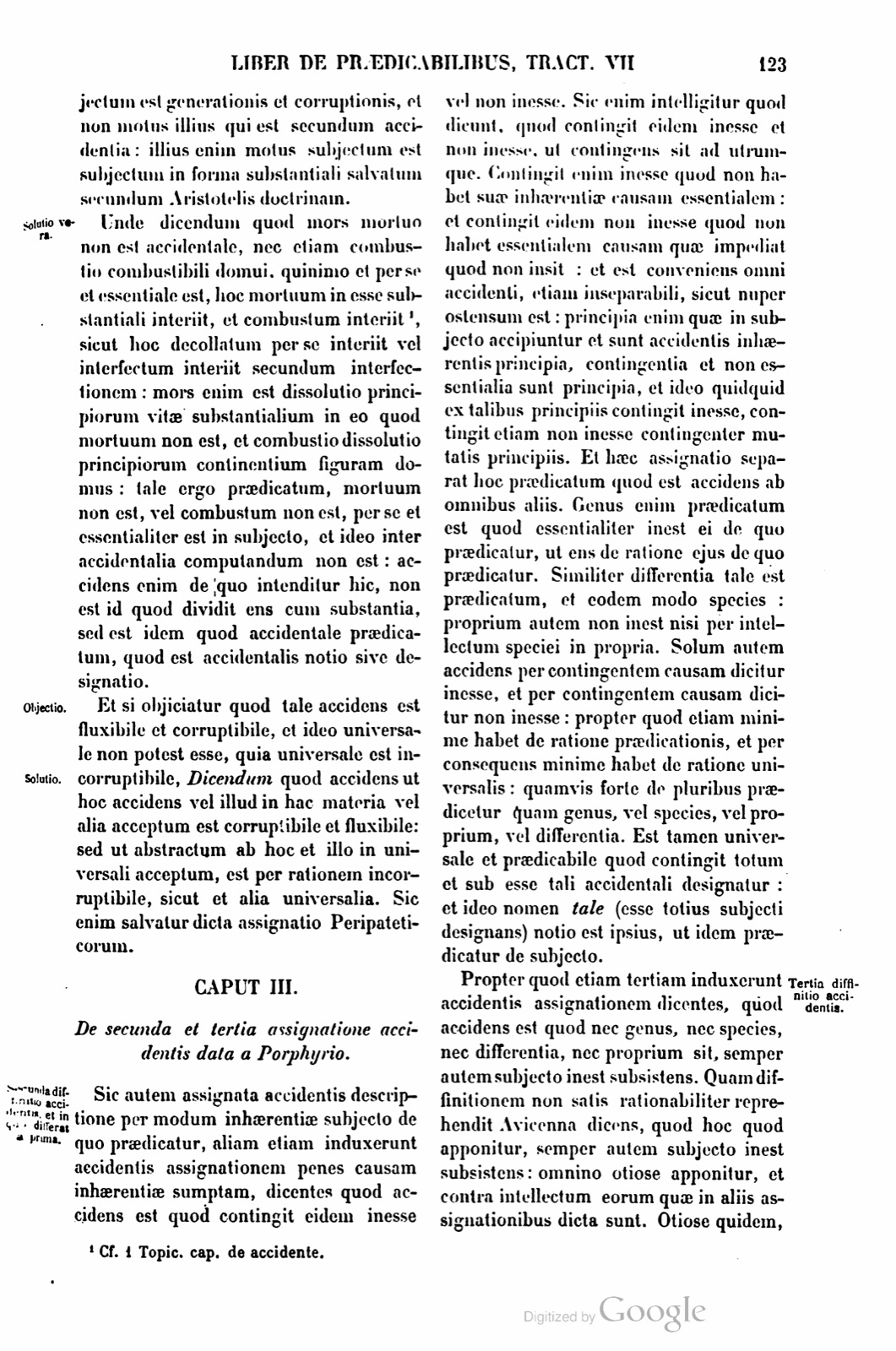
CAPUT III.
De secunda et tertia assignatione accidentis data a Porphyrio.
Sic autem assignata accidentis descriptione per modum inhaerentiae subjecto de quo praedicatur, aliam etiam induxerunt accidentis assignationem penes causam inhaerentiae sumptam, dicentes quod accidens est quod contingit eidem inesse vel non inesse. Sic enim intelligitur quod dicunt, quod contingit eidem inesse et non inesse, ut contingens sit ad utrumque. Contingit enim inesse quod non habet suae inhaerentiae causam essentialem: et contingit eidem non inesse quod non habet essentialem causam quae impediat quod non insit: et est conveniens omni accidenti, etiam inseparabili, sicut nuper ostensum est: principia enim quae in subjecto accipiuntur et sunt accidentis inhaerentis principia, contingentia et non essentialia sunt principia, et ideo quidquid ex talibus principiis contingit inesse, contingit etiam non inesse contingenter mutatis principiis. Et haec assignatio separat hoc praedicatum quod est accidens ab omnibus aliis. Genus enim praedicatum est quod essentialiter inest ei de quo praedicatur, ut ens de ratione ejus de quo praedicatur. Similiter differentia tale est praedicatum, et eodem modo species: proprium autem non inest nisi per intellectum speciei in propria. Solum autem accidens per contingentem causam dicitur inesse, et per contingentem causam dicitur non inesse: propter quod etiam minime habet de ratione praedicationis, et per consequens minime habet de ratione universalis: quamvis forte de pluribus praedicetur quam genus, vel species, vel proprium, vel differentia. Est tamen universale et praedicabile quod contingit totum et sub esse tali accidentali designatur: et ideo nomen tale, esse totius subjecti designans, notio est ipsius, ut idem praedicatur de subjecto.
Propter quod etiam tertiam induxerunt accidentis assignationem dicentes, quod accidens est quod nec genus, nec species, nec differentia, nec proprium sit, semper autem subjecto inest subsistens. Quam diffinitionem non satis rationabiliter reprehendit Avicenna dicens, quod hoc quod apponitur, semper autem subjecto inest subsistens: omnino otiose apponitur, et contra intellectum eorum quae in aliis assignationibus dicta sunt. Otiose quidem, quia cum accidens dicatur quasi cadens, eo quod non sit simpliciter ens, et sit potius entis quam ens, non oportuit ponere quod in subjecto est: non enim proprie est in subjecto, sed est aliquo modo subjecti aliquid potius quam sit, hoc est, esse habeat in subjecto: non enim habet esse in subjecto, sed subjectum secundum quod subjectum habet esse secundum ipsum. Et quod dicitur subsistens accidens, dicit Avicenna nihil significare: sed vox est non significativa, sicut buba, vel bultrix: accidens enim si accidens est, nullo modo subsistit, quia non habet subsistentiam aliquam, sed in subjecto tantum est, ita quod haec determinatio in subjecto determinat rationem essendi vel subsistendi. Et non est nisi secundum quid, quod non nisi in subjecto est, et sic superflue ponitur subsistens: et est sensus, quod accidens est subsistens, hoc est, quamdiu est, in subjecto est: et quando in subjecto non est, tunc non subsistit, nec est.
CHAPTER III.
On the second and third assignment of accident given by Porphyry.
But with the description of accident assigned in this way through the mode of inherence in the subject of which it is predicated, they also introduced another assignment of accident taken according to the cause of inherence, saying that accident is what can happen to be or not to be in the same thing. For what they say is understood thus, that it can happen to be and not to be in the same thing, so that the contingent is toward both. For what does not have an essential cause of its inherence can happen to be in; and what does not have an essential cause preventing it from not being in can happen not to be in the same thing. And it is fitting for every accident, even an inseparable one, as was shown just now. For the principles which are taken in the subject and are principles of the inhering accident are contingent and not essential principles; and therefore whatever from such principles can happen to be in, can also happen not to be in when the principles have been contingently changed. And this assignment separates this predicate, accident, from all the others. For genus is a predicate which inheres essentially in that of which it is predicated, as a being belonging to the account of that of which it is predicated. Difference is similarly such a predicate, and species in the same mode. Proper, however, inheres only through the understanding of the species in its propers. But accident alone is said to inhere through a contingent cause, and is said not to inhere through a contingent cause. On account of this it has least of the account of predication, and consequently least of the account of universal, although perhaps it is predicated of more things than genus, species, proper, or difference. Yet it is a universal and a predicable which can happen to be whole and is designated under such accidental being; and therefore such a name, designating the being of the whole subject, is its notion, so that the same is predicated of the subject.
On account of this they also introduced the third assignment of accident, saying that accident is what is neither genus, nor species, nor difference, nor proper, but always is in a subject while subsisting. Avicenna criticizes this definition not very reasonably, saying that what is added, but always is in a subject while subsisting, is added altogether idly and contrary to the understanding of the things said in the other assignments. Idly indeed, because since accident is called as though falling, because it is not simply a being and is rather of being than a being, it was not necessary to posit that it is in a subject. For it is not properly in a subject, but is in some way something of a subject rather than itself being, that is, having being in a subject; for it does not have being in a subject, but the subject as subject has being according to it. And Avicenna says that what is called a subsisting accident signifies nothing, but is a non-signifying utterance, like buba or bultrix. For if accident is accident, it in no way subsists, because it has no subsistence, but is only in a subject, so that this determination, in a subject, determines the account of being or subsisting. And it is only in a qualified sense, because it is only in a subject, and thus subsisting is placed superfluously; and the sense is that accident is subsisting, that is, as long as it is, it is in a subject, and when it is not in a subject, then it does not subsist and is not.
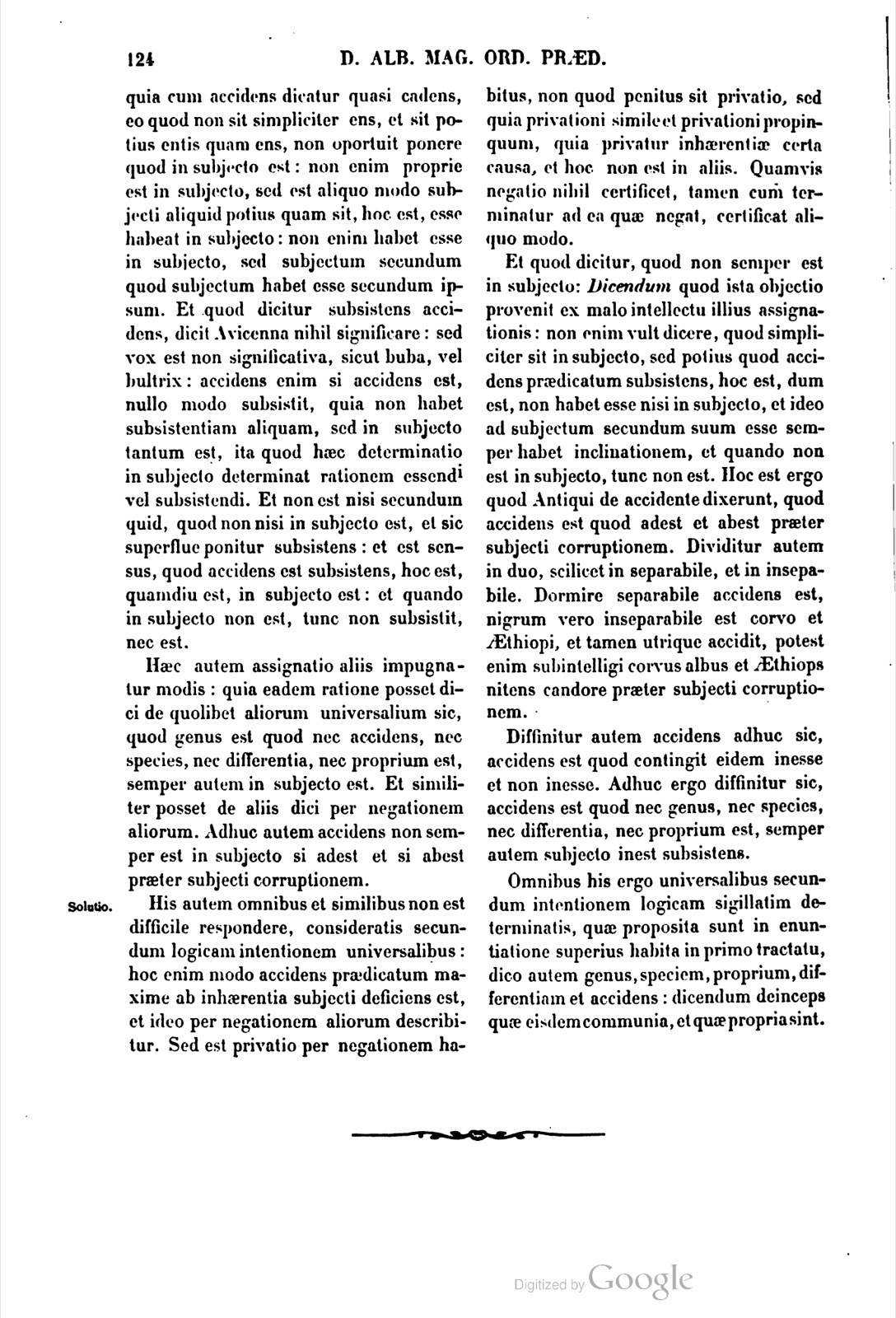
Haec autem assignatio aliis impugnatur modis: quia eadem ratione posset dici de quolibet aliorum universalium sic, quod genus est quod nec accidens, nec species, nec differentia, nec proprium est, semper autem in subjecto est. Et similiter posset de aliis dici per negationem aliorum. Adhuc autem accidens non semper est in subjecto si adest et si abest praeter subjecti corruptionem.
His autem omnibus et similibus non est difficile respondere, consideratis secundum logicam intentionem universalibus: hoc enim modo accidens praedicatum maxime ab inhaerentia subjecti deficiens est, et ideo per negationem aliorum describitur. Sed est privatio per negationem habitus, non quod penitus sit privatio, sed quia privationi simile et privationi propinquum, quia privatur inhaerentiae certa causa, et hoc non est in aliis. Quamvis negatio nihil certificet, tamen cum terminatur ad ea quae negat, certificat aliquo modo.
Et quod dicitur, quod non semper est in subjecto: dicendum quod ista objectio provenit ex malo intellectu illius assignationis: non enim vult dicere, quod simpliciter sit in subjecto, sed potius quod accidens praedicatum subsistens, hoc est, dum est, non habet esse nisi in subjecto, et ideo ad subjectum secundum suum esse semper habet inclinationem, et quando non est in subjecto, tunc non est. Hoc est ergo quod Antiqui de accidente dixerunt, quod accidens est quod adest et abest praeter subjecti corruptionem. Dividitur autem in duo, scilicet in separabile, et in inseparabile. Dormire separabile accidens est, nigrum vero inseparabile est corvo et Aethiopi, et tamen utrique accidit, potest enim subintelligi corvus albus et Aethiops nitens candore praeter subjecti corruptionem.
Diffinitur autem accidens adhuc sic, accidens est quod contingit eidem inesse et non inesse. Adhuc ergo diffinitur sic, accidens est quod nec genus, nec species, nec differentia, nec proprium est, semper autem subjecto inest subsistens.
Omnibus his ergo universalibus secundum intentionem logicam sigillatim determinatis, quae proposita sunt in enuntiatione superius habita in primo tractatu, dico autem genus, speciem, proprium, differentiam et accidens: dicendum deinceps quae eisdem communia, et quae propria sint.
But this assignment is attacked in other ways, because by the same reason it could be said of any of the other universals thus, that genus is what is neither accident, nor species, nor difference, nor proper, but always is in a subject. And similarly it could be said of the others through negation of the others. Further, accident is not always in a subject if it is present and if it is absent apart from corruption of the subject.
But to all these and similar points it is not difficult to respond, once the universals have been considered according to logical intention. For in this mode the predicate accident is most deficient from the inherence of a subject, and therefore it is described through negation of the others. But it is a privation through negation of habit, not because it is wholly privation, but because it is similar and near to privation, because it is deprived of a certain cause of inherence, and this is not the case in the others. Although negation certifies nothing, nevertheless when it is terminated to those things which it negates, it certifies in some way.
And as to what is said, that it is not always in a subject, one must say that this objection arises from a bad understanding of that assignment. For it does not mean to say that it is simply in a subject, but rather that the subsisting predicate accident, that is, while it is, has being only in a subject; and therefore according to its being it always has an inclination to the subject, and when it is not in a subject, then it is not. This therefore is what the Ancients said about accident: accident is what is present and absent apart from corruption of the subject. It is divided in two, namely into separable and inseparable. To sleep is a separable accident; black, however, is inseparable for raven and Ethiopian, and yet it happens to each, for a white raven and an Ethiopian shining with whiteness can be understood beneath apart from corruption of the subject.
But accident is further defined thus: accident is what can happen to be and not to be in the same thing. Again therefore it is defined thus: accident is what is neither genus, nor species, nor difference, nor proper, but always is in a subject while subsisting.
Therefore, with all these universals, according to logical intention, determined one by one, which were proposed in the statement had above in the first tractate, I mean genus, species, proper, difference, and accident, one must next state what things are common to them and what things are proper to them.
If a page does not appear, its photograph has not been uploaded yet.