Volume 1 · pp. 121–123
Chapter II. On the first assignment of accident given by Porphyry.
A marker with ≈ is an approximate page boundary, placed by measure of the text; the page photographs remain the authority. In the paired views, clicking a page marker brings that page into view.
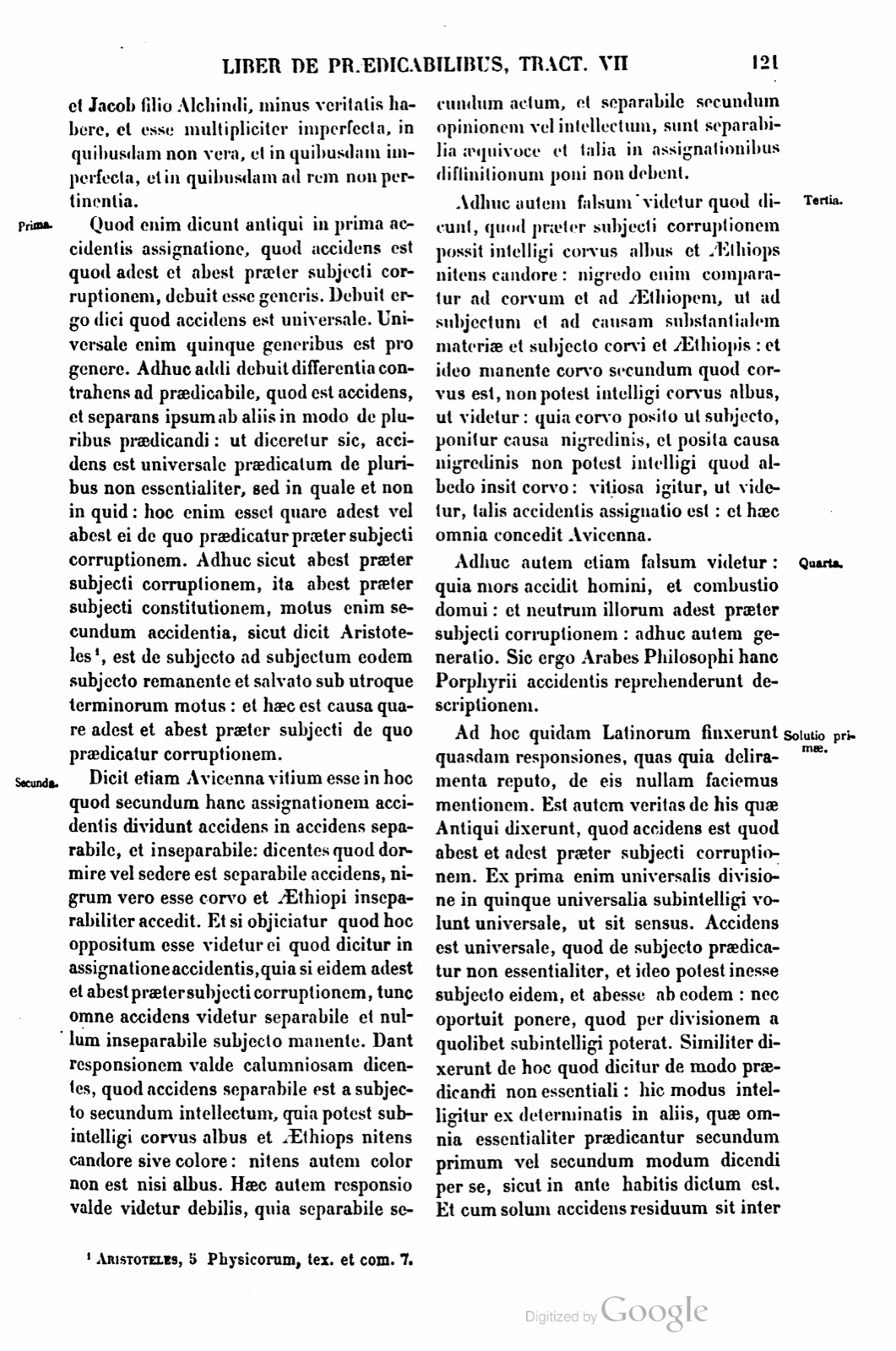
et Jacob filio Alchindi, minus veritatis habere, et esse multipliciter imperfecta, in quibusdam non vera, et in quibusdam imperfecta, et in quibusdam ad rem non pertinentia.
Quod enim dicunt antiqui in prima accidentis assignatione, quod accidens est quod adest et abest praeter subjecti corruptionem, debuit esse generis. Debuit ergo dici quod accidens est universale. Universale enim quinque generibus est pro genere. Adhuc addi debuit differentia contrahens ad praedicabile, quod est accidens, et separans ipsum ab aliis in modo de pluribus praedicandi: ut diceretur sic, accidens est universale praedicatum de pluribus non essentialiter, sed in quale et non in quid: hoc enim esset quare adest vel abest ei de quo praedicatur praeter subjecti corruptionem. Adhuc sicut abest praeter subjecti corruptionem, ita abest praeter subjecti constitutionem, motus enim secundum accidentia, sicut dicit Aristoteles1, est de subjecto ad subjectum eodem subjecto remanente et salvato sub utroque terminorum motus: et haec est causa quare adest et abest praeter subjecti de quo praedicatur corruptionem.
Dicit etiam Avicenna vitium esse in hoc quod secundum hanc assignationem accidentis dividunt accidens in accidens separabile, et inseparabile: dicentes quod dormire vel sedere est separabile accidens, nigrum vero esse corvo et Aethiopi inseparabiliter accedit. Et si objiciatur quod hoc oppositum esse videtur ei quod dicitur in assignatione accidentis, quia si eidem adest et abest praeter subjecti corruptionem, tunc omne accidens videtur separabile et nullum inseparabile subjecto manente. Dant responsionem valde calumniosam dicentes, quod accidens separabile est a subjecto secundum intellectum, quia potest subintelligi corvus albus et Aethiops nitens candore sive colore: nitens autem color non est nisi albus. Haec autem responsio valde videtur debilis, quia separabile secundum actum, et separabile secundum opinionem vel intellectum, sunt separabilia aequivoce et talia in assignationibus diffinitionum poni non debent.
Adhuc autem falsum videtur quod dicunt, quod praeter subjecti corruptionem possit intelligi corvus albus et Aethiops nitens candore: nigredo enim comparatur ad corvum et ad Aethiopem, ut ad subjectum et ad causam substantialem materiae et subjecto corvi et Aethiopis: et ideo manente corvo secundum quod corvus est, non potest intelligi corvus albus, ut videtur: quia corvo posito ut subjecto, ponitur causa nigredinis, et posita causa nigredinis non potest intelligi quod albedo insit corvo: vitiosa igitur, ut videtur, talis accidentis assignatio est: et haec omnia concedit Avicenna.
Adhuc autem etiam falsum videtur: quia mors accidit homini, et combustio domui: et neutrum illorum adest praeter subjecti corruptionem: adhuc autem generatio. Sic ergo Arabes Philosophi hanc Porphyrii accidentis reprehenderunt descriptionem.
Ad hoc quidam Latinorum finxerunt quasdam responsiones, quas quia deliramenta reputo, de eis nullam faciemus mentionem. Est autem veritas de his quae Antiqui dixerunt, quod accidens est quod abest et adest praeter subjecti corruptionem. Ex prima enim universalis divisione in quinque universalia subintelligi volunt universale, ut sit sensus. Accidens est universale, quod de subjecto praedicatur non essentialiter, et ideo potest inesse subjecto eidem, et abesse ab eodem: nec oportuit ponere, quod per divisionem a quolibet subintelligi poterat. Similiter dixerunt de hoc quod dicitur de modo praedicandi non essentiali: hic modus intelligitur ex determinatis in aliis, quae omnia essentialiter praedicantur secundum primum vel secundum modum dicendi per se, sicut in ante habitis dictum est. Et cum solum accidens residuum sit inter universalia et ultimum, eo quod minus habet de ratione praedicabilis, relinquebatur quod non essentialiter praedicaretur, et sic indifferenter ad affirmandum et negandum habet se ad suum subjectum, quod adest et abest eidem subjecto, subjecto eodem remanente incorrupto: quod non convenit alicui aliorum universalium quae se non habent ad subjecta de quibus praedicantur modo affirmando et modo negando: quia ipsa insunt subjectis actu et intellectu, vel subjecta insunt ipsis praedicatis secundum intellectum, quod non inest subjecto accidentis, nec etiam praedicato.
and Jacob son of Alchindi, have less truth, and are imperfect in several ways: in some points not true, in some imperfect, and in some not pertinent to the matter.
For when the ancients say in the first assignment of accident that accident is what is present and absent apart from the corruption of the subject, this ought to have belonged to the genus. Therefore it ought to have been said that accident is a universal. For universal is as genus for the five genera. Further, a difference narrowing it to the predicable which is accident, and separating it from the others in the mode of predicating of many, ought to have been added, so that it would be said thus: accident is a universal predicated of many non-essentially, but in what-sort-of and not in what. For this would be why it is present or absent from that of which it is predicated apart from the corruption of the subject. Further, just as it is absent apart from the corruption of the subject, so it is absent apart from the constitution of the subject; for motion according to accidents, as Aristotle says1, is from subject to subject while the same subject remains and is preserved under each term of the motion. And this is the cause why it is present and absent apart from the corruption of the subject of which it is predicated.
Avicenna also says there is a fault in this, that according to this assignment of accident they divide accident into separable and inseparable accident, saying that sleeping or sitting is a separable accident, but being black comes inseparably to raven and Ethiopian. And if it is objected that this seems to be opposite to what is said in the assignment of accident, because if it is present and absent from the same thing apart from corruption of the subject, then every accident seems separable and none inseparable while the subject remains. They give a very calumnious response, saying that accident is separable from the subject according to understanding, because a white raven and an Ethiopian shining with whiteness or color can be understood beneath; but a shining color is only white. This response, however, seems very weak, because separable according to act and separable according to opinion or understanding are separable equivocally, and such things ought not to be placed in the assignments of definitions.
Further, what they say seems false, that apart from corruption of the subject a white raven and an Ethiopian shining with whiteness can be understood: for blackness is compared to the raven and to the Ethiopian as to subject and as to the substantial cause of the matter and subject of raven and Ethiopian. Therefore, while the raven remains insofar as it is raven, a white raven cannot be understood, as it seems, because when raven is posited as subject, the cause of blackness is posited, and when the cause of blackness is posited it cannot be understood that whiteness is in the raven. Therefore such an assignment of accident seems faulty; and Avicenna concedes all these points.
Further it also seems false because death happens to man, and burning to a house, and neither of these is present apart from corruption of the subject; and further, generation. Thus therefore the Arab philosophers criticized this description of accident by Porphyry.
To this some of the Latins fashioned certain responses; since I consider them ravings, we shall make no mention of them. But the truth about the things which the Ancients said is that accident is what is absent and present apart from corruption of the subject. For from the first division of universal into five universals, they intend universal to be understood beneath, so that this is the sense: accident is a universal which is predicated of a subject non-essentially, and therefore can be in the same subject and be absent from the same subject. Nor was there need to posit what could be understood beneath by the division from each thing. Similarly they spoke about this which is said concerning the non-essential mode of predicating; this mode is understood from the things determined in the others, all of which are predicated essentially according to the first or second mode of speaking per se, as was said in the preceding matters. And since accident alone is left among the universals and is last, because it has less of the account of predicable, it remained that it would be predicated non-essentially, and thus it is indifferent to affirming and denying with respect to its subject, because it is present and absent from the same subject while the same subject remains incorrupt. This belongs to none of the other universals, which do not stand toward the subjects of which they are predicated now by affirming and now by denying; because they themselves are in the subjects in act and understanding, or the subjects are in those predicates according to understanding, which is not present in the subject of accident, nor even in the predicate.
Quod autem subjungitur de divisione accidentis, ratio est ut ostendatur assignatio vera de utroque accidente. Et de separabili quidem planum est quod dicitur. De inseparabili etiam verum est, quia docet Aristoteles quod alteratio est, quando eodem manente subjecto motus fit in suis passionibus: motu autem facto secundum inseparabile accidens non potest negari quin sit motus alterationis et non substantiae: oportet igitur quod maneat idem subjectum salvatum secundum esse substantiale: quia aliter motus esset aut de non subjecto ad subjectum, aut de subjecto ad non subjectum: et haec est necessitas quae compulit antiquos dicere, quod secundum inseparabilia accidentia praedicatio est accidentis, quod adest et abest praeter subjecti corruptionem. Est enim constitutio subjecti duplex, scilicet secundum esse simpliciter, et secundum esse talis vel talis complexionis. Secundum esse simpliciter constituitur solis principiis substantiae quae sunt forma et materia ad speciem vel ad individuum speciei determinata. Secundum autem esse talis vel talis complexionis constituitur ex qualitatibus principiorum substantialium et non ex ipsis principiis. Cujus signum est: quia si ovum corvi accipiatur, et argento vivo in humore viscoso sicut est unguentum anseris vel cati, quae frigida sunt animalia, circumliniatur, et nidus in frigidissimo sit loco, sicut in summis montibus frigidis, erit ex ovo corvus albus, et aliquando erit albus ex sola loci frigiditate: et hoc non esset nisi principia substantialia a talibus accidentibus essent separabilia. Est enim manifestum quod Ethiops in locis frigidis paulatim albescit propter eamdem causam.
But as for what is added about the division of accident, the reason is that the assignment may be shown true of each accident. And concerning the separable, what is said is indeed plain. Concerning the inseparable it is also true, because Aristotle teaches that alteration exists when, while the same subject remains, motion occurs in its passions. But when motion has occurred according to an inseparable accident, it cannot be denied that it is a motion of alteration and not of substance. Therefore the same subject must remain preserved according to substantial being, because otherwise the motion would be either from non-subject to subject, or from subject to non-subject. And this is the necessity that compelled the ancients to say that according to inseparable accidents the predication is of accident which is present and absent apart from corruption of the subject. For the constitution of a subject is twofold, namely according to being simply and according to being of such or such a complexion. According to being simply, it is constituted by the principles of substance alone, which are form and matter determined to the species or to the individual of the species. But according to being of such or such a complexion, it is constituted from qualities of substantial principles and not from those principles themselves. The sign of this is that if an egg of a raven is taken and smeared around with quicksilver in a viscous humor such as is the grease of goose or cat, which are cold animals, and if the nest is in a very cold place, as on the summits of cold mountains, from the egg there will be a white raven, and sometimes it will be white from the coldness of the place alone; and this would not be unless substantial principles were separable from such accidents. For it is manifest that an Ethiopian in cold places gradually becomes white for the same cause.
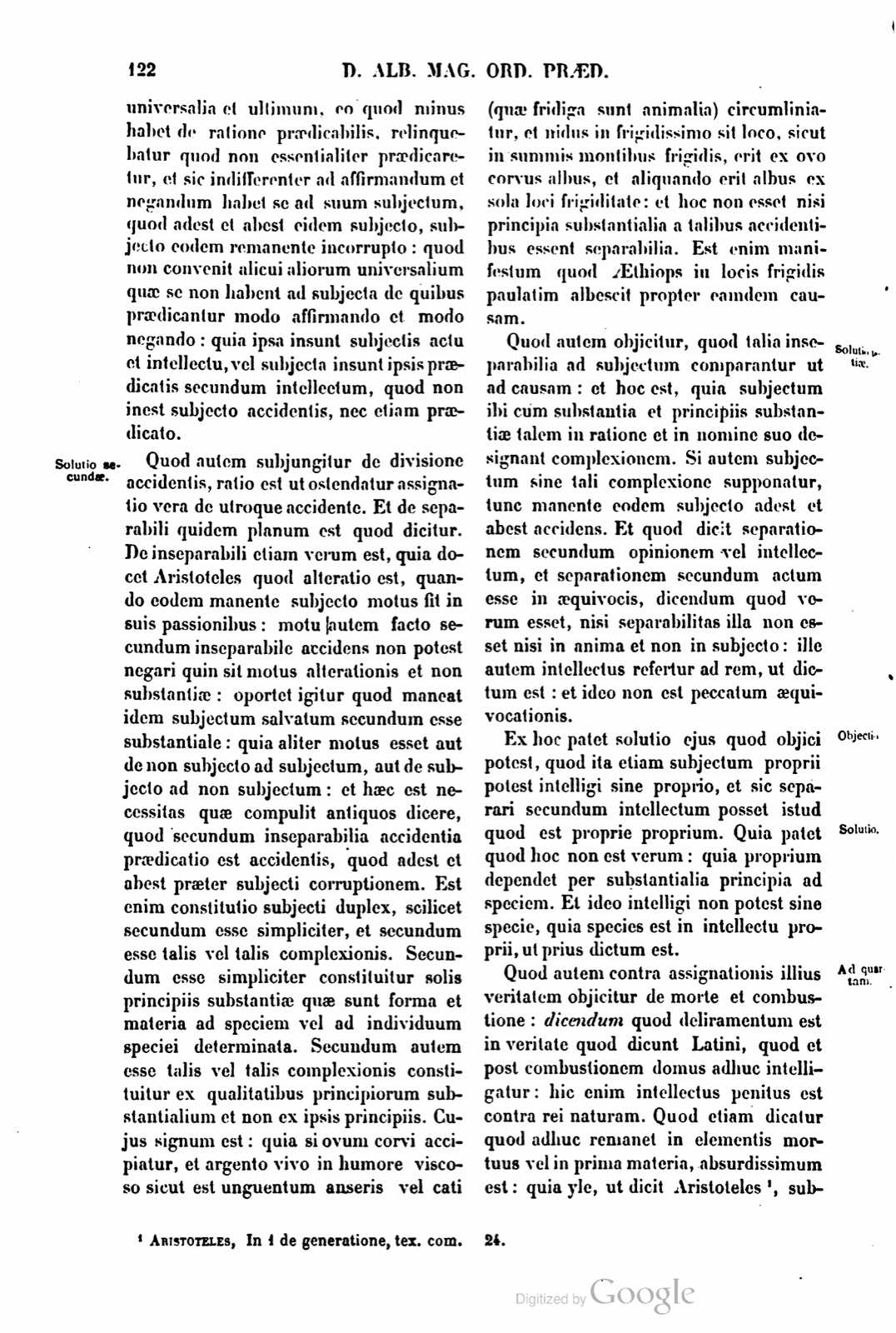
Quod autem objicitur, quod talia inseparabilia ad subjectum comparantur ut ad causam: et hoc est, quia subjectum ibi cum substantia et principiis substantiae talem in ratione et in nomine suo designant complexionem. Si autem subjectum sine tali complexione supponatur, tunc manente eodem subjecto adest et abest accidens. Et quod dicit separationem secundum opinionem vel intellectum, et separationem secundum actum esse in aequivocis, dicendum quod verum esset, nisi separabilitas illa non esset nisi in anima et non in subjecto: ille autem intellectus refertur ad rem, ut dictum est: et ideo non est peccatum aequivocationis.
Ex hoc patet solutio ejus quod objici potest, quod ita etiam subjectum proprii potest intelligi sine proprio, et sic separari secundum intellectum posset istud quod est proprie proprium. Quia patet quod hoc non est verum: quia proprium dependet per substantialia principia ad speciem. Et ideo intelligi non potest sine specie, quia species est in intellectu proprii, ut prius dictum est.
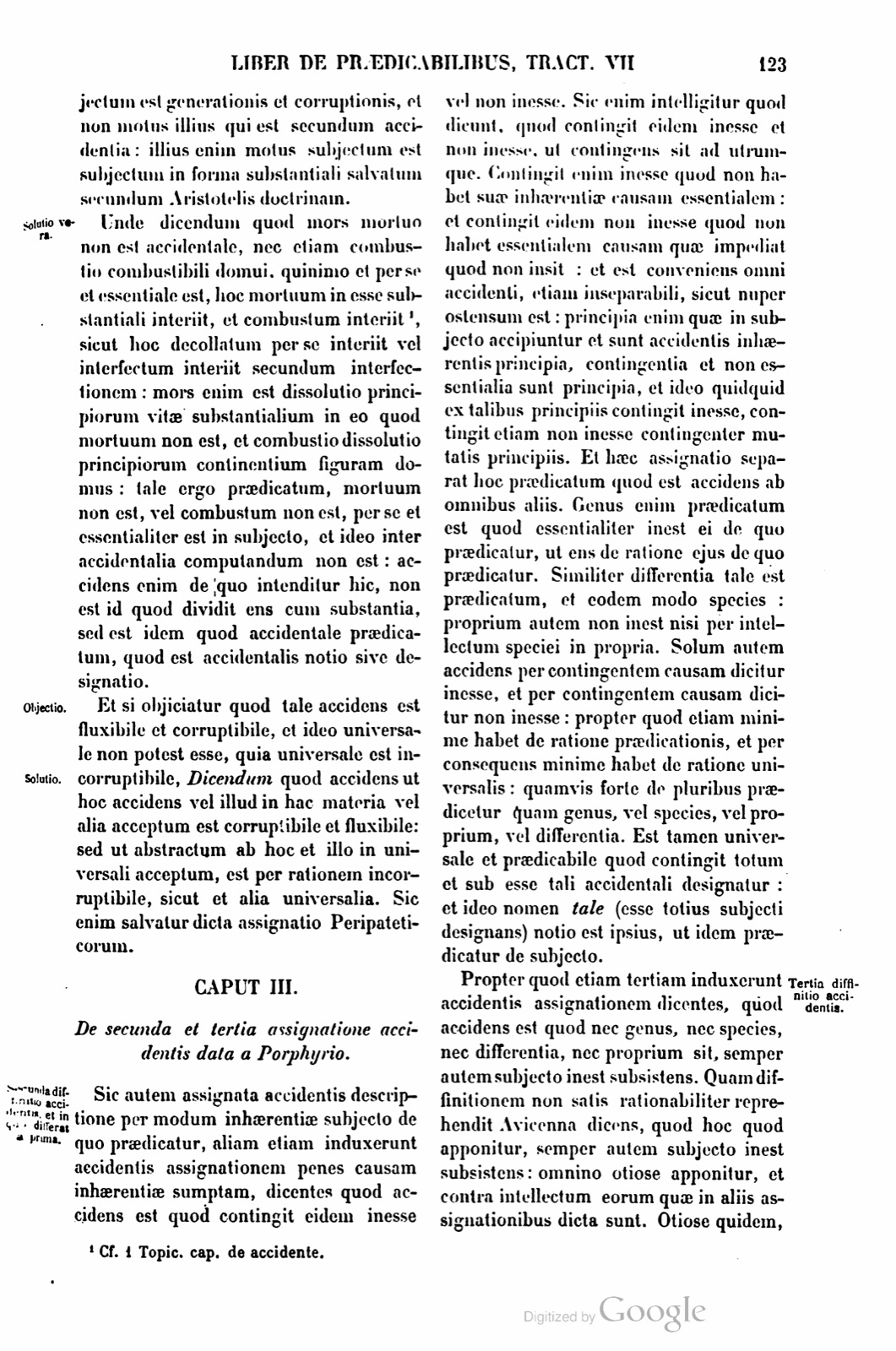
Quod autem contra assignationis illius veritatem objicitur de morte et combustione: dicendum quod deliramentum est in veritate quod dicunt Latini, quod et post combustionem domus adhuc intelligatur: hic enim intellectus penitus est contra rei naturam. Quod etiam dicatur quod adhuc remanet in elementis mortuus vel in prima materia, absurdissimum est: quia yle, ut dicit Aristoteles2, subjectum est generationis et corruptionis, et non motus illius qui est secundum accidentia: illius enim motus subjectum est subjectum in forma substantiali salvatum secundum Aristotelis doctrinam.
Unde dicendum quod mors mortuo non est accidentale, nec etiam combustio combustibili domui, quinimo et per se et essentiale est, hoc mortuum in esse substantiali interiit, et combustum interiit3, sicut hoc decollatum per se interiit vel interfectum interiit secundum interfectionem: mors enim est dissolutio principiorum vitae substantialium in eo quod mortuum non est, et combustio dissolutio principiorum continentium figuram domus: tale ergo praedicatum, mortuum non est, vel combustum non est, per se et essentialiter est in subjecto, et ideo inter accidentalia computandum non est: accidens enim de quo intenditur hic, non est id quod dividit ens cum substantia, sed est idem quod accidentale praedicatum, quod est accidentalis notio sive designatio.
Et si objiciatur quod tale accidens est fluxibile et corruptibile, et ideo universale non potest esse, quia universale est incorruptibile, dicendum quod accidens ut hoc accidens vel illud in hac materia vel alia acceptum est corruptibile et fluxibile: sed ut abstractum ab hoc et illo in universali acceptum, est per rationem incorruptibile, sicut et alia universalia. Sic enim salvatur dicta assignatio Peripateticorum.
But concerning what is objected, that such inseparable things are compared to the subject as to cause: this is because the subject there, together with the substance and principles of substance, designates such a complexion in its account and in its name. But if the subject is supposed without such a complexion, then, while the same subject remains, the accident is present and absent. And as for the claim that separation according to opinion or understanding and separation according to act are among equivocal things, one must say that it would be true, unless that separability were only in the soul and not in the subject; but that understanding is referred to the thing, as has been said, and therefore there is no fault of equivocation.
From this the solution is clear to what can be objected, that in this way the subject of a proper can also be understood without the proper, and so that which is properly proper could be separated according to understanding. For it is clear that this is not true, because proper depends upon species through substantial principles. And therefore it cannot be understood without species, because species is in the understanding of the proper, as was said before.
But as to what is objected against the truth of that assignment concerning death and burning, one must say that what the Latins say is in truth raving, namely that the house is still understood even after its burning; for this understanding is wholly against the nature of the thing. And if it is also said that the dead thing still remains in the elements or in prime matter, this is most absurd, because hyle, as Aristotle says2, is the subject of generation and corruption, and not of that motion which is according to accidents; for the subject of that motion is a subject preserved in substantial form according to Aristotle's doctrine.
Hence one must say that death is not accidental to the dead thing, nor burning to the combustible house; indeed it is both per se and essential: this dead thing perished in substantial being, and the burned thing perished3, just as this beheaded thing perished per se or the killed thing perished according to killing. For death is the dissolution of substantial principles of life in that which is not dead, and burning is the dissolution of principles containing the figure of a house. Therefore such a predicate, the dead thing is not, or the burned thing is not, is per se and essentially in the subject, and therefore it must not be counted among accidentals. For accident, about which the intention here is, is not that which divides being together with substance, but is the same as the accidental predicate, which is an accidental notion or designation.
And if it is objected that such an accident is fluent and corruptible, and therefore cannot be universal, because universal is incorruptible, one must say that accident as this accident or that, taken in this matter or another, is corruptible and fluent; but as abstracted from this and that and taken in the universal, it is incorruptible by reason, just as the other universals are. For in this way the stated assignment of the Peripatetics is preserved.
If a page does not appear, its photograph has not been uploaded yet.