Volume 1 · pp. 115–116
Chapter II. On the definition of proper and the explanation of its parts.
A marker with ≈ is an approximate page boundary, placed by measure of the text; the page photographs remain the authority. In the paired views, clicking a page marker brings that page into view.
CAPUT II.
De diffinitione proprii et explanatione partium ejus.
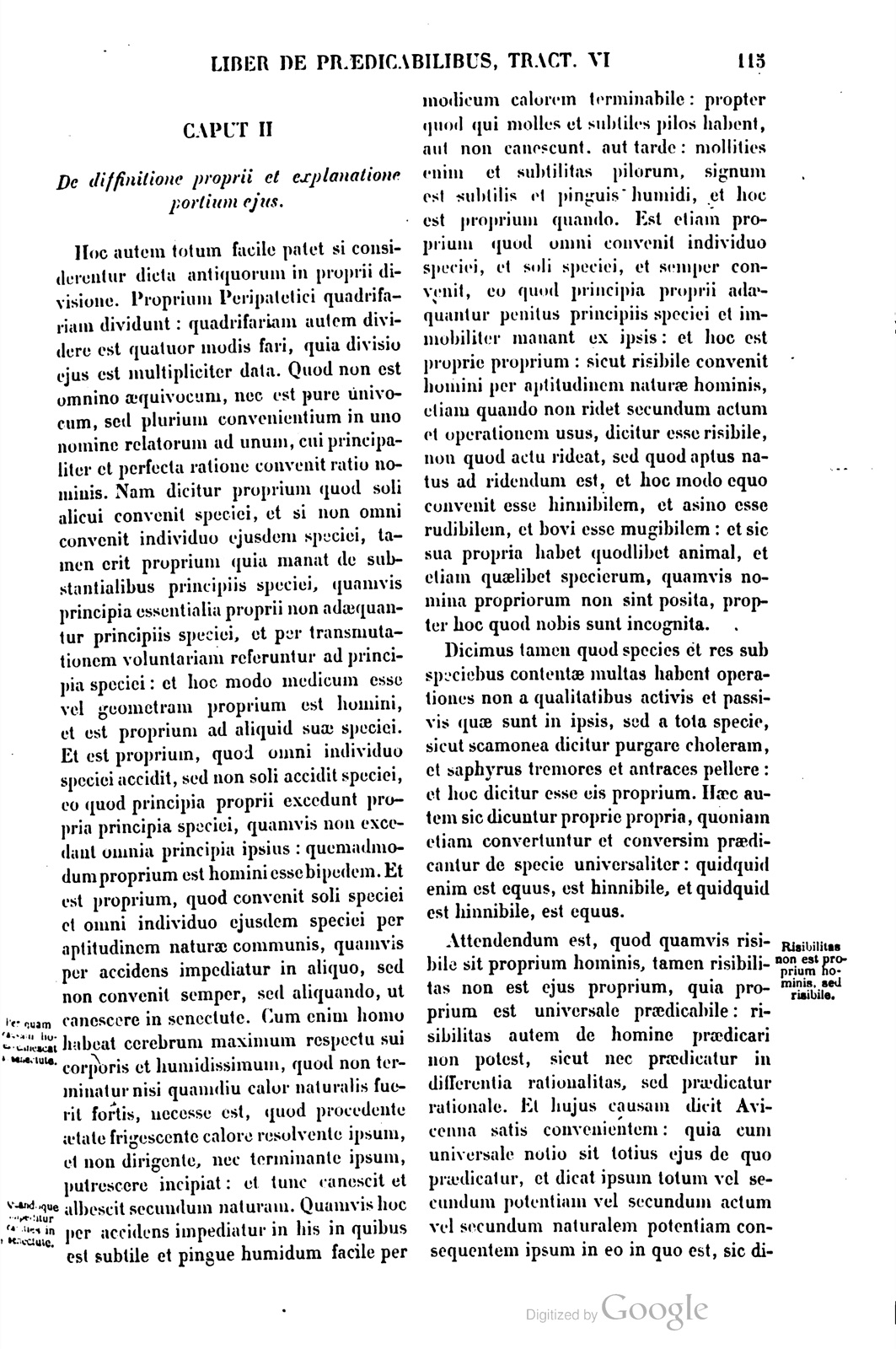
Hoc autem totum facile patet si considerentur dicta antiquorum in proprii divisione. Proprium Peripatetici quadrifariam dividunt: quadrifariam autem dividere est quatuor modis fari, quia divisio ejus est multipliciter data. Quod non est omnino aequivocum, nec est pure univocum, sed plurium convenientium in uno nomine relatorum ad unum, cui principaliter et perfecta ratione convenit ratio nominis. Nam dicitur proprium quod soli alicui convenit speciei, et si non omni convenit individuo ejusdem speciei, tamen erit proprium quia manat de substantialibus principiis speciei, quamvis principia essentialia proprii non adaequantur principiis speciei, et per transmutationem voluntariam referuntur ad principia speciei: et hoc modo medicum esse vel geometram proprium est homini, et est proprium ad aliquid suae speciei. Et est proprium, quod omni individuo speciei accidit, sed non soli accidit speciei, eo quod principia proprii excedunt propria principia speciei, quamvis non excedant omnia principia ipsius: quemadmodum proprium est homini esse bipedem. Et est proprium, quod convenit soli speciei et omni individuo ejusdem speciei per aptitudinem naturae communis, quamvis per accidens impediatur in aliquo, sed non convenit semper, sed aliquando, ut canescere in senectute. Cum enim homo habeat cerebrum maximum respectu sui corporis et humidissimum, quod non terminatur nisi quamdiu calor naturalis fuerit fortis, necesse est, quod procedente aetate frigescente calore resolvente ipsum, et non dirigente, nec terminante ipsum, putrescere incipiat: et tunc canescit et albescit secundum naturam. Quamvis hoc per accidens impediatur in his in quibus est subtile et pingue humidum facile per modicum calorem terminabile: propter quod qui molles et subtiles pilos habent, aut non canescunt, aut tarde: mollities enim et subtilitas pilorum, signum est subtilis et pinguis humidi, et hoc est proprium quando. Est etiam proprium quod omni convenit individuo speciei, et soli speciei, et semper convenit, eo quod principia proprii adaequantur penitus principiis speciei et immobiliter manant ex ipsis: et hoc est proprie proprium: sicut risibile convenit homini per aptitudinem naturae hominis, etiam quando non ridet secundum actum et operationem usus, dicitur esse risibile, non quod actu rideat, sed quod aptus natus ad ridendum est, et hoc modo equo convenit esse hinnibilem, et asino esse rudibilem, et bovi esse mugibilem: et sic sua propria habet quodlibet animal, et etiam quaelibet specierum, quamvis nomina propriorum non sint posita, propter hoc quod nobis sunt incognita.
CHAPTER II.
On the definition of proper and the explanation of its parts.
But this whole matter is easily clear if the sayings of the ancients are considered in the division of proper. The Peripatetics divide proper fourfold; but to divide fourfold is to speak in four modes, because its division is given in several ways. It is not wholly equivocal, nor is it purely univocal, but it belongs to several things agreeing in one name that are referred to one thing, to which the account of the name belongs principally and by perfect account. For proper is said of what belongs to one species alone; and if it does not belong to every individual of that same species, nevertheless it will be proper because it flows from the substantial principles of the species, although the essential principles of the proper are not adequate to the principles of the species, and through voluntary transmutation they are referred to the principles of the species. And in this way to be a physician or a geometer is proper to man, and it is proper relative to something of its species. And there is a proper which happens to every individual of the species, but does not happen to the species alone, because the principles of the proper exceed the proper principles of the species, although they do not exceed all its principles; in this way being two-footed is proper to man. And there is a proper which belongs to the species alone and to every individual of the same species through the aptitude of common nature, although it is impeded accidentally in some case, but it does not belong always, but at some time, as becoming gray-haired in old age. For since man has a brain that is very great with respect to his body and very moist, and it is not terminated except so long as the natural heat has been strong, it is necessary that as age advances and the resolving heat grows cold, not directing it nor terminating it, it begin to putrefy; and then he becomes gray-haired and white according to nature. Although this is accidentally impeded in those in whom there is a subtle and fat moisture easily terminated by a slight heat. On account of this, those who have soft and subtle hairs either do not become gray-haired or do so late; for softness and subtlety of hairs is a sign of a subtle and fat moisture, and this is proper at a time. There is also a proper which belongs to every individual of the species, and to the species alone, and always belongs, because the principles of the proper are entirely adequate to the principles of the species and immovably flow from them; and this is properly proper, as risible belongs to man through the aptitude of the nature of man, even when he does not laugh according to act and the operation of use. He is said to be risible not because he actually laughs, but because he is naturally apt for laughing; and in this mode it belongs to horse to be neigh-able, to ass to be bray-able, and to ox to be low-able. And thus every animal has its own propers, and also each of the species, although the names of the propers have not been imposed because they are unknown to us.
Dicimus tamen quod species et res sub speciebus contentae multas habent operationes non a qualitatibus activis et passivis quae sunt in ipsis, sed a tota specie, sicut scamonea dicitur purgare choleram, et saphyrus tremores et antraces pellere: et hoc dicitur esse eis proprium. Haec autem sic dicuntur proprie propria, quoniam etiam convertuntur et conversim praedicantur de specie universaliter: quidquid enim est equus, est hinnibile, et quidquid est hinnibile, est equus.
Attendendum est, quod quamvis risibile sit proprium hominis, tamen risibilitas non est ejus proprium, quia proprium est universale praedicabile: risibilitas autem de homine praedicari non potest, sicut nec praedicatur in differentia rationalitas, sed praedicatur rationale. Et hujus causam dicit Avicenna satis convenientem: quia cum universale notio sit totius ejus de quo praedicatur, et dicat ipsum totum vel secundum potentiam vel secundum actum vel secundum naturalem potentiam consequentem ipsum in eo in quo est, sic dicit totum proprium. Taliter autem totum non potest significari per abstractum, sed significatur per concretum. Oportet enim universale concretionis more significari per nomen.
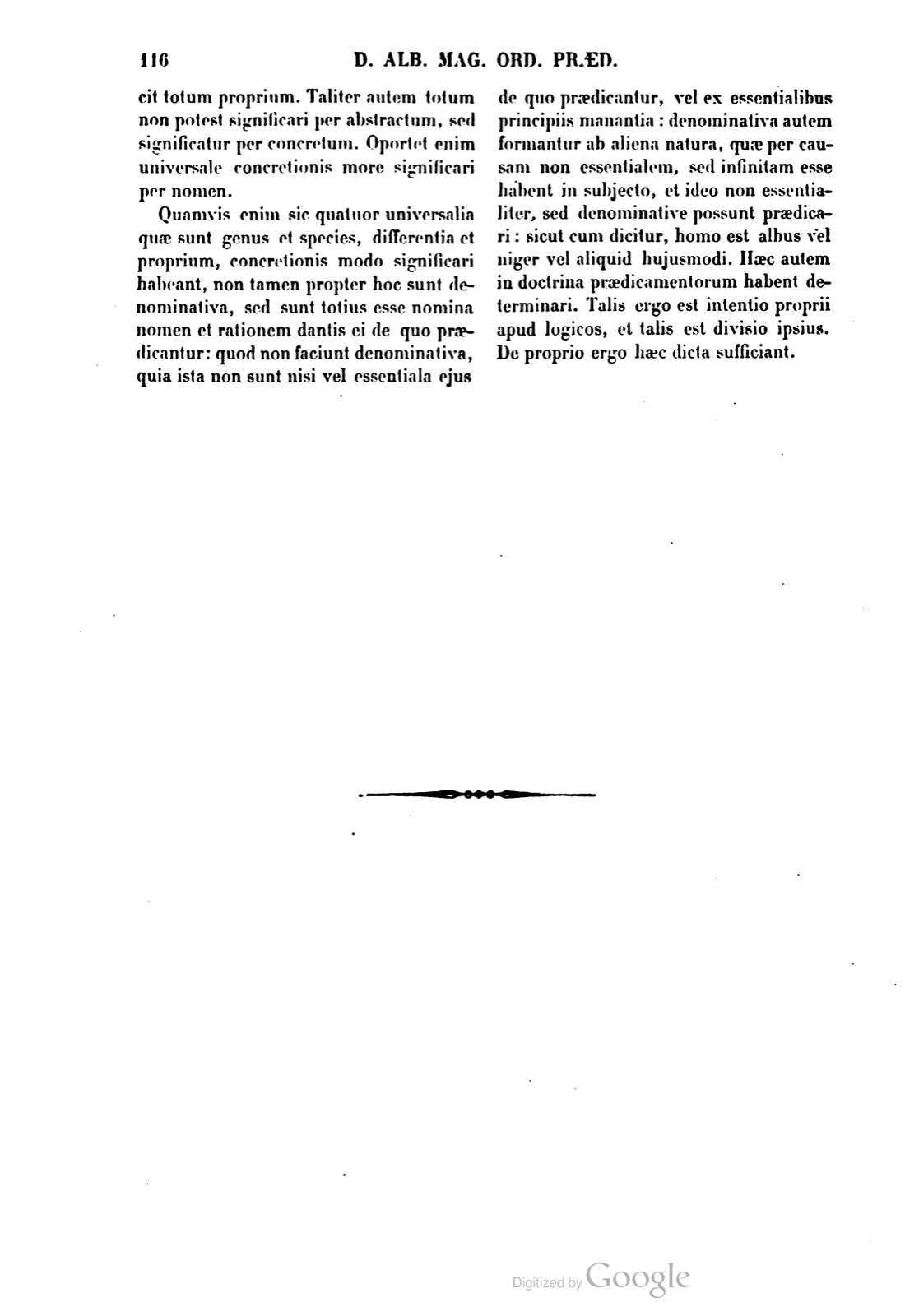
Quamvis enim sic quatuor universalia quae sunt genus et species, differentia et proprium, concretionis modo significari habeant, non tamen propter hoc sunt denominativa, sed sunt totius esse nomina nomen et rationem dantis ei de quo praedicantur: quod non faciunt denominativa, quia ista non sunt nisi vel essentialia ejus de quo praedicantur, vel ex essentialibus principiis manantia: denominativa autem formantur ab aliena natura, quae per causam non essentialem, sed infinitam esse habent in subjecto, et ideo non essentialiter, sed denominative possunt praedicari: sicut cum dicitur, homo est albus vel niger vel aliquid hujusmodi. Haec autem in doctrina praedicamentorum habent determinari. Talis ergo est intentio proprii apud logicos, et talis est divisio ipsius. De proprio ergo haec dicta sufficiant.
Nevertheless we say that species and things contained under species have many operations not from the active and passive qualities that are in them, but from the whole species, as scammony is said to purge choler, and sapphire to drive away tremors and anthraxes; and this is said to be proper to them. But these are called properly proper in this way, since they are also converted and predicated conversely of the species universally: for whatever is a horse is neigh-able, and whatever is neigh-able is a horse.
One must attend that although risible is proper to man, nevertheless risibility is not his proper, because proper is a predicable universal; but risibility cannot be predicated of man, just as rationality is not predicated in difference, but rational is predicated. And Avicenna states the cause of this sufficiently fittingly: because, since universal is the notion of the whole of that of which it is predicated, and says that whole either according to potency or according to act or according to the natural potency following it in that in which it is, so proper says the whole. But a whole in such a way cannot be signified through an abstract, but is signified through a concrete. For a universal must be signified by a name in the manner of concretion.
For although in this way the four universals which are genus and species, difference and proper, have to be signified in the mode of concretion, nevertheless on this account they are not denominatives, but are names of the whole being, giving name and account to that of which they are predicated; denominatives do not do this, because these are only either essentials of that of which they are predicated, or things flowing from essential principles. But denominatives are formed from an alien nature, which have being in a subject through a cause not essential but indefinite, and therefore they can be predicated not essentially but denominatively, as when it is said, man is white or black or something of this sort. These things, however, must be determined in the doctrine of the predicaments. Therefore such is the intention of proper among logicians, and such is its division. Therefore these things said about proper suffice.
If a page does not appear, its photograph has not been uploaded yet.