Volume 1 · pp. 117–120
Tractate VII. On Accident. Chapter I. On the difference of proper and accident insofar as accident is the fifth predicable.
A marker with ≈ is an approximate page boundary, placed by measure of the text; the page photographs remain the authority. In the paired views, clicking a page marker brings that page into view.
TRACTATUS VII
DE ACCIDENTE.
CAPUT I.
De differentia proprii et accidentis prout accidens est quintum praedicabile.
Antequam de assignationibus accidentis tractemus quibus Antiqui accidens descripserunt, oportet nos de differentia proprii et accidentis secundum quod est unum de quinque universalibus determinare. In hoc enim Avicenna dicit antiquos qui de quinque tractaverunt universalibus esse diminutos, qui descriptiones accidentis posuerunt antequam distinguerent in qua significatione accidens accipitur, secundum quod est unum quinque universalium. Cum enim omne quod est sit substantia, vel accidens, ut dicit Aristoteles, et proprium propter hoc quod consequitur esse completum speciei sit accidens, videbitur de necessitate, quod proprium sit accidens. Et sic si accidens sumitur pro omni eo quod non est substantia, videtur quod proprium non sit divisum ab accidente, et universalia non sunt quinque, sed quatuor tantum.
Adhuc autem proprium non potest dici essentiale speciei: quia ex quo proprium sequitur totam compositionem speciei, et completum esse ipsius, species intelligitur sine proprio: et cum non sit essentiale speciei, erit ut accidentale speciei, et sic est in natura sicut accidens: et cum in comparatione ad proprium subjectum sit accidentale, totum ponetur in naturam et essentiam accidentis: non ergo erit in aliqua consideratione nisi accidens, et sic iterum sequi videtur, quod non sint quinque universalia, sed quatuor tantum. Si autem aliquis dicere velit, quod duplex est comparatio accidentis ad subjectum: idem enim accidens comparatur ad subjectum ut ad substantiam tantum, et hoc est accidens: aut comparatur ad subjectum non ut ad subjectum, sed ad causam, et hoc emanat de principiis subjecti, et est proprium subjecto, et sic differt proprium ab accidente. Hoc stare non potest: quia omne accidens, ut dicit Aristoteles1, causatur a substantia et stabilitur et ordinatur ab ipsa, et sine ipsa est fluens et indeterminatum: et sic sequeretur quod omne accidens sit proprium, et sic iterum sequeretur, quod non essent nisi quatuor universalia, scilicet genus, differentia, proprium, et accidens. Hoc etiam probatur ratione: quia omne quod secundum ordinem naturae est prius aliquo, est causa ad illud, ut determinatur in libro Causarum, et in libro fontis vitae: non potest autem negari quin ordine naturae substantia sit ante accidens: accidens ergo sic comparatur ad substantiam sicut ad subjectum et ad causam. Hoc autem etiam dicit ratio nominis substantiae quae dicitur a substando, eo quod accidenti substet ut subjectum et causa.
Adhuc accidens dividitur in accidens separabile, et inseparabile. Inseparabile autem accidens est, quod causatur a principiis subjecti: proprium autem est accidens a principiis subjecti causatum. Videtur ergo quod proprium sit pars accidentis, et in minori ambitu communitatis quam accidens.
Adhuc Avicenna quaerit, quid vocatur accidens, quando accidens dicitur unum quinque universalium? Si enim accidens dicitur id cujus tota natura est accidens, ut color, vel albedo: cum talia sint et genera et species et differentiae et propria, videtur quod quinque universalia non differant re, sed modo tantum, ut videtur. Postea talia quaedam sunt modum tantum quemdam dicentia, sicut cum dicitur, corpus est creatura, vel non creatura, vel factum, vel aeternum: tunc talis praedicatio nihil de subjecto praedicaret, nec talis praedicatio posset reduci ad aliquem modum praedicationis quinque universalium. Si autem talis natura non dicitur accidens, sed accidens vocatur denominatum ab accidente, ut album, tunc accidens est idem quod accidentale, quod omnino falsum esse videtur, quia accidentale dicit plus quam accidens, et dicit subjectum quod non est de essentia vel natura accidentis.
TRACTATE VII
ON ACCIDENT.
CHAPTER I.
On the difference of proper and accident insofar as accident is the fifth predicable.
Before we treat the assignments of accident by which the Ancients described accident, we must determine the difference of proper and accident according as accident is one of the five universals. For in this Avicenna says that the ancients who treated the five universals were deficient, because they placed descriptions of accident before they distinguished in what signification accident is taken, according as it is one of the five universals. For since everything that is is either substance or accident, as Aristotle says, and proper, because it follows the completed being of species, is accident, it will seem of necessity that proper is accident. And thus, if accident is taken for everything that is not substance, it seems that proper is not divided from accident, and that the universals are not five, but only four.
Further, proper cannot be called essential to species, because from the fact that proper follows the whole composition of species and its completed being, species is understood without proper. And since it is not essential to species, it will be as an accidental of species, and thus in nature it is like accident; and since in comparison to its proper subject it is accidental, the whole will be placed in the nature and essence of accident. Therefore it will not be in any consideration except accident, and thus again it seems to follow that there are not five universals, but only four. But if someone wished to say that there is a twofold comparison of accident to subject, for the same accident is compared to subject as to substance only, and this is accident; or it is compared to subject not as to subject, but as to cause, and this emanates from the principles of the subject and is proper to the subject, and thus proper differs from accident. This cannot stand, because every accident, as Aristotle says1, is caused by substance and is stabilized and ordered by it, and without it is flowing and indeterminate. And thus it would follow that every accident is proper, and thus again it would follow that there were only four universals, namely genus, difference, proper, and accident. This is also proved by reason: because everything that is prior to something according to the order of nature is a cause with respect to it, as is determined in the Book of Causes and in the Book of the Fount of Life. But it cannot be denied that in the order of nature substance is before accident; therefore accident is compared to substance as to subject and to cause. The account of the name substance, which is said from standing-under, also says this, because it stands under accident as subject and cause.
Further, accident is divided into separable and inseparable accident. But inseparable accident is what is caused by the principles of the subject, while proper is an accident caused by the principles of the subject. Therefore it seems that proper is part of accident, and in a smaller range of commonness than accident.
Further, Avicenna asks what is called accident when accident is said to be one of the five universals. For if accident is called that whose whole nature is accident, as color or whiteness, since such things are also genera and species and differences and propers, it seems that the five universals do not differ in thing, but only in mode, as it seems. Next, certain such things say only a certain mode, as when it is said, body is creature, or not creature, or made, or eternal; then such a predication would predicate nothing of the subject, nor could such a predication be reduced to any mode of predication of the five universals. But if such a nature is not called accident, but accident is called what is denominated from accident, as white, then accident is the same as accidental, which seems altogether false, because accidental says more than accident, and says a subject which is not of the essence or nature of accident.
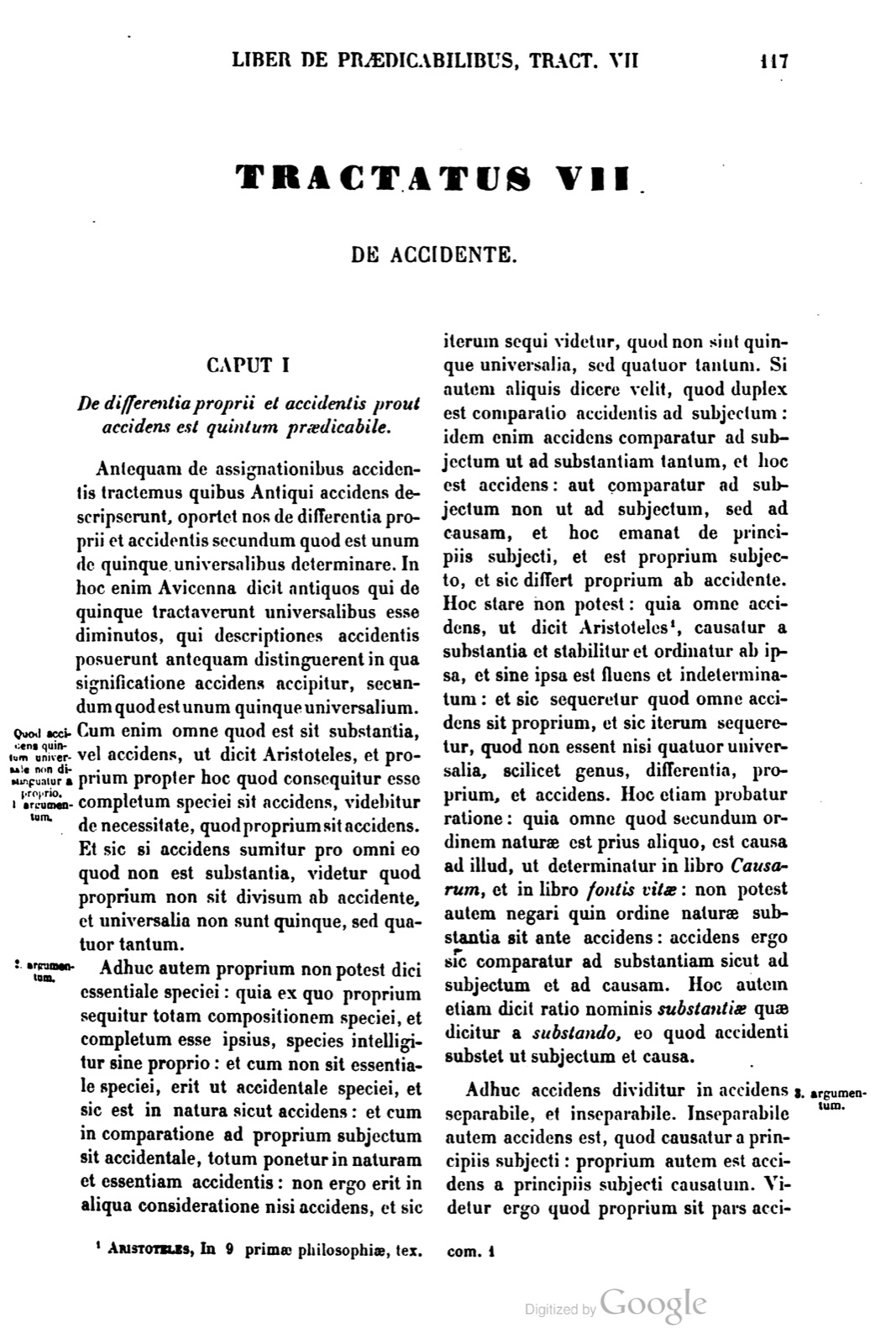
Adhuc quaeritur de comparatione hujus universalis quod est accidens ad individua de quibus praedicatur. Si enim non habet propria individua, sed habet individua substantiae, tunc videtur quod non sit proprie et per se universale. Si autem habet individua propria et per se non ab alio universali: tunc sequitur quod cum omne universale habeat esse completum et perfectum quando est in suis individuis, quod accidens completum esse habeat et perfectum, quando est in suis individuis, ut album in hoc albo: et sic accidens completum esse habere potest sine substantia, quod omnino est impossibile. Restat ergo quaestio, quid sit accidens secundum quod est unum quinque universalium secundum Avicennam et Alfarabium?
Ad haec et similia non est difficile respondere si bene revocentur ad memoriam, quae in tractatu primo de universalibus dicta sunt. Dictum est enim quod omnia ista quinque quantum ad communem modum praedicandi de pluribus universalia sunt, ita quod sunt in multis et de multis, et quod non aequivoce praedicantur de multis in quibus sunt, et quod suis particularibus dant nomina sua et rationem, ita quod unumquodque suo particulari nomen suum dat et rationem, genus scilicet ut genus, species ut species, differentia ut differentia, proprium ut proprium, et accidens ut accidens: sicut album dat nomen et rationem suam secundum praedicationem accidentis huic albo, de quo praedicatur ut accidens, et cui accidit sive inest ut accidens.
Et quod quaeritur de differentia proprii et accidentis secundum quod sunt diversa universalia praedicabilia de suis subjectis, dicendum quod differunt in hoc quod proprium est accidens manans de principiis essentialibus speciei, et maxime proprie proprium, cujus principia principiis speciei immobiliter sunt adaequata, quemadmodum in tractu de Proprio dictum est. Sunt autem sub principiis speciei principia substantialia individui componentia ipsum, sicut talis anima, et tale corpus, et talis complexio, et talis membrorum compositio, et talis habitudo, et hujusmodi, ex quibus oritur et manat accidens individui, quod secundum quod totum esse significat, et est notio totius sub esse talis accidentis, praedicabile de ipso est, nec idem est ipsi: et hoc sub hoc communi, quod est universale praedicabile de inferioribus, specialem dicit modum praedicandi, qui non est aliquis aliorum quatuor modorum, et ideo ipsum est universale quintum, et ideo etiam vocatur accidens individui, cum proprium dicatur accidens speciei propter causam quae saepius dicta est: et ideo deficerent praedicabilia nisi apponeretur aliis quatuor praedicabile accidens. Ideo etiam dicitur accidens commune, quia talis habitudo principiorum communiter in diversis generibus et speciebus particularium invenitur. Ideo etiam vocatur accidens infinitum, quia principia stantia non sunt, sed mobilia motu per accidens, qui in omnibus est et infinitus. Et ideo etiam dicitur accidens per accidens, quia talia principia essentialia individuis non sunt determinate de intellectu accidentis, ita quod concipiatur in ratione diffinitiva accidentis sicut determinata subjecta, quemadmodum concipitur determinatum subjectum in diffinitione accidentis per se. Tale ergo universale praedicabile de multis per hoc quod notio totius est sub esse accidentali hujus accidentis, ut dicit Alfarabius, est universale quintum quod vocatur accidens. Et quia nullum abstracte significatum potest esse notio totius subjecti secundum quod est sub esse substantiali vel accidentali, propter hoc accidens in solo genere accidentis signatum, ut color, vel albedo, non potest esse universale sic praedicabile ut accidens, quamvis possit esse universale ut genus, vel species, vel differentia, vel proprium. Quod dicit Avicenna, quod accidentale hic accidens vocatur, quando accidens quintum universale dicitur esse, quamvis etiam hoc subjectum dicat et accidens, quae sunt diversarum naturarum non ad idem ordinatarum, ut potentia et actus, tamen non praedicatur nisi secundum esse accidentis, quod habet in subjecto, et ideo totum praedicatum vocatur accidens.
Further, there is a question about the comparison of this universal, accident, to the individuals of which it is predicated. For if it does not have its own individuals, but has individuals of substance, then it seems that it is not properly and per se a universal. But if it has its own individuals and per se not from another universal, then it follows that, since every universal has completed and perfect being when it is in its individuals, accident has completed and perfect being when it is in its individuals, as white in this white thing; and thus accident can have completed being without substance, which is altogether impossible. Therefore the question remains: what is accident according as it is one of the five universals, according to Avicenna and Alfarabius?
To these and similar things it is not difficult to respond if the things said in the first tractate on universals are well recalled to memory. For it has been said that all these five, as to the common mode of predicating of several, are universals, so that they are in many and of many, and are not predicated equivocally of the many in which they are, and that they give their names and account to their particulars, so that each one gives its own name and account to its own particular: genus, namely, as genus; species as species; difference as difference; proper as proper; and accident as accident. Thus white gives its name and account according to the predication of accident to this white thing, of which it is predicated as accident and to which it happens or in which it is as accident.
And concerning what is asked about the difference of proper and accident according as they are diverse universal predicables of their subjects, one must say that they differ in this: proper is an accident flowing from the essential principles of species, and especially the properly proper, whose principles are immovably adequate to the principles of the species, as was said in the tractate on Proper. But under the principles of species there are substantial principles composing the individual itself, such as this soul, this body, this complexion, this composition of members, this relation, and the like, from which the accident of the individual arises and flows. According as it signifies whole being and is the notion of the whole under the being of such an accident, it is predicable of it and is not the same as it; and under this common point, that it is a universal predicable of inferiors, it says a special mode of predicating, which is not any of the other four modes. Therefore it itself is the fifth universal, and therefore it is also called accident of the individual, while proper is called accident of the species for the cause that has often been stated. And therefore the predicables would be deficient unless the predicable accident were added to the other four. Therefore it is also called common accident, because such a relation of principles is found commonly in particular things of diverse genera and species. Therefore it is also called infinite accident, because its principles are not standing but movable by accidental motion, which is in all things and is infinite. And therefore it is also called accident per accidens, because such principles are not essential to individuals determinately from the understanding of accident, so that they would be conceived in the definitive account of accident as determinate subjects, in the way a determinate subject is conceived in the definition of accident per se. Therefore such a universal predicable of many, through the fact that it is a notion of the whole under the accidental being of this accident, as Alfarabius says, is the fifth universal, which is called accident. And because nothing signified abstractly can be the notion of the whole subject according as it is under substantial or accidental being, for this reason accident, signified in the genus of accident alone, as color or whiteness, cannot be a universal predicable in this way as accident, although it can be a universal as genus, or species, or difference, or proper. As for what Avicenna says, that here the accidental is called accident when accident is said to be the fifth universal, although this also says subject and accident, which are of diverse natures not ordered to the same thing as potency and act are, nevertheless it is predicated only according to the being of accident which it has in a subject, and therefore the whole predicate is called accident.
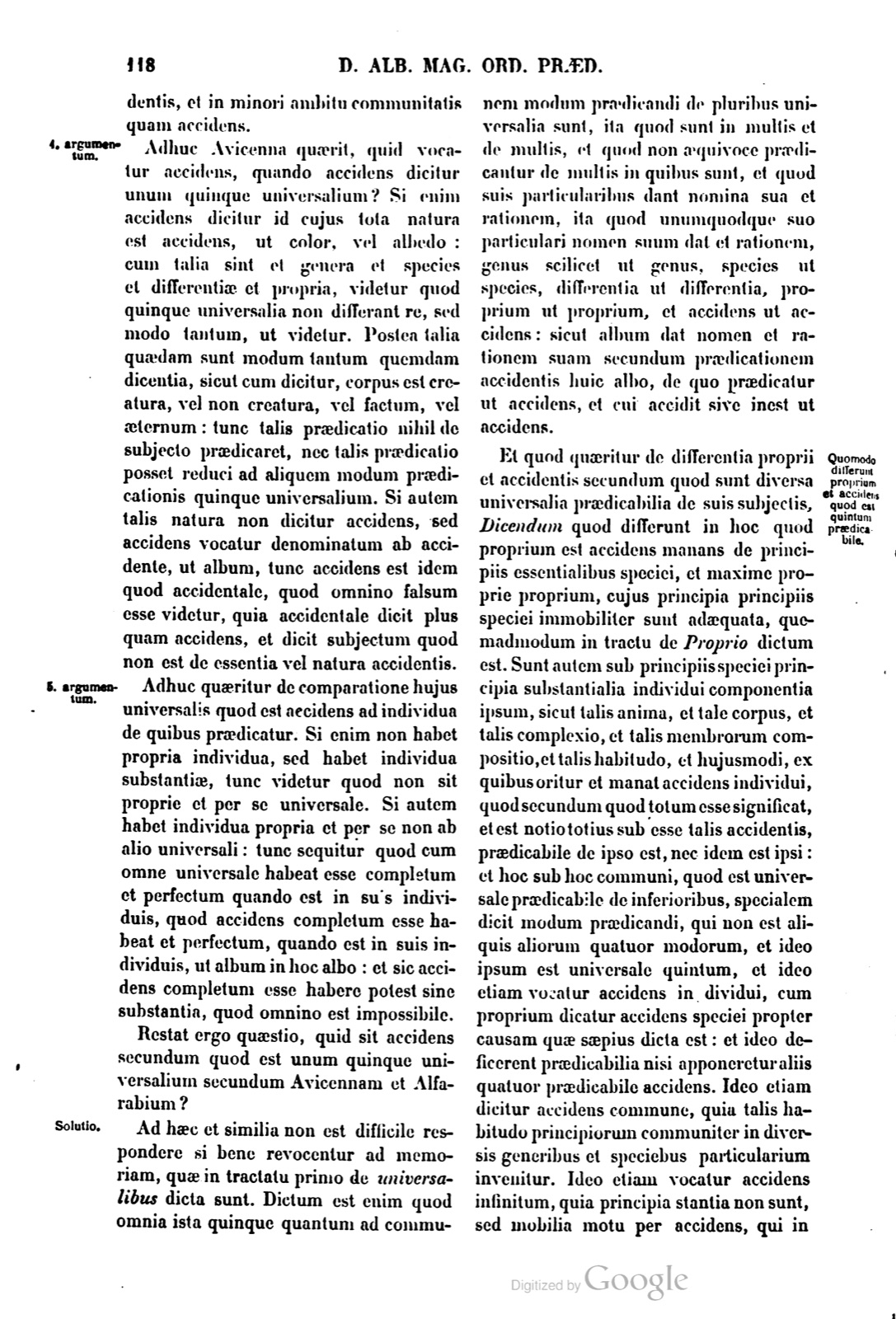
Et secundum hoc non est difficile respondere quae objiciendo inducta sunt. Quando enim dicitur quod omne quod est, aut est substantia, aut est accidens: hoc verum est secundum quod substantia est ens per se, et accidens est ens per aliud in alio: haec enim divisio reducitur ad hanc quae est, quod omne quod est, aut est per se ens, aut non per se ens, quae dividuntur per affirmationem et negationem: et sic proprium, ut dicit Boetius, est de genere accidentium. Secundum autem quod sunt diversi modi entis per se, secundum quos variatur praedicatum substantiale in quid et in quale, sic sunt diversi modi entis in alio et per aliud, secundum quos variatur modus praedicationis sive praedicabilis accidentalis. Quoddam enim est in alio et per aliud, ita quod principia ejus sunt adaequata isti, et immobiliter sunt in ipso: et hoc habet modum proprii quod simpliciter est proprium, quia proprium quando et proprium ad aliquid deficiunt a proprio simpliciter: et ideo accipiunt secundum aliquid modum accidentis. Propter quod dicit Aristoteles2 quod nihil prohibet accidens fieri proprium quando, et ad aliquid. Unde talia sunt accidentia aliquid convenientiae habentia cum proprio.
Ad hoc quod dicit, quod accidens per se non est essentiale subjecto, eo quod subjectum secundum esse perfectum natura et intellectu est ante illud. Dicendum quod quidem verum est, quod proprium non est essentiale speciei et subjecto de quo praedicatur: nec hoc dictum fuit, sed potius e converso, quod subjectum per principia universalia specificata est essentiale proprio, quia subjectum est in ratione proprii, et non proprium in ratione subjecti: nec dicitur subjectum essentiale proprio sive per se accidenti, quia sit aliquid de natura praedicati, sed quia est causa ipsius a qua fit et in qua fit secundum esse: et ideo dicitur essentiale sibi sicut non derelinquens ipsum actu et intellectu, et non sicut conceptum ut quid: vel quale essentiale ipsius, sicut genus et differentia componuntur in intellectu speciei. Hoc autem modo substantia non se habet ad accidens commune sive ad accidens per accidens, sed habet se tantum ut terminus ad quem terminatur esse accidentis sine quo fluidum et incertum est accidens, et sicut fundamentum quo fundatur: et hoc habet substantia ut substantia est, et non ut haec substantia vel ista, et ideo non per se accipitur in ratione sive diffinitione accidentis. Et ideo haec non est per se, sed per accidens, cum dicitur, homo est albus: quamvis haec sit per se, homo est risibilis. Cum enim dicitur homo est albus, notatur hominem subjectum esse fluxus albedinis, et illud in quo fundatur album, ut sit albedo in ipso, et subjectum non dicat causam quare accidens sit tale in ipso. Cum autem dicitur homo est risibilis, homo dicit causam quare risibilitas sit in ipso, et ideo diversus est modus praedicandi hic et ibi.
And according to this it is not difficult to answer the things introduced by objecting. For when it is said that everything that is is either substance or accident, this is true according as substance is a being through itself and accident is a being through another in another. For this division is reduced to this one, that everything that is is either a being through itself or not a being through itself, which are divided by affirmation and negation; and thus proper, as Boethius says, is of the genus of accidents. But according as there are diverse modes of being through itself, according to which the substantial predicate is varied in what and in what-sort-of, so there are diverse modes of being in another and through another, according to which the mode of accidental predication or accidental predicable is varied. For one thing is in another and through another in such a way that its principles are adequate to that one and immovably are in it; and this has the mode of the proper which is simply proper, because proper at a time and proper relative to something fall short of proper simply. And therefore in some respect they take on the mode of accident. On account of this Aristotle says2 that nothing prevents accident from becoming proper at a time and relative to something. Hence such things are accidents having some agreement with proper.
To this which says that accident per se is not essential to the subject, because the subject according to perfected being is prior to it by nature and understanding: one must say that it is indeed true that proper is not essential to the species and subject of which it is predicated; nor was this said, but rather the converse, that the subject through specified universal principles is essential to the proper, because the subject is in the account of the proper, and the proper is not in the account of the subject. Nor is the subject called essential to the proper or to the per se accident because it is something of the nature of the predicate, but because it is the cause of it, from which it comes to be and in which it comes to be according to being; and therefore it is called essential to it as not abandoning it in act and understanding, and not as conceived as its what or essential what-sort-of, as genus and difference are composed in the understanding of species. But substance does not relate in this mode to common accident or to accident per accidens, but relates only as the term to which the being of accident is terminated, without which accident is flowing and uncertain, and as the foundation by which it is founded; and substance has this as it is substance, and not as this substance or that, and therefore it is not taken per se in the account or definition of accident. And therefore this is not per se but per accidens when it is said, man is white, although this is per se, man is risible. For when it is said, man is white, man is marked as the subject of the flow of whiteness and that in which white is founded, so that whiteness is in him, and the subject does not say the cause why the accident is such in him. But when it is said, man is risible, man says the cause why risibility is in him, and therefore the mode of predicating is diverse here and there.
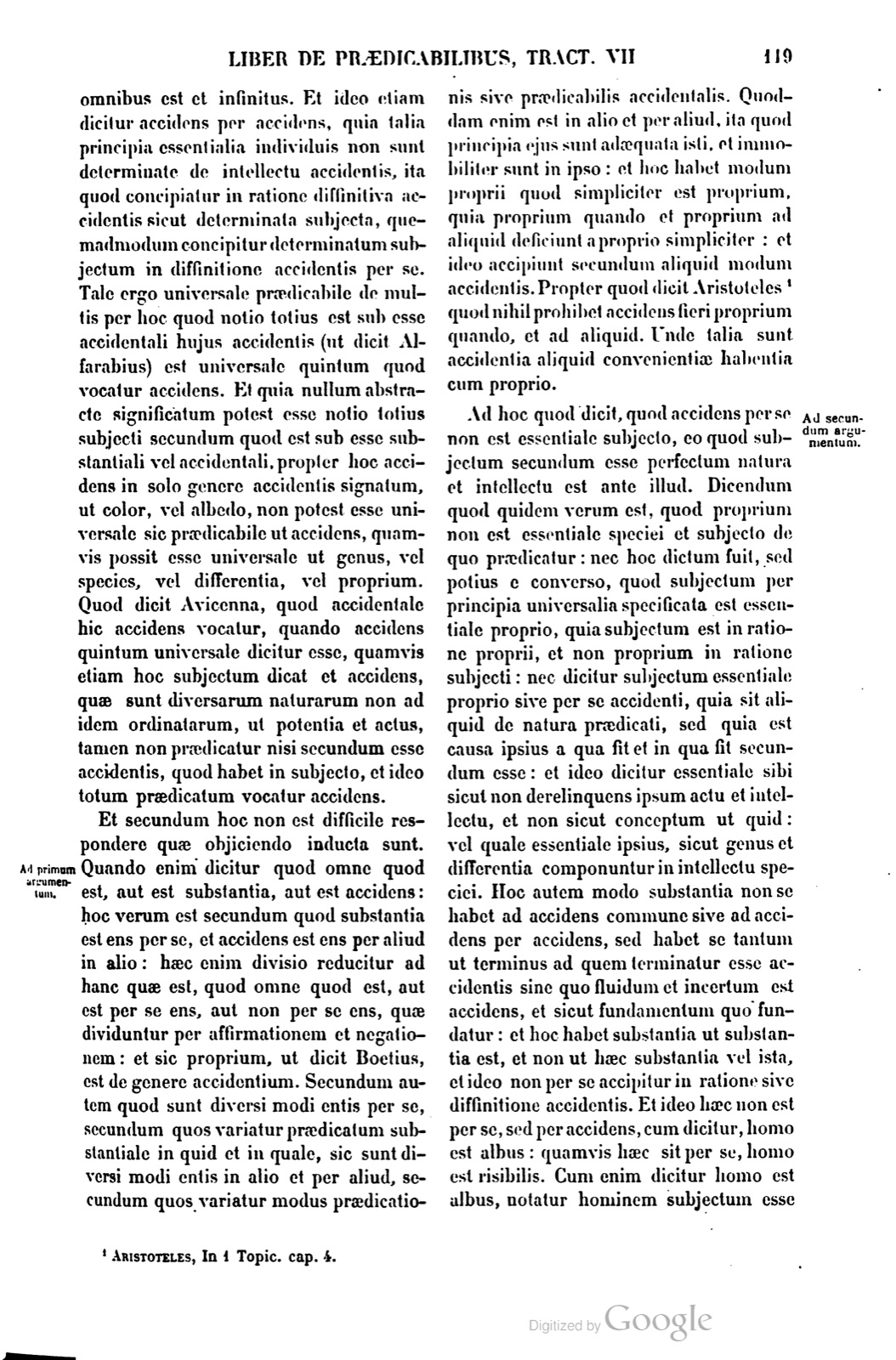
Ad hoc autem quod dicitur de accidente separabili et inseparabili, quod unum comparetur ad subjectum ut ad subjectum tantum, alter autem comparetur ad subjectum ut ad subjectum et ad causam, et sic proprium sit pars accidentis: dicendum quod quamvis accidens inseparabile comparetur ad subjectum ut ad causam, tamen non sequitur quod proprium sit pars accidentis. Comparatur enim proprium ad subjectum quod est species per principia incorruptibilia et immobilia, ut saepius dictum est: accidens autem inseparabile comparatur ad principia individui quae sunt mobilia et corruptibilia ut ad complexionem hanc vel ad compositionem hanc facientia, quamvis propter aliquam causam non mutetur subjecto manente, sicut nigredo ad Aethiopem, ut dicit Aristoteles3, quia semen in matrice decoquitur decoctione forti, et ideo resolvitur humidum clarum, et remanet nigrum terrestre et non clarum. Et cum alia sit comparatio proprii et inseparabilis accidentis ad subjectum, patet quod proprium non est pars accidentis, nisi forte proprium quando, et ad aliquid, quae sunt simpliciter de natura accidentis, et secundum quid propria, ut dictum est.
Ad hoc autem quod quaeritur, quid hic dicatur accidens, jam patet responsio in supradictis. Quod autem quaeri posset, quae differentia sit accidentis et accidentalis, ex quo accidens hic dicitur accidentale, ut dicit Avicenna, solvendum est per eumdem Avicennam dicentem, quod accidens dicitur per oppositionem ad substantiam: accidentale autem denominatum est ab accidente et ratione esse accidentalis quod habet praedicatum, et non ratione esse substantialis quod habet subjectum: et ideo dicit quod album non dicit albedinem, sed rem albam sub esse albedinis designatam. Et hoc quia in praecedentibus determinatum est universale non praedicari nisi per hoc quod est notio totius esse sui subjecti, hoc saepius dictum est.
Ad hoc autem quod de individuo hujus universalis quaeritur: dicendum quod sicut alia, quaedam propria habet individua: quia aliter non esset per se et univoce universale sicut alia: et hoc verum est, quod universale ut universale non habet perfectum esse secundum actum et naturam, nisi in suo particulari: et sic hoc album dat perfectum esse albo in universali designato. Sed ex hoc ulterius non sequitur, quin hoc accidentale esse dependeat ad substantiam, ut ad terminum sui fluxus, et sui esse fundamentum, et sic indiget individuo substantiae. Et hoc ideo, quia est universale quod est accidens, et in quantum universale habet individuum. Et in quantum hoc universale quod est accidens, indiget individuo substantiae, sicut et de proprio dictum est in antehabito tractatu: propter enim talem diversum modum praedicandi diversum est ab illis hoc universale. Sic igitur secundum Peripateticos posteriores determinandum est de intentione accidentis, antequam procedatur ad assignationes accidentis. Propter quod Avicenna Porphyrium redarguit, quod omissa determinatione accidentis, cujus intentio nota non erat, statim processit ad descriptiones ipsius.
But as to what is said about separable and inseparable accident, that one is compared to the subject as to subject only, while the other is compared to the subject as to subject and to cause, and thus proper is part of accident: one must say that although inseparable accident is compared to the subject as to cause, nevertheless it does not follow that proper is part of accident. For proper is compared to the subject which is species through incorruptible and immovable principles, as has often been said; but inseparable accident is compared to the principles of the individual, which are movable and corruptible, as to this complexion or this composition making it, although for some cause it is not changed while the subject remains, as blackness in relation to an Ethiopian, as Aristotle says3, because seed in the womb is decocted by a strong decoction, and therefore the clear moisture is resolved and the black earthly and not clear remains. And since the comparison of proper and of inseparable accident to subject is different, it is clear that proper is not part of accident, except perhaps proper at a time and proper relative to something, which are simply of the nature of accident and in a certain respect propers, as has been said.
As to what is asked, what is called accident here, the response is now clear in the things said above. But concerning what could be asked, namely what the difference is between accident and accidental, since accident here is called accidental, as Avicenna says, it must be solved through the same Avicenna, who says that accident is said by opposition to substance; but accidental is denominated from accident and from the account of accidental being which the predicate has, and not from the account of substantial being which the subject has. And therefore he says that white does not say whiteness, but designates a white thing under the being of whiteness. And this is because it has been determined in the preceding matters that a universal is not predicated except through the fact that it is the notion of the whole being of its subject; this has often been said.
As to what is asked about the individual of this universal: one must say that, like the others, it has certain proper individuals, because otherwise it would not be a universal per se and univocally like the others. And this is true, that a universal as universal does not have perfect being according to act and nature except in its own particular; and thus this white gives perfect being to white designated in the universal. But from this it does not further follow that this accidental being does not depend upon substance, as upon the term of its flow and the foundation of its being, and thus it needs an individual of substance. And this is because it is a universal which is accident, and insofar as it is universal it has an individual. And insofar as this universal, accident, needs an individual of substance, just as was said of proper in the preceding tractate, because on account of such a diverse mode of predicating this universal is different from those. Thus, therefore, according to the later Peripatetics, one must determine the intention of accident before proceeding to the assignments of accident. On account of this Avicenna rebukes Porphyry, because, with the determination of accident omitted, whose intention was not known, he immediately proceeded to its descriptions.
If a page does not appear, its photograph has not been uploaded yet.