Volume 1 · pp. 111–114
Tractate VI. On Proper. Chapter I. On the intention of proper according to which the logician treats of it.
A marker with ≈ is an approximate page boundary, placed by measure of the text; the page photographs remain the authority. In the paired views, clicking a page marker brings that page into view.
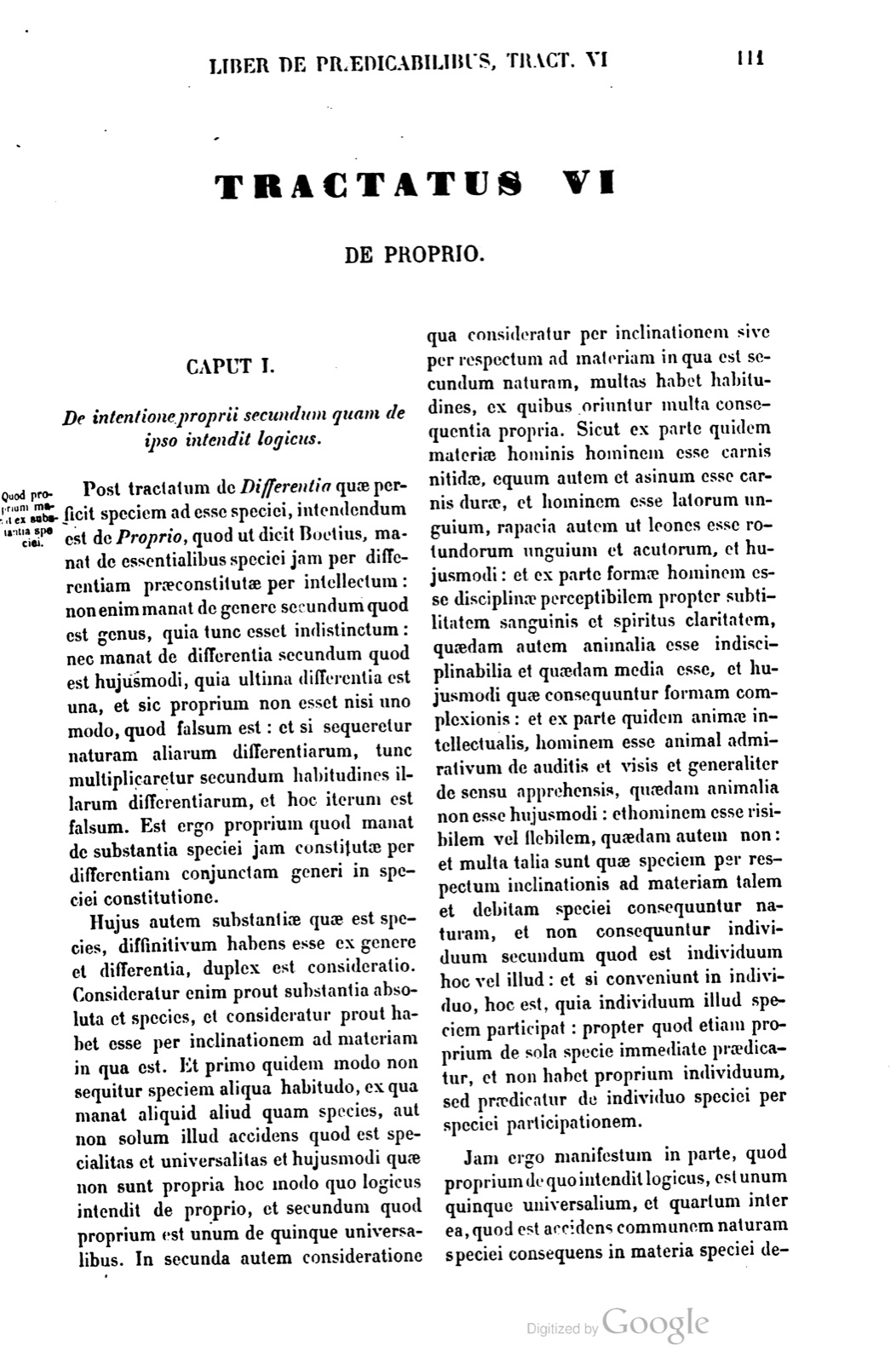
TRACTATUS VI
DE PROPRIO.
CAPUT I.
De intentione proprii secundum quam de ipso intendit logicus.
Post tractatum de Differentia quae perficit speciem ad esse speciei, intendendum est de Proprio, quod ut dicit Boetius, manat de essentialibus speciei jam per differentiam praeconstitutae per intellectum: non enim manat de genere secundum quod est genus, quia tunc esset indistinctum: nec manat de differentia secundum quod est hujusmodi, quia ultima differentia est una, et sic proprium non esset nisi uno modo, quod falsum est: et si sequeretur naturam aliarum differentiarum, tunc multiplicaretur secundum habitudines illarum differentiarum, et hoc iterum est falsum. Est ergo proprium quod manat de substantia speciei jam constitutae per differentiam conjunctam generi in speciei constitutione.
Hujus autem substantiae quae est species, diffinitivum habens esse ex genere et differentia, duplex est consideratio. Consideratur enim prout substantia absoluta et species, et consideratur prout habet esse per inclinationem ad materiam in qua est. Et primo quidem modo non sequitur speciem aliqua habitudo, ex qua manat aliquid aliud quam species, aut non solum illud accidens quod est specialitas et universalitas et hujusmodi quae non sunt propria hoc modo quo logicus intendit de proprio, et secundum quod proprium est unum de quinque universalibus. In secunda autem consideratione qua consideratur per inclinationem sive per respectum ad materiam in qua est secundum naturam, multas habet habitudines, ex quibus oriuntur multa consequentia propria. Sicut ex parte quidem materiae hominis hominem esse carnis nitidae, equum autem et asinum esse carnis durae, et hominem esse latorum unguium, rapacia autem ut leones esse rotundorum unguium et acutorum, et hujusmodi: et ex parte formae hominem esse disciplinae perceptibilem propter subtilitatem sanguinis et spiritus claritatem, quaedam autem animalia esse indisciplinabilia et quaedam media esse, et hujusmodi quae consequuntur formam complexionis: et ex parte quidem animae intellectualis, hominem esse animal admirativum de auditis et visis et generaliter de sensu apprehensis, quaedam animalia non esse hujusmodi: et hominem esse risibilem vel flebilem, quaedam autem non: et multa talia sunt quae speciem per respectum inclinationis ad materiam talem et debitam speciei consequuntur naturam, et non consequuntur individuum secundum quod est individuum hoc vel illud: et si conveniunt in individuo, hoc est, quia individuum illud speciem participat: propter quod etiam proprium de sola specie immediate praedicatur, et non habet proprium individuum, sed praedicatur de individuo speciei per speciei participationem.
Jam ergo manifestum in parte, quod proprium de quo intendit logicus, est unum quinque universalium, et quartum inter ea, quod est accidens communem naturam speciei consequens in materia speciei determinata secundum naturam: et secundum quod illa natura variatur in materia speciei debita, sic multiplicantur propria. Non ergo proprium logicum est solum quod vocatur proprie proprium, quod convenit omni, soli, et semper, sed hoc etiam est proprium logicum, quod convenit omni et non soli, sicut esse bipedem: et id quod convenit soli speciei etsi non omni individuo ejusdem speciei, ut esse medicum, vel agricolam, vel navigatorem, per artem medicinae, vel agriculturae, vel navigationis disciplinam: et etiam quod convenit omni et soli, sed aliquando et non semper, sicut hominem in senectute canescere, vel albescere senem, aut in processu temporis aetatis nigrescere, et cygnum in ultimo aetatis albos omnes dentes habere, et hujusmodi multa inveniuntur. Propter quod Aristoteles tripliciter assignat proprium. Proprium igitur quando, et proprium ad aliquid, et proprium simpliciter: quia proprium ad aliquid duo comprehendit, scilicet quod convenit omni, sed non soli, et quod convenit soli, sed non omni: et secundum hanc intentionem proprii est unum de quinque universalibus, et praedicatur de specie non essentialiter, quod respondetur ad quaestionem factam per quale, et non de genere, sed de specie. Interrogatis enim nobis quid sit Socrates, convenienter respondemus, quod homo est: rursus autem interrogatis nobis, qualis homo sit Socrates, vel qualis species animalis, convenienter respondemus, quod est risibilis, vel bipes, vel medicus, vel canus.
TRACTATE VI
ON PROPER.
CHAPTER I.
On the intention of proper according to which the logician treats of it.
After the tractate on Difference, which perfects species for the being of species, one must treat Proper, which, as Boethius says, flows from the essentials of a species already preconstituted through difference by the understanding. For it does not flow from genus insofar as it is genus, because then it would be indistinct; nor does it flow from difference insofar as it is of this sort, because the final difference is one, and thus proper would be only in one mode, which is false. And if it followed the nature of other differences, then it would be multiplied according to the relations of those differences, and this again is false. Therefore proper is what flows from the substance of a species already constituted through difference joined to genus in the constitution of the species.
But of this substance which is species, having definitive being from genus and difference, there is a twofold consideration. For it is considered as absolute substance and species, and it is considered as having being through inclination to the matter in which it is. And in the first mode no relation follows upon species from which something other than species flows, except perhaps that accident alone which is specialness and universality and the like, which are not propers in the mode in which the logician treats proper and according to which proper is one of the five universals. But in the second consideration, in which it is considered through inclination or through relation to the matter in which it exists according to nature, it has many relations, from which many proper consequences arise. Thus, on the part of the matter of man, man is of bright flesh, while horse and ass are of hard flesh, and man is of broad nails, but rapacious animals such as lions are of round and sharp nails, and things of this sort. And on the part of form, man is receptive of discipline because of the subtlety of the blood and the clarity of the spirit, while some animals are undisciplinable and some are intermediate, and things of this sort which follow the form of complexion. And on the part of the intellectual soul, man is an animal capable of wonder at things heard and seen and generally at things apprehended by sense, while some animals are not of this sort; and man is risible or capable of weeping, while some are not. And there are many such things which follow the nature of species through the relation of inclination to such matter due to the species, and they do not follow the individual insofar as it is this or that individual. And if they belong to the individual, this is because that individual participates the species. On account of this, too, proper is predicated immediately of species alone, and the individual does not have a proper proper to it, but proper is predicated of the individual of the species through participation of the species.
It is now therefore manifest in part that the proper of which the logician treats is one of the five universals and fourth among them, because it is an accident following the common nature of species in the matter of species determined according to nature; and according as that nature is varied in the due matter of the species, so propers are multiplied. Therefore logical proper is not only what is called properly proper, which belongs to every member, to it alone, and always, but this too is a logical proper, what belongs to every member and not to it alone, such as being two-footed; and that which belongs to the species alone even if not to every individual of the same species, such as being a physician, or farmer, or sailor, through the discipline of the art of medicine, agriculture, or navigation; and also what belongs to every member and to it alone, but at some time and not always, such as a man becoming gray-haired in old age, or an old man becoming white, or becoming dark in the passage of the time of age, and the swan in the last stage of age having all white teeth, and many things of this sort are found. On account of this Aristotle assigns proper in three ways: proper at a time, proper relative to something, and proper simply, because proper relative to something comprehends two things, namely what belongs to every member but not to it alone, and what belongs to it alone but not to every member. And according to this intention, proper is one of the five universals and is predicated of species non-essentially, as what is answered to the question made through what-sort-of, and not of genus but of species. For when we are asked what Socrates is, we fittingly answer that he is a man; but when we are again asked what-sort-of man Socrates is, or what-sort-of species of animal, we fittingly answer that he is risible, or two-footed, or a physician, or gray-haired.
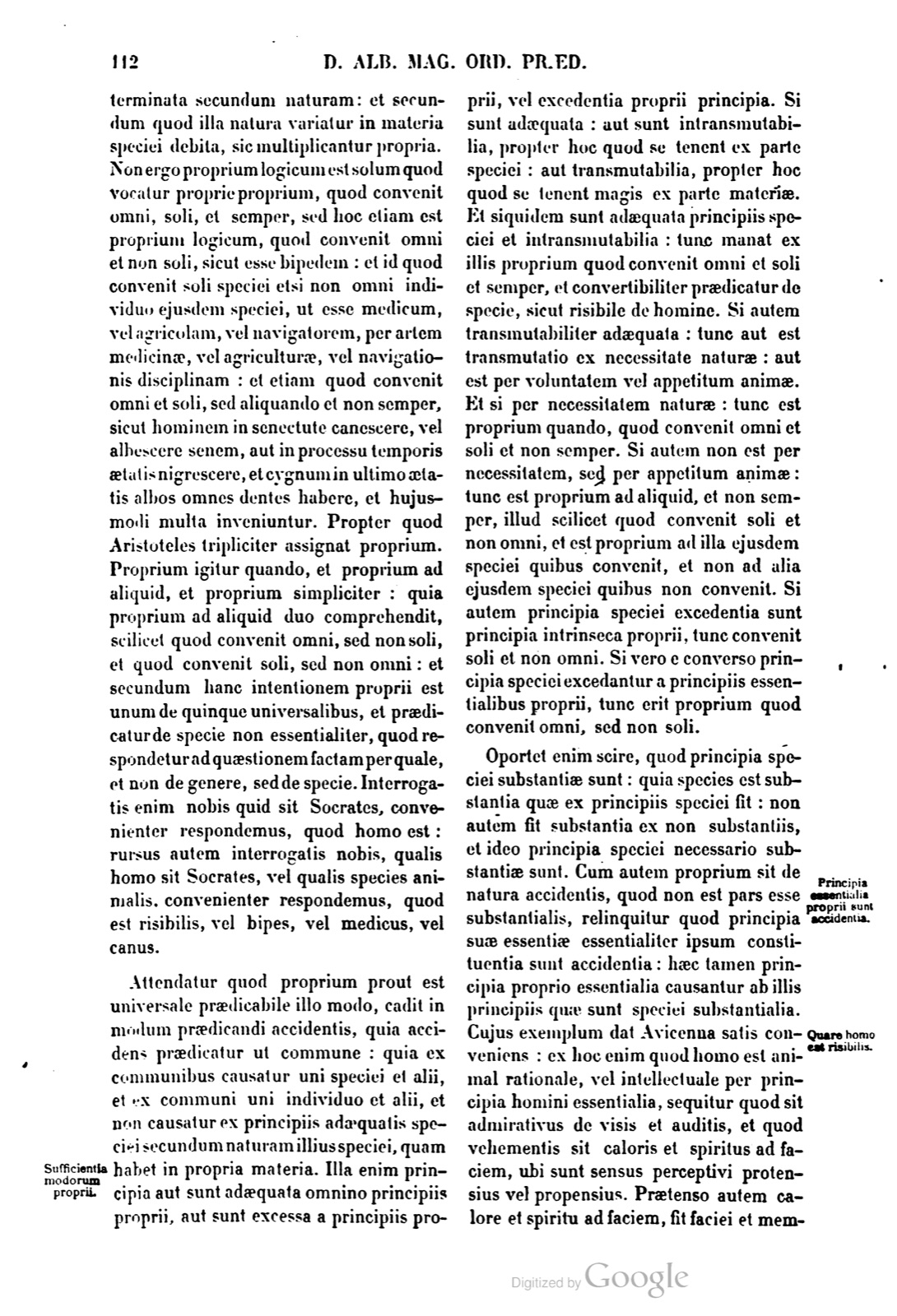
Attendatur quod proprium prout est universale praedicabile illo modo, cadit in modum praedicandi accidentis, quia accidens praedicatur ut commune: quia ex communibus causatur uni speciei et alii, et ex communi uni individuo et alii, et non causatur ex principiis adaequatis speciei secundum naturam illius speciei, quam habet in propria materia. Illa enim principia aut sunt adaequata omnino principiis proprii, aut sunt excessa a principiis proprii, vel excedentia proprii principia. Si sunt adaequata: aut sunt intransmutabilia, propter hoc quod se tenent ex parte speciei: aut transmutabilia, propter hoc quod se tenent magis ex parte materiae. Et siquidem sunt adaequata principiis speciei et intransmutabilia: tunc manat ex illis proprium quod convenit omni et soli et semper, et convertibiliter praedicatur de specie, sicut risibile de homine. Si autem transmutabiliter adaequata: tunc aut est transmutatio ex necessitate naturae: aut est per voluntatem vel appetitum animae. Et si per necessitatem naturae: tunc est proprium quando, quod convenit omni et soli et non semper. Si autem non est per necessitatem, sed per appetitum animae: tunc est proprium ad aliquid, et non semper, illud scilicet quod convenit soli et non omni, et est proprium ad illa ejusdem speciei quibus convenit, et non ad alia ejusdem speciei quibus non convenit. Si autem principia speciei excedentia sunt principia intrinseca proprii, tunc convenit soli et non omni. Si vero e converso principia speciei excedantur a principiis essentialibus proprii, tunc erit proprium quod convenit omni, sed non soli.
Oportet enim scire, quod principia speciei substantiae sunt: quia species est substantia quae ex principiis speciei fit: non autem fit substantia ex non substantiis, et ideo principia speciei necessario substantiae sunt. Cum autem proprium sit de natura accidentis, quod non est pars esse substantialis, relinquitur quod principia suae essentiae essentialiter ipsum constituentia sunt accidentia: haec tamen principia proprio essentialia causantur ab illis principiis quae sunt speciei substantialia. Cujus exemplum dat Avicenna satis conveniens: ex hoc enim quod homo est animal rationale, vel intellectuale per principia homini essentialia, sequitur quod sit admirativus de visis et auditis, et quod vehementis sit caloris et spiritus ad faciem, ubi sunt sensus perceptivi protensius vel propensius. Praetenso autem calore et spiritu ad faciem, fit faciei et membrorum in facie positorum dilatatio. Est igitur aptus natus ad ridendum, etiamsi actu non rideat. E contra autem si non desiderata sed contraria percipiat, sequitur ad cor caloris et spiritus retractio et cordis constrictio, cujus constrictionem sequitur faciei constrictio et cerebri, quo constricto et per panniculos cerebri compresso sequitur hujus lacrymabilis expressio distillans per poros cerebro continuatos, per venas et nervos, et tunc fluit per oculos, per nasum et os, quod est esse flebile. Quas proprietates non possunt participare animalia, quae hujusmodi prudentiam et admirationem de apprehensis habere non possunt. Proportionabiliter autem est in aliis propriis, quae propria sunt quando et ad aliquid, ut facile patet cuilibet principia speciei in materia intuenti per modum qui paulo ante dictus est.
It should be noted that proper, insofar as it is a universal predicable in that mode, falls into the mode of predicating accident, because accident is predicated as common: because from common things it is caused for one species and another, and from the common for one individual and another, and it is not caused from principles adequate to the species according to the nature of that species which it has in its proper matter. For those principles either are wholly adequate to the principles of the proper, or are exceeded by the principles of the proper, or exceed the principles of the proper. If they are adequate, they are either intransmutable, because they hold themselves on the side of the species, or transmutable, because they hold themselves more on the side of matter. And if indeed they are adequate to the principles of the species and intransmutable, then from them flows a proper which belongs to every member and to it alone and always, and is predicated convertibly of the species, as risible of man. But if they are transmutably adequate, then the transmutation is either from necessity of nature or through the will or appetite of the soul. And if through necessity of nature, then it is proper at a time, which belongs to every member and to it alone and not always. But if it is not through necessity but through appetite of the soul, then it is proper relative to something and not always, namely that which belongs to it alone and not to every member, and is proper relative to those of the same species to which it belongs, and not to others of the same species to which it does not belong. But if the exceeding principles of the species are intrinsic principles of the proper, then it belongs to it alone and not to every member. If, conversely, the principles of the species are exceeded by the essential principles of the proper, then it will be a proper which belongs to every member but not to it alone.
For one must know that the principles of species are substances, because species is a substance which comes to be from the principles of species; but substance does not come to be from non-substances, and therefore the principles of species are necessarily substances. But since proper is of the nature of accident, which is not part of substantial being, it remains that the principles constituting it essentially in its own essence are accidents. Yet these principles essential to the proper are caused by those principles which are substantial principles of the species. Avicenna gives a sufficiently fitting example of this: for from the fact that man is a rational animal, or intellectual through principles essential to man, it follows that he is capable of wonder at things seen and heard, and that he is of vehement heat and spirit toward the face, where the perceptive senses are extended or more inclined. Once heat and spirit have been stretched toward the face, there occurs dilation of the face and of the members placed in the face. Therefore he is naturally apt for laughing, even if he does not actually laugh. But conversely, if he perceives not desired things but contrary things, a retraction of heat and spirit to the heart and a constriction of the heart follows; upon this constriction follows constriction of the face and of the brain, and when it has been constricted and compressed through the membranes of the brain, there follows an expression of this weepable thing, distilling through the pores continuous with the brain, through veins and nerves; and then it flows through the eyes, nose, and mouth, which is to be capable of weeping. Animals that cannot have this kind of prudence and wonder about apprehended things cannot participate these properties. Proportionally, moreover, it is so in other propers which are proper at a time and relative to something, as is easily clear to anyone contemplating the principles of species in matter according to the mode said a little before.
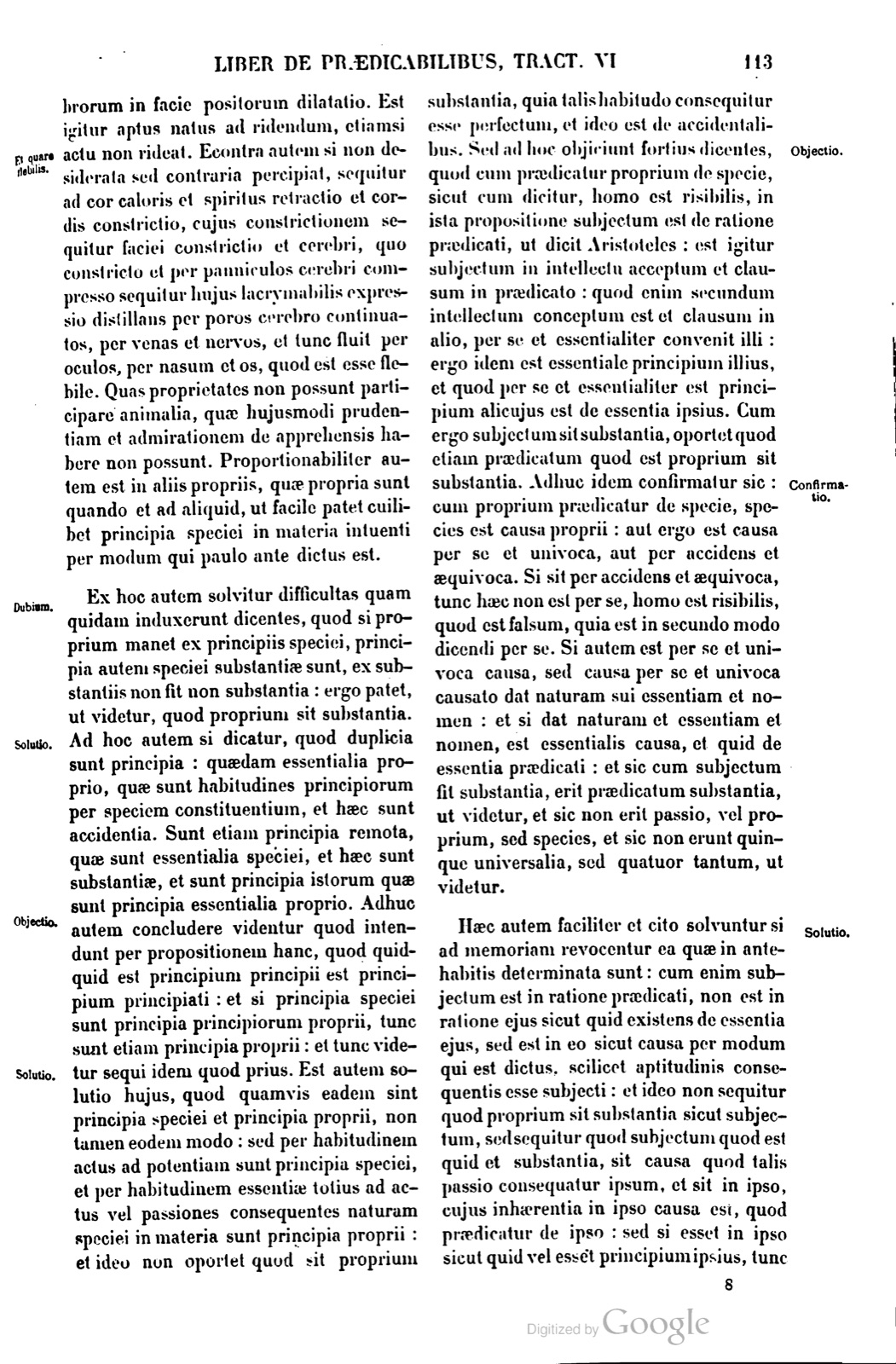
Ex hoc autem solvitur difficultas quam quidam induxerunt dicentes, quod si proprium manet ex principiis speciei, principia autem speciei substantiae sunt, ex substantiis non fit non substantia: ergo patet, ut videtur, quod proprium sit substantia. Ad hoc autem si dicatur, quod duplicia sunt principia: quaedam essentialia proprio, quae sunt habitudines principiorum per speciem constituentium, et haec sunt accidentia. Sunt etiam principia remota, quae sunt essentialia speciei, et haec sunt substantiae, et sunt principia istorum quae sunt principia essentialia proprio. Adhuc autem concludere videntur quod intendunt per propositionem hanc, quod quidquid est principium principii est principium principiati: et si principia speciei sunt principia principiorum proprii, tunc sunt etiam principia proprii: et tunc videtur sequi idem quod prius. Est autem solutio hujus, quod quamvis eadem sint principia speciei et principia proprii, non tamen eodem modo: sed per habitudinem actus ad potentiam sunt principia speciei, et per habitudinem essentiae totius ad actus vel passiones consequentes naturam speciei in materia sunt principia proprii: et ideo non oportet quod sit proprium substantia, quia talis habitudo consequitur esse perfectum, et ideo est de accidentalibus. Sed ad hoc objiciunt fortius dicentes, quod cum praedicatur proprium de specie, sicut cum dicitur, homo est risibilis, in ista propositione subjectum est de ratione praedicati, ut dicit Aristoteles: est igitur subjectum in intellectu acceptum et clausum in praedicato: quod enim secundum intellectum conceptum est et clausum in alio, per se et essentialiter convenit illi: ergo idem est essentiale principium illius, et quod per se et essentialiter est principium alicujus est de essentia ipsius. Cum ergo subjectum sit substantia, oportet quod etiam praedicatum quod est proprium sit substantia. Adhuc idem confirmatur sic: cum proprium praedicatur de specie, species est causa proprii: aut ergo est causa per se et univoca, aut per accidens et aequivoca. Si sit per accidens et aequivoca, tunc haec non est per se, homo est risibilis, quod est falsum, quia est in secundo modo dicendi per se. Si autem est per se et univoca causa, sed causa per se et univoca causato dat naturam sui essentiam et nomen: et si dat naturam et essentiam et nomen, est essentialis causa, et quid de essentia praedicati: et sic cum subjectum fit substantia, erit praedicatum substantia, ut videtur, et sic non erit passio, vel proprium, sed species, et sic non erunt quinque universalia, sed quatuor tantum, ut videtur.
Haec autem faciliter et cito solvuntur si ad memoriam revocentur ea quae in ante habitis determinata sunt: cum enim subjectum est in ratione praedicati, non est in ratione ejus sicut quid existens de essentia ejus, sed est in eo sicut causa per modum qui est dictus, scilicet aptitudinis consequentis esse subjecti: et ideo non sequitur quod proprium sit substantia sicut subjectum, sed sequitur quod subjectum quod est quid et substantia, sit causa quod talis passio consequatur ipsum, et sit in ipso, cujus inhaerentia in ipso causa est, quod praedicatur de ipso: sed si esset in ipso sicut quid vel esset principium ipsius, tunc bene sequeretur id quod conclusum est. Id autem quod objicitur de essentiali, dicendum quod essentiale dupliciter dicitur: est enim essentiale quod est quid essentiae, et de hoc verum est quod probat objectio. Est iterum essentiale quod est causa non derelinquens essentiam, cum tamen non sit quid essentiae, et de hoc non est verum. Hoc modo subjectum est essentiale praedicato et conceptum in ipso, quando proprium de specie praedicatur, et generaliter propria passio de subjecto: tale ergo est proprium quod quartum est inter quinque. Sic ergo proprium est universale.
From this, moreover, the difficulty is solved which certain people introduced, saying that if proper flows from the principles of species, and the principles of species are substances, non-substance does not come to be from substances; therefore it is clear, as it seems, that proper is substance. But if to this it is said that principles are twofold, some essential to the proper, which are relations of the principles constituting through the species, and these are accidents; and there are also remote principles, which are essential to the species, and these are substances and are principles of those which are essential principles to the proper. Yet they also seem to conclude what they intend through this proposition: whatever is a principle of a principle is a principle of the thing principled. And if the principles of species are principles of the principles of the proper, then they are also principles of the proper; and then the same thing as before seems to follow. But the solution of this is that although the principles of species and the principles of the proper are the same, nevertheless they are not the same in the same mode. Rather, through the relation of act to potency they are principles of species, and through the relation of the essence of the whole to the acts or passions following the nature of species in matter they are principles of proper. And therefore proper need not be substance, because such a relation follows perfected being, and therefore it is among accidental things. But against this they object more strongly, saying that when proper is predicated of species, as when it is said, man is risible, in that proposition the subject belongs to the account of the predicate, as Aristotle says. Therefore the subject is accepted and enclosed in the predicate in understanding; but what is conceived according to understanding and enclosed in another belongs per se and essentially to it. Therefore the same is an essential principle of it, and what is per se and essentially a principle of something belongs to its essence. Since therefore the subject is substance, the predicate which is proper must also be substance. They further confirm the same thus: when proper is predicated of species, species is the cause of the proper. Therefore either it is a per se and univocal cause, or an accidental and equivocal cause. If it is accidental and equivocal, then this is not per se, man is risible, which is false, because it is in the second mode of speaking per se. But if it is a per se and univocal cause, a per se and univocal cause gives to the caused thing the nature, essence, and name of itself; and if it gives nature and essence and name, it is an essential cause and something of the essence of the predicate. And thus, since the subject becomes substance, the predicate will be substance, as it seems, and thus it will not be a passion or proper, but species; and thus there will not be five universals, but only four, as it seems.
These things, however, are solved easily and quickly if the things determined in the preceding matters are recalled to memory. For when the subject is in the account of the predicate, it is not in its account as what exists from its essence, but it is in it as a cause in the mode that has been stated, namely of an aptitude following the being of the subject. And therefore it does not follow that proper is substance like the subject; but it follows that the subject, which is a what and a substance, is the cause that such a passion follows it and is in it, and its inherence in it is the cause why it is predicated of it. But if it were in it as a what, or were a principle of it, then what has been concluded would indeed follow. But concerning what is objected about essential, one must say that essential is said in two ways. For there is the essential which is the what of essence, and about this what the objection proves is true. Again there is the essential which is a cause not abandoning the essence, although it is not the what of essence, and about this it is not true. In this mode the subject is essential to the predicate and conceived in it when proper is predicated of species, and generally when a proper passion is predicated of a subject. Therefore proper, which is fourth among the five, is such. Thus therefore proper is a universal.
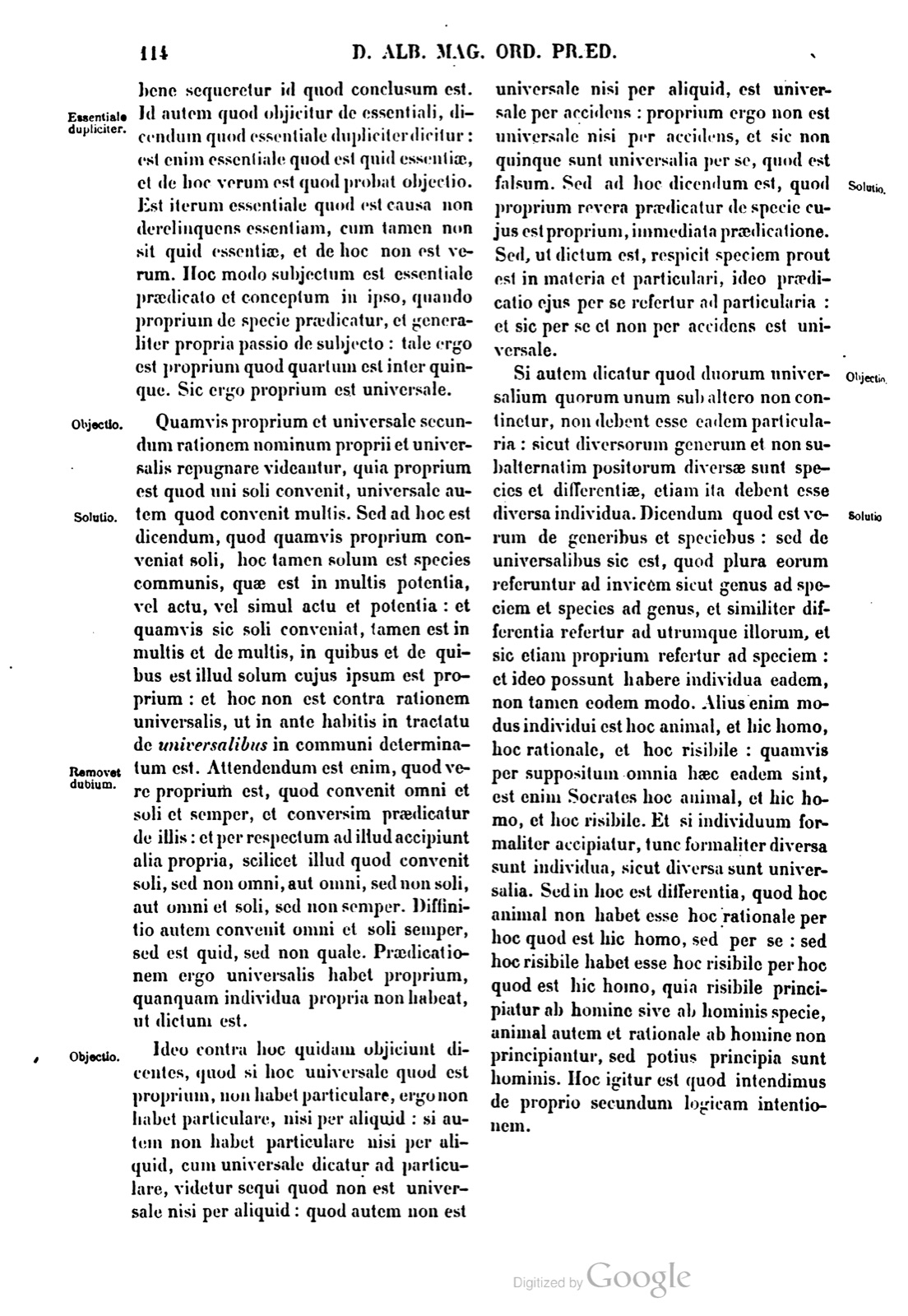
Quamvis proprium et universale secundum rationem nominum proprii et universalis repugnare videantur, quia proprium est quod uni soli convenit, universale autem quod convenit multis. Sed ad hoc est dicendum, quod quamvis proprium conveniat soli, hoc tamen solum est species communis, quae est in multis potentia, vel actu, vel simul actu et potentia: et quamvis sic soli conveniat, tamen est in multis et de multis, in quibus et de quibus est illud solum cujus ipsum est proprium: et hoc non est contra rationem universalis, ut in ante habitis in tractatu de universalibus in communi determinatum est. Attendendum est enim, quod vere proprium est, quod convenit omni et soli et semper, et conversim praedicatur de illis: et per respectum ad illud accipiunt alia propria, scilicet illud quod convenit soli, sed non omni, aut omni, sed non soli, aut omni et soli, sed non semper. Diffinitio autem convenit omni et soli semper, sed est quid, sed non quale. Praedicationem ergo universalis habet proprium, quanquam individua propria non habeat, ut dictum est.
Ideo contra hoc quidam objiciunt dicentes, quod si hoc universale quod est proprium, non habet particulare, ergo non habet particulare, nisi per aliquid: si autem non habet particulare nisi per aliquid, cum universale dicatur ad particulare, videtur sequi quod non est universale nisi per aliquid: quod autem non est universale nisi per aliquid, est universale per accidens: proprium ergo non est universale nisi per accidens, et sic non quinque sunt universalia per se, quod est falsum. Sed ad hoc dicendum est, quod proprium revera praedicatur de specie cujus est proprium, immediata praedicatione. Sed, ut dictum est, respicit speciem prout est in materia et particulari, ideo praedicatio ejus per se refertur ad particularia: et sic per se et non per accidens est universale.
Si autem dicatur quod duorum universalium quorum unum sub altero non continetur, non debent esse eadem particularia: sicut diversorum generum et non subalternatim positorum diversae sunt species et differentiae, etiam ita debent esse diversa individua. Dicendum quod est verum de generibus et speciebus: sed de universalibus sic est, quod plura eorum referuntur ad invicem sicut genus ad speciem et species ad genus, et similiter differentia refertur ad utrumque illorum, et sic etiam proprium refertur ad speciem: et ideo possunt habere individua eadem, non tamen eodem modo. Alius enim modus individui est hoc animal, et hic homo, hoc rationale, et hoc risibile: quamvis per suppositum omnia haec eadem sint, est enim Socrates hoc animal, et hic homo, et hoc risibile. Et si individuum formaliter accipiatur, tunc formaliter diversa sunt individua, sicut diversa sunt universalia. Sed in hoc est differentia, quod hoc animal non habet esse hoc rationale per hoc quod est hic homo, sed per se: sed hoc risibile habet esse hoc risibile per hoc quod est hic homo, quia risibile principiatur ab homine sive ab hominis specie, animal autem et rationale ab homine non principiantur, sed potius principia sunt hominis. Hoc igitur est quod intendimus de proprio secundum logicam intentionem.
Although proper and universal seem to be opposed according to the account of the names proper and universal, because proper is what belongs to one alone, while universal is what belongs to many. But to this one must say that although proper belongs to one alone, that one alone is nevertheless a common species, which is in many potentially, or actually, or at once actually and potentially. And although in this way it belongs to one alone, nevertheless it is in many and of many, in which and of which there is that one thing alone of which it itself is the proper; and this is not against the account of universal, as was determined in the preceding matters in the tractate on universals in common. For one must attend that the truly proper is what belongs to every member and to it alone and always, and is predicated conversely of them; and with respect to it other propers are taken, namely that which belongs to it alone but not to every member, or to every member but not to it alone, or to every member and to it alone but not always. Definition, however, belongs to every member and to it alone always, but it is a what, not a what-sort-of. Therefore proper has the predication of a universal, although it does not have proper individuals, as has been said.
Therefore against this certain people object, saying that if this universal, which is proper, does not have a particular, then it does not have a particular except through something. But if it does not have a particular except through something, since universal is said in relation to particular, it seems to follow that it is not a universal except through something. But what is not a universal except through something is a universal per accidens; therefore proper is not a universal except per accidens, and thus there are not five universals per se, which is false. But to this one must say that proper in truth is predicated of the species of which it is the proper by immediate predication. But, as has been said, it regards species as it is in matter and in a particular; therefore its predication per se is referred to particulars. And thus it is a universal per se and not per accidens.
But if it is said that of two universals, one of which is not contained under the other, the particulars ought not to be the same, just as of diverse genera not placed subalternately the species and differences are diverse, so also the individuals ought to be diverse. One must say that this is true of genera and species; but with universals it is this way, that several of them are referred to one another as genus to species and species to genus, and similarly difference is referred to both of them, and thus also proper is referred to species. And therefore they can have the same individuals, though not in the same mode. For one mode of individual is this animal, and this man, this rational thing, and this risible thing; although by supposit all these are the same, for Socrates is this animal, and this man, and this risible thing. And if individual is taken formally, then the individuals are formally diverse, just as the universals are diverse. But in this is the difference: that this animal does not have being this rational thing through the fact that it is this man, but through itself; whereas this risible thing has being this risible thing through the fact that it is this man, because risible is principled by man or by the species of man, while animal and rational are not principled by man, but rather are principles of man. This, therefore, is what we intend concerning proper according to logical intention.
If a page does not appear, its photograph has not been uploaded yet.