Volume 1 · pp. 109–110
Chapter IX. On the definition which more properly belongs to difference alone.
A marker with ≈ is an approximate page boundary, placed by measure of the text; the page photographs remain the authority. In the paired views, clicking a page marker brings that page into view.
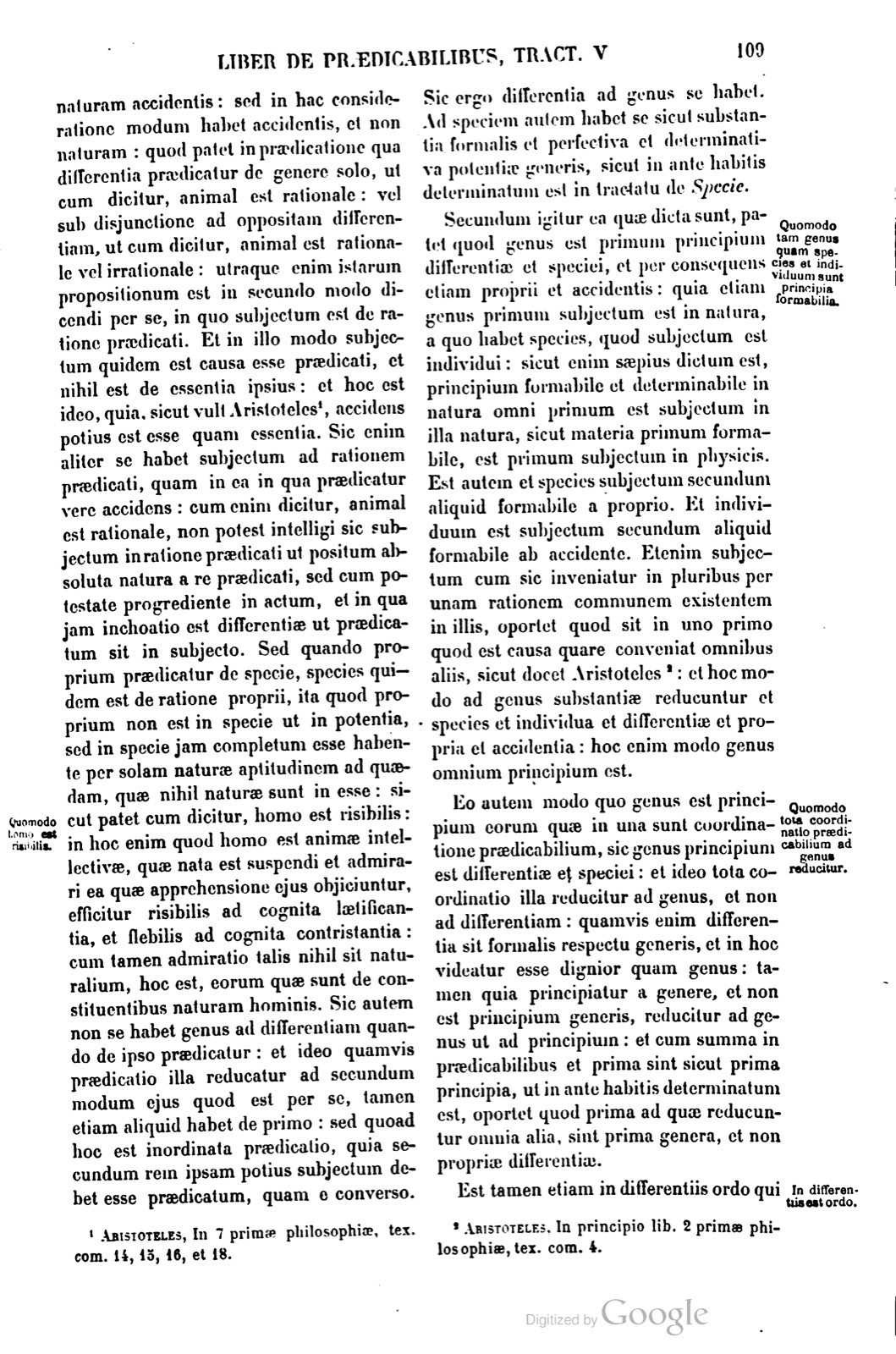
naturam accidentis: sed in hac consideratione modum habet accidentis, et non naturam: quod patet in praedicatione qua differentia praedicatur de genere solo, ut cum dicitur, animal est rationale: vel sub disjunctione ad oppositam differentiam, ut cum dicitur, animal est rationale vel irrationale: utraque enim istarum propositionum est in secundo modo dicendi per se, in quo subjectum est de ratione praedicati. Et in illo modo subjectum quidem est causa esse praedicati, et nihil est de essentia ipsius: et hoc est ideo, quia, sicut vult Aristoteles1, accidens potius est esse quam essentia. Sic enim aliter se habet subjectum ad rationem praedicati, quam in ea in qua praedicatur vere accidens: cum enim dicitur, animal est rationale, non potest intelligi sic subjectum in ratione praedicati ut positum absoluta natura a re praedicati, sed cum potestate progrediente in actum, et in qua jam inchoatio est differentiae ut praedicatum sit in subjecto. Sed quando proprium praedicatur de specie, species quidem est de ratione proprii, ita quod proprium non est in specie ut in potentia, sed in specie jam completum esse habente per solam naturae aptitudinem ad quaedam, quae nihil naturae sunt in esse: sicut patet cum dicitur, homo est risibilis: in hoc enim quod homo est animae intellectivae, quae nata est suspendi et admirari ea quae apprehensione ejus objiciuntur, efficitur risibilis ad cognita laetificantia, et flebilis ad cognita contristantia: cum tamen admiratio talis nihil sit naturalium, hoc est, eorum quae sunt de constituentibus naturam hominis. Sic autem non se habet genus ad differentiam quando de ipso praedicatur: et ideo quamvis praedicatio illa reducatur ad secundum modum ejus quod est per se, tamen etiam aliquid habet de primo: sed quoad hoc est inordinata praedicatio, quia secundum rem ipsam potius subjectum debet esse praedicatum, quam e converso.
Sic ergo differentia ad genus se habet. Ad speciem autem habet se sicut substantia formalis et perfectiva et determinativa potentiae generis, sicut in ante habitis determinatum est in tractatu de Specie.
Secundum igitur ea quae dicta sunt, patet quod genus est primum principium differentiae et speciei, et per consequens etiam proprii et accidentis: quia etiam genus primum subjectum est in natura, a quo habet species, quod subjectum est individui: sicut enim saepius dictum est, principium formabile et determinabile in natura omni primum est subjectum in illa natura, sicut materia primum formabile, est primum subjectum in physicis. Est autem et species subjectum secundum aliquid formabile a proprio. Et individuum est subjectum secundum aliquid formabile ab accidente. Etenim subjectum cum sic inveniatur in pluribus per unam rationem communem existentem in illis, oportet quod sit in uno primo quod est causa quare conveniat omnibus aliis, sicut docet Aristoteles2: et hoc modo ad genus substantiae reducuntur et species et individua et differentiae et propria et accidentia: hoc enim modo genus omnium principium est.
Eo autem modo quo genus est principium eorum quae in una sunt coordinatione praedicabilium, sic genus principium est differentiae et speciei: et ideo tota coordinatio illa reducitur ad genus, et non ad differentiam: quamvis enim differentia sit formalis respectu generis, et in hoc videatur esse dignior quam genus: tamen quia principiatur a genere, et non est principium generis, reducitur ad genus ut ad principium: et cum summa in praedicabilibus et prima sint sicut prima principia, ut in ante habitis determinatum est, oportet quod prima ad quae reducuntur omnia alia, sint prima genera, et non propriae differentiae.
Est tamen etiam in differentiis ordo qui est superiorum ad inferiores: qui est ordo superioris et inferioris, quo differentiae inferiores per additionem ad genera fiunt compositiores et minoris communitatis: sicut est ordo in causis formalibus primariis et secundariis, in quo ordine primariae causae virtus est in secundaria, et remanet virtus superioris in causato, quando secundaria subtrahit a causato suam causalitatem. Etiam in hoc ordine quidquid causalitatis habet secunda, totum habet a prima. Sed iste ordo non est ad primum recurrens principium, quia primum omnium principium est genus. Et haec est vera causa quare differentia non potest esse primum et generalissimum, sed oportet quod primum vel generalissimum esse generi attribuat.
the nature of accident; but in this consideration it has the mode of accident, and not the nature. This is clear in the predication by which difference is predicated of genus alone, as when it is said, animal is rational; or under disjunction to the opposite difference, as when it is said, animal is rational or irrational. For each of those propositions is in the second mode of speaking per se, in which the subject belongs to the account of the predicate. And in that mode the subject indeed is the cause of the being of the predicate, and is nothing of its essence; and this is because, as Aristotle holds1, accident is rather being than essence. For in this way the subject is related otherwise to the account of the predicate than in that in which accident is truly predicated: for when it is said, animal is rational, the subject cannot be understood in the account of the predicate as posited with its nature absolute from the thing predicated, but with a power progressing into act, and in which there is already the beginning of difference so that the predicate is in the subject. But when a proper is predicated of species, the species indeed belongs to the account of the proper, so that the proper is not in the species as in potency, but in the species now having completed being through the sole aptitude of nature toward certain things, which are nothing of nature in being; as is clear when it is said, man is risible. For in this, that man belongs to an intellective soul, which is naturally apt to be suspended and to wonder at the things presented to its apprehension, he is made risible toward known things that gladden, and capable of weeping toward known things that sadden; although such wonder is nothing of the natural things, that is, of those things that constitute the nature of man. But genus is not related in this way to difference when difference is predicated of it; and therefore, although that predication is reduced to the second mode of what is per se, still it also has something of the first. But in this respect it is disordered predication, because according to the thing itself the subject ought rather to be the predicate than conversely.
Thus, therefore, difference is related to genus. But to species it is related as the formal and perfective substance and the determinative substance of the potency of the genus, as was determined in the preceding matters in the tractate on Species.
Accordingly, from the things that have been said, it is clear that genus is the first principle of difference and species, and consequently also of proper and accident, because genus is also the first subject in nature, from which species has that it is the subject of the individual. For as has often been said, the first formable and determinable principle in every nature is the subject in that nature, just as matter, the first formable thing, is the first subject in physics. Species, however, is also in a certain respect a subject formable by proper. And the individual is in a certain respect a subject formable by accident. For since a subject is found in this way in several things through one common account existing in them, it must be in one first thing which is the cause why it belongs to all the others, as Aristotle teaches2; and in this way species and individuals and differences and propers and accidents are reduced to the genus of substance, for in this way genus is the principle of all.
But in the mode in which genus is the principle of those things that are in one coordination of predicables, so genus is the principle of difference and species; and therefore that whole coordination is reduced to genus, and not to difference. For although difference is formal with respect to genus, and in this respect seems to be worthier than genus, nevertheless, because it is principled by genus and is not the principle of genus, it is reduced to genus as to a principle. And since the highest and first things among predicables are like first principles, as was determined in the preceding matters, the first things to which all the others are reduced must be first genera, and not proper differences.
Nevertheless there is also an order in differences which is of higher ones to lower ones. This is the order of superior and inferior, by which lower differences through addition to genera become more composite and of less commonness. It is like the order in primary and secondary formal causes, in which order the power of the primary cause is in the secondary, and the power of the superior remains in the caused thing when the secondary withdraws its own causality from the caused thing. Also in this order, whatever causality the second has, it has wholly from the first. But that order is not one recurring to the first principle, because the first principle of all is genus. And this is the true cause why difference cannot be first and most general, but why it must attribute being first or most general to genus.
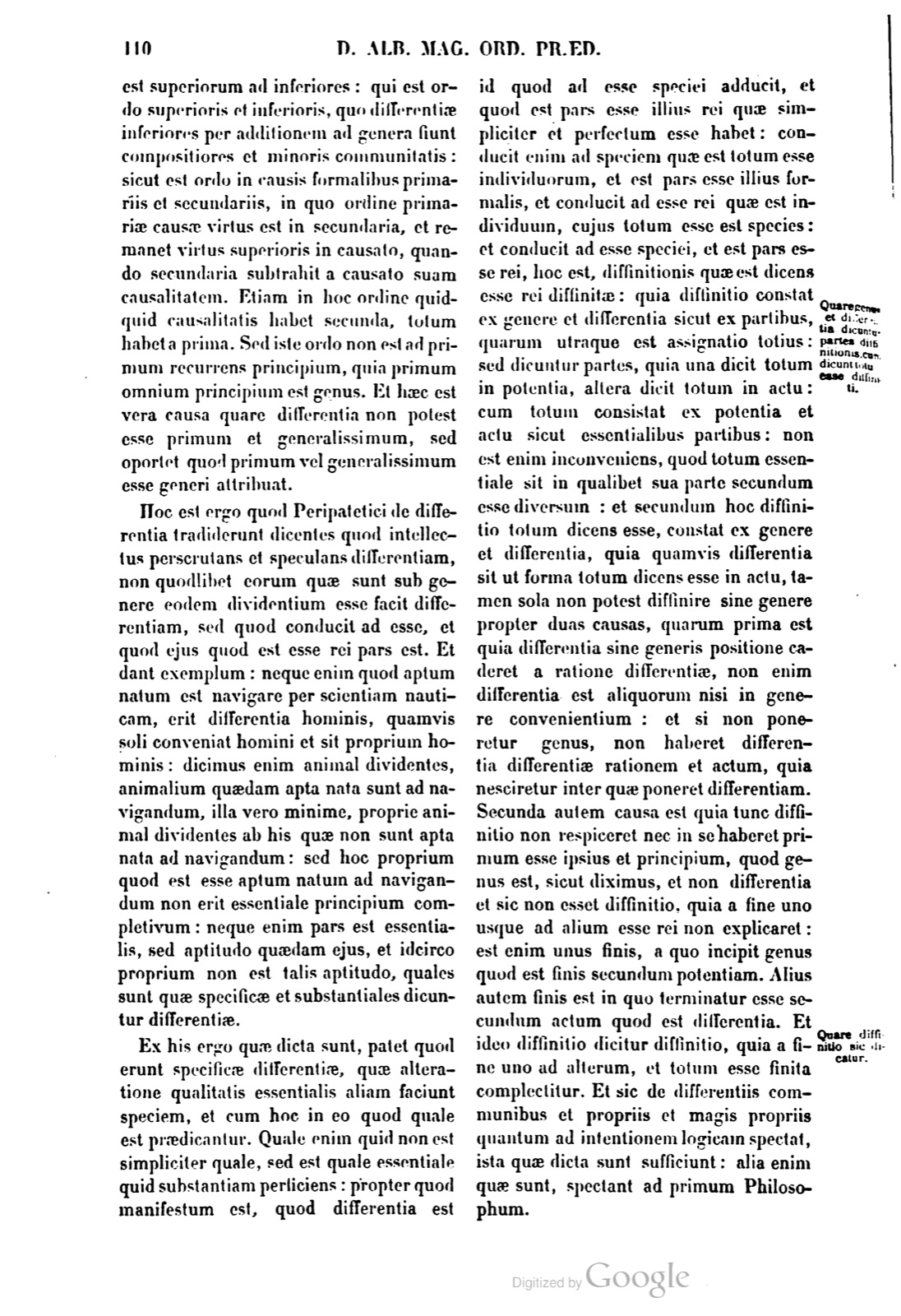
Hoc est ergo quod Peripatetici de differentia tradiderunt dicentes quod intellectus perscrutans et speculans differentiam, non quodlibet eorum quae sunt sub genere eodem dividentium esse facit differentiam, sed quod conducit ad esse, et quod ejus quod est esse rei pars est. Et dant exemplum: neque enim quod aptum natum est navigare per scientiam nauticam, erit differentia hominis, quamvis soli conveniat homini et sit proprium hominis: dicimus enim animal dividentes, animalium quaedam apta nata sunt ad navigandum, illa vero minime, proprie animal dividentes ab his quae non sunt apta nata ad navigandum: sed hoc proprium quod est esse aptum natum ad navigandum non erit essentiale principium completivum: neque enim pars est essentialis, sed aptitudo quaedam ejus, et idcirco proprium non est talis aptitudo, quales sunt quae specificae et substantiales dicuntur differentiae.
Ex his ergo quae dicta sunt, patet quod erunt specificae differentiae, quae alteratione qualitatis essentialis aliam faciunt speciem, et cum hoc in eo quod quale est praedicantur. Quale enim quid non est simpliciter quale, sed est quale essentiale quid substantiam perficiens: propter quod manifestum est, quod differentia est id quod ad esse speciei adducit, et quod est pars esse illius rei quae simpliciter et perfectum esse habet: conducit enim ad speciem quae est totum esse individuorum, et est pars esse illius formalis, et conducit ad esse rei quae est individuum, cujus totum esse est species: et conducit ad esse speciei, et est pars esse rei, hoc est, diffinitionis quae est dicens esse rei diffinitae: quia diffinitio constat ex genere et differentia sicut ex partibus, quarum utraque est assignatio totius: sed dicuntur partes, quia una dicit totum in potentia, altera dicit totum in actu: cum totum consistat ex potentia et actu sicut essentialibus partibus: non est enim inconveniens, quod totum essentiale sit in qualibet sua parte secundum esse diversum: et secundum hoc diffinitio totum dicens esse, constat ex genere et differentia, quia quamvis differentia sit ut forma totum dicens esse in actu, tamen sola non potest diffinire sine genere propter duas causas, quarum prima est quia differentia sine generis positione caderet a ratione differentiae, non enim differentia est aliquorum nisi in genere convenientium: et si non poneretur genus, non haberet differentia differentiae rationem et actum, quia nesciretur inter quae poneret differentiam. Secunda autem causa est quia tunc diffinitio non respiceret nec in se haberet primum esse ipsius et principium, quod genus est, sicut diximus, et non differentia et sic non esset diffinitio, quia a fine uno usque ad alium esse rei non explicaret: est enim unus finis, a quo incipit genus quod est finis secundum potentiam. Alius autem finis est in quo terminatur esse secundum actum quod est differentia. Et ideo diffinitio dicitur diffinitio, quia a fine uno ad alterum, et totum esse finita complectitur. Et sic de differentiis communibus et propriis et magis propriis quantum ad intentionem logicam spectat, ista quae dicta sunt sufficiunt: alia enim quae sunt, spectant ad primum Philosophum.
This, therefore, is what the Peripatetics handed down about difference, saying that the understanding, searching out and speculating on difference, does not make any one whatever of the things dividing being under the same genus to be a difference, but only what leads to being, and what is part of that which is the being of the thing. And they give an example: for what is naturally apt to sail through nautical knowledge will not be a difference of man, although it belongs only to man and is a proper of man. For when we divide animal we say that some animals are naturally apt for sailing, but others not at all, dividing animal properly from those which are not naturally apt for sailing. But this proper, which is to be naturally apt for sailing, will not be an essential completive principle; for it is not an essential part, but a certain aptitude of it, and therefore a proper is not such an aptitude as those which are called specific and substantial differences.
From these things, therefore, which have been said, it is clear that there will be specific differences which by alteration of an essential quality make another species, and with this are predicated in that which is what-sort-of. For what-sort-of something is not simply what-sort-of, but is an essential what-sort-of completing substance. On account of this it is manifest that difference is that which leads to the being of species, and that it is part of the being of that thing which has being simply and perfectly; for it leads to species, which is the whole being of individuals, and it is part of that formal being, and it leads to the being of the thing which is an individual, whose whole being is species. And it leads to the being of species and is part of the being of the thing, that is, of the definition which says the being of the defined thing; because definition consists of genus and difference as of parts, each of which is an assignment of the whole. But they are called parts because one says the whole in potency, the other says the whole in act, since the whole consists of potency and act as essential parts. For it is not unfitting that the essential whole be in each of its parts according to diverse being. And according to this, definition, saying the whole being, consists of genus and difference, because although difference is as form saying the whole being in act, still it alone cannot define without genus for two causes. The first is that difference without the positing of genus would fall from the account of difference; for difference is not of things unless they agree in a genus. And if genus were not posited, difference would not have the account and act of difference, because it would not be known between which things it placed difference. The second cause is that then definition would not look to nor have in itself the first being of the thing and its principle, which is genus, as we have said, and not difference; and thus it would not be a definition, because it would not unfold the being of the thing from one boundary up to the other. For there is one boundary from which genus begins, which is the boundary according to potency. But another boundary is that in which being according to act is terminated, which is difference. And therefore definition is called definition because from one boundary to another it embraces the whole bounded being. And thus, concerning common, proper, and more proper differences, as much as pertains to logical intention, these things that have been said suffice; for the other things that there are belong to the First Philosopher.
Notes
If a page does not appear, its photograph has not been uploaded yet.