Volume 1 · pp. 104–105
Chapter VII. On the description of difference insofar as it regards genus.
A marker with ≈ is an approximate page boundary, placed by measure of the text; the page photographs remain the authority. In the paired views, clicking a page marker brings that page into view.
CAPUT VII.
De descriptione differentiae prout respicit genus.
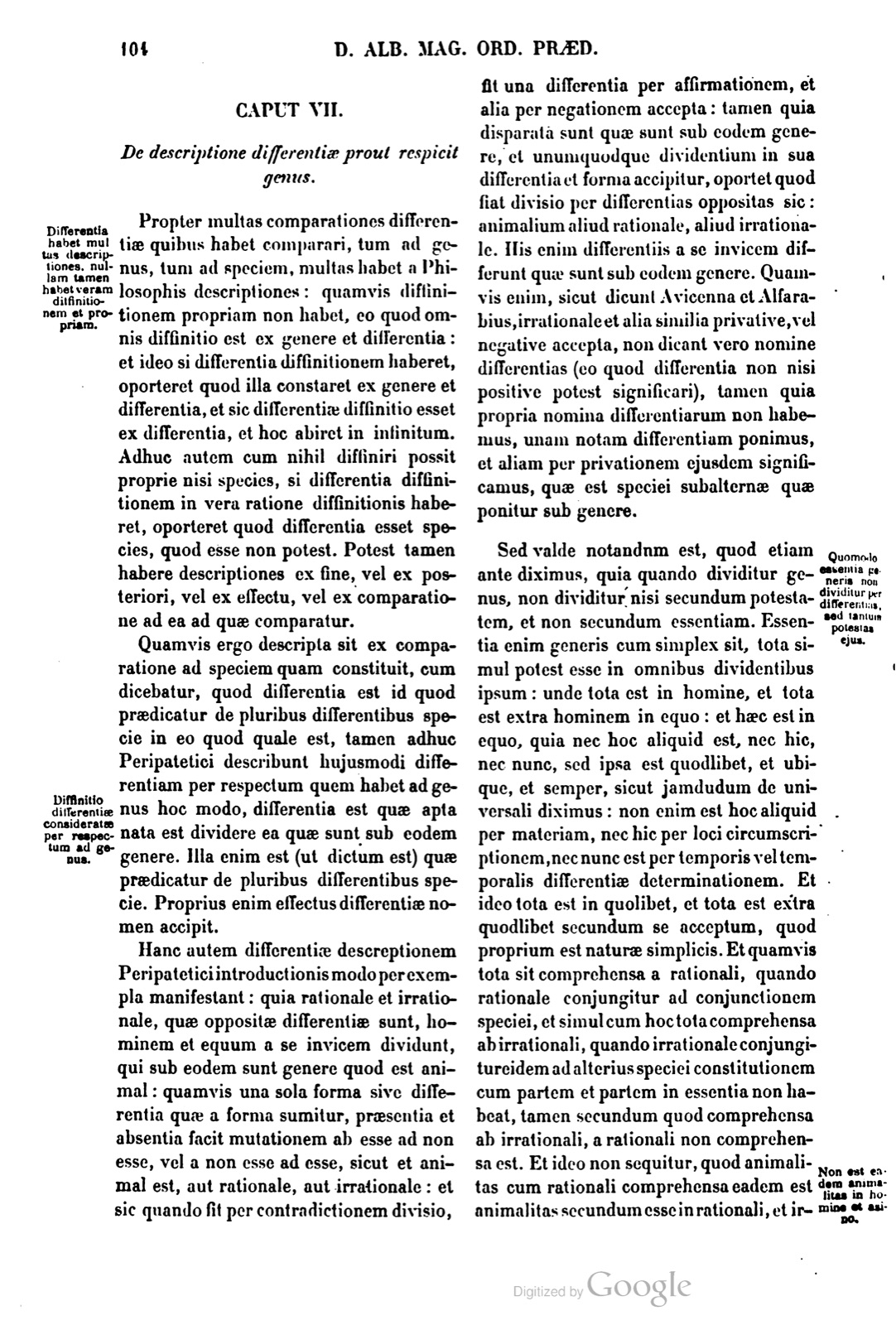
Propter multas comparationes differentiae quibus habet comparari, tum ad genus, tum ad speciem, multas habet a Philosophis descriptiones: quamvis diffinitionem propriam non habet, eo quod omnis diffinitio est ex genere et differentia: et ideo si differentia diffinitionem haberet, oporteret quod illa constaret ex genere et differentia, et sic differentiae diffinitio esset ex differentia, et hoc abiret in infinitum. Adhuc autem cum nihil diffiniri possit proprie nisi species, si differentia diffinitionem in vera ratione diffinitionis haberet, oporteret quod differentia esset species, quod esse non potest. Potest tamen habere descriptiones ex fine, vel ex posteriori, vel ex effectu, vel ex comparatione ad ea ad quae comparatur.
Quamvis ergo descripta sit ex comparatione ad speciem quam constituit, cum dicebatur, quod differentia est id quod praedicatur de pluribus differentibus specie in eo quod quale est, tamen adhuc Peripatetici describunt hujusmodi differentiam per respectum quem habet ad genus hoc modo, differentia est quae apta nata est dividere ea quae sunt sub eodem genere. Illa enim est, ut dictum est, quae praedicatur de pluribus differentibus specie. Proprius enim effectus differentiae nomen accipit.
Hanc autem differentiae descriptionem Peripatetici introductionis modo per exempla manifestant: quia rationale et irrationale, quae oppositae differentiae sunt, hominem et equum a se invicem dividunt, qui sub eodem sunt genere quod est animal: quamvis una sola forma sive differentia quae a forma sumitur, praesentia et absentia facit mutationem ab esse ad non esse, vel a non esse ad esse, sicut et animal est, aut rationale, aut irrationale: et sic quando fit per contradictionem divisio, fit una differentia per affirmationem, et alia per negationem accepta: tamen quia disparata sunt quae sunt sub eodem genere, et unumquodque dividentium in sua differentia et forma accipitur, oportet quod fiat divisio per differentias oppositas sic: animalium aliud rationale, aliud irrationale. His enim differentiis a se invicem differunt quae sunt sub eodem genere. Quamvis enim, sicut dicunt Avicenna et Alfarabius, irrationale et alia similia privative, vel negative accepta, non dicant vero nomine differentias, eo quod differentia non nisi positive potest significari, tamen quia propria nomina differentiarum non habemus, unam notam differentiam ponimus, et aliam per privationem ejusdem significamus, quae est speciei subalternae quae ponitur sub genere.
Sed valde notandum est, quod etiam ante diximus, quia quando dividitur genus, non dividitur nisi secundum potestatem, et non secundum essentiam. Essentia enim generis cum simplex sit, tota simul potest esse in omnibus dividentibus ipsum: unde tota est in homine, et tota est extra hominem in equo: et haec est in equo, quia nec hoc aliquid est, nec hic, nec nunc, sed ipsa est quodlibet, et ubique, et semper, sicut jamdudum de universali diximus: non enim est hoc aliquid per materiam, nec hic per loci circumscriptionem, nec nunc est per temporis vel temporalis differentiae determinationem. Et ideo tota est in quolibet, et tota est extra quodlibet secundum se acceptum, quod proprium est naturae simplicis. Et quamvis tota sit comprehensa a rationali, quando rationale conjungitur ad conjunctionem speciei, et simul cum hoc tota comprehensa ab irrationali, quando irrationale conjungitur eidem ad alterius speciei constitutionem cum partem et partem in essentia non habeat, tamen secundum quod comprehensa ab irrationali, a rationali non comprehensa est. Et ideo non sequitur, quod animalitas cum rationali comprehensa eadem est animalitas secundum esse in rationali, et irrationali. Sic enim rationale transmutaretur in irrationale, quod negat Aristoteles 1 fieri posse. Hoc autem ideo est, quia animalitas una inchoatio est et rationalis et irrationalis, et unum et idem inchoationis principium in essentia: quod tamen ut comprehensum est ab uno, tractum est ad esse principiati. Et ideo secundum hoc non potest esse comprehensum ab alio: quod secundum partem suae potestatis est in alio.
CHAPTER VII.
On the description of difference insofar as it regards genus.
Because of the many comparisons of difference by which it has to be compared, both to genus and to species, it has many descriptions from the Philosophers, although it does not have a proper definition, because every definition is from genus and difference. Therefore if difference had a definition, that definition would have to consist of genus and difference, and thus the definition of difference would be from difference, and this would go to infinity. Further, since nothing can properly be defined except species, if difference had a definition in the true account of definition, difference would have to be species, which cannot be. Nevertheless it can have descriptions from an end, from a posterior thing, from an effect, or from comparison to those things to which it is compared.
Therefore although it has been described from comparison to the species which it constitutes, when it was said that difference is that which is predicated of several things differing in species in that which is what-sort-of, nevertheless the Peripatetics also describe a difference of this sort through the relation which it has to genus in this way: difference is what is apt by nature to divide those things which are under the same genus. For it is that, as was said, which is predicated of several things differing in species. For it receives its name from the proper effect of difference.
The Peripatetics manifest this description of difference by way of introduction through examples, because rational and irrational, which are opposite differences, divide man and horse from one another, which are under the same genus, animal. Although one single form or difference which is taken from form, by presence and absence, makes a change from being to non-being, or from non-being to being, as animal is either rational or irrational; and thus when division is made through contradiction, one difference is made by affirmation and another taken by negation. Nevertheless, because those things which are under the same genus are disparate, and each of the things dividing is received in its own difference and form, division must be made through opposite differences thus: of animals one is rational, another irrational. For by these differences those things which are under the same genus differ from one another. For although, as Avicenna and Alfarabi say, irrational and other similar things taken privatively or negatively do not name differences by a true name, because difference can be signified only positively, nevertheless because we do not have proper names of differences, we posit one known difference and signify the other through privation of the same, which is of the subaltern species placed under genus.
But it must be noted strongly that we also said before that when genus is divided, it is divided only according to power and not according to essence. For since the essence of genus is simple, it can be wholly at once in all the things dividing it. Hence it is wholly in man and wholly outside man in horse; and it is in horse because it is neither this something, nor here, nor now, but it itself is anything, everywhere, and always, as we said long ago about the universal. For it is not this something through matter, nor here through circumscription of place, nor now through determination of time or temporal difference. Therefore it is whole in anything and whole outside anything taken according to itself, which is proper to a simple nature. And although it is wholly comprehended by rational when rational is joined for the conjunction of species, and at the same time wholly comprehended by irrational when irrational is joined to the same for the constitution of another species, since it does not have part and part in essence, nevertheless insofar as it is comprehended by irrational, it is not comprehended by rational. Therefore it does not follow that animality comprehended with rational is the same animality according to being in rational and irrational. For thus rational would be changed into irrational, which Aristotle denies can occur 1. This is so because animality is one beginning of both rational and irrational, and one and the same principle of beginning in essence; nevertheless, as comprehended by one, it is drawn to the being of what is principled. Therefore according to this it cannot be comprehended by another, because according to part of its power it is in another.
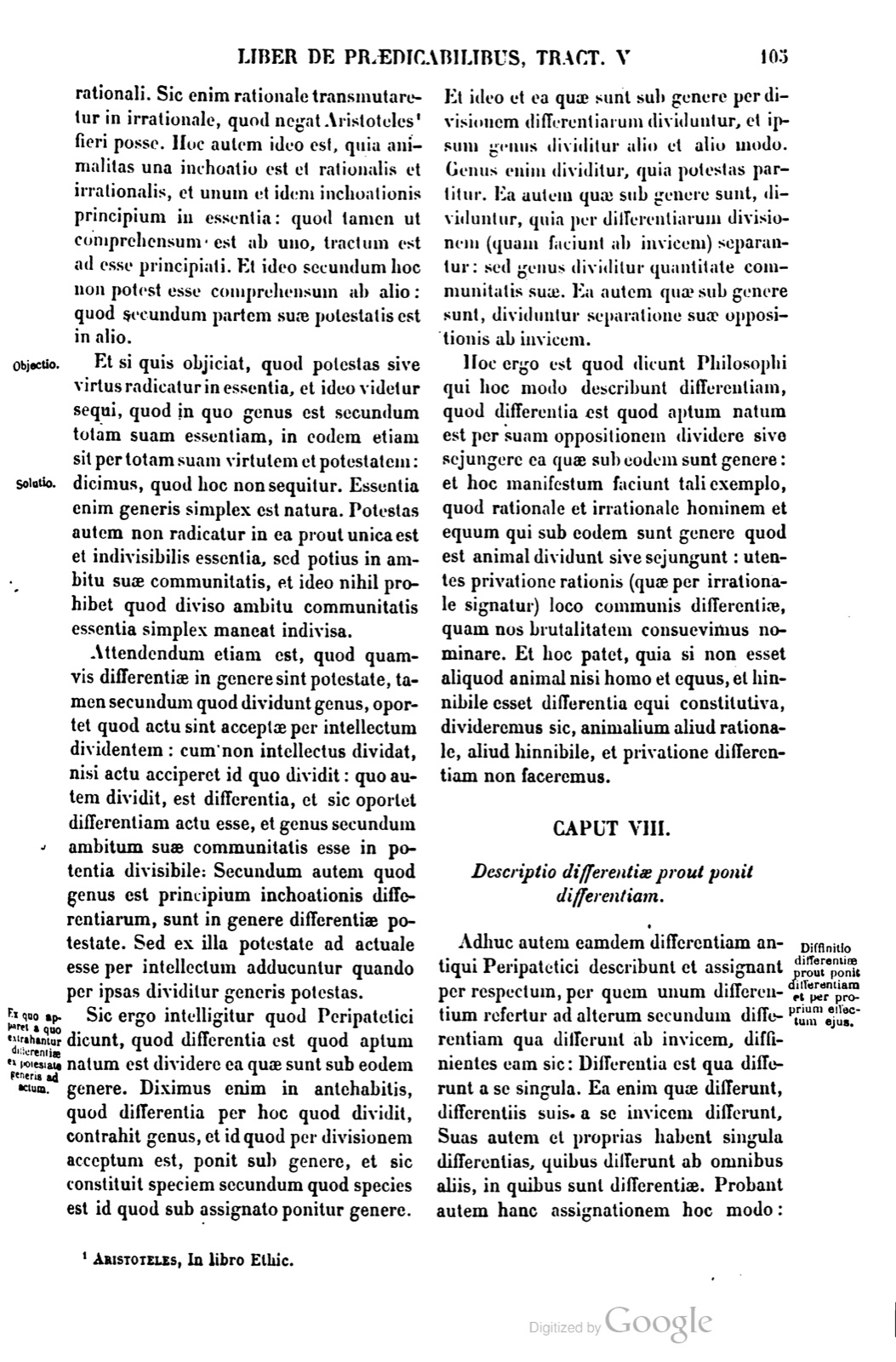
Et si quis objiciat, quod potestas sive virtus radicatur in essentia, et ideo videtur sequi, quod in quo genus est secundum totam suam essentiam, in eodem etiam sit per totam suam virtutem et potestatem: dicimus, quod hoc non sequitur. Essentia enim generis simplex est natura. Potestas autem non radicatur in ea prout unica est et indivisibilis essentia, sed potius in ambitu suae communitatis, et ideo nihil prohibet quod diviso ambitu communitatis essentia simplex maneat indivisa.
Attendendum etiam est, quod quamvis differentiae in genere sint potestate, tamen secundum quod dividunt genus, oportet quod actu sint acceptae per intellectum dividentem: cum non intellectus dividat, nisi actu acciperet id quo dividit: quo autem dividit, est differentia, et sic oportet differentiam actu esse, et genus secundum ambitum suae communitatis esse in potentia divisibile: Secundum autem quod genus est principium inchoationis differentiarum, sunt in genere differentiae potestate. Sed ex illa potestate ad actuale esse per intellectum adducuntur quando per ipsas dividitur generis potestas.
Sic ergo intelligitur quod Peripatetici dicunt, quod differentia est quod aptum natum est dividere ea quae sunt sub eodem genere. Diximus enim in ante habitis, quod differentia per hoc quod dividit, contrahit genus, et id quod per divisionem acceptum est, ponit sub genere, et sic constituit speciem secundum quod species est id quod sub assignato ponitur genere. Et ideo et ea quae sunt sub genere per divisionem differentiarum dividuntur, et ipsum genus dividitur alio et alio modo. Genus enim dividitur, quia potestas partitur. Ea autem quae sub genere sunt, dividuntur, quia per differentiarum divisionem quam faciunt ab invicem separantur: sed genus dividitur quantitate communitatis suae. Ea autem quae sub genere sunt, dividuntur separatione suae oppositionis ab invicem.
Hoc ergo est quod dicunt Philosophi qui hoc modo describunt differentiam, quod differentia est quod aptum natum est per suam oppositionem dividere sive sejungere ea quae sub eodem sunt genere: et hoc manifestum faciunt tali exemplo, quod rationale et irrationale hominem et equum qui sub eodem sunt genere quod est animal dividunt sive sejungunt: utentes privatione rationis, quae per irrationale signatur, loco communis differentiae, quam nos brutalitatem consuevimus nominare. Et hoc patet, quia si non esset aliquod animal nisi homo et equus, et hinnibile esset differentia equi constitutiva, divideremus sic, animalium aliud rationale, aliud hinnibile, et privatione differentiam non faceremus.
And if someone objects that power or virtue is rooted in essence, and therefore it seems to follow that in whatever genus is according to its whole essence, in the same it is also according to its whole virtue and power, we say that this does not follow. For the essence of genus is a simple nature. But power is not rooted in it insofar as it is a single and indivisible essence, but rather in the range of its commonness; and therefore nothing prevents that, with the range of commonness divided, the simple essence remains undivided.
It must also be attended to that although differences are in genus by power, nevertheless insofar as they divide genus, they must be taken in act by the dividing intellect, since the intellect would not divide unless it actually received that by which it divides. But that by which it divides is difference, and thus difference must actually be, and genus according to the range of its commonness must be divisible in potency. But insofar as genus is the principle of the beginning of differences, differences are in genus by power. Yet from that power they are led by the intellect to actual being when the power of genus is divided through them.
Thus therefore what the Peripatetics say is understood: difference is what is apt by nature to divide the things which are under the same genus. For we said above that through the fact that it divides, difference contracts genus and places that which is received by division under genus, and thus constitutes species according as species is that which is placed under an assigned genus. Therefore both those things which are under genus are divided by division of differences, and the genus itself is divided in one and another mode. For genus is divided because its power is apportioned. But the things under genus are divided because they are separated from one another through the division of differences which they make; but genus is divided by the quantity of its commonness. The things under genus, however, are divided by the separation of their opposition from one another.
This therefore is what the Philosophers say who describe difference in this way: difference is what is apt by nature through its own opposition to divide or separate those things which are under the same genus. They make this manifest by such an example, that rational and irrational divide or separate man and horse, which are under the same genus, animal; using the privation of reason, which is signified by irrational, in the place of a common difference, which we are accustomed to name brutality. And this is clear, because if there were no animal except man and horse, and neigh-capable were the constitutive difference of horse, we would divide thus: of animals one is rational, another neigh-capable, and we would not make difference by privation.
Notes
- Aristotle, In the book of the Ethics. (Aristoteles, In libro Ethic.) ↩
If a page does not appear, its photograph has not been uploaded yet.