Volume 1 · pp. 100–103
Chapter VI. On doubts against the definition of difference, on the errors of those solving badly, and on the true solution of all of them.
A marker with ≈ is an approximate page boundary, placed by measure of the text; the page photographs remain the authority. In the paired views, clicking a page marker brings that page into view.
CAPUT VI.
De dubitationibus contra diffinitionem differentiae, et erroribus male solventium, et de vera omnium solutione.
Haec sunt quae de differentia prout est universale de specie praedicabile antiqui tradiderunt Peripatetici: et sunt circa ea multae dubitationes et errores. Aristoteles et ibidem Averroes in commento expresse dicunt et probant, quod ultima differentia cujuslibet speciei constitutiva convertibilis est cum ea, ita quod non convenit eam nisi de illa specie praedicari 1. Differentia ergo illa non nisi de illa specie praedicatur: non ergo praedicatur de pluribus differentibus specie, ut videtur.
Hoc autem idem dicit Boetius in libro Divisionum dicens, quod si non esset penuria nominum, in qualibet diffinitione non nisi duobus terminis uteremur, nomine scilicet generis, et nomine differentiae ultimae, quae ad speciem genus restringit et coarctat. Si ergo illa tunc differentia convertibilis esset cum specie, hujusmodi convertibilitatis causa cum non possit esse genus, relinquitur ergo quod talis differentia causa esset convertibilitatis. Sequitur ergo necessario, quia illa sit convertibilis: non ergo praedicabilis est de pluribus specie differentibus.
Hoc autem dicit Averroes, dicens quod omnia intermedia inter genus et ultimam differentiam circumlocutio sunt proximi generis, qua circumlocutione opus non esset si nomina proximorum generum haberemus. Adhuc autem hoc ratione inevitabiliter probatur sic: aut enim ultima differentia convertibilis est, et soli illi speciei conveniens, aut communis illi speciei et aliis. Si est convertibilis, habetur propositum. Si autem illi et aliis communis, ergo illa species ab alia specie non differt, sed convenit. Quod autem principium convenientiae est, non est principium differentiae: ergo illa ultima differentia non fuit. Si autem dicatur quod illa differentia habet aliam differentiam per quam differt, tunc quaero iterum de illa differentia, utrum sit communis, vel propria: et sequitur idem quod prius, et ibit hoc usque in infinitum: vel oportet dicere, quod ultima propria est, et illi soli speciei conveniens quam constituit. Non ergo differentia omnis praedicatur de pluribus specie differentibus: et sic diffinitio inducta vitiosa esse videtur.
Adhuc autem si omnino quod differt, differentia differt, quaeratur qua differentia differentia differt a differentia. Si enim illa differt alia differentia, tunc hoc ibit in infinitum, quia de illa differentia quaereretur sicut de prima.
Ad hoc etiam quidam respondere videntur, quod in divisione generum per differentias et specierum constitutiones sic se habet, quod quanto species sunt inferiores, tanto sunt certiores, id est, quod certissimae species sunt quae specialissimae dicuntur, et quanto differentiae per quas fit divisio sunt superiores, tanto sunt certiores. Et ideo notiores sunt primae dividentes genus generalissimum, quam dividentes genus subalternum: ita quod tandem differentiae specierum in paucis sunt notae et nominatae, quamvis illae notissimae sunt et certae. Et quia primae generales differentiae notae et certae de pluribus differentibus specie praedicantur, ideo de omnibus dictum est logica probabilitate, cui sufficit quod in pluribus verum sit, quod differentia de pluribus et differentibus specie praedicatur. Sed haec responsio in philosophia valde irridenda est, quod hoc generaliter per diffinitionem determinetur, cujus contradictorium convincitur esse verum. Concluditur enim de necessitate, quod differentia quaedam non praedicatur de pluribus specie differentibus. Scitur enim et notum est omni Philosopho, quod diffinitio debet convenire omni et soli. Ergo si differentia diffinitur per praedicari de pluribus differentibus specie, hoc debet omni differentiae convenire et soli, quae magis propria est differentia: et ideo ridiculosa est ista solutio.
CHAPTER VI.
On doubts against the definition of difference, on the errors of those solving badly, and on the true solution of all of them.
These are the things which the ancient Peripatetics handed down concerning difference insofar as it is a universal predicable of species; and concerning them there are many doubts and errors. Aristotle, and Averroes in the commentary in the same place, expressly say and prove that the final difference constitutive of any species is convertible with it, so that it is fitting for it to be predicated only of that species 1. Therefore that difference is predicated only of that species; therefore, as it seems, it is not predicated of several things differing in species.
Boethius says this same thing in the book of Divisions, saying that if there were not a poverty of names, in any definition we would use only two terms, namely the name of the genus and the name of the final difference, which restricts and narrows the genus to species. Therefore if that difference were then convertible with the species, since genus cannot be the cause of such convertibility, it remains that such a difference would be the cause of convertibility. Therefore it follows necessarily that it is convertible; therefore it is not predicable of several things differing in species.
Averroes also says this, saying that all the intermediates between genus and the final difference are a circumlocution of the proximate genus; there would be no need of this circumlocution if we had names of proximate genera. Further, this is inevitably proved by reason thus: either the final difference is convertible and belongs only to that species, or it is common to that species and to others. If it is convertible, the proposed point is had. But if it is common to it and to others, then that species does not differ from another species, but agrees with it. But what is a principle of agreement is not a principle of difference; therefore that was not the final difference. But if it is said that that difference has another difference through which it differs, then I again ask about that difference, whether it is common or proper; and the same follows as before, and this will go to infinity. Or one must say that the final difference is proper and belongs only to the species which it constitutes. Therefore not every difference is predicated of several things differing in species, and thus the definition introduced seems vicious.
Further, if altogether what differs differs by difference, let it be asked by what difference a difference differs from a difference. For if that differs by another difference, then this will go to infinity, because the question would be asked about that difference as about the first.
To this some also seem to respond that in the division of genera through differences and in constitutions of species the matter stands thus: the lower species are, the more certain they are, that is, the most certain species are those called most special; and the higher the differences are by which division is made, the more certain they are. Therefore the first differences dividing the most general genus are better known than those dividing a subaltern genus, so that at last differences of species are known and named only among few, although they are most known and certain. And because the first general differences, known and certain, are predicated of several things differing in species, therefore it has been said of all with logical probability, for which it suffices that it be true in many cases, that difference is predicated of several and of things differing in species. But in philosophy this response is very laughable, that something should generally be determined by definition whose contradictory is proved to be true. For it is concluded of necessity that some difference is not predicated of several things differing in species. For every philosopher knows that a definition must belong to every case and only to it. Therefore if difference is defined by being predicated of several things differing in species, this must belong to every difference and only to it, namely the difference which is more proper. And therefore this solution is ridiculous.
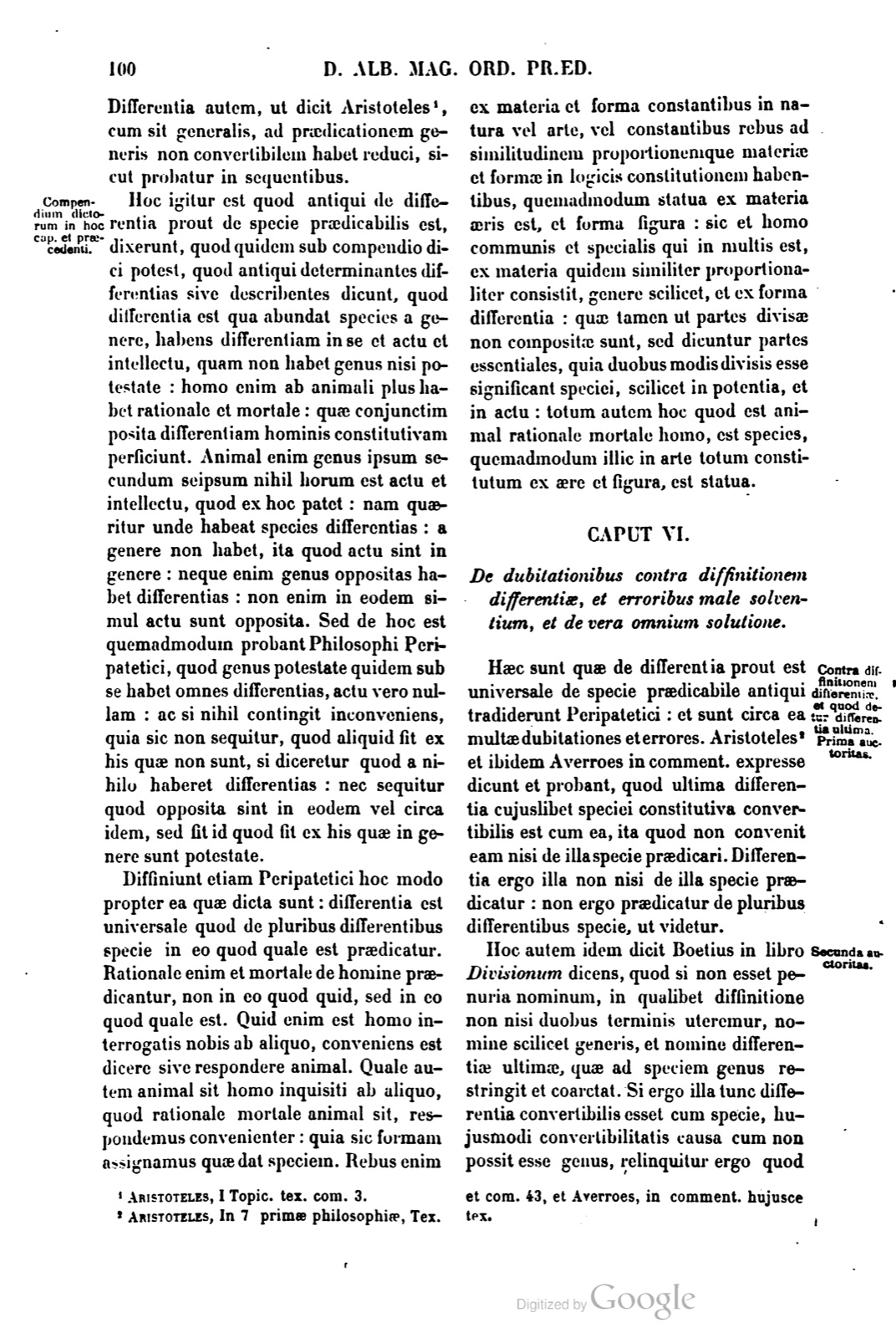
Propter quod dicunt alii, quod est differentia simplex, et differentia composita. Et simplicem dicunt illam quae in una sola consistit, sicut generalissimae differentiae quae sunt corporeum et incorporeum, vel corporis differentiae, quae sunt animatum et inanimatum, vel animati differentiae quae sunt sensibile et insensibile. Sed differentiae ultimae specierum constitutivae dicunt, quod non sunt nisi duarum vel plurium congregatione sufficientes ad constitutionem. Rationale enim solum speciem non facit, nisi addatur mortale vel immortale: et hoc non fuit in superioribus differentiis, quarum una sola conjuncta generi facit et sufficit facere speciem subalternam. Dicunt ergo quod illae differentiae quae simplices sunt, per se solas specierum cum genere constitutivae, praedicantur de pluribus differentibus specie. Quae autem nec per se sunt sufficientes, nec constituunt speciem nisi una alteri conjungatur, non sunt differentiae solum, sed aliquid simile differentiae. Et ideo illae non de pluribus specie differentibus praedicantur, sicut rationale mortale simul sumpta non praedicantur nisi de homine. Haec autem solutio magis adhuc deridenda est quam prior: quia rationale mortale dicta de homine circumlocutio sunt unius simplicis differentiae, quae est unicus et simplex actus, cujus est unum esse quod perficit: et quamvis illius aliquando nomen non habeatur, tamen in talibus licet nomina fingere. Dicamus igitur quod illa differentia vocetur A: tunc A differentia praedicabitur de una sola specie, et non de pluribus specie differentibus, et tunc sequitur diffinitionem vitiosam esse sicut prius.
Propter hoc dicunt alii, quod cum dicitur, universale est quod praedicatur de pluribus sibi subjectis, hoc dictum est, non quod actu praedicetur de multis, sed quod aptitudinem habet quod sit in multis, quamvis actu non sit nisi in uno solo, ut sol est universale unum. Unde cum species subjectum sit de quo praedicari habet hoc universale differentia, dicunt quod aptitudine praedicatur de pluribus, quamvis aliqua differentia actu non sit nisi in una sola specie. Et hanc opinionem recitat Avicenna, et est omnino nulla. Quod statim patet, quia species certa non est certa, nisi quia unica differentia est constituta, quae nullo modo habet aptitudinem quod sit in alia specie. Falsum ergo est, quod aptitudinem habeat ad hoc quod praedicetur de pluribus specie differentibus.
Dicit autem iterum Avicenna, quod quidam dictam diffinitionem inductam sic intelligunt, quod sit sensus, quod differentia praedicetur de pluribus quae quidem plura differunt specie: quia ex differentia constitutiva non habent, quod differant numero, sed specie tantum. Et tunc sensus est, quod differentia praedicatur de hoc quod in pluralitate est, quorum quodlibet differt specie ab altero, et non quod differentia dicatur de pluribus speciebus semper. Dant exemplum sicut quando dicitur, quod omnis homo percutit gladio: non enim sensus est, quod quilibet homo singulariter gladio aliquo percutiat, sed quicumque percutit, non nisi gladio percutit: ita dicunt, quod omnis differentia praedicatur de pluribus differentibus specie, non quod omne de quo praedicatur differentia sit plura secundum speciem, sed quod omne de quo praedicatur differentia, differt aliqua specie a suis oppositis vel disparatis. Hanc autem expositionem Avicenna dicit extortam, et non contineri in intellectu hujus orationis qua dicitur, quod differentia praedicatur de pluribus specie differentibus. Diffinitio enim cum detur causa innotescendi, ut dicit Aristoteles, plene debet notificare diffinitum. Adhuc autem cum de genere dictum est, quod praedicatur de pluribus differentibus specie, sic intellectum fuit quod praedicatur de pluribus speciebus. Cum ergo dicat Aristoteles quod differentia cum sit generalis cum genere collocanda est, videtur quod eumdem modum praedicandi cum genere retineat. Et sic praedicari de pluribus differentibus specie, idem est quod praedicari de pluribus speciebus. Sic redit idem inconveniens quod supra dictum est vel inductum est.
On account of this others say that there is simple difference and composite difference. They call simple that which consists in one alone, as the most general differences, which are corporeal and incorporeal, or the differences of body, which are animated and inanimate, or the differences of the animated, which are sensible and insensible. But they say that the final differences constitutive of species are not sufficient for constitution except by the gathering of two or more. For rational alone does not make a species unless mortal or immortal is added; and this was not the case in higher differences, of which one alone joined to genus makes and suffices to make a subaltern species. Therefore they say that those differences which are simple, constitutive of species with genus by themselves alone, are predicated of several things differing in species. But those which are not sufficient by themselves, nor constitute species unless one is joined to another, are not differences alone, but something similar to difference. Therefore those are not predicated of several things differing in species, just as rational mortal taken together are predicated only of man. But this solution is still more to be laughed at than the prior one, because rational mortal said of man are a circumlocution of one simple difference, which is one and simple act, whose being which it perfects is one. And although sometimes the name for it is not had, nevertheless in such matters it is permitted to fashion names. Let us therefore say that that difference is called A. Then difference A will be predicated of one species alone and not of several things differing in species; and then it follows that the definition is vicious as before.
On account of this others say that when it is said that universal is what is predicated of several subjects under it, this is said not because it is actually predicated of many, but because it has aptitude to be in many, although actually it is only in one alone, as the sun is one universal. Hence since species is the subject of which this universal, difference, has to be predicated, they say that it is predicated of several by aptitude, although some difference actually is only in one species. Avicenna recounts this opinion, and it is altogether nothing. This is immediately clear, because a certain species is not certain except because it is constituted by a single difference, which in no way has aptitude to be in another species. Therefore it is false that it has aptitude to be predicated of several things differing in species.
Again Avicenna says that some understand the definition introduced in this way, that the sense is that difference is predicated of several things which indeed differ in species, because from constitutive difference they do not have that they differ in number, but only in species. And then the sense is that difference is predicated of that which is in plurality, of which each differs in species from another, and not that difference is always said of several species. They give an example: when it is said that every man strikes with a sword, the sense is not that each man singularly strikes with some sword, but that whoever strikes strikes only with a sword. Thus they say that every difference is predicated of several things differing in species, not because everything of which difference is predicated is several according to species, but because everything of which difference is predicated differs in some species from its opposites or disparates. But Avicenna says that this exposition is forced and is not contained in the understanding of this phrase by which it is said that difference is predicated of several things differing in species. For since definition is given as a cause of becoming known, as Aristotle says, it must fully make the defined thing known. Further, when it was said of genus that it is predicated of several things differing in species, it was understood in this way, that it is predicated of several species. Therefore since Aristotle says that difference, since it is general, must be placed together with genus, it seems that it retains the same mode of predicating with genus. And thus to be predicated of several things differing in species is the same as to be predicated of several species. Thus the same unfitting consequence returns which was said or introduced above.
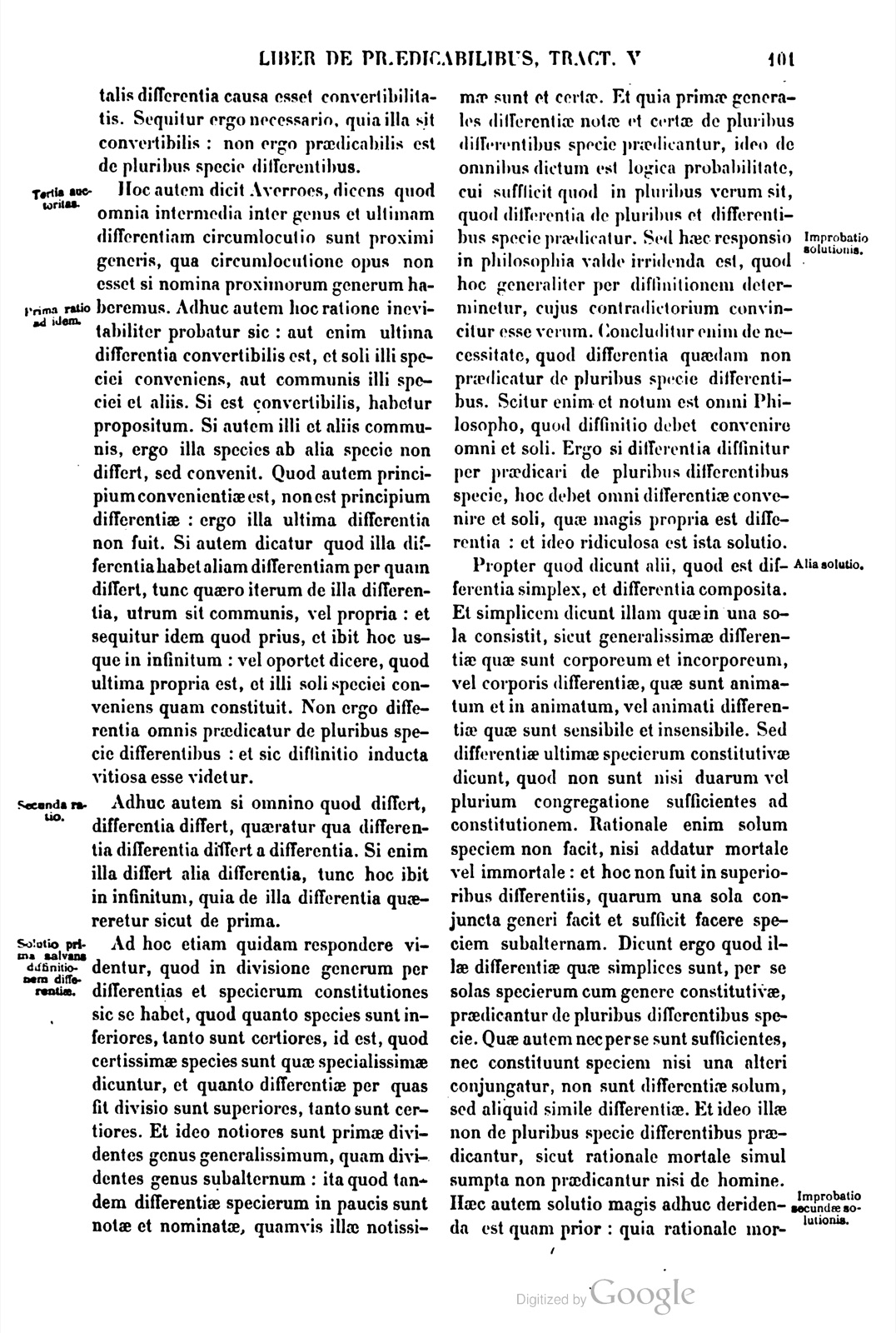
Omnibus autem his erroribus abjectis, dicendum cum Avicenna quod differentia in se tria habet, scilicet quod est simplex divisiva, et per hoc est differentia; et quod est simpliciter constitutiva, et hoc habet ab eo quod est divisiva; habet et tertio quod est ad certam speciem determinativa, et hoc non habet ex hoc quod est divisiva, nec ex hoc quod est constitutiva, sed hoc habet ex hoc quod est certa rei specialis natura et forma propria et essentialis. Quod autem ex hoc quod est divisiva, habeat quod sit differentia, probatur ex eo quod divisio separatio est. Separatio autem causa est differentiae separatorum. Et quod ex hoc quod divisiva sit constitutiva, ex hoc probatur, quod divisio est ex hoc quod separat, separata contrahit et coarctat ab ambitu generis divisi: et hoc est constituere sub genere et generis communitate. Quod autem certificat et appropriat, ex nullo habere potest. Et ideo est quod generalissimum non habet differentias nisi divisivas, et specialissimum non habet nisi constitutivas. Et quod proprium efficitur, habet a propria natura, per quam ex consequenti differt ab aliis, et per hoc quod illa natura in aliis non invenitur; et illa natura in se continet quasi virtutem termini diffinitivi, quia sic est in talibus, quod semper prior differentia est in consequenti, sicut corporeum in animato, et animatum in sensibili, et sensibile in rationali, sicut trigonum in tetragono. Et ideo quod proprium est unius naturae, non vero nomine est differentia, nec est simplicis virtutis: quia quamvis sit simplex actus, tamen non est unius simplicis virtutis, sed virtus omnium aliorum est ex quibus fluit secundum ordinem, sicut ex causis primariis. Quod ergo dicitur, quod differentia praedicatur de pluribus differentibus speciebus, intelligendum est de his quae sunt verae differentiae, simplicis virtutis, quae simpliciter dividunt, et dividendo sub genere constituunt, et de his est verum. Quae autem certificant et determinant, non verae differentiae sunt, sed verae quibus aliquid alteri comparatum potest differre. Nec sunt virtutis simplicis differentiae, sed sunt virtutis simplicis ut terminus diffinitivus. Et est sententia tam Avicennae quam Alfarabii, et Averrois. Et hoc est quod dicit Aristoteles 2: differentia cum sit generalis, cum genere ordinanda est. Generalis enim non est, quae ad certam naturam determinat.
But with all these errors rejected, one must say with Avicenna that difference has three things in itself: namely, that it is simply divisive, and through this it is difference; that it is simply constitutive, and it has this from the fact that it is divisive; and third, that it is determinative to a certain species, and it does not have this from the fact that it is divisive, nor from the fact that it is constitutive, but it has this from the fact that it is the certain nature and proper and essential form of a special thing. That it has from being divisive that it is difference is proved from this, that division is separation. But separation is the cause of the difference of separated things. And that it is constitutive from the fact that it is divisive is proved from this, that division, from the fact that it separates, contracts and narrows the separated things from the range of the divided genus; and this is to constitute under genus and under the commonness of genus. But it can have from nothing the fact that it certifies and appropriates. And therefore the most general has only divisive differences, and the most special has only constitutive ones. And what is made proper it has from proper nature, through which consequently it differs from others and through the fact that that nature is not found in others. And that nature contains in itself as it were the power of a definitive term, because in such things it is always the case that the prior difference is in the consequent, as corporeal is in animated, and animated in sensible, and sensible in rational, as triangle is in quadrangle. Therefore what is proper to one nature is not truly difference by name, nor is it of simple power; because although it is a simple act, nevertheless it is not of one simple power, but is the power of all the others from which it flows according to order, as from primary causes. Therefore when it is said that difference is predicated of several species-differing things, this must be understood of those which are true differences of simple power, which simply divide and by dividing constitute under genus, and of these it is true. But those which certify and determine are not true differences, but true things by which something compared to another can differ. Nor are they differences of simple power, but are of simple power as a definitive term. And this is the opinion of Avicenna, Alfarabi, and Averroes. And this is what Aristotle says 2: difference, since it is general, must be ordered with genus. For that which determines to a certain nature is not general.
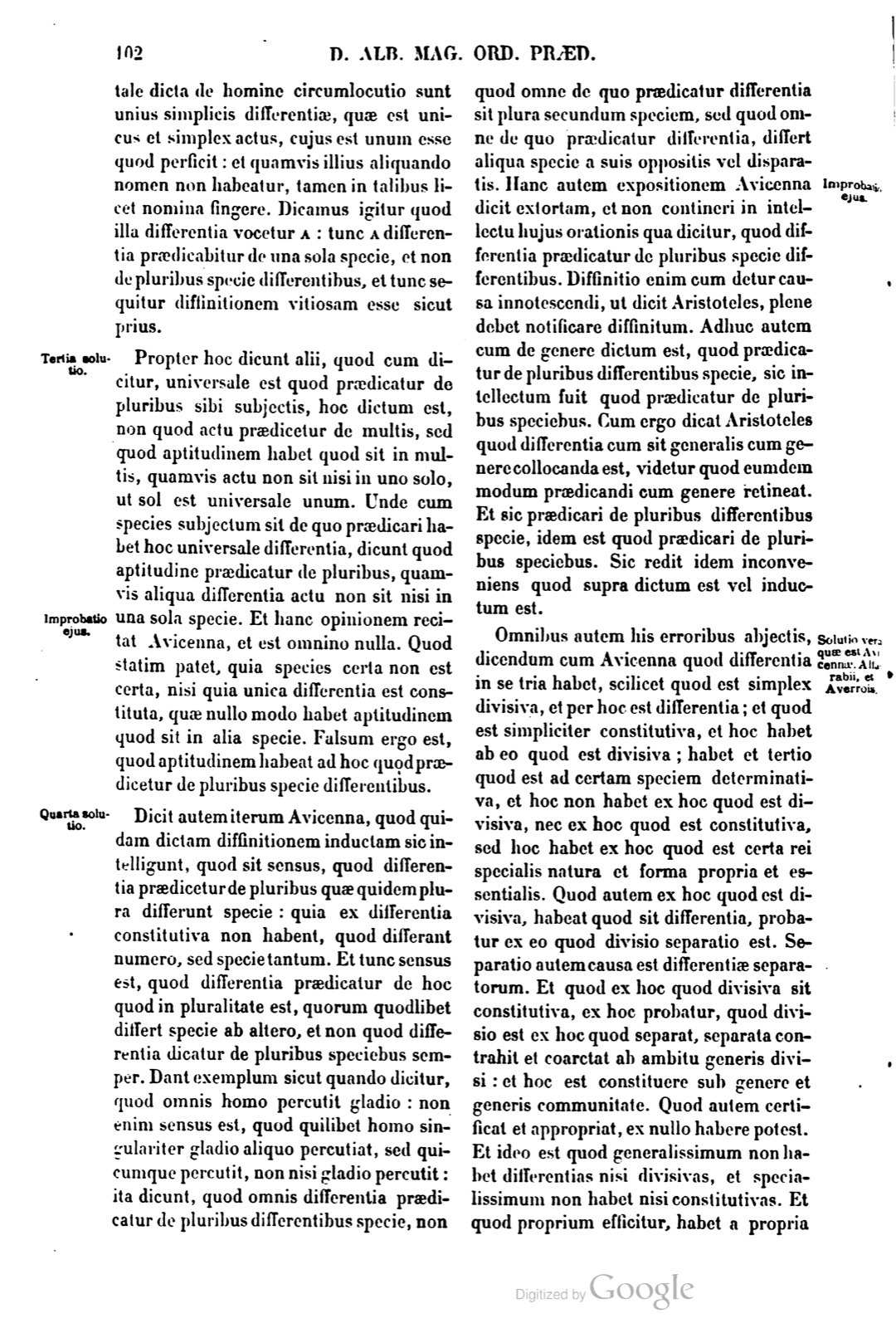
Quod autem quaeritur, quomodo differt differentia a differentia: dicendum quod seipsa, et non ibitur in infinitum, principia enim omnia differunt seipsis. Et per hoc patet solutio omnium inductorum. Nec potest dici, quod generalis, ut quidam dicunt, quia sit pars essentialis vel speciei sicut genus. Ex hoc enim cum genere in modo praedicandi in problematibus ordinanda non esset, sed potius in modo differendi cum genere esset ordinanda.
Ex hoc autem patet illud quod dicit Aristoteles 3, quod scilicet partes in diffinitione sunt in plus, totum autem in aeque. Ibi enim docet venari diffinitionem per divisionem. Verae autem differentiae sunt, quae sunt divisivae, ut dictum est. Differentia enim divisiva eo quod generis est divisiva, pars est esse rei in potentia, et non in actu: esse enim in potentia pars est esse, et non totum, et ideo quaelibet talis est in plus. Totum autem duplex est, scilicet explicite totum esse, et in potentia et in actu colligens, et sic diffinitio dicit totum esse. Dicitur etiam totum quod in se virtute habet esse totum, quia praecedentia omnia sunt virtute in ipso, sicut in causis formalibus ultimum continet omnia quae praecedunt ex quibus fluit, sicut vita habet esse et sentire in se habet esse et vivere, et esse rationale habet in se et esse et vivere et sentire, ut nuper ante dictum est. Et ideo etiam hoc totum est quod est in aeque cum eo quod constituit: quamvis enim sit actus purus et simplex, secundum essentiam tamen omnia praecedentia virtute et causalitate sunt in potentia, et in eo influunt super causatum sicut causae primariae influunt in causas secundarias, sicut in prima propositione libri Causarum.
Ex omnibus quae dicta sunt patet quod differentia duos habet respectus immediatos: unum scilicet ad genus quod dividit, et secundum hoc cum divisione praedicatur de genere sic, quod animal est aut rationale, aut irrationale: dividentis enim est praedicari sub divisione de eo quod dividit. Alterum autem ad speciem quam constituit, et de illa praedicatur absolute. Sic homo est rationale. Et hi sunt respectus mediati ejus ad particulare, ad quod non respicit nisi per speciem quam ipsum particulare participat: sicut cum dicimus, hic homo est rationalis. Et ideo non habet particulare proprium quod sibi respondeat immediate, sicut habet genus et species. Et hoc est ideo, quia a forma sumitur quae secundum se est speciei et communis, et per speciem est particularis speciem participantis.
But as to what is asked, how difference differs from difference, one must say: by itself, and there will not be an infinite regress, for all principles differ by themselves. And through this the solution of all the things introduced is clear. Nor can it be said, as certain people say, that it is general because it is an essential part of species like genus. For from this it would not have to be ordered with genus in the mode of predicating in problems, but rather it would have to be ordered with genus in the mode of differing.
From this is clear what Aristotle says 3, namely that the parts in a definition are broader, but the whole is equal. For there he teaches how to hunt for definition through division. But true differences are those which are divisive, as was said. For divisive difference, because it is divisive of genus, is part of the being of the thing in potency and not in act; for being in potency is part of being and not the whole, and therefore each such difference is broader. But whole is twofold: one is explicitly the whole being, gathering in potency and in act, and thus definition names the whole being. Whole is also said of that which in itself virtually has whole being, because all preceding things are virtually in it, as in formal causes the last contains all things which precede from which it flows, just as life has being, and sensing has in itself being and living, and rational being has in itself being, living, and sensing, as was said just before. Therefore this too is the whole which is equal with what it constitutes. For although it is pure and simple act, nevertheless according to essence all preceding things are virtually and causally in potency, and in it they flow upon the caused thing as primary causes flow into secondary causes, as in the first proposition of the Book of Causes.
From all the things that have been said, it is clear that difference has two immediate relations: one to genus, which it divides, and according to this it is predicated of genus with division, so that animal is either rational or irrational; for it belongs to what divides to be predicated under division of what it divides. The other relation is to species, which it constitutes, and of that it is predicated absolutely. Thus man is rational. And these are its mediate relations to the particular, to which it has no relation except through the species which the particular itself participates, as when we say, this man is rational. And therefore it does not have a proper particular which immediately corresponds to it, as genus and species have. And this is because it is taken from form, which according to itself belongs to species and is common, and through species belongs particularly to what participates the species.
Notes
- Aristotle, In book 7 of the First Philosophy, text and comment 43, and Averroes, in the commentary on this text. (Aristoteles, In 7 primae philosophiae, Tex. et com. 43, et Averroes, in comment. hujusce tex.) ↩
- Aristotle, Topics, book 1, comment 3. (Aristoteles, 1 Topic. com. 3.) ↩
- The same, in the Posterior Analytics, book 2, text-comment 17. (Id. In Posterioribus, in 2, tex. com. 17.) ↩
If a page does not appear, its photograph has not been uploaded yet.