Volume 1 · pp. 97–100
Chapter V. How difference is defined according as it is a universal predicable of species.
A marker with ≈ is an approximate page boundary, placed by measure of the text; the page photographs remain the authority. In the paired views, clicking a page marker brings that page into view.
CAPUT V.
Qualiter diffinitur differentia secundum quod est universale de specie praedicabile.
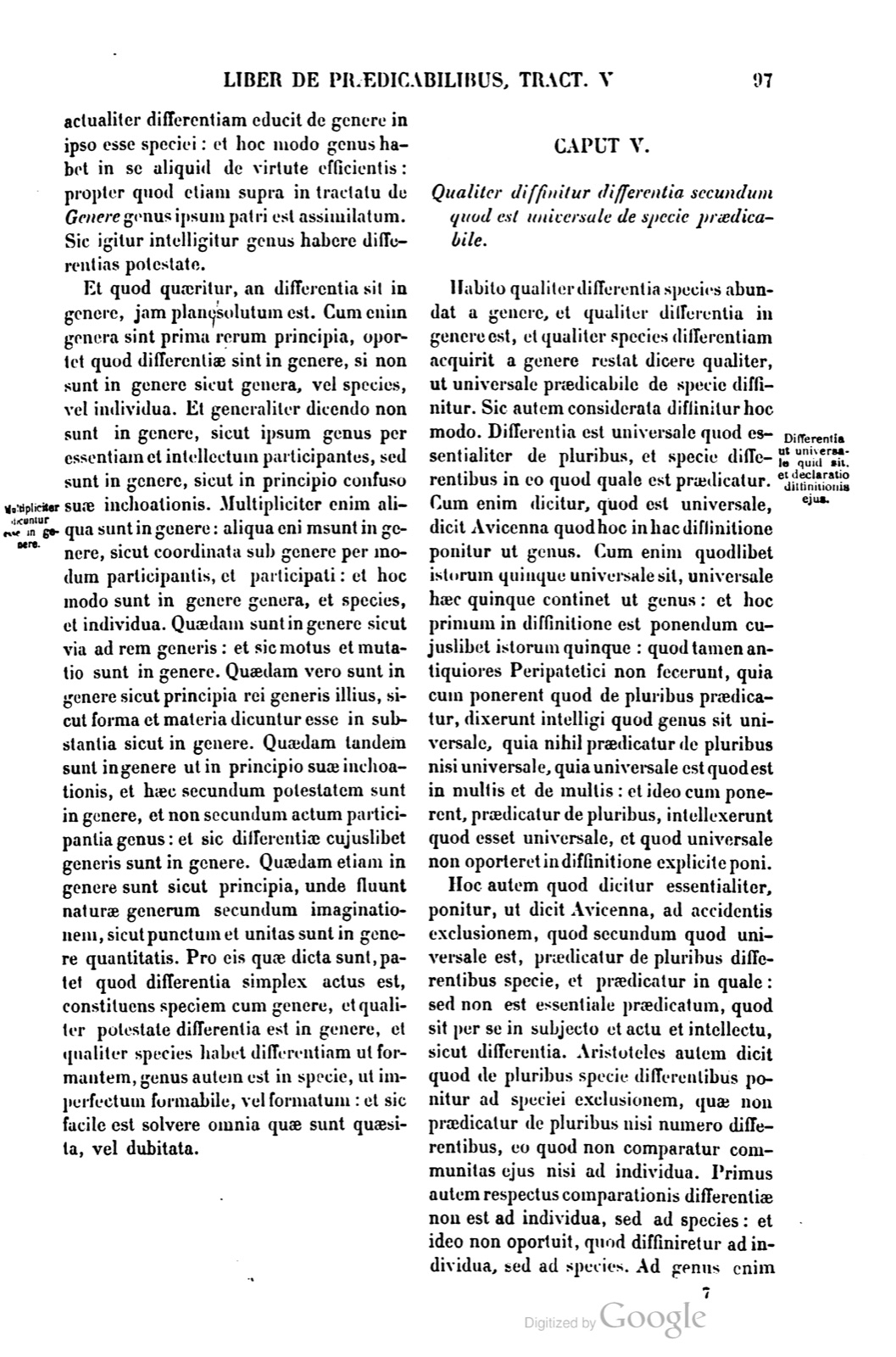
Habito qualiter differentia species abundat a genere, et qualiter differentia in genere est, et qualiter species differentiam acquirit a genere restat dicere qualiter, ut universale praedicabile de specie diffinitur. Sic autem considerata diffinitur hoc modo. Differentia est universale quod essentialiter de pluribus, et specie differentibus in eo quod quale est praedicatur. Cum enim dicitur, quod est universale, dicit Avicenna quod hoc in hac diffinitione ponitur ut genus. Cum enim quodlibet istorum quinque universale sit, universale haec quinque continet ut genus: et hoc primum in diffinitione est ponendum cujuslibet istorum quinque: quod tamen antiquiores Peripatetici non fecerunt, quia cum ponerent quod de pluribus praedicatur, dixerunt intelligi quod genus sit universale, quia nihil praedicatur de pluribus nisi universale, quia universale est quod est in multis et de multis: et ideo cum ponerent, praedicatur de pluribus, intellexerunt quod esset universale, et quod universale non oporteret in diffinitione explicite poni.
Hoc autem quod dicitur essentialiter, ponitur, ut dicit Avicenna, ad accidentis exclusionem, quod secundum quod universale est, praedicatur de pluribus differentibus specie, et praedicatur in quale: sed non est essentiale praedicatum, quod sit per se in subjecto et actu et intellectu, sicut differentia. Aristoteles autem dicit quod de pluribus specie differentibus ponitur ad speciei exclusionem, quae non praedicatur de pluribus nisi numero differentibus, eo quod non comparatur communitas ejus nisi ad individua. Primus autem respectus comparationis differentiae non est ad individua, sed ad species: et ideo non oportuit, quod diffiniretur ad individua, sed ad species. Ad genus enim, ut genus est, ut universale est, diffiniri non poterat: quia prout universale est, non continet genus, nec continetur a genere nisi potestate tantum, et ideo praedicari de genere non potest. Cum igitur praedicandi specialem modum habere debeat, oportuit quod ut praedicabile ad speciem haberet respectum: non autem potuit praedicabile esse de uno, quia sic esset individuum: oportuit ergo quod esset praedicabile de pluribus specie differentibus. Adhuc autem non potuit diffiniri ut praedicatum convertibile cum specie in quale, quia sic esset proprium: nec ut praedicatum convertibile in quid, quia sic esset diffinitio vel synonimum. Relinquitur ergo, quod diffinietur non ut convertibile, et sic diffinitur ut praedicatum de pluribus differentibus specie.
Quia vero et genus praedicatur de pluribus differentibus specie, ideo additur quod praedicatur in quale. Genus enim de pluribus specie differentibus praedicatur in eo quod quid. Haec igitur fuit necessitas propter quam antiqui sic differentiam diffinierunt. Et ut haec melius intelligantur, sciendum quod quale in hoc differt a qualitate, quod qualitas est accidens secundum quod aliud dicitur quale: quale autem dicitur subjectum qualitate formatum. Unde praedicatum in quale dicitur id quod praedicatum praedicatur ut est in subjecto, quia aliter de subjecto praedicari non posset. Nihil enim praedicari potest de subjecto, nisi quod est in subjecto, et nisi sit acceptum et signatum prout est in subjecto, de subjecto non praedicatur nec praedicari potest. Unde rationalitas, vel animalitas, vel humanitas, vel risibilitas, vel albedo non praedicantur, sed rationale, et animal, et homo, et risibile, et album sunt praedicata de suis subjectis. Unde logice loquendo tria qualia sunt composita. Species cum differentia est quale essentiale, et dicitur quale secundum differentiam et non secundum se, et quale ipsum differentia in subjecto existens. Secundum autem quale est proprium, quod quale secundum qualitatem dicitur proprietatis, id est, proprii. Tertium est quale accidentis, quod quale dicitur secundum qualitatem accidentis. Talis igitur est hujusmodi diffinitionis explanatio.
CHAPTER V.
How difference is defined according as it is a universal predicable of species.
Having treated how species exceeds genus by difference, and how difference is in genus, and how species acquires difference from genus, it remains to say how it is defined as a universal predicable of species. Considered in this way, it is defined thus: difference is a universal which is predicated essentially of several things differing in species in that which is what-sort-of. When it is said that it is universal, Avicenna says that this is placed in this definition as genus. For since each of these five is a universal, universal contains these five as genus; and this must be placed first in the definition of any of these five. Yet the older Peripatetics did not do this, because when they posited that it is predicated of several, they said that it was understood that the genus is universal, since nothing is predicated of several except a universal, because a universal is what is in many and of many; and therefore when they posited, is predicated of several, they understood that it was universal, and that universal did not have to be put explicitly in the definition.
But what is called essentially is placed, as Avicenna says, to exclude accident, which, insofar as it is universal, is predicated of several things differing in species and is predicated in what-sort-of; but it is not an essential predicate which is per se in the subject both in act and in understanding, as difference is. Aristotle, however, says that of several things differing in species is placed to exclude species, which is not predicated of several except of things differing in number, because its commonness is compared only to individuals. But the first relation of the comparison of difference is not to individuals, but to species; and therefore it did not have to be defined toward individuals, but toward species. For toward genus, as genus is, as it is universal, it could not be defined, because insofar as it is universal it does not contain genus, nor is it contained by genus except by power only; and therefore it cannot be predicated of genus. Therefore, since it must have a special mode of predicating, it had to have relation to species as predicable. But it could not be predicable of one, because then it would be an individual; therefore it had to be predicable of several things differing in species. Further, it could not be defined as a predicate convertible with species in what-sort-of, because then it would be property, nor as a convertible predicate in what, because then it would be definition or synonym. It remains therefore that it will be defined as not convertible, and so it is defined as a predicate of several things differing in species.
But because genus too is predicated of several things differing in species, it is added that it is predicated in what-sort-of. For genus is predicated of several things differing in species in that which is what. This therefore was the necessity because of which the ancients thus defined difference. And so that these things may be better understood, one must know that what-sort-of differs from quality in this: quality is an accident according to which something else is said to be qualified; but what-sort-of is said of a subject formed by quality. Hence a predicate in what-sort-of is said to be that which is predicated as it is in the subject, because otherwise it could not be predicated of a subject. For nothing can be predicated of a subject unless it is in the subject, and unless it is taken and signified insofar as it is in the subject, it is not predicated of the subject nor can be predicated. Hence rationality, animality, humanity, risibility, or whiteness are not predicated, but rational, animal, man, risible, and white are predicates of their subjects. Hence, speaking logically, three qualified things are composites. Species with difference is an essential what-sort-of, and it is called what-sort-of according to difference and not according to itself, and what-sort-of itself by difference existing in a subject. The second what-sort-of is property, which is called what-sort-of according to the quality of property, that is, of what is proper. The third is the what-sort-of of accident, which is called what-sort-of according to the quality of accident. Such, therefore, is the explanation of this definition.
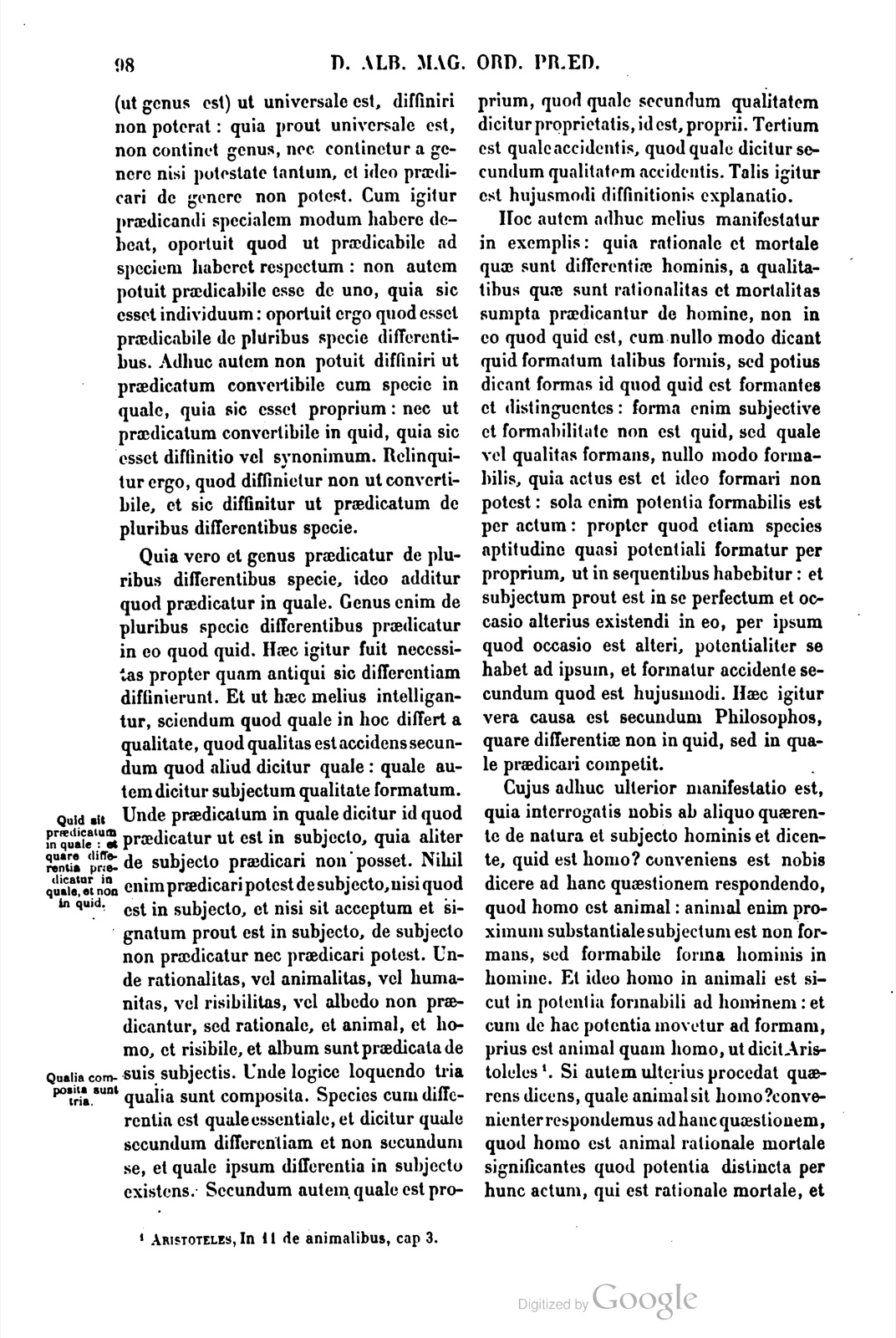
Hoc autem adhuc melius manifestatur in exemplis: quia rationale et mortale quae sunt differentiae hominis, a qualitatibus quae sunt rationalitas et mortalitas sumpta praedicantur de homine, non in eo quod quid est, cum nullo modo dicant quid formatum talibus formis, sed potius dicant formas id quod quid est formantes et distinguentes: forma enim subjective et formabilitate non est quid, sed quale vel qualitas formans, nullo modo formabilis, quia actus est et ideo formari non potest: sola enim potentia formabilis est per actum: propter quod etiam species aptitudine quasi potentiali formatur per proprium, ut in sequentibus habebitur: et subjectum prout est in se perfectum et occasio alterius existendi in eo, per ipsum quod occasio est alteri, potentialiter se habet ad ipsum, et formatur accidente secundum quod est hujusmodi. Haec igitur vera causa est secundum Philosophos, quare differentiae non in quid, sed in quale praedicari competit.
Cujus adhuc ulterior manifestatio est, quia interrogatis nobis ab aliquo quaerente de natura et subjecto hominis et dicente, quid est homo? conveniens est nobis dicere ad hanc quaestionem respondendo, quod homo est animal: animal enim proximum substantiale subjectum est non formans, sed formabile forma hominis in homine. Et ideo homo in animali est sicut in potentia formabili ad hominem: et cum de hac potentia movetur ad formam, prius est animal quam homo, ut dicit Aristoteles 1. Si autem ulterius procedat quaerens dicens, quale animal sit homo? convenienter respondemus ad hanc quaestionem, quod homo est animal rationale mortale significantes quod potentia distincta per hunc actum, qui est rationale mortale, et formata est homo: designantes quod homo in rationali et mortali non est sicut in quid potentiae et subjecti formabilis, sed est in eo sicut in actu formante et distinguente secundum esse actuale et formatum et distinctum.
Quod adhuc in simili poterit manifestari: quia enim ars imitatur naturam, ideo quae in arte sunt, secundum aliquid similia sunt his quae sunt in natura. Rebus igitur ex materia constantibus in his quae habent materiam, vel constantibus ex talibus suae compositionis principiis quae sunt in eis ad similitudinem et proportionem materiae, sicut in his quae non habent materiam, sed componuntur a duabus naturis formalibus, quarum una proportionatur materiae, et altera formae, sicut genus et differentia componunt speciem: ostenditur nobis hoc, quod jam dictum est, sicut est videre in statua, sive imagine, vel idolo. In statua enim idoli aes de quo fit, est sicut materia formabilis, et est in aere idoli in potentia forma quae dat aeri esse idolum vel statuam: quae statua dicitur, quia statuit imaginem quam intendimus: ipsa, inquam, forma hoc faciens et perficiens est figura inducta per artificem. Sic est in his quae non habent materiam, sicut est homo communis acceptus in specie, non acceptus ut hic et ille qui sunt ex materia: communis autem homo qui est in pluribus et est specialis sive in communitate speciei acceptus, consistit in sua compositione secundum quamdam similitudinem et secundum quamdam proportionem, quamvis secundum veritatem non sit compositus ex materia et forma, sed totus sit in esse formali sumptus, quia aliter non esset communis, nec praedicabilis de aliqua re secundum veram praedicabilis rationem: secundum quamdam enim similitudinem et secundum quamdam ad materiam proportionem est in eo genus ut primum subjectum potentialiter formabile et distinguibile ad hominem, et est in eo differentia ut formans et distinguens ad speciem hominis, totum essentiale sic perfectum et constitutum, quod est animal rationale mortale, est homo secundum speciem proportionaliter, quemadmodum in artificialibus totum constitutum ex aere et figura fuit statua secundum imaginem, cujus similitudinem statuit ante oculos eam intuentium.
This is still better manifested in examples, because rational and mortal, which are differences of man, taken from the qualities rationality and mortality, are predicated of man not in that which is what, since they in no way name a what formed by such forms, but rather name forms forming and distinguishing that which is what. For form subjectively and in formability is not a what, but a what-sort-of or forming quality, in no way formable, because it is act and therefore cannot be formed; for only potency is formable by act. On account of this, species also is formed by a property by an aptitude as though potential, as will be had in what follows; and the subject, insofar as it is perfect in itself and the occasion of another existing in it, through the very fact that it is the occasion for another, is disposed potentially to it and is formed by accident according as it is of this sort. This therefore is the true cause according to the Philosophers why differences properly are predicated not in what, but in what-sort-of.
A further manifestation of this is that, when we are questioned by someone asking about the nature and subject of man and saying, what is man?, it is fitting for us to answer this question by saying that man is animal; for animal is the proximate substantial subject, not forming but formable by the form of man in man. Therefore man is in animal as in a potency formable to man; and when he is moved from this potency to form, animal is prior to man, as Aristotle says 1. But if the questioner proceeds further, saying what sort of animal is man?, we fittingly answer this question that man is a rational mortal animal, signifying that the potency distinguished by this act, which is rational mortal, and formed, is man; indicating that man in rational and mortal is not as in the what of potency and of a formable subject, but is in it as in the act forming and distinguishing according to actual, formed, and distinct being.
This can still be manifested in a likeness: since art imitates nature, those things which are in art are in some respect similar to those which are in nature. Therefore, in things consisting from matter among things which have matter, or consisting from such principles of their composition which are in them according to the likeness and proportion of matter, as in those things which do not have matter but are composed from two formal natures, of which one is proportioned to matter and the other to form, as genus and difference compose species, this which has now been said is shown to us, as can be seen in a statue, image, or idol. For in the statue of an idol, the bronze from which it is made is as formable matter, and in the bronze of the idol the form which gives the bronze being as an idol or statue is in potency. It is called a statue because it sets up the image which we intend; the very form, I say, doing and perfecting this is the figure induced by the artisan. So it is in things which do not have matter, as common man accepted in species, not accepted as this one and that one, who are from matter. But common man, who is in several and is specific or accepted in the commonness of species, consists in his composition according to a certain likeness and according to a certain proportion, although according to truth he is not composed from matter and form, but is taken wholly in formal being, because otherwise he would not be common, nor predicable of any thing according to the true account of the predicable. For according to a certain likeness and according to a certain proportion to matter, genus is in him as the first subject potentially formable and distinguishable toward man; and difference is in him as forming and distinguishing to the species of man. The essential whole thus perfected and constituted, which is rational mortal animal, is man according to species proportionally, in the way that in artificial things the whole constituted from bronze and figure was a statue according to the image whose likeness it set before the eyes of those looking at it.
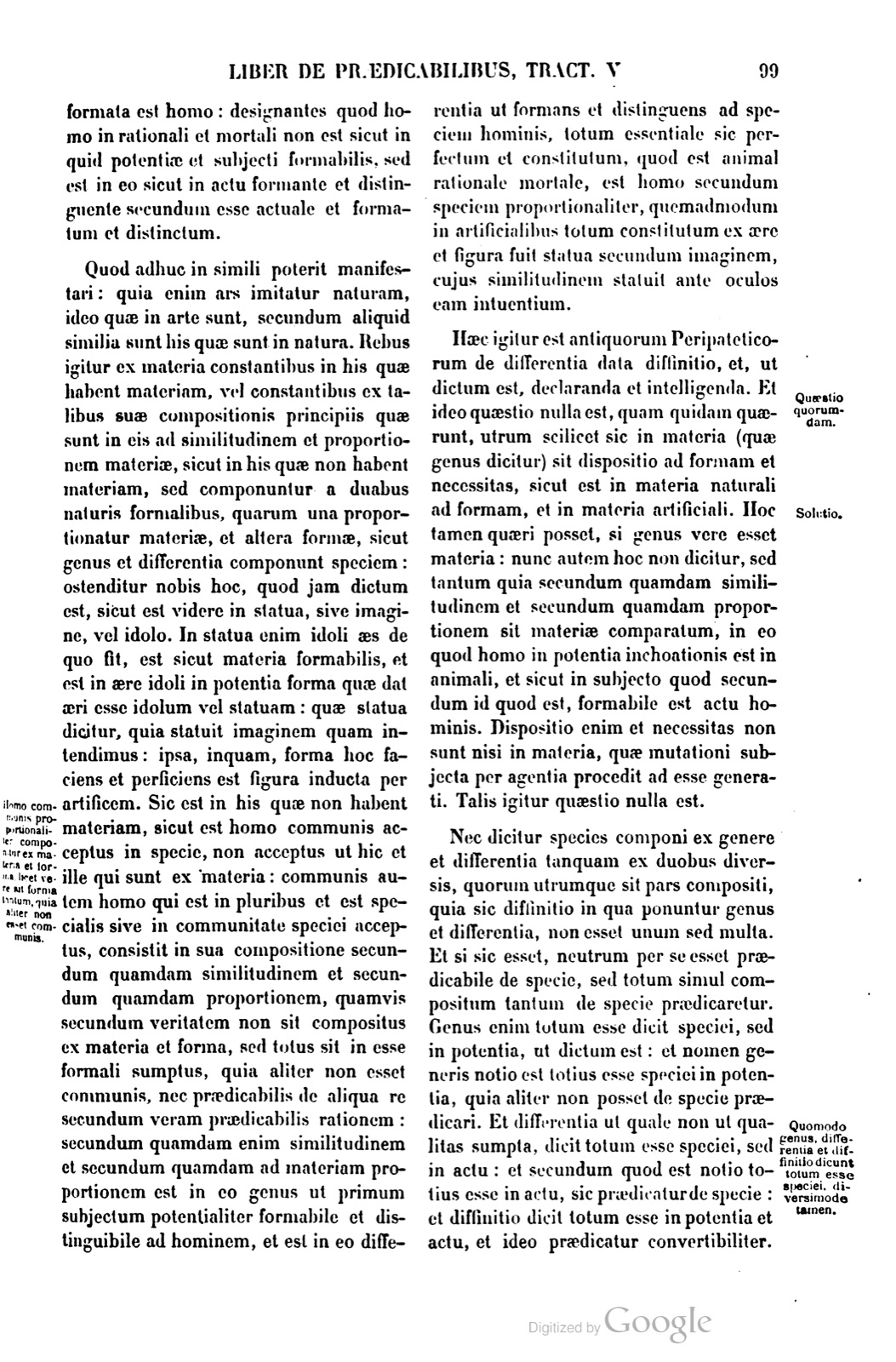
Haec igitur est antiquorum Peripateticorum de differentia data diffinitio, et, ut dictum est, declaranda et intelligenda. Et ideo quaestio nulla est, quam quidam quaerunt, utrum scilicet sic in materia, quae genus dicitur, sit dispositio ad formam et necessitas, sicut est in materia naturali ad formam, et in materia artificiali. Hoc tamen quaeri posset, si genus vere esset materia: nunc autem hoc non dicitur, sed tantum quia secundum quamdam similitudinem et secundum quamdam proportionem sit materiae comparatum, in eo quod homo in potentia inchoationis est in animali, et sicut in subjecto quod secundum id quod est, formabile est actu hominis. Dispositio enim et necessitas non sunt nisi in materia, quae mutationi subjecta per agentia procedit ad esse generati. Talis igitur quaestio nulla est.
Nec dicitur species componi ex genere et differentia tanquam ex duobus diversis, quorum utrumque sit pars compositi, quia sic diffinitio in qua ponuntur genus et differentia, non esset unum sed multa. Et si sic esset, neutrum per se esset praedicabile de specie, sed totum simul compositum tantum de specie praedicaretur. Genus enim totum esse dicit speciei, sed in potentia, ut dictum est: et nomen generis notio est totius esse speciei in potentia, quia aliter non posset de specie praedicari. Et differentia ut quale non ut qualitas sumpta, dicit totum esse speciei, sed in actu: et secundum quod est notio totius esse in actu, sic praedicatur de specie: et diffinitio dicit totum esse in potentia et actu, et ideo praedicatur convertibiliter. Differentia autem, ut dicit Aristoteles 2, cum sit generalis, ad praedicationem generis non convertibilem habet reduci, sicut probatur in sequentibus.
This therefore is the definition given by the ancient Peripatetics concerning difference, and, as was said, it must be declared and understood. Therefore the question which some ask is no question, namely whether there is disposition and necessity toward form in the matter which is called genus, as there is in natural matter toward form and in artificial matter. Yet this could be asked if genus were truly matter; but now this is not said, but only that according to a certain likeness and proportion it is compared to matter, in that man in the potency of beginning is in animal, and as in a subject which according to what it is is formable by the act of man. For disposition and necessity are only in matter, which, subject to change, proceeds through agents to the being of the generated thing. Therefore such a question is nothing.
Nor is species said to be composed from genus and difference as from two diverse things, each of which is part of the composite, because then the definition in which genus and difference are posited would not be one but many. And if it were so, neither would be predicable per se of species, but only the whole composite together would be predicated of species. For genus names the whole being of species, but in potency, as was said; and the name of genus is the notion of the whole being of species in potency, because otherwise it could not be predicated of species. And difference taken as what-sort-of, not as quality, names the whole being of species, but in act; and insofar as it is the notion of the whole being in act, thus it is predicated of species. And definition names the whole being in potency and act, and therefore is predicated convertibly. But difference, as Aristotle says 2, since it is general, has to be reduced to the non-convertible predication of genus, as is proved in what follows.
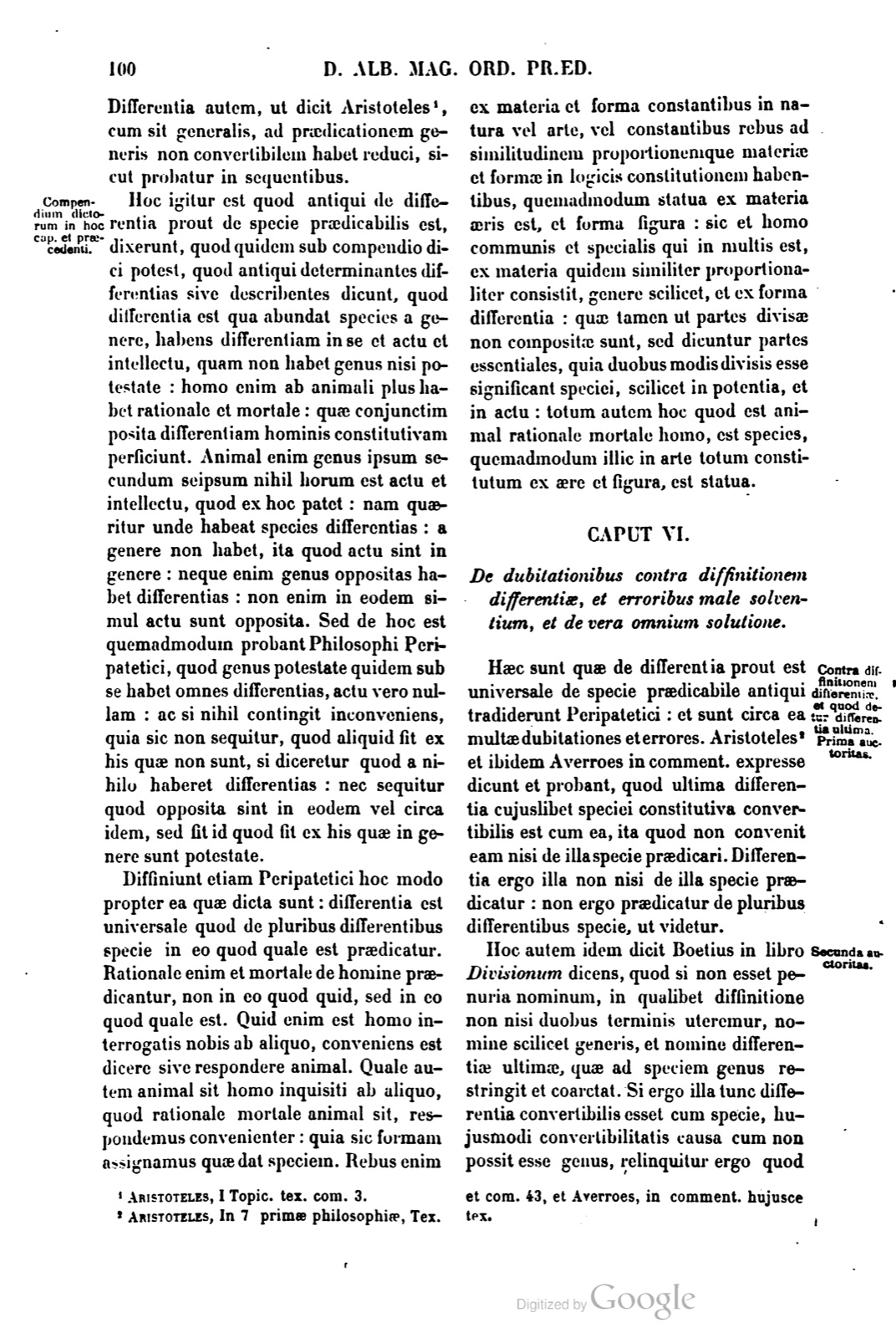
Hoc igitur est quod antiqui de differentia prout de specie praedicabilis est, dixerunt, quod quidem sub compendio dici potest, quod antiqui determinantes differentias sive describentes dicunt, quod differentia est qua abundat species a genere, habens differentiam in se et actu et intellectu, quam non habet genus nisi potestate: homo enim ab animali plus habet rationale et mortale: quae conjunctim posita differentiam hominis constitutivam perficiunt. Animal enim genus ipsum secundum seipsum nihil horum est actu et intellectu, quod ex hoc patet: nam quaeritur unde habeat species differentias: a genere non habet, ita quod actu sint in genere: neque enim genus oppositas habet differentias: non enim in eodem simul actu sunt opposita. Sed de hoc est quemadmodum probant Philosophi Peripatetici, quod genus potestate quidem sub se habet omnes differentias, actu vero nullam: ac si nihil contingit inconveniens, quia sic non sequitur, quod aliquid fit ex his quae non sunt, si diceretur quod a nihilo haberet differentias: nec sequitur quod opposita sint in eodem vel circa idem, sed fit id quod fit ex his quae in genere sunt potestate.
Diffiniunt etiam Peripatetici hoc modo propter ea quae dicta sunt: differentia est universale quod de pluribus differentibus specie in eo quod quale est praedicatur. Rationale enim et mortale de homine praedicantur, non in eo quod quid, sed in eo quod quale est. Quid enim est homo interrogatis nobis ab aliquo, conveniens est dicere sive respondere animal. Quale autem animal sit homo inquisiti ab aliquo, quod rationale mortale animal sit, respondemus convenienter: quia sic formam assignamus quae dat speciem. Rebus enim ex materia et forma constantibus in natura vel arte, vel constantibus rebus ad similitudinem proportionemque materiae et formae in logicis constitutionem habentibus, quemadmodum statua ex materia aeris est, et forma figura: sic et homo communis et specialis qui in multis est, ex materia quidem similiter proportionaliter consistit, genere scilicet, et ex forma differentia: quae tamen ut partes divisae non compositae sunt, sed dicuntur partes essentiales, quia duobus modis divisis esse significant speciei, scilicet in potentia, et in actu: totum autem hoc quod est animal rationale mortale homo, est species, quemadmodum illic in arte totum constitutum ex aere et figura, est statua.
This therefore is what the ancients said about difference insofar as it is predicable of species, and this can be said in brief: the ancients determining or describing differences say that difference is that by which species exceeds genus, having difference in itself both in act and in understanding, which genus has only by power. For man has rational and mortal more than animal, and these, placed together, complete the constitutive difference of man. For animal, the genus itself according to itself, is none of these in act and understanding, which is clear from this: one asks from where species has differences. It does not have them from genus in such a way that they are actually in genus; for genus does not have opposite differences, since opposites are not actually together in the same thing. But on this point it is as the Peripatetic Philosophers prove, that genus by power indeed has all differences under itself, but actually none; as though nothing unfitting happens, because thus it does not follow that something comes to be from things which are not, if it were said that it had differences from nothing. Nor does it follow that opposites are in the same thing or around the same thing, but what comes to be comes to be from those things which are in genus by power.
The Peripatetics also define in this way because of the things that have been said: difference is a universal which is predicated of several things differing in species in that which is what-sort-of. For rational and mortal are predicated of man, not in that which is what, but in that which is what-sort-of. For when someone asks us what man is, it is fitting to say or answer animal. But when someone asks what sort of animal man is, we fittingly answer that he is rational mortal animal, because thus we assign the form which gives species. For things consisting from matter and form in nature or art, or things having constitution in logic according to the likeness and proportion of matter and form, just as a statue is from the matter of bronze and the form figure, so also common and specific man who is in many consists similarly and proportionally from matter, namely genus, and from form, difference. Yet these are not composed as divided parts, but are called essential parts because in two divided modes they signify the being of species, namely in potency and in act. But this whole, rational mortal animal man, is species, just as there in art the whole constituted from bronze and figure is a statue.
If a page does not appear, its photograph has not been uploaded yet.