Volume 1 · pp. 91–96
Chapter IV. How species exceeds genus through difference, and how genus has differences by power.
A marker with ≈ is an approximate page boundary, placed by measure of the text; the page photographs remain the authority. In the paired views, clicking a page marker brings that page into view.
CAPUT IV.
Qualiter per differentiam abundet species a genere, et qualiter potestate genus habet differentias.
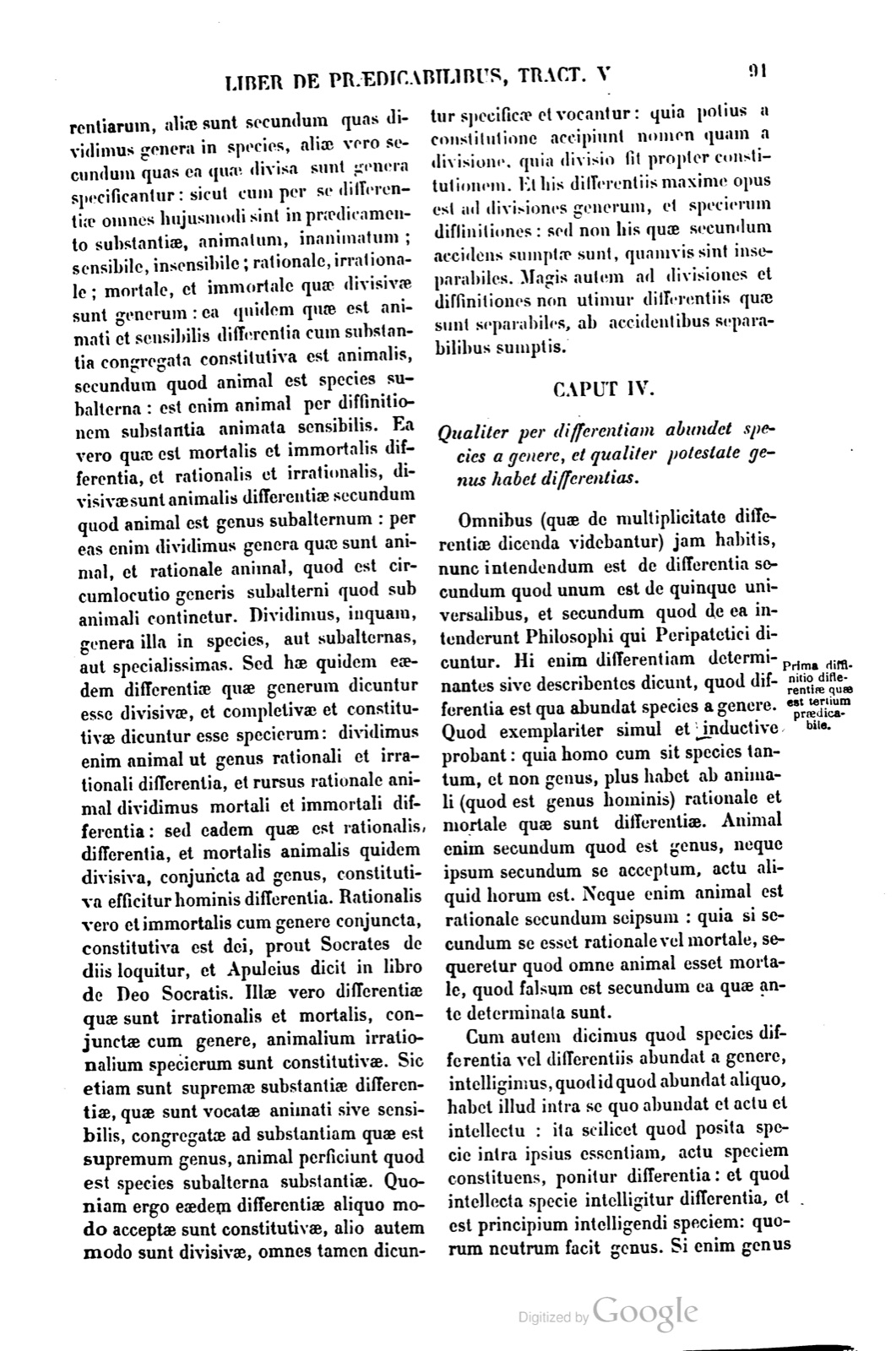
Omnibus quae de multiplicitate differentiae dicenda videbantur jam habitis, nunc intendendum est de differentia secundum quod unum est de quinque universalibus, et secundum quod de ea intenderunt Philosophi qui Peripatetici dicuntur. Hi enim differentiam determinantes sive describentes dicunt, quod differentia est qua abundat species a genere. Quod exemplariter simul et inductive probant: quia homo cum sit species tantum, et non genus, plus habet ab animali, quod est genus hominis, rationale et mortale quae sunt differentiae. Animal enim secundum quod est genus, neque ipsum secundum se acceptum, actu aliquid horum est. Neque enim animal est rationale secundum seipsum: quia si secundum se esset rationale vel mortale, sequeretur quod omne animal esset mortale, quod falsum est secundum ea quae ante determinata sunt.
Cum autem dicimus quod species differentia vel differentiis abundat a genere, intelligimus, quod id quod abundat aliquo, habet illud intra se quo abundat et actu et intellectu: ita scilicet quod posita specie intra ipsius essentiam, actu speciem constituens, ponitur differentia: et quod intellecta specie intelligitur differentia, et est principium intelligendi speciem: quorum neutrum facit genus. Si enim genus actu haberet differentiam, omnia quae exiguntur ad speciei positionem haberet. Et si differentia prout est principium intelligendi speciem, esset in intellectu generis, non oporteret, quod in diffinitione speciei posito genere poneretur differentia: quia in nomine generis intelligeretur, et esset nugatio, quando in diffinitione cum genere poneretur. Igitur differentia nec actu nec intellectu est in genere: in specie autem et actu et intellectu. Differentia igitur est, qua abundat species a genere, sive superat genus et actu et intellectu. Abundat autem actu, ut species sit in actu sive in effectu: intellectu vero abundat, quia est de intellectu speciei differentia, nec intelligi potest in actu nisi per differentiam sine qua non intelligitur nisi in potentia.
Tali autem assignatione non potest diffiniri neque differentia communis, neque differentia propria. Hae enim, ut per antedicta manifestum est, non constituunt simpliciter, sed secundum quid, sive secundum esse formae accidentalis: et ideo non sunt in actu constitutionis in esse specifico, quando sunt in specie: sed sunt in ipsa sicut in subjecto, quod non constituitur ab accidente, sed potius in esse constituit accidens quod est in eo: et hoc est quod dicit Avicenna, quod subjectum est ens in se completum, quod est occasio alteri, hoc est, accidenti existenti in eo. Hae etiam differentiae, communis scilicet et propria, non sunt de intellectu speciei, sed principium intelligendi eam: quia accidens, ut docet Aristoteles 1, non diffinit subjectum, sed potius subjectum cadit in diffinitione ipsius loco differentiae, et non e converso: sicut patet cum diffinitur simum, et dicitur quod est nasi curvitas. Curvitas enim quod est formale ad simum, est ut genus ambiens et curvitatem in naso et in tibia. Nasus autem in diffinitione illa positus, contrahit curvitatem ad simitatem. Cum igitur differentia in diffinitione sit contrahens genus et determinans ad speciem, patet quod subjectum est ut differentia: et curvitas quae formale est, in diffinitione est ut genus: et hoc est ideo, quia accidens causatur a subjecto, et non essentialiter ab eo quod formaliter est in ipso, eo quod essentialitatem propriam a seipso non habet, nec etiam est ens proprie loquendo, sed in hoc habet entitatem, quia est entis vel mensura vel dispositio vel aliqua alia passio ipsius. Planum igitur est, quod assignatio nec convenit communi, neque propriae differentiae, sed tantum ei quae est magis propria et per se, et per essentiam differentiae.
CHAPTER IV.
How species exceeds genus through difference, and how genus has differences by power.
With all things now treated which seemed to have to be said about the multiplicity of difference, we must now direct attention to difference according as it is one of the five universals, and according as the Philosophers who are called Peripatetics directed attention to it. For they, determining or describing difference, say that difference is that by which species exceeds genus. They prove this at once by example and inductively, because man, since he is only a species and not a genus, has more than animal, which is the genus of man, namely rational and mortal, which are differences. For animal, according as it is genus, taken according to itself, is not actually any of these. For animal is not rational according to itself, because if according to itself it were rational or mortal, it would follow that every animal was mortal, which is false according to the things determined before.
But when we say that species exceeds genus by difference or by differences, we understand that that which exceeds by something has within itself that by which it exceeds, both in act and in understanding. Namely, when the species is posited, within its essence, the difference is posited as actually constituting the species; and when the species is understood, the difference is understood and is the principle of understanding the species. Genus does neither of these. For if genus actually had the difference, it would have all things required for the positing of species. And if difference, insofar as it is the principle of understanding species, were in the understanding of genus, it would not be necessary that, with genus posited in the definition of species, difference be posited, because it would be understood in the name of genus, and there would be redundancy when it was posited with genus in the definition. Therefore difference is neither in act nor in understanding in genus; but in species it is both in act and in understanding. Therefore difference is that by which species exceeds genus, or surpasses genus both in act and in understanding. It exceeds in act so that species may be in act or in effect; but it exceeds in understanding because difference belongs to the understanding of species, nor can species be understood in act except through difference, without which it is understood only in potency.
But by such an assignment neither common difference nor proper difference can be defined. For these, as is manifest from what has been said before, do not constitute simply, but in a qualified respect, or according to the being of an accidental form. Therefore when they are in species, they are not in the act of constitution in specific being, but are in it as in a subject, which is not constituted by accident, but rather constitutes in being the accident which is in it. And this is what Avicenna says, that a subject is a being complete in itself, which is the occasion for another, that is, for an accident existing in it. These differences also, namely common and proper, do not belong to the understanding of species nor are they the principle of understanding it, because accident, as Aristotle teaches 1, does not define the subject, but rather the subject falls into its definition in the place of difference, and not conversely; as is clear when snub is defined and it is said that it is curvature of the nose. For curvature, which is formal with respect to snub, is as genus encompassing both curvature in the nose and in the shin. But nose, posited in that definition, contracts curvature to snubness. Therefore since difference in a definition contracts genus and determines it to species, it is clear that the subject is as difference; and curvature, which is formal, is as genus in the definition. This is so because accident is caused by the subject and not essentially by that which is formally in it, since it does not have proper essentiality from itself, nor even is it a being properly speaking; rather it has entity in this, that it is either a measure or disposition or some other passion of being. Therefore it is clear that the assignment belongs neither to common nor to proper difference, but only to that which is more proper and per se and through the essence of difference.
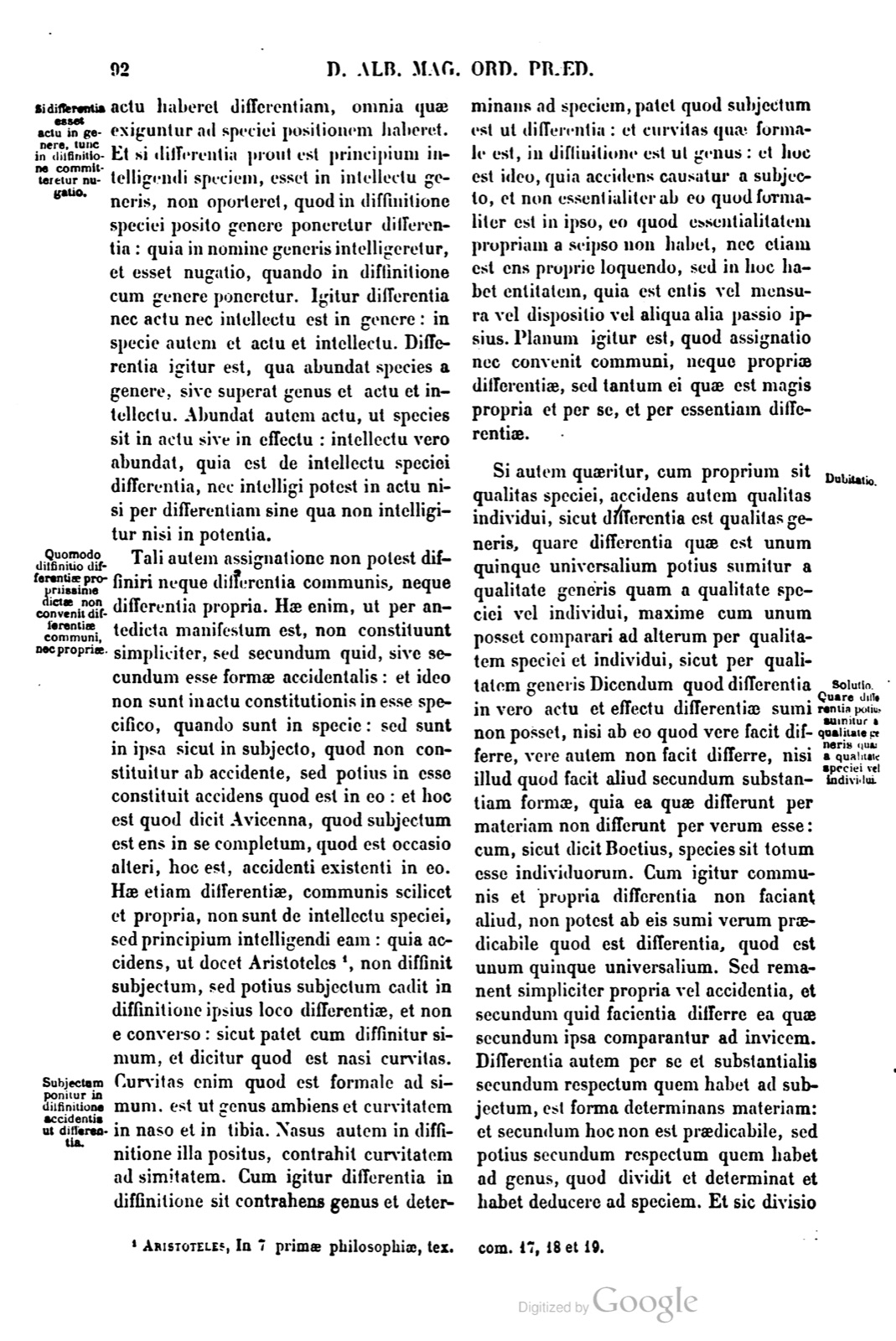
Si autem quaeritur, cum proprium sit qualitas speciei, accidens autem qualitas individui, sicut differentia est qualitas generis, quare differentia quae est unum quinque universalium potius sumitur a qualitate generis quam a qualitate speciei vel individui, maxime cum unum posset comparari ad alterum per qualitatem speciei et individui, sicut per qualitatem generis. Dicendum quod differentia in vero actu et effectu differentiae sumi non posset, nisi ab eo quod vere facit differre, vere autem non facit differre, nisi illud quod facit aliud secundum substantiam formae, quia ea quae differunt per materiam non differunt per verum esse: cum, sicut dicit Boetius, species sit totum esse individuorum. Cum igitur communis et propria differentia non faciant aliud, non potest ab eis sumi verum praedicabile quod est differentia, quod est unum quinque universalium. Sed remanent simpliciter propria vel accidentia, et secundum quid facientia differre ea quae secundum ipsa comparantur ad invicem. Differentia autem per se et substantialis secundum respectum quem habet ad subjectum, est forma determinans materiam: et secundum hoc non est praedicabile, sed potius secundum respectum quem habet ad genus, quod dividit et determinat et habet deducere ad speciem. Et sic divisio secundum intellectum prior est in ea quam constitutio: quia dividendo determinat ad speciem, et constituit eam. Et ideo per actum dividendi, qui prior est in ea, nomen accipit differentiae quae est unum de quinque praedicabilibus, ut dictum est. Sic ergo patet quod assignatio conveniens est, qua dicitur quod differentia est, qua abundat species a genere.
Sed his sic determinatis, quaestio est, unde species habent differentias quibus sic abundant a genere: aut enim habebunt a seipsis, aut a nihilo, aut a genere. Et si quidem habent eas a seipsis, tunc idem est constituens seipsum seipso: et sic idem erit faciens et factum, et formatum: eo quod differentia est faciens et formans et constituens speciem. Si enim species a seipsa habet differentiam, tunc oportet quod differentia secundum seipsam sit species, et species secundum seipsam sit differentia: quia aliter species a seipsa et secundum seipsam non haberet differentiam: secundum seipsam enim habere, et essentialiter habere idem est. Si autem a nihilo haberet differentiam, tunc sequeretur aliquid fieri perfectum in esse ex nihilo: quod omnes negaverunt Philosophi. Sequeretur etiam, quod differentia esset ens primum creatum, quod solum fit ex nihilo. Fit enim non supposito quodam alio per intellectum. Hoc autem falsum est, quia differentia supposita quoddam aliud supponitur secundum intellectum, sicut patet in hoc quod est rationale: supposito enim rationali supponitur vivum, et substantia, et ens. Patet igitur quod non habet ex nihilo. Si autem haberet eas ex genere, tunc cum non sit differentia, nisi per oppositionem, eo quod oppositio causa est differendi, sequitur quod habet oppositas in genere: non enim est ratio, quod una unius speciei differentia sit in genere, et non alia sibi opposita. Adhuc autem opposita nata sunt circa idem fieri. Si autem sic est, tunc sequitur quod opposita sunt simul in eodem: quod est impossibile.
But if it is asked, since property is the quality of species, and accident the quality of the individual, just as difference is the quality of genus, why difference, which is one of the five universals, is taken rather from the quality of genus than from the quality of species or individual, especially since one thing can be compared to another through the quality of species and individual just as through the quality of genus, one must say that difference in the true act and effect of difference could not be taken except from that which truly makes a thing differ. But nothing truly makes a thing differ except what makes another thing according to the substance of form, because things which differ through matter do not differ through true being, since, as Boethius says, species is the whole being of individuals. Therefore since common and proper difference do not make another thing, the true predicable which is difference, which is one of the five universals, cannot be taken from them. Rather they remain simply properties or accidents, and things making to differ in a qualified respect those things which are compared to one another according to them. But per se and substantial difference, according to the relation which it has to subject, is form determining matter; and according to this it is not a predicable, but rather according to the relation which it has to genus, which it divides and determines and has to lead down to species. And thus division according to understanding is prior in it to constitution, because by dividing it determines to species and constitutes it. Therefore through the act of dividing, which is prior in it, it receives the name of difference which is one of the five predicables, as was said. Thus therefore it is clear that the assignment is fitting by which it is said that difference is that by which species exceeds genus.
But with these things thus determined, the question is from where species have the differences by which they thus exceed genus: for they will have them either from themselves, or from nothing, or from genus. And if they have them from themselves, then the same thing is constituting itself by itself; and thus the same will be making and made and formed, because difference is making and forming and constituting species. For if species has difference from itself, then difference according to itself must be species, and species according to itself must be difference; because otherwise species would not have difference from itself and according to itself. For to have according to itself and to have essentially are the same. But if it had difference from nothing, then it would follow that something becomes perfect in being from nothing, which all the Philosophers denied. It would also follow that difference was the first created being, which alone comes to be from nothing. For it comes to be without some other thing being supposed by understanding. But this is false, because when difference is supposed, some other thing is supposed according to understanding, as is clear in that which is rational; for when rational is supposed, living thing, substance, and being are supposed. Therefore it is clear that it does not have it from nothing. But if it had them from genus, then since there is no difference except through opposition, because opposition is the cause of differing, it follows that it has opposites in genus. For there is no reason why one difference of one species should be in genus and not another opposed to it. Further, opposites are naturally apt to come to be around the same thing. But if this is so, then it follows that opposites are simultaneously in the same thing, which is impossible.
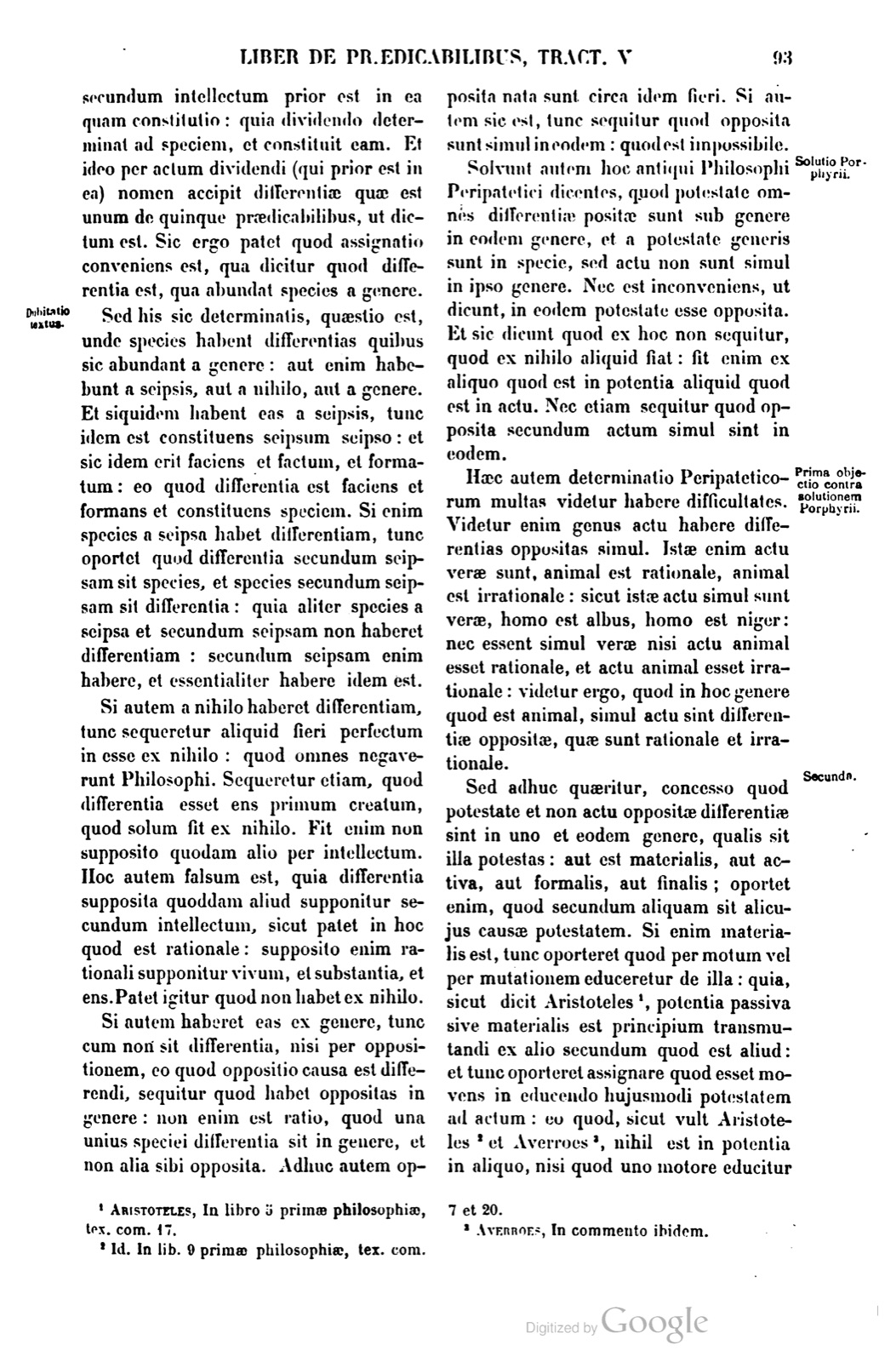
Solvunt autem hoc antiqui Philosophi Peripatetici dicentes, quod potestate omnes differentiae positae sunt sub genere in eodem genere, et a potestate generis sunt in specie, sed actu non sunt simul in ipso genere. Nec est inconveniens, ut dicunt, in eodem potestate esse opposita. Et sic dicunt quod ex hoc non sequitur, quod ex nihilo aliquid fiat: fit enim ex aliquo quod est in potentia aliquid quod est in actu. Nec etiam sequitur quod opposita secundum actum simul sint in eodem.
Haec autem determinatio Peripateticorum multas videtur habere difficultates. Videtur enim genus actu habere differentias oppositas simul. Istae enim actu verae sunt, animal est rationale, animal est irrationale: sicut istae actu simul sunt verae, homo est albus, homo est niger: nec essent simul verae nisi actu animal esset rationale, et actu animal esset irrationale: videtur ergo, quod in hoc genere quod est animal, simul actu sint differentiae oppositae, quae sunt rationale et irrationale.
Sed adhuc quaeritur, concesso quod potestate et non actu oppositae differentiae sint in uno et eodem genere, qualis sit illa potestas: aut est materialis, aut activa, aut formalis, aut finalis; oportet enim, quod secundum aliquam sit alicujus causae potestatem. Si enim materialis est, tunc oporteret quod per motum vel per mutationem educeretur de illa: quia, sicut dicit Aristoteles 2, potentia passiva sive materialis est principium transmutandi ex alio secundum quod est aliud: et tunc oporteret assignare quod esset movens in educendo hujusmodi potestatem ad actum: eo quod, sicut vult Aristoteles 3 et Averroes 4, nihil est in potentia in aliquo, nisi quod uno motore educitur de illo ad actum. Quid autem sit movens ad hoc, quod potestas generis materialis in actum exeat, a Peripateticis non est assignatum. Postea quod est in potestate materiali, est sicut in imperfecto. Imperfectum autem causa perfecti esse non potest. Differentia autem causa est perfectionis speciei. Et sic differentia non potest esse in specie a potestate generis, ut videtur, etiam si dicatur potestate esse in genere. Adhuc autem Peripatetici dicunt quod differentiae in genere sunt potestate. Quaeritur igitur, utrum idem sit habere differentias potestate, et habere differentias potentia? Si enim hoc dicatur esse idem, tunc videtur quod differentiae sint in genere sicut formae sunt in materia. Materia autem nullo modo causa est quod forma sit, vel quod actu sit: et sic videtur quod genus nullo modo sit causa quod differentia sit, vel quod actu sit. Adhuc autem quaeritur, an differentia sit in genere per hoc, quod genus habet potestate differentias? Si enim in genere sit differentia, cum idem sit esse in genere et esse sub genere, tunc differentia erit generi supposita. Suppositum autem generi species est. Videbitur ergo differentia species esse, quod omnino falsum est. Adhuc autem si differentia esset in genere, esset ut genus participans secundum essentiam et intellectum, quod omnino est absurdum: quia tunc differentia esset composita ex genere et quodam alio contrahente, quod contrahens non posset esse nisi differentia, et sic differentiae esset differentia: et tunc idem sequeretur de illa differentiae differentia, et abiret hoc in infinitum.
But the ancient Peripatetic Philosophers solve this by saying that all differences are placed under genus in the same genus by power, and from the power of genus they are in species, but they are not actually together in the genus itself. Nor is it unfitting, as they say, for opposites to be by power in the same thing. And thus they say that from this it does not follow that something comes to be from nothing, for something which is in act comes to be from something which is in potency. Nor does it follow that opposites according to act are together in the same thing.
But this determination of the Peripatetics seems to have many difficulties. For genus seems actually to have opposite differences at once. For these are actually true: animal is rational, animal is irrational; just as these are actually true at once: man is white, man is black. Nor would they be true at once unless animal actually were rational and animal actually were irrational. Therefore it seems that in this genus which is animal, opposite differences, which are rational and irrational, are simultaneously actually present.
But still it is asked, once it has been granted that opposite differences are in one and the same genus by power and not actually, what sort of power that is: either it is material, active, formal, or final; for it must be according to some power of some cause. For if it is material, then it would have to be brought out from it through motion or change, because, as Aristotle says 2, passive or material potency is a principle of being transmuted by another according as it is another. And then it would be necessary to assign what the mover would be in bringing such power out to act, since, as Aristotle 3 and Averroes 4 hold, nothing is in potency in something unless it is brought out from that to act by one mover. But what the mover is for this, that the material power of genus goes forth into act, has not been assigned by the Peripatetics. Next, what is in material power is as in something imperfect. But the imperfect cannot be the cause of the perfect. Yet difference is the cause of the perfection of species. And thus difference cannot be in species from the power of genus, as it seems, even if it is said to be by power in genus. Further, the Peripatetics say that differences are in genus by power. Therefore it is asked whether to have differences by power and to have differences by potency are the same. If this is said to be the same, then it seems that differences are in genus as forms are in matter. But matter in no way is the cause that form is, or that it is actually; and thus it seems that genus in no way is the cause that difference is, or that it actually is. Further it is asked whether difference is in genus through this, that genus has differences by power. For if difference is in genus, since to be in genus and to be under genus are the same, then difference will be supposed under genus. But what is supposed under genus is species. Therefore difference will seem to be species, which is altogether false. Further, if difference were in genus, it would be as participating genus according to essence and understanding, which is altogether absurd, because then difference would be composed from genus and some other contracting thing, and that contracting thing could be nothing except difference, and thus there would be a difference of difference; and then the same would follow concerning that difference of difference, and this would go on to infinity.
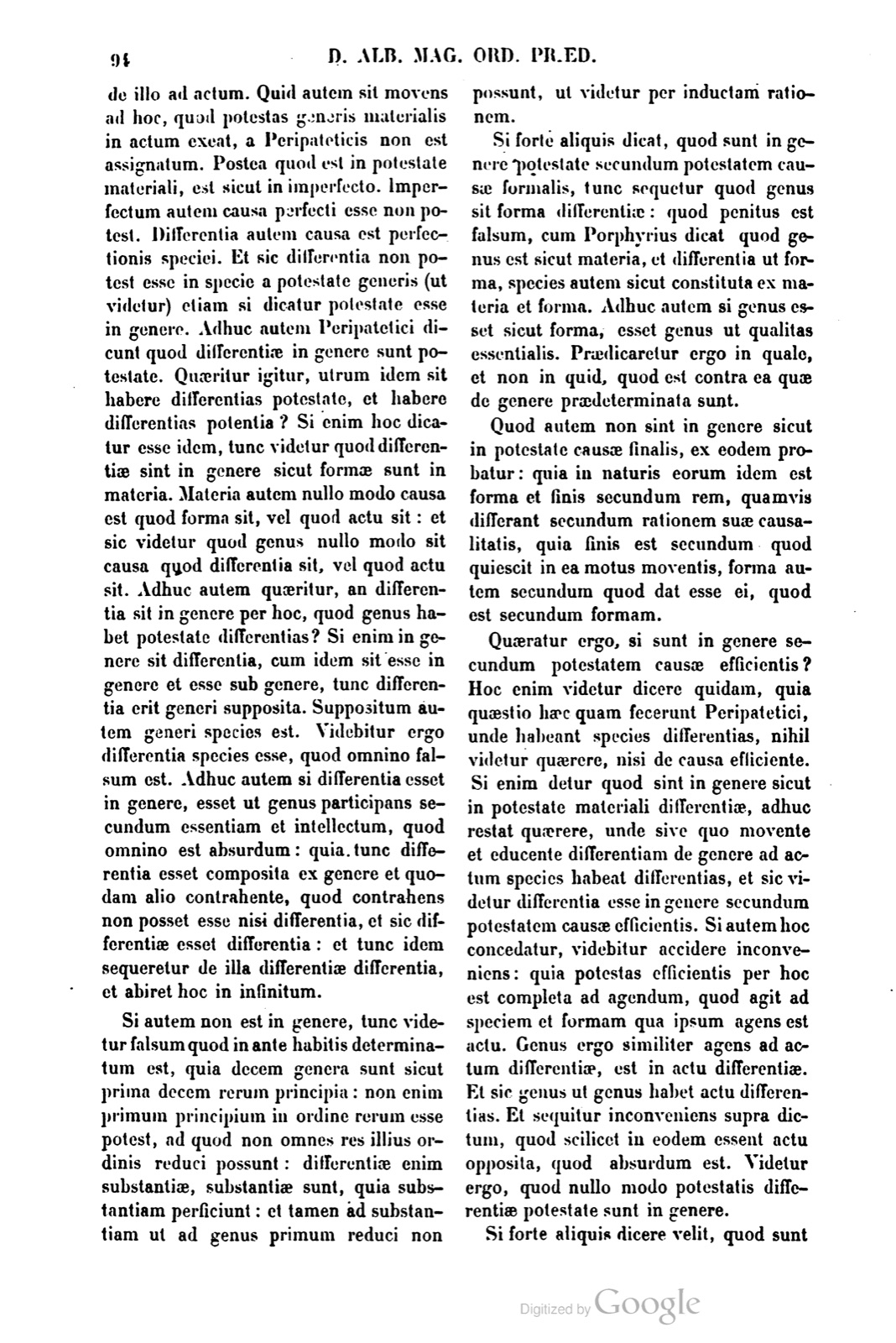
Si autem non est in genere, tunc videtur falsum quod in ante habitis determinatum est, quia decem genera sunt sicut prima decem rerum principia: non enim primum principium in ordine rerum esse potest, ad quod non omnes res illius ordinis reduci possunt: differentiae enim substantiae, substantiae sunt, quia substantiam perficiunt: et tamen ad substantiam ut ad genus primum reduci non possunt, ut videtur per inductam rationem.
Si forte aliquis dicat, quod sunt in genere potestate secundum potestatem causae formalis, tunc sequetur quod genus sit forma differentiae: quod penitus est falsum, cum Porphyrius dicat quod genus est sicut materia, et differentia ut forma, species autem sicut constituta ex materia et forma. Adhuc autem si genus esset sicut forma, esset genus ut qualitas essentialis. Praedicaretur ergo in quale, et non in quid, quod est contra ea quae de genere praedeterminata sunt.
Quod autem non sint in genere sicut in potestate causae finalis, ex eodem probatur: quia in naturis eorum idem est forma et finis secundum rem, quamvis differant secundum rationem suae causalitatis, quia finis est secundum quod quiescit in ea motus moventis, forma autem secundum quod dat esse ei, quod est secundum formam.
Quaeratur ergo, si sunt in genere secundum potestatem causae efficientis? Hoc enim videtur dicere quidam, quia quaestio haec quam fecerunt Peripatetici, unde habeant species differentias, nihil videtur quaerere, nisi de causa efficiente. Si enim detur quod sint in genere sicut in potestate materiali differentiae, adhuc restat quaerere, unde sive quo movente et educente differentiam de genere ad actum species habeat differentias, et sic videtur differentia esse in genere secundum potestatem causae efficientis. Si autem hoc concedatur, videbitur accidere inconveniens: quia potestas efficientis per hoc est completa ad agendum, quod agit ad speciem et formam qua ipsum agens est actu. Genus ergo similiter agens ad actum differentiae, est in actu differentiae. Et sic genus ut genus habet actu differentias. Et sequitur inconveniens supra dictum, quod scilicet in eodem essent actu opposita, quod absurdum est. Videtur ergo, quod nullo modo potestatis differentiae potestate sunt in genere.
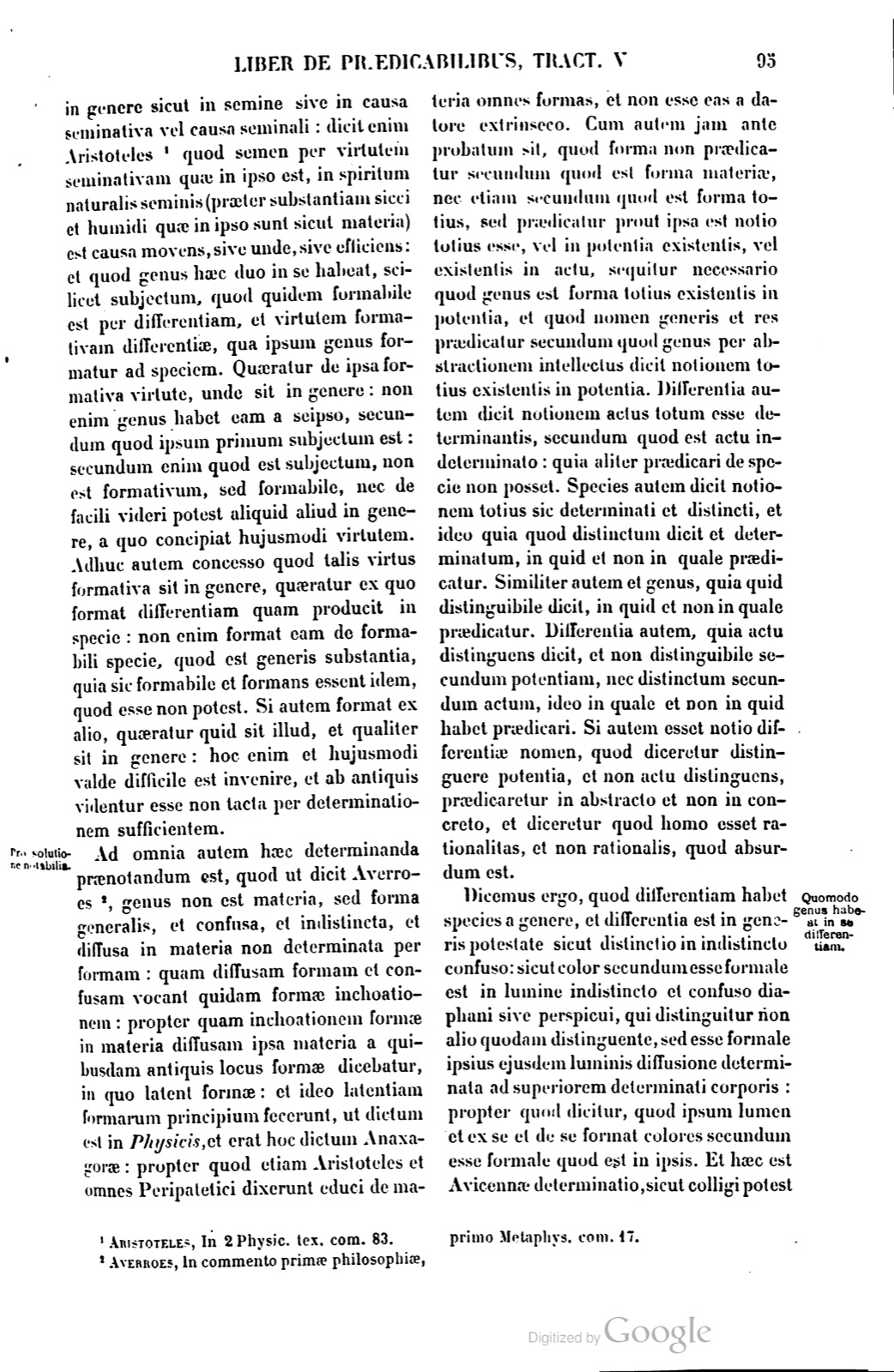
Si forte aliquis dicere velit, quod sunt in genere sicut in semine sive in causa seminativa vel causa seminali: dicit enim Aristoteles 5 quod semen per virtutem seminativam quae in ipso est, in spiritum naturalis seminis, praeter substantiam sicci et humidi quae in ipso sunt sicut materia, est causa movens, sive unde, sive efficiens: et quod genus haec duo in se habeat, scilicet subjectum, quod quidem formabile est per differentiam, et virtutem formativam differentiae, qua ipsum genus formatur ad speciem. Quaeratur de ipsa formativa virtute, unde sit in genere: non enim genus habet eam a seipso, secundum quod ipsum primum subjectum est: secundum enim quod est subjectum, non est formativum, sed formabile, nec de facili videri potest aliquid aliud in genere, a quo concipiat hujusmodi virtutem. Adhuc autem concesso quod talis virtus formativa sit in genere, quaeratur ex quo format differentiam quam producit in specie: non enim format eam de formabili specie, quod est generis substantia, quia sic formabile et formans essent idem, quod esse non potest. Si autem format ex alio, quaeratur quid sit illud, et qualiter sit in genere: hoc enim et hujusmodi valde difficile est invenire, et ab antiquis videntur esse non tacta per determinationem sufficientem.
But if it is not in genus, then what was determined above seems false, because the ten genera are like ten first principles of things; for there cannot be a first principle in an order of things to which all things of that order cannot be reduced. For differences of substance are substances, because they perfect substance, and nevertheless they cannot be reduced to substance as to a first genus, as seems by the reason introduced.
If perhaps someone says that they are in genus by power according to the power of formal cause, then it will follow that genus is the form of difference, which is wholly false, since Porphyry says that genus is like matter, and difference as form, but species as constituted from matter and form. Further, if genus were as form, genus would be as an essential quality. Therefore it would be predicated in what-sort-of and not in what, which is contrary to what was predetermined about genus.
But that they are not in genus as in the power of final cause is proved from the same point, because in their natures form and end are the same according to the thing, although they differ according to the account of their causality, because the end is according as the motion of the mover rests in it, but form according as it gives being to that which exists according to form.
Therefore let it be asked whether they are in genus according to the power of efficient cause. For some seem to say this, because this question which the Peripatetics made, from where species have differences, seems to ask nothing except about the efficient cause. For if it is granted that differences are in genus as in material power, it still remains to ask from where or by what mover and bringer-out species has differences by bringing difference from genus to act; and thus difference seems to be in genus according to the power of efficient cause. But if this is granted, an unfitting thing will seem to occur, because the power of an efficient is complete for acting through this, that it acts toward the species and form by which the agent itself is in act. Therefore genus, similarly acting toward the act of difference, is in the act of difference. And thus genus as genus actually has differences. And the unfitting consequence stated above follows, namely that opposites would be actually in the same thing, which is absurd. Therefore it seems that differences are in genus by power in no mode of power.
If perhaps someone wants to say that they are in genus as in seed or in a seminative cause or seminal cause: for Aristotle says 5 that seed through the seminative power which is in it, in the natural spirit of the seed, beyond the substance of dry and moist which are in it as matter, is a moving cause, or that from which, or efficient cause; and that genus has these two things in itself, namely a subject, which indeed is formable by difference, and a formative power of difference, by which genus itself is formed into species. Let it be asked about this formative power itself, from where it is in genus. For genus does not have it from itself according as it is the first subject; for according as it is subject, it is not formative but formable, nor can anything else in genus easily be seen from which it might conceive such a power. Further, granted that such a formative power is in genus, let it be asked from what it forms the difference which it produces in species. For it does not form it from the formable species, which is the substance of genus, because in this way the formable and the forming would be the same, which cannot be. But if it forms from another, let it be asked what that is, and how it is in genus; for this and things of this sort are very difficult to find, and seem not to have been touched by the ancients through sufficient determination.
Ad omnia autem haec determinanda praenotandum est, quod ut dicit Averroes 6, genus non est materia, sed forma generalis, et confusa, et indistincta, et diffusa in materia non determinata per formam: quam diffusam formam et confusam vocant quidam formae inchoationem: propter quam inchoationem formae in materia diffusam ipsa materia a quibusdam antiquis locus formae dicebatur, in quo latent formae: et ideo latentiam formarum principium fecerunt, ut dictum est in Physicis, et erat hoc dictum Anaxagorae: propter quod etiam Aristoteles et omnes Peripatetici dixerunt educi de materia omnes formas, et non esse eas a datore extrinseco. Cum autem jam ante probatum sit, quod forma non praedicatur secundum quod est forma materiae, nec etiam secundum quod est forma totius, sed praedicatur prout ipsa est notio totius esse, vel in potentia existentis, vel existentis in actu, sequitur necessario quod genus est forma totius existentis in potentia, et quod nomen generis et res praedicatur secundum quod genus per abstractionem intellectus dicit notionem totius existentis in potentia. Differentia autem dicit notionem actus totum esse determinantis, secundum quod est actu indeterminato: quia aliter praedicari de specie non posset. Species autem dicit notionem totius sic determinati et distincti, et ideo quia quod distinctum dicit et determinatum, in quid et non in quale praedicatur. Similiter autem et genus, quia quid distinguibile dicit, in quid et non in quale praedicatur. Differentia autem, quia actu distinguens dicit, et non distinguibile secundum potentiam, nec distinctum secundum actum, ideo in quale et non in quid habet praedicari. Si autem esset notio differentiae nomen, quod diceretur distinguere potentia, et non actu distinguens, praedicaretur in abstracto et non in concreto, et diceretur quod homo esset rationalitas, et non rationalis, quod absurdum est.
Dicemus ergo, quod differentiam habet species a genere, et differentia est in generis potestate sicut distinctio in indistincto confuso: sicut color secundum esse formale est in lumine indistincto et confuso diaphani sive perspicui, qui distinguitur non alio quodam distinguente, sed esse formale ipsius ejusdem luminis diffusione determinata ad superficiem determinati corporis: propter quod dicitur, quod ipsum lumen et ex se et de se format colores secundum esse formale quod est in ipsis. Et haec est Avicennae determinatio, sicut colligi potest in prima philosophia ipsius. Propter quod dicitur genus potestate habere differentias potius quam potentia: quia potentia ad esse et non esse indifferens est, potestas autem est potentia stans per actus inchoationem. Et haec est causa, quare inter genus et differentiam cum in una et eadem diffinitione colliguntur, non est naturarum diversarum congregatio: quia si hoc esset, diffinitio esset multa et non unum. Non tamen hoc dicere intendimus, quod genus et differentiae non sint diversae naturae. Sed intendimus quod non sunt naturae diversorum generum, sicut sunt substantia et accidens, quantitas et qualitas: sunt enim naturae ejusdem generis ordinabiles ad unum idem sicut potentia et actus. Nec posset aliquis dicere quod actus hujus potentiae esset actus, et non alterius, nisi per aliquid actus esset inchoatus in potentia: neque haec potentia inchoaret hunc actum, nisi aliquid simile actui esset inchoatum in potentia.
But for determining all these things one must note beforehand that, as Averroes says 6, genus is not matter, but a general, confused, indistinct form diffused in matter not determined by form. Some call this diffused and confused form the beginning of form. Because of this beginning of form diffused in matter, matter itself was called by some ancients the place of form, in which forms lie hidden; and therefore they made the hiddenness of forms a principle, as was said in the Physics, and this was the saying of Anaxagoras. On account of this Aristotle and all the Peripatetics also said that all forms are educed from matter and are not from an extrinsic giver. But since it has already been proved before that form is not predicated according as it is the form of matter, nor even according as it is the form of the whole, but is predicated insofar as it is the notion of the whole being, either of what exists in potency or of what exists in act, it follows necessarily that genus is the form of the whole existing in potency, and that the name of genus and the thing is predicated according as genus, through abstraction of the intellect, names the notion of the whole existing in potency. But difference names the notion of act determining the whole being, according as it is in indeterminate act; because otherwise it could not be predicated of species. But species names the notion of the whole thus determined and distinct, and therefore, because it names what is distinct and determined, it is predicated in what and not in what-sort-of. Likewise genus also, because it names a distinguishable what, is predicated in what and not in what-sort-of. But difference, because it names what is distinguishing in act, and not what is distinguishable according to potency, nor what is distinct according to act, therefore has to be predicated in what-sort-of and not in what. But if the name of difference were a notion which was said to distinguish in potency, and not actually distinguishing, it would be predicated in the abstract and not in the concrete, and it would be said that man is rationality and not rational, which is absurd.
Therefore we will say that species has difference from genus, and difference is in the power of genus as distinction is in the indistinct confused thing: just as color according to formal being is in the indistinct and confused light of the diaphanous or transparent, which is distinguished not by some other distinguishing thing, but by the formal being of that very same light by a diffusion determined to the surface of a determinate body. On account of this it is said that light itself, both from itself and of itself, forms colors according to the formal being which is in them. And this is Avicenna's determination, as can be gathered in his First Philosophy. On account of this genus is said to have differences by power rather than by potency, because potency is indifferent to being and not being, but power is potency standing through the beginning of act. And this is the cause why, between genus and difference when they are gathered in one and the same definition, there is not a gathering of diverse natures; because if this were so, the definition would be many and not one. Nevertheless we do not intend to say that genus and differences are not diverse natures. Rather we intend that they are not natures of diverse genera, as substance and accident, quantity and quality are. For they are natures of the same genus orderable to one and the same thing as potency and act. Nor could someone say that the act of this potency would be the act and not of another, unless through something the act had been begun in potency; nor would this potency begin this act unless something similar to act had been begun in potency.
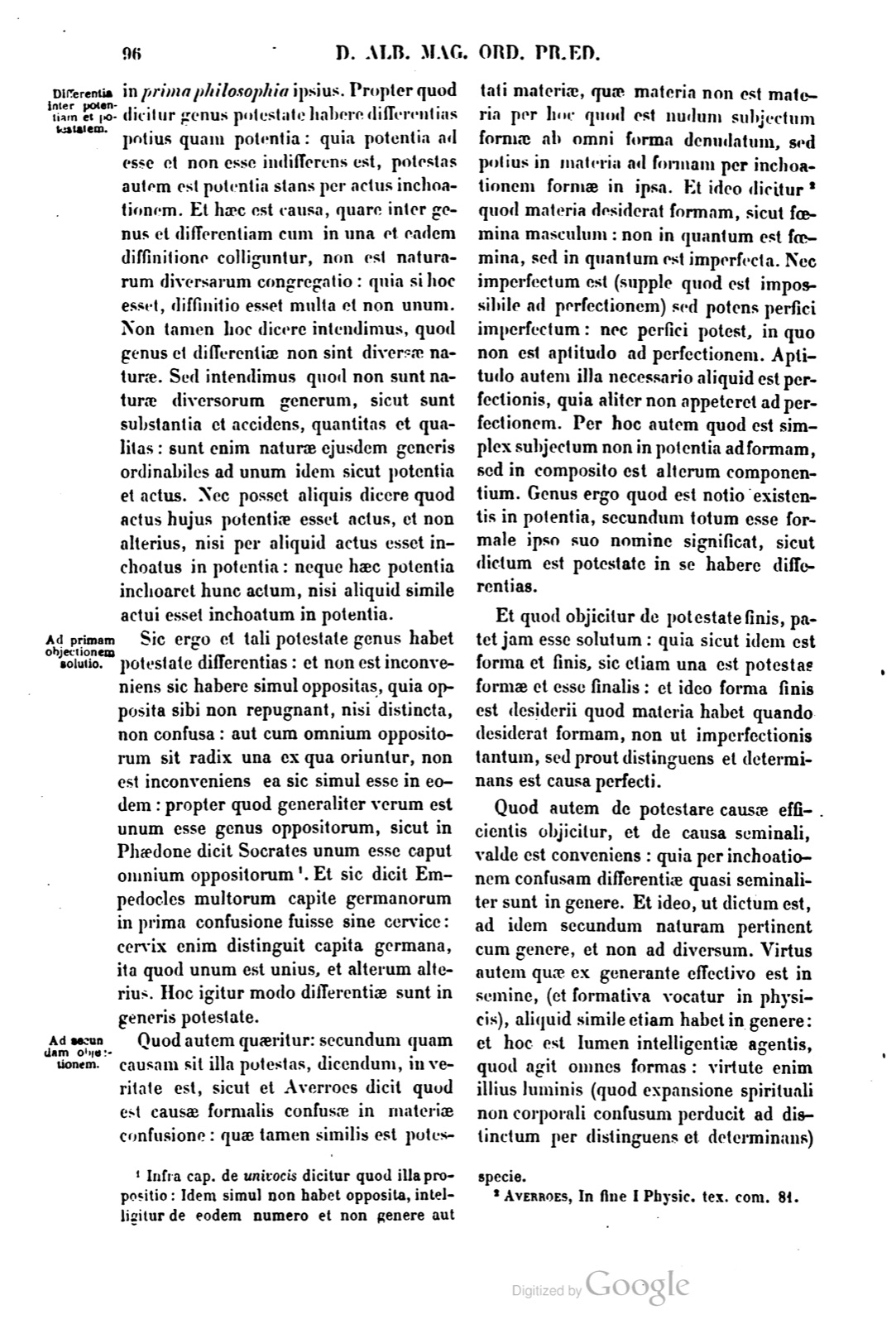
Sic ergo et tali potestate genus habet potestate differentias: et non est inconveniens sic habere simul oppositas, quia opposita sibi non repugnant, nisi distincta, non confusa: aut cum omnium oppositorum sit radix una ex qua oriuntur, non est inconveniens ea sic simul esse in eodem: propter quod generaliter verum est unum esse genus oppositorum, sicut in Phaedone dicit Socrates unum esse caput omnium oppositorum 7. Et sic dicit Empedocles multorum capite germanorum in prima confusione fuisse sine cervice: cervix enim distinguit capita germana, ita quod unum est unius, et alterum alterius. Hoc igitur modo differentiae sunt in generis potestate.
Quod autem quaeritur: secundum quam causam sit illa potestas, dicendum, in veritate est, sicut et Averroes dicit quod est causae formalis confusae in materiae confusione: quae tamen similis est potestati materiae, quae materia non est materia per hoc quod est nudum subjectum formae ab omni forma denudatum, sed potius in materia ad formam per inchoationem formae in ipsa. Et ideo dicitur 8 quod materia desiderat formam, sicut foemina masculum: non in quantum est foemina, sed in quantum est imperfecta. Nec imperfectum est, supple quod est impossibile ad perfectionem, sed potens perfici imperfectum: nec perfici potest, in quo non est aptitudo ad perfectionem. Aptitudo autem illa necessario aliquid est perfectionis, quia aliter non appeteret ad perfectionem. Per hoc autem quod est simplex subjectum non in potentia ad formam, sed in composito est alterum componentium. Genus ergo quod est notio existentis in potentia, secundum totum esse formale ipso suo nomine significat, sicut dictum est potestate in se habere differentias.
Et quod objicitur de potestate finis, patet jam esse solutum: quia sicut idem est forma et finis, sic etiam una est potestas formae et esse finalis: et ideo forma finis est desiderii quod materia habet quando desiderat formam, non ut imperfectionis tantum, sed prout distinguens et determinans est causa perfecti.
Quod autem de potestate causae efficientis objicitur, et de causa seminali, valde est conveniens: quia per inchoationem confusam differentiae quasi seminaliter sunt in genere. Et ideo, ut dictum est, ad idem secundum naturam pertinent cum genere, et non ad diversum. Virtus autem quae ex generante effectivo est in semine, et formativa vocatur in physicis, aliquid simile etiam habet in genere: et hoc est lumen intelligentiae agentis, quod agit omnes formas: virtute enim illius luminis, quod expansione spirituali non corporali confusum perducit ad distinctum per distinguens et determinans,
Therefore in this way and by such power genus has differences by power; and it is not unfitting to have opposites together in this way, because opposites do not resist one another unless they are distinct, not confused. Or, since there is one root of all opposites from which they arise, it is not unfitting for them thus to be together in the same thing. On account of this it is generally true that there is one genus of opposites, just as in the Phaedo Socrates says that there is one head of all opposites 7. And thus Empedocles says that in the first confusion there was the head of many twin things without a neck; for the neck distinguishes twin heads, so that one is of one, and the other of another. Therefore in this mode differences are in the power of genus.
But as to what is asked, according to what cause that power exists, one must say, in truth, as Averroes also says, that it is of a formal cause confused in the confusion of matter. Yet this is similar to the power of matter, which matter is not matter through being a bare subject of form stripped of every form, but rather is in matter toward form through the beginning of form in it. And therefore it is said 8 that matter desires form as female desires male, not insofar as it is female, but insofar as it is imperfect. Nor is the imperfect, supply: what is impossible for perfection, but the imperfect capable of being perfected; nor can that in which there is no aptitude for perfection be perfected. But that aptitude necessarily is something of perfection, because otherwise it would not desire toward perfection. But through this, that it is a simple subject, it is not in potency to form, but in the composite it is one of the components. Therefore genus, which is the notion of what exists in potency, signifies according to the whole formal being by its very name that it has differences in itself by power, as was said.
And what is objected about the power of the end is already clearly solved: because just as form and end are the same, so also there is one power of form and final being; and therefore form is the end of the desire which matter has when it desires form, not as of imperfection only, but insofar as, distinguishing and determining, it is the cause of the perfect.
But what is objected concerning the power of efficient cause and concerning the seminal cause is very fitting, because through confused beginning differences are, as it were, seminally in genus. And therefore, as was said, they pertain according to nature to the same thing with genus and not to something diverse. But the power which is from the effective generator in seed, and is called formative in physics, also has something similar in genus; and this is the light of the agent intelligence, which acts all forms. For by the power of that light, which by spiritual expansion, not corporeal, leads the confused to the distinct through what distinguishes and determines,
Notes
- Aristotle, In book 7 of the First Philosophy, text-comments 17, 18, and 19. (Aristoteles, In 7 primae philosophiae, tex. com. 17, 18 et 19.) ↩
- Aristotle, In book 5 of the First Philosophy, text-comment 17. (Aristoteles, In libro 5 primae philosophiae, tex. com. 17.) ↩
- The same, In book 9 of the First Philosophy, text-comments 7 and 20. (Id. In lib. 9 primae philosophiae, tex. com. 7 et 20.) ↩
- Averroes, In the commentary in the same place. (Averroes, In commento ibidem.) ↩
- Aristotle, In book 2 of the Physics, text-comment 83. (Aristoteles, In 2 Physic. tex. com. 83.) ↩
- Averroes, In the commentary on the First Philosophy, first Metaphysics, commentary 17. (Averroes, In commento primae philosophiae, primo Metaphys, com. 17.) ↩
- Below, in the chapter on univocals, it is said that that proposition, The same thing does not have opposites at the same time, is understood of the same in number and not in genus or species. (Infra cap. de univocis dicitur quod illa propositio: Idem simul non habet opposita, intelligitur de eodem numero et non genere aut specie.) ↩
- Averroes, At the end of book 1 of the Physics, text-comment 81. (Averroes, In fine I Physic. tex. com. 81.) ↩
If a page does not appear, its photograph has not been uploaded yet.