Volume 1 · pp. 87–91
Chapter III. How substantial differences are constitutive, and how they are divisive.
A marker with ≈ is an approximate page boundary, placed by measure of the text; the page photographs remain the authority. In the paired views, clicking a page marker brings that page into view.
CAPUT III.
Qualiter differentiae substantiales sunt constitutivae, et qualiter sunt divisivae.
Omnibus autem divisionibus et speciebus differentiarum sic determinatis, illa sola differentia est unum de quinque Praedicabilibus, prout hic de universalibus intendimus, quae est per se et substantialis differentia. Hoc autem sic probatur: quia cum tres modi differentiae, ut praedictum est, considerentur, scilicet communis, propriae, et magis propriae; adhuc autem cum quaedam quidem sint separabiles, quaedam autem inseparabiles propter rationem quae in antehabitis dicta est; et rursus cum inseparabilium differentiarum quaedam quidem sint per se, quaedam per accidens, ut nuper dictum est: patet quod si eas quae sunt per se consideremus per comparationem ad ea quorum sunt differentiae, inveniemus quod per se differentiarum quaedam sunt secundum quas dividimus genera in species, potestatem et non essentiam generis dividentes. Essentia enim generis in omnibus per divisionem acceptis integra manet et indivisa in quolibet: potestas autem partitur, et secundum aliquid ejus est in uno dividentium, et secundum aliquid manet in alio, et in nullo secundum totum. Aliae autem earum differentiarum quae per se et substantiales sunt, tales sunt secundum quas ea quae per divisionem generum accepta sunt, specificantur.
Haec autem divisio differentiarum per se non nisi modi divisio est: qui modus sumitur a proprio differentiae effectu. Si enim differentia in oppositione actuali accipitur ad id a quo facit differre, pro certo hoc modo divisiva est et separativa. Oppositio enim dividit et separat, nec potest esse una et eadem potestas oppositorum secundum actum acceptorum. Si autem accipiatur differentia ut actus completivus actu potentiae generis et determinativus, sic differentia generi et potentiae adveniens, in speciem genus determinat, et constituit speciem. Si autem forma a qua sumitur differentia, in se secundum id quod est consideratur, eadem differentia est quae genus dividit, et speciem constituit. Sed tamen secundum rationem prius est differentia dividens quam differentia constituens: quia oportet quod differentia prius per divisionem quam facit a genere exeat, antequam adveniens generi speciem constituat.
Hoc autem facilius scitur si exempla subjiciantur. Per se enim differentiae omnes sunt hujusmodi, animatum, inanimatum, per quae dividitur corpus: sensibile, insensibile, per quae dividitur vivum: rationale, irrationale, per quae dividitur animal: mortale, et immortale, per quae dividitur rationale animal, et sic de omnibus aliis quae a formis substantialibus sumuntur, et sunt notiones ejus quod est secundum substantiam, etiam illae eaedem sunt constitutivae: quia illa quae erit animati sensibilis, ita quod animatum sensibile determinetur per actum essendi, erit differentia constitutiva animalis: est enim animal per diffinitionem substantialem substantia animata sensibilis, planta autem substantia animata insensibilis, lapis autem substantia inanimata insensibilis. Ea vero differentia quae est mortalis immortalis, et rationalis irrationalis, sunt differentiae divisivae quidem animalis: quia per ea genera animalium dividimus in species duabus sibi succedentibus divisionibus sic: Animalium aliud mortale, aliud immortale; aliud rationale, aliud irrationale. Per has ergo animalis species divisionem accipiunt. Sed hae quidem differentiae eaedem quae per sui oppositionem divisivae dicuntur generum, sunt et completivae et constitutivae specierum, quando una earum sumitur ut complementum potentiae generi adveniens: tunc enim cum ex potentia et actu compositum completum sit et perfectum, species constituta sic completa est. Dividimus enim primo hoc genus quod est animal rationali et irrationali differentiis, potentiam animalis in duo partientes: et rursus rationale animal dividimus oppositis differentiis, mortali scilicet et immortali, et eisdem differentiis constituimus species animalis, quia differentia quae est rationalis conjuncta cum ea quae est mortalis, constitutivae sunt hominis, cum genere conjunctae quod est animal. Est enim homo secundum diffinitionem quae dicit esse substantiale, animal rationale mortale: opposita autem differentia quae est immortale, conjuncta cum animali rationali, constitutiva est dei secundum quod de diis Stoici locuti sunt. Quos etiam diffiniunt, quod dii sunt natura optimi, sicut dicit Socrates, natura animales, mente rationales, tempore autem aeterni. Illae vero quae sunt differentiae dictae irrationale et mortale, cum genere conjunctae, constitutivae sunt specierum animalium irrationalium, ut asini, et leonis, et aliorum brutorum animalium.
CHAPTER III.
How substantial differences are constitutive, and how they are divisive.
But with all the divisions and species of differences thus determined, only that difference which is per se and substantial difference is one of the five Predicables, insofar as here we intend universals. This is proved in this way: since three modes of difference are considered, as was said before, namely common, proper, and more proper; and further, since some are separable and some inseparable because of the reason stated above; and again, since among inseparable differences some are per se and some by accident, as was just said, it is clear that if we consider those which are per se by comparison to the things whose differences they are, we will find that certain per se differences are those according to which we divide genera into species, dividing the power and not the essence of the genus. For the essence of the genus remains whole and undivided in every one of the things taken by division; but the power is divided, and according to something of it it is in one of the things dividing, and according to something it remains in another, and in none according to the whole. But others of those differences which are per se and substantial are such that according to them those things which are taken by division of genera are specified.
But this division of per se differences is only a division of mode; and this mode is taken from the proper effect of difference. For if difference is taken in actual opposition to that from which it makes a thing differ, certainly in this mode it is divisive and separative. For opposition divides and separates, nor can there be one and the same power of opposites taken according to act. But if difference is taken as an act completing the potency of genus and determining it in act, then difference coming to genus and potency determines genus into species and constitutes species. But if the form from which difference is taken is considered in itself according to what it is, the same difference is that which divides genus and constitutes species. Nevertheless, according to reason the dividing difference is prior to the constituting difference, because difference must first come forth from genus through the division which it makes before, when coming to genus, it constitutes species.
But this is known more easily if examples are put beneath. For all per se differences are of this sort: animated and inanimate, by which body is divided; sensible and insensible, by which living thing is divided; rational and irrational, by which animal is divided; mortal and immortal, by which rational animal is divided; and so with all others which are taken from substantial forms and are notions of that which exists according to substance. These same ones are also constitutive, because that which will be of the animated sensible, so that animated sensible is determined through the act of being, will be the constitutive difference of animal. For animal by substantial definition is animated sensible substance; but plant is animated insensible substance, and stone is inanimate insensible substance. But the difference which is mortal or immortal, and rational or irrational, are indeed divisive differences of animal, because through them we divide genera of animals into species by two successive divisions in this way: of animals one is mortal, another immortal; one rational, another irrational. Through these, therefore, species of animal receive division. But these same differences which through their opposition are called divisive of genera are also completing and constitutive of species when one of them is taken as a complement of the potency coming to genus. For then, since the composite from potency and act is complete and perfect, the constituted species is complete in this way. For first we divide this genus which is animal by rational and irrational differences, dividing the potency of animal into two; and again we divide rational animal by opposite differences, namely mortal and immortal, and by the same differences we constitute species of animal, because the difference which is rational joined with that which is mortal are constitutive of man, when joined with the genus which is animal. For man, according to the definition which names substantial being, is rational mortal animal. But the opposite difference, which is immortal, joined with rational animal, is constitutive of god according as the Stoics spoke about gods. They also define them as gods by nature best, as Socrates says, animals by nature, rational in mind, but eternal in time. But those which are the differences called irrational and mortal, when joined with genus, are constitutive of species of irrational animals, as of ass, lion, and other brute animals.
Quamvis autem in infimis generibus subalternis magis sit perspicuum ad videndum, tamen supremae et supremorum generum differentiae per eumdem se habent modum, sicut differentiae per quas dividitur substantia quae est generalissimum: sicut si dicimus illas esse differentias, quibus differunt animatae substantiae ab inanimatis, cum dicitur, substantiarum alia est animata, alia est inanimata: sive non proximas accipiendo dicimus, quod substantiarum alia est sensibilis, alia insensibilis: eaedem enim erunt inferiorum specierum constitutivae: differentia enim animata et sensibilis ad substantiam sicut ad genus congregatae et adjunctae ut actus ad potentiam, animal perficiunt, quod est species substantiae: est enim animal per diffinitionem substantia animata sensibilis. Substantia enim quamvis aliquando dividatur per corporeum et incorporeum, tamen non est propria divisio: quia corporeum proprie mathematicum est, quod proprie loquendo non est substantia: et ideo hic non tali utimur divisione. Corpus autem animatum et inanimatum dicimus differentias.
Although this is more evident to see in the lowest subaltern genera, nevertheless the highest differences of the highest genera have themselves in the same mode, as do the differences through which substance, which is the most general, is divided. Thus if we say that those are differences by which animated substances differ from inanimate ones, when it is said that of substances one is animated and another inanimate; or, by taking non-proximate differences, we say that of substances one is sensible and another insensible, the same will be constitutive of lower species. For the difference animated and sensible, gathered and joined to substance as to genus as act to potency, perfect animal, which is a species of substance; for animal by definition is animated sensible substance. For although substance is sometimes divided by corporeal and incorporeal, nevertheless this is not a proper division, because corporeal is properly mathematical, which properly speaking is not substance; and therefore here we do not use such a division. But we call animated body and inanimate body differences.
Quidam impugnant per id quod Aristoteles in libro de Anima dicere videtur 1, quod partes animalium quorumdam anulorum animatae sunt, et quod non convalescant, causam esse, quia organa nutrimenti non habent in partibus, ut os, et stomachum, et universaliter ea per quae fit cibi digestio et egestio: partes tamen illae non sunt animalia. Non igitur esse animatum sensibile animal esse videtur: quod est contra ea quae dicta sunt. Haec autem objectio nihil valet penitus: et si valeret, naturalis esset, et nihil faceret ad propositam intentionem. Est enim animatum simpliciter sensibile, et est animatum sensibile secundum quid. Simpliciter quidem animatum est, cujus endelechia est anima, qua fluunt virtutes sive potentiae particulares particulariter in membris, vitam et motum et sensum operantes: et esse sic animatum est animal. Animatum autem secundum quid est, in quo sensus et motus est per spiritum et fluxum ab anima, qui cum expirat, deficit sensus et motus. Causa autem expirandi est, quia organa reficientia et restituentia spiritum non habet. Restituuntur autem spiritus per nutrimentum in organis in nutrimento operantibus: et haec quia non nisi secundum quid animata sunt, ideo animalia non sunt. Animatum igitur quod simpliciter animatum est, nihil prohibet differentiam animalis esse constitutivam.
Avicenna etiam hanc differentiam quam mortale diximus impugnare videtur, dicens quod a privatione non tantum secundum nomen, sed etiam secundum rem nomen accipit. Privatio autem non est forma. Cum igitur omnis differentia a forma aliqua sumpta sit, videtur mortale differentia non esse. Ad haec autem ipsemet Avicenna videtur respondere, quod ea quae pro differentiis hic assignantur, gratia exempli ponuntur: et non est vis de nomine, dummodo per nomina res quocumque modo designentur. Sed aliter dicendum est, quod mortale dicitur dupliciter. Uno quidem modo dicit actum in materia privationem ejusdem actus secundum potentiam concipientem: et sic mortalis est forma substantialis, et notio ejus quod potentiam habet ad moriendum: et sic dictum mortale nihil prohibet esse differentiam, quando per talem formam ad sui oppositum vel disparatum secundum eamdem formam comparatur. Dicitur etiam mortale simpliciter, in quo est privatio potentiae ad vitam perpetuam, et sic ab eo non sumitur differentia. Cum autem dicitur irrationale et immortale differentiae quae per privationes importantur in nomine, positiones intelliguntur formarum oppositarum a quibus sumuntur differentiae. Et quia horum nomina non habemus, ideo necesse est, quod eas privatione suorum oppositorum significemus.
Ex his omnibus patet, quod eaedem secundum quod sunt differentiae, acceptae alio et alio modo, et ad aliud comparatae, sunt et constitutivae et divisivae: et omnes sive divisivae sive constitutivae vocantur specificae, quae cum suis generibus conjunctae faciunt species et subalternas et specialissimas. Et his differentiis quia per se sunt et substantiales, maxime opus est ad divisiones generum quae in suas potestates particulares dividuntur. Et hae etiam perutiles sunt ad specierum diffinitiones, quae omnes tales a prima usque ad ultimam cum genere colligunt ad speciei plenam diffinitionem, quae diffinitio non esset, nisi a primo usque ad ultimum finem, in quo complementum est, omnia essentialia per debitum ordinem congregaret, secundum quod res a prima inchoatione sui esse procedit usque ad ultimum complementum. His autem differentiis quae sunt secundum accidens inseparabiles, quia de esse rei non sunt: et his quae sunt secundum accidens separabiles, quae longius sunt ab esse rei quam inseparabiles, non utimur ad generum divisiones et diffinitiones specierum: et ideo non sunt de hac nostra intentione, nisi illae quae per se sunt et substantiales.
Some attack this through what Aristotle seems to say in the book On the Soul 1, that the parts of certain ringed animals are animated, and that the cause why they do not grow together is that they do not have organs of nourishment in the parts, such as mouth and stomach and universally those things through which digestion and egestion of food occur; nevertheless those parts are not animals. Therefore to be animated sensible does not seem to be to be animal, which is contrary to what has been said. But this objection has no force at all; and if it had force, it would be natural and would do nothing for the proposed intention. For there is animated sensible simply, and there is animated sensible in a qualified respect. Animated simply is that whose endelechy is soul, from which particular powers or potencies flow particularly in the members, carrying out life and motion and sense; and to be animated in this way is animal. But animated in a qualified respect is that in which sense and motion exist through spirit and a flow from the soul, and when this expires, sense and motion fail. But the cause of expiring is that it does not have organs refreshing and restoring the spirit. Spirits are restored through nourishment in organs operating in nourishment; and because these are animated only in a qualified respect, therefore they are not animals. Therefore nothing prevents the animated which is animated simply from being the constitutive difference of animal.
Avicenna also seems to attack this difference which we have called mortal, saying that it takes its name from privation not only according to the name but also according to the thing. But privation is not a form. Therefore since every difference is taken from some form, mortal does not seem to be a difference. To these things Avicenna himself seems to respond that those things assigned here as differences are put for the sake of example, and there is no force in the name, provided that through names the things are designated in some way. But one must speak otherwise: mortal is said in two ways. In one way it names an act in matter conceiving the privation of the same act according to potency; and thus mortal is a substantial form and the notion of that which has potency for dying. And mortal so said is not prevented from being a difference when, through such a form, it is compared to its opposite or disparate according to the same form. Mortal is also said simply, in that in which there is privation of potency for perpetual life, and in this way difference is not taken from it. But when irrational and immortal are called differences which are conveyed in name through privations, positions of opposite forms are understood, from which differences are taken. And because we do not have names for these, it is necessary that we signify them by privation of their opposites.
From all these things it is clear that the same things, according as they are differences, taken in one way and another and compared to another thing, are both constitutive and divisive; and all, whether divisive or constitutive, are called specific, which, joined with their genera, make both subaltern and most special species. And because these differences are per se and substantial, they are especially needed for the divisions of genera which are divided into their particular powers. And these are also very useful for definitions of species, which gather all such differences from the first to the last together with genus for the full definition of species. That would not be a definition unless from the first to the last end, in which the completion is, it gathered all essential things in due order, according as the thing proceeds from the first beginning of its being up to the last completion. But those differences which are inseparable according to accident, because they do not belong to the being of the thing, and those which are separable according to accident, which are farther from the being of the thing than inseparable ones, we do not use for divisions of genera and definitions of species; and therefore none are of our present intention except those which are per se and substantial.
Ad haec tamen quidam objiciunt dicentes, quod esse rei mortalis immaterialis est, quae propter contrariorum commixtionem in continua est passionum alteratione. Omnis autem passio magis facta, abjicit a substantia: propter quod dicit Aristoteles quod non est eadem sanitas in mane et vespere 2. Videtur ergo quod etiam esse rei intenditur et remittitur, et similiter rei essentialia principia, et sic non videntur differentiae esse quae dictae sunt: quia non secundum esse aeque participantur ab his, quorum sunt ut subjectorum. Adhuc ad idem inducunt, quod si esse rei staret secundum esse unum et idem penitus, tunc secundum esse non susciperent designationem praeteriti et futuri, sed praesentis tantum. Et hoc praesens esset instans et non movens se: et sic dicere non possemus, homo fuit, et homo erit, sed tantum homo est. Et ad hoc quidem dicendum est, quod esse rei dupliciter consideratur, si secundum comparationem ad id in quo est et cujus esse est, et secundum comparationem ad id a quo est formaliter constituente ipsum. Et primo quidem modo esse mobilis mobile est, et esse temporalis est temporale: et hoc esse non est omnino idem mane et vespere ex parte ejus in quo est. Sic autem est et mobile et temporale, aliquid abjiciens, et aliquid suscipiens continue secundum quod determinatur ad praeteritum et ad futurum. Secundo autem modo consideratum est essentiae simpliciter actus: quae, inquam, essentia secundum se incorruptibilis est et ingenerabilis: neque generatur, neque corrumpitur, nisi secundum accidens, et sic esse immobile est et intemporale. Differentiae autem cum ab actu differendi quem faciunt, dicuntur, sumuntur ab esse quod sic ambo haec habet, scilicet quod est actus essentiae in eo quod est, et ideo utroque modo designantur.
Yet some object to these things, saying that the being of a mortal immaterial thing is in continuous alteration of passions because of the commixture of contraries. But every passion, when made greater, casts away from substance; on account of this Aristotle says that health is not the same in the morning and in the evening 2. Therefore it seems that even the being of the thing is intensified and remitted, and likewise the essential principles of the thing; and thus the things which have been said do not seem to be differences, because they are not equally participated according to being by those things of which they are as subjects. Further, they bring in toward the same point that if the being of a thing stood utterly according to one and the same being, then according to being they would not receive the designation of past and future, but of present only. And this present would be an instant and not moving itself; and so we could not say man was and man will be, but only man is. To this, one must say that the being of a thing is considered in two ways: according to comparison to that in which it is and whose being it is, and according to comparison to that from which it is, formally constituting it. In the first way, the being of the movable is movable, and the being of the temporal is temporal; and this being is not entirely the same in the morning and evening on the part of that in which it is. In this way it is both movable and temporal, continually casting off something and receiving something according as it is determined to past and future. But considered in the second way, it is simply the act of essence; and this essence, I say, according to itself is incorruptible and ungenerable, and it is neither generated nor corrupted except according to accident, and thus being is immovable and intemporal. But since differences are named from the act of differing which they make, they are taken from being which thus has both these things, namely that it is the act of essence in that which is; and therefore they are designated in both modes.
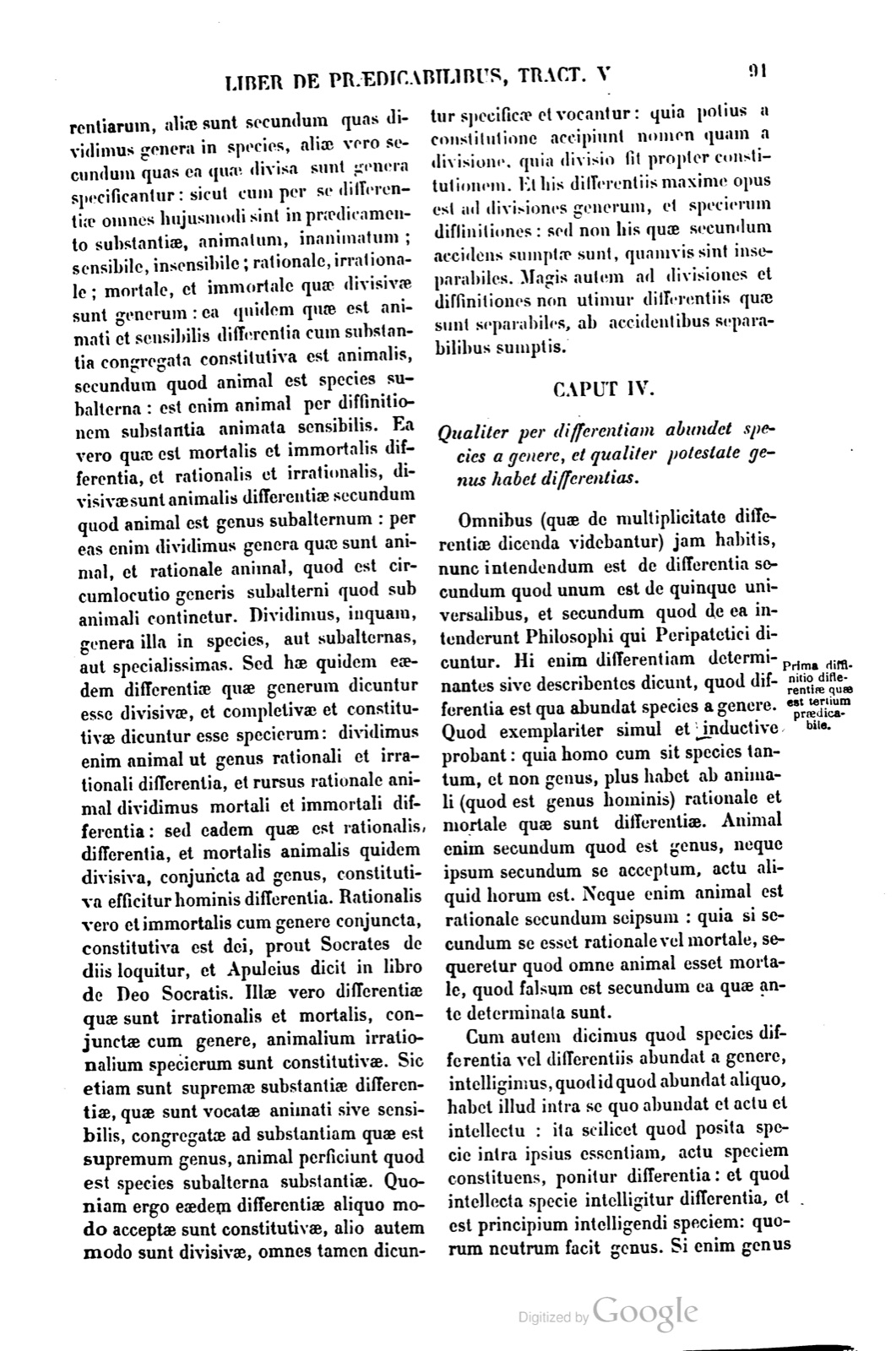
Hoc igitur est, quod antiqui sub compendio de differentia dixerunt, quod cum tres species sive tres modi differentiae considerentur, et cum hae quidem sint separabiles, illae vero inseparabiles: et rursus cum inseparabilium quidem hae sint per se sive substantiales, illae vero per accidens a formis accidentalibus sumptae: et rursus earum quae per se sunt differentiarum, aliae sunt secundum quas dividimus genera in species, aliae vero secundum quas ea quae divisa sunt genera specificantur: sicut cum per se differentiae omnes hujusmodi sint in praedicamento substantiae, animatum, inanimatum; sensibile, insensibile; rationale, irrationale; mortale, et immortale quae divisivae sunt generum: ea quidem quae est animati et sensibilis differentia cum substantia congregata constitutiva est animalis, secundum quod animal est species subalterna: est enim animal per diffinitionem substantia animata sensibilis. Ea vero quae est mortalis et immortalis differentia, et rationalis et irrationalis, divisivae sunt animalis differentiae secundum quod animal est genus subalternum: per eas enim dividimus genera quae sunt animal, et rationale animal, quod est circumlocutio generis subalterni quod sub animali continetur. Dividimus, inquam, genera illa in species, aut subalternas, aut specialissimas. Sed hae quidem eaedem differentiae quae generum dicuntur esse divisivae, et completivae et constitutivae dicuntur esse specierum: dividimus enim animal ut genus rationali et irrationali differentia, et rursus rationale animal dividimus mortali et immortali differentia: sed eadem quae est rationalis, differentia, et mortalis animalis quidem divisiva, conjuncta ad genus, constitutiva efficitur hominis differentia. Rationalis vero et immortalis cum genere conjuncta, constitutiva est dei, prout Socrates de diis loquitur, et Apuleius dicit in libro de Deo Socratis. Illae vero differentiae quae sunt irrationalis et mortalis, conjunctae cum genere, animalium irrationalium specierum sunt constitutivae. Sic etiam sunt supremae substantiae differentiae, quae sunt vocatae animati sive sensibilis, congregatae ad substantiam quae est supremum genus, animal perficiunt quod est species subalterna substantiae. Quoniam ergo eaedem differentiae aliquo modo acceptae sunt constitutivae, alio autem modo sunt divisivae, omnes tamen dicuntur specificae et vocantur: quia potius a constitutione accipiunt nomen quam a divisione, quia divisio fit propter constitutionem. Et his differentiis maxime opus est ad divisiones generum, et specierum diffinitiones: sed non his quae secundum accidens sumptae sunt, quamvis sint inseparabiles. Magis autem ad divisiones et diffinitiones non utimur differentiis quae sunt separabiles, ab accidentibus separabilibus sumptis.
This therefore is what the ancients said in summary about difference: that when three species or three modes of difference are considered, and since some are separable and others inseparable; and again, since of the inseparable some are per se or substantial, but others by accident taken from accidental forms; and again, of those differences which are per se, some are those according to which we divide genera into species, and others those according to which the things which are divided as genera are specified. Thus, since all per se differences of this sort are in the category of substance, animated, inanimate; sensible, insensible; rational, irrational; mortal and immortal, which are divisive of genera: that which is the difference of animated and sensible, gathered with substance, is constitutive of animal according as animal is a subaltern species; for animal by definition is animated sensible substance. But that which is the difference of mortal and immortal, and of rational and irrational, are divisive differences of animal according as animal is a subaltern genus; for through them we divide the genera which are animal and rational animal, which is a circumlocution of the subaltern genus contained under animal. We divide, I say, those genera into species, either subaltern or most special. But these same differences which are said to be divisive of genera are also said to be completing and constitutive of species; for we divide animal as genus by rational and irrational difference, and again we divide rational animal by mortal and immortal difference. But the same difference which is rational, and also mortal, though indeed divisive of animal, when joined to genus becomes constitutive difference of man. But rational and immortal joined with genus is constitutive of god, as Socrates speaks of the gods and Apuleius says in the book On the God of Socrates. But those differences which are irrational and mortal, joined with genus, are constitutive of the species of irrational animals. Thus also the highest differences of substance, which are called animated or sensible, gathered to substance which is the highest genus, perfect animal which is a subaltern species of substance. Therefore, because the same differences taken in one way are constitutive, but in another way are divisive, nevertheless all are called and named specific, because they take the name from constitution rather than from division, since division is made for the sake of constitution. And these differences are chiefly needed for divisions of genera and definitions of species, but not those which are taken according to accident, although they are inseparable. Still less for divisions and definitions do we use differences which are separable, taken from separable accidents.
If a page does not appear, its photograph has not been uploaded yet.