Volume 1 · pp. 85–87
Chapter II. On the manifestation of the modes of difference and of the parts of the division already introduced.
A marker with ≈ is an approximate page boundary, placed by measure of the text; the page photographs remain the authority. In the paired views, clicking a page marker brings that page into view.
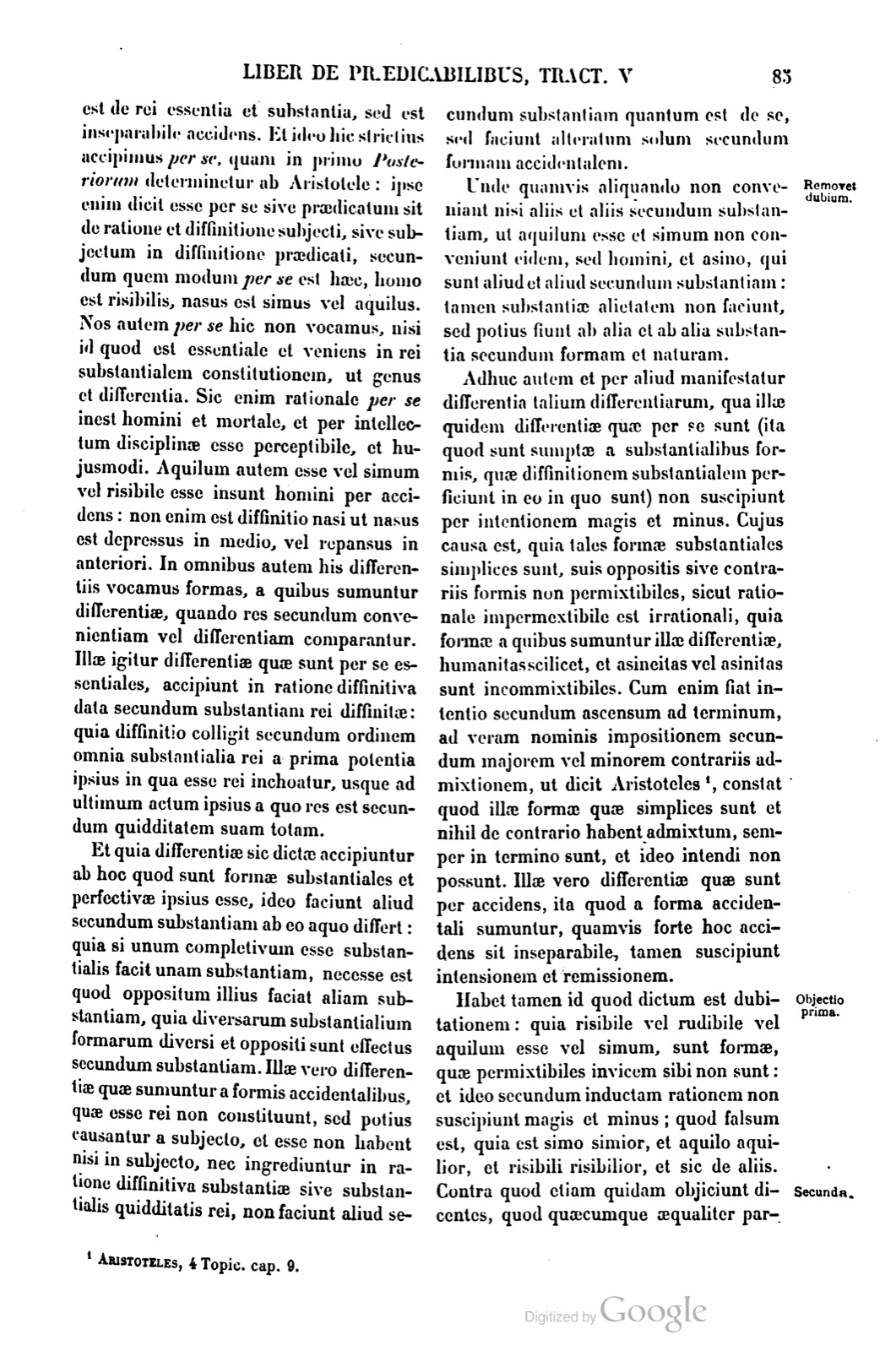
est de rei essentia et substantia, sed est inseparabile accidens. Et ideo hic strictius accipimus per se, quam in primo Posteriorum determinetur ab Aristotele: ipse enim dicit esse per se sive praedicatum sit de ratione et diffinitione subjecti, sive subjectum in diffinitione praedicati, secundum quem modum per se est haec, homo est risibilis, nasus est simus vel aquilus. Nos autem per se hic non vocamus, nisi id quod est essentiale et veniens in rei substantialem constitutionem, ut genus et differentia. Sic enim rationale per se inest homini et mortale, et per intellectum disciplinae esse perceptibile, et hujusmodi. Aquilum autem esse vel simum vel risibile esse insunt homini per accidens: non enim est diffinitio nasi ut nasus est depressus in medio, vel repansus in anteriori. In omnibus autem his differentiis vocamus formas, a quibus sumuntur differentiae, quando res secundum convenientiam vel differentiam comparantur. Illae igitur differentiae quae sunt per se essentiales, accipiunt in ratione diffinitiva data secundum substantiam rei diffinitae: quia diffinitio colligit secundum ordinem omnia substantialia rei a prima potentia ipsius in qua esse rei inchoatur, usque ad ultimum actum ipsius a quo res est secundum quidditatem suam totam.
Et quia differentiae sic dictae accipiuntur ab hoc quod sunt formae substantiales et perfectivae ipsius esse, ideo faciunt aliud secundum substantiam ab eo a quo differt: quia si unum completivum esse substantialis facit unam substantiam, necesse est quod oppositum illius faciat aliam substantiam, quia diversarum substantialium formarum diversi et oppositi sunt effectus secundum substantiam. Illae vero differentiae quae sumuntur a formis accidentalibus, quae esse rei non constituunt, sed potius causantur a subjecto, et esse non habent nisi in subjecto, nec ingrediuntur in ratione diffinitiva substantiae sive substantialis quidditatis rei, non faciunt aliud secundum substantiam quantum est de se, sed faciunt alteratum solum secundum formam accidentalem.
Unde quamvis aliquando non conveniant nisi aliis et aliis secundum substantiam, ut aquilum esse et simum non conveniunt eidem, sed homini, et asino, qui sunt aliud et aliud secundum substantiam: tamen substantiae alietatem non faciunt, sed potius fiunt ab alia et ab alia substantia secundum formam et naturam.
Adhuc autem et per aliud manifestatur differentia talium differentiarum, qua illae quidem differentiae quae per se sunt, ita quod sunt sumptae a substantialibus formis, quae diffinitionem substantialem perficiunt in eo in quo sunt, non suscipiunt per intentionem magis et minus. Cujus causa est, quia tales formae substantiales simplices sunt, suis oppositis sive contrariis formis non permixtibiles, sicut rationale impermixtibile est irrationali, quia formae a quibus sumuntur illae differentiae, humanitas scilicet, et asineitas vel asinitas sunt incommixtibiles. Cum enim fiat intentio secundum ascensum ad terminum, ad veram nominis impositionem secundum majorem vel minorem contrariis admixtionem, ut dicit Aristoteles 1, constat quod illae formae quae simplices sunt et nihil de contrario habent admixtum, semper in termino sunt, et ideo intendi non possunt. Illae vero differentiae quae sunt per accidens, ita quod a forma accidentali sumuntur, quamvis forte hoc accidens sit inseparabile, tamen suscipiunt intensionem et remissionem.
Habet tamen id quod dictum est dubitationem: quia risibile vel rudibile vel aquilum esse vel simum, sunt formae, quae permixtibiles invicem sibi non sunt: et ideo secundum inductam rationem non suscipiunt magis et minus; quod falsum est, quia est simo simior, et aquilo aquilior, et risibili risibilior, et sic de aliis. Contra quod etiam quidam objiciunt dicentes, quod quaecumque aequaliter participant aliquod commune, aequaliter debent participare id quod est illud commune universaliter consequens: participatur autem hoc commune quod est homo aequaliter ab unoquoque individuorum: videbitur etiam forte alicui, quod risibile quod est universaliter consequens hominem, ab unoquoque homine aequaliter debeat participari. Adhuc autem etiam illae quae sunt per se differentiae videntur suscipere magis et minus: videmus enim quod est unus homo rationabilior alio. Praeterea in Ethicis quidam vocantur peculiares sive brutales homines, et quidam longius ab usu rationis remoti vocantur homines arborei: videtur igitur quod et differentiae substantiales magis et minus suscipiant, et sic verum non esse videtur quod dictum est.
is of the essence and substance of the thing, but is an inseparable accident. And therefore here we take per se more strictly than it is determined by Aristotle in the first book of the Posterior Analytics. For he says that something is per se whether the predicate is of the account and definition of the subject, or the subject is in the definition of the predicate, according to which mode this is per se: man is risible, the nose is snub or aquiline. But here we call per se only that which is essential and comes into the substantial constitution of the thing, as genus and difference. For thus rational and mortal are in man per se, and being perceptive of discipline through understanding, and things of this sort. But to be aquiline or snub or risible are in man by accident; for the definition of nose is not that a nose is depressed in the middle, or spread out in front. But in all these differences we call forms those from which differences are taken when things are compared according to agreement or difference. Therefore those differences which are per se essential are taken in the definitive account given according to the substance of the thing defined, because definition gathers in order all the substantial things of the thing from its first potency, in which the being of the thing is begun, up to its last act, from which the thing exists according to its whole quiddity.
And because differences so called are received from this, that they are substantial forms and perfective of the very being, they therefore make that which differs other in substance than that from which it differs. For if one completion of substantial being makes one substance, it is necessary that its opposite make another substance, because the effects of diverse substantial forms are diverse and opposite according to substance. But those differences which are taken from accidental forms, which do not constitute the being of the thing, but rather are caused by the subject, and have being only in the subject, and do not enter into the definitive account of substance or of the substantial quiddity of the thing, do not make another thing according to substance as far as they themselves are concerned, but make only an altered thing according to accidental form.
Hence, although sometimes they agree only with things other and other according to substance, as to be aquiline and snub do not agree in the same thing, but in man and ass, which are one thing and another according to substance, nevertheless they do not make the otherness of substance, but rather are made by one and another substance according to form and nature.
Further, the difference of such differences is manifested by another point also: those differences which are per se, in such a way that they are taken from substantial forms which perfect the substantial definition in that in which they are, do not receive more and less by intension. The cause of this is that such substantial forms are simple and cannot be mixed with their opposite or contrary forms, as rational cannot be mixed with irrational, because the forms from which those differences are taken, namely humanity and asinine-ness or asinity, are not commingled. For since intension is made according to ascent to a term, to the true imposition of the name according to greater or lesser admixture with contraries, as Aristotle says 1, it is established that those forms which are simple and have nothing of a contrary admixed are always at the term, and therefore cannot be intensified. But those differences which are by accident, so that they are taken from an accidental form, although perhaps this accident is inseparable, nevertheless receive intension and remission.
Yet what has been said has a doubt: because risible or capable of laughter, or to be aquiline or snub, are forms which cannot be mixed mutually with one another; and therefore according to the reason introduced they do not receive more and less. This is false, because one is snubbier than a snub thing, and more aquiline than an aquiline thing, and more risible than a risible thing, and so with the others. Against this also certain people object, saying that whatever things equally participate some common thing ought equally to participate that which universally follows that common thing. But this common thing which is man is participated equally by each of the individuals; it will perhaps also seem to someone that the risible, which universally follows man, ought to be participated equally by each man. Further, even those differences which are per se seem to receive more and less, for we see that one man is more rational than another. Besides, in the Ethics some are called peculiar or brutal men, and some who are more remote from the use of reason are called tree-like men. Therefore it seems that substantial differences also receive more and less, and thus what has been said seems not to be true.
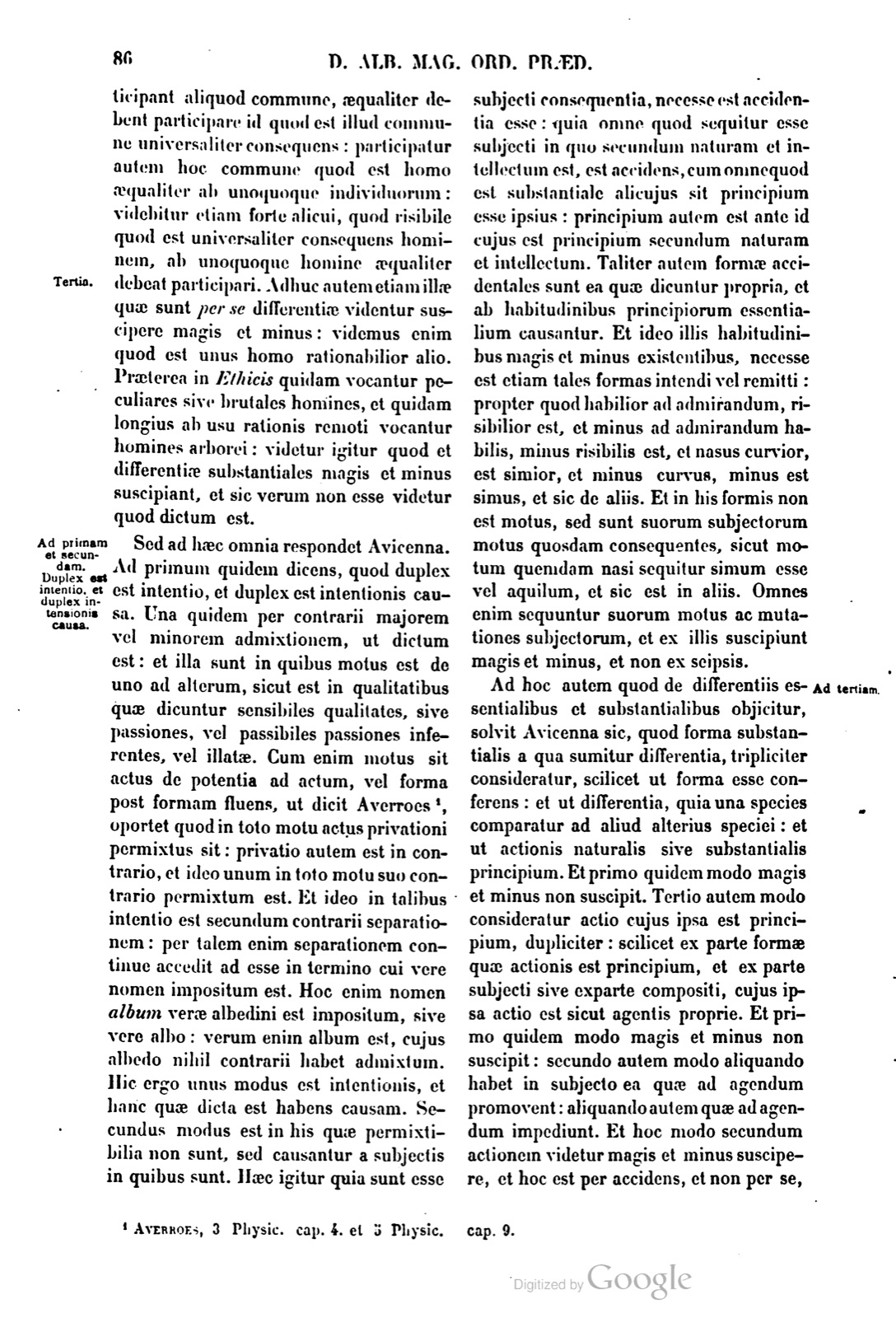
Sed ad haec omnia respondet Avicenna. Ad primum quidem dicens, quod duplex est intentio, et duplex est intentionis causa. Una quidem per contrarii majorem vel minorem admixtionem, ut dictum est: et illa sunt in quibus motus est de uno ad alterum, sicut est in qualitatibus quae dicuntur sensibiles qualitates, sive passiones, vel passibiles passiones inferentes, vel illatae. Cum enim motus sit actus de potentia ad actum, vel forma post formam fluens, ut dicit Averroes 2, oportet quod in toto motu actus privationi permixtus sit: privatio autem est in contrario, et ideo unum in toto motu suo contrario permixtum est. Et ideo in talibus intentio est secundum contrarii separationem: per talem enim separationem continue accedit ad esse in termino cui vere nomen impositum est. Hoc enim nomen album verae albedini est impositum, sive vere albo: verum enim album est, cujus albedo nihil contrarii habet admixtum. Hic ergo unus modus est intentionis, et hanc quae dicta est habens causam.
Secundus modus est in his quae permixtibilia non sunt, sed causantur a subjectis in quibus sunt. Haec igitur quia sunt esse subjecti consequentia, necesse est accidentia esse: quia omne quod sequitur esse subjecti in quo secundum naturam et intellectum est, est accidens, cum omne quod est substantiale alicujus sit principium esse ipsius: principium autem est ante id cujus est principium secundum naturam et intellectum. Taliter autem formae accidentales sunt ea quae dicuntur propria, et ab habitudinibus principiorum essentialium causantur. Et ideo illis habitudinibus magis et minus existentibus, necesse est etiam tales formas intendi vel remitti: propter quod habilior ad admirandum, risibilior est, et minus ad admirandum habilis, minus risibilis est, et nasus curvior, est simior, et minus curvus, minus est simus, et sic de aliis. Et in his formis non est motus, sed sunt suorum subjectorum motus quosdam consequentes, sicut motum quemdam nasi sequitur simum esse vel aquilum, et sic est in aliis. Omnes enim sequuntur suorum motus ac mutationes subjectorum, et ex illis suscipiunt magis et minus, et non ex seipsis.
Ad hoc autem quod de differentiis essentialibus et substantialibus objicitur, solvit Avicenna sic, quod forma substantialis a qua sumitur differentia, tripliciter consideratur, scilicet ut forma esse conferens: et ut differentia, quia una species comparatur ad aliud alterius speciei: et ut actionis naturalis sive substantialis principium. Et primo quidem modo magis et minus non suscipit. Tertio autem modo consideratur actio cujus ipsa est principium, dupliciter: scilicet ex parte formae quae actionis est principium, et ex parte subjecti sive ex parte compositi, cujus ipsa actio est sicut agentis proprie. Et primo quidem modo magis et minus non suscipit: secundo autem modo aliquando habet in subjecto ea quae ad agendum promovent: aliquando autem quae ad agendum impediunt. Et hoc modo secundum actionem videtur magis et minus suscipere, et hoc est per accidens, et non per se, et ideo per se nec magis nec minus suscipiunt. Hoc autem per inductionem probatur: quia nec genus secundum magis et minus praedicatur de eo cujus est genus: cum tamen genus sit forma quae est notio ejus quod est in potentia. Non enim animal secundum magis praedicatur de homine, et secundum minus de asino, sed aeque de utroque. Nec differentiae generis quae dividunt genus et cum genere constituunt speciem, secundum magis et minus praedicantur de speciebus quarum sunt differentiae: quia homo non est magis rationale, et asinus minus irrationale, sed aeque. Illae enim differentiae sunt, quae uniuscujusque speciei complent rationem diffinitivam, et sunt actus complentes esse ipsius. Esse autem uniuscujusque substantiale sive dicatur nomine generis secundum quod est in potentia, sive significetur nomine differentiae secundum quod est in actu, est unum et idem non suscipiens magis et minus secundum quod est effectus substantialium principiorum. Sic enim nec intentionem nec remissionem suscipiens est. Sed aquilum esse vel simum vel coloratum esse, aliquo modo intensionem vel remissionem suscipiunt: eo quod, sicut dictum est, plures modi sunt intensionis et remissionis.
But Avicenna responds to all these things. To the first two he says that intension is twofold, and the cause of intension is twofold. One kind is through greater or lesser admixture of the contrary, as was said; and these are in things in which there is motion from one thing to another, as in qualities which are called sensible qualities, or passions, or passible qualities inferring passions or having them inflicted. For since motion is act from potency to act, or form flowing after form, as Averroes says 2, it is necessary that in the whole motion act be mixed with privation; but privation is in the contrary, and therefore one thing in its whole motion is mixed with its contrary. And therefore in such things intension is according to the separation of the contrary, for through such separation it continuously approaches being in the term to which the name is truly imposed. For this name white is imposed on true whiteness or on the truly white; for the truly white is that whose whiteness has nothing contrary admixed. This therefore is one mode of intension, having the cause which has been stated.
The second mode is in those things which are not mixable, but are caused by the subjects in which they are. Therefore because these are consequences of the being of the subject, they must be accidents; for everything which follows the being of the subject in which it is according to nature and understanding is an accident, since everything substantial of something is a principle of its being, and a principle is before that of which it is the principle according to nature and understanding. But in this way accidental forms are those things which are called properties, and they are caused by the dispositions of essential principles. And therefore, when those dispositions exist more and less, it is necessary that such forms also be intensified or remitted. On this account one more apt for wondering is more risible, and one less apt for wondering is less risible, and the more curved nose is snubbier, and the less curved is less snub, and so with the others. And in these forms there is not motion, but they are certain consequences of the motions of their subjects, just as to be snub or aquiline follows a certain motion of the nose, and so it is in others. For all follow the motions and changes of their subjects, and from them they receive more and less, and not from themselves.
But as to what is objected concerning essential and substantial differences, Avicenna solves it thus: that the substantial form from which difference is taken is considered in three ways, namely as a form conferring being, as a difference because one species is compared to another thing of another species, and as the principle of natural or substantial action. In the first mode it does not receive more and less. But in the third mode the action of which it is the principle is considered in two ways, namely from the part of the form which is the principle of action, and from the part of the subject or from the part of the composite, whose action it is as of what properly acts. And in the first way it does not receive more and less; but in the second way it sometimes has in the subject things which promote acting, and sometimes things which impede acting. And in this way, according to action, it seems to receive more and less; and this is by accident and not per se, and therefore per se they receive neither more nor less. But this is proved by induction, because genus is not predicated according to more and less of that of which it is the genus, although genus is a form which is the notion of that which is in potency. For animal is not predicated more of man and less of ass, but equally of both. Nor are the differences of genus which divide genus and with genus constitute species predicated according to more and less of the species whose differences they are, because man is not more rational and ass less irrational, but equally. For those are the differences which complete the definitive account of each species and are acts completing its being. But the substantial being of each thing, whether it is named by the name of genus according as it is in potency, or signified by the name of difference according as it is in act, is one and the same, not receiving more and less according as it is the effect of substantial principles. For thus it receives neither intension nor remission. But to be aquiline or snub or colored receives intension or remission in some way, because, as was said, there are several modes of intension and remission.
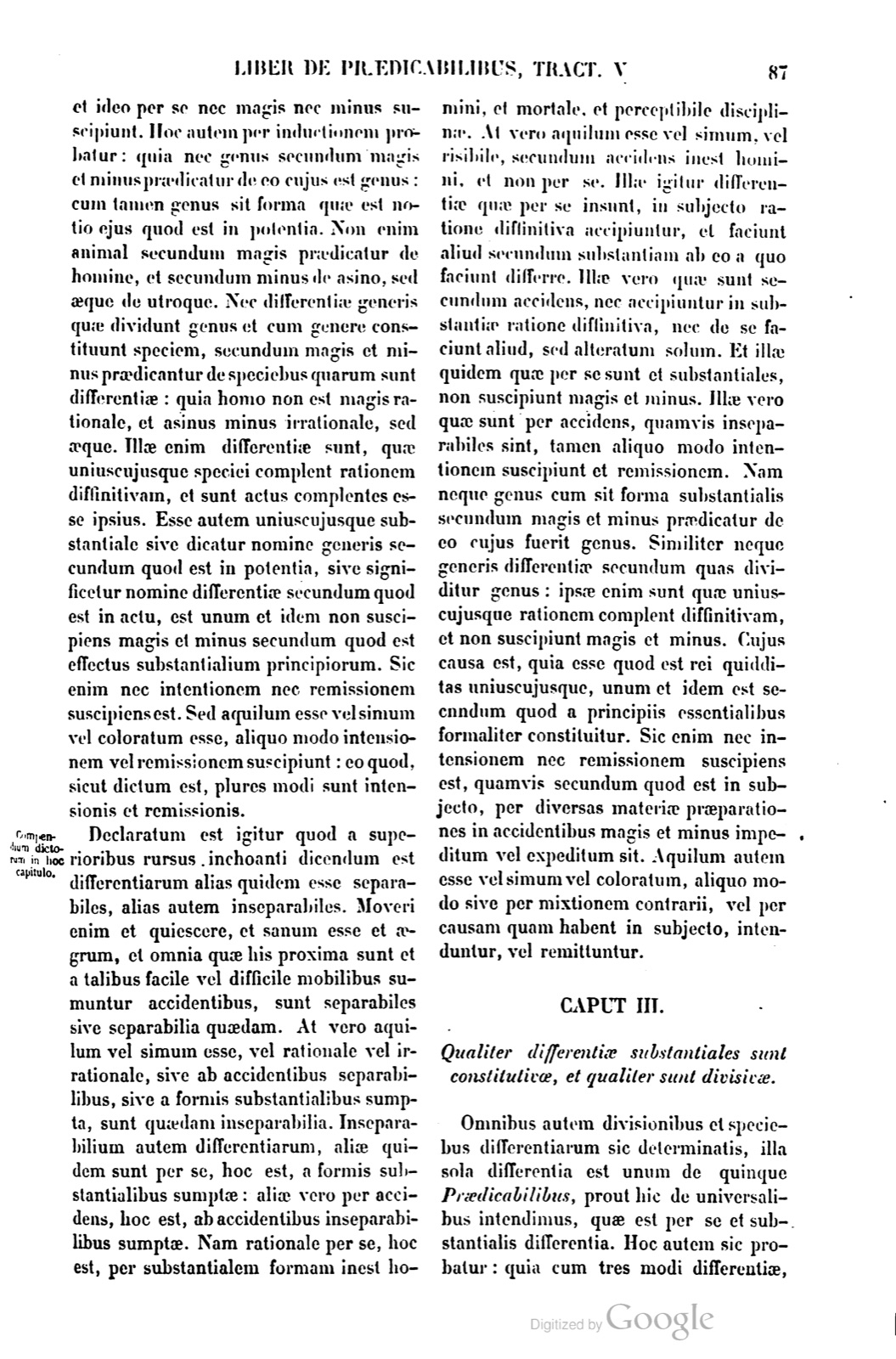
Declaratum est igitur quod a superioribus rursus inchoanti dicendum est differentiarum alias quidem esse separabiles, alias autem inseparabiles. Moveri enim et quiescere, et sanum esse et aegrum, et omnia quae his proxima sunt et a talibus facile vel difficile mobilibus sumuntur accidentibus, sunt separabiles sive separabilia quaedam. At vero aquilum vel simum esse, vel rationale vel irrationale, sive ab accidentibus separabilibus, sive a formis substantialibus sumpta, sunt quaedam inseparabilia. Inseparabilium autem differentiarum, aliae quidem sunt per se, hoc est, a formis substantialibus sumptae; aliae vero per accidens, hoc est, ab accidentibus inseparabilibus sumptae. Nam rationale per se, hoc est, per substantialem formam inest homini, et mortale, et perceptibile disciplinae. At vero aquilum esse vel simum, vel risibile, secundum accidens inest homini, et non per se. Illae igitur differentiae quae per se insunt, in subjecto ratione diffinitiva accipiuntur, et faciunt aliud secundum substantiam ab eo a quo faciunt differre. Illae vero quae sunt secundum accidens, nec accipiuntur in substantiae ratione diffinitiva, nec de se faciunt aliud, sed alteratum solum. Et illae quidem quae per se sunt et substantiales, non suscipiunt magis et minus. Illae vero quae sunt per accidens, quamvis inseparabiles sint, tamen aliquo modo intentionem suscipiunt et remissionem. Nam neque genus cum sit forma substantialis secundum magis et minus praedicatur de eo cujus fuerit genus. Similiter neque generis differentiae secundum quas dividitur genus: ipsae enim sunt quae uniuscujusque rationem complent diffinitivam, et non suscipiunt magis et minus. Cujus causa est, quia esse quod est rei quidditas uniuscujusque, unum et idem est secundum quod a principiis essentialibus formaliter constituitur. Sic enim nec intensionem nec remissionem suscipiens est, quamvis secundum quod est in subjecto, per diversas materiae praeparationes in accidentibus magis et minus impeditum vel expeditum sit. Aquilum autem esse vel simum vel coloratum, aliquo modo sive permixtionem contrarii, vel per causam quam habent in subjecto, intenduntur, vel remittuntur.
Therefore it has been declared that for one beginning again from the higher things, one must say that of differences some are separable, while others are inseparable. For to be moved and to be at rest, and to be healthy and ill, and all things which are near to these and are taken from such accidents movable easily or with difficulty, are separable or certain separable things. But to be aquiline or snub, or rational or irrational, whether taken from separable accidents or from substantial forms, are certain inseparable things. But of inseparable differences, some are per se, that is, taken from substantial forms, while others are by accident, that is, taken from inseparable accidents. For rational belongs to man per se, that is, through substantial form, and mortal, and perceptive of discipline. But to be aquiline or snub or risible belongs to man according to accident and not per se. Therefore those differences which are in a subject per se are taken in the definitive account, and make that from which they make a thing differ other according to substance. But those which are according to accident are neither taken in the definitive account of substance nor of themselves make another thing, but only an altered thing. And those which are per se and substantial do not receive more and less. But those which are by accident, although they are inseparable, nevertheless receive intension and remission in some way. For neither is genus, since it is substantial form, predicated according to more and less of that of which it is the genus. Likewise neither are the differences of genus according to which genus is divided; for they are what complete the definitive account of each thing, and they do not receive more and less. The cause of this is that the being which is the quiddity of each thing is one and the same according as it is formally constituted by essential principles. For thus it receives neither intension nor remission, although according as it is in a subject, through diverse preparations of matter, it may be impeded or made ready in accidents more and less. But to be aquiline or snub or colored is intensified or remitted in some way, either through mixture of the contrary or through the cause which they have in the subject.
If a page does not appear, its photograph has not been uploaded yet.