Volume 1 · pp. 77–79
Chapter VII. On the mode of the predicables which are predicated.
A marker with ≈ is an approximate page boundary, placed by measure of the text; the page photographs remain the authority. In the paired views, clicking a page marker brings that page into view.
CAPUT VII.
De modo praedicabilium quae praedicantur.
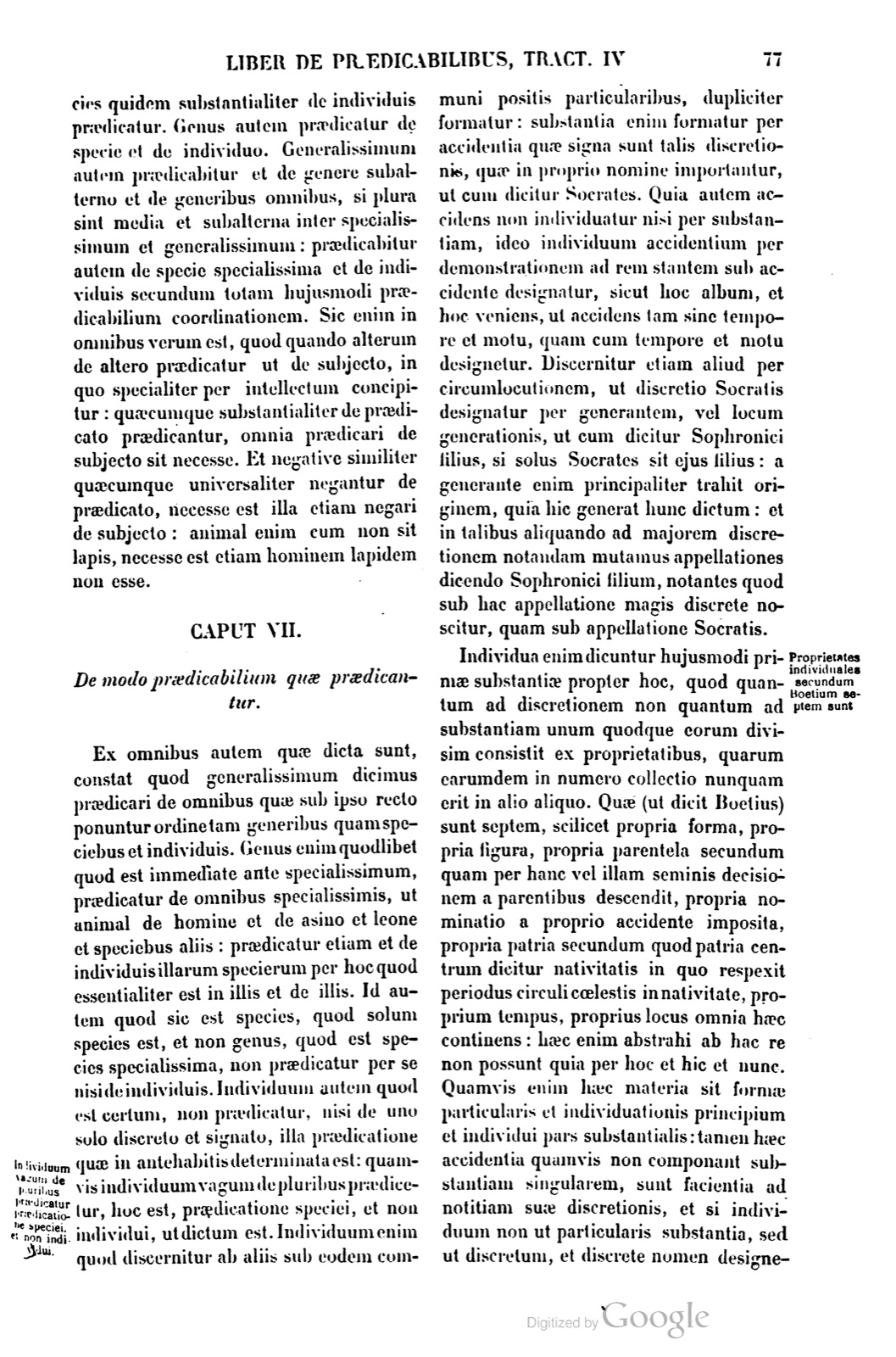
Ex omnibus autem quae dicta sunt, constat quod generalissimum dicimus praedicari de omnibus quae sub ipso recto ponuntur ordine tam generibus quam speciebus et individuis. Genus enim quodlibet quod est immediate ante specialissimum, praedicatur de omnibus specialissimis, ut animal de homine et de asino et leone et speciebus aliis: praedicatur etiam et de individuis illarum specierum per hoc quod essentialiter est in illis et de illis. Id autem quod sic est species, quod solum species est, et non genus, quod est species specialissima, non praedicatur per se nisi de individuis. Individuum autem quod est certum, non praedicatur, nisi de uno solo discreto et signato, illa praedicatione quae in antehabitis determinata est: quamvis individuum vagum de pluribus praedicetur, hoc est, praedicatione speciei, et non individui, ut dictum est. Individuum enim quod discernitur ab aliis sub eodem communi positis particularibus, dupliciter formatur: substantia enim formatur per accidentia quae signa sunt talis discretionis, quae in proprio nomine importantur, ut cum dicitur Socrates. Quia autem accidens non individuatur nisi per substantiam, ideo individuum accidentium per demonstrationem ad rem stantem sub accidente designatur, sicut hoc album, et hoc veniens, ut accidens tam sine tempore et motu, quam cum tempore et motu designetur. Discernitur etiam aliud per circumlocutionem, ut discretio Socratis designatur per generantem, vel locum generationis, ut cum dicitur Sophronici filius, si solus Socrates sit ejus filius: a generante enim principaliter trahit originem, quia hic generat hunc dictum: et in talibus aliquando ad majorem discretionem notandam mutamus appellationes dicendo Sophronici filium, notantes quod sub hac appellatione magis discrete noscitur, quam sub appellatione Socratis.
Individua enim dicuntur hujusmodi primae substantiae propter hoc, quod quantum ad discretionem non quantum ad substantiam unum quodque eorum divisim consistit ex proprietatibus, quarum earumdem in numero collectio nunquam erit in alio aliquo. Quae, ut dicit Boetius, sunt septem, scilicet propria forma, propria figura, propria parentela secundum quam per hanc vel illam seminis decisionem a parentibus descendit, propria nominatio a proprio accidente imposita, propria patria secundum quod patria centrum dicitur nativitatis in quo respexit periodus circuli coelestis in nativitate, proprium tempus, proprius locus omnia haec continens: haec enim abstrahi ab hac re non possunt quia per hoc et hic et nunc. Quamvis enim haec materia sit formae particularis et individuationis principium et individui pars substantialis: tamen haec accidentia quamvis non componant substantiam singularem, sunt facientia ad notitiam suae discretionis, et si individuum non ut particularis substantia, sed ut discretum, et discrete nomen designetur: tunc accidentia sunt nomina in ratione concepta, et de essentia individui sic designati: quamvis non sint aliqua pars particularis substantiae secundum quod substantia est, haec enim non componitur nisi ex hac forma.
CHAPTER VII.
On the mode of the predicables which are predicated.
But from all the things which have been said, it is established that we say the most general is predicated of all things which are placed under it in right order, both genera and species and individuals. For every genus which is immediately before the most special is predicated of all most special species, as animal is predicated of man and of ass and lion and other species; it is also predicated of the individuals of those species through this, that it is essentially in them and of them. But that which is species in such a way that it is only species and not genus, which is the most special species, is not predicated per se except of individuals. But the individual which is determinate is not predicated except of one thing alone, discrete and designated, by that predication which has been determined above; although the vague individual is predicated of several things, that is, by the predication of species and not of the individual, as was said. For the individual which is discerned from other particulars placed under the same common thing is formed in two ways. Substance is formed through accidents which are signs of such discreteness, which are conveyed in the proper name, as when Socrates is said. But because accident is not individuated except through substance, therefore the individual of accidents is designated through demonstration toward a thing standing under the accident, as this white thing and this coming thing, so that an accident may be designated both without time and motion and with time and motion. Another is also discerned by circumlocution, as the discreteness of Socrates is designated through his generator or the place of generation, as when he is called the son of Sophroniscus, if Socrates alone is his son; for from the generator he principally draws origin, because this one generates this said one. And in such cases, sometimes, for marking greater discreteness, we change appellations by saying son of Sophroniscus, noting that under this appellation he is known more distinctly than under the appellation Socrates.
Individuals of this sort are called first substances for this reason, that with respect to discreteness, not with respect to substance, each one of them consists separately from properties, of which the collection of the same in number will never be in any other. These, as Boethius says, are seven, namely proper form, proper figure, proper parentage according to which through this or that separation of seed one descends from parents, proper naming imposed from a proper accident, proper homeland according as homeland is called the center of nativity in which the period of the heavenly circle looked upon one in nativity, proper time, and proper place containing all these. For these cannot be abstracted from this thing because through this both here and now. For although this matter is the principle of particular form and individuation and a substantial part of the individual, nevertheless these accidents, although they do not compose the singular substance, are things making for the knowledge of its discreteness; and if the individual is designated not as particular substance but as discrete, and its name as discrete, then accidents are names conceived in its account and belong to the essence of the individual so designated, although they are not any part of particular substance according as it is substance; for this is composed only from this form.
Sed proprietates quae sunt communis hominis per hoc quod communis homo est in pluribus, inveniuntur etiam in pluribus, ut risibile, et mansuetum natura, et disciplinae perceptibile, et hujusmodi. Haec enim in pluribus, et plus est, in omnibus hominibus particularibus inveniuntur: sunt enim in eis per commune quod est in eis, et ideo conveniunt eis in eo quod homines sunt. Directo enim praedicabilium ordine continetur individuum sub homine, sive generaliter loquendo sub specie. Species autem continetur sub genere. Est enim genus totum quoddam universale, et id quod est genus secundum quod genus est, non nisi totum. Individuum autem non est totum, sed tantum pars subjectiva totius universalis. Species vero quae est in medio, est inter genus et individuum, et totum est et pars diversis comparata: sed pars quidem alterius generis quod est totum ad ipsam. Species enim pars est generis potestate: quia genus non secundum totam suam potestatem est in specie. Totum autem est species, non totius alicujus: quia nihil participat eam secundum partem suae potestatis, sicut ipsa species participat genus, sed est totum omnibus aliis individuis: quia ipsa species, ut dicit Boetius, totum esse est in individuis. Nec referuntur individua ad speciem ut partes ipsius, sed potius ut singularia secundum totum esse et potestatem, in se habentia speciem et participantia.
Compendiose ergo dicendo generalissimum quidem de omnibus sub se secundum suam coordinationem positis speciebus, generibus, et individuis dicimus sive praedicamus. Genus autem subalternum, quod ante specialissimum de omnibus specialissimis et individuis praedicamus. Species autem praedicamus de individuis omnibus sub se positis. Individuum vero de uno solo non propria praedicatione praedicamus. Individuum enim sub descriptione nominatum Socrates, vel in accidentibus hoc album vel hoc nomen per demonstrationem vel per circumlocutionem manifestioris loquelae Sophronici filius: si enim plures haberet, tunc tali circumlocutione non discerneretur Socrates. Individua ergo voce discretionis dicuntur hujusmodi: quoniam quantum ad suam discretionem ex talibus proprietatibus consistit unumquodque eorum, quorum collectio nunquam in alio eadem erit. Socratis enim discretiva proprietas nunquam in aliquo alio esset particulari homine. Hae vero proprietates quae sunt communes proprietates, erunt eaedem in pluribus. Illae enim sunt proprietates communis et non singularis secundum quod singulare est. Et, ut plus dicatur, communis hominis proprietates sunt in omnibus in quibus est una natura communis: participantia enim naturam communem, participant etiam propria illam naturam consequentia. Tales ergo hominis communes proprietates erunt in omnibus particularibus in eo quod homines sunt. Secundum ergo praedictum praedicabilium ordinem continetur individuum sub specie, species autem sub genere. Est enim genus totum quoddam in quantum genus est. Individuum autem secundum quod individuum est, pars quaedam. Species vero est et totum et pars. Sed pars quidem est alterius, hoc est, generis quod secundum partem suae potestatis participat: totum autem non est alterius quod ipsius partem participet, sed est totum aliis: partibus enim totum est, quarum quaelibet ipsum totum participat.
But the properties which belong to common man, through the fact that common man is in several, are also found in several, such as risible, gentle by nature, perceptive of discipline, and things of this sort. For these are found in several, and more than this, in all particular men; for they are in them through the common thing which is in them, and therefore they belong to them in that they are men. For in the direct order of predicables the individual is contained under man, or speaking generally, under species. But species is contained under genus. For genus is a certain universal whole, and that which is genus according as it is genus is nothing except whole. But the individual is not a whole, but only a subjective part of the universal whole. But species, which is in the middle, is between genus and individual, and is both whole and part when compared to diverse things: but it is a part of another, namely of genus, which is a whole toward it. For species is a part of genus in power, because genus is not in species according to its whole power. But species is a whole, not of some whole, because nothing participates it according to a part of its power, as the species itself participates genus, but it is a whole to all other individuals; because the species itself, as Boethius says, is the whole being in individuals. Nor are individuals referred to species as its parts, but rather as singulars having and participating species in themselves according to the whole being and power.
Therefore, speaking compendiously, we say or predicate the most general of all species, genera, and individuals placed under it according to its coordination. But we predicate the subaltern genus, which is before the most special, of all most special species and individuals. But we predicate species of all individuals placed under it. But the individual we predicate of one alone, not by proper predication. For the individual named under description is Socrates, or in accidents this white thing or this name through demonstration, or through circumlocution of a more manifest speech, son of Sophroniscus; for if he had several sons, then Socrates would not be discerned by such a circumlocution. Therefore individuals are called by the word of discreteness in this way, because with respect to its own discreteness each one of them consists from such properties, the collection of which will never be the same in another. For the property distinguishing Socrates would never be in some other particular man. But these properties which are common properties will be the same in several. For those are properties of the common and not of the singular according as it is singular. And, to say more, the properties of common man are in all in which there is one common nature; for things participating the common nature also participate the properties consequent upon that nature. Therefore such common properties of man will be in all particulars insofar as they are men. Therefore according to the aforesaid order of predicables, the individual is contained under species, but species under genus. For genus is a certain whole insofar as it is genus. But the individual, according as it is an individual, is a certain part. But species is both whole and part. It is indeed a part of another, that is, of genus, which it participates according to a part of its power; but it is not a whole of another thing which participates a part of it, but it is a whole to others, for it is a whole to parts, each of which participates the whole itself.
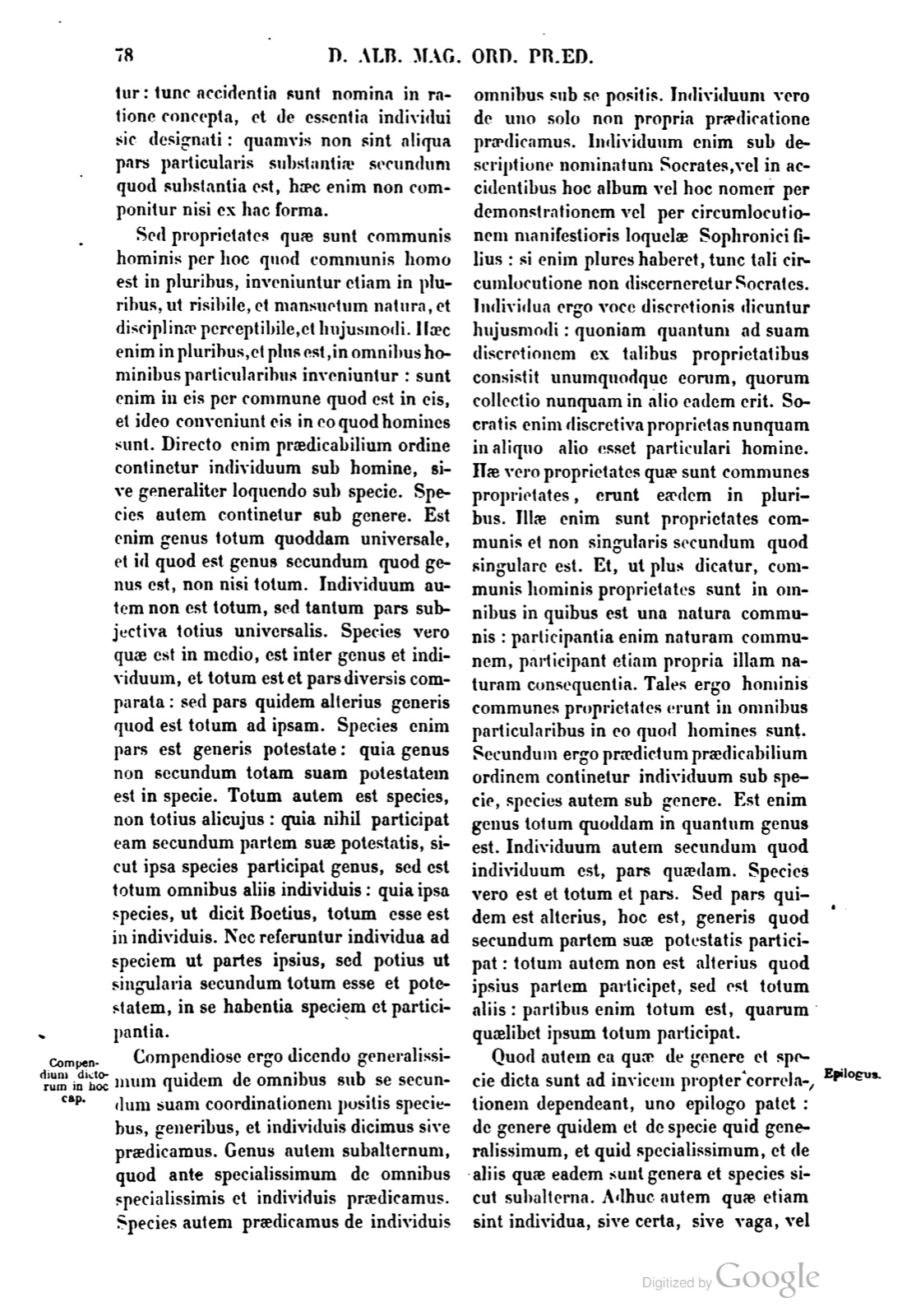
Quod autem ea quae de genere et specie dicta sunt ad invicem propter correlationem dependeant, uno epilogo patet: de genere quidem et de specie quid generalissimum, et quid specialissimum, et de aliis quae eadem sunt genera et species sicut subalterna. Adhuc autem quae etiam sint individua, sive certa, sive vaga, vel per demonstrationem vel circumlocutionem certificata. Adhuc autem quot modis genus dicitur, et quot modis species dicitur, quantum ad praesentem spectat intentionem logicam, sufficienter dictum est.
But that the things said about genus and species depend upon one another because of correlation is clear in one epilogue: concerning genus and species, what the most general is, and what the most special is, and concerning others which are the same things as genera and species, as subalterns. Further, also what individuals are, whether determinate or vague, or made determinate through demonstration or circumlocution. Further, in how many ways genus is said, and in how many ways species is said, has been said sufficiently as far as the present logical intention is concerned.

If a page does not appear, its photograph has not been uploaded yet.