Volume 1 · pp. 80–84
Tractate V. On Difference. Chapter I. On the distinction of the name of difference, which is said in many ways.
A marker with ≈ is an approximate page boundary, placed by measure of the text; the page photographs remain the authority. In the paired views, clicking a page marker brings that page into view.
TRACTATUS V.
DE DIFFERENTIA.
CAPUT I.
De distinctione nominis differentiae quod multipliciter dicitur.
Consequenter de universali quod differentia vocatur, pertractare est. Haec enim quia constituit speciem, et praedicatur de specie et de ratione diffinitiva ipsius speciei, ideo ante speciem erat ponenda, nisi obstitisset correlatio ad invicem speciei ad genus, et generis ad speciem, quemadmodum in prae habitis dictum est. Antequam autem notificemus differentiam quae sola una est de quinque universalibus, et determinemus de ipsa, oportet nos distinguere multiplicitatem nominis differentiae: haec enim multipliciter dicitur secundum prius et posterius.
Differentia igitur multipliciter dicitur, ut dicit Avicenna, non sicut genus et species: quia in genere et specie primo fuit usus horum nominum in physicis et politicis, et ab illis haec nomina ad usum philosophiae sumpta sunt. Sed in differentia factum est e converso. Nomen enim differentiae primo fuit in usu Philosophorum, et ab illa transsumptum est ad usum communiter loquentium. Haec igitur est causa vera, quod multipliciter dicitur nomen differentiae, communiter scilicet, proprie, et magis proprie.
Communiter autem dicitur differentia, quae est apud communiter loquentes considerando ea quae sensibus primo objiciuntur. Communiter ergo alterum ab altero differre differentia dicitur, quando unum ab altero alteritate quadam cujuscumque communiter apprehensibilis accidentis differre dicitur, quocumque modo secundum omnia genera formarum accidentium. Nec tales differentiae communes ideo dicuntur, quia rebus insint communiter quas faciunt differre: si enim sic esset, non dicerentur differentiae, sed convenientiae. Sed dicuntur differentiae communiter, quia a communiter loquentibus sunt in usu. Vulgus enim assignando differentias rerum, talibus res differre facit, qualia forinsecus in rebus per sensum communiter apprehendit.
Sic autem in tali differentia individuum unius speciei differt ab alio individuo ejusdem speciei, ut Socrates a Platone differt accidentium sensibilium alteritate quadam, sicut dicit Apulejus, quod Plato latus fuit facie, Socrates autem non. Haec etiam differentia unum individuum unius speciei differt a seipso in duobus temporibus, sicut Socrates jam vir vel senex existens, differt a se puero per accidentia juventutis et senectutis, quae non cito derelinquunt subjectum. Sic etiam Socrates differt a seipso quando aliquid facit, scribit, vel legit, quiescente seipso a tali opere, quae sunt accidentia cito separabilia. Et ut generaliter dicatur, haec differentia semper consideratur secundum aliquem modum diversimode se habendi ad seipsum, vel ad alium alteritatibus quibuscumque: vel cujuslibet generis accidentia cito vel non cito separabilia. Haec igitur est acceptio differentiae secundum intentionem nominis dicta apud communiter loquentes: propter quod etiam communis vocatur differentia, hoc est, quam attendunt communiter loquentes.
Juxta istum modum magis vicine ad verum modum accipitur differentia quae vocatur propria: eo quod ei in quo est, per causam connaturalem est appropriata, ut quando unum differre dicitur ab altero per accidens inseparabile: quod ideo inseparabile est, quia causam habet quae est in subjecto in quo est, sicut est nasi simitas in simo, cujus nasus simiae comparatur: vel cicatrix aliqua indurata vel inseparabilis, cum ex vulnere occaluerit: simitas enim inest per naturam, sed cicatricem habens differt ab eo qui cicatricem non habet, et aliquando idem cicatricem habens nunc a seipso antequam cicatricem haberet. Haec autem dicitur propria: quia per aliquam rationem accedit ad illam, quae vero nomine differentia vocatur: haec enim quamvis non sit de essentia ejus in quo est et quod differre facit, habet tamen causam in essentialibus ipsius sive sint essentialia complexioni, sive sint essentialia compositioni ipsius, et sic accedet ad verae differentiae rationem. Quando autem dicimus, quod talis differentia causam habet in subjecto in quo est, et quod differre facit, non intelligimus de subjecto quod est specie tantum, sed de illo in numero subjecto in quo est id quod differre facit, sicut simitas in naso, vel claudicatio in tibia. Hanc differentiam considerare per rationem necesse est: et ideo jam ad usum verum differentiae, secundum modum quo philosophia utitur differentia, appropinquat.
TRACTATE V.
ON DIFFERENCE.
CHAPTER I.
On the distinction of the name of difference, which is said in many ways.
Consequently one must treat the universal which is called difference. For because this constitutes species and is predicated of species and of the definitive account of the species itself, it had therefore to be placed before species, unless the correlation of species to genus and of genus to species with one another had stood in the way, as was said in the preceding matters. But before we make known the difference which alone is one of the five universals, and determine concerning it, we must distinguish the multiplicity of the name difference; for this is said in many ways according to prior and posterior.
Therefore difference is said in many ways, as Avicenna says, not as genus and species are. For in genus and species the use of these names was first in physical and political matters, and from those these names were taken over to the use of philosophy. But in difference the reverse occurred. For the name of difference was first in the use of the Philosophers, and from that it was transferred to the use of common speakers. This therefore is the true cause why the name difference is said in many ways, namely commonly, properly, and more properly.
But difference is said commonly as it exists among common speakers considering those things which are first presented to the senses. Therefore one thing is commonly said to differ from another by difference when one thing is said to differ from another by some otherness of any commonly apprehensible accident, in whatever way, according to all genera of forms of accidents. Nor are such differences called common for this reason, that they are commonly in the things which they make to differ; for if it were so, they would not be called differences, but agreements. Rather, they are called differences commonly because they are in use among common speakers. For the multitude, in assigning differences of things, makes things differ by such things as it commonly apprehends externally in things through sense.
But in such a difference an individual of one species differs from another individual of the same species, as Socrates differs from Plato by a certain otherness of sensible accidents, as Apuleius says, that Plato was broad in face, but Socrates was not. This difference also makes one individual of one species differ from itself in two times, as Socrates, now existing as a man or an old man, differs from himself as a boy through the accidents of youth and old age, which do not quickly leave the subject. Thus Socrates also differs from himself when he does something, writes, or reads, while he is at rest from such a work; these are quickly separable accidents. And to speak generally, this difference is always considered according to some mode of being disposed in diverse ways toward itself, or toward another by any othernesses whatever, or by accidents of any genus, quickly or not quickly separable. This therefore is the acceptance of difference according to the intention of the name spoken among common speakers; on account of this it is also called common difference, that is, the difference to which common speakers attend.
Next to this mode, a difference which is called proper is received more nearly to the true mode, because it is appropriated to that in which it is through a connatural cause, as when one thing is said to differ from another through an inseparable accident. This is inseparable for this reason, that it has a cause which is in the subject in which it is, as is the snubness of the nose in a snub thing, whose nose is compared to that of a monkey; or some hardened or inseparable scar, when it has become calloused from a wound. For snubness is present by nature, but one having a scar differs from one who does not have a scar, and sometimes the same one having a scar now differs from himself before he had the scar. But this is called proper because by some account it approaches that which is truly called by the name difference. For this, although it is not of the essence of that in which it is and which it makes to differ, nevertheless has its cause in the essentials of that thing, whether they are essentials of its complexion or essentials of its composition, and thus it will approach the account of true difference. But when we say that such a difference has a cause in the subject in which it is and which it makes to differ, we do not understand this of the subject which is species only, but of that numerically one subject in which that which makes it differ exists, as snubness in the nose or lameness in the shin. It is necessary to consider this difference by reason; and therefore it now approaches the true use of difference, according to the mode in which philosophy uses difference.
Secundum autem modum magis et maxime proprium alterum ab altero differre dicitur: quoniam sub alia et universali et specifica differentia differt, sicut differt homo ab equo specifica differentia: quae quidem differentia est qualitas essentialis hominis, quae ratio dicitur. Haec enim differentia quamvis sit forma essentialis hominis, tamen est qualitas naturalis generis et perfectiva potentiae ipsius et determinativa communitatis et confusionis ejus, ut dicit Avicenna, et ideo substantialis est speciei, et substantia et principium substantiae sicut forma: et perfectiva est materiae, et determinativa confusionis ejus, et principium rei quae composita est ex materia et forma.
Igitur ista distinctio differentiae vel divisio est multipliciter dicti per analogiam ad unum actum qui est facere differre unum ab altero: qui quidem convenit verae, hoc est, secundum veram rationem differentiae magis propriae, aliis autem secundum quod plus vel minus faciunt differre. Et ideo prima differentia vocatur simpliciter ea quae dicitur magis propria, secundario illa quae vocatur propria, tertio autem illa quae vocatur communis. Quoad nos autem per prius dicitur differentia quae communis est: propter hoc quod prima facie notitiae nostrae se objicit. Secundario autem dicitur ea quae dicitur propria: quia minus communiter est apprehensibilis. Ultimo vero quae paucioribus substantia et intellectu utentibus innotescit.
Hac igitur divisione sic posita, per proprios effectus uniuscujusque membri declaremus partes hoc commune dividentes, quod est differentia. Dicamus igitur, quod in hoc conveniunt duae primae, ea scilicet quae est communiter differentia, et ea quae est proprie vocata differentia, quod id in quo sunt et differre faciunt per id quod est causa differentiae, non faciunt suum subjectum nisi solum alteratum quando cuilibet subjecto adveniunt. Illa autem differentia quae est magis propria per id quod est causa differendi, facit aliud in substantia esse id quod differt ab eo a quo differt.
But according to the more and most proper mode, one thing is said to differ from another because it differs under another universal and specific difference, as man differs from horse by a specific difference. This difference indeed is the essential quality of man, which is called reason. For this difference, although it is the essential form of man, nevertheless is the natural quality of the genus and perfective of its potency and determinative of its commonness and confusion, as Avicenna says; and therefore it is substantial of the species, and substance and the principle of substance as form; and it is perfective of matter, and determinative of its confusion, and the principle of the thing which is composed from matter and form.
Therefore this distinction or division of difference is of what is said in many ways by analogy to one act, which is to make one thing differ from another. This indeed belongs to the true difference, that is, to the more proper difference according to the true account; but to the others it belongs according as they make a thing differ more or less. And therefore the first difference is called simply that which is called more proper, secondarily that which is called proper, and thirdly that which is called common. But as regards us, the difference which is common is said prior, because it presents itself to our knowledge at first appearance. Secondarily that which is called proper is said, because it is less commonly apprehensible. Last is that which becomes known to fewer persons using substance and intellect.
Therefore, with this division thus posited, let us declare through the proper effects of each member the parts dividing this common thing, which is difference. Let us therefore say that the two first agree in this, namely that which is difference commonly, and that which is properly called difference, that the thing in which they are and which they make to differ, through that which is the cause of difference, they make their subject nothing except only altered when they come to any subject. But that difference which is more proper, through that which is the cause of differing, makes that which differs from that from which it differs to be other in substance.
Concluditur ergo proprius effectus differentiarum, quod differentiarum quaedam per id quod faciunt differre, faciunt alteratum esse solum id quod differt ab eo a quo differt. Aliae vero per id quod differre facit, faciunt aliud in substantia esse quod differt ab eo a quo differt. Hujus autem causa est, quia differentia communis et propria non faciunt differre nisi per accidens, quod aut habet causam in subjecto, aut non habet causam in subjecto: et quocumque modo sit accidens, nullo modo potest esse perfectivum vel constitutivum substantiae: et ideo per se non potest facere aliud, quia aliud non est nisi quod secundum substantiam est aliud. Et quamvis simum et aquilum sit aliud per substantiam nasi, hoc tamen non est per simitatem et aquilinitatem quae sunt accidentia, sed potius per diversitatem substantiae simi nasi, et per substantiam nasi aquili: sicut risibile et hinnibile differunt per substantiam, sed hujus differentiae non est causa risibile vel hinnibile, sed formae specificae, et differentiae substantiales, quibus substantialiter differunt homo et equus.
Ex hoc autem iterum surgit istarum differentiarum dividentium manifestatio, quod illae quidem differentiae quae faciunt aliud in substantia et specie per id quod facit differre, dicuntur esse specificae differentiae, hoc est, ad speciem pertinentes et in specie constituentes. Illae vero quae alteratum solum faciunt, dicuntur simpliciter differentiae: non ita quod nomen differentiae praedicetur simpliciter de illis ratione absoluta et perfecta, sed quia super nomen differentiae nihil addunt quod ponat eas in formam verae et propriae differentiae: sicut cum dicimus, quod ens in potentia dicitur simpliciter ens, non ita dicimus hoc, quod ens in potentia entis simpliciter habeat nomen vel rationem, cum sit ens secundum quid et non simpliciter, sed dicitur ens simpliciter, hoc est, sine determinatione alicujus per quod ad ens actu trahatur et determinetur.
Hoc autem quod dictum est manifestatur exemplariter: quia huic generi quod est animal, rationale adveniens in diffinitione hominis vel Dei facit id quod in substantia est alicujus aliud ab eo a quo differt per illam differentiam, facit enim rationale animal, et facit speciem subalternam animal. Illa vero quae est communiter differentia per id quod est causa differentiae, ut movendi quo differt aliquis a quiescente, non facit nisi alteratum et non aliud, quantum est de eo quod est causa differentiae quod est separabile accidens. Concludit ergo quod quaedam differentiarum facit aliud secundum substantiam, quaedam autem non facit nisi alteratum.
Ex his igitur ostenditur, quod in prooemio istius libri dictum est, quod scilicet notitia universalium valet et utilis est ad divisiones et ad diffinitiones: quia secundum differentias quae faciunt aliud, divisiones faciunt genera in species: et secundum easdem et per easdem diffinitiones specierum assignantur, eo quod diffinitiones verae sunt ex genere et talibus differentiis. Sed secundum eas quae solum faciunt alteratum et non aliud, alteratio sola in accidente consistit generaliter dicta secundum omne accidens et secundum aliquem modum se habendi per mutationes secundum omne genus praedicamenti, sive in ipso sit motus per se, sive ad ipsum sit motus per accidens. Alteratio enim proprie solum est in una specie qualitatis quae est passio vel passibilis qualitas. Motus autem per se non est nisi in tribus praedicamentis quae sunt qualitas, quantitas, et ubi. Per accidens etiam in omnibus est, ut dicit Aristoteles 1, et hoc modo dicimus communiter sumi penes alterationem accidentalem quamcunque sive sit per se sive per accidens: quia sequitur actum differentiae, qui est differre facere unum ab alio, vel idem a seipso.
Therefore the proper effect of differences is concluded: that certain differences, through that by which they make to differ, make only altered the thing which differs from that from which it differs. But others, through that which makes to differ, make that which differs from that from which it differs to be other in substance. The cause of this is that common and proper difference do not make a thing differ except through accident, which either has a cause in the subject or does not have a cause in the subject. And in whatever way it is an accident, in no way can it be perfective or constitutive of substance; and therefore through itself it cannot make another thing, because another thing is only that which is other according to substance. And although a snub thing and an aquiline thing are other through the substance of the nose, nevertheless this is not through snubness and aquilinity, which are accidents, but rather through the diversity of the substance of a snub nose and through the substance of an aquiline nose; just as risible and neigh-capable differ through substance, but risible or neigh-capable is not the cause of this difference, but specific forms and substantial differences are, by which man and horse differ substantially.
From this again arises the manifestation of those differences which divide: namely that those differences which make another thing in substance and species through that which makes to differ are said to be specific differences, that is, pertaining to species and constituting in species. But those which make only an altered thing are called differences simply; not in such a way that the name difference is predicated simply of them by an absolute and perfect account, but because they add nothing beyond the name difference which would place them in the form of true and proper difference. This is as when we say that being in potency is called simply being; we do not say this as though being in potency had the name or account of being simply, since it is being in a qualified respect and not simply, but it is called being simply, that is, without the determination of something through which it is drawn and determined to being in act.
But what has been said is manifested by example: because when rational comes to this genus which is animal in the definition of man or of God, it makes that which is in the substance of someone other than that from which it differs through that difference; for it makes rational animal, and it makes a subaltern species animal. But that which is difference commonly, through that which is the cause of difference, as moving by which someone differs from one at rest, makes only an altered thing and not another thing, as far as belongs to that which is the cause of difference, which is a separable accident. Therefore he concludes that one kind of difference makes another thing according to substance, while another kind makes only an altered thing.
From these things therefore it is shown that what was said in the proemium of this book, namely that knowledge of universals is valuable and useful for divisions and for definitions, is true, because according to differences which make another thing, divisions make genera into species, and according to the same and through the same the definitions of species are assigned, since true definitions are from genus and such differences. But according to those which only make an altered thing and not another thing, alteration alone, broadly and universally said, consists in accident, according to every accident and according to some mode of being disposed through changes according to every genus of category, whether motion is in it per se or motion is toward it by accident. For alteration properly is only in one species of quality, which is passion or passible quality. But motion per se is only in three categories, which are quality, quantity, and where. Yet by accident it is also in all, as Aristotle says 1, and in this way we say that it is commonly taken according to any accidental alteration whatever, whether it is per se or by accident, because it follows the act of difference, which is to make one differ from another, or the same from itself.
Sumuntur enim differentiae istae ab accidentibus communibus sive propriis. Et hujusmodi accidentis triplex consideratio est: si enim in se consideretur, tunc est accidens vel proprium, quae sunt duo de quinque universalibus e diverso dividentia cum differentia hoc commune quod est universale: et sic nec differentia est accidens, nec proprium. Considerantur etiam in comparatione ad subjectum in quo sunt, et sic sunt comparata ad sua singularia de quibus praedicantur, et est similis comparatio sicut speciei ad individua. Considerantur etiam secundum quod per ea est convenientia vel differentia ad illa comparata, et sic ab ipsis sumuntur duo differentiae modi, qui sunt communis, et propria differentia.
Illa autem differentia quae facit aliud, sumitur a forma specifica, quae etiam tripliciter consideratur, in se scilicet prout est substantia quae est forma substantiam faciens, et prout est in specie constituta, et sic est specificata: et prout per ipsam id quod ea formatum est comparatur ad aliud secundum convenientiam vel differentiam, et hoc solum modo differentia vocatur, primo autem modo forma, secundo vero modo species, secundum quam species unum est quinque universalium, dividens hoc commune quod est universale cum differentia et aliis universalibus.
Et ista quidem differentia est unum ex quinque universalibus, cujus assignationem secundum diffinitionem primam dat Avicenna dicens, quod est universale simplex praedicatum de specie in quale quid. Haec enim est differentia magis proprie vocata differentia, quae aliud facit, et non alteratum. Dico autem alteratum vel qualitate accidentali vel essentiali. Sed differentia magis propria non tantum alteratum, sed etiam facit aliud, quia alteratum qualitate essentiali aliud factum est. Haec est igitur differentia magis propria, quae est unum de quinque universalibus in quale praedicatum de specie: eo quod differentia qualitas substantialis est generis: sicut qualitas non substantialis, sed ex substantialibus manans sive fluens, est proprium: et sicut qualitas individui accidentalis non ex substantialibus fluens, est accidens commune.
Nec valet argumentum si quis objiciat: Differentia substantialis facit alteratum: id autem quod alteratum facit, est accidens proprium: ergo differentia substantialis est accidens vel proprium. Quia alteratum esse contingit dupliciter, qualitate scilicet essentiali vel accidentali, arguit autem ac si solum qualitate accidentali fieret alteratum. Haec omnia autem dicta, sunt ab antiquis sub compendio comprehensa tali modo, quod differentia communiter, et proprie, et magis proprie dicitur, secundum divisionem multiplicis, quod medium est inter aequivocum et univocum. Communiter autem differre alterum ab altero dicitur, quando alteritate quadam differt: et quocumque modo cujuscumque accidentis quod est causa differentiae vel a seipso in diverso tempore: differt enim Socrates a Platone alteritate quadam cujuscumque accidentis quod est in Socrate, et non in Platone. Et ipse Socrates differt a seipso in diversis temporibus: sicut Socrates jam vir factus, differt a se puero: sicut Socrates faciens aliquid, differt a seipso quiescente a tali opere. Et causa hujus differentiae est propter aliquem modum se habendi in aliquo accidente, quod alteritatibus aliquibus per se vel per accidens inducitur. Proprie autem differre dicitur alterum ab altero, quando inseparabili accidente alterum ab altero differt: et ideo inseparabili, quia causam inseparabilem habet in subjecto: unde quamvis inseparabile sit actu, tamen est separabile intellectu, eo quod subjectum intelligibile est sine illo, potest enim intelligi nasus sine curvitate, et homo sine risibilitate. Inseparabile autem accidens est ut nasi simitas, et cicatrix cum ex vulnere occaluerit. Magis proprie tam alterum ab altero differre dicitur, hoc est, per magis propria et per magis substantiae intrinseca, quando specifica differentia differt, quemadmodum differt homo ab equo specifica differentia, rationali scilicet qualitate, quae est essentialis qualitas generis, potentiam generis determinans et perficiens.
For these differences are taken from common or proper accidents. And of an accident of this sort there is a threefold consideration. For if it is considered in itself, then it is an accident or a property, which are two of the five universals dividing from another side, together with difference, this common thing which is universal; and thus difference is neither accident nor property. They are also considered in comparison to the subject in which they are, and thus they are compared to their singulars of which they are predicated, and the comparison is similar to that of species to individuals. They are also considered according as through them there is agreement or difference in relation to those things compared; and thus two modes of difference are taken from them, which are common and proper difference.
But that difference which makes another thing is taken from specific form, which is also considered in three ways: namely in itself, insofar as it is substance which is a form making substance; and insofar as it is constituted in species, and thus is specified; and insofar as through it that which has been formed by it is compared to another according to agreement or difference. In this way alone it is called difference; but in the first way it is form, and in the second way species, according to which species is one of the five universals dividing this common thing which is universal together with difference and the other universals.
And this difference indeed is one of the five universals, whose assignment according to a first definition Avicenna gives, saying that it is a simple universal predicated of species in what-sort-of what. For this is the difference more properly called difference, which makes another thing and not an altered thing. But I say altered either by accidental quality or by essential quality. But the more proper difference not only makes an altered thing, but also makes another thing, because what has been altered by essential quality has been made another thing. This therefore is the more proper difference, which is one of the five universals predicated of species in what-sort-of: because difference is a substantial quality of genus, just as a non-substantial quality, but one flowing or issuing from substantial things, is a property, and just as an accidental quality of an individual not flowing from substantial things is a common accident.
Nor is the argument valid if someone objects: substantial difference makes an altered thing; but that which makes an altered thing is a proper accident; therefore substantial difference is accident or property. For to be altered happens in two ways, namely by essential or accidental quality; but the argument proceeds as if a thing became altered only by accidental quality. But all these things which have been said were comprehended by the ancients in summary in such a way that difference is said commonly, properly, and more properly, according to the division of the multiple, which is intermediate between equivocal and univocal. But one thing is commonly said to differ from another when it differs by a certain otherness, and in whatever way by any accident whatever which is the cause of difference, or from itself at a different time. For Socrates differs from Plato by a certain otherness of any accident which is in Socrates and not in Plato. And Socrates himself differs from himself at different times, as Socrates, now made a man, differs from himself as a boy; as Socrates doing something differs from himself resting from such a work. And the cause of this difference is on account of some mode of being disposed in some accident, which is induced by some othernesses per se or by accident. But one thing is said properly to differ from another when one differs from another by an inseparable accident; and therefore by an inseparable one, because it has an inseparable cause in the subject. Hence although it is inseparable in act, nevertheless it is separable in understanding, because the subject is intelligible without it; for nose can be understood without curvature, and man without risibility. But an inseparable accident is as the snubness of a nose, and a scar when it has become calloused from a wound. More properly, in turn, one thing is said to differ from another, that is, through things more proper and more intrinsic to substance, when it differs by specific difference, in the way man differs from horse by specific difference, namely by rational quality, which is the essential quality of genus determining and perfecting the potency of the genus.
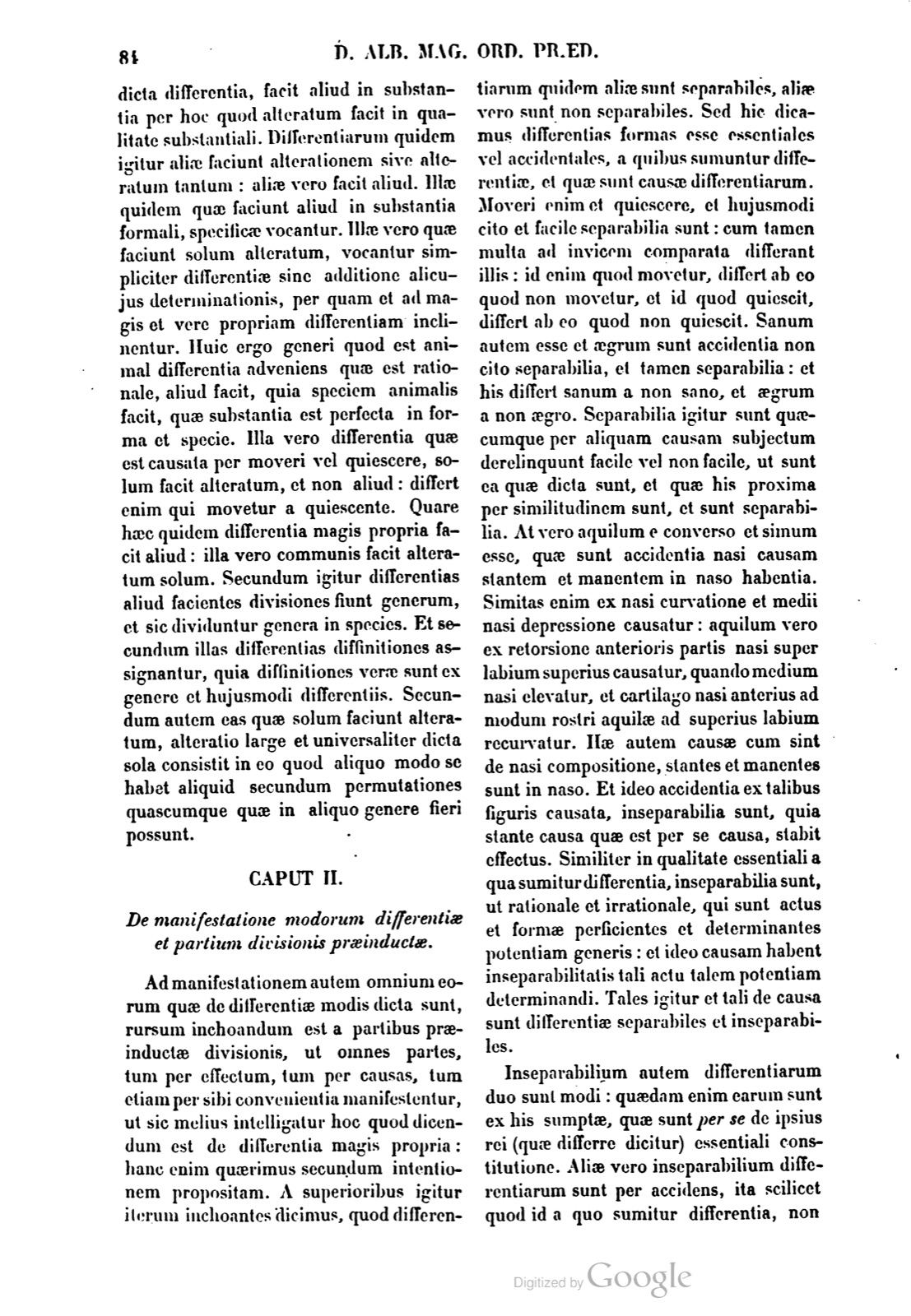
Et quia hae differentiae ab actu differendi dicuntur, quia scilicet differre faciunt, ideo sciendum est quod omnis differentia facit alteratum adveniens cuilibet: alteratum dico essentiali vel accidentali qualitate. Sed ea differentia quae communiter et proprie dicta quantum est de se, cum utraque sit accidens, facit alteratum solum. Illa autem quae est magis proprie dicta differentia, facit aliud in substantia per hoc quod alteratum facit in qualitate substantiali. Differentiarum quidem igitur aliae faciunt alterationem sive alteratum tantum: aliae vero faciunt aliud. Illae quidem quae faciunt aliud in substantia formali, specificae vocantur. Illae vero quae faciunt solum alteratum, vocantur simpliciter differentiae sine additione alicujus determinationis, per quam et ad magis et vere propriam differentiam inclinentur. Huic ergo generi quod est animal differentia adveniens quae est rationale, aliud facit, quia speciem animalis facit, quae substantia est perfecta in forma et specie. Illa vero differentia quae est causata per moveri vel quiescere, solum facit alteratum, et non aliud: differt enim qui movetur a quiescente. Quare haec quidem differentia magis propria facit aliud: illa vero communis facit alteratum solum. Secundum igitur differentias aliud facientes divisiones fiunt generum, et sic dividuntur genera in species. Et secundum illas differentias diffinitiones assignantur, quia diffinitiones verae sunt ex genere et hujusmodi differentiis. Secundum autem eas quae solum faciunt alteratum, alteratio large et universaliter dicta sola consistit in eo quod aliquo modo se habet aliquid secundum permutationes quascumque quae in aliquo genere fieri possunt.
And because these differences are said from the act of differing, namely because they make a thing differ, therefore one must know that every difference, when it comes to anything, makes an altered thing; I say altered by essential or accidental quality. But that difference which is commonly and properly said, as far as belongs to itself, since each is an accident, makes an altered thing only. But that which is more properly called difference makes another thing in substance through the fact that it makes an altered thing in substantial quality. Therefore among differences some make alteration or only an altered thing, but others make another thing. Those indeed which make another thing in formal substance are called specific. But those which make only an altered thing are called differences simply, without the addition of any determination through which they might incline toward the more and truly proper difference. Therefore when the difference rational comes to this genus which is animal, it makes another thing, because it makes a species of animal which is substance perfected in form and species. But the difference which is caused by being moved or being at rest only makes an altered thing and not another thing; for one who is moved differs from one at rest. Wherefore this more proper difference indeed makes another thing, while that common difference makes only an altered thing. Therefore according to differences making another thing, divisions of genera are made, and thus genera are divided into species. And according to those differences definitions are assigned, because true definitions are from genus and differences of this sort. But according to those which only make an altered thing, alteration broadly and universally said alone consists in the fact that something is disposed in some way according to whatever changes can occur in some genus.
Notes
- Aristotle, In book 3 of the Physics, text-comment 6. (Aristoteles, In 3 Physic. Tex. com. 6.) ↩
If a page does not appear, its photograph has not been uploaded yet.