Volume 1 · pp. 73–77
Chapter VI. On the mode of coming from the most general to the most special things, and conversely.
A marker with ≈ is an approximate page boundary, placed by measure of the text; the page photographs remain the authority. In the paired views, clicking a page marker brings that page into view.
quamvis non secundum quod est in uno, sit etiam in alio sicut in principio et universalibus dictum est. Magis autem est collectivum et adunativum genus, quam species, in hoc quod plura colligit quam species, etsi etiam species magis secundum intentionem sit una, quam forma generis: minus enim a se distant et magis unum sunt quae sunt unum in specie, quam ea quae sunt unum in genere, cum plura uniat in se et colligat genus quam species: unit enim et colligit multas species et omnia quae in speciebus colliguntur.
Particularia vero et singularia secundum quod hujusmodi sunt, semper sunt in multitudine: cujus multitudinis causa est divisio materiae, et ideo per contrarium modum collectionum communis speciei, dividunt id quod est unum in natura in multa, non quidem divisione formae, sed divisione materiae, ut dictum est.
Dividitur autem totius universalis divisione, quod divisum per esse dividitur, et per naturam et formam, secundum totam suam essentiam et potentiam est in singulis. Et e contra species multa sicut divisa in unum colligit et unit: participatione enim speciei plures homines sunt unus homo. Non quidem sic, quod iste homo qui est unus homo per materiam, sit plures homines divisi per suas materias et sua supposita: sed quia ipsa participatione unius quod participatur a multis secundum quod ipsum in natura et essentia unum est, plures uniuntur, et unum sunt secundum hunc modum. Et hoc est idem ac si dicatur quod Socrates et Plato et alii singulares homines unum sunt in homine, secundum quod homo dicit naturam speciei praedicatae de ipsis. Et si sic participatione speciei plures homines sunt unus homo, non sequitur ex hoc, quod simpliciter plures homines sint unus homo: quia unus homo et plures homines simpliciter dicuntur a materiae subjectae pluralitate vel unitate. E contra vero particularibus sive particulatis per materiam hominibus, unus homo, una natura, et una forma communis omnium efficitur plures homines secundum esse singulare: et per subjectum divisus in omnes, indivisus tamen manens secundum naturam communem et formam et secundum esse universalis. Id enim quod singulare est et determinatum secundum esse et subjectum, semper est divisivum communis sui proximi et determinativum. Quod autem commune est et universale, semper est collectivum et adunativum.
Quamvis autem colligere et adunare sint idem in substantia, differunt tamen secundum rationem. Collectio enim incipit a multis, et terminatur ad unum: adunatio incipit ab uno, et terminatur ad multa, quae in uno uniuntur. Hoc autem ut melius manifestetur, explanetur in pluribus. Est enim collectio tantum in unum locum continentem, sed non unientem, sicut acervus lapidum dicitur colligi. Et haec proprie dicuntur nomina collectiva, ut acervus, turba, populus, et alia hujusmodi. In talibus quidem perfecta est collectio, sed imperfecta adunatio. Et ideo talia de suis partibus non praedicantur: quia singuli lapides non sunt acervus, nec singuli homines sunt populus vel turba.
Est item collectio multorum ad unum movens et ad unum finem: sicut est collectio exercitus in movente duce, et fine, qui est victoria. Et haec collectio magis adunat quam antecedens, etiam et haec non perfectam facit secundum naturam adunationem. Et ideo totum de parte non praedicatur, quia unicus miles non est exercitus, sed quia omnes in movente et fine uniuntur, ideo sequitur quod singuli moventur in singulis et duce, et singuli secundum analogiam suae operationis perficiunt victoriam.
although not according as it is in one, it is also in another, as was said at the beginning and concerning universals. But genus is more collective and unitive than species in this, that it gathers more things than species, even if species also is more one according to intention than the form of genus. For things which are one in species are less distant from themselves and more one than those which are one in genus, since genus unites in itself and gathers more things than species; for it unites and gathers many species and all the things which are gathered in species.
But particular and singular things, according as they are of this sort, are always in multitude. The cause of this multitude is the division of matter; and therefore, in a contrary mode to the collections of a common species, they divide what is one in nature into many things, not indeed by division of form, but by division of matter, as was said.
But that which is divided by division of the universal whole, which is divided by being, and by nature and form, according to its whole essence and power is in each singular. And conversely species gathers and unites many things as divided into one: for by participation in species several men are one man. Not indeed in such a way that this man, who is one man through matter, is several men divided through their matters and their supposits; but because by the very participation in one thing which is participated by many, according as it is itself one in nature and essence, several are united and are one according to this mode. And this is the same as if it were said that Socrates and Plato and the other singular men are one in man, according as man names the nature of the species predicated of them. And if, in this way, by participation in species several men are one man, it does not follow from this that several men simply are one man, because one man and several men are said simply from the plurality or unity of the subject matter. But conversely, by particular men, or men particularized through matter, one man, one nature, and one form common to all is made several men according to singular being; and it is divided through subject into all, while nevertheless remaining undivided according to common nature and form and according to the being of the universal. For that which is singular and determined according to being and subject is always divisive and determinative of its proximate common thing. But what is common and universal is always collective and unitive.
Although to collect and to unite are the same in substance, nevertheless they differ according to reason. For collection begins from many things and is terminated at one; uniting begins from one and is terminated at many things which are united in one. But so that this may be manifested better, let it be explained in several instances. For there is collection merely into one containing place, but not into a uniting thing, as a heap of stones is said to be gathered. And these are properly called collective names, such as heap, crowd, people, and other things of this sort. In such things collection is indeed perfect, but uniting is imperfect. And therefore such things are not predicated of their parts, because single stones are not a heap, nor are single men a people or a crowd.
Again there is a collection of many things toward one mover and toward one end, as there is the collection of an army in the moving leader and in the end, which is victory. And this collection unites more than the preceding one, yet even this does not make a perfect uniting according to nature. And therefore the whole is not predicated of the part, because a single soldier is not an army; but because all are united in the mover and the end, it therefore follows that individuals are moved in the individuals and the leader, and that individuals according to the analogy of their operation accomplish victory.
Est item collectio in unam perfectae quantitatis figuram, sicut dicuntur fundamentum, et paries, et tectum colligi in unam totius integri formam: quia forma non est in partibus divisim, sed simpliciter quidem in partibus conjunctim sumptis, et in qualibet divisim non est nisi secundum quid: ideo ista forma quamvis colligat partes et adunet eas sibi, non tamen praedicatur de partibus omnibus nisi conjunctim, et non de qualibet divisim.
Juxta hanc erit adhuc alia forma, quae quamvis colligat partes, et aliquo modo uniat, non tamen cuilibet totam suam addit potestatem perfectam, sicut est forma regni, et generaliter totius potestas regni constituitur potestatibus ut partibus, ut est praesidis, palatini, et ducis, et comitis potestas, ex quibus omnibus conficitur regnum. Et haec forma quae non unit secundum totam potestatem, iterum de partibus praedicari non potest simpliciter: quia praesidatus non est regnum. Talis enim forma suam potestatem partibus ordinatim communicat, et ideo quaelibet pars est aliqua regni potestas, et in talibus verum est, quod quidquid potest inferior, potest et superior, sed non convertitur.
Et secundum modum isti aliquo modo similem, forma naturalis colligit et unit sibi partes materiae quas terminat. Et ideo de materia vel de partibus materiae non praedicatur, quia ipsa in potestate partes excedit: et sic animal non est visus, vel auditus, vel aliud hujusmodi, cum potest quod potest visus, et plus, et sic est in omnibus aliis. Est tandem forma quae perfecte colligit et unit partes, ita quod singulas colligit et unit sibi, ita quod esse ejus in singulis idem est cum esse singulorum, vel non diversum ab ipso, et ideo praedicatur de singulis partibus: et talis forma est generis et speciei et aliorum quae sunt universalia. Et hoc modo intelligimus hic, quod ascendens a specialissimo ad generalissimum, colligit et adunat multitudinem in unum, et quod commune sit collectivum et adunativum.
Assignato autem sic genere, et assignata sic specie, quid sit utrumque per diffinitionem, palam est ex praedictis, quod in omni divisione proxima generis in species, semper genus unum est et plures species in quas dividitur. Semper enim unius et ejusdem generis divisio est in plures species: cujus ratio est, quia differentia non dividit nec habet actum nisi per oppositionem. Nihil autem sibi ipsi oppositum est, sed ei opponitur cui contrariatur. Omnis ergo differentia quae dividit genus, sibi oppositam habet differentiam: et ideo genus conjunctum cum una differentia facit speciem aliam illi oppositam, quia alietas, ut dicit Boetius, causatur ab oppositione: propter quod dicit Aristoteles 1, quod si aliquis in diffinitione aliquid assignaverit pro differentia, considerandum est si oppositum ejus est etiam ejusdem generis differentia. Si enim non est oppositum differentia, nec hoc quod assignavit, fuit vera differentia: genus enim non dividitur nisi per oppositas differentias sive formas quae sunt differentiae: oppositae autem differentiae conjunctae cum genere non unum, sed plures species semper constituunt.
Again there is collection into one figure of perfect quantity, as foundation, wall, and roof are said to be gathered into one form of an integral whole. Because the form is not in the parts separately, but is simply in the parts taken together, and in each separately it exists only in a qualified respect, therefore this form, although it gathers parts and unites them to itself, nevertheless is not predicated of all the parts except conjointly, and not of each separately.
Next to this there will still be another form which, although it gathers parts and in some way unites them, nevertheless does not add its whole perfect power to each one, as is the form of a kingdom; and generally the power of the whole kingdom is constituted by powers as by parts, such as the power of a president, a palatine, a duke, and a count, from all of which the kingdom is composed. And this form, which does not unite according to the whole power, again cannot be predicated simply of the parts, because presidency is not the kingdom. For such a form communicates its power to the parts in order, and therefore each part is some power of the kingdom; and in such things it is true that whatever the inferior can do, the superior can also do, but it is not converted.
And according to a mode in some way similar to this, natural form gathers and unites to itself the parts of matter which it terminates. And therefore it is not predicated of matter or of the parts of matter, because it exceeds the parts in power; and thus animal is not sight, or hearing, or anything else of this sort, since it can do what sight can do, and more, and so it is in all other things. Finally there is a form which perfectly gathers and unites parts, so that it gathers each and unites each to itself, so that its being in each is the same as the being of the singulars, or not diverse from it, and therefore it is predicated of each part; and such a form is the form of genus and species and of the other things which are universals. And in this way we understand here that one ascending from the most special to the most general gathers and unites multitude into one, and that the common thing is collective and unitive.
Thus, genus having been assigned and species having thus been assigned, what each is through definition is clear from what has been said, namely that in every proximate division of genus into species, there is always one genus and several species into which it is divided. For the division of one and the same genus is always into several species. The reason for this is that difference neither divides nor has act except through opposition. But nothing is opposite to itself; rather, that to which it is contrary is opposed to it. Therefore every difference which divides a genus has a difference opposite to itself; and therefore genus joined with one difference makes another species opposed to it, because otherness, as Boethius says, is caused by opposition. On account of this Aristotle says 1 that if someone in a definition has assigned something as a difference, one must consider whether its opposite is also a difference of the same genus. For if the opposite is not a difference, neither was this which he assigned a true difference; for genus is divided only through opposite differences or forms which are differences. But opposite differences joined with genus always constitute not one species, but several.
Sunt tamen qui contra hoc quod dictum est objiciunt per id quod a principio de universali dictum est, quod scilicet ab aptitudine existendi in pluribus et dicendi de pluribus universale dicatur, et non ab actu: quod scilicet actu sit in pluribus et de pluribus: quia aliter sol non esset universale. Ex hoc enim volunt inferre, quod genus est quod non habet plures species, sed quod aptum natum sit habere plures species. Et sic non oportet genus semper in plures species dividi. Sed ad hoc dicendum, quod non est verum de genere, sed de specie specialissima solum: quia genus non dividitur nisi per ea quae potestate naturali et substantiali sunt in ipso, et ideo per se dividitur: et oportet quod dividatur in plura quae actu plura sunt. Species autem non dividitur per ea quae sunt in ipsa: nec dividitur secundum suam substantialem potestatem, sed potius multiplicatur et numeratur quam dividatur per id quod totum substantialiter est extra naturam et essentiam ipsius, scilicet per materiam quae nihil est formalis essentiae suae potestatis. Et ideo accidit speciei esse in ipsa: propter quod sola sufficit aptitudo in specie ut sit apta existere in pluribus, ad hoc quod sit universale, etiamsi actu non sit nisi in uno solo, vel forte in nullo, dummodo sit forma quae secundum aptitudinem apta nata sit esse in pluribus 2.
Est ergo sciendum, quod genus non est, quod non habet pluries species. Unde si ponamus non esse aliquam speciem animalis nisi hominem, tunc quidem sequitur, si homo est, animal est: sed non sequitur, quod animal sit genus propter causam quae dicta est. In specie autem specialissima sola quidem, ut dictum est, sufficit aptitudo ad hoc quod sit universale secundum aptitudinem. Si autem haec aptitudo ad actum reduci debeat, oportet quod actu sit in pluribus et de pluribus: et non solum est universale secundum actum, sed secundum aptitudinem solam. In his autem in quibus aptitudo ad actum reducitur, per divisionem materiae ad actum reducitur, sicut dictum est: quia naturae aptitudo ad plura, non est ad tot, quin possit esse ad plura: ideo continue sic in infinitum potest reduci ad actum.
In omni autem tali praedicabilium coordinatione genus quidem substantialiter et universaliter de specie praedicatur, et omnia superiora de inferioribus substantialiter et universaliter praedicantur: species autem sive subalterna sit, sive specialissima, neque praedicatur substantialiter et universaliter de proximo superiori sibi genere, neque praedicatur de superioribus sibi generibus non proximis, sed per medium sibi conjunctis. Hujus autem causa est: quia inter talia superiora de inferioribus praedicata substantialiter et universaliter praedicatio non convertitur, eo quod praedicatum in plus est quam subjectum. Unde non sequitur, si homo substantialiter et universaliter est animal, quod animal substantialiter et universaliter sit homo: est enim aliquod animal quod non est homo, ut asinus, vel leo: animal enim quamvis de intellectu sit hominis (et ideo necesse sit praedicari de ipso) non tamen e converso homo est de intellectu animalis: propter quod animal sine homine esse potest.
Yet there are some who object against what has been said by means of what was said at the beginning concerning the universal, namely that universal is said from the aptitude of existing in many and of being said of many, and not from act, namely because it actually is in many and is said of many; because otherwise the sun would not be a universal. For from this they wish to infer that genus is not what has several species, but what is apt by nature to have several species. And thus it is not necessary that genus always be divided into several species. But to this one must say that it is not true of genus, but only of the most special species, because genus is divided only through those things which by natural and substantial power are in it, and therefore it is divided through itself, and it must be divided into several things which are actually several. But species is not divided through the things which are in it, nor is it divided according to its substantial power, but rather it is multiplied and numbered rather than divided through that which is wholly outside its nature and essence substantially, namely through matter, which is nothing of the formal essence of its power. And therefore to be in matter happens to species; on account of this aptitude alone suffices in species so that it may be apt to exist in several, for it to be universal, even if actually it is only in one alone, or perhaps in none, provided that it is a form which according to aptitude is apt by nature to be in several 2.
Therefore one must know that genus is not that which does not have several species. Hence if we posit that there is no species of animal except man, then indeed it follows, if man is, animal is; but it does not follow that animal is a genus, because of the cause which has been stated. But in the most special species alone, as was said, aptitude suffices for it to be universal according to aptitude. But if this aptitude ought to be reduced to act, it is necessary that it actually be in several and be said of several. And it is not only a universal according to act, but according to aptitude alone. But in those things in which aptitude is reduced to act, it is reduced to act through division of matter, as was said, because the aptitude of nature toward many things is not toward so many that it cannot be toward more; therefore it can thus continuously be reduced to act into infinity.
But in every such coordination of predicables, genus is predicated substantially and universally of species, and all superior things are predicated substantially and universally of inferiors. But species, whether it is subaltern or most special, is neither predicated substantially and universally of the proximate genus superior to itself, nor is it predicated of genera superior to itself which are not proximate but joined to itself through a middle. The cause of this is that among such superior things predicated substantially and universally of inferior things, the predication is not converted, because the predicate is broader than the subject. Hence it does not follow, if man is substantially and universally animal, that animal is substantially and universally man; for there is some animal which is not man, such as an ass or a lion. For animal, although it belongs to the understanding of man, and therefore must be predicated of him, nevertheless conversely man does not belong to the understanding of animal; for this reason animal can exist without man.
In omni autem ordinata praedicatione (in qua secundum naturalem ordinem praedicabilium unum de altero praedicatur) oportet aequa sive paria de aequis, sive paribus praedicari, sicut praedicatio convertibilium, sicut omne hinnibile est equus, et omnis equus est hinnibilis. In talibus enim subjectum est conversum praedicati: et ideo nec praedicatum relinquit subjectum, nec subjectum relinquit praedicatum. Aut oportet majora de minoribus praedicari: et in talibus praedicatum est de ratione subjecti: et ideo subjectum nunquam relinquit praedicatum, quamvis praedicatum possit relinquere subjectum: et talis praedicatio est ut quando animal de homine praedicatur sine conversione.
Et si instet aliquis, quod homo de animali praedicatur, cum dicitur, aliquod animal est homo, vel hoc animal est hic homo. Nulla est instantia: quia haec praedicatio non est substantialis et secundum ordinem praedicabilium, quia per accidens: accidit enim animali hoc animal esse quod est homo vel hic homo. Minora vero de majoribus secundum hunc modum praedicationis minime praedicantur: neque enim animal universaliter dicis esse hominem, quemadmodum hominem universaliter et substantialiter dicis esse animal 3.
Secundum autem totam coordinationem praedicabilium de quibuscumque species praedicatur sive subalterna sive specialissima, de omnibus eisdem praedicabitur universaliter et illius speciei genus, et illius generis genus, et sic usque ad generalissimum, quod ultimum in ascendendo, et primum in descendendo praedicatum est in illa praedicamentorum coordinatione. Cujus exemplum est, quod si verum est Socratem esse hominem, hominem autem animal, animal vero substantiam: verum est, quod et Socrates est homo, et quod Socrates est substantia: semper enim et substantialiter et universaliter in tali coordinatione superiora de inferioribus praedicantur et de individuo. Generalissimum autem et de genere sibi proximo sub eo posito praedicabitur, et de generibus omnibus inferioribus, si plura sint media subalterna inter ipsum et specialissimum: et praedicatur de specie specialissima, et de individuis quae sub ipsa sunt.
Attende autem, quod sicut dictum est, forma quae praedicatur, non praedicatur nisi sit notior, et nomen totius esse rei. Esse autem rei totum vel est in potentia remota, et sic nominatur per generalissimum: vel in potentia propinqua, et sic nominatur genere subalterno: vel in potentia propinquissima, et sic vocatur genere immediato: vel est in actu, et sic nominatur nomine speciei. De praedicatione autem differentiae, proprii, et accidentis, inferius pertractabitur. Et ideo dicit Aristoteles quod non est vivens et animal, nec animal et homo simul. Talis ergo modus praedicandi concluditur ex eo qui dictus praedicabilium ordine.
But in every ordered predication, in which according to the natural order of predicables one thing is predicated of another, equals or peers must be predicated of equals or peers, as in the predication of convertibles, as every neigh-capable thing is a horse, and every horse is neigh-capable. For in such things the subject is converted with the predicate; and therefore neither does the predicate leave the subject, nor does the subject leave the predicate. Or greater things must be predicated of lesser things; and in such cases the predicate belongs to the notion of the subject, and therefore the subject never leaves the predicate, although the predicate can leave the subject; and such is the predication when animal is predicated of man without conversion.
And if someone insists that man is predicated of animal, when it is said, some animal is man, or this animal is this man, there is no objection: because this predication is not substantial and according to the order of predicables, because it is by accident. For it happens to animal that this animal is what is man or this man. But lesser things are least of all predicated of greater things according to this mode of predication; for you do not universally say that animal is man in the way in which you universally and substantially say that man is animal 3.
But according to the whole coordination of predicables, of whatever things species is predicated, whether subaltern or most special, of all the same things the genus of that species, and the genus of that genus, and so on up to the most general, which is the last predicate in ascending and the first in descending in that coordination of categories, will be predicated universally. An example of this is that if it is true that Socrates is man, and man is animal, and animal is substance, it is true both that Socrates is man and that Socrates is substance; for always, both substantially and universally in such a coordination, superior things are predicated of inferior things and of the individual. But the most general will be predicated both of the genus proximate to itself placed under it and of all inferior genera, if there are several subaltern middles between it and the most special; and it is predicated of the most special species and of the individuals which are under it.
But attend to this: as was said, the form which is predicated is not predicated unless it is better known and the name of the whole being of the thing. But the whole being of the thing either is in remote potency, and thus is named by the most general; or in proximate potency, and thus is named by a subaltern genus; or in most proximate potency, and thus is called by an immediate genus; or it is in act, and thus is named by the name of species. But the predication of difference, property, and accident will be treated below. And therefore Aristotle says that it is not living thing and animal, nor animal and man, simultaneously. Therefore such a mode of predicating is concluded from that order of predicables which has been stated.
Haec autem quae dicta sunt, in compendio dicuntur sic, quod descendentibus ad specialissima necesse est ire per multitudinem specierum dividendo genus oppositis differentiis. Ascendentibus autem a specialissimis ad generalissima necesse est colligere multitudinem in unam generis divisi naturam. Collectivum enim in unam communem naturam species est, et magis collectivum multorum est id quod est genus: particularia vero et singularia semper in multitudine existentia, e contrario dividunt in multitudinem id quod est unum commune: et sic participatione speciei plures homines sunt unus homo. Particularibus autem sic speciem dividentibus, et in multitudinem distrahentibus, unus et communis homo est plures homines: divisivum enim semper communis est id quod est singulare: collectivum autem et adunativum plurium in unum est id quod commune est.
Assignato autem sic genere et specie per diffinitivam rationem quid sit utrumque ipsorum, et genere quidem uno existente, speciebus vero pluribus per divisionem oppositarum differentiarum, semper erit in plures species divisio generis per causam superius assignatam. Genus quidem in tali ordine semper universaliter et substantialiter de specie praedicatur, et omnia superiora de inferioribus. Species autem nec praedicatur de proximo sibi superiori genere, neque de superioribus non immediate conjunctis: nec enim talis praedicatio convertitur qua genus de specie praedicatur. In omni enim substantiali ordinata praedicatione oportet aut aequalia de aequis praedicari, ut hinnibile de equo: aut oportet praedicari majora, hoc est, communiora de minoribus, ut animal praedicatur de homine, cum animal in plus sit quam homo. Minora vero de majoribus secundum hunc modum praedicabilium minime praedicantur, nisi per accidens, ut dictum est. Nec enim animal universaliter dicis et praedicas hominem esse, quemadmodum hominem universaliter dicis esse animal.
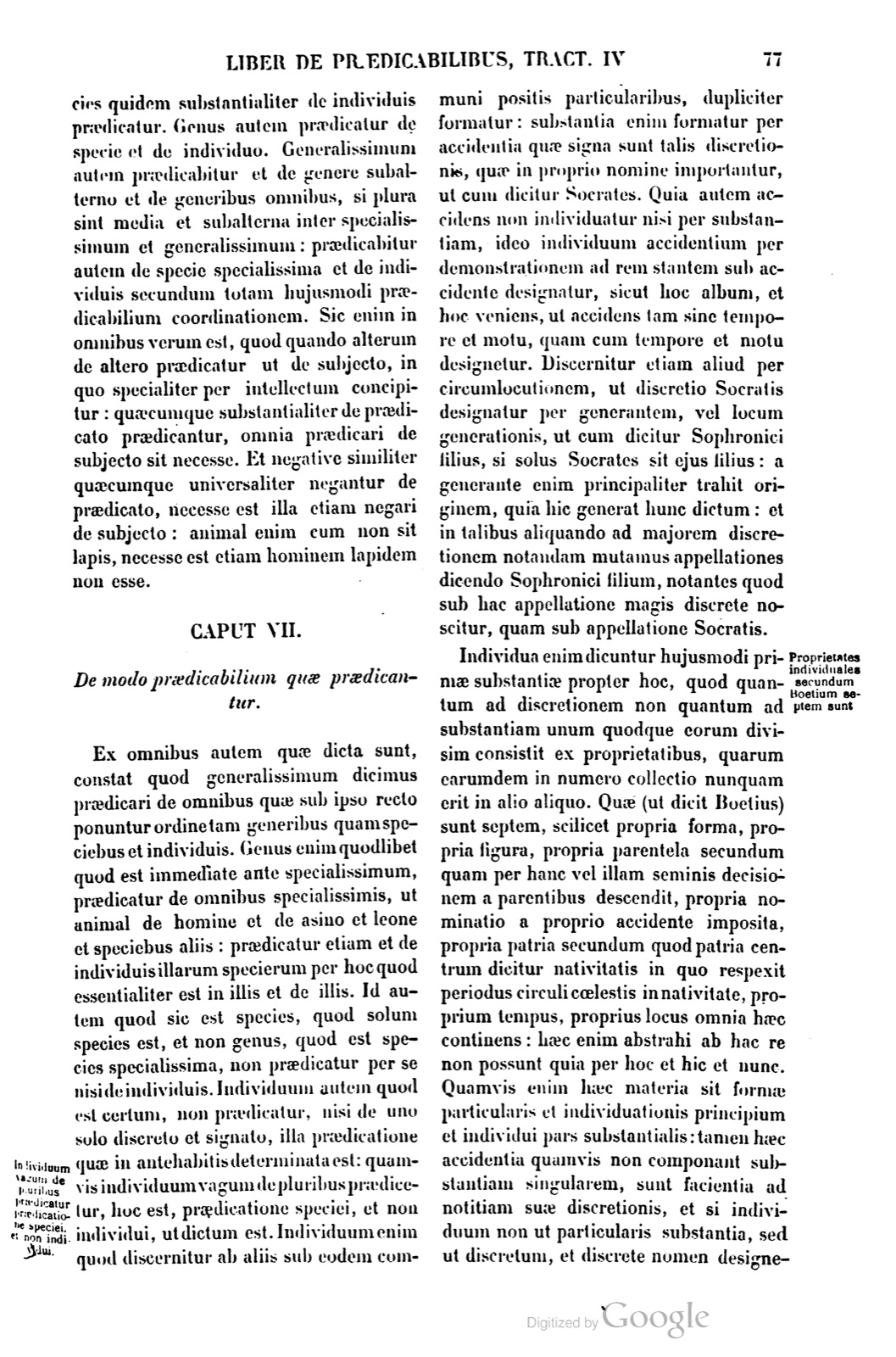
De quibus autem species universaliter et substantialiter praedicatur, de his necessario et speciei genus praedicabitur, et generis genus usque ad generalissima. Si enim exempli gratia verum est dicere Socratem esse hominem, hominem autem animal, animal autem substantiam: verum est et Socratem animal dicere atque substantiam. Semper ergo naturaliter superiora de inferioribus praedicantur. Species quidem substantialiter de individuis praedicatur. Genus autem praedicatur de specie et de individuo. Generalissimum autem praedicabitur et de genere subalterno et de generibus omnibus, si plura sint media et subalterna inter specialissimum et generalissimum: praedicabitur autem de specie specialissima et de individuis secundum totam hujusmodi praedicabilium coordinationem. Sic enim in omnibus verum est, quod quando alterum de altero praedicatur ut de subjecto, in quo specialiter per intellectum concipitur: quaecumque substantialiter de praedicato praedicantur, omnia praedicari de subjecto sit necesse. Et negative similiter quaecumque universaliter negantur de praedicato, necesse est illa etiam negari de subjecto: animal enim cum non sit lapis, necesse est etiam hominem lapidem non esse.
But these things which have been said are stated in summary thus: for those descending to the most special things, it is necessary to go through a multitude of species by dividing genus through opposite differences. But for those ascending from the most special things to the most general, it is necessary to gather multitude into one nature of the divided genus. For species is collective into one common nature, and that which is genus is more collective of many things. But particular and singular things, always existing in multitude, conversely divide into multitude what is one common thing; and thus by participation in species several men are one man. But by particulars thus dividing species and drawing it away into multitude, one and common man is several men. For the singular is always divisive of the common; but that which is common is collective and unitive of several into one.
Thus genus and species having been assigned by definitive reason as to what each of them is, and with genus indeed being one, but species several through the division of opposite differences, there will always be a division of genus into several species because of the cause assigned above. Genus indeed in such an order is always predicated universally and substantially of species, and all superior things of inferiors. But species is predicated neither of the proximate genus superior to itself, nor of superior things not immediately joined; for such a predication, by which genus is predicated of species, is not converted. For in every substantial ordered predication, either equal things must be predicated of equals, as neigh-capable of horse; or greater things, that is, more common things, must be predicated of lesser things, as animal is predicated of man, since animal is broader than man. But lesser things are least of all predicated of greater things according to this mode of predicables, except by accident, as was said. For you do not universally say and predicate that animal is man in the way in which you universally say that man is animal.
But of the things of which species is universally and substantially predicated, necessarily the genus of the species also will be predicated, and the genus of the genus up to the most general. For if for the sake of example it is true to say that Socrates is man, and man is animal, and animal is substance, it is true also to say that Socrates is animal and substance. Therefore superior things are always naturally predicated of inferior things. Species indeed is predicated substantially of individuals. But genus is predicated of species and of the individual. The most general, however, will be predicated both of the subaltern genus and of all genera, if there are several middles and subalterns between the most special and the most general; and it will be predicated of the most special species and of individuals according to the whole coordination of predicables of this sort. For thus in all things it is true that when one thing is predicated of another as of a subject, in which it is specially conceived by the intellect, whatever things are predicated substantially of the predicate must all be predicated of the subject. And negatively in like manner, whatever things are universally denied of the predicate must also be denied of the subject; for since animal is not stone, man also must not be stone.
Notes
- Aristotle, In book 6 of the Topics, chapter 8. (Aristoteles, In 6 Topicorum, cap. 8.) ↩
- Consider how the things said here do not contradict the things said above, in the tractate on genus, chapter 5. (Considera quomodo hic dicta non contradicant dictis supra, in tract. de genere, cap. 5.) ↩
- Since this predication is not substantial, but by accident, it follows that it is not per se in the first mode, as Paul of Venice wished, in book 1 of the Posterior Analytics. (Cum haec praedicatio non sit substantialis, sed per accidens, sequitur quod non est per se in primo modo, ut voluit Paulus Venetus, I Post.) ↩
If a page does not appear, its photograph has not been uploaded yet.