Volume 1 · p. 72
Chapter VI. On the mode of coming from the most general to the most special things, and conversely.
CAPUT VI.
De modo veniendi a generalissimo ad specialissima, et e converso.
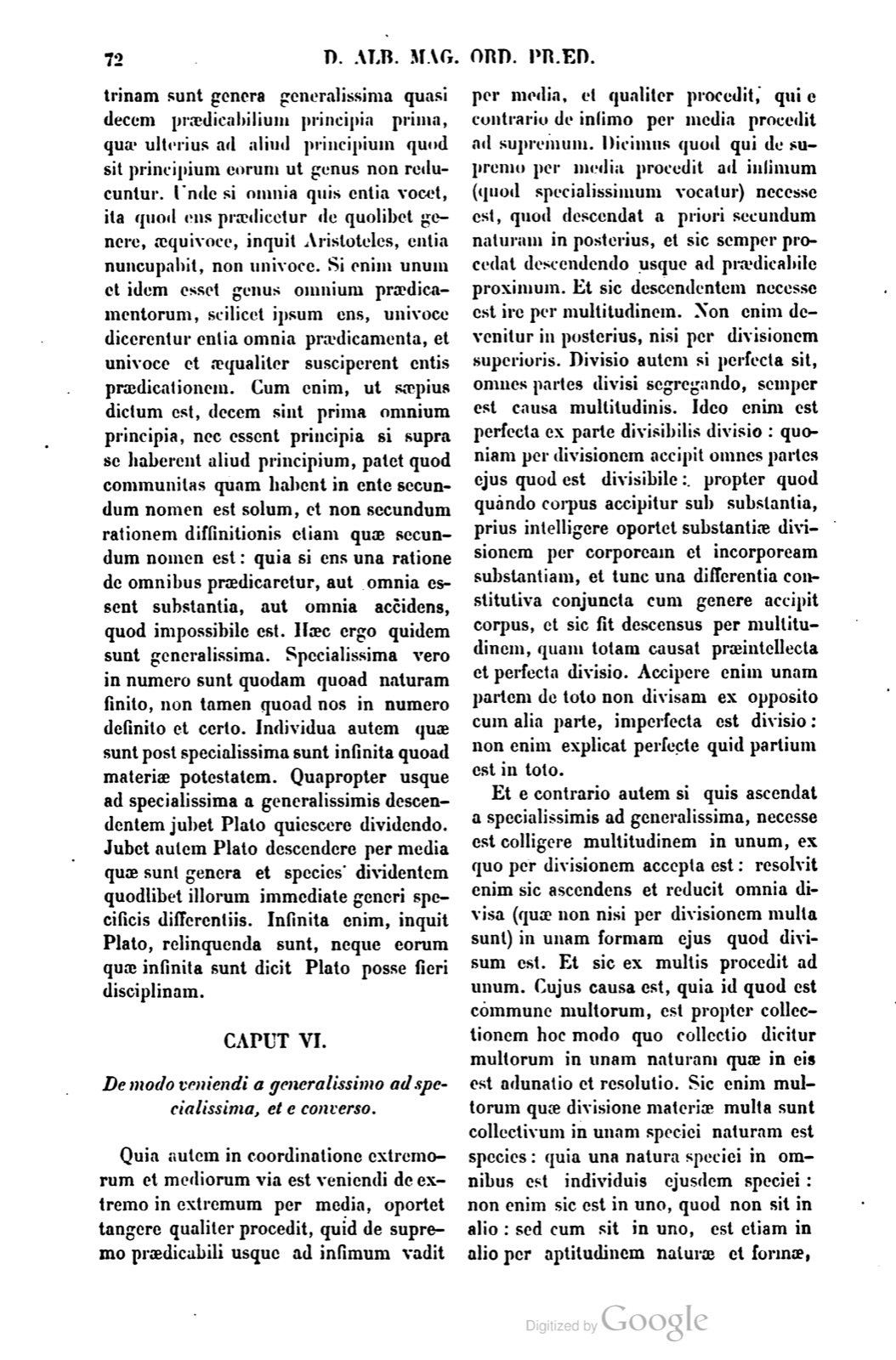
Quia autem in coordinatione extremorum et mediorum via est veniendi de extremo in extremum per media, oportet tangere qualiter procedit, quid de supremo praedicabili usque ad infimum vadit per media, et qualiter procedit, qui e contrario de infimo per media procedit ad supremum. Dicimus quod qui de supremo per media procedit ad infimum quod specialissimum vocatur, necesse est, quod descendat a priori secundum naturam in posterius, et sic semper procedat descendendo usque ad praedicabile proximum. Et sic descendentem necesse est ire per multitudinem. Non enim devenitur in posterius, nisi per divisionem superioris. Divisio autem si perfecta sit, omnes partes divisi segregando, semper est causa multitudinis. Ideo enim est perfecta ex parte divisibilis divisio: quoniam per divisionem accipit omnes partes ejus quod est divisibile: propter quod quando corpus accipitur sub substantia, prius intelligere oportet substantiae divisionem per corpoream et incorpoream substantiam, et tunc una differentia constitutiva conjuncta cum genere accipit corpus, et sic fit descensus per multitudinem, quam totam causat praeintellecta et perfecta divisio. Accipere enim unam partem de toto non divisam ex opposito cum alia parte, imperfecta est divisio: non enim explicat perfecte quid partium est in toto.
Et e contrario autem si quis ascendat a specialissimis ad generalissima, necesse est colligere multitudinem in unum, ex quo per divisionem accepta est: resolvit enim sic ascendens et reducit omnia divisa, quae non nisi per divisionem multa sunt, in unam formam ejus quod divisum est. Et sic ex multis procedit ad unum. Cujus causa est, quia id quod est commune multorum, est propter collectionem hoc modo quo collectio dicitur multorum in unam naturam quae in eis est adunatio et resolutio. Sic enim multorum quae divisione materiae multa sunt collectivum in unam speciei naturam est species: quia una natura speciei in omnibus est individuis ejusdem speciei: non enim sic est in uno, quod non sit in alio: sed cum sit in uno, est etiam in alio per aptitudinem naturae et formae,
CHAPTER VI.
On the mode of coming from the most general to the most special things, and conversely.
But because in the coordination of extremes and middles there is a way of coming from extreme to extreme through middles, it is necessary to touch upon how he proceeds who goes from the highest predicable down to the lowest through middles, and how he proceeds who, on the contrary, proceeds from the lowest through middles to the highest. We say that he who proceeds from the highest through middles to the lowest, which is called the most special, must descend from what is prior according to nature into what is posterior, and thus always proceed by descending down to the proximate predicable. And thus one descending must go through multitude. For one does not come to the posterior except through division of the superior. But division, if it is perfect, by separating all parts of the thing divided, is always the cause of multitude. For division is perfect on the part of the divisible for this reason: because through division it receives all parts of what is divisible. On account of this, when body is taken under substance, first one must understand the division of substance through corporeal and incorporeal substance, and then one constitutive difference joined with the genus receives body; and thus descent is made through multitude, the whole of which a pre-understood and perfect division causes. For to receive one part of a whole not divided from the opposite with another part is an imperfect division, since it does not perfectly unfold what parts are in the whole.
And on the contrary, if someone ascends from the most special things to the most general, it is necessary to gather multitude into one, from which it has been received through division. For one ascending thus resolves and reduces all divided things, which are many only through division, into one form of that which was divided. And thus from many he proceeds to one. The cause of this is that what is common to many is for the sake of collection, in the way in which collection is called the uniting and resolving of many into one nature which is in them. For thus the species is collective of many things, which are many by the division of matter, into one nature of species, because one nature of species is in all individuals of the same species: for it is not in one in such a way that it is not in another; but since it is in one, it is also in another through the aptitude of nature and form,
If a page does not appear, its photograph has not been uploaded yet.