Volume 1 · pp. 67–72
Chapter V. On the manifestation of the things said from consequents and similar things.
A marker with ≈ is an approximate page boundary, placed by measure of the text; the page photographs remain the authority. In the paired views, clicking a page marker brings that page into view.
CAPUT V.
De manifestatione eorum quae dicta sunt ex consequentibus et similibus.
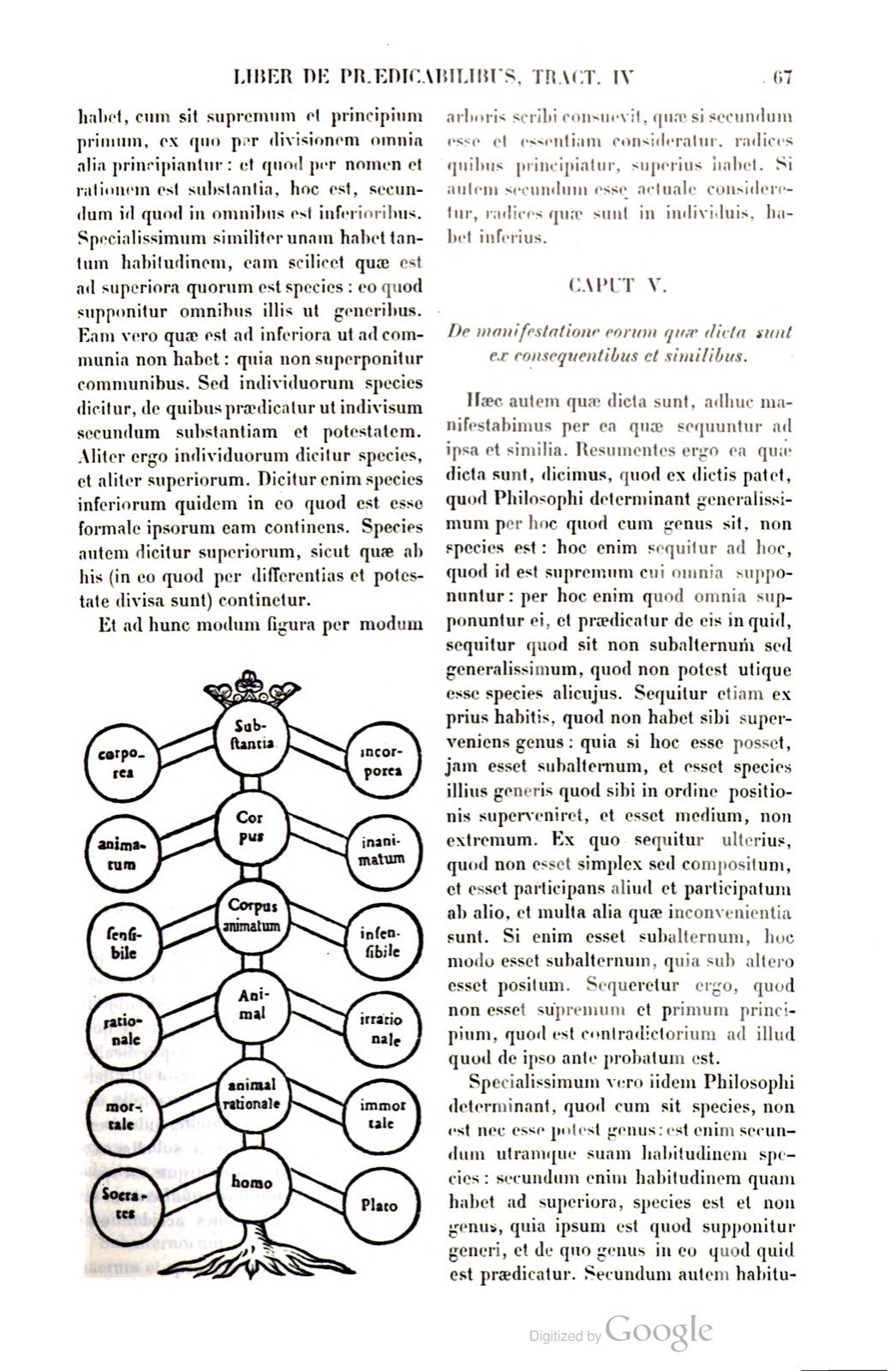
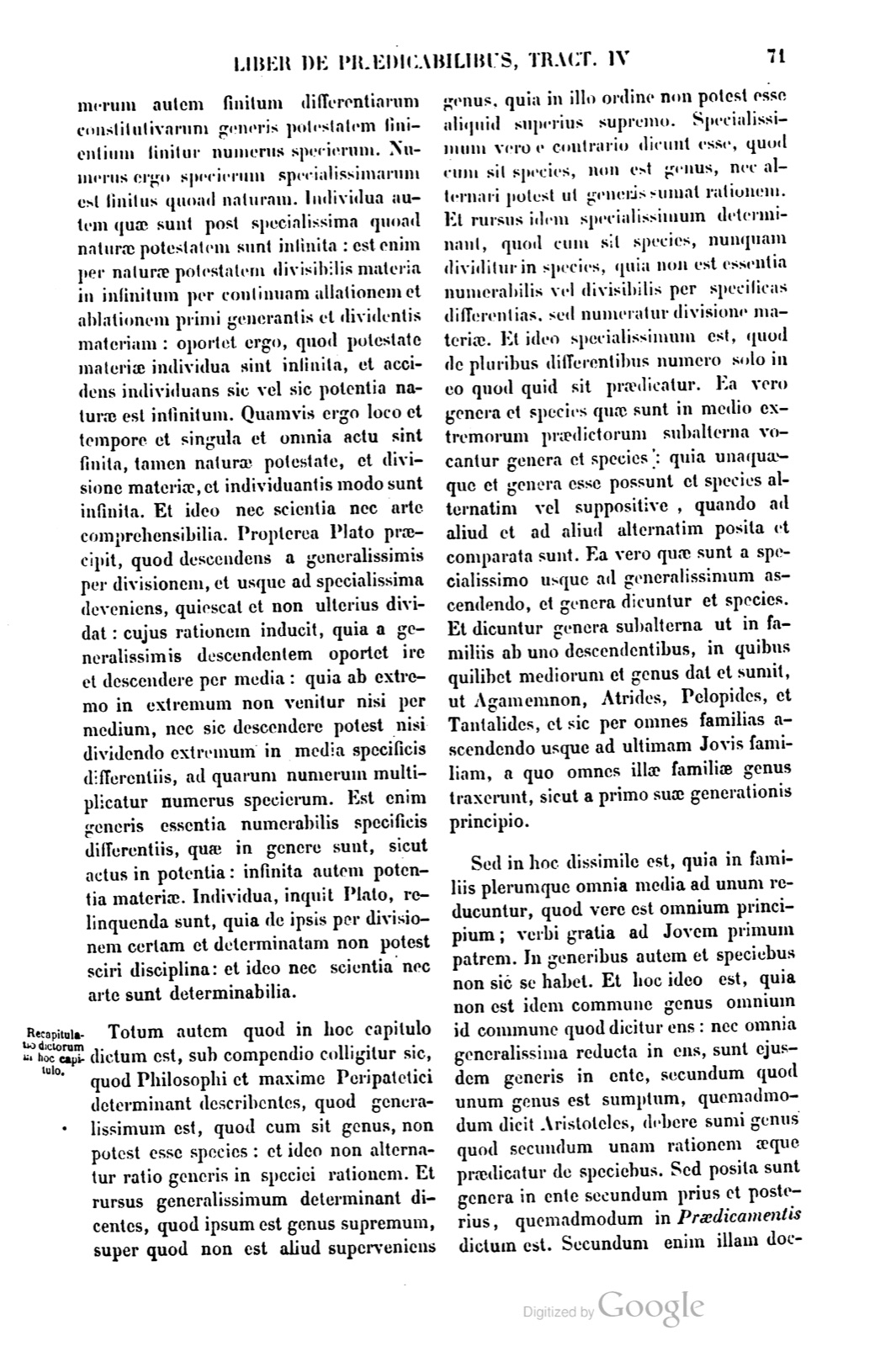
Haec autem quae dicta sunt, adhuc manifestabimus per ea quae sequuntur ad ipsa et similia. Resumentes ergo ea quae dicta sunt, dicimus, quod ex dictis patet, quod Philosophi determinant generalissimum per hoc quod cum genus sit, non species est: hoc enim sequitur ad hoc, quod id est supremum cui omnia supponuntur: per hoc enim quod omnia supponuntur ei, et praedicatur de eis in quid, sequitur quod sit non subalternum sed generalissimum, quod non potest utique esse species alicujus. Sequitur etiam ex prius habitis, quod non habet sibi superveniens genus: quia si hoc esse posset, jam esset subalternum, et esset species illius generis quod sibi in ordine positionis superveniret, et esset medium, non extremum. Ex quo sequitur ulterius, quod non esset simplex sed compositum, et esset participans aliud et participatum ab alio, et multa alia quae inconvenientia sunt. Si enim esset subalternum, hoc modo esset subalternum, quia sub altero esset positum. Sequeretur ergo, quod non esset supremum et primum principium, quod est contradictorium ad illud quod de ipso ante probatum est.
Specialissimum vero iidem Philosophi determinant, quod cum sit species, non est nec esse potest genus: est enim secundum utramque suam habitudinem species: secundum enim habitudinem quam habet ad superiora, species est et non genus, quia ipsum est quod supponitur generi, et de quo genus in eo quod quid est praedicatur. Secundum autem habitudinem quam habet ad individua, non dividitur differentiis, ut secundum partem suae potestatis sit in inferioribus, sed est in quolibet secundum totam suam essentiam, et secundum totam suam potestatem: quod non convenit generi, sed speciei, non in quantum species est, sed in quantum species specialissima, quae nihil habet sub se nisi individuum, quod solum per materiam est numerabile et non per formam, in eo quod in materia totum esse et posse diffundit forma. Hoc ergo specialissimum cum sit species, nunquam dividitur vel dividi potest in species: quia divisio in species non est nisi generis per differentias formaliter oppositas: non ergo dividitur nisi per materiam. Et quia, ut dicit Aristoteles 1, divisio est causa numeri, et divisio materiae est causa numeri materialis: sequitur quod praedicatur de pluribus differentibus solo numero materiae in eo quod quid sit: quia ipsum est quid et quidditas individuorum et totum esse ipsorum.
Ea vero omnia quae sunt secundum ordinem positionis in medio istorum extremorum participantia et participata per substantiam, et per id quod sunt, vocantur quidem subalterna, et simul non secundum idem sunt genera et species: et ideo unumquodque talium simul genus et species esse potest: possunt ergo omnia talia genera esse et species, ad aliud quidem et ad aliud secundum comparationis habitudinem sumpta. Et sic omnia quae secundum ordinem a specialissimo usque ad generalissimum disposita sunt secundum ascensum ab inferiori ad superius, sive a composito ad simplex, sive a posteriori in prius, secundum naturam et genera dicuntur et species, et dicuntur genera subalterna, et species subalternae. Genus autem subalternum non dicitur quod sub se habeat genus: quia sic generalissimum esset subalternum, habet enim sub se aliud genus: sed dicitur subalternato genere positum. Et similiter species specialissima non dicitur non subalterna, propter hoc quod generi non supponatur, generi enim supponitur: sed ideo dicitur non subalterna, quia nulla ei supponitur species communis; hoc enim sonat nomen subalterni, quod scilicet alternato ordine participato supponatur et participanti supponatur: et quod non habet nisi unum istorum, non est subalternum. Superponitur enim generalissimum omni se participanti, sed alternato ordine nihil participat. Supponitur autem specialissimum omni participato, sed a nullo communi participatur. Et ideo haec duo non habent alternatum ordinem, et ideo non sunt subalterna.
CHAPTER V.
On the manifestation of the things said from consequents and similar things.
But we will further manifest the things which have been said through those things which follow upon them and are similar. Therefore, resuming the things which have been said, we say that from the things said it is clear that the Philosophers determine the most general through this, that, although it is genus, it is not species. For this follows upon this, that it is the highest under which all things are placed; for through this, that all things are placed under it and it is predicated of them in what, it follows that it is not subaltern but most general, which cannot in any way be the species of anything. It also follows from the things had earlier that it does not have a genus coming over it, because if this could be, it would already be subaltern, and would be a species of that genus which would come over it in the order of position, and it would be a middle, not an extreme. From this it follows further that it would not be simple but composite, and would be participating another and participated by another, and many other things which are unfitting. For if it were subaltern, it would be subaltern in this way, because it would be placed under another. Therefore it would follow that it would not be the highest and first principle, which is contradictory to that which was proved about it before.
But the same Philosophers determine the most special as that which, although it is species, is not and cannot be genus; for it is species according to each of its relations. According to the relation which it has to superiors, it is species and not genus, because it is what is placed under genus and of which genus is predicated in that which is what. But according to the relation which it has to individuals, it is not divided by differences so that according to part of its power it is in inferiors, but it is in any one according to its whole essence and according to its whole power. This does not belong to genus, but to species, not insofar as it is species, but insofar as it is most special species, which has nothing under itself except the individual, which alone is numerable through matter and not through form, in that form diffuses whole being and power in matter. Therefore this most special, since it is species, is never divided or able to be divided into species, because division into species is only of genus through formally opposed differences. Therefore it is divided only through matter. And because, as Aristotle says 1, division is the cause of number, and division of matter is the cause of material number, it follows that it is predicated of several things differing only in number of matter in that which is what, because it is the what and quiddity of individuals and their whole being.
But all those things which, according to the order of position, are in the middle of these extremes, participating and participated through substance and through that which they are, are called subaltern; and at the same time, not according to the same thing, they are genera and species. And therefore each such thing can at once be genus and species. Therefore all such things can be genera and species, taken with respect to one thing and to another according to the relation of comparison. And thus all things which according to order are disposed from the most special to the most general according to ascent from inferior to superior, or from composite to simple, or from posterior into prior, according to nature are called both genera and species, and are called subaltern genera and subaltern species. But a subaltern genus is not called so because it has a genus under itself, because thus the most general would be subaltern, since it has another genus under itself; rather it is called placed under an alternated genus. And similarly the most special species is not called non-subaltern because it is not placed under a genus, for it is placed under a genus; rather it is called non-subaltern because no common species is placed under it. For the name of subaltern sounds this, namely that in an alternated order it is placed under what is participated and is placed over what participates; and what has only one of these is not subaltern. For the most general is placed over everything participating it, but in an alternated order it participates nothing. But the most special is placed under everything participated, but is participated by no common thing. And therefore these two do not have alternated order, and therefore they are not subaltern.
Attende autem, quod cum dicitur genus subalternum, videtur esse oppositio in adjecto: quia genus ut genus dicit superponere in ordine praedicabilium, et dicit id quod est principium et diffinitivum ejus quod sibi supponitur. Subalternum autem cum dicat id quod in ordine est alternatum, aliquo modo dicit id quod supponitur, et quod est principiatum et diffinitum. Sed hoc facile solvitur, si consideratur qualiter dicitur genus subalternum: genus enim esse habet ex ratione prioris et principii, et superpositionis: sed subalternum esse habet a suppositione alterna in superpositione. Et quia sic generalitas et subalternatio ad diversa referuntur, sequitur quod unum non privat et diminuit rationem alterius.
Adhuc autem cum dividitur genus per istas differentias, subalternum et non subalternum, pro certo divisio est subjecti in accidens. Accidit enim illi naturae quae est genus, quod sit in ordine praedicabilium stans in uno situ, vel quod sit alternata secundum ordinem positionum diversarum. Idem autem intelligendum est de specie subalterna et non subalterna: hoc enim accidit illi naturae quae est species: haec enim nomina subalternum et non subalternum, rationes accidentium positionis in ordine tali praedicabilium nominant in natura praedicabilium hujusmodi. Et ideo cum dicitur, praedicabilium quaedam sunt secundum praedicationem subalterna, quaedam non subalterna, est divisio subjecti in accidentia secundum rei veritatem.
Sed hoc verum est, quod si consideretur causa hujus divisionis et positionis, tunc praeintelligitur quaedam alia divisio, quae est, quod natura praedicabilium talium alia est simplex, alia composita: et composita natura quaedam est numerabilis et divisibilis per differentias, eo quod est composita ex genere et differentia: quaedam autem est numerabilis numero solo, eo quod per differentias ultimas dividi non potest: et haec divisio est generis in species, quia numerabilis natura per differentias, est genus compositum: numerabilis autem per materiam et non per differentias, est species specialissima.
Attend, however, that when subaltern genus is said, there seems to be an opposition in the adjective, because genus as genus states placing-over in the order of predicables, and states that which is the principle and definitive of what is placed under it. But subaltern, since it states that which is alternated in order, in some way states what is placed under and what is principled and defined. But this is easily solved if it is considered how subaltern genus is said. For genus has being from the notion of prior and principle and superposition, but subaltern has being from alternate supposition in superposition. And because thus generality and subalternation are referred to diverse things, it follows that one does not remove or diminish the notion of the other.
Further, when genus is divided through these differences, subaltern and non-subaltern, certainly the division is of a subject into an accident. For it happens to that nature which is genus that it stands in one position in the order of predicables, or that it is alternated according to the order of diverse positions. The same is to be understood concerning subaltern and non-subaltern species, for this happens to that nature which is species. For these names, subaltern and non-subaltern, name notions of accidents of position in such an order of predicables in the nature of such predicables. And therefore when it is said that some predicables according to predication are subaltern and some non-subaltern, it is a division of a subject into accidents according to the truth of the thing.
But this is true, that if the cause of this division and position is considered, then another division is pre-understood, which is that of the nature of such predicables one is simple, another composite; and of composite nature, one is numerable and divisible through differences, because it is composed from genus and difference, but another is numerable by number alone, because it cannot be divided through ultimate differences. And this division is of genus into species, because a nature numerable through differences is a composite genus, but a nature numerable through matter and not through differences is most special species.
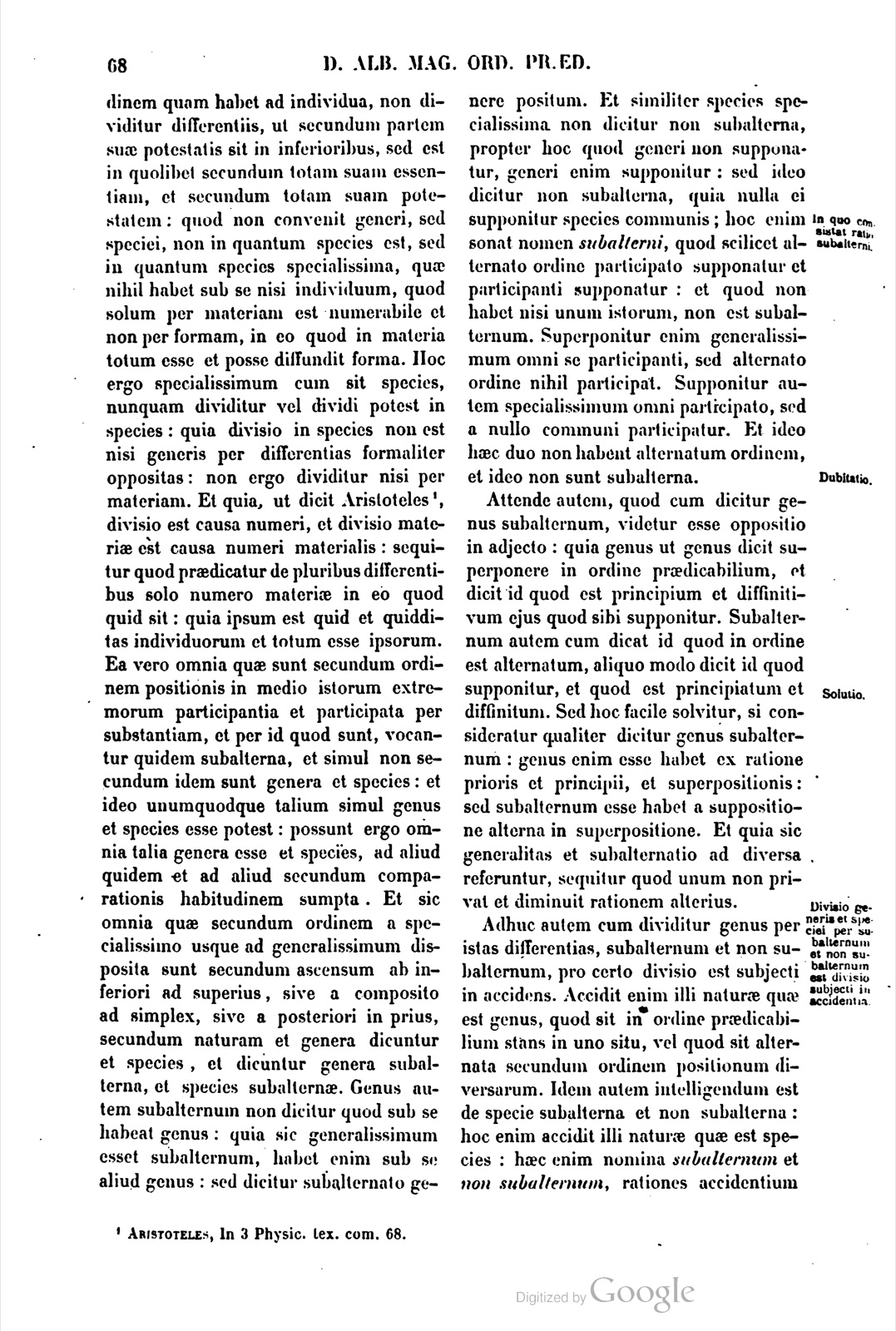
Nec est aliquo modo dicendum, quod subalternum dicatur vel genus vel species, quod sic subalternari non potest, ut sit subtus et supra: sicut quidam dicunt, quod genus subalternum dicatur, quod est sub alio tantum: et species dicatur quae super aliud: haec enim non est ratio subalterni: alternum enim est, quod alternatim supponitur et superponitur, sicut dictum est. Si enim diceretur subalternum in genere, cui superponitur genus, et subalternum in specie, cui supponitur species, sicut quidam dixerunt, esset subalternum alterius et alterius rationis, quod falsum est. Unde subalternum simul ab utroque dicitur, secundum quod alternatim ponitur subtus et supra, potest esse genus et species. Et ideo generalissimum non potest esse subalternum: quia alternare se non potest, ut fiat subtus et subjectum ut species. Et specialissimum non potest esse subalternum, quia subalternare se non potest, ut respectu alicujus communis fiat subjectum et praedicatum.
Subalternorum autem et generalissimorum et specialissimorum quae non subalternantur, exemplum et similitudo est in familiis, a quibus ut in tractatu generis dictum est, primo logicum genus est transsumptum. Si enim familia Jovis, hoc est quae a Jove descendit, per domos sive familias distinguatur, dicemus quod Agamemnon sive domus et familia Agamemnonis, quae ultima et inferior est, reducitur ad Atridem a quo descendit, et ab Atride duxit genus et originem: et sic Atrides genus dat Agamennoni, Atrides autem duxit genus a Pelopide, et Pelopides genus traxit a Tantalide, Tantalides autem a Jove: quoniam Deus sublimis est et primus in ordine: quare generalissimi locum tenens, eo quod alii non subjiciatur. Jupiter autem deus sublimis ab omnibus antiquis appellabatur: omnes ergo intermedii et patres sunt et filii. In extremis autem Agamemnon filius tantum accipiens et non perfundens genus: Jupiter autem dans et non accipiens in illo ordine ab aliquo. Quia si etiam Jupiter filius Saturni esse dicatur: tamen quia patrem expulit de regno, in dignitate regali et familia regni et gradu honoris priorem non habuit: et ideo familia regalis stat in Jove in supremo, in Agamemnone autem in infimo. Intermedii autem alternatim sunt: et accipientes et dantes familiam ad regnum pertinentem. Et hoc est sicut in generibus subalternatim et non subalternatim positis, sicut ex praedictis manifestum est.
Sed in hoc est dissimilitudo: quia in familiis quidem omnia descendentia plerumque ad unum reducuntur principium. Dico autem plerumque in omni familia quae ab uno descendit, ad unum principium fit reductio: quando autem ab uno non fit descensus, tunc ad unum reduci non possunt: ut si dicamus, quod in diversis quartis mundi divisa fuerunt hominis principia. Sola enim una terrae quarta nobis nota est, ut probat Ptolemaeus in Almagesto, et in hac nostra habitabili omnes familiae ad Adam reducuntur. In aliis autem quartis si habitabiles sunt, alia et alia habuerunt principia. Sed in generibus et speciebus logicis non sic se habet: quia omnia quae sunt in omnibus generibus et speciebus tam substantiae quam accidentium non ad aliquid unum quod sit secundum unam rationem omnium principium reduci possunt, eo quod ens, ad quod omnes aliquo modo reducuntur, non est commune omnium genus tam generum substantiae quam generum accidentium. Non enim omnia et substantiae et accidentia sunt ejusdem generis: sic enim accideret, quod omnia aut essent substantia, aut omnia essent accidentia, eo quod primum genus est quidem omnium aliorum: et unum genus non est principium nisi ejus quod est quidem unius et ejusdem rationis. Tunc ergo unius generis praedicamenta essent omnia tam substantiae quam accidentia, si sumatur unum genus in illa generis ratione: quemadmodum in Praedicamentis dicit Aristoteles, quia scilicet nomine et substantiae ratione in quid sic praedicatur de his quae sunt in specie, sicut in genere.
Nor must it be said in any way that either genus or species is called subaltern which cannot so be subalternated that it is below and above, as certain people say that a subaltern genus is called what is only under another, and species what is over another. For this is not the notion of subaltern; for alternate is what is placed under and placed over alternately, as has been said. For if subaltern were said in genus, over which genus is placed, and subaltern in species, under which species is placed, as certain people have said, subaltern would be of one notion and another, which is false. Whence subaltern is said from both at once, according as it is placed alternately below and above, and can be genus and species. And therefore the most general cannot be subaltern, because it cannot alternate itself so that it becomes below and subject as species. And the most special cannot be subaltern, because it cannot subalternate itself so that with respect to some common thing it becomes subject and predicate.
But an example and likeness of the subalterns and of the most generals and most specials which are not subalternated is in families, from which, as was said in the treatise on genus, logical genus was first taken over. For if the family of Jove, that is, the one which descends from Jove, is distinguished by houses or families, we will say that Agamemnon, or the house and family of Agamemnon, which is last and lower, is reduced to Atrides from whom it descends, and from Atrides it drew genus and origin; and thus Atrides gives genus to Agamemnon, but Atrides drew genus from Pelopides, and Pelopides drew genus from Tantalides, and Tantalides from Jove, because a god is sublime and first in order; wherefore he holds the place of the most general, since he is not subjected to another. But Jupiter was called the sublime god by all the ancients; therefore all intermediates are both fathers and sons. But in the extremes, Agamemnon is only a son receiving and not pouring forth genus; but Jupiter is giving and not receiving in that order from anyone. For even if Jupiter is said to be the son of Saturn, nevertheless because he expelled his father from the kingdom, in royal dignity and in the family of the kingdom and degree of honor he had no prior; and therefore the royal family stands in Jove at the highest point, but in Agamemnon at the lowest point. But the intermediates are alternately both receiving and giving the family pertaining to the kingdom. And this is as in genera placed alternately and non-alternately, as is manifest from the foregoing.
But in this there is unlikeness: because in families all descending things are for the most part reduced to one principle. I say for the most part: in every family which descends from one, reduction is made to one principle; but when descent is not from one, then they cannot be reduced to one, as if we say that the principles of man were divided in the diverse quarters of the world. For only one quarter of the earth is known to us, as Ptolemy proves in the Almagest, and in this our habitable quarter all families are reduced to Adam. But in the other quarters, if they are habitable, they had different principles. But in logical genera and species the matter does not have itself so, because all things which are in all genera and species, both of substance and accidents, cannot be reduced to some one thing which according to one notion is the principle of all, since being, to which all are in some way reduced, is not the common genus of all, both of the genera of substance and the genera of accidents. For all things, both substances and accidents, are not of the same genus; for then it would happen that all would either be substance or all would be accidents, since the first genus is indeed the genus of all the others, and one genus is not a principle except of that which is of one and the same notion. Therefore then all categories, both of substance and accidents, would be categories of one genus, if one genus were taken in that notion of genus, in the way Aristotle says in the Categories, namely because by name and by the notion of substance it is thus predicated in what of those things which are in species, as in genus.
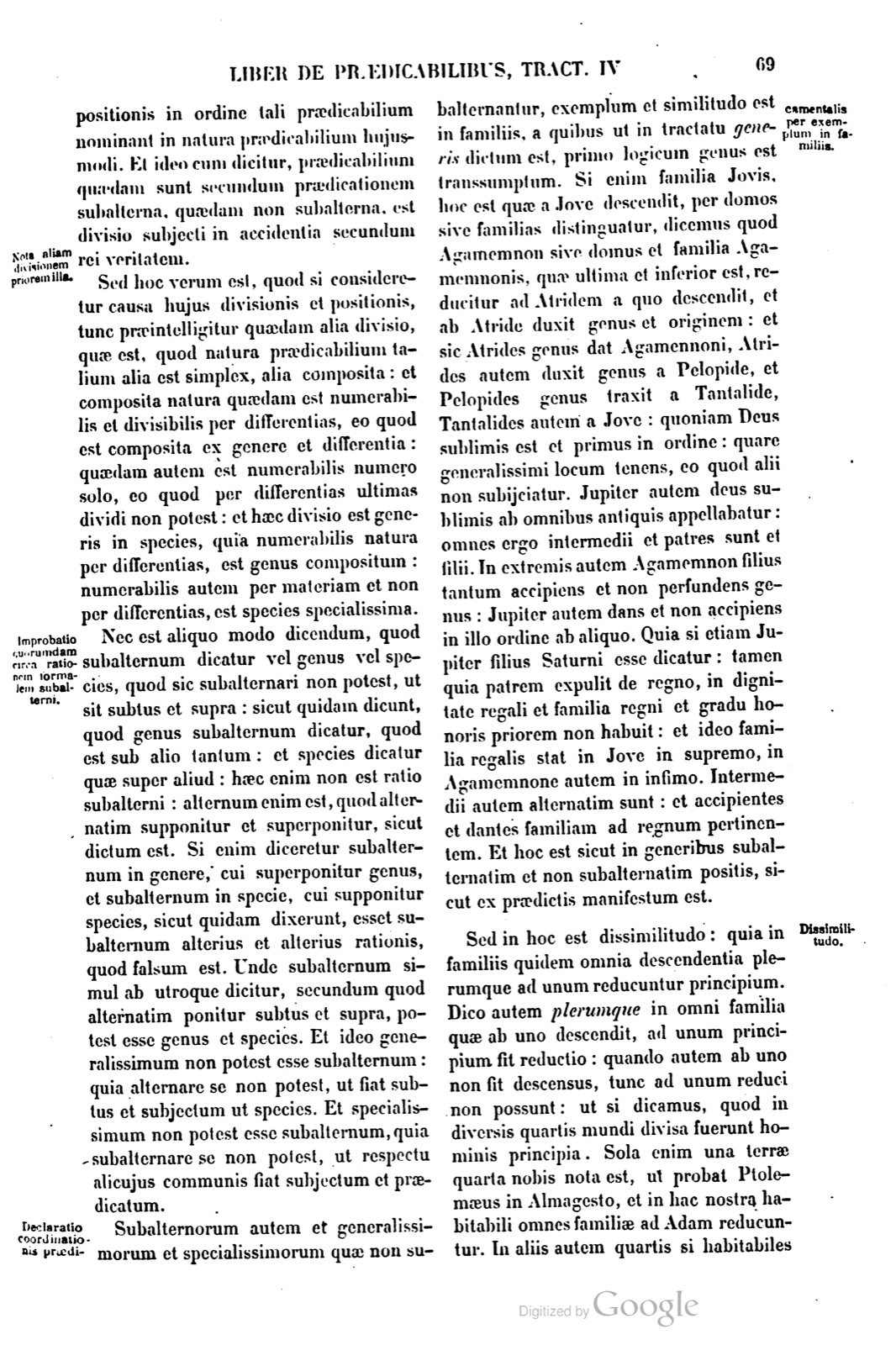
Entia ergo secundum sui diversitatem in diversis generibus posita sunt, sicut in Praedicamentis ab Aristotele dictum est. Sunt enim decem genera quasi prima decem principia, quorum unum ad alterum reduci non potest. Et si omnia docet Aristoteles 2 reducere ad substantiam, haec reductio omnium ad unum non est sicut ad unum genus, sed sicut reductio aliquorum ad unum subjectum: propter quod si quis dicat, quod omnia sunt entia, et quod ens sit commune praedicatum de omnibus, aequivoce, ut inquit Aristoteles, et non univoce omnia entia nuncupabit. Si autem unum commune genus esset omnium hoc ipsum quod dicimus ens, adhuc omnia univoce entia dicerentur, quia genus nomine et ratione praedicatur de his quorum est genus. Cum enim decem sint principia prima communia et generalissima, si haec dicuntur entia, erit praedicatio secundum communitatem nominis solum, et non erit communitas secundum rationem diffinitionis, quae secundum nomen est assignanda. In talibus enim ens simpliciter est substantia, et alia non simpliciter entia sunt, sed sunt entis passiones, ut quantitas mensura entis, qualitas autem non ens simpliciter, sed entis dispositio: et sic de aliis. Tamen quia in talibus respectus est ad unum quod est simpliciter ens, ideo non simpliciter est aequivocum. Quare non omnium ad unum respicientium est idem modus et ratio respiciendi: unum enim est ut mensura, alterum ut dispositio. Ideo quoad hoc est aequivocum. Et ideo totum simul analogum, hoc est, commune secundum proportionem vocatur, quod medium est inter univocum et aequivocum: quod simpliciter, ut dicit Boetius, a casu et fortuna aequivocum est. Et univocum quod simpliciter per unitatem nominis et unitatem diffinitae rationis est univocum. In tali enim univoco et ad quod multa respiciunt, unum et idem est esse in substantia, et in omnibus quae respiciunt ad id, est unus modus et una ratio respectus et respiciendi ad ipsum.
Therefore beings according to their diversity are placed in diverse genera, as was said by Aristotle in the Categories. For there are ten genera, as it were the ten first principles, of which one cannot be reduced to another. And if Aristotle teaches that all things are to be reduced to substance 2, this reduction of all to one is not as to one genus, but as the reduction of certain things to one subject; on account of which if someone says that all things are beings and that being is a common predicate of all, he will name all things beings equivocally, as Aristotle says, and not univocally. But if the very thing which we call being were one common genus of all, all things would still be called beings univocally, because genus is predicated by name and notion of those things of which it is genus. For since the ten are first common and most general principles, if these are called beings, the predication will be according to community of name only, and there will not be a community according to the notion of definition which must be assigned according to the name. For in such matters being simply is substance, and the others are not beings simply, but are passions of being, as quantity is the measure of being, while quality is not being simply, but a disposition of being, and so with the others. Nevertheless, because in such things there is a respect to one which is being simply, therefore it is not simply equivocal. Wherefore not of all things looking to one is there the same mode and notion of looking; for one is as measure, another as disposition. Therefore with respect to this it is equivocal. And therefore the whole together is called analogous, that is, common according to proportion, which is middle between univocal and equivocal, which, as Boethius says, is simply equivocal by chance and fortune; and univocal is that which is simply univocal through unity of name and unity of defined notion. For in such a univocal and in that to which many look, one and the same is being in substance, and in all things which look to it there is one mode and one notion of respect and looking to it.
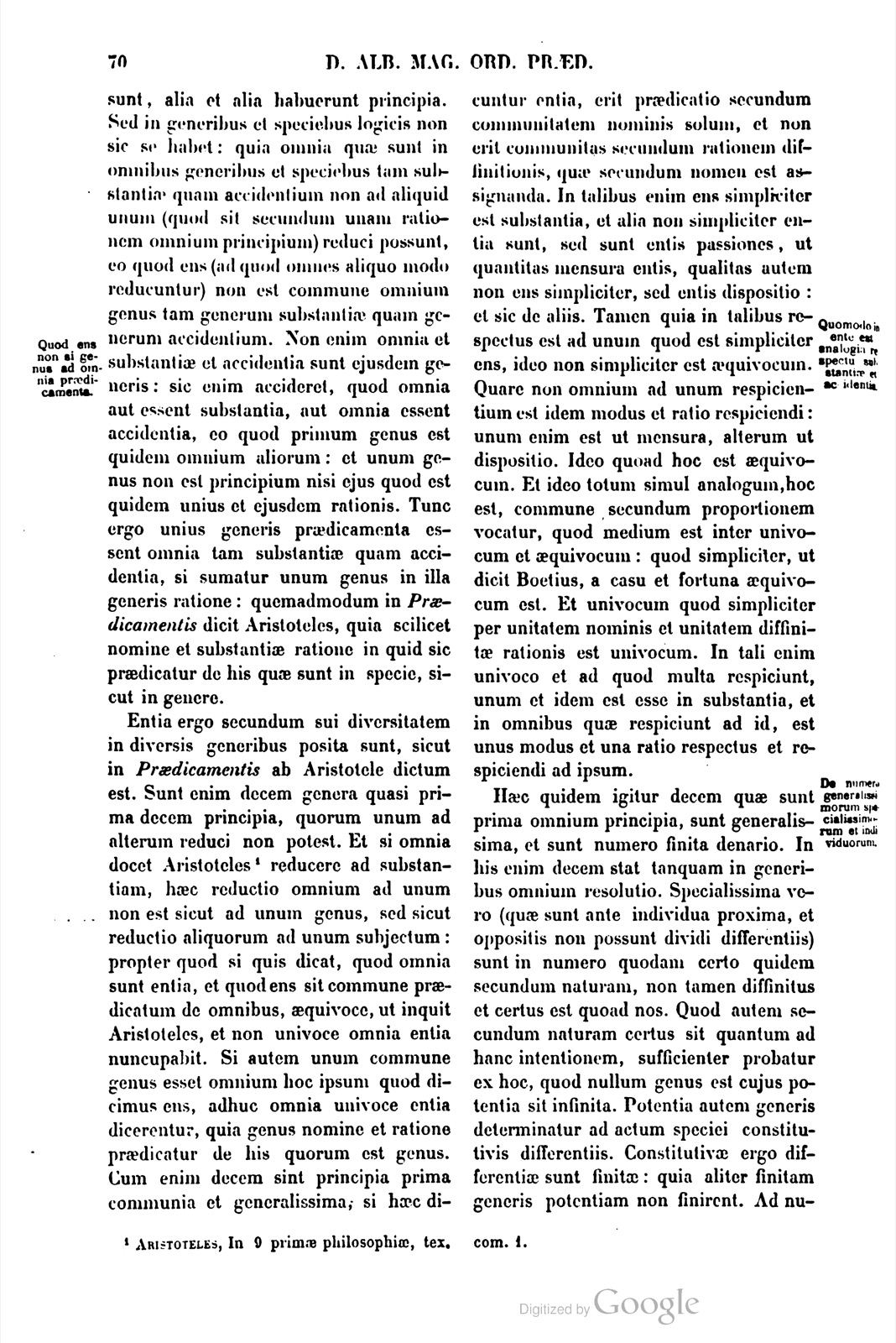
Haec quidem igitur decem quae sunt prima omnium principia, sunt generalissima, et sunt numero finita denario. In his enim decem stat tanquam in generibus omnium resolutio. Specialissima vero, quae sunt ante individua proxima, et oppositis non possunt dividi differentiis, sunt in numero quodam certo quidem secundum naturam, non tamen diffinitus et certus est quoad nos. Quod autem secundum naturam certus sit quantum ad hanc intentionem, sufficienter probatur ex hoc, quod nullum genus est cujus potentia sit infinita. Potentia autem generis determinatur ad actum speciei constitutivis differentiis. Constitutivae ergo differentiae sunt finitae: quia aliter finitam generis potentiam non finirent. Ad numerum autem finitum differentiarum constitutivarum generis potestatem finientium finitur numerus specierum. Numerus ergo specierum specialissimarum est finitus quoad naturam. Individua autem quae sunt post specialissima quoad naturae potestatem sunt infinita: est enim per naturae potestatem divisibilis materia in infinitum per continuam allationem et ablationem primi generantis et dividentis materiam: oportet ergo, quod potestate materiae individua sint infinita, et accidens individuans sic vel sic potentia naturae est infinitum. Quamvis ergo loco et tempore et singula et omnia actu sint finita, tamen naturae potestate, et divisione materiae, et individuantis modo sunt infinita. Et ideo nec scientia nec arte comprehensibilia. Propterea Plato praecipit, quod descendens a generalissimis per divisionem, et usque ad specialissima deveniens, quiescat et non ulterius dividat: cujus rationem inducit, quia a generalissimis descendentem oportet ire et descendere per media: quia ab extremo in extremum non venitur nisi per medium, nec sic descendere potest nisi dividendo extremum in media specificis differentiis, ad quarum numerum multiplicatur numerus specierum. Est enim generis essentia numerabilis specificis differentiis, quae in genere sunt, sicut actus in potentia: infinita autem potentia materiae. Individua, inquit Plato, relinquenda sunt, quia de ipsis per divisionem certam et determinatam non potest sciri disciplina: et ideo nec scientia nec arte sunt determinabilia.
Totum autem quod in hoc capitulo dictum est, sub compendio colligitur sic, quod Philosophi et maxime Peripatetici determinant describentes, quod generalissimum est, quod cum sit genus, non potest esse species: et ideo non alternatur ratio generis in speciei rationem. Et rursus generalissimum determinant dicentes, quod ipsum est genus supremum, super quod non est aliud superveniens genus, quia in illo ordine non potest esse aliquid superius supremo. Specialissimum vero e contrario dicunt esse, quod cum sit species, non est genus, nec alternari potest ut generis sumat rationem. Et rursus idem specialissimum determinant, quod cum sit species, nunquam dividitur in species, quia non est essentia numerabilis vel divisibilis per specificas differentias, sed numeratur divisione materiae. Et ideo specialissimum est, quod de pluribus differentibus numero solo in eo quod quid sit praedicatur. Ea vero genera et species quae sunt in medio extremorum praedictorum subalterna vocantur genera et species: quia unaquaque et genera esse possunt et species alternatim vel suppositive, quando ad aliud et ad aliud alternatim posita et comparata sunt. Ea vero quae sunt a specialissimo usque ad generalissimum ascendendo, et genera dicuntur et species. Et dicuntur genera subalterna ut in familiis ab uno descendentibus, in quibus quilibet mediorum et genus dat et sumit, ut Agamemnon, Atrides, Pelopides, et Tantalides, et sic per omnes familias ascendendo usque ad ultimam Jovis familiam, a quo omnes illae familiae genus traxerunt, sicut a primo suae generationis principio.
These ten, therefore, which are the first principles of all, are most general, and are finite in number as ten. For in these ten, as in genera, the resolution of all things stands. But the most special things, which are proximate before individuals and cannot be divided by opposed differences, are in some number that is indeed certain according to nature, yet not defined and certain for us. That it is certain according to nature as to this intention is sufficiently proved from this, that there is no genus whose potency is infinite. But the potency of genus is determined to the act of species by constitutive differences. Therefore constitutive differences are finite, because otherwise they would not limit the finite potency of genus. But by the finite number of constitutive differences limiting the potency of genus, the number of species is limited. Therefore the number of most special species is finite with respect to nature. But individuals which are after the most special things are infinite with respect to the power of nature: for matter is divisible in infinity by the power of nature through the continual bringing-to and taking-away of the first generator and divider of matter. Therefore it is necessary that by the power of matter individuals be infinite, and the individuating accident in this way or that is infinite by the potency of nature. Therefore although in place and time both single things and all things are finite in act, nevertheless by the power of nature, the division of matter, and the mode of individuation, they are infinite. And therefore they are comprehensible neither by science nor by art. On account of this Plato instructs that one descending from the most general things through division, and coming down as far as the most special things, should rest and not divide further. He introduces the reason for this: because one descending from the most general things must go and descend through middles, because one does not come from extreme to extreme except through a middle; nor can one descend thus except by dividing the extreme into middles by specific differences, by whose number the number of species is multiplied. For the essence of genus is numerable by specific differences, which are in genus as act in potency; but infinite is the potency of matter. Individuals, says Plato, must be left behind, because concerning them through certain and determinate division discipline cannot be known; and therefore they are determinable neither by science nor by art.
But the whole which has been said in this chapter is gathered under a compendium thus: that the Philosophers, and especially the Peripatetics, determine by describing that the most general is what, although it is genus, cannot be species, and therefore the notion of genus is not alternated into the notion of species. And again they determine the most general, saying that it is the supreme genus over which there is no other supervening genus, because in that order there cannot be anything higher than the highest. But on the contrary they say that the most special is that which, although it is species, is not genus, nor can it be alternated so that it takes the notion of genus. And again they determine the same most special as that which, although it is species, is never divided into species, because it is not an essence numerable or divisible by specific differences, but is numbered by the division of matter. And therefore the most special is what is predicated of several things differing in number alone in that which is what. But those genera and species which are in the middle of the aforesaid extremes are called subaltern genera and species, because each can be both genus and species alternately or by supposition, when they are alternately placed and compared to one thing and another. But those things which are from the most special up to the most general by ascending are called both genera and species. And they are called subaltern genera as in families descending from one, in which any one of the middle things both gives and takes genus, as Agamemnon, Atrides, Pelopides, and Tantalides, and so through all families by ascending up to the last family of Jove, from whom all those families drew genus, as from the first principle of their generation.
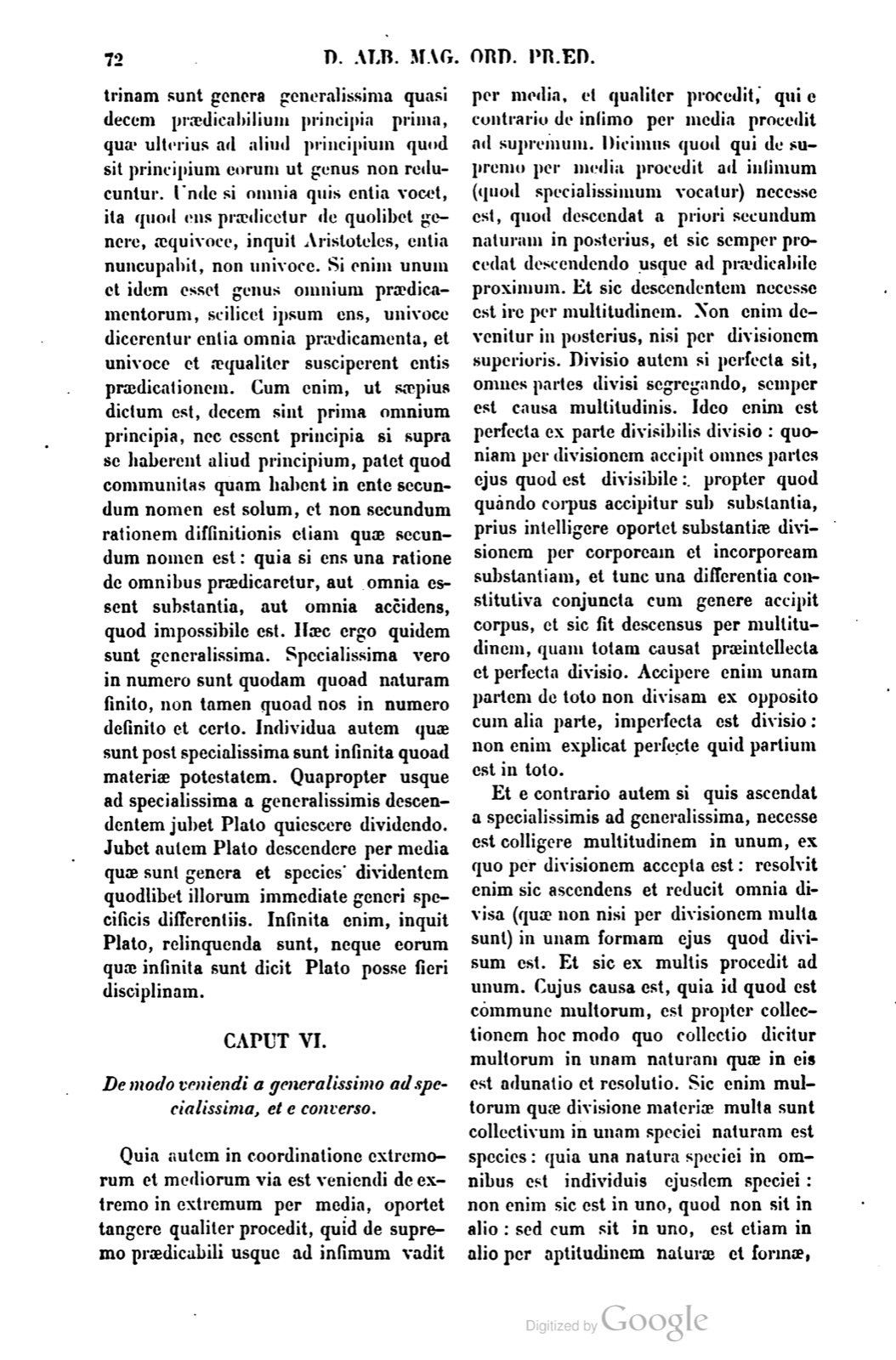
Sed in hoc dissimile est, quia in familiis plerumque omnia media ad unum reducuntur, quod vere est omnium principium; verbigratia ad Jovem primum patrem. In generibus autem et speciebus non sic se habet. Et hoc ideo est, quia non est idem commune genus omnium id commune quod dicitur ens: nec omnia generalissima reducta in ens, sunt ejusdem generis in ente, secundum quod unum genus est sumptum, quemadmodum dicit Aristoteles, debere sumi genus quod secundum unam rationem aeque praedicatur de speciebus. Sed posita sunt genera in ente secundum prius et posterius, quemadmodum in Praedicamentis dictum est. Secundum enim illam doctrinam sunt genera generalissima quasi decem praedicabilium principia prima, quae ulterius ad aliud principium quod sit principium eorum ut genus non reducuntur. Unde si omnia quis entia vocet, ita quod ens praedicetur de quolibet genere, aequivoce, inquit Aristoteles, entia nuncupabit, non univoce. Si enim unum et idem esset genus omnium praedicamentorum, scilicet ipsum ens, univoce dicerentur entia omnia praedicamenta, et univoce et aequaliter susciperent entis praedicationem. Cum enim, ut saepius dictum est, decem sint prima omnium principia, nec essent principia si supra se haberent aliud principium, patet quod communitas quam habent in ente secundum nomen est solum, et non secundum rationem diffinitionis etiam quae secundum nomen est: quia si ens una ratione de omnibus praedicaretur, aut omnia essent substantia, aut omnia accidens, quod impossibile est. Haec ergo quidem sunt generalissima. Specialissima vero in numero sunt quodam quoad naturam finito, non tamen quoad nos in numero definito et certo. Individua autem quae sunt post specialissima sunt infinita quoad materiae potestatem. Quapropter usque ad specialissima a generalissimis descendentem jubet Plato quiescere dividendo. Jubet autem Plato descendere per media quae sunt genera et species dividentem quodlibet illorum immediate generi specificis differentiis. Infinita enim, inquit Plato, relinquenda sunt, neque eorum quae infinita sunt dicit Plato posse fieri disciplinam.
But in this it is unlike, because in families for the most part all middles are reduced to one thing which is truly the principle of all, for example to Jove the first father. But in genera and species it is not so. And this is because the common thing which is called being is not the same common genus of all; nor are all most general things, reduced into being, of the same genus in being, according as one genus is taken, in the way Aristotle says that genus ought to be taken, namely what according to one notion is equally predicated of species. Rather genera are placed in being according to prior and posterior, as has been said in the Categories. For according to that doctrine the most general genera are as it were the ten first principles of predicables, which are not further reduced to another principle which would be their principle as genus. Whence if someone calls all things beings, so that being is predicated of any genus, he will name them beings equivocally, says Aristotle, not univocally. For if one and the same thing were the genus of all categories, namely being itself, all categories would be called beings univocally, and they would receive the predication of being univocally and equally. For since, as has often been said, the ten are first principles of all, and they would not be principles if above themselves they had another principle, it is clear that the community which they have in being is only according to the name, and not according to the notion of definition which is also according to the name; because if being were predicated of all by one notion, either all things would be substance, or all accident, which is impossible. These, therefore, are the most general. But the most special things are in a certain number finite with respect to nature, though not in a number defined and certain with respect to us. But individuals which are after the most special are infinite with respect to the power of matter. For this reason Plato orders the one descending from the most general things to rest by dividing as far as the most special things. But Plato orders him to descend through the middles which are genera and species, dividing any of them immediately by specific differences of the genus. For infinite things, says Plato, must be left behind, and Plato says that no discipline can be made of those things which are infinite.
If a page does not appear, its photograph has not been uploaded yet.