Volume 1 · pp. 61–65
Chapter III. How the most special species is found, and on predicamental coordination.
A marker with ≈ is an approximate page boundary, placed by measure of the text; the page photographs remain the authority. In the paired views, clicking a page marker brings that page into view.
CAPUT III.
Qualiter inveniatur species specialissima, et de coordinatione praedicamentali.
Qua autem arte inveniantur species specialissimae secundum diversas intentiones, de quibus dictum est, planum et manifestum erit hoc modo. In unoquoque enim praedicamento secundum omnia genera praedicamentorum sunt quaedam in supremo secundum totam illius generis praedicabilium coordinationem, quae dicuntur generalissima: non quia in uno sint plura, quia hoc impossibile est, et id quod per superabundantiam dicitur in uno ordine rerum, non nisi uni soli potest convenire, sed quod in quolibet genere est unum, et in eodem ordine praedicabilium sunt quaedam secundum suas communitates et universalitates infima, quae dicuntur specialissima, et in quolibet sunt plura, propter hoc quia quamvis specialissima in uno et eodem genere praedicabilium necesse est stare in uno, ubi resolvuntur ad unum, non tamen propter hoc secundum viam divisionis et compositionis, quae ab uno incipit, necesse est, quod divisio stet in uno sicut in infimo: quia divisio multis viis procedit ex uno: et illae viae non sunt nisi per diversas formas et oppositas, quae differentiae vocantur, quas uniri ad unum est impossibile, et ideo divisio ex uno stat in multis ultimis: et quodlibet illorum est indivisibile secundum formam, non habens sub se commune, et ideo quodlibet illorum est specialissimum.
In tali autem praedicabilium ordine supremum ideo dicitur generalissimum, quia non habet supra se genus superius superveniens sibi, quod ut genus praedicetur de ipso. Specialissimum autem dicitur, quod in tali ordine est indivisibile secundum formam et naturae potestatem: propter quod sub se non habet aliquod commune quod sit species, et modum praedicandi habeat speciei: quamvis sub se habeat individua, in quibus omnibus est ipsa species secundum totum suum esse et secundum totam suam potestatem. Hoc autem modo, ut in ante habitis dictum est, non est genus in speciebus: in nulla enim specie secundum se est genus secundum totum ambitum suae potestatis. Nec aliquis miretur, quod per intentionem loquentes dicimus generalissimum, generalius, et generale, et specialissimum, specialius, et speciale: quia sicut in ante habitis determinatum est, id universale quod est genus, per accidens quoddam quod sibi accidit genus vocatur: et in illo potest intendi et remitti, maxime secundum prius et posterius dicta intentione, potius quam secundum accessum ad terminum aliquem vel recessum ab illo: magis enim genus est id quod in omnibus genus est, quam id quod genus est ad quaedam: et similiter est de specie, quod magis est species quod omnibus est species, quam id quod non est species nisi ad quaedam.
Inter generalissimum autem in summo, et specialissimum in infimo, sunt media quaedam, quae eadem in substantia existentia sunt genera et species, sed ad aliud et aliud comparata sive per comparationem sumpta.
Gratia autem exempli potest hoc in uno praedicamento esse manifestum, ut in aliis omnibus similiter esse intelligatur, in ordine praedicabilium quae sunt in genere substantiae. In genere substantiae primo ponitur substantia, quae sine conversione ut genus praedicatur de omnibus quae in genere sunt substantiae: et ideo generalissimum est vocatum. Proximum autem quod sub hac ponitur per differentiam constitutivam, est substantia corporea quae vocatur corpus. Cum autem iterum corpus per animatum et inanimatum dividitur, proximum sub hoc communi quod est corpus, constitutum est corpus animatum, quod uno nomine vivum vocatur, communitate sua ambiens et vegetabilia et sentientia quae dicuntur animalia. Corpus autem animatum iterum per opposita dividitur, scilicet sensibile, et insensibile: et cum adjunctum fuerit corpori animato sive vivo sensibile, proximum sub ipso positum erit animal. Cum vero animal iterum per rationale et irrationale dividitur, quae sunt oppositae differentiae, et rationale adjunctum fuerit animali, fit rationale animal complectens deos secundum Stoicos et homines. Cum autem ipsum quod est rationale animal, per mortale et immortale dividitur, et mortale junctum fuerit animali rationali, constituitur homo: qui ulterius per differentiam non est divisibile, quia secundum totam suae naturae potestatem est in quolibet suorum suppositorum. Sub homine ergo non est commune aliquod, sed particularia, ut Socrates, et Plato, qui sunt particulares homines.
CHAPTER III.
How the most special species is found, and on predicamental coordination.
By what art the most special species are found according to the diverse intentions about which it has been spoken will be plain and manifest in this way. For in each category, according to all the genera of categories, there are some things at the highest point according to the whole coordination of predicables of that genus, which are called most general; not because there are several in one, because this is impossible, and what is said by superabundance in one order of things can belong only to one alone, but because in each genus there is one; and in the same order of predicables there are certain things lowest according to their communities and universalities, which are called most special, and in each there are several, because although the most special in one and the same genus of predicables must stand in one where they are resolved to one, nevertheless for this reason according to the way of division and composition, which begins from one, it is not necessary that division stand in one as in the lowest, because division proceeds from one by many ways, and those ways are only through diverse and opposed forms, which are called differences, which it is impossible to unite into one; and therefore division from one stands in many last things, and any one of them is indivisible according to form, not having a common thing under it, and therefore any one of them is most special.
But in such an order of predicables the highest is therefore called most general because it does not have above itself a superior genus coming over it, which may be predicated of it as genus. But that is called most special which in such an order is indivisible according to form and the power of nature; on account of this it has under itself no common thing which is species and has the mode of predicating of species, although under itself it has individuals, in all of which the species itself is according to its whole being and according to its whole power. But in this way, as was said above, genus is not in species; for in no species according to itself is genus according to the whole range of its power. Nor should anyone wonder that, speaking by intention, we say most general, more general, and general, and most special, more special, and special; because, as was determined above, that universal which is genus is called genus through a certain accident which happens to it, and in that it can be intensified and remitted, especially according to intention said as prior and posterior, rather than according to approach to some term or recession from it. For that is more genus which is genus in all things, than that which is genus to certain things; and similarly concerning species, that is more species which is species to all than that which is species only to certain things.
But between the most general at the summit and the most special at the lowest point there are certain middles which, existing the same in substance, are genera and species, but as compared to one thing and another, or as taken by comparison.
For the sake of example, this can be manifest in one category, so that in all others it may be understood similarly, in the order of predicables which are in the genus of substance. In the genus of substance, substance is first placed, which without conversion is predicated as genus of all things which are in the genus of substance; and therefore it is called most general. But the proximate thing which is placed under it through constitutive difference is corporeal substance, which is called body. But when body is again divided through animated and inanimate, the proximate thing constituted under this common thing which is body is animated body, which by one name is called living thing, encompassing in its community both vegetative things and sentient things which are called animals. But animated body is again divided through opposites, namely sensible and insensible; and when sensible has been joined to animated or living body, animal will be the proximate thing placed under it. But when animal is again divided through rational and irrational, which are opposed differences, and rational has been joined to animal, rational animal is made, encompassing gods according to the Stoics and men. But when that which is rational animal is divided through mortal and immortal, and mortal has been joined to rational animal, man is constituted; he is not further divisible through difference, because according to the whole power of his nature he is in any of his supposits. Therefore under man there is no common thing, but particulars, such as Socrates and Plato, who are particular men.
Sed inter omnia substantia quidem est generalissimum: et ideo est id quod est tantum genus, quia nullo modo potest fieri species: omnis enim species est quae sub assignato genere ponitur. Et cum substantia non habeat superveniens genus, constat quod non potest fieri species. Homo vero inter haec est species specialissima, et quae nullo modo potest fieri genus: cum enim genus sit, sicut in ante habitis dictum est, cui supponitur species, et cum nihil commune nec genus nec species supponatur homini in quo homo sit secundum partem suae naturalis potestatis, et non secundum totum, patet quod homo non potest esse genus. Est ergo species solum, et non genus.
Omnia autem intermedia inter substantiam quae est genus tantum, et hominem qui est species tantum, sunt simul genera et species respectu diversorum, sicut corpus sive substantia corporea, quae proxima est substantiae in supremo: est quidem species substantiae, quia species est quae sub assignato genere ponitur: genus vero est idem corpus corporis animati sive vivi, cum genus sit cui supponitur species, et in qua genus est secundum partem suae naturalis potestatis. Omnino autem eodem modo id quod substat tertium in ordine secundum descensum a substantia, quod est corpus animatum sive vivum, est species quidem corporis, cui tanquam generi supponitur: genus vero est animalis, quia sibi animal tanquam assignato generi supponitur.
Animal vero secundum Stoicos species quidem est animati corporis sive vivi: genus vero est animalis rationalis, eo quod non habemus unum nomen, quo id commune significemus, quod continet hominem et Deos: quoniam secundum Stoicos substantiae incorporeae sunt animalia, ut dicit Apuleius in lib. de Deo Socratis. Homo vero species quidem est animalis rationalis, quia illi tanquam generi assignato supponitur: genus autem non est alicujus, quia in nullo communi quod post ipsum sit est secundum partem suae naturalis potestatis, sed in quolibet secundum totum esse, et secundum totum esse suae potestatis. Patet ergo, quod est species animalis rationalis, et non est genus particularium hominum.
But among all these, substance indeed is most general, and therefore it is that which is only genus, because in no way can it become species; for every species is that which is placed under an assigned genus. And since substance does not have a genus coming over it, it is clear that it cannot become species. But man among these is the most special species, and in no way can become genus: for since genus is, as was said above, that under which species is placed, and since no common thing, neither genus nor species, is placed under man in which man is according to part of his natural power and not according to the whole, it is clear that man cannot be genus. Therefore he is species only, and not genus.
But all intermediates between substance, which is only genus, and man, who is only species, are at once genera and species with respect to diverse things, as body or corporeal substance, which is proximate to substance at the highest point: it is indeed a species of substance, because species is what is placed under an assigned genus; but the same body is genus of animated or living body, since genus is that under which species is placed, and in which genus is according to part of its natural power. In altogether the same way that which stands third in order according to descent from substance, which is animated or living body, is indeed species of body, under which as under genus it is placed; but it is genus of animal, because animal is placed under it as under an assigned genus.
But animal according to the Stoics is indeed a species of animated or living body; but it is the genus of rational animal, because we do not have one name by which we signify that common thing which contains man and gods, since according to the Stoics incorporeal substances are animals, as Apuleius says in the book On the God of Socrates. But man is indeed a species of rational animal, because he is placed under it as under an assigned genus; but he is not genus of anything, because in no common thing which is after him is he according to part of his natural power, but in any one according to whole being and according to the whole being of his power. Therefore it is clear that man is the species of rational animal and is not the genus of particular men.
Sic ergo patet quod omnia haec triplicem habent modum et suae positionis rationem: unum quidem supremum quod non potest esse species, aliud inter communia infimum indivisibile secundum suae naturae potestatem, et intermedia quae respectu superiorum sunt species, respectu inferiorum sunt genera.
Comparemus ergo extrema ad invicem, et dicamus, quod quemadmodum substantia cum suprema sit, cum supra eam nihil sit quod possit esse genus ad ipsam, et ideo genus est generalissimum: sic homo quod infimum est in hac ordinis dispositione, est species specialissima, post quam non est alia inferior species ad quam possit esse genus: cum non post hominem sit aliquid eorum communium, quod differentiis oppositis possit dividi, vel in quibus sit secundum partem suae naturalis potestatis, sed sola individua, quae individua sunt post hominem: individua enim sunt Socrates, et Plato: quae indivisibilia sunt, non quidem secundum materiam et quantitatem, sed sunt indivisibilia secundum formam suae communitatis et secundum potestatem: quia homo remanet in quolibet eorum secundum suum esse totum, et secundum totam suae naturae potestatem. Et ideo erit species sola quae non poterit esse genus, et erit ultima species, in qua stat hujusmodi formalis secundum potestatem divisio, et erit species, ut dictum est, specialissima.
Ea vero quae sunt in medio istorum extremorum, ad utraque referuntur extrema. Eorum enim quae sunt supra ipsa in ordine secundum ascensum, sunt species et subjecta secundum illam rationem speciei qua species dicitur, quae sub assignato genere vere posita est, et de qua genus in eo quod quid est praedicatur. Eorum vero quae post ipsa sunt in ordine ipsius positionis secundum descensum, erunt genera secundum illam generis diffinitionem, qua dicitur, quod genus est cui supponitur species. Relinquitur ergo ex his, quod illa quidem quae sunt media, duas habent habitudinum comparationes. Habent enim habitudinem ad priora secundum ascensum, secundum quam habitudinem priorum species esse dicuntur. Habent etiam habitudinem ad posteriora secundum descensum, secundum quam habitudinem posteriorum genera esse dicuntur. In prima enim habitudine sunt in ipsis secundum esse et essentiam sua superiora, et sunt de ratione ipsorum, sicut genera sunt de ratione specierum. In secunda vero habitudine ipsa secundum essentiam suam et secundum suum esse sunt in posterioribus, et sunt de ratione ipsorum, sicut genera sunt de ratione specierum. Et haec est causa, quod in priori habitudine sunt species, et in secunda habitudine sunt genera.
Attendendum autem est, quod haec media alterius rationis sunt quam media quae dicuntur per participationem extremorum, sicut in coloribus, et saporibus, et odoribus sunt media: illa enim, quia participatione utriusque extremi media sunt, ab extremis causantur et principiantur. Et ideo secundum naturam posteriora sunt utrorumque extremorum. Ista autem quia non participatione media sunt, sed ordinis et positionis inter extrema, quia quodlibet medium est in toto medio universaliter, ideo superius quidem causa est et principium medii, et medium principium est et causa posterioris 1. Et ideo medium natura est posterius superiore, et prius est inferiore. Et medium participat totum superius, et participatur totum ab inferiori, et non participat utrumque extremorum. Nec participat unum extremorum illo modo participationis, quo medii colores vel medii sapores participant extremos colores vel sapores. Sensibilia enim media extrema sua non participant secundum essentias suas totas, et secundum totum esse, sed potius secundum mixtionem quamdam et intentionem et remissionem participant alterum. Sed secundum totam essentiam et secundum totum esse participant alterum suorum extremorum, et secundum totum esse participantur ab altero, sed secundum potestatem totam non participant id quod participant, nec secundum totam potestatem participantur ab eo a quo participantur. Taliter igitur media vocantur, et sic positione et ordine media dicto modo duas habent habitudines.
Thus therefore it is clear that all these have a threefold mode and notion of their position: one is the highest which cannot be species, another is the lowest among common things, indivisible according to the power of its nature, and the intermediates which with respect to superiors are species and with respect to inferiors are genera.
Therefore let us compare the extremes to one another and say that just as substance, since it is highest, since above it there is nothing which could be genus to it, is therefore most general genus, so man, which is lowest in this disposition of order, is the most special species, after which there is no other lower species to which it could be genus, since after man there is not something of those common things which could be divided by opposed differences or in which it is according to part of its natural power, but only individuals which are individuals after man; for individuals are Socrates and Plato. These are indivisible, not indeed according to matter and quantity, but they are indivisible according to the form of their community and according to power, because man remains in any of them according to his whole being and according to the whole power of his nature. And therefore it will be species alone which cannot be genus, and will be the ultimate species in which formal division of this kind according to power stands, and it will be, as has been said, the most special species.
But those things which are in the middle of these extremes are referred to each extreme. For of those things which are above them in order according to ascent, they are species and subjects according to that notion of species by which species is said to be what is truly placed under an assigned genus and of which genus is predicated in that which is what. But of those things which are after them in the order of that position according to descent, they will be genera according to that definition of genus by which it is said that genus is that under which species is placed. Therefore from these things it remains that those things which are middles have two comparisons of relations. For they have a relation to prior things according to ascent, according to which relation they are said to be species of prior things. They also have a relation to posterior things according to descent, according to which relation they are said to be genera of posterior things. For in the first relation their superiors are in them according to being and essence and are of their notion, just as genera are of the notion of species. But in the second relation they themselves according to their essence and according to their being are in the posterior things and are of their notion, just as genera are of the notion of species. And this is the cause that in the prior relation they are species, and in the second relation they are genera.
But it must be attended to that these middles are of a different notion than the middles which are said by participation in the extremes, as in colors and tastes and odors there are middles. For those, because they are middles by participation in each extreme, are caused and principled by the extremes. And therefore according to nature they are posterior to each extreme. But these, because they are middles not by participation but by order and position between extremes, because any middle is in the whole middle universally, therefore the superior is indeed cause and principle of the middle, and the middle is principle and cause of the posterior 1. And therefore the middle by nature is posterior to the superior and prior to the inferior. And the middle participates the whole superior, and is participated wholly by the inferior, and does not participate each extreme. Nor does it participate one of the extremes in that mode of participation by which middle colors or middle tastes participate extreme colors or tastes. For sensible middles do not participate their extremes according to their whole essences and according to whole being, but rather they participate one or the other according to a certain mixture and intensification and remission. But according to whole essence and according to whole being they participate one of their extremes, and according to whole being they are participated by the other; yet according to whole power they do not participate that which they participate, nor according to whole power are they participated by that by which they are participated. Therefore they are called middles in such a way, and thus, as middles by position and order, they have two relations in the stated way.
Extrema vero quae simpliciter extrema sunt, ita quod non possunt esse media, quae tantum duo sunt, generalissimum scilicet et specialissimum, unam tantum habent habitudinem. Generalissimum enim, cum supra se habeat nullum genus, eam habitudinem quae est ad superiora habere non potest, nisi secundum negationem, sicut scilicet quod superius genus non habet. Illa autem sic per negationem dicta habitudo nihil ponit in genere generalissimo: per hanc enim nec est genus nec species: sed potius per eam habitudinem quam habet ad inferiora, habet generis rationem, quia genus est cui supponitur species. Sed per negationem habitudinis ad superiora, non habet quidem generis nec speciei rationem, sed excessum in generalitate. Et per specialitatis negationem, quod scilicet sic genus sit, quod non possit esse species, hoc est, quia superabundantia est, et in termino generalitatem significat: notificari non potest, nisi negatione, quia nihil habet quod affirmetur de ipso: et hoc est propter suam simplicitatis rationem sive perfectionem: et ideo per talem negationem nihil imperfectionis concludi potest de ipso. Adhuc autem sic per negationem notificatum et determinatum est, quamvis negatio secundum se sit infinita et indeterminata, quia negatio per quam determinatur, finitur: quando dicitur, quod ex abundantia simplicitatis et generalitatis et superioritatis superius habere non ponitur.
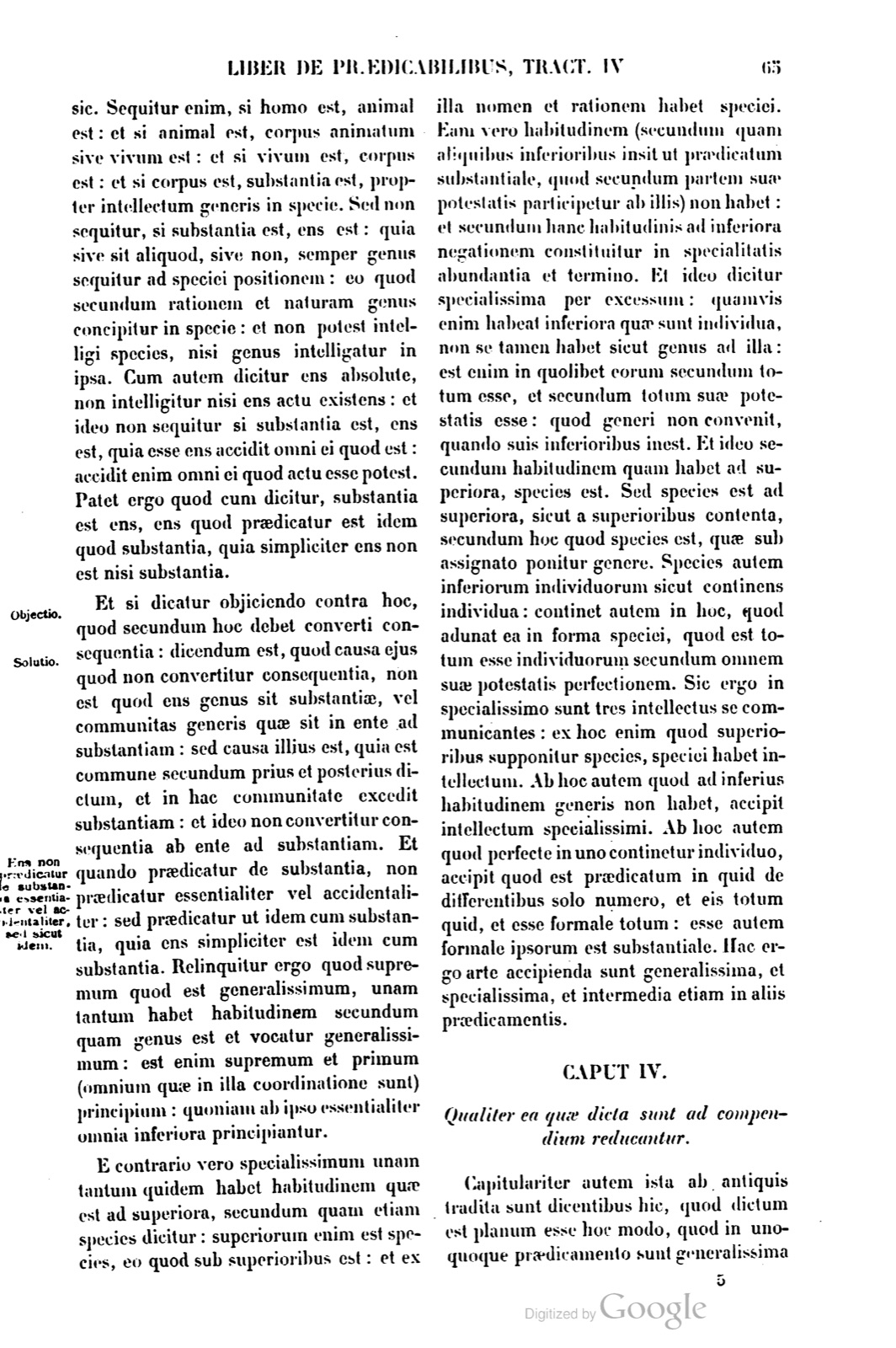
Si quis autem instet et dicat, quod substantia habet superius. Ens enim est ante substantiam per intellectum: quia omnis substantia est ens, sed non omne ens est substantia. Et non potest dici, quod per accidens praedicatur de substantia. Et similiter potest dici de quolibet quod genera transcendit, ut est res, unum, et aliquid. Inferius quidem subtiliter huic satisfaciemus objectioni: hic autem ad praesens sufficiat, quod cum ens praedicatur de substantia, vel res, vel unum, vel aliquid: non praedicatur praedicatione generis, cum non sit una ratione praedicatum de his de quibus praedicatur, sed per prius et posterius: sed talia praedicantur praedicatione principii non generis 2. Et hoc probat Avicenna et Alfarabius et Algazel et omnes Arabes sic. Sequitur enim, si homo est, animal est: et si animal est, corpus animatum sive vivum est: et si vivum est, corpus est: et si corpus est, substantia est, propter intellectum generis in specie. Sed non sequitur, si substantia est, ens est: quia sive sit aliquod, sive non, semper genus sequitur ad speciei positionem: eo quod secundum rationem et naturam genus concipitur in specie: et non potest intelligi species, nisi genus intelligatur in ipsa. Cum autem dicitur ens absolute, non intelligitur nisi ens actu existens: et ideo non sequitur si substantia est, ens est, quia esse ens accidit omni ei quod est: accidit enim omni ei quod actu esse potest. Patet ergo quod cum dicitur, substantia est ens, ens quod praedicatur est idem quod substantia, quia simpliciter ens non est nisi substantia.
But the extremes which are simply extremes, so that they cannot be middles, and which are only two, namely the most general and the most special, have only one relation. For the most general, since it has no genus above itself, cannot have that relation which is to superiors except according to negation, namely that it does not have a superior genus. But that relation so said by negation posits nothing in the most general genus; for by this it is neither genus nor species. Rather, through that relation which it has to inferiors it has the notion of genus, because genus is that under which species is placed. But through negation of relation to superiors it has indeed neither the notion of genus nor of species, but excess in generality. And through negation of speciality, namely that it is genus in such a way that it cannot be species, because this is superabundance and signifies generality at the term, it cannot be made known except by negation, because it has nothing which is affirmed of it. And this is on account of its notion of simplicity or perfection; and therefore through such negation nothing of imperfection can be concluded about it. Further, it is thus made known and determined through negation, although negation according to itself is infinite and indeterminate, because the negation by which it is determined is bounded when it is said that, from abundance of simplicity and generality and superiority, it is not posited to have a superior.
But if someone insists and says that substance has a superior, for being is before substance through understanding, because every substance is being, but not every being is substance, and it cannot be said that being is predicated of substance by accident; and similarly one can speak of anything which transcends genera, such as thing, one, and something. Below we will subtly satisfy this objection; but here for the present let it suffice that when being is predicated of substance, or thing, or one, or something, it is not predicated by the predication of genus, since it is not predicated by one notion of those things of which it is predicated, but by prior and posterior; rather such things are predicated by the predication of principle, not of genus 2. And Avicenna and Alfarabi and Algazel and all the Arabs prove this thus. For it follows: if man is, animal is; and if animal is, animated or living body is; and if living thing is, body is; and if body is, substance is, because of the understanding of genus in species. But it does not follow: if substance is, being is, because whether there is something or not, genus always follows upon the positing of species, since according to notion and nature genus is conceived in species, and species cannot be understood unless genus is understood in it. But when being is said absolutely, nothing is understood except being actually existing; and therefore it does not follow, if substance is, being is, because to be being happens to everything which is; for it happens to everything which can actually be. Therefore it is clear that when it is said substance is being, the being which is predicated is the same as substance, because being simply is nothing except substance.
Et si dicatur objiciendo contra hoc, quod secundum hoc debet converti consequentia: dicendum est, quod causa ejus quod non convertitur consequentia, non est quod ens genus sit substantiae, vel communitas generis quae sit in ente ad substantiam: sed causa illius est, quia est commune secundum prius et posterius dictum, et in hac communitate excedit substantiam: et ideo non convertitur consequentia ab ente ad substantiam. Et quando praedicatur de substantia, non praedicatur essentialiter vel accidentaliter: sed praedicatur ut idem cum substantia, quia ens simpliciter est idem cum substantia. Relinquitur ergo quod supremum quod est generalissimum, unam tantum habet habitudinem secundum quam genus est et vocatur generalissimum: est enim supremum et primum omnium quae in illa coordinatione sunt principium: quoniam ab ipso essentialiter omnia inferiora principiantur.
E contrario vero specialissimum unam tantum quidem habet habitudinem quae est ad superiora, secundum quam etiam species dicitur: superiorum enim est species, eo quod sub superioribus est: et ex illa nomen et rationem habet speciei. Eam vero habitudinem, secundum quam aliquibus inferioribus insit ut praedicatum substantiale, quod secundum partem suae potestatis participetur ab illis, non habet: et secundum hanc habitudinis ad inferiora negationem constituitur in specialitatis abundantia et termino. Et ideo dicitur specialissima per excessum: quamvis enim habeat inferiora quae sunt individua, non se tamen habet sicut genus ad illa: est enim in quolibet eorum secundum totum esse, et secundum totum suae potestatis esse: quod generi non convenit, quando suis inferioribus inest. Et ideo secundum habitudinem quam habet ad superiora, species est. Sed species est ad superiora, sicut a superioribus contenta, secundum hoc quod species est, quae sub assignato ponitur genere. Species autem inferiorum individuorum sicut continens individua: continet autem in hoc, quod adunat ea in forma speciei, quod est totum esse individuorum secundum omnem suae potestatis perfectionem. Sic ergo in specialissimo sunt tres intellectus se communicantes: ex hoc enim quod superioribus supponitur species, speciei habet intellectum. Ab hoc autem quod ad inferius habitudinem generis non habet, accipit intellectum specialissimi. Ab hoc autem quod perfecte in uno continetur individuo, accipit quod est praedicatum in quid de differentibus solo numero, et eis totum quid, et esse formale totum: esse autem formale ipsorum est substantiale. Hac ergo arte accipienda sunt generalissima, et specialissima, et intermedia etiam in aliis praedicamentis.
And if it is said by objecting against this that according to this the consequence ought to be converted, one must say that the cause why the consequence is not converted is not that being is the genus of substance, or that there is a community of genus which is in being toward substance, but the cause of this is that it is common according to prior and posterior, and in this community it exceeds substance; and therefore the consequence is not converted from being to substance. And when it is predicated of substance, it is not predicated essentially or accidentally, but is predicated as the same with substance, because being simply is the same as substance. Therefore it remains that the highest which is most general has only one relation according to which it is genus and is called most general; for it is the highest and first principle of all things which are in that coordination, since from it essentially all inferiors are principled.
But on the contrary the most special has only one relation, which is to superiors, according to which it is also called species. For it is a species of the superiors, because it is under the superiors, and from that it has the name and notion of species. But it does not have that relation according to which it is in some inferiors as a substantial predicate which is participated by them according to part of its power; and according to this negation of relation to inferiors it is constituted in abundance and term of speciality. And therefore it is called most special by excess. For although it has inferiors which are individuals, nevertheless it does not have itself toward them as genus, for it is in each of them according to whole being and according to the whole being of its power, which does not belong to genus when it is in its inferiors. And therefore according to the relation which it has to superiors, it is species. But it is species in relation to superiors as contained by superiors, according to this, that species is what is placed under an assigned genus. But it is species of inferior individuals as containing the individuals; it contains them in this, that it unites them in the form of species, which is the whole being of individuals according to every perfection of its power. Thus therefore in the most special there are three understandings communicating with one another: from this, that it is placed under superiors, it has the understanding of species; from this, that it does not have the relation of genus to the inferior, it receives the understanding of most special; from this, that it is perfectly contained in one individual, it receives that it is predicated in what of things differing in number alone, and is for them the whole what and the whole formal being; but their formal being is substantial. Therefore by this art the most general, the most special, and also the intermediates in the other categories must be taken.
Notes
- Note that intermediate genera are not middles through participation in extremes, but by position and order. (Nota genera intermedia non esse media per participationem extremorum, sed positione et ordine.) ↩
- Therefore transcendentals are not predicated of substance by the predication of genus, but by the predication of principle. (Ergo transcendentia non praedicantur de substantia praedicatione generis, sed praedicatione principii.) ↩
If a page does not appear, its photograph has not been uploaded yet.