Volume 1 · pp. 59–60
Chapter II. On two questions concerning the things said before.
A marker with ≈ is an approximate page boundary, placed by measure of the text; the page photographs remain the authority. In the paired views, clicking a page marker brings that page into view.
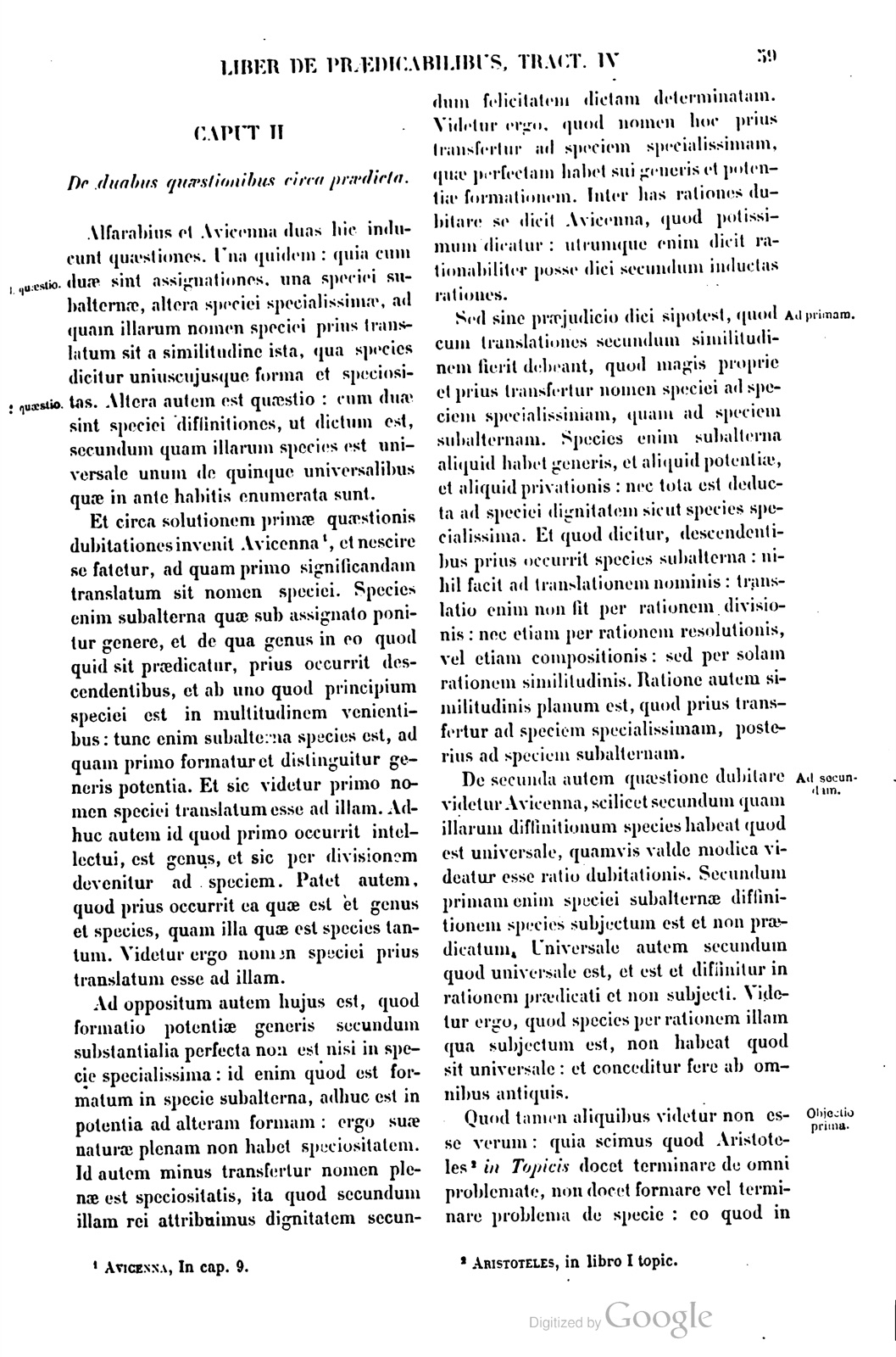
CAPUT II.
De duabus quaestionibus circa praedicta.
Alfarabius et Avicenna duas hic inducunt quaestiones. Una quidem: quia cum duae sint assignationes, una speciei subalternae, altera speciei specialissimae, ad quam illarum nomen speciei prius translatum sit a similitudine ista, qua species dicitur uniuscujusque forma et speciositas. Altera autem est quaestio: cum duae sint speciei diffinitiones, ut dictum est, secundum quam illarum species est universale unum de quinque universalibus quae in ante habitis enumerata sunt.
Et circa solutionem primae quaestionis dubitationes invenit Avicenna 1, et nescire se fatetur, ad quam primo significandam translatum sit nomen speciei. Species enim subalterna quae sub assignato ponitur genere, et de qua genus in eo quod quid sit praedicatur, prius occurrit descendentibus, et ab uno quod principium speciei est in multitudinem venientibus: tunc enim subalterna species est, ad quam primo formatur et distinguitur generis potentia. Et sic videtur primo nomen speciei translatum esse ad illam. Adhuc autem id quod primo occurrit intellectui, est genus, et sic per divisionem devenitur ad speciem. Patet autem, quod prius occurrit ea quae est et genus et species, quam illa quae est species tantum. Videtur ergo nomen speciei prius translatum esse ad illam.
Ad oppositum autem hujus est, quod formatio potentiae generis secundum substantialia perfecta non est nisi in specie specialissima: id enim quod est formatum in specie subalterna, adhuc est in potentia ad alteram formam: ergo suae naturae plenam non habet speciositatem. Id autem minus transfertur nomen plenae est speciositatis, ita quod secundum illam rei attribuimus dignitatem secundum felicitatem dictam determinatam. Videtur ergo, quod nomen hoc prius transfertur ad speciem specialissimam, quae perfectam habet sui generis et potentiae formationem. Inter has rationes dubitare se dicit Avicenna, quod potissimum dicatur: utrumque enim dicit rationabiliter posse dici secundum inductas rationes.
Sed sine praejudicio dici si potest, quod cum translationes secundum similitudinem fieri debeant, quod magis proprie et prius transfertur nomen speciei ad speciem specialissimam, quam ad speciem subalternam. Species enim subalterna aliquid habet generis, et aliquid potentiae, et aliquid privationis: nec tota est deducta ad speciei dignitatem sicut species specialissima. Et quod dicitur, descendentibus prius occurrit species subalterna: nihil facit ad translationem nominis: translatio enim non fit per rationem divisionis: nec etiam per rationem resolutionis, vel etiam compositionis: sed per solam rationem similitudinis. Ratione autem similitudinis planum est, quod prius transfertur ad speciem specialissimam, posterius ad speciem subalternam.
De secunda autem quaestione dubitare videtur Avicenna, scilicet secundum quam illarum diffinitionum species habeat quod est universale, quamvis valde modica videatur esse ratio dubitationis. Secundum primam enim speciei subalternae diffinitionem species subjectum est et non praedicatum. Universale autem secundum quod universale est, et est et diffinitur in rationem praedicati et non subjecti. Videtur ergo, quod species per rationem illam qua subjectum est, non habeat quod sit universale: et conceditur fere ab omnibus antiquis.
Quod tamen aliquibus videtur non esse verum: quia scimus quod Aristoteles in Topicis docet terminare de omni problemate, non docet formare vel terminare problema de specie: eo quod in omni problemate subjicitur species, et sic videtur quod species est, subjici habet in problemate et non praedicari 2.
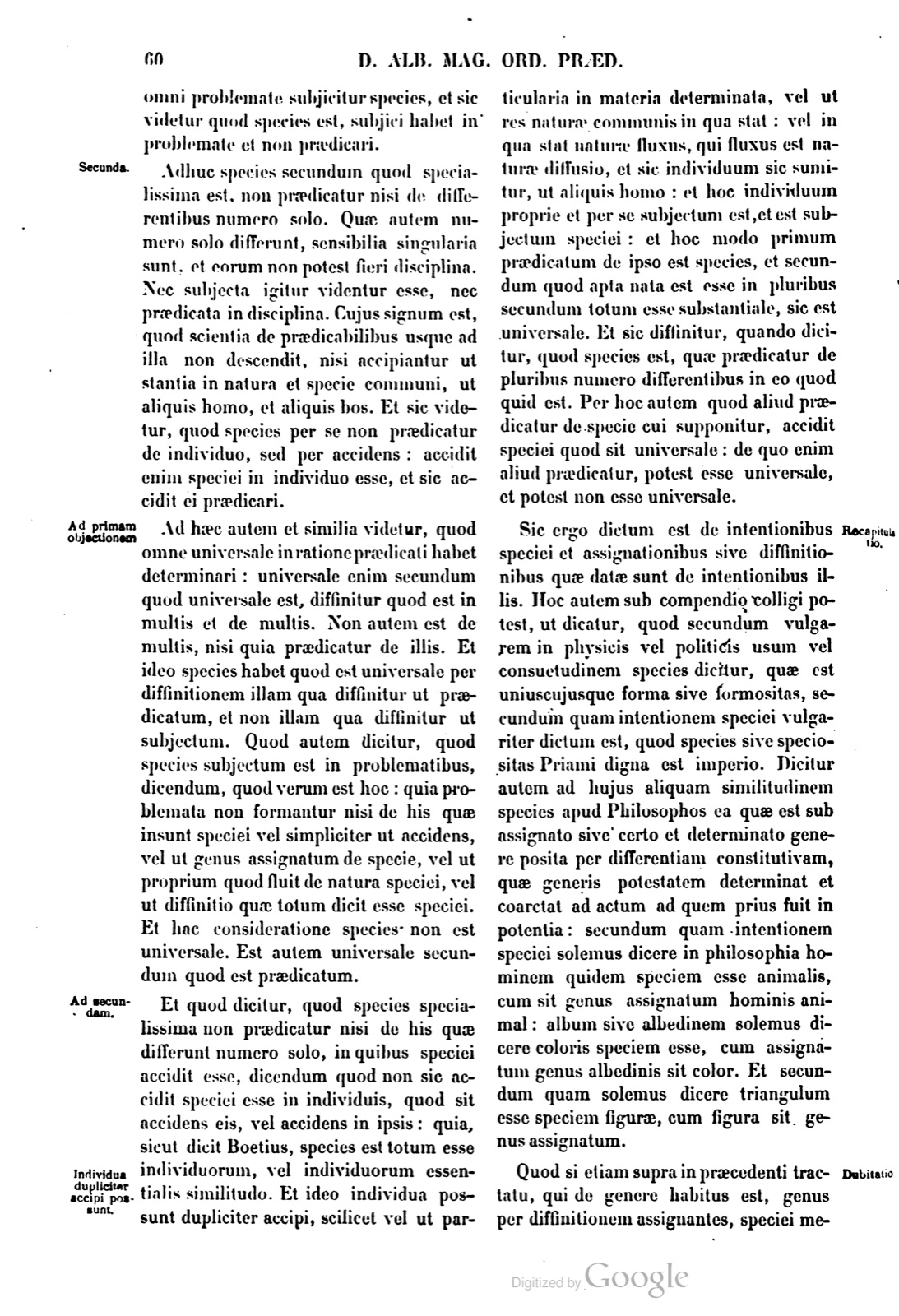
Adhuc species secundum quod specialissima est, non praedicatur nisi de differentibus numero solo. Quae autem numero solo differunt, sensibilia singularia sunt, et eorum non potest fieri disciplina. Nec subjecta igitur videntur esse, nec praedicata in disciplina. Cujus signum est, quod scientia de praedicabilibus usque ad illa non descendit, nisi accipiantur ut stantia in natura et specie communi, ut aliquis homo, et aliquis bos. Et sic videtur, quod species per se non praedicatur de individuo, sed per accidens: accidit enim speciei in individuo esse, et sic accidit ei praedicari.
CHAPTER II.
On two questions concerning the things said before.
Alfarabi and Avicenna introduce two questions here. One indeed is this: since there are two assignments, one of subaltern species and the other of most special species, to which of them the name species was first transferred from that likeness by which species is called the form and beauty of each thing. But the other question is this: since there are two definitions of species, as has been said, according to which of them species is one universal among the five universals enumerated above.
And concerning the solution of the first question Avicenna 1 finds doubts and confesses that he does not know to which meaning the name of species was first transferred. For the subaltern species, which is placed under an assigned genus and of which genus is predicated in that which is what, occurs first to those descending and coming from the one which is the principle of species into multitude; for then there is a subaltern species to which the potency of genus is first formed and distinguished. And thus it seems that the name species was first transferred to that. Further, that which first occurs to the intellect is genus, and thus through division one comes to species. But it is clear that that which is both genus and species occurs earlier than that which is species only. Therefore it seems that the name species was first transferred to that.
But against this is that the formation of the potency of genus according to perfected substantial things exists only in the most special species. For that which is formed in a subaltern species is still in potency to another form; therefore it does not have the full beauty of its nature. But the name of full beauty is transferred less to that, so that according to that we attribute the dignity of a thing according to the happiness mentioned and determined. Therefore it seems that this name is first transferred to the most special species, which has the perfect formation of its genus and potency. Between these reasons Avicenna says that he doubts what should be said especially; for he says that each can be said reasonably according to the reasons introduced.
But, if it can be said without prejudice, since transfers ought to be made according to likeness, the name species is more properly and first transferred to the most special species than to subaltern species. For subaltern species has something of genus, something of potency, and something of privation, nor is it wholly brought to the dignity of species as the most special species is. And what is said, that subaltern species occurs first to those descending, does nothing for the transfer of the name; for transfer is not made by the notion of division, nor even by the notion of resolution or composition, but by the notion of likeness alone. But by the notion of likeness it is plain that it is first transferred to the most special species, and later to subaltern species.
But concerning the second question Avicenna seems to doubt, namely according to which of those definitions species has that it is universal, although the reason for doubt seems very slight. For according to the first definition of subaltern species, species is subject and not predicate. But the universal, insofar as it is universal, both is and is defined in the notion of a predicate and not a subject. Therefore it seems that species, through that notion by which it is subject, does not have that it is universal; and this is conceded by almost all the ancients.
Yet to some this does not seem true, because we know that Aristotle in the Topics teaches how to determine concerning every problem; he does not teach how to form or determine a problem about species, because in every problem species is subjected, and thus it seems that species has being subjected in a problem and not being predicated 2.
Further, species insofar as it is most special is predicated only of things differing in number alone. But the things which differ in number alone are sensible singulars, and concerning them no discipline can be made. Therefore they seem to be neither subjects nor predicates in discipline. A sign of this is that the science concerning predicables does not descend as far as those things unless they are taken as standing in a common nature and species, as some man and some ox. And thus it seems that species is not predicated per se of an individual, but by accident; for it happens to species to be in an individual, and thus it happens to it to be predicated.
Ad haec autem et similia videtur, quod omne universale in ratione praedicati habet determinari: universale enim secundum quod universale est, diffinitur quod est in multis et de multis. Non autem est de multis, nisi quia praedicatur de illis. Et ideo species habet quod est universale per diffinitionem illam qua diffinitur ut praedicatum, et non illam qua diffinitur ut subjectum. Quod autem dicitur, quod species subjectum est in problematibus, dicendum, quod verum est hoc: quia problemata non formantur nisi de his quae insunt speciei vel simpliciter ut accidens, vel ut genus assignatum de specie, vel ut proprium quod fluit de natura speciei, vel ut diffinitio quae totum dicit esse speciei. Et hac consideratione species non est universale. Est autem universale secundum quod est praedicatum.
Et quod dicitur, quod species specialissima non praedicatur nisi de his quae differunt numero solo, in quibus speciei accidit esse, dicendum quod non sic accidit speciei esse in individuis, quod sit accidens eis, vel accidens in ipsis: quia, sicut dicit Boetius, species est totum esse individuorum, vel individuorum essentialis similitudo. Et ideo individua possunt dupliciter accipi, scilicet vel ut particularia in materia determinata, vel ut res naturae communis in qua stat: vel in qua stat naturae fluxus, qui fluxus est naturae diffusio, et sic individuum sic sumitur, ut aliquis homo: et hoc individuum proprie et per se subjectum est, et est subjectum speciei: et hoc modo primum praedicatum de ipso est species, et secundum quod apta nata est esse in pluribus secundum totum esse substantiale, sic est universale. Et sic diffinitur, quando dicitur, quod species est, quae praedicatur de pluribus numero differentibus in eo quod quid est. Per hoc autem quod aliud praedicatur de specie cui supponitur, accidit speciei quod sit universale: de quo enim aliud praedicatur, potest esse universale, et potest non esse universale.
Sic ergo dictum est de intentionibus speciei et assignationibus sive diffinitionibus quae datae sunt de intentionibus illis. Hoc autem sub compendio colligi potest, ut dicatur, quod secundum vulgarem in physicis vel politicis usum vel consuetudinem species dicitur, quae est uniuscujusque forma sive formositas, secundum quam intentionem speciei vulgariter dictum est, quod species sive speciositas Priami digna est imperio. Dicitur autem ad hujus aliquam similitudinem species apud Philosophos ea quae est sub assignato sive certo et determinato genere posita per differentiam constitutivam, quae generis potestatem determinat et coarctat ad actum ad quem prius fuit in potentia: secundum quam intentionem speciei solemus dicere in philosophia hominem quidem speciem esse animalis, cum sit genus assignatum hominis animal: album sive albedinem solemus dicere coloris speciem esse, cum assignatum genus albedinis sit color. Et secundum quam solemus dicere triangulum esse speciem figurae, cum figura sit genus assignatum.
Quod si etiam supra in praecedenti tractatu, qui de genere habitus est, genus per diffinitionem assignantes, speciei meminimus
But to these and similar things it seems that every universal has to be determined in the notion of a predicate; for the universal, insofar as it is universal, is defined as what is in many and of many. But it is not of many except because it is predicated of them. And therefore species has that it is universal through that definition by which it is defined as predicate, and not through that by which it is defined as subject. But as to what is said, that species is the subject in problems, one must say that this is true, because problems are formed only concerning those things which are in species, either simply as accident, or as assigned genus of species, or as property which flows from the nature of species, or as definition which states the whole being of species. And in this consideration species is not universal. But it is universal insofar as it is predicate.
And as to what is said, that the most special species is predicated only of those things which differ in number alone, in which it happens to species to be, one must say that it does not so happen to species to be in individuals that it is an accident to them or an accident in them; because, as Boethius says, species is the whole being of individuals, or the essential likeness of individuals. And therefore individuals can be taken in two ways, namely either as particulars determined in matter, or as things of common nature in which it stands, or in which the flow of nature stands, which flow is the diffusion of nature; and thus the individual is so taken as some man. And this individual is properly and per se a subject, and it is the subject of species; and in this way the first predicate of it is species, and insofar as it is apt by nature to be in several according to the whole substantial being, thus it is universal. And thus it is defined when it is said that species is that which is predicated of several things differing in number in that which is what. But through this, that something else is predicated of species to which it is subjected, it happens to species that it is universal; for that of which something else is predicated can be universal and can be not universal.
Thus therefore it has been said concerning the intentions of species and the assignments or definitions which have been given concerning those intentions. But this can be gathered compendiously, so that it may be said that according to vulgar use or custom in physical or political matters, species is said to be that which is the form or handsomeness of each thing; according to this intention of species it has been said in the common way that the species or beauty of Priam is worthy of rule. But according to some likeness to this, species among the Philosophers is said to be that which is placed under an assigned or certain and determinate genus through a constitutive difference, which determines and constricts the potency of genus to the act to which it was previously in potency. According to this intention of species, we are accustomed to say in philosophy that man is a species of animal, since animal is the assigned genus of man; we are accustomed to say that white or whiteness is a species of color, since color is the assigned genus of whiteness; and according to this we are accustomed to say that triangle is a species of figure, since figure is the assigned genus.
But if also above in the preceding treatise, which was held concerning genus, when assigning genus by definition, we made mention of species
If a page does not appear, its photograph has not been uploaded yet.