Volume 1 · pp. 54–55
Tractate IV. On species. Chapter I. On the diverse intentions of species.
A marker with ≈ is an approximate page boundary, placed by measure of the text; the page photographs remain the authority. In the paired views, clicking a page marker brings that page into view.
TRACTATUS IV.
DE SPECIE.
CAPUT I.
De diversis intentionibus specierum.
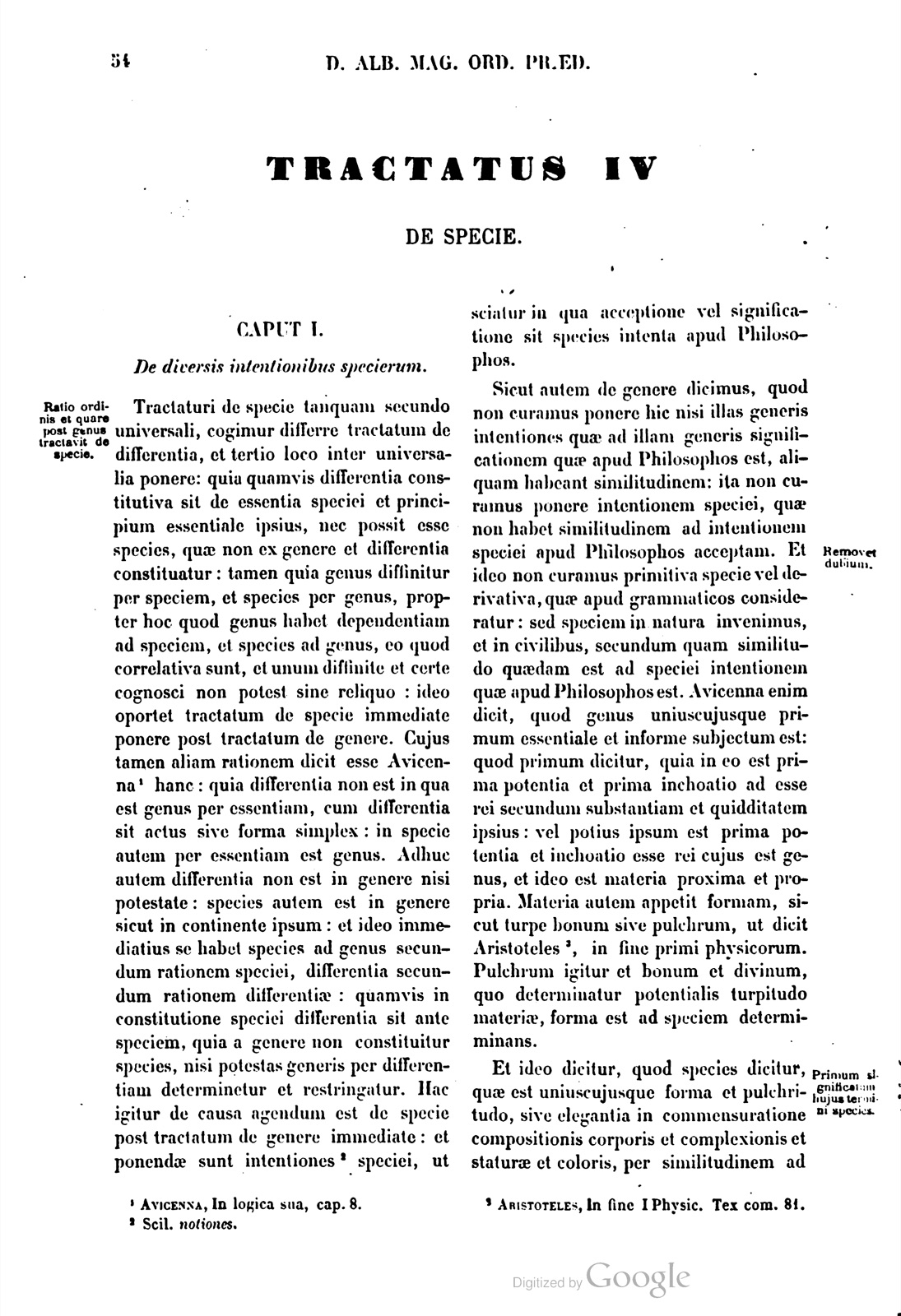
Tractaturi de specie tanquam secundo post genus universali, cogimur differre tractatum de differentia, et tertio loco inter universalia ponere: quia quamvis differentia constitutiva sit de essentia speciei et principium essentiale ipsius, nec possit esse species, quae non ex genere et differentia constituatur: tamen quia genus diffinitur per speciem, et species per genus, propter hoc quod genus habet dependentiam ad speciem, et species ad genus, eo quod correlativa sunt, et unum diffinite et certe cognosci non potest sine reliquo: ideo oportet tractatum de specie immediate ponere post tractatum de genere. Cujus tamen aliam rationem dicit esse Avicenna 1 hanc: quia differentia non est in qua est genus per essentiam, cum differentia sit actus sive forma simplex: in specie autem per essentiam est genus. Adhuc autem differentia non est in genere nisi potestate: species autem est in genere sicut in continente ipsum: et ideo immediatius se habet species ad genus secundum rationem speciei, differentia secundum rationem differentiae: quamvis in constitutione speciei differentia sit ante speciem, quia a genere non constituitur species, nisi potestas generis per differentiam determinetur et restringatur. Hac igitur de causa agendum est de specie post tractatum de genere immediate: et ponendae sunt intentiones speciei 2, ut sciatur in qua acceptione vel significatione sit species intenta apud Philosophos.
Sicut autem de genere dicimus, quod non curamus ponere hic nisi illas generis intentiones quae ad illam generis significationem quae apud Philosophos est, aliquam habeant similitudinem: ita non curamus ponere intentionem speciei, quae non habet similitudinem ad intentionem speciei apud Philosophos acceptam. Et ideo non curamus primitiva specie vel derivativa, quae apud grammaticos consideratur: sed speciem in natura invenimus, et in civilibus, secundum quam similitudo quaedam est ad speciei intentionem quae apud Philosophos est. Avicenna enim dicit, quod genus uniuscujusque primum essentiale et informe subjectum est: quod primum dicitur, quia in eo est prima potentia et prima inchoatio ad esse rei secundum substantiam et quidditatem ipsius: vel potius ipsum est prima potentia et inchoatio esse rei cujus est genus, et ideo est materia proxima et propria. Materia autem appetit formam, sicut turpe bonum sive pulchrum, ut dicit Aristoteles 3, in fine primi physicorum. Pulchrum igitur et bonum et divinum, quo determinatur potentialis turpitudo materiae, forma est ad speciem determinans.
Et ideo dicitur, quod species dicitur, quae est uniuscujusque forma et pulchritudo, sive elegantia in commensuratione compositionis corporis et complexionis et staturae et coloris, per similitudinem ad formam naturalem, quae turpitudinem materiae terminat ad pulchrum, bonum, et divinum 4. Sunt autem quaedam, sicut in primo Ethicorum determinatum est 5, concomitantia felicitatem in eo qui felix est. Non enim felix est qui specie turpissimus est. Et etiam in civilibus species quae talis formositas est, hac de causa refertur ad ea quae maxime felici competunt in potestatibus et honoribus, secundum quod dicimus, quod species Priami Trojani regis, qui forma elegantissima fuit, digna est imperio: quia ex elegantia formae demonstratur dispositio ad virtutes et ad perfectos actus felicitatis, sicut in signo. Quia sicut dicit Averroes 6: omnis diversitas quae est in corpore quoad compositionem membrorum, est ex diversitate potentiarum quae sunt in anima: et hoc modo etiam species ad intentionem philosophicam de specie habet similitudinem: quia sic dignitas attribuitur vel indignitas his quae in specie sunt constituta, sicut homo dicitur dignissima creaturarum, bufo autem animal contemnendum. His ergo modis accepta species ad speciem sive speciei intentionem quae in philosophia est habet similitudinem: et ab ista similitudine, ut dicit Avicenna, ad intentionem speciei Philosophorum nomen est translatum.
TRACTATE IV.
ON SPECIES.
CHAPTER I.
On the diverse intentions of species.
Since we are about to treat species as the second universal after genus, we are compelled to defer the treatment of difference and to place it in the third place among the universals, because although constitutive difference belongs to the essence of species and is its essential principle, and there cannot be a species which is not constituted from genus and difference, nevertheless because genus is defined through species and species through genus, on account of this, that genus has dependence on species and species on genus, since they are correlatives and one cannot be definitely and certainly known without the other, therefore the treatment of species must be placed immediately after the treatment of genus. Avicenna 1, however, says that there is another reason for this: because difference is not that in which genus is through essence, since difference is act or simple form; but genus is in species through essence. Further, difference is in genus only in potency, but species is in genus as in what contains it; and therefore species has itself more immediately to genus according to the notion of species, difference according to the notion of difference, although in the constitution of species difference is before species, because species is not constituted from genus unless the potency of genus is determined and restricted through difference. Therefore for this cause one must deal with species immediately after the treatment of genus, and the intentions of species 2 must be set down, so that it may be known in what acceptance or signification species is intended among the Philosophers.
But as concerning genus we say that we take care to posit here only those intentions of genus which have some likeness to that signification of genus which exists among the Philosophers, so we do not take care to posit an intention of species which has no likeness to the intention of species accepted among the Philosophers. And therefore we do not care for primitive or derivative species, which is considered among grammarians; but we find species in nature and in civic matters, according to which there is a certain likeness to the intention of species which exists among the Philosophers. For Avicenna says that the genus of each thing is the first essential and unformed subject; it is called first because in it there is the first potency and first beginning toward the being of the thing according to its substance and quiddity, or rather it itself is the first potency and beginning of the being of the thing of which it is the genus, and therefore it is proximate and proper matter. But matter desires form, as the ugly desires the good or beautiful, as Aristotle says 3 at the end of the first book of the Physics. Therefore the beautiful and good and divine, by which the potential ugliness of matter is determined, is form determining to species.
And therefore it is said that species is said to be the form and beauty of each thing, or elegance in the commensuration of the composition of body and complexion and stature and color, by likeness to the natural form which terminates the ugliness of matter to the beautiful, good, and divine 4. But there are certain things, as has been determined in the first book of the Ethics 5, accompanying happiness in the one who is happy. For one who is most ugly in species is not happy. And also in civic matters species, which is such handsomeness, is for this cause referred to those things which most belong to the happy person in powers and honors, according as we say that the species of Priam, the Trojan king, who was of most elegant form, is worthy of rule; because from the elegance of form a disposition to virtues and to perfect acts of happiness is demonstrated, as in a sign. Because, as Averroes says 6, every diversity which is in the body as to the composition of members is from the diversity of powers which are in the soul; and in this way also species has a likeness to the philosophical intention concerning species, because thus dignity or indignity is attributed to those things which are constituted in species, just as man is called the worthiest of creatures, but the toad an animal to be despised. Therefore species taken in these ways has likeness to species or to the intention of species which is in philosophy; and from this likeness, as Avicenna says, the name was transferred to the intention of species of the Philosophers.
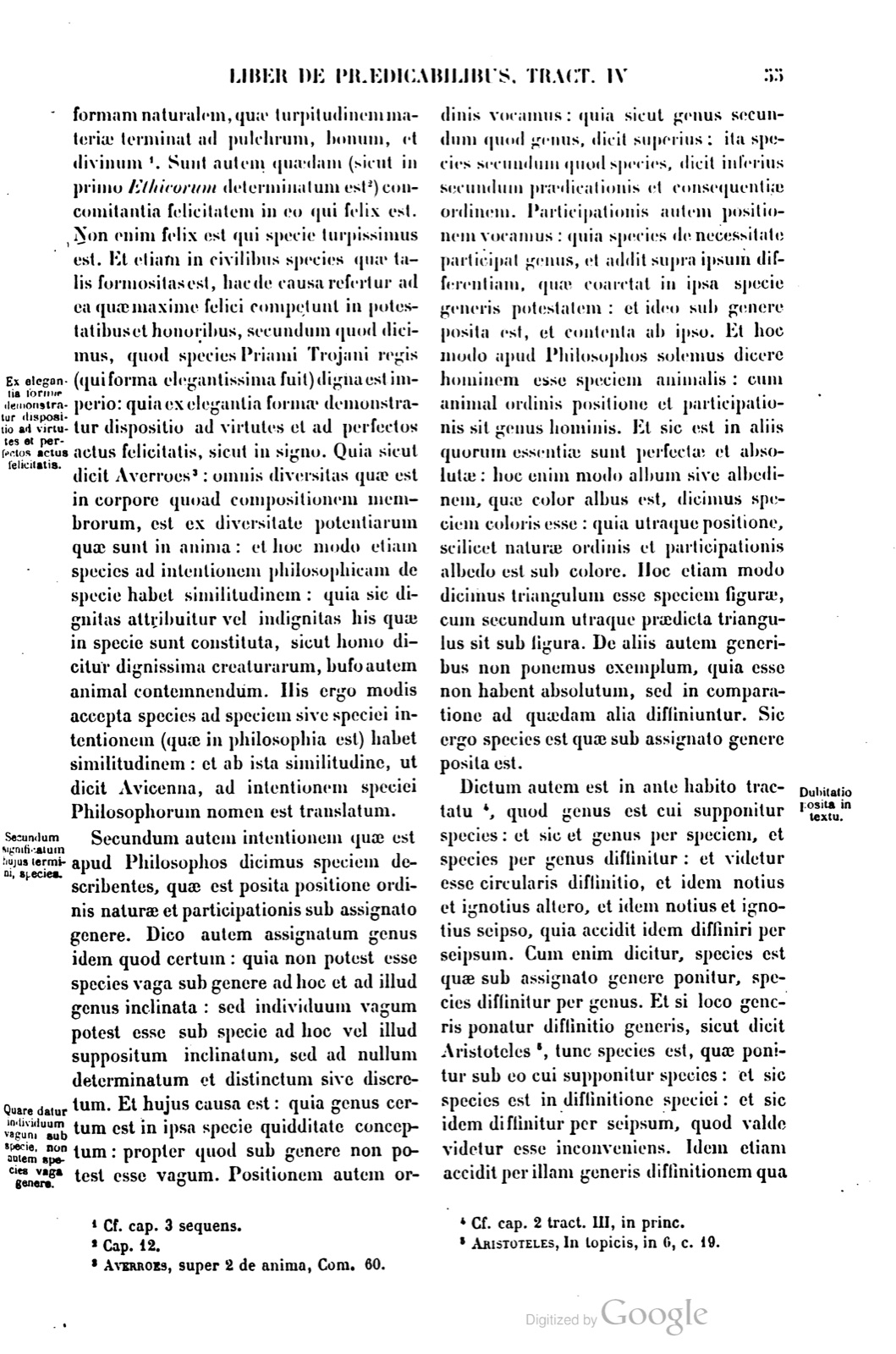
Secundum autem intentionem quae est apud Philosophos dicimus speciem describentes, quae est posita positione ordinis naturae et participationis sub assignato genere. Dico autem assignatum genus idem quod certum: quia non potest esse species vaga sub genere ad hoc et ad illud genus inclinata: sed individuum vagum potest esse sub specie ad hoc vel illud suppositum inclinatum, sed ad nullum determinatum et distinctum sive discretum. Et hujus causa est: quia genus certum est in ipsa specie quidditate conceptum: propter quod sub genere non potest esse vagum. Positionem autem ordinis vocamus: quia sicut genus secundum quod genus, dicit superius: ita species secundum quod species, dicit inferius secundum praedicationis et consequentiae ordinem. Participationis autem positionem vocamus: quia species de necessitate participat genus, et addit supra ipsum differentiam, quae coarctat in ipsa specie generis potestatem: et ideo sub genere posita est, et contenta ab ipso. Et hoc modo apud Philosophos solemus dicere hominem esse speciem animalis: cum animal ordinis positione et participationis sit genus hominis. Et sic est in aliis quorum essentiae sunt perfectae et absolutae: hoc enim modo album sive albedinem, quae color albus est, dicimus speciem coloris esse: quia utraque positione, scilicet naturae ordinis et participationis albedo est sub colore. Hoc etiam modo dicimus triangulum esse speciem figurae, cum secundum utraque praedicta triangulus sit sub figura. De aliis autem generibus non ponemus exemplum, quia esse non habent absolutum, sed in comparatione ad quaedam alia diffiniuntur. Sic ergo species est quae sub assignato genere posita est.
Dictum autem est in ante habito tractatu 7, quod genus est cui supponitur species: et sic et genus per speciem, et species per genus diffinitur: et videtur esse circularis diffinitio, et idem notius et ignotius altero, et idem notius et ignotius seipso, quia accidit idem diffiniri per seipsum. Cum enim dicitur, species est quae sub assignato genere ponitur, species diffinitur per genus. Et si loco generis ponatur diffinitio generis, sicut dicit Aristoteles 8, tunc species est, quae ponitur sub eo cui supponitur species: et sic species est in diffinitione speciei: et sic idem diffinitur per seipsum, quod valde videtur esse inconveniens. Idem etiam accidit per illam generis diffinitionem qua
But according to the intention which is among the Philosophers, describing species, we say that it is what is placed under an assigned genus by the position of the order of nature and of participation. But I say assigned genus as the same as certain genus, because there cannot be a vague species under genus inclined to this and to that genus; but a vague individual can be under species inclined to this or that supposit, but to none determined and distinct or discrete. And the cause of this is that a certain genus is conceived in the very quiddity of the species; on account of this there cannot be something vague under genus. But we call it a position of order because, just as genus insofar as it is genus states a superior, so species insofar as it is species states an inferior according to the order of predication and consequence. But we call it a position of participation because species of necessity participates genus and adds above it difference, which constricts the potency of genus in the species itself; and therefore it is placed under genus and contained by it. And in this way among the Philosophers we are accustomed to say that man is a species of animal, since animal is the genus of man by the position of order and participation. And so it is in the other things whose essences are perfected and absolute; for in this way we say that white or whiteness, which is white color, is a species of color, because by each position, namely of the order of nature and of participation, whiteness is under color. In this way also we say that triangle is a species of figure, since according to each of the aforesaid triangle is under figure. But concerning other genera we will not place an example, because they do not have absolute being, but are defined in comparison to certain other things. Thus therefore species is what is placed under an assigned genus.
But it was said in the preceding treatise 7 that genus is that under which species is placed; and thus both genus is defined through species and species through genus. And this seems to be a circular definition, and the same thing better known and less known than another, and the same thing better known and less known than itself, because the same thing happens to be defined through itself. For when it is said that species is what is placed under an assigned genus, species is defined through genus. And if the definition of genus is put in the place of genus, as Aristotle says 8, then species is what is placed under that under which species is placed; and thus species is in the definition of species, and thus the same thing is defined through itself, which seems very unfitting. The same also happens through that definition of genus by which
Notes
- Avicenna, in his Logic, chapter 8. (Avicenna, In logica sua, cap. 8.) ↩
- Namely, notions. (Scil. notiones.) ↩
- Aristotle, at the end of Physics I, text, commentary 81. (Aristoteles, In fine I Physic. Tex. com. 81.) ↩
- Compare the following chapter 3. (Cf. cap. 3 sequens.) ↩
- Chapter 12. (Cap. 12.) ↩
- Averroes, on On the Soul II, commentary 60. (Averroes, super 2 de anima, Com. 60.) ↩
- Compare chapter 2 of tractate III, at the beginning. (Cf. cap. 2 tract. III, in princ.) ↩
- Aristotle, in the Topics, in book 6, chapter 19, in the text. (Aristoteles, In topicis, in 6, c. 19. textu.) ↩
If a page does not appear, its photograph has not been uploaded yet.