Volume 1 · pp. 52–53
Chapter V. On the recapitulation of the things that have been said about the discourse on genus.
A marker with ≈ is an approximate page boundary, placed by measure of the text; the page photographs remain the authority. In the paired views, clicking a page marker brings that page into view.
CAPUT V.
De recapitulatione eorum quae de sermone generis dicta sunt.
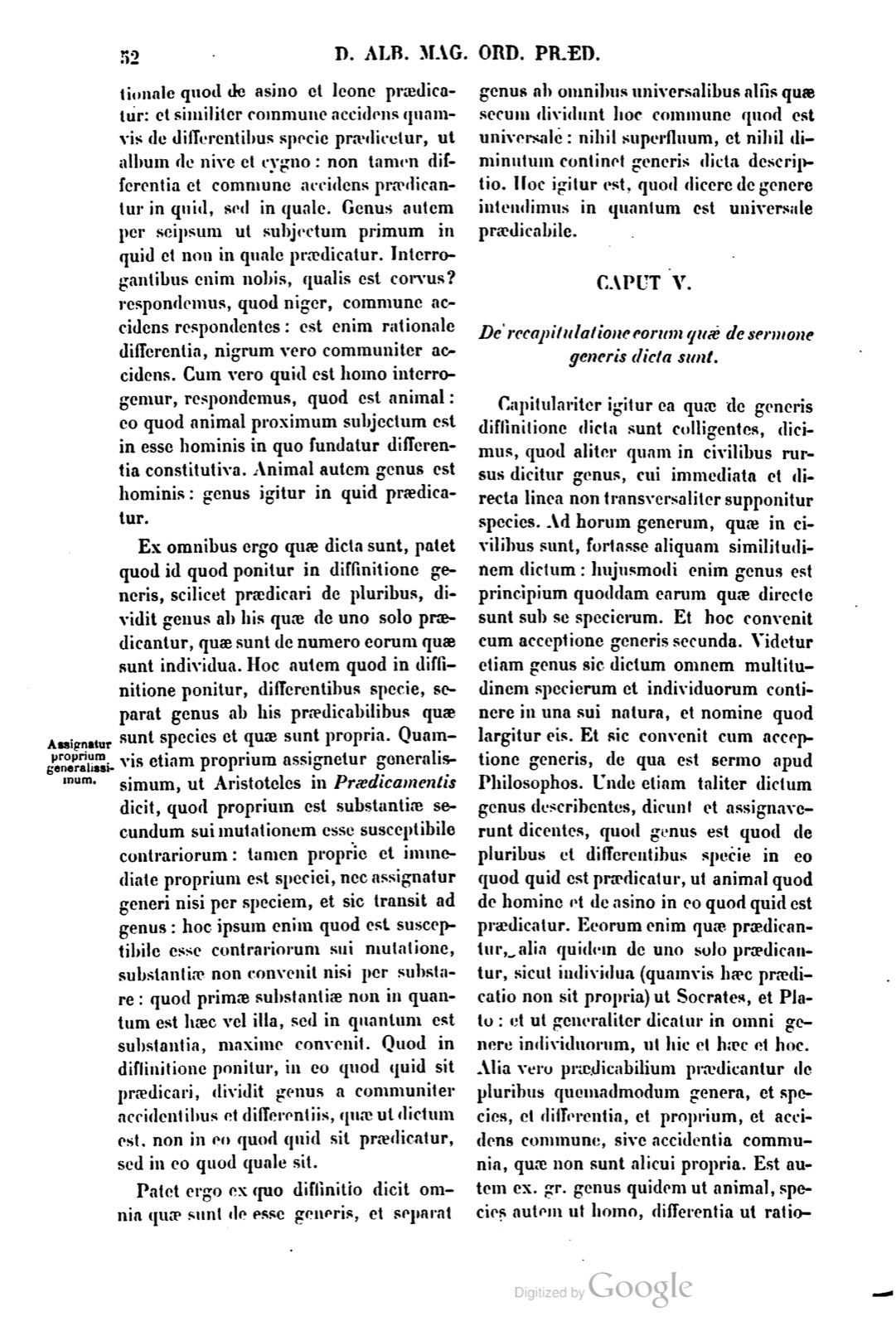
Capitulariter igitur ea quae de generis diffinitione dicta sunt colligentes, dicimus, quod aliter quam in civilibus rursus dicitur genus, cui immediata et directa linea non transversaliter supponitur species. Ad horum generum, quae in civilibus sunt, fortasse aliquam similitudinem dictum: hujusmodi enim genus est principium quoddam earum quae directe sunt sub se specierum. Et hoc convenit cum acceptione generis secunda. Videtur etiam genus sic dictum omnem multitudinem specierum et individuorum continere in una sui natura, et nomine quod largitur eis. Et sic convenit cum acceptione generis, de qua est sermo apud Philosophos. Unde etiam taliter dictum genus describentes, dicunt et assignaverunt dicentes, quod genus est quod de pluribus et differentibus specie in eo quod quid est praedicatur, ut animal quod de homine et de asino in eo quod quid est praedicatur. Eorum enim quae praedicantur, alia quidem de uno solo praedicantur, sicut individua, quamvis haec praedicatio non sit propria, ut Socrates, et Plato: et ut generaliter dicatur in omni genere individuorum, ut hic et haec et hoc. Alia vero praedicabilium praedicantur de pluribus quemadmodum genera, et species, et differentia, et proprium, et accidens commune, sive accidentia communia, quae non sunt alicui propria. Est autem ex. gr. genus quidem ut animal, species autem ut homo, differentia ut rationale, proprium ut risibile, accidens ut album, nigrum, et sedere, et hujusmodi.
Ab his ergo quae de uno solo praedicantur, differunt genera per id quod in diffinitione inducta positum est: eo quod ipsa genera per diffinitionem praeinductam assignata sunt in eo quod de pluribus praedicantur.
Ab his autem speciebus quae de pluribus praedicantur, differunt genera: quoniam non praedicatur species de pluribus differentibus specie sicut genus, sed praedicatur de pluribus solo numero differentibus, non quidem secundum quod numerus est accidens, sed secundum quod numerus est in rebus numeratis: propter quod dicit Aristoteles, quod numero differunt quaecumque differunt materiae divisione: homo enim cum sit species, de Socrate praedicatur, et de Platone, qui non specie differunt ab invicem, sed numero solum et divisione materiae, quia materia Socratis non est materia Platonis. Animal autem cum sit genus, de homine praedicatur, et de bove, qui specie differunt a se invicem, et non numero solum.
CHAPTER V.
On the recapitulation of the things that have been said about the discourse on genus.
Therefore gathering chapter by chapter the things which have been said about the definition of genus, we say that, otherwise than in civic matters, genus is again said to be that to which species is subjected by an immediate and direct line, not transversely. It was perhaps said according to some likeness to these genera which are in civic matters; for genus of this sort is a certain principle of those species which are directly under it. And this agrees with the second acceptance of genus. Genus so called also seems to contain every multitude of species and individuals in one nature of itself and in the name which it grants to them. And thus it agrees with the acceptance of genus concerning which there is discourse among the Philosophers. Whence also, describing genus so called, they say and assigned, saying that genus is what is predicated of several things differing in species in that which is what, as animal, which is predicated of man and ass in that which is what. For of the things which are predicated, some are predicated of one alone, such as individuals, although this predication is not proper, as Socrates and Plato, and, to speak generally in every genus of individuals, as this masculine, this feminine, and this neuter. But other predicables are predicated of several, as genera, species, difference, property, and common accident or common accidents, which are proper to no one. For example, genus is as animal, species as man, difference as rational, property as risible, accident as white, black, sitting, and things of this sort.
Therefore genera differ from those which are predicated of one alone through that which is placed in the introduced definition, because the genera themselves, assigned by the previously introduced definition, are assigned in that they are predicated of several.
But genera differ from those species which are predicated of several, because species is not predicated of several things differing in species as genus is, but is predicated of several things differing in number alone, not indeed according as number is an accident, but according as number is in numbered things. On account of this Aristotle says that whatever differ by the division of matter differ in number. For man, since it is a species, is predicated of Socrates and Plato, who do not differ from one another in species, but only in number and by the division of matter, because the matter of Socrates is not the matter of Plato. But animal, since it is genus, is predicated of man and ox, which differ from one another in species and not in number alone.
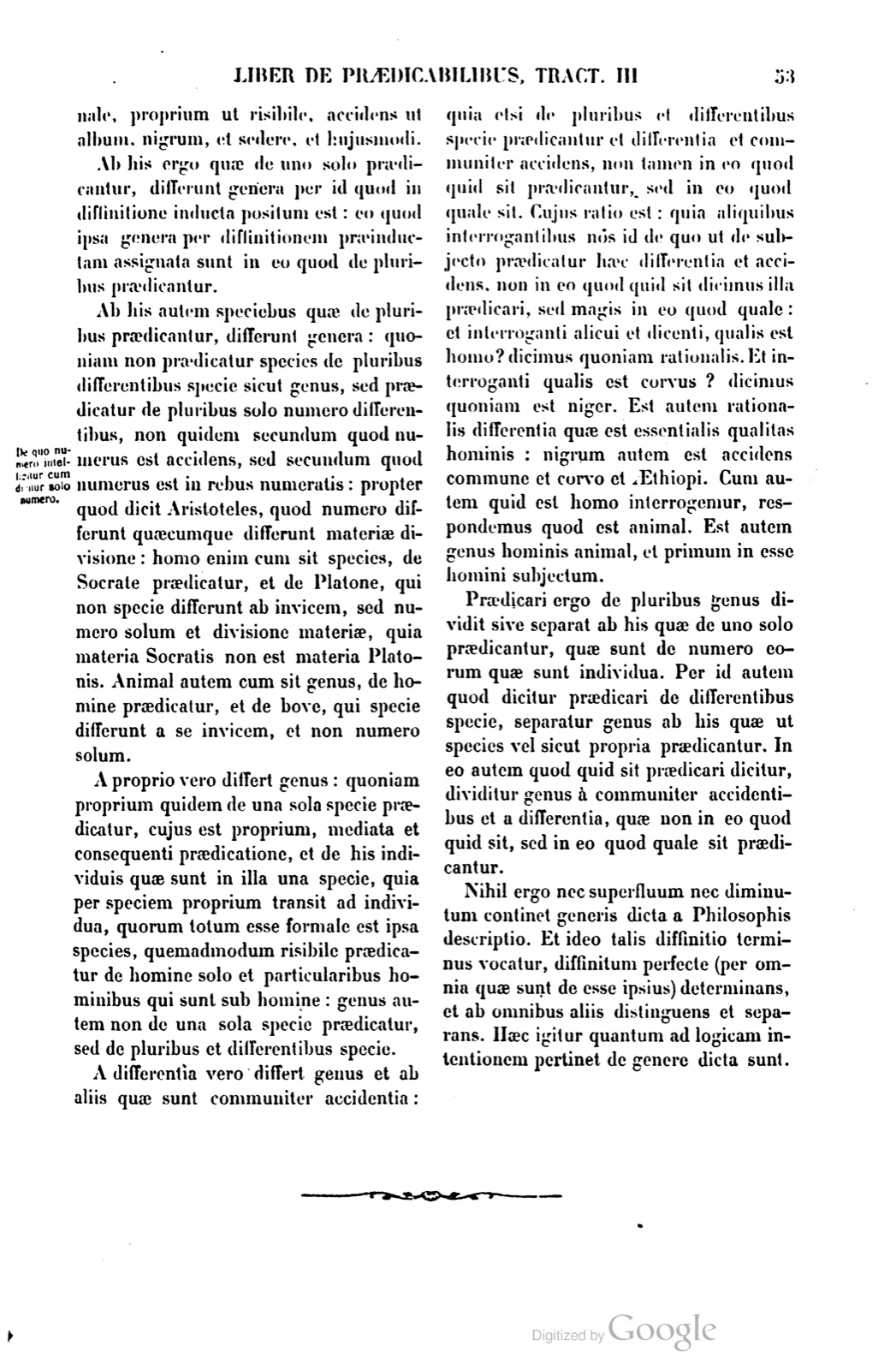
A proprio vero differt genus: quoniam proprium quidem de una sola specie praedicatur, cujus est proprium, mediata et consequenti praedicatione, et de his individuis quae sunt in illa una specie, quia per speciem proprium transit ad individua, quorum totum esse formale est ipsa species, quemadmodum risibile praedicatur de homine solo et particularibus hominibus qui sunt sub homine: genus autem non de una sola specie praedicatur, sed de pluribus et differentibus specie.
A differentia vero differt genus et ab aliis quae sunt communiter accidentia: quia etsi de pluribus et differentibus specie praedicantur et differentia et communiter accidens, non tamen in eo quod quid sit praedicantur, sed in eo quod quale sit. Cujus ratio est: quia aliquibus interrogantibus nos id de quo ut de subjecto praedicatur haec differentia et accidens, non in eo quod quid sit dicimus illa praedicari, sed magis in eo quod quale: et interroganti alicui et dicenti, qualis est homo? dicimus quoniam rationalis. Et interroganti qualis est corvus? dicimus quoniam est niger. Est autem rationalis differentia quae est essentialis qualitas hominis: nigrum autem est accidens commune et corvo et Ethiopi. Cum autem quid est homo interrogemur, respondemus quod est animal. Est autem genus hominis animal, et primum in esse homini subjectum.
Praedicari ergo de pluribus genus dividit sive separat ab his quae de uno solo praedicantur, quae sunt de numero eorum quae sunt individua. Per id autem quod dicitur praedicari de differentibus specie, separatur genus ab his quae ut species vel sicut propria praedicantur. In eo autem quod quid sit praedicari dicitur, dividitur genus a communiter accidentibus et a differentia, quae non in eo quod quid sit, sed in eo quod quale sit praedicantur.
Nihil ergo nec superfluum nec diminutum continet generis dicta a Philosophis descriptio. Et ideo talis diffinitio terminus vocatur, diffinitum perfecte, per omnia quae sunt de esse ipsius, determinans, et ab omnibus aliis distinguens et separans. Haec igitur quantum ad logicam intentionem pertinet de genere dicta sunt.
But genus differs from property because property indeed is predicated of one species alone, of which it is the property, by mediated and consequent predication, and of those individuals which are in that one species, because through species property passes to individuals, whose whole formal being is the species itself; as risible is predicated only of man and of particular men who are under man. But genus is not predicated of one species alone, but of several things differing in species.
But genus differs from difference and from the other things which are common accidents because, although difference and common accident are predicated of several things differing in species, nevertheless they are not predicated in that which is what, but in that which is quale. The reason for this is that when some people ask us about that of which this difference and accident are predicated as of a subject, we do not say that they are predicated in that which is what, but rather in that which is quale. And to someone asking and saying, what sort is man, we say that he is rational. And to one asking what sort the raven is, we say that it is black. Rational is a difference, which is the essential quality of man; but black is a common accident both to raven and to Ethiopian. But when we are asked what man is, we answer that he is animal. Animal is the genus of man and the first thing subjected to man in being.
Therefore being predicated of several divides or separates genus from those things which are predicated of one alone, which are among the number of those things which are individuals. But through that which is said to be predicated of things differing in species, genus is separated from those which are predicated as species or as properties. But in that it is said to be predicated in what a thing is, genus is divided from common accidents and from difference, which are predicated not in what a thing is, but in what sort it is.
Therefore the description of genus stated by the Philosophers contains nothing either superfluous or diminished. And therefore such a definition is called a term, perfectly determining the defined thing through all things which belong to its being, and distinguishing and separating it from all others. These things therefore have been said about genus insofar as it belongs to the logical intention.
If a page does not appear, its photograph has not been uploaded yet.