Volume 1 · pp. 49–52
Chapter IV. That the definition of genus neither abounds nor is deficient, and its declaration.
A marker with ≈ is an approximate page boundary, placed by measure of the text; the page photographs remain the authority. In the paired views, clicking a page marker brings that page into view.
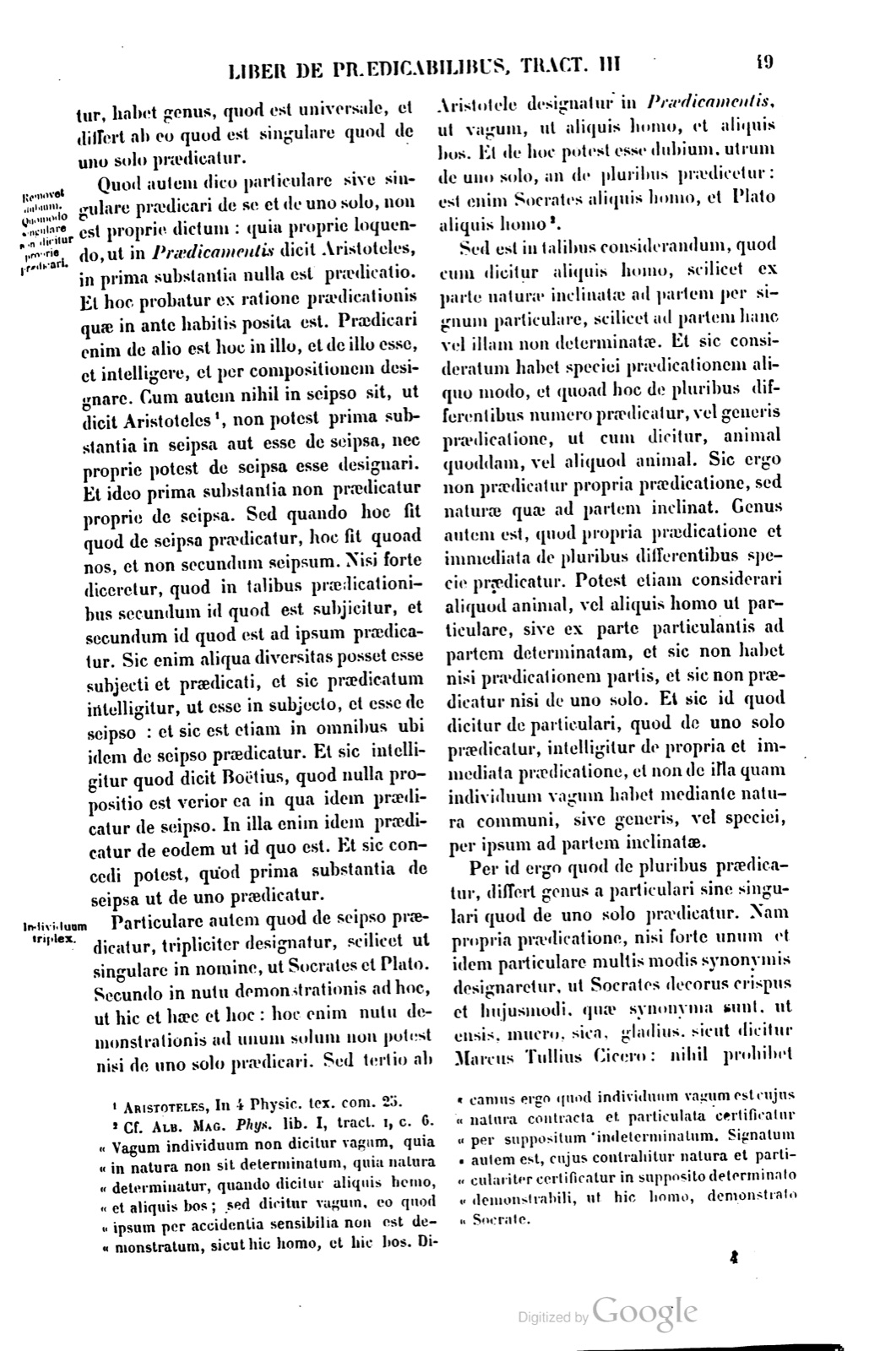
habet genus, quod est universale, et differt ab eo quod est singulare quod de uno solo praedicatur.
Quod autem dico particulare sive singulare praedicari de se et de uno solo, non est proprie dictum: quia proprie loquendo, ut in Praedicamentis dicit Aristoteles, in prima substantia nulla est praedicatio. Et hoc probatur ex ratione praedicationis quae in ante habitis posita est. Praedicari enim de alio est hoc in illo, et de illo esse, et intelligere, et per compositionem designare. Cum autem nihil in seipso sit, ut dicit Aristoteles 1, non potest prima substantia in seipsa aut esse de seipsa, nec proprie potest de seipsa esse designari. Et ideo prima substantia non praedicatur proprie de seipsa. Sed quando hoc fit quod de seipsa praedicatur, hoc fit quoad nos, et non secundum seipsum. Nisi forte diceretur, quod in talibus praedicationibus secundum id quod est subjicitur, et secundum id quod est ad ipsum praedicatur. Sic enim aliqua diversitas posset esse subjecti et praedicati, et sic praedicatum intelligitur, ut esse in subjecto, et esse de seipso: et sic est etiam in omnibus ubi idem de seipso praedicatur. Et sic intelligitur quod dicit Boetius, quod nulla propositio est verior ea in qua idem praedicatur de seipso. In illa enim idem praedicatur de eodem ut id quo est. Et sic concedi potest, quod prima substantia de seipsa ut de uno praedicatur.
Particulare autem quod de seipso praedicatur, tripliciter designatur, scilicet ut singulare in nomine, ut Socrates et Plato. Secundo in nutu demonstrationis ad hoc, ut hic et haec et hoc: hoc enim nutu demonstrationis ad unum solum non potest nisi de uno solo praedicari. Sed tertio ab Aristotele designatur in Praedicamentis, ut vagum, ut aliquis homo, et aliquis bos. Et de hoc potest esse dubium, utrum de uno solo, an de pluribus praedicetur: est enim Socrates aliquis homo, et Plato aliquis homo 2.
Sed est in talibus considerandum, quod cum dicitur aliquis homo, scilicet ex parte naturae inclinatae ad partem per signum particulare, scilicet ad partem hanc vel illam non determinatae. Et sic consideratum habet speciei praedicationem aliquo modo, et quoad hoc de pluribus differentibus numero praedicatur, vel generis praedicatione, ut cum dicitur, animal quoddam, vel aliquod animal. Sic ergo non praedicatur propria praedicatione, sed naturae quae ad partem inclinat. Genus autem est, quod propria praedicatione et immediata de pluribus differentibus specie praedicatur. Potest etiam considerari aliquod animal, vel aliquis homo ut particulare, sive ex parte particulantis ad partem determinatam, et sic non habet nisi praedicationem partis, et sic non praedicatur nisi de uno solo. Et sic id quod dicitur de particulari, quod de uno solo praedicatur, intelligitur de propria et immediata praedicatione, et non de illa quam individuum vagum habet mediante natura communi, sive generis, vel speciei, per ipsum ad partem inclinatae.
Per id ergo quod de pluribus praedicatur, differt genus a particulari sive singulari quod de uno solo praedicatur. Nam propria praedicatione, nisi forte unum et idem particulare multis modis synonymis designaretur, ut Socrates decorus crispus et hujusmodi, quae synonyma sunt, ut ensis, mucro, sica, gladius, sicut dicitur Marcus Tullius Cicero: nihil prohibet singulare sub uno nomine notius esse, quam sub alio, et sic notius praedicari de se secundum quod est sub nomine minus noto: ut si quaeram, quis sit talis? et dicatur mihi, Tullius est Marcus: videtur enim aliquo modo propinquius esse propriae praedicationi. Sic ergo genus distinguitur ab individuis per hoc quod est de pluribus praedicari.
genus has, which is universal, and it differs from that which is singular, which is predicated of one alone.
But what I say, that the particular or singular is predicated of itself and of one alone, is not said properly, because properly speaking, as Aristotle says in the Categories, in first substance there is no predication. And this is proved from the notion of predication which was posited above. For to be predicated of another is for this to be in that, and to be of that, and to understand and designate through composition. But since nothing is in itself, as Aristotle says 1, first substance cannot be in itself or be of itself, nor can it properly be designated as being of itself. And therefore first substance is not properly predicated of itself. But when this occurs, that it is predicated of itself, this occurs with respect to us and not according to itself. Unless perhaps it were said that in such predications it is subjected according to that which it is, and it is predicated according to that which is toward itself. For thus there could be some diversity of subject and predicate, and thus the predicate is understood as being in the subject and as being of itself; and so it is also in all cases where the same is predicated of itself. And thus is understood what Boethius says, that no proposition is truer than that in which the same is predicated of itself. For in that one the same is predicated of the same as that by which it is. And thus it can be conceded that first substance is predicated of itself as of one.
But the particular which is predicated of itself is designated in three ways, namely as singular in name, as Socrates and Plato. Second, in the nod of demonstration to this, as this masculine, this feminine, and this neuter: for by the nod of demonstration to one alone this cannot be predicated except of one alone. But third, it is designated by Aristotle in the Categories as vague, as some man and some ox. And concerning this there can be doubt whether it is predicated of one alone or of several, for Socrates is some man and Plato is some man 2.
But in such cases it must be considered that when some man is said, namely on the part of the nature inclined to a part by a particular sign, namely to this part or that part not determined, then, considered thus, it has the predication of species in some way, and with respect to this it is predicated of several differing in number, or by predication of genus, as when a certain animal or some animal is said. Thus therefore it is not predicated by proper predication, but by the predication of a nature which inclines to a part. But genus is that which by proper and immediate predication is predicated of several things differing in species. Some animal or some man can also be considered as particular, or on the part of that which particularizes to a determined part, and thus it has only the predication of a part, and thus is predicated only of one alone. And thus what is said of the particular, that it is predicated of one alone, is understood of proper and immediate predication, and not of that which the vague individual has by means of the common nature, whether of genus or of species, inclined through it to a part.
Therefore by that which is predicated of several, genus differs from the particular or singular which is predicated of one alone. For by proper predication, unless perhaps one and the same particular were designated in many synonymous ways, as Socrates handsome curly-haired and things of this sort, which are synonyms, as sword, point, dagger, blade, just as Marcus Tullius Cicero is said, nothing prevents the singular from being better known under one name than under another, and thus from being more knownly predicated of itself according as it is under a less known name: as if I ask who such a one is, and it is said to me, Tullius is Marcus, for this seems in some way nearer to proper predication. Thus therefore genus is distinguished from individuals through this, that it is predicated of several.
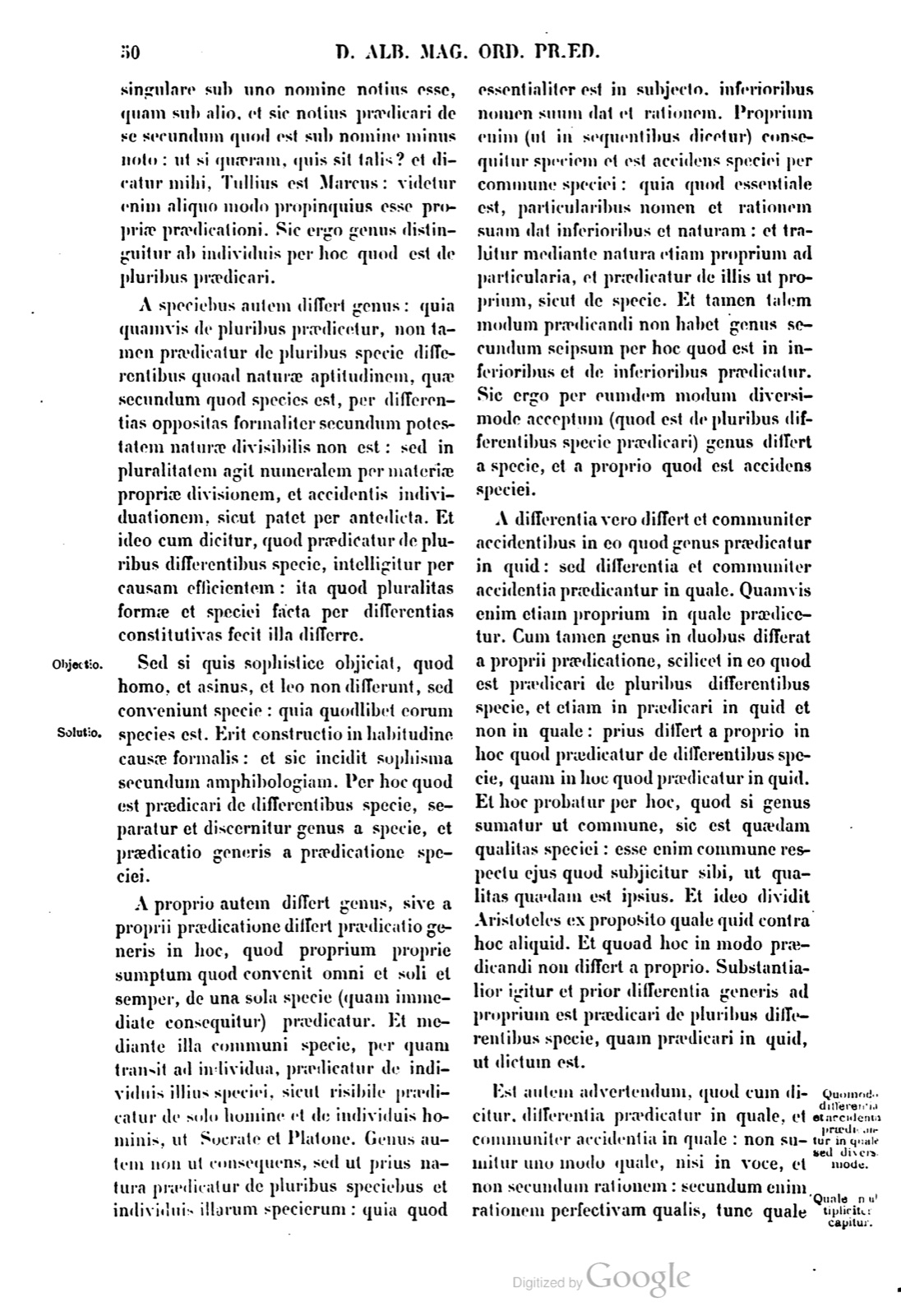
A speciebus autem differt genus: quia quamvis de pluribus praedicetur, non tamen praedicatur de pluribus specie differentibus quoad naturae aptitudinem, quae secundum quod species est, per differentias oppositas formaliter secundum potestatem naturae divisibilis non est: sed in pluralitatem agit numeralem per materiae propriae divisionem, et accidentis individuationem, sicut patet per antedicta. Et ideo cum dicitur, quod praedicatur de pluribus differentibus specie, intelligitur per causam efficientem: ita quod pluralitas formae et speciei facta per differentias constitutivas fecit illa differre.
Sed si quis sophistice objiciat, quod homo, et asinus, et leo non differunt, sed conveniunt specie: quia quodlibet eorum species est. Erit constructio in habitudine causae formalis: et sic incidit sophisma secundum amphibologiam. Per hoc quod est praedicari de differentibus specie, separatur et discernitur genus a specie, et praedicatio generis a praedicatione speciei.
A proprio autem differt genus, sive a proprii praedicatione differt praedicatio generis in hoc, quod proprium proprie sumptum quod convenit omni et soli et semper, de una sola specie quam immediate consequitur praedicatur. Et mediante illa communi specie, per quam transit ad individua, praedicatur de individuis illius speciei, sicut risibile praedicatur de solo homine et de individuis hominis, ut Socrate et Platone. Genus autem non ut consequens, sed ut prius natura praedicatur de pluribus speciebus et individuis illarum specierum: quia quod essentialiter est in subjecto, inferioribus nomen suum dat et rationem. Proprium enim, ut in sequentibus dicetur, consequitur speciem et est accidens speciei per commune speciei: quia quod essentiale est, particularibus nomen et rationem suam dat inferioribus et naturam: et trahitur mediante natura etiam proprium ad particularia, et praedicatur de illis ut proprium, sicut de specie. Et tamen talem modum praedicandi non habet genus secundum seipsum per hoc quod est in inferioribus et de inferioribus praedicatur. Sic ergo per eumdem modum diversimode acceptum, quod est de pluribus differentibus specie praedicari, genus differt a specie, et a proprio quod est accidens speciei.
A differentia vero differt et communiter accidentibus in eo quod genus praedicatur in quid: sed differentia et communiter accidentia praedicantur in quale. Quamvis enim etiam proprium in quale praedicetur. Cum tamen genus in duobus differat a proprii praedicatione, scilicet in eo quod est praedicari de pluribus differentibus specie, et etiam in praedicari in quid et non in quale: prius differt a proprio in hoc quod praedicatur de differentibus specie, quam in hoc quod praedicatur in quid. Et hoc probatur per hoc, quod si genus sumatur ut commune, sic est quaedam qualitas speciei: esse enim commune respectu ejus quod subjicitur sibi, ut qualitas quaedam est ipsius. Et ideo dividit Aristoteles ex proposito quale quid contra hoc aliquid. Et quoad hoc in modo praedicandi non differt a proprio. Substantialior igitur et prior differentia generis ad proprium est praedicari de pluribus differentibus specie, quam praedicari in quid, ut dictum est.
But genus differs from species because, although it is predicated of several, nevertheless it is not predicated of several things differing in species with respect to the aptitude of nature, which, insofar as it is species, is not formally divisible by opposed differences according to the potency of nature, but acts into numerical plurality through the division of its proper matter and the individuation of accident, as is clear through what has been said. And therefore when it is said that it is predicated of several things differing in species, this is understood through the efficient cause, so that the plurality of form and species made by constitutive differences made those things differ.
But if someone should object sophistically that man, ass, and lion do not differ but agree in species because each of them is a species, the construction will be in the relation of formal cause, and thus the sophism falls under amphiboly. Through this, that it is predicated of things differing in species, genus is separated and distinguished from species, and the predication of genus from the predication of species.
But genus differs from property, or the predication of genus differs from the predication of property, in this: that property, properly taken, which belongs to every one, to only one, and always, is predicated of one species alone, which it immediately follows. And through that common species, through which it passes to individuals, it is predicated of the individuals of that species, just as risible is predicated only of man and of the particular men who are under man, such as Socrates and Plato. But genus is predicated not as following, but as prior by nature, of several species and of the individuals of those species, because what is essentially in a subject gives its name and notion to the inferiors. For property, as will be said below, follows species and is an accident of species through the common of species, because what is essential gives to the particulars beneath it its name and notion and nature; and through the mediation of nature also property is drawn to particulars and is predicated of them as property, just as of the species. And yet genus according to itself does not have such a mode of predicating through this, that it is in inferiors and is predicated of inferiors. Thus therefore through the same mode taken in diverse ways, namely to be predicated of several things differing in species, genus differs from species and from property, which is an accident of species.
But from difference and from accidents commonly it differs in that genus is predicated in what, but difference and accidents commonly are predicated in quale. For although property also is predicated in quale, nevertheless, since genus differs from the predication of property in two things, namely in being predicated of several things differing in species, and also in being predicated in what and not in quale, it differs from property earlier in this, that it is predicated of things differing in species, than in this, that it is predicated in what. And this is proved through this, that if genus is taken as common, thus it is a certain quality of species; for common being with respect to that which is subjected to it is as a certain quality of it. And therefore Aristotle deliberately divides quale quid against this something. And with respect to this in the mode of predicating it does not differ from property. Therefore the more substantial and prior difference of genus from property is to be predicated of several things differing in species, rather than to be predicated in what, as has been said.
Est autem advertendum, quod cum dicitur, differentia praedicatur in quale, et communiter accidentia in quale: non sumitur uno modo quale, nisi in voce, et non secundum rationem: secundum enim rationem perfectivam qualis, tunc quale est qualitatis informatio et dispositio secundum quam quales dicimur: et hoc modo quale est, quod non convenit substantiae nec generi alicujus accidentis nisi qualitatis. Alio modo et posterius dicitur quale, quod est consequens quid perfectum: et hoc modo accidens omne quale est, quod est accidens individui: et tunc dividitur quale contra quid perfectum in esse et substantia. Tertio modo dicitur quale, quod est consequens essentialia speciei et naturae: et hoc modo dicitur proprium quale. Et hoc minus habet de quali quam id quod est consequens esse individui. Quarto modo quale dicitur, quod est potentiae determinativum ad esse speciei: et hoc ideo dicitur quale, quia est consequens quid sive subjectum primum quod est genus rei.
Nec dicitur quale, quia sit in genere primo modo dicto, vel quia sit consequens quid speciei: sed tantum ideo, quia est consequens aliquid generis sicut actus consequens potentiam in eodem in quo est aliquid secundum potentiam et aliquid secundum actum. Et hoc quantum ad essentiam suam est substantia et substantiae effectivum, licet habeat modum praedicandi in quale, inquantum est quid generis consequens: et hoc modo differentia praedicatur in quale. Et convenit cum quali accidente in quantum utrumque est ad quid consequens: quamvis quid ad quod consequitur accidens, sit ejus quod est hoc aliquid in individuo. Quid autem ad quod consequitur differentia, est quid imperfectum: ideo differentia consequens est perfectiva potentiae illius secundum substantiam: et quantum ad essentiam est de genere substantiae. Quia vero accidens commune est consequens quid perfectum in eo quod est hoc aliquid et post hoc aliquid, nihil est addere ei quod est esse secundum substantiam. Ideo quale id remanet in natura accidentis, quod cum sit in aliquo, non est in eo sicut pars quaedam: quod differentiae quae consequitur quid imperfectum convenire non potest: non enim potest consequi quid et imperfectum, nisi id quod est pars esse ejus in quo est. Sic ergo et tot modis dicitur quale.
Alio etiam modo dicitur quale quid secundum quod dividitur contra hoc aliquid: et sic quale sumitur termino infinito, per quem quaeritur quale, nec sumitur sive determinatur quaestio quousque stetur in hoc aliquid. Dicentes enim, quod Socrates est animal, quaerimus quale animal: et dicimus, homo. Et quaerentes, qualis homo, dicimus, quod est hic homo: et sic quod habet commune quale quid est respectu sui inferioris. Et etiam genus non praedicatur quidem in quale nec in quid determinatum, sed praedicatur in quale quid indeterminatum, et similiter species, et in quid determinatum sola praedicatur prima substantia.
But it must be noticed that when it is said difference is predicated in quale, and accidents commonly in quale, quale is not taken in one way except in utterance and not according to notion. For according to the perfective notion of what sort, then quale is the informing and disposition of quality according to which we are called qualified; and in this way quale is what does not belong to substance nor to the genus of any accident except quality. In another and later way that is called quale which follows the perfected what; and in this way every accident is a quale, which is an accident of the individual, and then quale is divided against a what perfected in being and substance. In a third way quale is said of that which follows the essentials of species and nature; and in this way property is called quale. And this has less of quale than that which follows the being of the individual. In a fourth way quale is said of what is determinative of potency to the being of species; and this is therefore called quale because it follows the what or first subject which is the genus of the thing.
Nor is it called quale because it is in the genus in the first mode mentioned, or because it follows the what of the species, but only because it follows something of genus, as act follows potency in the same thing in which something is according to potency and something according to act. And this, as to its own essence, is substance and effective of substance, although it has the mode of predicating in quale, insofar as it follows the what of genus; and in this mode difference is predicated in quale. And it agrees with accidental quale insofar as each is consequent upon a what, although the what to which accident is consequent is that of what is this something in the individual. But the what to which difference is consequent is an imperfect what; therefore the consequent difference is perfective of that potency according to substance, and as to essence it is of the genus of substance. But because common accident is consequent upon a perfected what in that which is this something and after this something, it adds nothing to that which is being according to substance. Therefore that quale remains in the nature of accident, which, although it is in something, is not in it as some part; this cannot belong to difference, which follows an imperfect what, for nothing can follow a what and an imperfect thing except that which is part of the being of that in which it is. Thus therefore quale is said also in so many ways.
In another way also quale quid is said insofar as it is divided against this something; and thus quale is taken as an indefinite term, through which it is asked what sort, and the question is not taken or determined until it stands in this something. For saying that Socrates is an animal, we ask what sort of animal, and we say, man. And asking what sort of man, we say that he is this man; and thus what has something common is quale quid with respect to its inferior. And also genus is not predicated in quale nor in a determinate what, but is predicated in an indeterminate quale quid, and similarly species; and in a determinate what only first substance is predicated.
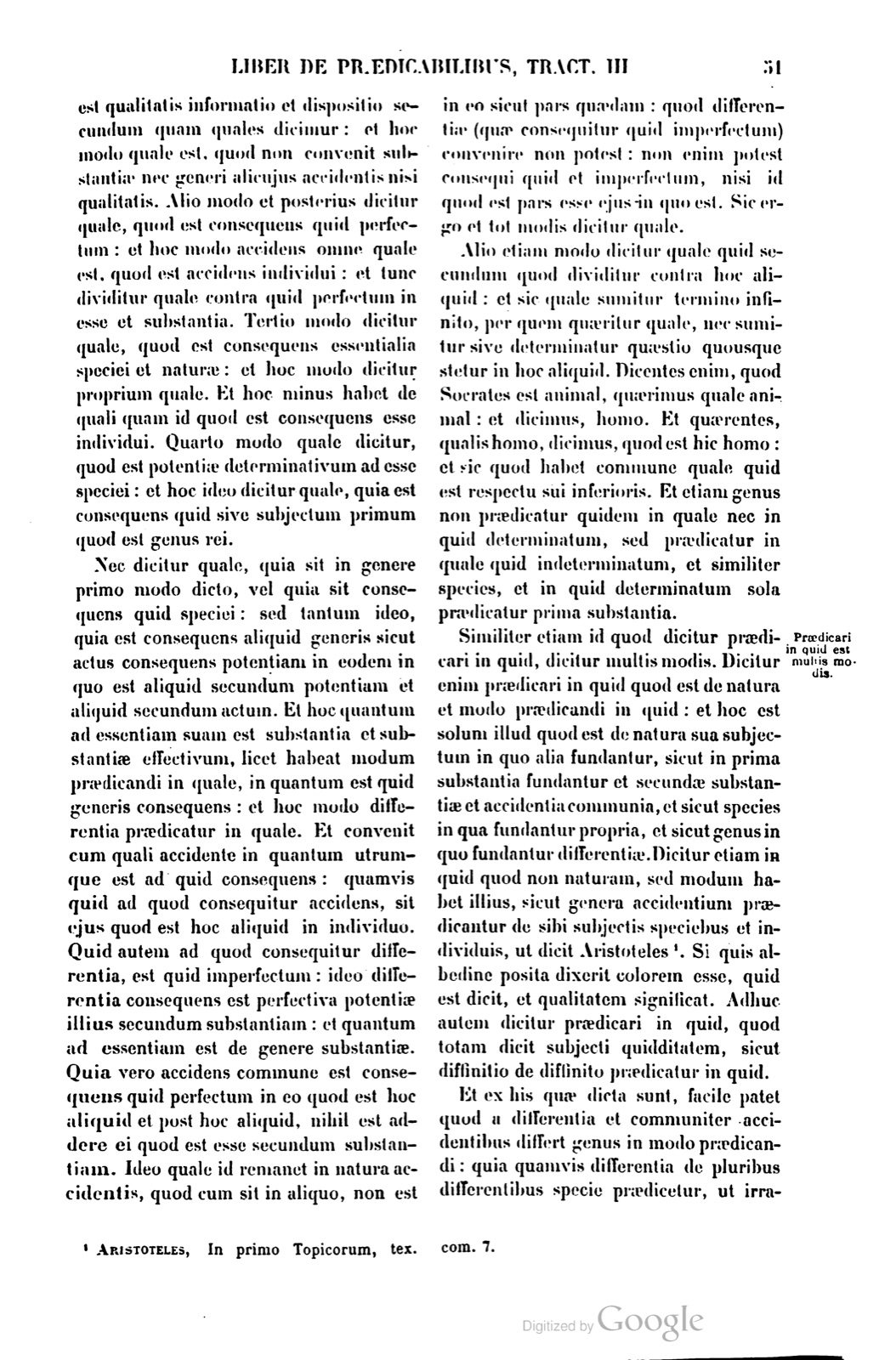
Similiter etiam id quod dicitur praedicari in quid, dicitur multis modis. Dicitur enim praedicari in quid quod est de natura et modo praedicandi in quid: et hoc est solum illud quod est de natura sua subjectum in quo alia fundantur, sicut in prima substantia fundantur et secundae substantiae et accidentia communia, et sicut species in qua fundantur propria, et sicut genus in quo fundantur differentiae. Dicitur etiam in quid quod non naturam, sed modum habet illius, sicut genera accidentium praedicantur de sibi subjectis speciebus et individuis, ut dicit Aristoteles 3. Si quis albedine posita dixerit colorem esse, quid est dicit, et qualitatem significat. Adhuc autem dicitur praedicari in quid, quod totam dicit subjecti quidditatem, sicut diffinitio de diffinito praedicatur in quid.
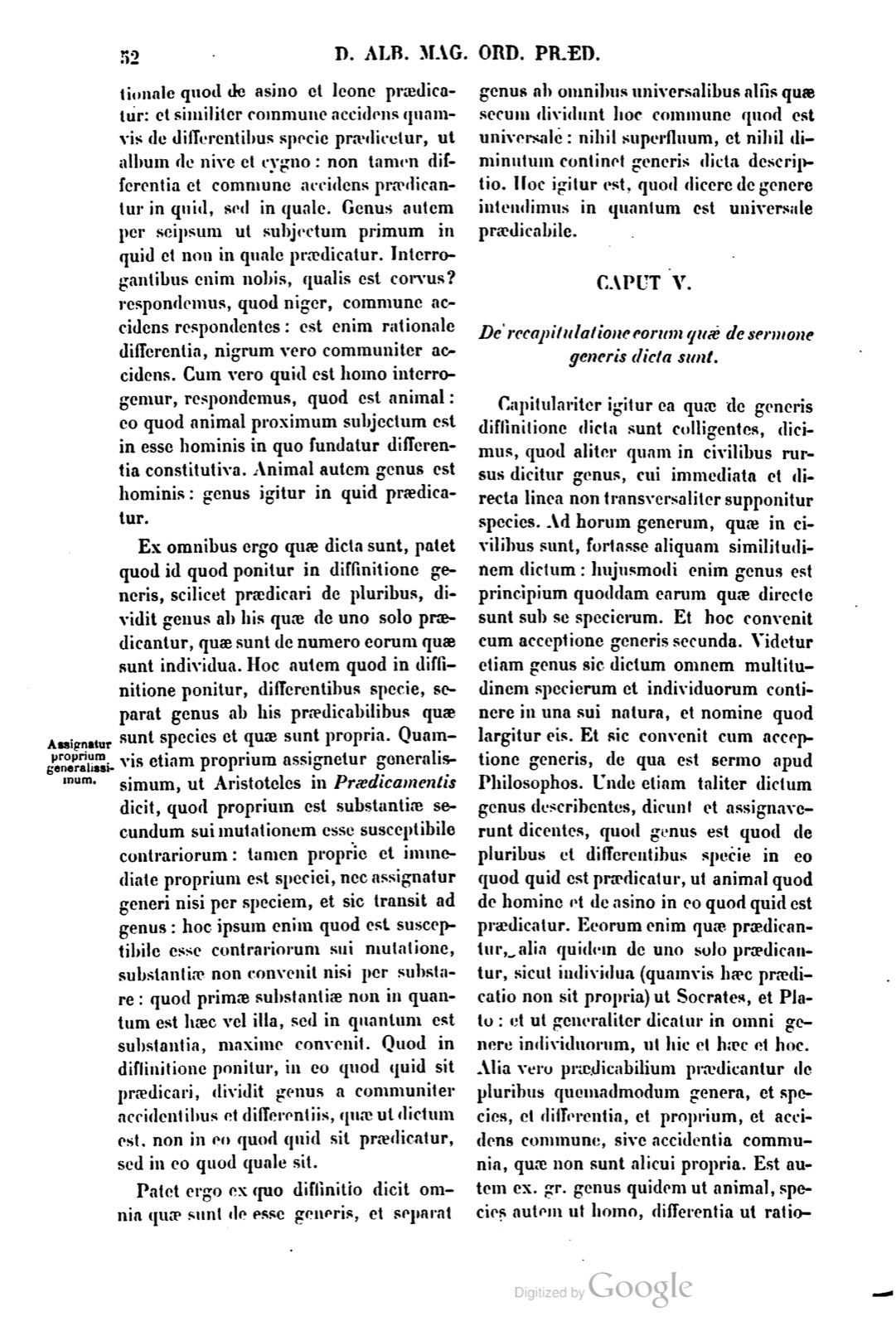
Et ex his quae dicta sunt, facile patet quod a differentia et communiter accidentibus differt genus in modo praedicandi: quia quamvis differentia de pluribus differentibus specie praedicetur, ut irrationale quod de asino et leone praedicatur: et similiter commune accidens quamvis de differentibus specie praedicetur, ut album de nive et cygno: non tamen differentia et commune accidens praedicantur in quid, sed in quale. Genus autem per seipsum ut subjectum primum in quid et non in quale praedicatur. Interrogantibus enim nobis, qualis est corvus? respondemus, quod niger, commune accidens respondentes: est enim rationale differentia, nigrum vero communiter accidens. Cum vero quid est homo interrogemur, respondemus, quod est animal: eo quod animal proximum subjectum est in esse hominis in quo fundatur differentia constitutiva. Animal autem genus est hominis: genus igitur in quid praedicatur.
Ex omnibus ergo quae dicta sunt, patet quod id quod ponitur in diffinitione generis, scilicet praedicari de pluribus, dividit genus ab his quae de uno solo praedicantur, quae sunt de numero eorum quae sunt individua. Hoc autem quod in diffinitione ponitur, differentibus specie, separat genus ab his praedicabilibus quae sunt species et quae sunt propria. Quamvis etiam proprium assignetur generalissimum, ut Aristoteles in Praedicamentis dicit, quod proprium est substantiae secundum sui mutationem esse susceptibile contrariorum: tamen proprie et immediate proprium est speciei, nec assignatur generi nisi per speciem, et sic transit ad genus: hoc ipsum enim quod est susceptibile esse contrariorum sui mutatione, substantiae non convenit nisi per substare: quod primae substantiae non in quantum est haec vel illa, sed in quantum est substantia, maxime convenit. Quod in diffinitione ponitur, in eo quod quid sit praedicari, dividit genus a communiter accidentibus et differentiis, quae ut dictum est, non in eo quod quid sit praedicatur, sed in eo quod quale sit.
Patet ergo ex quo diffinitio dicit omnia quae sunt de esse generis, et separat genus ab omnibus universalibus aliis quae secum dividunt hoc commune quod est universale: nihil superfluum, et nihil diminutum continet generis dicta descriptio. Hoc igitur est, quod dicere de genere intendimus in quantum est universale praedicabile.
Likewise also that which is said to be predicated in what is said in many ways. For that is said to be predicated in what which is of the nature and mode of predicating in what; and this is only that which by its nature is the subject in which other things are founded, just as in first substance second substances and common accidents are founded, and as species in which properties are founded, and as genus in which differences are founded. That also is said in what which does not have the nature, but has the mode of it, just as genera of accidents are predicated of the species and individuals subject to them, as Aristotle says 3. If someone, with whiteness posited, says that color exists, he states what it is and signifies quality. Further, that is said to be predicated in what which states the whole quiddity of the subject, just as definition is predicated of the defined in what.
And from the things which have been said, it is easily clear that genus differs from difference and from accidents commonly in the mode of predicating; because although difference is predicated of several things differing in species, as irrational is predicated of ass and lion, and likewise although a common accident is predicated of things differing in species, as white of snow and swan, nevertheless difference and common accident are not predicated in what, but in quale. But genus by itself as first subject is predicated in what and not in quale. For when we ask what sort the raven is, we answer that it is black, answering with a common accident; for rational is a difference, but black is a common accident. But when we are asked what man is, we answer that he is animal, because animal is the proximate subject in the being of man in which the constitutive difference is founded. But animal is the genus of man; therefore genus is predicated in what.
Therefore from all the things which have been said, it is clear that what is placed in the definition of genus, namely to be predicated of several, divides genus from those things which are predicated of one alone, which are among the number of those which are individuals. But what is placed in the definition, differing in species, separates genus from those predicables which are species and properties. Although even property is assigned most generally, as Aristotle says in the Categories, that it is proper to substance according to its own change to be receptive of contraries, nevertheless properly and immediately property belongs to species, nor is it assigned to genus except through species, and thus it passes to genus. For this very thing, to be receptive of contraries by its own change, does not belong to substance except through standing-under; and this belongs most of all to first substance, not insofar as it is this one or that one, but insofar as it is substance. What is placed in the definition, to be predicated in that which is what, divides genus from common accidents and differences, which, as has been said, are not predicated in that which is what, but in that which is quale.
Therefore it is clear that, since the definition states all things which belong to the being of genus and separates genus from all the other universals which divide with it this common thing which is universal, the stated description of genus contains nothing superfluous and nothing diminished. This therefore is what we intend to say about genus insofar as it is a predicable universal.
Notes
- Aristotle, in Physics IV, text, commentary 25. (Aristoteles, In 4 Physic. tex. com. 25.) ↩
- Compare Albert the Great, Physics, book I, tractate 1, chapter 6: A vague individual is not called vague because it is not determined in nature, because nature is determined when some man and some ox are said; but it is called vague because it itself is not demonstrated through sensible accidents, as this man and this ox are. Therefore let us say that a vague individual is that whose contracted and particularized nature is certified through an indeterminate supposit. But the signed individual is that whose nature is contracted and particularly certified in a determinate demonstrable supposit, as this man, with Socrates demonstrated. (Cf. Alb. Mag. Phys. lib. I, tract. 1, c. 6: Vagum individuum non dicitur vagum, quia in natura non sit determinatum, quia natura determinatur, quando dicitur aliquis homo, et aliquis bos; sed dicitur vagum, eo quod ipsum per accidentia sensibilia non est demonstratum, sicut hic homo, et hic bos. Dicamus ergo quod individuum vagum est cujus natura contracta et particulata certificatur per suppositum indeterminatum. Signatum autem est, cujus contrahitur natura et particulariter certificatur in supposito determinato demonstrabili, ut hic homo, demonstrato Socrate.) ↩
- Aristotle, in Topics I, text, commentary 7. (Aristoteles, In primo Topicorum, tex. com. 7.) ↩
If a page does not appear, its photograph has not been uploaded yet.