Volume 1 · p. 48
Chapter IV. That the definition of genus neither abounds nor is deficient, and its declaration.
CAPUT IV.
Quod diffinitio generis nec abundet, nec deficiat, et ejus declaratio.
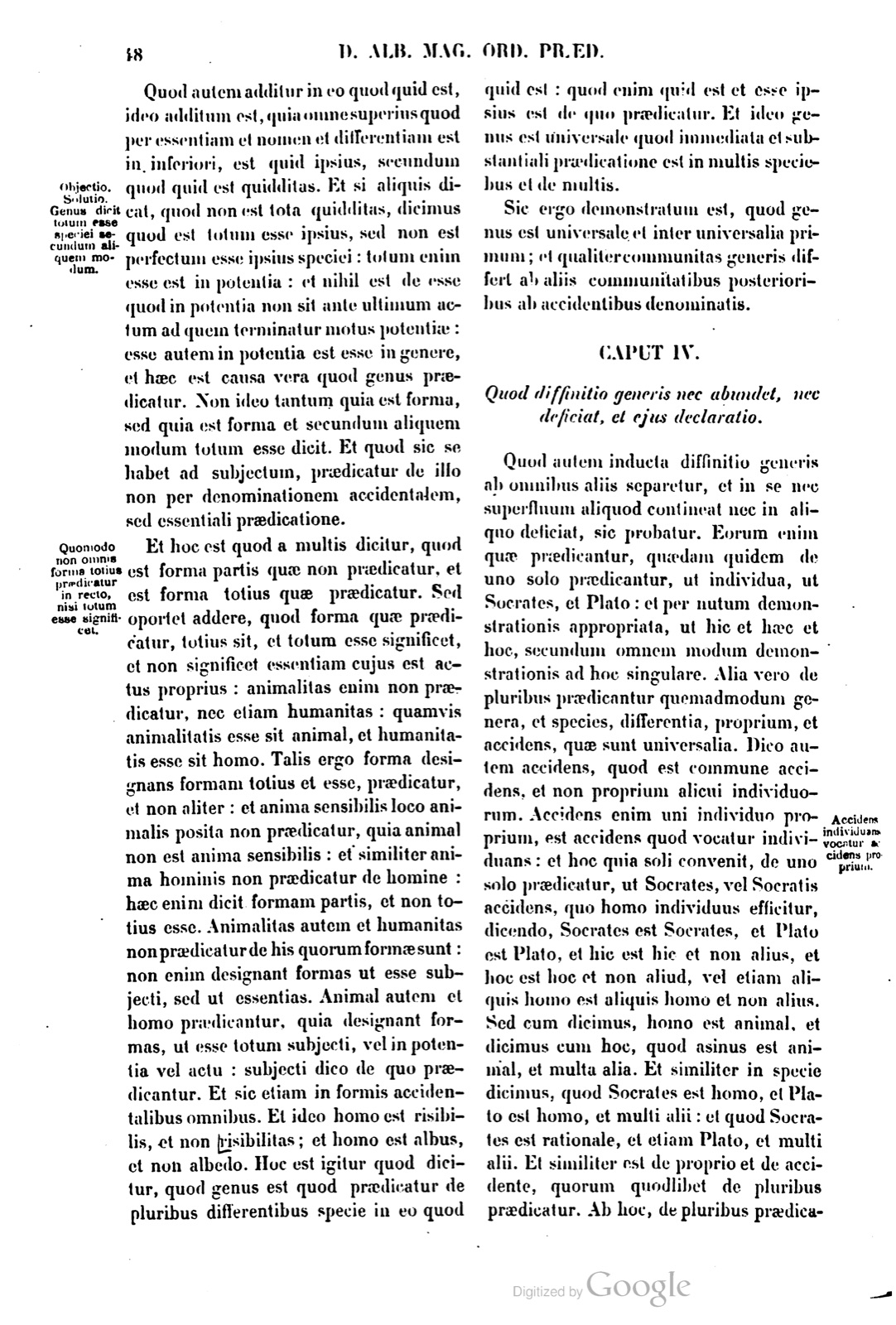
Quod autem inducta diffinitio generis ab omnibus aliis separetur, et in se nec superfluum aliquod contineat nec in aliquo deficiat, sic probatur. Eorum enim quae praedicantur, quaedam quidem de uno solo praedicantur, ut individua, ut Socrates, et Plato: et per nutum demonstrationis appropriata, ut hic et haec et hoc, secundum omnem modum demonstrationis ad hoc singulare. Alia vero de pluribus praedicantur quemadmodum genera, et species, differentia, proprium, et accidens, quae sunt universalia. Dico autem accidens, quod est commune accidens, et non proprium alicui individuorum. Accidens enim uni individuo proprium, est accidens quod vocatur individuans: et hoc quia soli convenit, de uno solo praedicatur, ut Socrates, vel Socratis accidens, quo homo individuus efficitur, dicendo, Socrates est Socrates, et Plato est Plato, et hic est hic et non alius, et hoc est hoc et non aliud, vel etiam aliquis homo est aliquis homo et non alius. Sed cum dicimus, homo est animal, et dicimus cum hoc, quod asinus est animal, et multa alia. Et similiter in specie dicimus, quod Socrates est homo, et Plato est homo, et multi alii: et quod Socrates est rationale, et etiam Plato, et multi alii. Et similiter est de proprio et de accidente, quorum quodlibet de pluribus praedicatur. Ab hoc, de pluribus praedicatur,
CHAPTER IV.
That the definition of genus neither abounds nor is deficient, and its declaration.
But that the introduced definition of genus is separated from all the others, and in itself neither contains anything superfluous nor is deficient in anything, is proved thus. For of the things which are predicated, certain ones indeed are predicated of one alone, as individuals, such as Socrates and Plato; and things appropriated through the nod of demonstration, as this masculine and this feminine and this neuter, according to every mode of demonstration to this singular. But others are predicated of several, in the manner of genera and species, difference, property, and accident, which are universals. But I mean accident which is a common accident, and not one proper to some individual. For an accident proper to one individual is the accident which is called individuating; and because this belongs to one alone, it is predicated of one alone, as Socrates, or an accident of Socrates by which an individual man is effected, by saying: Socrates is Socrates, and Plato is Plato, and this is this and not another, and this thing is this thing and not another, or also some man is some man and not another. But when we say man is animal, and with this we say that ass is animal, and many other things. And similarly in species we say that Socrates is man, and Plato is man, and many others; and that Socrates is rational, and also Plato, and many others. And similarly it is with property and accident, any of which is predicated of several. From this, that it is predicated of several,
If a page does not appear, its photograph has not been uploaded yet.