Volume 1 · pp. 46–48
Chapter III. On the definition or description of physical genus.
A marker with ≈ is an approximate page boundary, placed by measure of the text; the page photographs remain the authority. In the paired views, clicking a page marker brings that page into view.
CAPUT III.
De diffinitione vel descriptione generis physici.
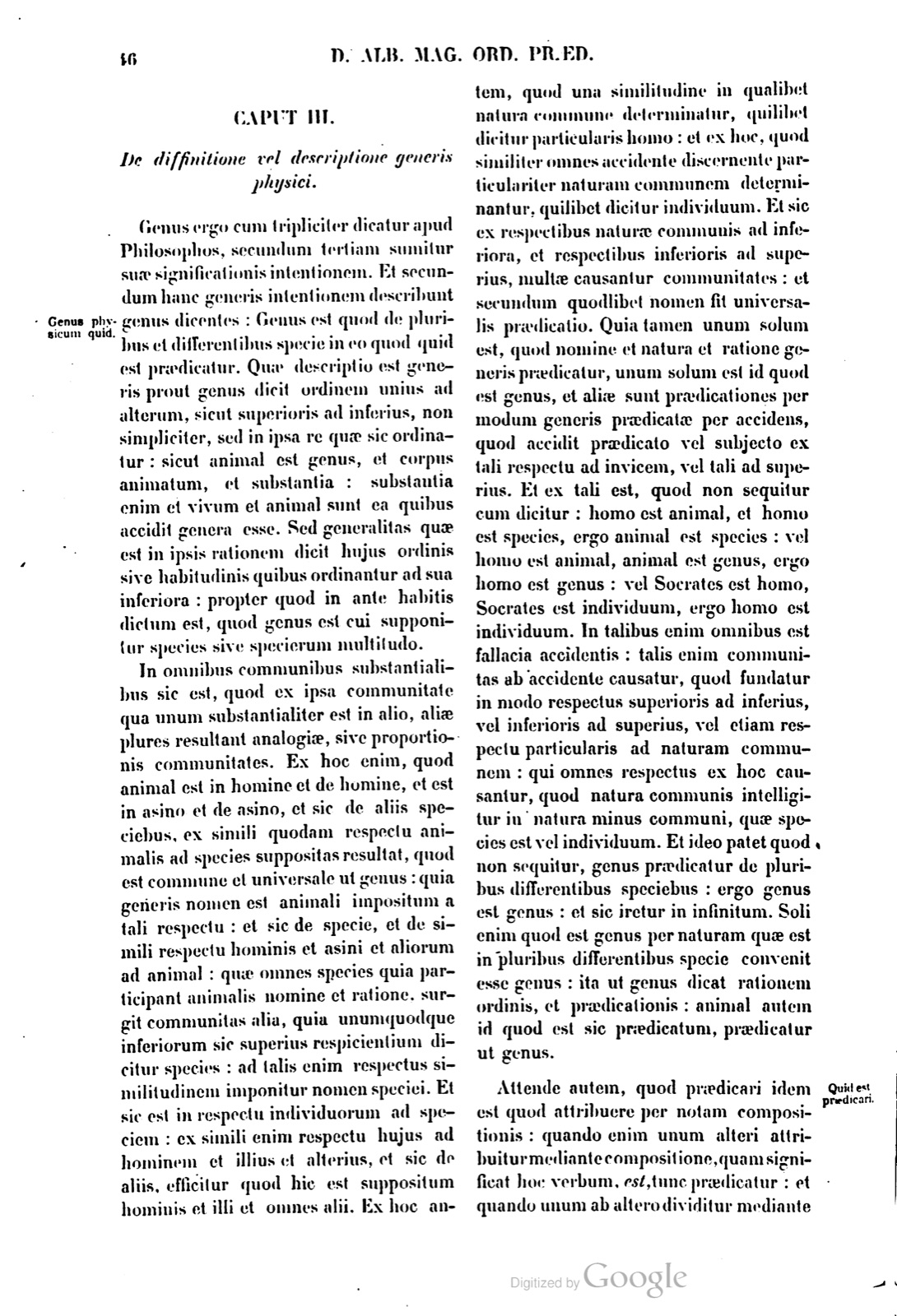
Genus ergo cum tripliciter dicatur apud Philosophos, secundum tertiam sumitur suae significationis intentionem. Et secundum hanc generis intentionem describunt genus dicentes: genus est quod de pluribus et differentibus specie in eo quod quid est praedicatur. Quae descriptio est generis prout genus dicit ordinem unius ad alterum, sicut superioris ad inferius, non simpliciter, sed in ipsa re quae sic ordinatur: sicut animal est genus, et corpus animatum, et substantia: substantia enim et vivum et animal sunt ea quibus accidit genera esse. Sed generalitas quae est in ipsis rationem dicit hujus ordinis sive habitudinis quibus ordinantur ad sua inferiora: propter quod in ante habitis dictum est, quod genus est cui supponitur species sive specierum multitudo.
In omnibus communibus substantialibus sic est, quod ex ipsa communitate qua unum substantialiter est in alio, aliae plures resultant analogiae, sive proportiones communitates. Ex hoc enim, quod animal est in homine et de homine, et est in asino et de asino, et sic de aliis speciebus, ex simili quodam respectu animalis ad species suppositas resultat, quod est commune et universale ut genus: quia generis nomen est animali impositum a tali respectu: et sic de specie, et de simili respectu hominis et asini et aliorum ad animal: quae omnes species quia participant animalis nomine et ratione, surgit communitas alia, quia unumquodque inferiorum sic superius respicientium dicitur species: ad talis enim respectus similitudinem imponitur nomen speciei. Et sic est in respectu individuorum ad speciem: ex simili enim respectu hujus ad hominem et illius et alterius, et sic de aliis, efficitur quod hic est suppositum hominis et illi et omnes alii. Ex hoc autem, quod una similitudine in qualibet natura commune determinatur, quilibet dicitur particularis homo: et ex hoc, quod similiter omnes accidente discernente particulariter naturam communem determinant, quilibet dicitur individuum. Et sic ex respectibus naturae communis ad inferiora, et respectibus inferioris ad superius, multae causantur communitates: et secundum quodlibet nomen fit universalis praedicatio. Quia tamen unum solum est, quod nomine et natura et ratione generis praedicatur, unum solum est id quod est genus, et aliae sunt praedicationes per modum generis praedicatae per accidens, quod accidit praedicato vel subjecto ex tali respectu ad invicem, vel tali ad superius. Et ex tali est, quod non sequitur cum dicitur: homo est animal, et homo est species, ergo animal est species: vel homo est animal, animal est genus, ergo homo est genus: vel Socrates est homo, Socrates est individuum, ergo homo est individuum. In talibus enim omnibus est fallacia accidentis: talis enim communitas ab accidente causatur, quod fundatur in modo respectus superioris ad inferius, vel inferioris ad superius, vel etiam respectu particularis ad naturam communem: qui omnes respectus ex hoc causantur, quod natura communis intelligitur in natura minus communi, quae species est vel individuum. Et ideo patet quod non sequitur, genus praedicatur de pluribus differentibus speciebus: ergo genus est genus: et sic iretur in infinitum. Soli enim quod est genus per naturam quae est in pluribus differentibus specie convenit esse genus: ita ut genus dicat rationem ordinis, et praedicationis: animal autem id quod est sic praedicatum, praedicatur ut genus.
CHAPTER III.
On the definition or description of physical genus.
Therefore since genus is said triply among the Philosophers, it is taken according to the third intention of its signification. And according to this intention of genus they describe genus, saying: genus is what is predicated of several things different in species in that which is what. This description is of genus insofar as genus states the order of one thing to another, as of superior to inferior, not simply, but in the thing itself which is thus ordered: as animal is a genus, and animated body, and substance; for substance and living thing and animal are those to which it happens to be genera. But the generality which is in them states the notion of this order or relation by which they are ordered to their inferiors; on account of which it was said above that genus is that under which species or a multitude of species is placed.
In all substantial commons it is thus, that from the very community by which one thing is substantially in another, several other analogies, or proportional communities, result. For from this, that animal is in man and of man, and is in ass and of ass, and so of the other species, from a certain similar respect of animal to the supposed species, there results that it is common and universal as genus, because the name of genus is imposed on animal from such a respect. And so concerning species, and from the similar respect of man and ass and the others to animal, all of which are species because they participate in the name and notion of animal, another community arises, because each of the inferiors so looking to a superior is called species; for the name of species is imposed according to the likeness of such a respect. And so it is in the respect of individuals to species: for from the similar respect of this one to man and of that one and another, and so of the others, it is effected that this one is a supposit of man and those and all the others are. But from this, that by one likeness the common is determined in any nature, each is called a particular man; and from this, that similarly all determine the common nature particularly by a discerning accident, each is called an individual. And thus from the respects of common nature to inferiors, and from the respects of the inferior to the superior, many communities are caused; and according to each name a universal predication is made. Nevertheless, because there is only one thing which is predicated by name and nature and notion of genus, there is only one thing which is genus, and the others are predications predicated by the mode of genus by accident, which happens to the predicate or subject from such a mutual respect, or from such a respect to the superior. And from such a case it does not follow when it is said: man is animal, and man is species, therefore animal is species; or man is animal, animal is genus, therefore man is genus; or Socrates is man, Socrates is individual, therefore man is individual. For in all such cases there is the fallacy of accident: for such community is caused by an accident which is founded in the mode of the respect of superior to inferior, or of inferior to superior, or also in the respect of the particular to the common nature. All these respects are caused from this, that common nature is understood in a less common nature, which is species or individual. And therefore it is clear that it does not follow: genus is predicated of several species-differing things, therefore genus is genus, and thus one would go to infinity. For only to that which is genus through the nature which is in several things differing in species does it belong to be genus, so that genus states the notion of order and predication; but animal, that which is thus predicated, is predicated as genus.
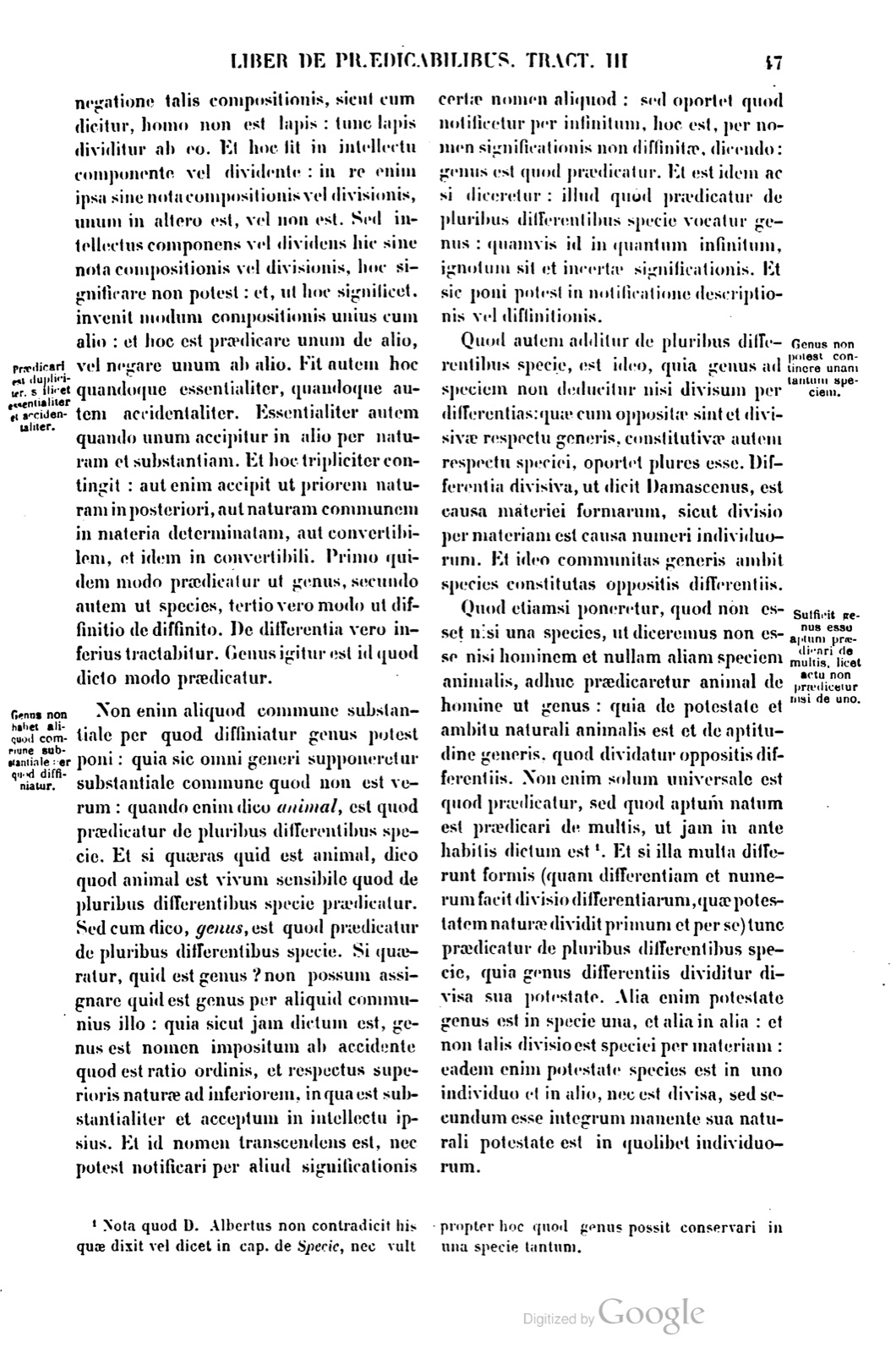
Attende autem, quod praedicari idem est quod attribuere per notam compositionis: quando enim unum alteri attribuitur mediante compositione, quam significat hoc verbum, est, tunc praedicatur: et quando unum ab altero dividitur mediante negatione talis compositionis, sicut cum dicitur, homo non est lapis: tunc lapis dividitur ab eo. Et hoc fit in intellectu componente vel dividente: in re enim ipsa sine nota compositionis vel divisionis, unum in altero est, vel non est. Sed intellectus componens vel dividens hic sine nota compositionis vel divisionis, hoc significare non potest: et, ut hoc significet, invenit modum compositionis unius cum alio: et hoc est praedicare unum de alio, vel negare unum ab alio. Fit autem hoc quandoque essentialiter, quandoque autem accidentaliter. Essentialiter autem quando unum accipitur in alio per naturam et substantiam. Et hoc tripliciter contingit: aut enim accipit ut priorem naturam in posteriori, aut naturam communem in materia determinatam, aut convertibilem, et idem in convertibili. Primo quidem modo praedicatur ut genus, secundo autem ut species, tertio vero modo ut diffinitio de diffinito. De differentia vero inferius tractabitur. Genus igitur est id quod dicto modo praedicatur.
Non enim aliquod commune substantiale per quod diffiniatur genus potest poni: quia sic omni generi supponeretur substantiale commune quod non est verum: quando enim dico animal, est quod praedicatur de pluribus differentibus specie. Et si quaeras quid est animal, dico quod animal est vivum sensibile quod de pluribus differentibus specie praedicatur. Sed cum dico, genus, est quod praedicatur de pluribus differentibus specie. Si quaeratur, quid est genus? non possum assignare quid est genus per aliquid communius illo: quia sicut jam dictum est, genus est nomen impositum ab accidente quod est ratio ordinis, et respectus superioris naturae ad inferiorem, in qua est substantialiter et acceptum in intellectu ipsius. Et id nomen transcendens est, nec potest notificari per aliud significationis certae nomen aliquod: sed oportet quod notificetur per infinitum, hoc est, per nomen significationis non diffinitae, dicendo: genus est quod praedicatur. Et est idem ac si diceretur: illud quod praedicatur de pluribus differentibus specie vocatur genus: quamvis id in quantum infinitum, ignotum sit et incertae significationis. Et sic poni potest in notificatione descriptionis vel diffinitionis.
Quod autem additur de pluribus differentibus specie, est ideo, quia genus ad speciem non deducitur nisi divisum per differentias: quae cum oppositae sint et divisivae respectu generis, constitutivae autem respectu speciei, oportet plures esse. Differentia divisiva, ut dicit Damascenus, est causa materiae formarum, sicut divisio per materiam est causa numeri individuorum. Et ideo communitas generis ambit species constitutas oppositis differentiis.
Quod etiamsi poneretur, quod non esset nisi una species, ut diceremus non esse nisi hominem et nullam aliam speciem animalis, adhuc praedicaretur animal de homine ut genus: quia de potestate et ambitu naturali animalis est et de aptitudine generis, quod dividatur oppositis differentiis. Non enim solum universale est quod praedicatur, sed quod aptum natum est praedicari de multis, ut jam in ante habitis dictum est 1. Et si illa multa differunt formis, quam differentiam et numerum facit divisio differentiarum, quae potestatem naturae dividit primum et per se, tunc praedicatur de pluribus differentibus specie, quia genus differentiis dividitur divisa sua potestate. Alia enim potestate genus est in specie una, et alia in alia: et non talis divisio est speciei per materiam: eadem enim potestate species est in uno individuo et in alio, nec est divisa, sed secundum esse integrum manente sua naturali potestate est in quolibet individuorum.
Attend, however, that to be predicated is the same as to attribute through the mark of composition. For when one thing is attributed to another by means of composition, which this verb is signifies, then it is predicated; and when one thing is divided from another by means of the negation of such composition, as when it is said, man is not stone, then stone is divided from him. And this happens in the intellect composing or dividing; for in the thing itself, without the mark of composition or division, one thing is in another, or is not. But the intellect composing or dividing cannot signify this here without the mark of composition or division; and, in order that it may signify this, it finds the mode of composition of one thing with another; and this is to predicate one thing of another, or to deny one thing of another. But this happens sometimes essentially, sometimes accidentally. Essentially, when one thing is taken in another through nature and substance. And this happens triply: for it takes either as a prior nature in a posterior, or as a common nature determined in matter, or as convertible, and the same in a convertible. In the first way it is predicated as genus, in the second as species, and in the third as definition of the defined. But concerning difference the treatment will be below. Therefore genus is that which is predicated in the aforesaid mode.
For no substantial common through which genus is defined can be posited, because thus some substantial common would be placed under every genus, which is not true. For when I say animal, it is that which is predicated of several things differing in species. And if you ask what animal is, I say that animal is a sensible living thing which is predicated of several things differing in species. But when I say genus, it is what is predicated of several things differing in species. If it is asked what genus is, I cannot assign what genus is through something more common than it, because, as has now been said, genus is a name imposed from an accident which is the notion of order and the respect of a superior nature to an inferior, in which it is substantially and taken in the intellect of it. And that name is transcendent, and it cannot be made known through any other name of certain signification; rather it must be made known through an infinite term, that is, through a name of undefined signification, by saying: genus is what is predicated. And it is the same as if it were said: that which is predicated of several things differing in species is called genus, although that, insofar as it is indefinite, is unknown and of uncertain signification. And thus it can be placed in the notification of a description or definition.
But what is added, of several things differing in species, is for this reason, that genus is not led down to species except as divided through differences; and because these are opposed and divisive with respect to genus, but constitutive with respect to species, they must be several. Divisive difference, as Damascene says, is the cause of the matter of forms, just as division through matter is the cause of the number of individuals. And therefore the community of genus encompasses species constituted by opposed differences.
And even if it were posited that there were only one species, so that we should say there is only man and no other species of animal, still animal would be predicated of man as genus, because it belongs to the power and natural range of animal and to the aptitude of genus that it be divided by opposed differences. For a universal is not only what is predicated, but what is apt by nature to be predicated of many, as has now been said above 1. And if those many differ by forms, and the division of differences makes this difference and number, which first and per se divides the power of nature, then it is predicated of several things differing in species, because genus is divided by differences when its power has been divided. For by one power genus is in one species, and by another in another; and such is not the division of species through matter, for by the same power species is in one individual and in another, and it is not divided, but according to integral being, with its natural power remaining, it is in each of the individuals.
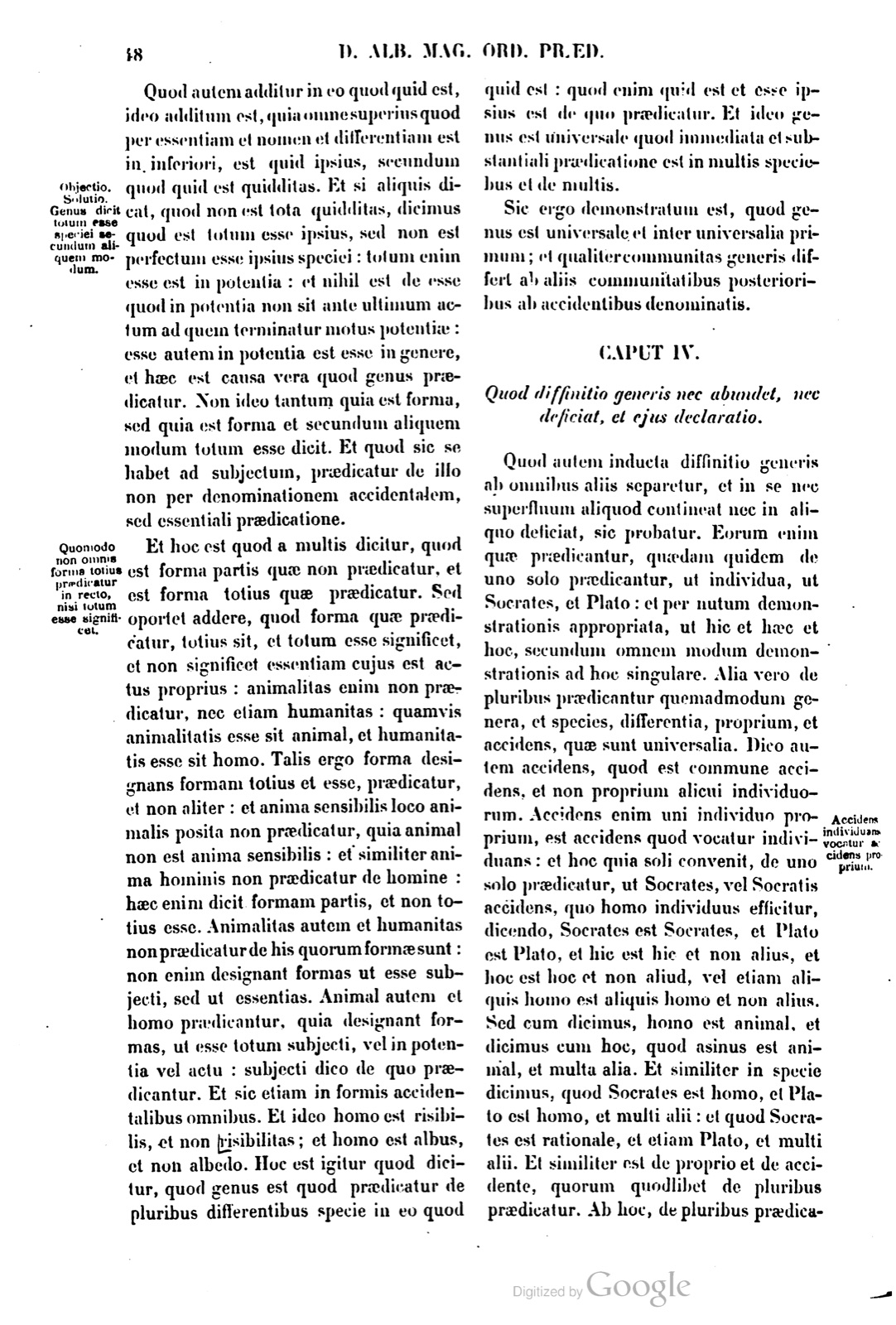
Quod autem additur in eo quod quid est, ideo additum est, quia omne superius quod per essentiam et nomen et differentiam est in inferiori, est quid ipsius, secundum quod quid est quidditas. Et si aliquis dicat, quod non est tota quidditas, dicimus quod est totum esse ipsius, sed non est perfectum esse ipsius speciei: totum enim esse est in potentia: et nihil est de esse quod in potentia non sit ante ultimum actum ad quem terminatur motus potentiae: esse autem in potentia est esse in genere, et haec est causa vera quod genus praedicatur. Non ideo tantum quia est forma, sed quia est forma et secundum aliquem modum totum esse dicit. Et quod sic se habet ad subjectum, praedicatur de illo non per denominationem accidentalem, sed essentiali praedicatione.
Et hoc est quod a multis dicitur, quod forma totius est forma partis quae non praedicatur, et est forma totius quae praedicatur. Sed oportet addere, quod forma quae praedicatur, totius sit, et totum esse significet, et non significet essentiam cujus est actus proprius: animalitas enim non praedicatur, nec etiam humanitas: quamvis animalitatis esse sit animal, et humanitatis esse sit homo. Talis ergo forma designans formam totius et esse, praedicatur, et non aliter: et anima sensibilis loco animalis posita non praedicatur, quia animal non est anima sensibilis: et similiter anima hominis non praedicatur de homine: haec enim dicit formam partis, et non totius esse. Animalitas autem et humanitas non praedicantur de his quorum formae sunt: non enim designant formas ut esse subjecti, sed ut essentias. Animal autem et homo praedicantur, quia designant formas, ut esse totum subjecti, vel in potentia vel actu: subjecti dico de quo praedicantur. Et sic etiam in formis accidentalibus omnibus. Et ideo homo est risibilis, et non risibilitas; et homo est albus, et non albedo. Hoc est igitur quod dicitur, quod genus est quod praedicatur de pluribus differentibus specie in eo quod quid est: quod enim quid est et esse ipsius est de quo praedicatur. Et ideo genus est universale quod immediata et substantiali praedicatione est in multis speciebus et de multis.
Sic ergo demonstratum est, quod genus est universale et inter universalia primum; et qualiter communitas generis differt ab aliis communitatibus posterioribus ab accidentibus denominatis.
But what is added, in that which is what, is added for this reason, that every superior which through essence and name and difference is in the inferior is the what of it, according as what is quiddity. And if someone says that it is not the whole quiddity, we say that it is the whole being of it, but not the perfected being of its species: for the whole being is in potency, and there is nothing of being which in potency is not before the ultimate act at which the motion of potency is terminated; but being in potency is being in genus, and this is the true cause why genus is predicated. It is not only because it is form, but because it is form and in some mode states the whole being. And what has itself thus to a subject is predicated of that subject not by accidental denomination, but by essential predication.
And this is what is said by many, that the form of the whole is the form of a part which is not predicated, and is the form of the whole which is predicated. But one must add that the form which is predicated is of the whole, and signifies the whole being, and does not signify the essence of which it is the proper act. For animality is not predicated, nor even humanity, although the being of animality is animal, and the being of humanity is man. Therefore such a form designating the form of the whole and being is predicated, and not otherwise; and the sensible soul placed in the place of animal is not predicated, because animal is not the sensible soul; and similarly the soul of man is not predicated of man. For these state the form of a part, and not the being of the whole. But animality and humanity are not predicated of those things of which they are forms, for they do not designate forms as the being of a subject, but as essences. But animal and man are predicated, because they designate forms as the whole being of the subject, either in potency or in act; I mean of the subject of which they are predicated. And so also in all accidental forms. And therefore man is risible, and not risibility; and man is white, and not whiteness. This, therefore, is what is said, that genus is what is predicated of several things differing in species in that which is what; for what a thing is and its being belong to that of which it is predicated. And therefore genus is a universal which by immediate and substantial predication is in many species and of many.
Thus therefore it has been demonstrated that genus is a universal and first among universals, and how the community of genus differs from the other later communities denominated from accidents.
Notes
- Note that St. Albert does not contradict those things which he said or will say in the chapter On Species, nor on account of this does he mean that genus can be preserved in one species only. (Nota quod D. Albertus non contradicit his quae dixit vel dicet in cap. de Specie, nec vult propter hoc quod genus possit conservari in una specie tantum.) ↩
If a page does not appear, its photograph has not been uploaded yet.