Volume 1 · pp. 39–40
Chapter IX. How universal is predicated of the five universals, and concerning the sufficiency and order of the five universals.
A marker with ≈ is an approximate page boundary, placed by measure of the text; the page photographs remain the authority. In the paired views, clicking a page marker brings that page into view.
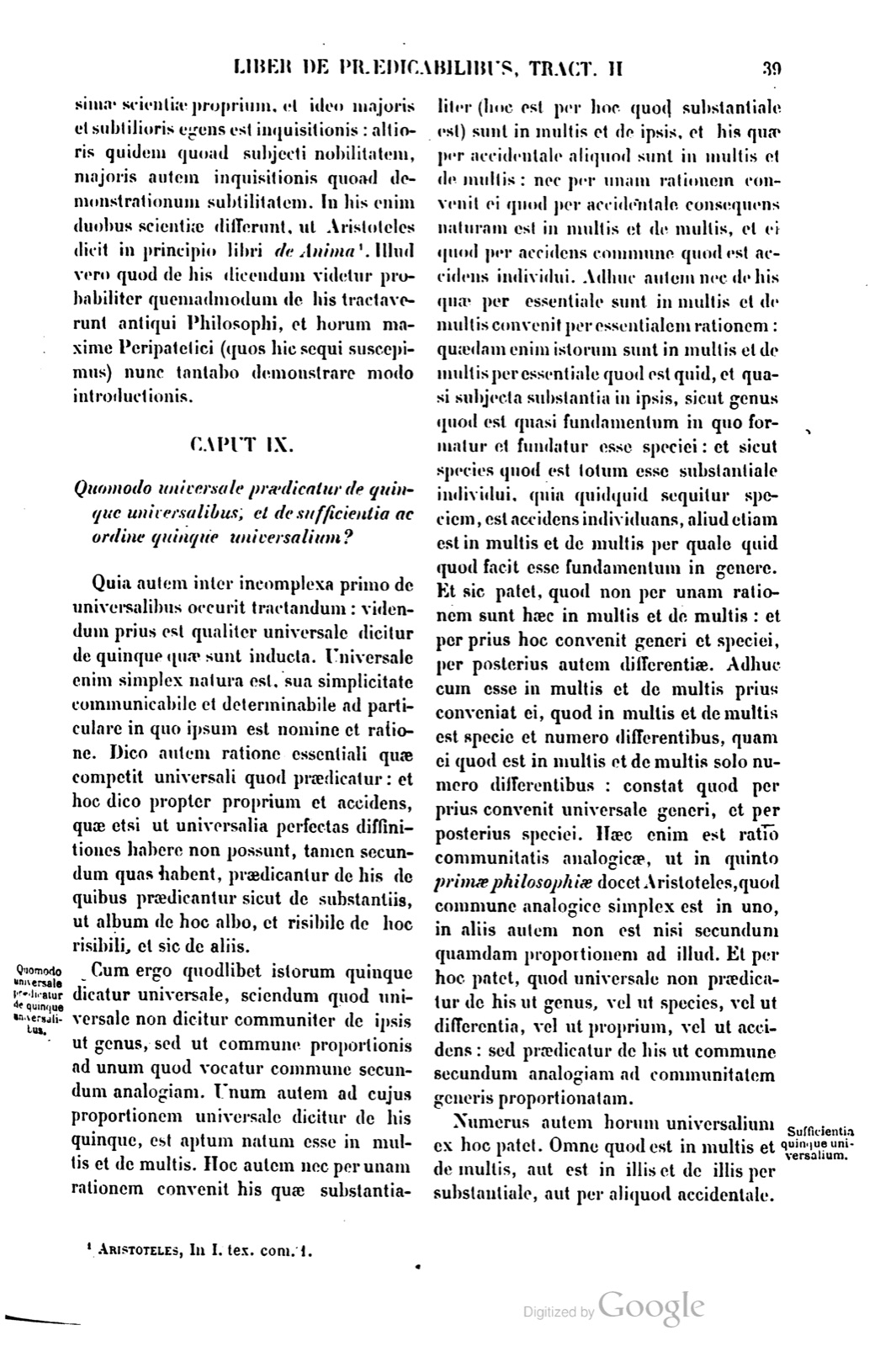
CAPUT IX.
Quomodo universale praedicatur de quinque universalibus, et de sufficientia ac ordine quinque universalium?
Quia autem inter incomplexa primo de universalibus occurrit tractandum: videndum prius est qualiter universale dicitur de quinque quae sunt inducta. Universale enim simplex natura est, sua simplicitate communicabile et determinabile ad particulare in quo ipsum est nomine et ratione. Dico autem ratione essentiali quae competit universali quod praedicatur: et hoc dico propter proprium et accidens, quae etsi ut universalia perfectas diffinitiones habere non possunt, tamen secundum quas habent, praedicantur de his de quibus praedicantur sicut de substantiis, ut album de hoc albo, et risibile de hoc risibili, et sic de aliis.
Cum ergo quodlibet istorum quinque dicatur universale, sciendum quod universale non dicitur communiter de ipsis ut genus, sed ut commune proportionis ad unum quod vocatur commune secundum analogiam. Unum autem ad cujus proportionem universale dicitur de his quinque, est aptum natum esse in multis et de multis. Hoc autem nec per unam rationem convenit his quae substantialiter, hoc est per hoc quod substantiale est, sunt in multis et de ipsis, et his quae per accidentale aliquod sunt in multis et de multis: nec per unam rationem convenit ei quod per accidentale consequens naturam est in multis et de multis, et ei quod per accidens commune quod est accidens individui. Adhuc autem nec de his quae per essentiale sunt in multis et de multis convenit per essentialem rationem: quaedam enim istorum sunt in multis et de multis per essentiale quod est quid, et quasi subjecta substantia in ipsis, sicut genus quod est quasi fundamentum in quo formatur et fundatur esse speciei: et sicut species quod est totum esse substantiale individui, quia quidquid sequitur speciem, est accidens individuans, aliud etiam est in multis et de multis per quale quid quod facit esse fundamentum in genere.
Et sic patet, quod non per unam rationem sunt haec in multis et de multis: et per prius hoc convenit generi et speciei, per posterius autem differentiae. Adhuc cum esse in multis et de multis prius conveniat ei, quod in multis et de multis est specie et numero differentibus, quam ei quod est in multis et de multis solo numero differentibus: constat quod per prius convenit universale generi, et per posterius speciei. Haec enim est ratio communitatis analogicae, ut in quinto primae philosophiae docet Aristoteles, quod commune analogice simplex est in uno, in aliis autem non est nisi secundum quamdam proportionem ad illud. Et per hoc patet, quod universale non praedicatur de his ut genus, vel ut species, vel ut differentia, vel ut proprium, vel ut accidens: sed praedicatur de his ut commune secundum analogiam ad communitatem generis proportionatam.
Numerus autem horum universalium ex hoc patet. Omne quod est in multis et de multis, aut est in illis et de illis per substantiale, aut per aliquod accidentale. Si quidem est in illis per aliquod, quod in illis est substantiale, non debet dividi, quod aut insit per substantiale quod est pars esse, aut per id quod est totum, sicut quidam dicunt: quia quod est pars, non praedicatur de eo in quo est secundum quod est pars. Sed sic dividi debet, quod si est in multis et de multis, aut est in eis per id quod est esse secundum potentiam inchoationis: aut in eis est per essentiale quod est totum secundum actum perficientis esse ipsum: aut est in eis secundum totum esse perfectum et constitutum. Et primo quidem modo est genus, secundo autem modo differentia, tertio vero modo species. Et patet quod divisio sufficiens et ex immediatis est: quia substantiale quod est in multis et de multis, aut est principium, aut principiatum. Et si est principium: aut est principium secundum potentiam, aut secundum actum. Si autem est principiatum et in substantiali esse perfectum, tunc est altero modo a duobus dictis modis. Si autem est in multis et de multis secundum esse accidentale existens in illis, non potest esse in eis, nisi aut secundum accidens naturae communis per quam refertur ad singularia, et hoc est proprium: aut secundum accidens individui aut singularis, per quod refertur ad naturam communem, et tunc est accidens. Socrates enim est risibilis per communem naturam quae est in Socrate. Homo autem est albus per hoc quod Socrates est albus, in quo natura hominis est. Et patet iterum per hoc, quod illa divisio ex immediatis est: quia in nullo est, nisi vel natura communis, vel hypostasis sive suppositum vel singulare quod substat naturae communi. Et cum commune quod est in multis et de multis pluribus modis verificari non possit per immediatam divisionem: ideo universalia non possunt esse formaliter differentia nisi quinque.
CHAPTER IX.
How universal is predicated of the five universals, and concerning the sufficiency and order of the five universals.
Because among the incomplex things there first occurs the need to treat universals, one must first see in what way universal is said of the five things which have been introduced. For the universal is a simple nature, by its simplicity communicable and determinable to the particular in which it is by name and notion. But I mean by an essential notion which belongs to the universal that is predicated; and I say this because of property and accident, which, although as universals they cannot have perfect definitions, nevertheless according to those which they do have, are predicated of those of which they are predicated as of substances, as white of this white thing, and risible of this risible thing, and so with the others.
Therefore since each of these five is called a universal, it must be known that universal is not said commonly of them as a genus, but as a common thing of proportion to one thing, which is called common according to analogy. But the one thing according to whose proportion universal is said of these five is aptitude by nature to be in many and of many. This does not belong by one notion to those things which substantially, that is, through that which is substantial, are in many and of them, and to those which through something accidental are in many and of many; nor by one notion does it belong to that which is in many and of many through an accidental following nature, and to that which is in many and of many through a common accident which is an accident of the individual. Further, even among those things which through the essential are in many and of many, it does not belong by one essential notion: for certain of these are in many and of many through an essential which is what, and as it were a subjected substance in them, as genus, which is as it were the foundation in which the being of the species is formed and founded; and as species, which is the whole substantial being of the individual, because whatever follows species is an individuating accident; and another also is in many and of many through a quale quid, which makes the foundation exist in the genus.
And thus it is clear that these are not in many and of many by one notion; and this belongs first to genus and species, but later to difference. Further, since being in many and of many belongs first to that which is in many and of many differing in species and number, rather than to that which is in many and of many differing in number alone, it is clear that universal belongs first to genus and later to species. For this is the notion of analogical community, as Aristotle teaches in the fifth book of first philosophy, that what is analogically common is simple in one thing, but in the others is only according to a certain proportion to that. And through this it is clear that universal is not predicated of these as genus, or as species, or as difference, or as property, or as accident, but is predicated of these as common according to analogy, proportioned to the community of genus.
But the number of these universals is clear from this. Everything which is in many and of many is either in them and of them through the substantial, or through something accidental. If indeed it is in them through something which is substantial in them, it ought not to be divided so that it either is in them through the substantial which is part of being, or through that which is the whole, as certain people say; because what is part is not predicated of that in which it is insofar as it is a part. Rather it ought to be divided thus: if it is in many and of many, either it is in them through that which is being according to the potency of beginning, or it is in them through the essential which is the whole according to the act perfecting that being, or it is in them according to the whole perfected and constituted being. In the first way it is genus; in the second way difference; and in the third way species. And it is clear that the division is sufficient and from immediates, because the substantial which is in many and of many is either principle or what is principled. And if it is principle, it is either principle according to potency or according to act. But if it is what is principled and perfected in substantial being, then it is in another mode than the two modes mentioned. But if it is in many and of many according to accidental being existing in them, it cannot be in them except either according to an accident of the common nature through which it is referred to singulars, and this is property, or according to an accident of the individual or singular, through which it is referred to the common nature, and then it is accident. For Socrates is risible through the common nature which is in Socrates. But man is white through this, that Socrates is white, in whom the nature of man is. And it is again clear through this that that division is from immediates: because in no one is there anything except either common nature, or hypostasis or supposit or singular which stands under the common nature. And since the common which is in many and of many cannot be verified in more ways through an immediate division, therefore universals cannot be formally different except as five.
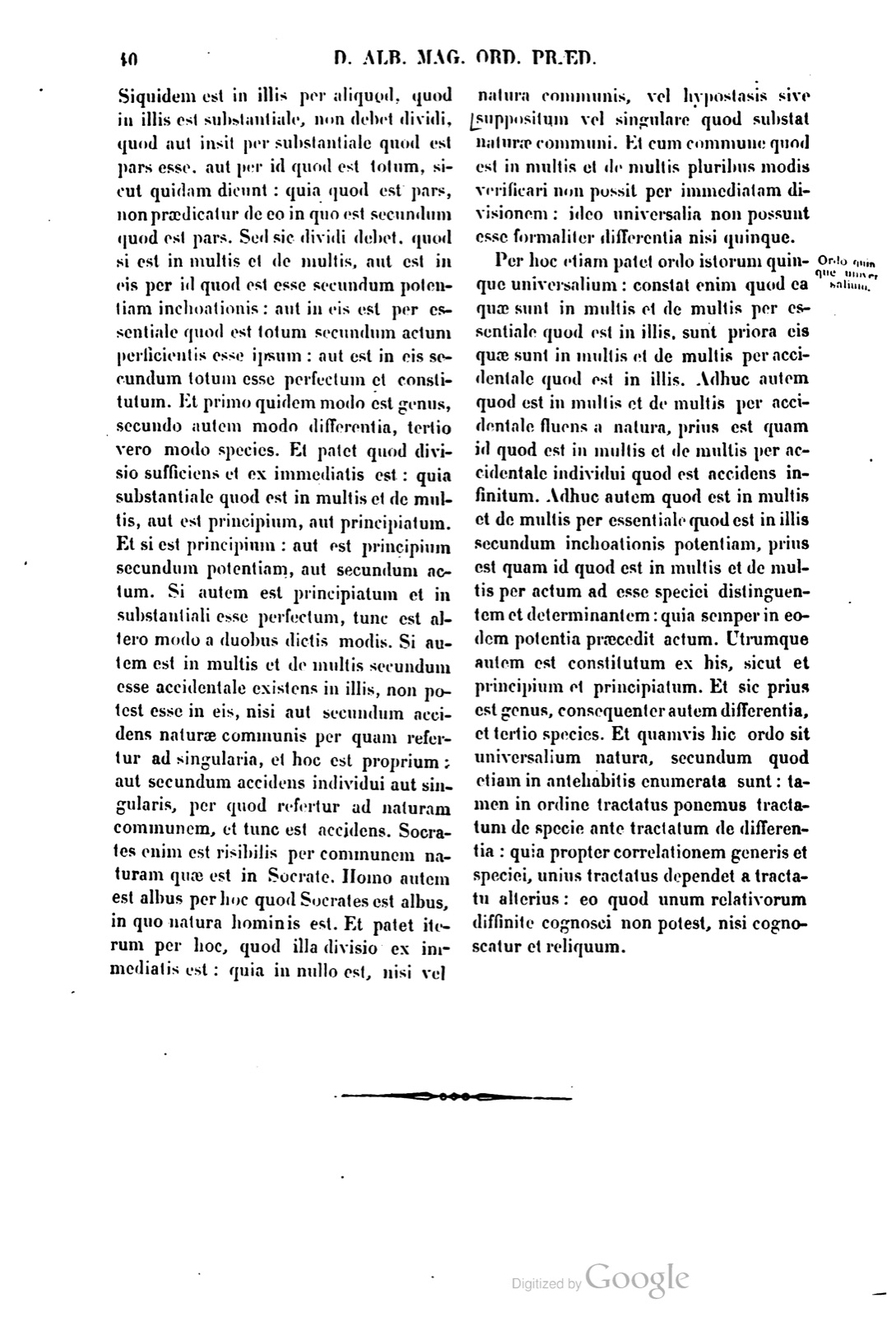
Per hoc etiam patet ordo istorum quinque universalium: constat enim quod ea quae sunt in multis et de multis per essentiale quod est in illis, sunt priora eis quae sunt in multis et de multis per accidentale quod est in illis. Adhuc autem quod est in multis et de multis per accidentale fluens a natura, prius est quam id quod est in multis et de multis per accidentale individui quod est accidens infinitum. Adhuc autem quod est in multis et de multis per essentiale quod est in illis secundum inchoationis potentiam, prius est quam id quod est in multis et de multis per actum ad esse speciei distinguentem et determinantem: quia semper in eodem potentia praecedit actum. Utrumque autem est constitutum ex his, sicut et principium et principiatum. Et sic prius est genus, consequenter autem differentia, et tertio species. Et quamvis hic ordo sit universalium natura, secundum quod etiam in antehabitis enumerata sunt: tamen in ordine tractatus ponemus tractatum de specie ante tractatum de differentia: quia propter correlationem generis et speciei, unius tractatus dependet a tractatu alterius: eo quod unum relativorum diffinite cognosci non potest, nisi cognoscatur et reliquum.
Through this also the order of these five universals is clear. For it is clear that those which are in many and of many through the essential which is in them are prior to those which are in many and of many through the accidental which is in them. Further, that which is in many and of many through an accidental flowing from nature is prior to that which is in many and of many through an accidental of the individual, which is an infinite accident. Further, that which is in many and of many through the essential which is in them according to the potency of beginning is prior to that which is in many and of many through act distinguishing and determining to the being of species, because potency always precedes act in the same thing. But each is constituted from these, as principle and what is principled. And thus genus is first, then difference, and thirdly species. And although this is the natural order of universals, according to the way in which they have also been enumerated above, nevertheless in the order of treatment we will place the treatment of species before the treatment of difference, because on account of the correlation of genus and species, the treatment of one depends upon the treatment of the other, since one of relatives cannot be known definitely unless the other is also known.
If a page does not appear, its photograph has not been uploaded yet.