Volume 1 · pp. 25–26
Chapter III. Whether universals are posited in bare and pure intellects alone, or outside the soul?
A marker with ≈ is an approximate page boundary, placed by measure of the text; the page photographs remain the authority. In the paired views, clicking a page marker brings that page into view.
intellectu cognoscente per abstractionem ea per universalitatem agente et educente.
Ad id ergo quod primo medio pro prima parte opinionis inducitur, quod cum dicunt Aristoteles et Boetius, quod omne quod est, ideo est, quia unum numero est: hoc intelligitur de his quae ultimo actu in natura perfecta sunt; de illis enim verum est. Sed universalia hoc modo non sunt: sunt enim ut rerum principia, et non ut res ultimo actu in natura constitutae et completae. Aut sic intelligitur 1, quod unum numero sit dictum a numero ultimi esse, vel a numero essentiae. Esse enim quod est unum numero, habet esse suae essentiae: sicut et universale unum numero, est unum numero essentiae et non duo vel tria, quamvis numerus materiae et accidentis sit, in multis et de multis. Et hoc accidit sibi et non convenit ei secundum se: et sic intelligitur quod dicitur, quod participatione speciei plures homines sunt unus homo.
Similiter dicendum ad id quod secundo dicunt, quod illud quod separatum habere esse habet extra intellectum in natura, est hoc aliquid: quia separatum esse habere dicitur duobus modis. Uno scilicet modo quo separatum esse habet id quod in se habet esse non dependens ad aliquid, ad hoc quod esse habeat quod sit extra ipsum: et sic non generaliter verum quod dicunt; quia universale sic separatum, habet esse in natura, et tamen non est hoc aliquid. Alio modo separatum esse dicitur, quod in se est indivisum, et ab aliis per discretionem divisum et separatum. Et hoc modo generaliter verum est quod dicunt: quia sic non nisi singulariter existentia separatum habent esse.
Ad id quod tertio inducunt per dictum Avicennae, dicendum quod omne quod est in individuo, secundum quod est in individuo, singulare est. Sed id quod in individuo est, nil prohibet esse universale, non secundum quod est in individuo acceptum: hoc enim secundum se acceptum, nihil prohibet esse quale quid, et non hoc aliquid.
Si quis autem sic objiciat: quod est in individuo est in eo per modum individui. Individuum autem est hoc aliquid. Ergo illud quod est in individuo, est singulare et hoc aliquid. Non valet argumentum. Quod enim est in individuo, non semper est in eo per modum esse individui, sed aliquando per modum principii individui. Et non oportet quod hoc secundum id quod est, sit individuum et hoc aliquid: quia potest esse quale quid. Et ideo in argumento paralogismus est figurae dictionis: quia interpretatur quale quid ut hoc aliquid.
Ad id autem quod quarto inducunt, dicendum quod universale secundum esse quod habet in singulari, non habet aliud esse quam esse singularis: et hoc probat Aristoteles 2 contra eos qui dixerunt formas universales distinctum et divisum esse retinere praeter esse singularis, sicut ex sigillo receptum esse separatum ab illo sicut separatum est esse sigilli et cerae sigillatae: sed quod id quod est in singulari, non habeat esse naturae et principii, non secundum quod est in singulari, sed secundum se acceptum, non probat Aristoteles: quia hoc est verum et necessarium in omni natura.
by the intellect knowing through abstraction, acting upon and drawing them out through universality.
Therefore to that which is introduced by the first means on behalf of the first part of the opinion, that when Aristotle and Boethius say that everything which is, is for this reason, because it is one in number: this is understood of those things which are perfected in nature by ultimate act; for of those it is true. But universals are not in this way: for they are as principles of things, and not as things constituted and completed in nature by ultimate act. Or it is understood thus 1, that one in number is said from the number of ultimate being, or from the number of essence. For being which is one in number has the being of its essence: just as also a universal one in number is one in number of essence and not two or three, although the number of matter and of accident belongs to it, in many and of many. And this happens to it and does not belong to it according to itself: and thus is understood what is said, that by participation in the species several men are one man.
Likewise one must speak to that which they say second, that that which has separated being outside the intellect in nature is this something: because to have separated being is said in two ways. In one way, namely, that has separated being which in itself has being not dependent upon anything, in order that it should have being which is outside itself: and thus what they say is not generally true; because the universal thus separated has being in nature, and nevertheless is not this something. In another way separated being is said of what in itself is undivided, and divided and separated from others by discretion. And in this way what they say is generally true: because thus only things singularly existing have separated being.
To that which they introduce third through the saying of Avicenna, one must say that everything which is in an individual, insofar as it is in an individual, is singular. But nothing prevents that which is in an individual from being universal, not as taken insofar as it is in the individual: for this, taken according to itself, nothing prevents from being a quale quid, and not this something.
But if someone should object thus: what is in an individual is in it according to the mode of the individual. But an individual is this something. Therefore that which is in an individual is singular and this something. The argument is not valid. For what is in an individual is not always in it according to the mode of the being of the individual, but sometimes according to the mode of a principle of the individual. And it is not necessary that this, according to that which it is, be an individual and this something: because it can be a quale quid. And therefore in the argument there is a paralogism of figure of speech: because a quale quid is interpreted as this something.
To that which they introduce fourth, one must say that the universal according to the being which it has in the singular does not have another being than the being of the singular: and Aristotle proves this 2 against those who said that universal forms retained distinct and divided being besides the being of the singular, as something received from a seal has a being separated from it, just as the being of the seal and of the sealed wax is separated: but Aristotle does not prove that that which is in the singular does not have the being of nature and of principle, not insofar as it is in the singular, but as taken according to itself: because this is true and necessary in every nature.
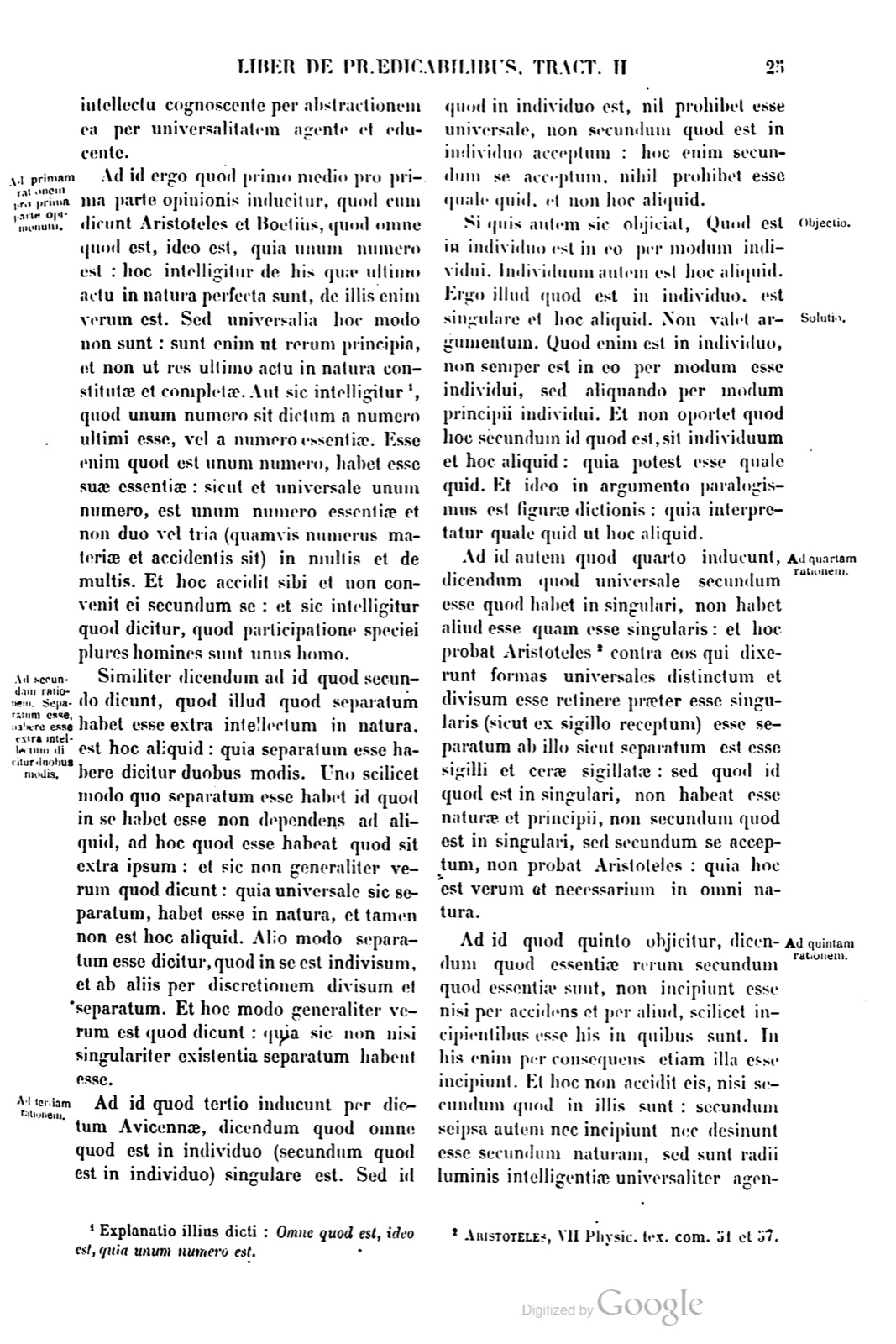
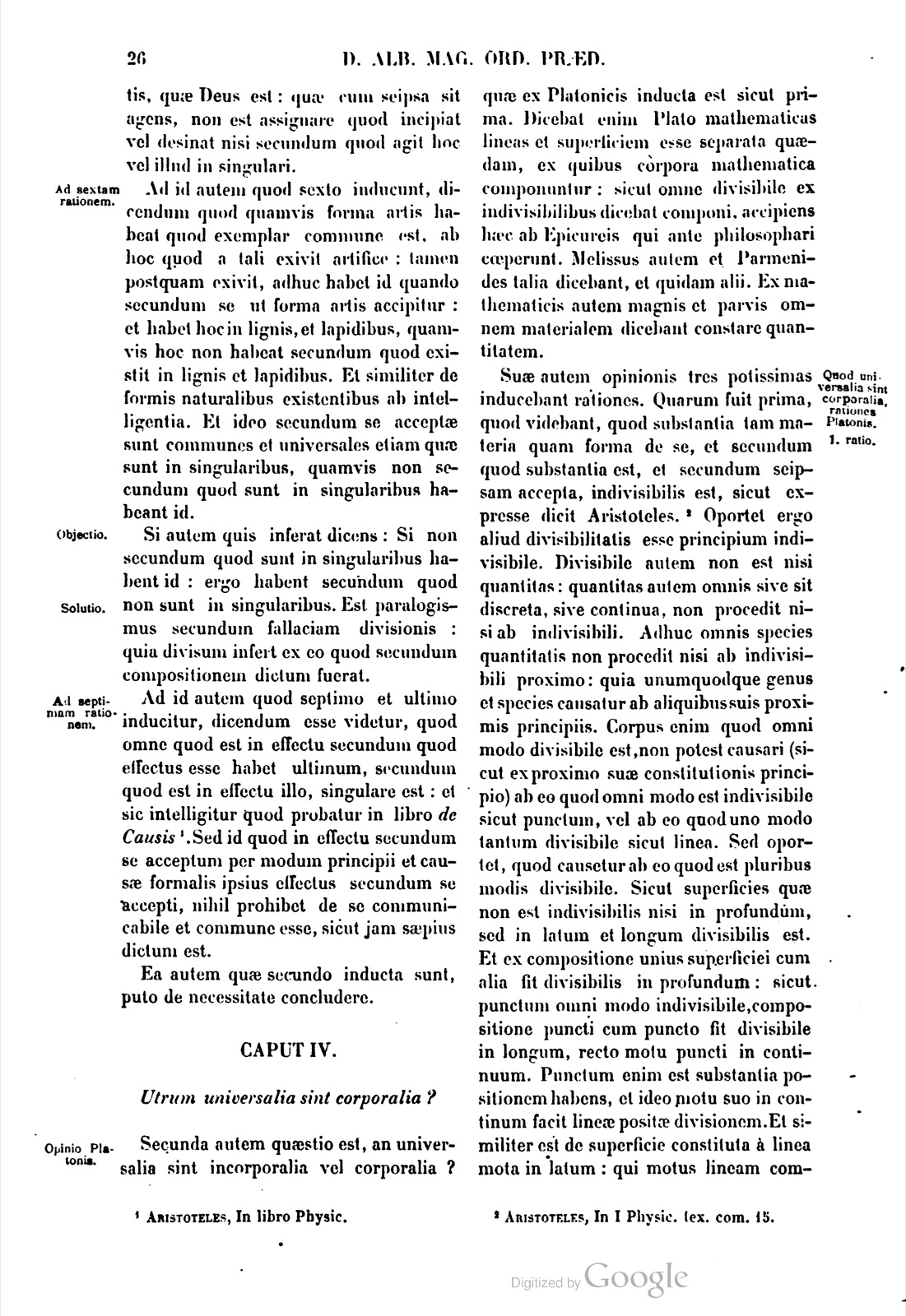
Ad id quod quinto objicitur, dicendum quod essentiae rerum secundum quod essentiae sunt, non incipiunt esse nisi per accidens et per aliud, scilicet incipientibus esse his in quibus sunt. In his enim per consequens etiam illa esse incipiunt. Et hoc non accidit eis, nisi secundum quod in illis sunt: secundum seipsa autem nec incipiunt nec desinunt esse secundum naturam, sed sunt radii luminis intelligentiae universaliter agentis, quae Deus est: quae cum seipsa sit agens, non est assignare quod incipiat vel desinat nisi secundum quod agit hoc vel illud in singulari.
Ad id autem quod sexto inducunt, dicendum quod quamvis forma artis habeat quod exemplar commune est, ab hoc quod a tali exivit artifice: tamen postquam exivit, adhuc habet id quando secundum se ut forma artis accipitur: et habet hoc in lignis et lapidibus, quamvis hoc non habeat secundum quod existit in lignis et lapidibus. Et similiter de formis naturalibus existentibus ab intelligentia. Et ideo secundum se acceptae sunt communes et universales etiam quae sunt in singularibus, quamvis non secundum quod sunt in singularibus habeant id.
Si autem quis inferat dicens: si non secundum quod sunt in singularibus habent id; ergo habent secundum quod non sunt in singularibus. Est paralogismus secundum fallaciam divisionis: quia divisum infert ex eo quod secundum compositionem dictum fuerat.
Ad id autem quod septimo et ultimo inducitur, dicendum esse videtur, quod omne quod est in effectu secundum quod effectus esse habet ultimum, secundum quod est in effectu illo, singulare est: et sic intelligitur quod probatur in libro de Causis 3. Sed id quod in effectu secundum se acceptum per modum principii et causae formalis ipsius effectus secundum se accepti, nihil prohibet de se communicabile et commune esse, sicut jam saepius dictum est.
Ea autem quae secundo inducta sunt, puto de necessitate concludere.
To that which is objected fifth, one must say that the essences of things, insofar as they are essences, begin to be only by accident and through another, namely when those things in which they are begin to be. For in these, as a consequence, those also begin to be. And this happens to them only insofar as they are in those things: but according to themselves they neither begin nor cease to be according to nature, but are rays of the light of intelligence universally acting, which is God; since this, being itself acting, it is not possible to assign that it begins or ceases except insofar as it does this or that in a singular.
To that which they introduce sixth, one must say that although the form of art has that it is a common exemplar from the fact that it has issued from such an artificer, nevertheless after it has issued it still has that when it is taken according to itself as a form of art: and it has this in woods and stones, although it does not have this insofar as it exists in woods and stones. And similarly concerning natural forms existing from intelligence. And therefore, taken according to themselves, they are common and universal even those which are in singulars, although they do not have that insofar as they are in singulars.
But if someone infers, saying: if they do not have it insofar as they are in singulars; therefore they have it insofar as they are not in singulars. This is a paralogism according to the fallacy of division: because he infers dividedly from that which had been said according to composition.
To that which is introduced seventh and last, it seems one must say that everything which is in an effect insofar as the effect has ultimate being, insofar as it is in that effect, is singular: and thus is understood what is proved in the Book of Causes 3. But nothing prevents that which is in an effect, taken according to itself by the mode of a principle and formal cause of the effect itself taken according to itself, from being of itself communicable and common, as has now often been said.
But the things which have been introduced second, I think, conclude of necessity.
Notes
- Explanation of that saying: Everything which is, is for this reason, because it is one in number. (Explanatio illius dicti: Omne quod est, ideo est, quia unum numero est.) ↩
- Aristotle, Physics VII, text, commentaries 51 and 57. (Aristoteles, VII Physic. tex. com. 51 et 57.) ↩
- Aristotle, in the book of the Physics. (Aristoteles, In libro Physic.) ↩
If a page does not appear, its photograph has not been uploaded yet.