Volume 1 · pp. 20–24
Chapter III. On the declaration and examination of the first question.
A marker with ≈ is an approximate page boundary, placed by measure of the text; the page photographs remain the authority. In the paired views, clicking a page marker brings that page into view.
Caput III. De declaratione et examinatione primae quaestionis.
Quamvis autem haec determinata sint supra vires logicae, eo quod oportet in his uti rationibus sumptis ex principiis entis secundum quod est ens, ex quibus cognoscitur quid sit subsistens in intellectu solo, nudo, et puro, et aliam subsistentiam non habet. Et quid est subsistens extra intellectum in natura secundum esse completum. Ad quod non sufficiunt rationes logicae. Tamen propter bonitatem doctrinae, et ne sit suspensus lectoris animus, haec aliquantulum explanare tentandum est.
Ad quaestionem ergo primam, difficultates majores quae dubitationem pro parte faciunt, sunt inducendae, ut visa ratione dubitationis melius intelligatur veritas soluta dubitatione. Est ergo quaestio prima, utrum universalia et praecipue genera et species, quae quidem significantur, subsistant in natura secundum esse separatum ab intellectu: aut non quidem sic subsistant, sed in solis, nudis, purisque intellectibus posita sint. Ita quod separatum non habeant esse, sed tantum sint accepta prout sunt rationes et intentiones in mente et lumine intellectus acceptae.
Sic ergo explicata quaestione, hi qui dicunt in solis, nudis, purisque intellectibus posita esse septem pro se fortiores inducunt rationes. Dicunt enim, quod Boetius et Aristoteles et Avicenna dicunt, quod omne quod separatum in natura est, ideo est quia unum numero est. Universale autem quod est genus et species non unum numero est, eo quod universale est unum in multis, et de multis. Quod autem est unum in multis et de multis, separatum non est a multis. Ergo ipsum separatum non est: non ergo unum numero est. Et si unum numero non est, sequitur ipsum non esse. Ergo universale separatum non est. Si ergo aliquo modo est, non nisi in solis, nudis, purisque intellectibus est. In solis quidem, quia in re non est: nudis autem, quia universale denudatum est a phantasmatibus; puris autem, quia non nisi purum intelligentiae lumen est, nulli comparatum materiae sensibili.
Secundam adducunt rationem. Dicunt enim quod omne quod separatum a natura est, separatum habens esse extra intelligentiam, hoc aliquid est. Et hoc quidem dictum est Aristotelis et Avicennae, et probatur per inductionem. Sed universale non est hoc aliquid, sed quale quid. Ergo universale in natura existens non est. Si ergo est, oportet quod in solis, nudis, purisque intellectibus sit.
Tertiam adducunt rationem. Si omne quod est secundum esse separatum in natura, particulare et individuum est, ut omnis forma quae est in individuo individua est, sive sit substantialis, sive accidentalis, individuatur enim per materiam quae omnis individuationis principium est et causa. Universale autem ponitur esse in suo particulari, ut in subjecto et substantia in qua subsistit, et quae sibi substat, ut dicit Aristoteles in Praedicamentis. Universale ergo si subsistat extra intellectum in suo particulari, particulare est: quod absurdum est, quia particulare nec est in multis, nec de multis est. Universale autem est in multis et de multis.
Quarto ad idem inducunt, quod Aristoteles in prima probat philosophia multipliciter, quod in eodem idem est esse universalis et particularis: quia aliter homo esset duo et non unum. Si ergo universale esse habet unum cum esse particularis, hoc esse secundum quod in particulari, est particulare: et particularis esse est non esse de multis et in multis: hic enim homo singularis est, et non in multis et de multis: a destructione consequentis arguitur. Si universale secundum suum esse, in multis et de multis est, universalis esse, non est esse particularis. Est autem esse particularis si extra est. Ergo non extra in natura est, sed in solis, nudis, purisque intellectibus est: quia aliter universale nullo modo esset: quod valde inconveniens est. An vero universale sit nunquam aliquis dubitavit. Et ideo Antiqui non quaerebant an universale sit, vel non sit, sed quaerebant an universale extra intellectum separatum in natura sit, an in solis, nudis, purisque intellectibus positum sit et fundatum, eo quia extra intellectum sit in rerum natura.
Chapter III. On the declaration and examination of the first question.
Although these things are determined above the powers of logic, because in these matters one must use reasons taken from the principles of being insofar as it is being, from which it is known what that is which subsists in the intellect alone, bare and pure, and has no other subsistence, and what that is which subsists outside the intellect in nature according to complete being. Logical reasons do not suffice for this. Nevertheless, because of the goodness of doctrine, and lest the reader's mind be held in suspense, one must attempt to explain these things somewhat.
Therefore for the first question, the greater difficulties which produce doubt on one side must be introduced, so that, once the reason for doubt has been seen, the truth may be better understood when the doubt has been solved. Therefore the first question is whether universals, and especially genera and species, which are indeed signified, subsist in nature according to being separated from intellect; or whether they do not so subsist, but are posited only in bare and pure intellects. Thus they would not have separated being, but would only be received insofar as they are accounts and intentions received in the mind and light of intellect.
Thus, therefore, with the question explained, those who say that they are posited only in bare and pure intellects introduce seven stronger reasons for themselves. For they say that Boethius and Aristotle and Avicenna say that everything which is separated in nature exists for this reason, that it is one in number. But the universal which is genus and species is not one in number, because the universal is one in many and of many. But what is one in many and of many is not separated from many. Therefore it itself is not separated, and therefore is not one in number. And if it is not one in number, it follows that it is not. Therefore the separated universal is not. If therefore it is in some way, it is only in bare and pure intellects: in intellects alone because it is not in the thing; bare because the universal has been stripped from phantasms; pure because it is only the pure light of intelligence, compared with no sensible matter.
They adduce a second reason. For they say that everything which is separated from nature, having separated being outside intelligence, is this something. And this is indeed a saying of Aristotle and Avicenna, and it is proved by induction. But the universal is not this something, but a qualified something. Therefore the universal existing in nature is not. Therefore if it is, it must be in bare and pure intellects alone.
They adduce a third reason. If everything which exists according to separated being in nature is particular and individual, as every form which is in an individual is individual, whether it is substantial or accidental, for it is individuated by matter, which is the principle and cause of all individuation. But the universal is posited to be in its particular as in a subject and substance in which it subsists and which underlies it, as Aristotle says in the Predicaments. Therefore if the universal subsists outside the intellect in its particular, it is particular; which is absurd, because the particular is neither in many nor of many. But the universal is in many and of many.
Fourth, they introduce to the same point that Aristotle in first philosophy proves in many ways that in the same thing the being of the universal and of the particular is the same, because otherwise man would be two and not one. Therefore if the universal has one being with the being of the particular, this being, insofar as it is in the particular, is particular, and the being of the particular is not to be of many and in many. For this man is singular and is not in many and of many. They argue from destruction of the consequent: if the universal according to its own being is in many and of many, the being of the universal is not the being of the particular. But it is the being of the particular if it is outside. Therefore it is not outside in nature, but is in bare and pure intellects alone; because otherwise the universal would in no way be, which is very unsuitable. But no one ever doubted whether the universal is. And therefore the Ancients did not ask whether the universal is or is not, but asked whether the universal, separated outside intellect, is in nature, or whether it is posited and founded in bare and pure intellects alone, because it would be outside intellect in the nature of things.
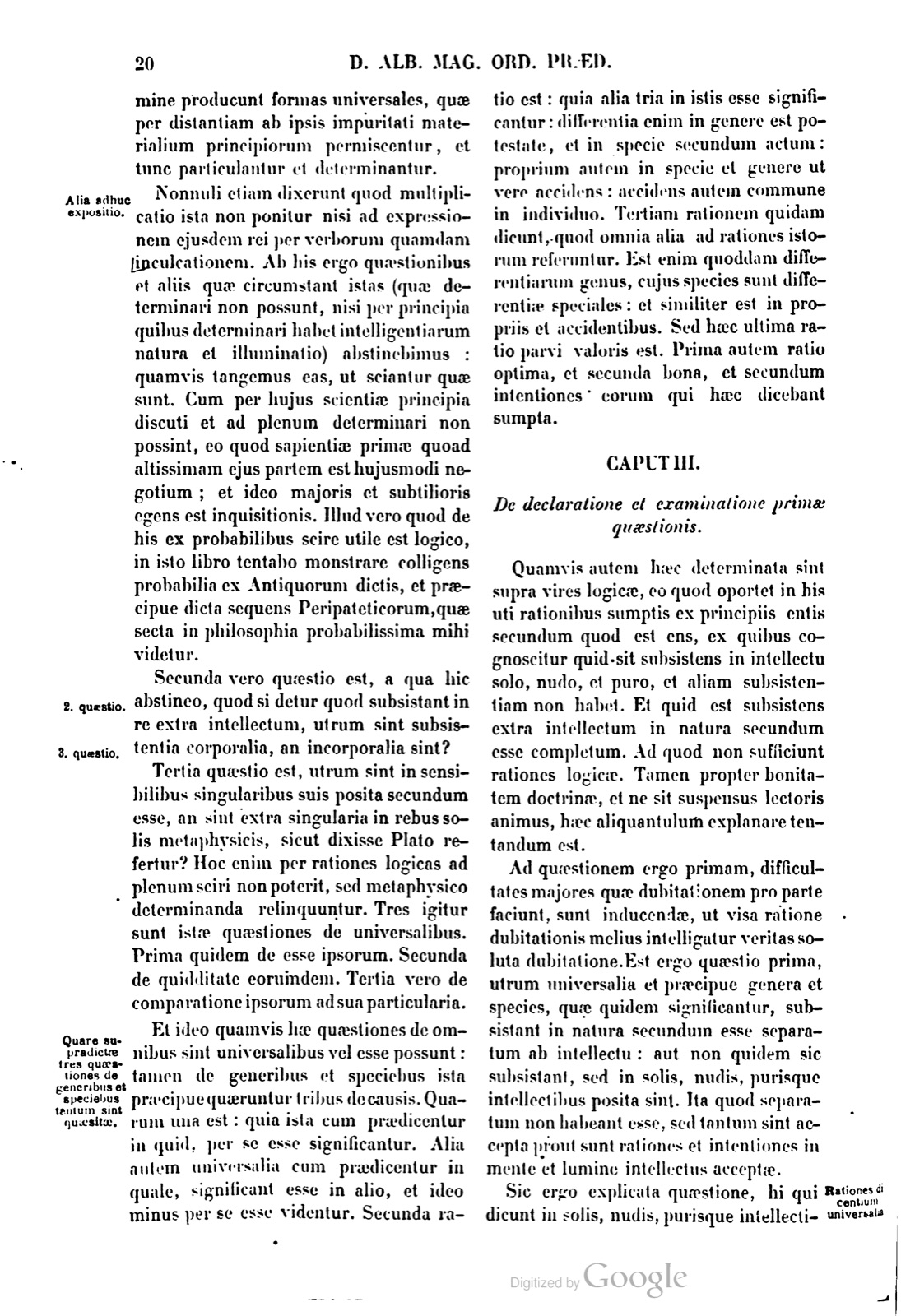
Quinto opponunt dicentes quae Avicenna dixit et Algazel, quod universale quod est genus vel species, si extra intellectum est, aut coepit esse, aut non coepit esse. Si dicatur quod non coepit esse, sequitur quod aeternum sit: quod esse non potest, cum causam habeat intelligentiae lumen quod facit et dat omnes formas. Si autem coepit esse, aut coepit esse a seipso, aut ab alio. Non autem coepit esse a seipso: quia nihil incipit a se, cum Plato dicat quod nihil est cujus ortum legitima causa non praecesserit. Si autem ab alio coepit, per actum agentis coepit. Nihil autem fit per actum agentis, nisi particulare et individuum: quia omnis actus circa particularia est. Ergo universale particulare et individuum est. Destruamus ergo consequens, dicentes quod universale particulare et individuum non est, sicut jam superius probatum est: ergo universale non coepit esse, nec in aeternum est. Ergo universale non est in natura, sed in intellectu est.
Sextum quod in assertionem suae inducunt opinionis, est, quod in arte, quae naturam imitatur, duo esse videntur in forma artis. Si enim consideretur secundum quod in artifice est, communis est ad omnia quae sunt ejusdem generis et speciei, quia in artifice est per modum artificis. Et sicut unus est artifex valens producere multa artificiata: ita forma in artifice commune exemplar est ad omnia in quibus illa forma potest exemplificari. Quando autem extra artem artificis est in materia artificiata, particulata est, et nulli potest esse communis, nec aliquam habet aptitudinem ad hoc quod in alio et de alio sit. Similiter autem in formis naturalibus esse videtur. In his enim intelligentia est ut artifex, et forma naturalis est forma in rebus, sicut forma artis in materia artificiati. Videtur ergo, quod si universale commune est et aptum natura esse in multis, quod hoc non habeat, nisi secundum quod est in intelligentia quae communis artifex est. Universale ergo ut universale est, non est nisi quod in solis, nudis, purisque intellectibus est.
Septimo etiam per hoc confirmant hoc quod dicunt, quod in libro de Causis multipliciter probatum est, quod res in causa non est, nisi per modum et virtutem effecti per causam. In effectu autem causa non est, nisi per formam quam in effectum causa producit: quia omne quod de potentia producitur ad effectum, non producit nisi per id quod est in effectu tam in univocis accidentibus, quam in aequivocis: quia aequivocas ad univocas reduci necesse est. Forma igitur primae intelligentiae agentis in hoc quod effectus est, non est id nisi per conditionem et virtutem effectus. Effectus autem individuus et singularis est. Ergo forma, sive substantialis, sive accidentalis, in effectu procedens ab intelligentia, individua est et singularis. Universale autem nec individuum, nec singulare est. Universale ergo in effectu naturae extra intelligentiam procedens non est; in solis ergo et nudis, purisque intellectibus positum est.
Haec sunt quae ut fortiora inducunt, qui universalia in solo intellectu posita esse concedunt. Et ideo dicunt Aristotelem dixisse 1, quod universale est, dum intelligitur; singulare autem est, dum extra sentitur.
Econtra autem illi qui universalia dicunt esse res extra intellectum existentes per se, fortiora inducunt septem, quibus maxime innituntur. Quorum primum est, quod hic homo non est nisi a simpliciter homine: et eadem ratione alius homo non est nisi a simpliciter homine, et sic de omnibus aliis. Non autem potest homo esse, nisi ab eo quod est secundum rem in natura extra intellectum existens simpliciter. Propter quod dicitur homo dignissima creaturarum. Si enim hoc conveniret huic homini secundum quod hic homo, non conveniret alii. Similiter quod homo est rationalis, non convenit huic secundum quod hic: quia tunc alii non conveniret. Ergo convenit secundum quod homo. Ergo homo secundum quod homo, et non hic homo, est aliquid in natura praeter intellectum existens. Eadem ratio est de animali secundum quod animal.
Fifth they object by saying the things which Avicenna and Algazel said, that the universal which is genus or species, if it is outside intellect, either began to be or did not begin to be. If it is said that it did not begin to be, it follows that it is eternal, which cannot be, since it has as cause the light of intelligence which makes and gives all forms. But if it began to be, it began to be either from itself or from another. But it did not begin to be from itself, because nothing begins from itself, since Plato says that there is nothing whose arising a legitimate cause has not preceded. But if it began from another, it began through the act of an agent. But nothing comes to be through the act of an agent except a particular and individual, because every act is concerned with particulars. Therefore the universal is particular and individual. Therefore let us destroy the consequent, saying that the universal is not particular and individual, as has already been proved above; therefore the universal did not begin to be, nor is it eternal. Therefore the universal is not in nature, but is in intellect.
The sixth thing which they introduce in assertion of their opinion is that in art, which imitates nature, there seem to be two modes of being in the form of art. For if it is considered according as it is in the artisan, it is common to all things which are of the same genus and species, because in the artisan it is according to the mode of the artisan. And just as one artisan is able to produce many artifacts, so the form in the artisan is a common exemplar for all things in which that form can be exemplified. But when it is outside the art of the artisan in the artifact's matter, it is particularized, and can be common to no one, nor does it have any aptitude to be in another and of another. It seems to be similar in natural forms. For in these intelligence is as artisan, and natural form is form in things, as the form of art is in the matter of the artifact. Therefore it seems that if the universal is common and by nature apt to be in many, it does not have this except according as it is in intelligence, which is the common artisan. Therefore the universal, insofar as it is universal, is only that which is in bare and pure intellects alone.
Seventh, they also confirm what they say through this, that in the book On Causes it is proved in many ways that the thing in a cause is only through the mode and power of the effect by the cause. But in the effect the cause exists only through the form which the cause produces into the effect, because everything that is led out from potency to effect produces only through that which is in the effect, both in univocal accidents and in equivocal ones, because equivocal causes must be reduced to univocal causes. Therefore the form of the first agent intelligence, in this that it is an effect, is not that except through the condition and power of the effect. But the effect is individual and singular. Therefore form, whether substantial or accidental, proceeding in the effect from intelligence, is individual and singular. But the universal is neither individual nor singular. Therefore the universal proceeding in the effect of nature outside intelligence is not; therefore it is posited in bare and pure intellects alone.
These are the stronger things which those who concede that universals are posited in intellect alone introduce. And therefore they say that Aristotle said 1 that the universal exists while it is understood, but the singular exists while it is sensed outside.
On the contrary, those who say that universals are things existing through themselves outside intellect introduce seven stronger reasons on which they especially rely. The first of these is that this man is only from man simply, and by the same reason another man is only from man simply, and so concerning all the others. But man cannot be except from that which, according to reality in nature outside intellect, exists simply. For this reason man is called the most worthy of creatures. For if this belonged to this man insofar as he is this man, it would not belong to another. Similarly, that man is rational does not belong to this one insofar as he is this one, because then it would not belong to another. Therefore it belongs according as he is man. Therefore man according as man, and not this man, is something existing in nature besides intellect. The same reasoning applies to animal according as animal.
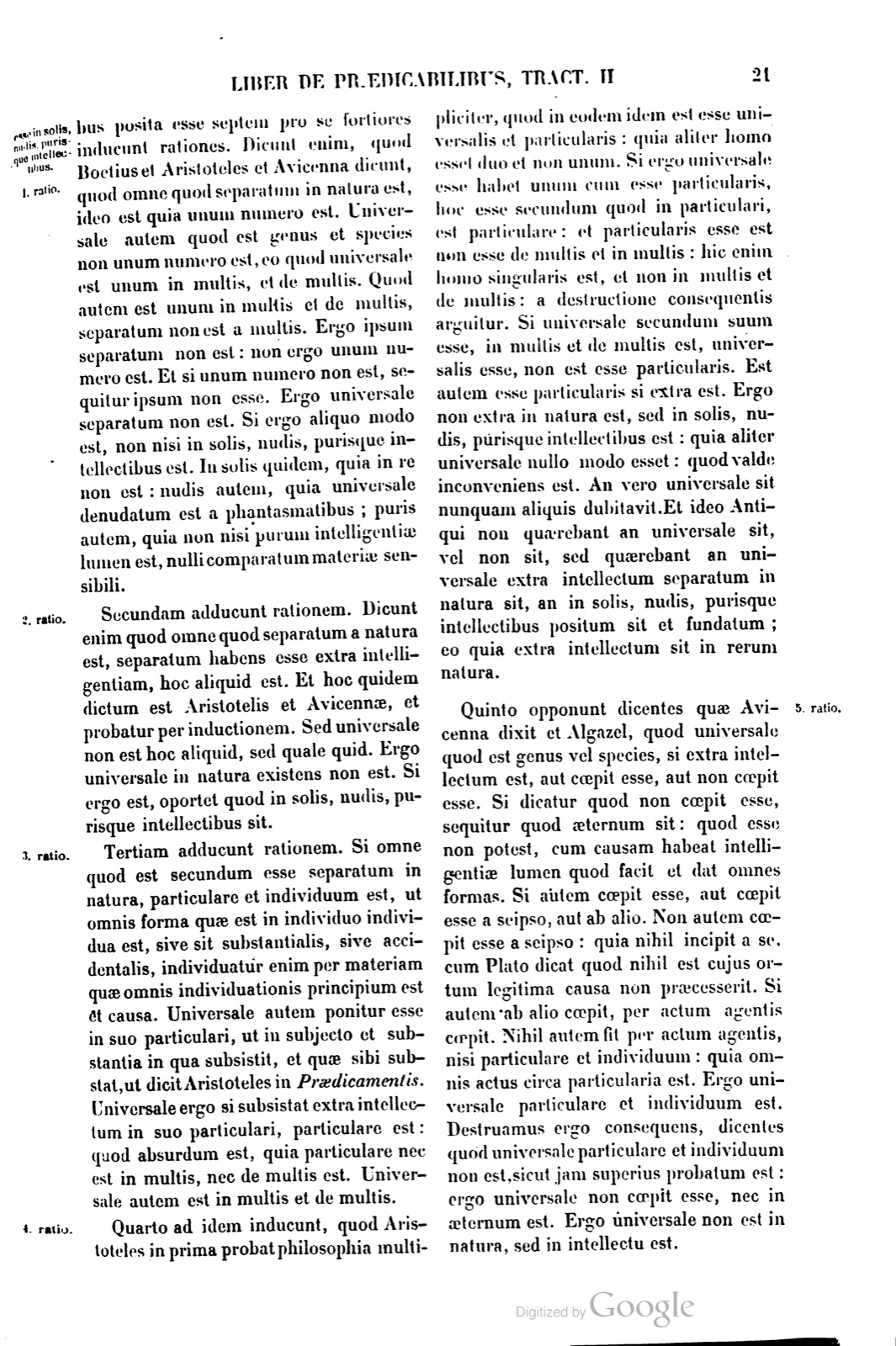
Secundum est, quod sicut dicit Aristoteles 2, eadem sunt quibus res est, et quibus cognoscitur et scitur. Non est autem scientia nisi de universali et per universale. Ergo res non est, nisi per id quod universale est. Scientia enim non est nisi de rebus et per res, praecipue in physicis. Ergo universalia sunt res extra intellectum. Si enim essent in intellectu tantum, essent rerum intentiones, et non res ipsae.
Tertio inducunt, quod forma quae dat esse, non habet esse a materia, quamvis sit in materia: sed habet esse ab agente secundum formam et agente univoco. Et secundum quod est ab agente, vere est, et est extra intellectum: et tamen non est hoc vel illud, sed est simpliciter. Sed universale est, quod secundum se non est hoc vel illud, sed est simpliciter communicabile factum hoc vel illud. Ergo universale simpliciter et secundum se separatum ab agente et in natura existens est, quamvis non sit hoc vel illud. Universale ergo simpliciter est, et magis est quam particulare, sive hoc vel illud. Et haec fuit objectio Platonis, qui dixit universalia esse formas.
Quarto adducunt: quia id quod est ab agente formaliter, vere est in natura: et tamen de esse suo formali nihil habet a materia: sed ab eo quod est in materia, habet quod est forma hujus vel illius. Ens autem vere ab agente non secundum quod est hujus vel illius, verissime habet esse in natura et agente formaliter: quia uno modo se habet ad omnia quae ab eo exemplificantur. Quod ergo sic est, verissime est apud naturam: quia esse suum non est ab aliquo obumbratum vel variatum. Forma autem secundum quod uno modo se habet ad omnia particularia sua sic est, et tale habet esse. Hoc autem modo est universale. Ergo universale verissime est in natura, et verius est quam particulare.
Quinto inducunt, quod forma dat esse rei et specie et ratione: et natura non est nisi lumen intelligentiae terminatum ad hoc, et incorporatum isti. Quod ergo dat esse et rationem, aut habet ab hoc quod est incorporatum isti, et terminatum ad hoc, aut non. Constat autem quod non habet dare esse et rationem secundum quod est terminatum ad hoc, et secundum quod est incorporatum isti: quia hoc accidit isti, et ab hoc accidente non potest habere actum substantialem. Habet ergo ab hoc quod est lumen intelligentiae, quae est dans esse in natura. Non autem dat esse in natura, nisi quod vere in natura est. Ergo forma quae dat esse in natura, vere in natura est extra intellectum. Sicut forma artis non dat artificiato esse in genere et specie artificiati, nisi secundum quod in artificiato vere est, et extra intellectum artificis: quamvis hoc quod dat esse artificiato, non habeat ab eo secundum quod in artificiato est, sed secundum quod est ab artifice.
Sexto adducunt, quod lumen faciens colores, non amittit aliquid per hoc quod est in corpore terminato: nec aliquid accipit essentiae vel virtutis ad agendum, quamvis ei quod constituitur per ipsum, multa accidant per hoc quod ad hoc vel illud terminatur. Ergo similiter lumen intelligentiae, quod de se formas largitur, non amittit id quod de se vel ab efficiente habet, per hoc quod est in isto vel in illo: nec aliquid accipit essentiae vel virtutis ab hoc quod terminatur ad hoc vel illud, quamvis ei quod constituitur ab isto multa conveniant secundum quod lumen istud constituens agit in hoc vel illo. Sic autem virtutem constituendi habens, est vere in natura, et non secundum quod est in isto vel in illo. Hoc autem dicitur existens simpliciter et verissime et ex natura unam aptitudinem habens ad omnia quibus dat esse et rationem. Hoc autem est genus et species prout sunt universalia. Genus ergo et species universalia verissime sunt in natura.
Septimo inducunt, quod id quod secundum naturam et virtutem est ante rem, ab eo quod est post ipsum, nec esse accipit nec unitatem vel multiplicationem secundum seipsum, nisi secundum quod habet in isto vel illo quod post ipsum est. Universale autem sive forma quae est rei causa et principium, est ante rem secundum causam et naturae ordinem. Ergo ab eo in quo est, nec accipit esse, nec unitatem, nec multiplicationem secundum quod ipsum est in se: quamvis multiplicetur tantum secundum esse quod habet in isto vel illo. Si ergo in se accipiatur, nihil horum habet ab eo in quo est. Secundum seipsum autem acceptum verissime est: quia secundum se acceptum non habet hoc quod non sit nisi in intellectu: quamvis ab intellectu cognoscente et causante. Secundum se ergo acceptum verissime est res in natura simplici existens. Sic autem universale est aptitudinem habens ad omnia sua singularia. Universale ergo verissime est et res in natura est, etiam absque eo quod in intellectu solo, puro, et nudo sit acceptum.
The second is that, as Aristotle says 2, the things by which a thing is are the same as the things by which it is cognized and known. But there is no science except concerning the universal and through the universal. Therefore the thing is only through that which is universal. For science is only concerning things and through things, especially in physical matters. Therefore universals are things outside intellect. For if they were only in intellect, they would be intentions of things, and not the things themselves.
Third they introduce that form which gives being does not have being from matter, although it is in matter, but has being from the agent according to form and from a univocal agent. And according as it is from the agent, it truly is, and is outside intellect; and yet it is not this or that, but is simply. But the universal is that which according to itself is not this or that, but is simply communicable, made this or that. Therefore the universal simply and according to itself exists as separated from the agent and existing in nature, although it is not this or that. Therefore the universal simply is, and is more than the particular, or this or that. And this was Plato's objection, who said that universals are forms.
Fourth they adduce: because that which is from the agent formally is truly in nature, and yet has nothing of its formal being from matter; but from the fact that it is in matter, it has that it is the form of this or that. But being truly from the agent, not according as it is of this or that, most truly has being in nature and from the agent formally, because it is related in one mode to all the things which are exemplified from it. Therefore what is thus is most truly with nature, because its being is not shadowed or varied by anything. But form, according as it is related in one mode to all its particulars, is thus and has such being. But in this way it is universal. Therefore the universal is most truly in nature, and is truer than the particular.
Fifth they introduce that form gives being to the thing both in species and in reason, and nature is nothing other than the light of intelligence terminated to this and incorporated in this. Therefore that which gives being and reason either has this from the fact that it is incorporated in this and terminated to this, or it does not. But it is agreed that it does not have the power of giving being and reason according as it is terminated to this and according as it is incorporated in this, because this belongs accidentally to this, and from this accident it cannot have substantial act. Therefore it has it from this, that it is the light of intelligence, which gives being in nature. But nothing gives being in nature except what truly is in nature. Therefore the form which gives being in nature is truly in nature outside intellect. As the form of art does not give being to the artifact in the genus and species of the artifact except according as it truly is in the artifact and outside the intellect of the artisan; although that which gives being to the artifact does not have this from it according as it is in the artifact, but according as it is from the artisan.
Sixth they adduce that the light making colors does not lose anything through the fact that it is in a terminated body, nor does it receive anything of essence or power for acting, although many things belong to that which is constituted through it because it is terminated to this or that. Therefore similarly the light of intelligence, which of itself bestows forms, does not lose that which it has of itself or from the efficient cause through the fact that it is in this or that, nor does it receive anything of essence or power from the fact that it is terminated to this or that, although many things belong to that which is constituted by this according as that constituting light acts in this or that. But thus, having the power of constituting, it is truly in nature, and not according as it is in this or that. But this is called existing simply and most truly and by nature having one aptitude to all things to which it gives being and reason. But this is genus and species insofar as they are universals. Therefore genus and species as universals are most truly in nature.
Seventh they introduce that what according to nature and power is before the thing receives neither being nor unity nor multiplication according to itself from that which is after it, except according as it has being in this or that which is after it. But the universal, or the form which is the cause and principle of the thing, is before the thing according to cause and the order of nature. Therefore from that in which it is, it receives neither being nor unity nor multiplication according as it is in itself, although it is multiplied only according to the being which it has in this or that. If therefore it is taken in itself, it has none of these from that in which it is. But taken according to itself it most truly is, because taken according to itself it does not have this, that it is only in intellect, although it is from intellect knowing and causing. Therefore taken according to itself it is most truly a thing existing in simple nature. But thus the universal has aptitude to all its singulars. Therefore the universal most truly is and is a thing in nature, even apart from the fact that it is received in intellect alone, pure and bare.
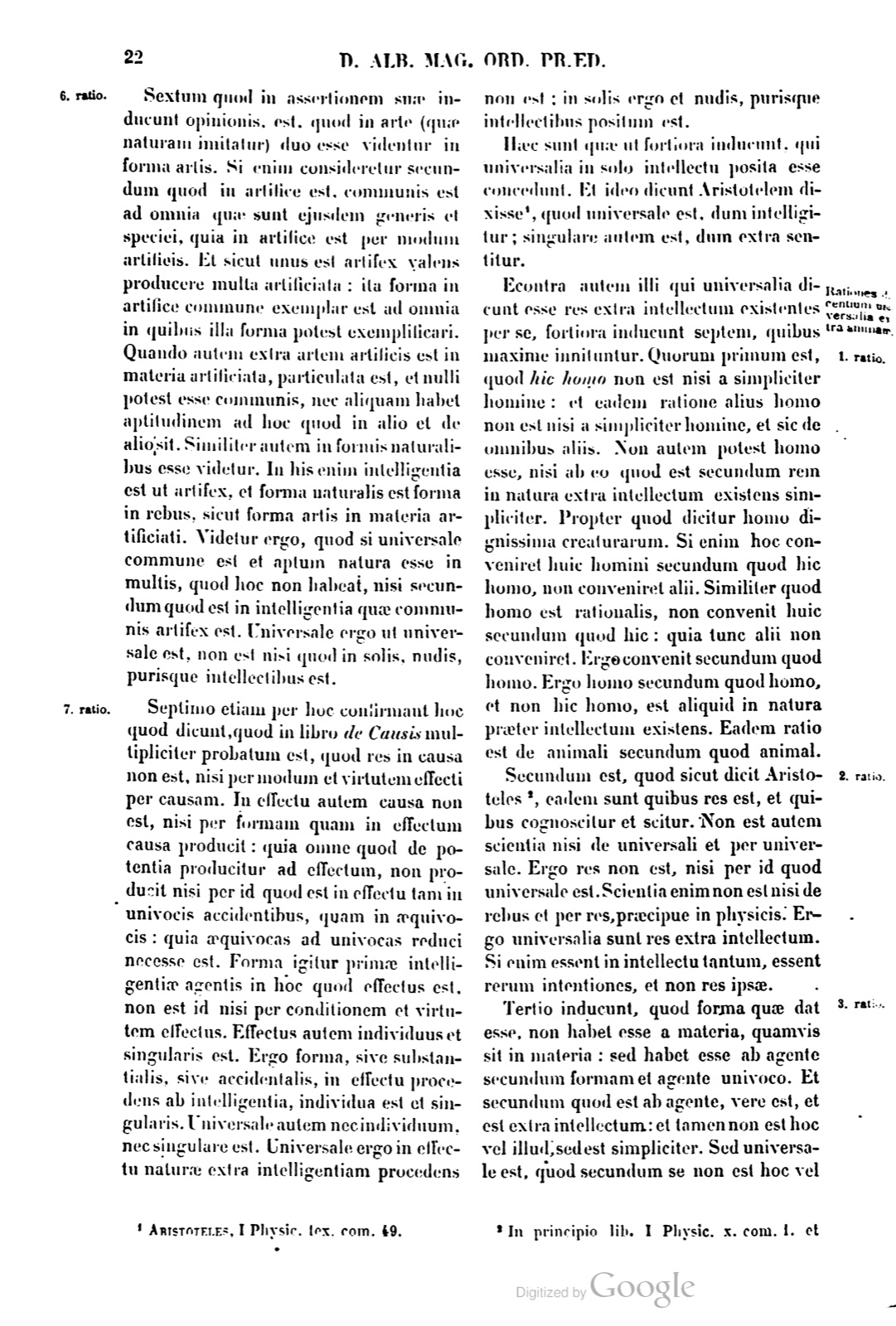
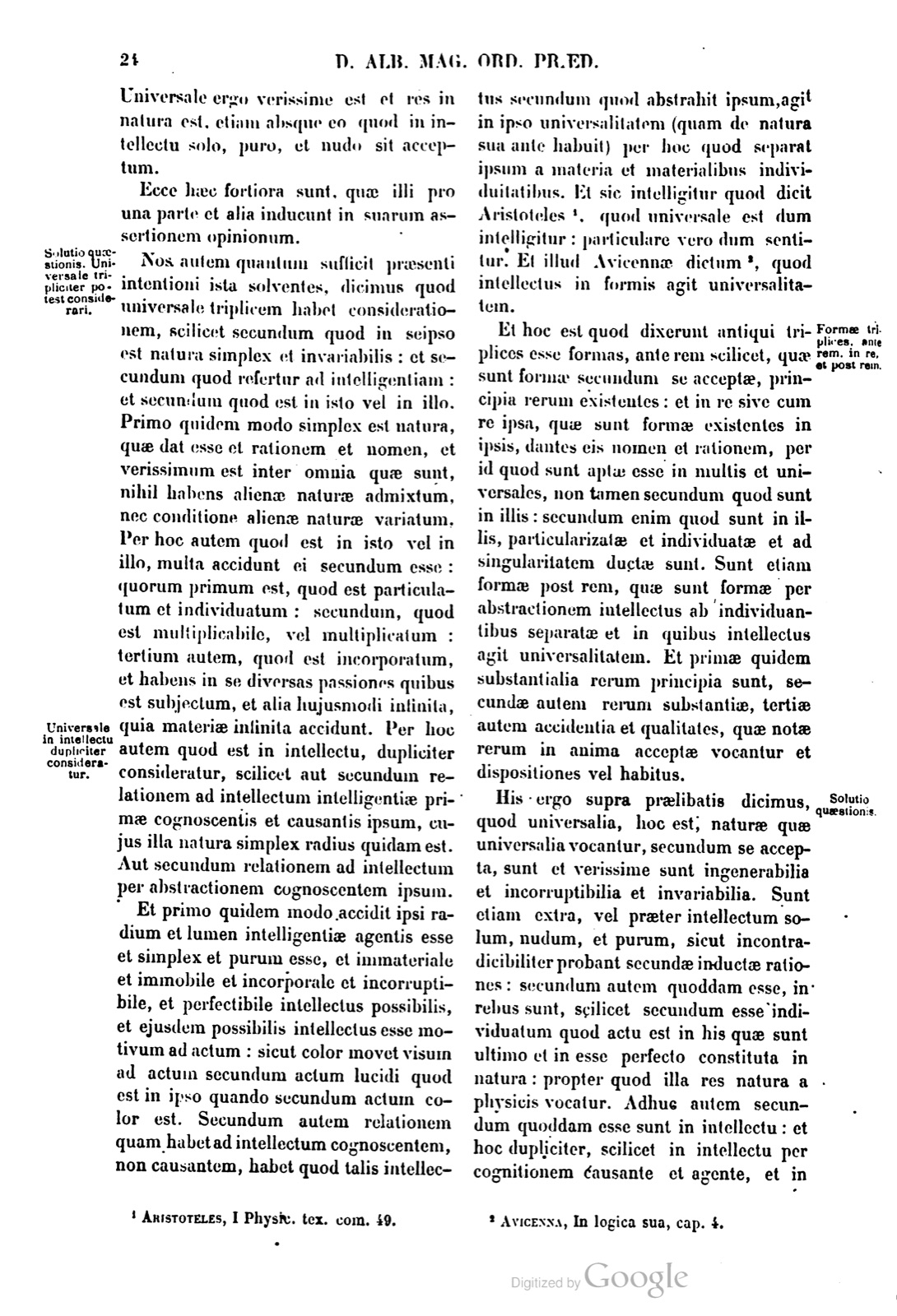
Ecce haec fortiora sunt, quae illi pro una parte et alia inducunt in suarum assertionem opinionum.
Nos autem quantum sufficit praesenti intentioni ista solventes, dicimus quod universale triplicem habet considerationem, scilicet secundum quod in seipso est natura simplex et invariabilis: et secundum quod refertur ad intelligentiam: et secundum quod est in isto vel in illo. Primo quidem modo simplex est natura, quae dat esse et rationem et nomen, et verissimum est inter omnia quae sunt, nihil habens alienae naturae admixtum, nec conditione alienae naturae variatum. Per hoc autem quod est in isto vel in illo, multa accidunt ei secundum esse: quorum primum est, quod est particulatum et individuatum: secundum, quod est multiplicabile, vel multiplicatum: tertium autem, quod est incorporatum, et habens in se diversas passiones quibus est subjectum, et alia hujusmodi infinita, quia materiae infinita accidunt. Per hoc autem quod est in intellectu, dupliciter consideratur, scilicet aut secundum relationem ad intellectum intelligentiae primae cognoscentis et causantis ipsum, cujus illa natura simplex radius quidam est. Aut secundum relationem ad intellectum per abstractionem cognoscentem ipsum. Et primo quidem modo accidit ipsi radium et lumen intelligentiae agentis esse et simplex et purum esse, et immateriale et immobile et incorporale et incorruptibile, et perfectibile intellectus possibilis, et ejusdem possibilis intellectus esse motivum ad actum: sicut color movet visum ad actum secundum actum lucidi quod est in ipso quando secundum actum color est. Secundum autem relationem quam habet ad intellectum cognoscentem, non causantem, habet quod talis intellectus secundum quod abstrahit ipsum, agit in ipso universalitatem, quam de natura sua ante habuit, per hoc quod separat ipsum a materia et materialibus individuitatibus. Et sic intelligitur quod dicit Aristoteles 3, quod universale est dum intelligitur: particulare vero dum sentitur. Et illud Avicennae dictum 4, quod intellectus in formis agit universalitatem.
Et hoc est quod dixerunt antiqui triplices esse formas, ante rem scilicet, quae sunt formae secundum se acceptae, principia rerum existentes: et in re sive cum re ipsa, quae sunt formae existentes in ipsis, dantes eis nomen et rationem, per id quod sunt aptae esse in multis et universales, non tamen secundum quod sunt in illis: secundum enim quod sunt in illis, particularizatae et individuatae et ad singularitatem ductae sunt. Sunt etiam formae post rem, quae sunt formae per abstractionem intellectus ab individuantibus separatae et in quibus intellectus agit universalitatem. Et primae quidem substantialia rerum principia sunt, secundae autem rerum substantiae, tertiae autem accidentia et qualitates, quae notae rerum in anima acceptae vocantur et dispositiones vel habitus.
His ergo supra praelibatis dicimus, quod universalia, hoc est, naturae quae universalia vocantur, secundum se accepta, sunt et verissime sunt ingenerabilia et incorruptibilia et invariabilia. Sunt etiam extra, vel praeter intellectum solum, nudum, et purum, sicut in contradicibiliter probant secundae inductae rationes: secundum autem quoddam esse, in rebus sunt, scilicet secundum esse individuatum quod actu est in his quae sunt ultimo et in esse perfecto constituta in natura: propter quod illa res natura a physicis vocatur. Adhuc autem secundum quoddam esse sunt in intellectu: et hoc dupliciter, scilicet in intellectu per cognitionem causante et agente, et in intellectu cognoscente per abstractionem et per universalitatem agente et educente.
Behold, these are the stronger things which they introduce for one side and the other in assertion of their opinions.
But we, solving these things so far as suffices for the present intention, say that the universal has a threefold consideration, namely according as in itself it is a simple and invariable nature; and according as it is referred to intelligence; and according as it is in this or in that. In the first mode, indeed, it is a simple nature, which gives being and reason and name, and is most true among all things which are, having nothing of an alien nature mixed in, nor varied by the condition of an alien nature. But through the fact that it is in this or that, many things belong to it according to being. The first of these is that it is particularized and individuated; the second, that it is multipliable or multiplied; the third, that it is incorporated and has in itself diverse properties to which it is subject, and other infinite things of this sort, because infinite things belong to matter. But through the fact that it is in intellect, it is considered in two ways, namely either according to relation to the intellect of the first intelligence knowing and causing it, of which that simple nature is a certain ray, or according to relation to the intellect knowing it through abstraction. And in the first mode there belongs to it that it is a ray and light of the agent intelligence, and that it is simple and pure, immaterial, immobile, incorporeal, incorruptible, perfective of possible intellect, and motive of the same possible intellect to act, just as color moves sight to act according to the act of the luminous which is in it when it is color according to act. But according to the relation which it has to the knowing intellect, not the causing intellect, it has this, that such an intellect, according as it abstracts it, acts universality in it, which it previously had from its own nature, through this, that it separates it from matter and material individuations. And thus what Aristotle says 3 is understood, that the universal exists while it is understood, but the particular while it is sensed. And also that saying of Avicenna 4, that intellect acts universality in forms.
And this is what the ancients said: that forms are threefold, namely before the thing, which are forms taken according to themselves, existing as principles of things; and in the thing, or with the thing itself, which are forms existing in the things themselves, giving them name and reason through the fact that they are apt to be in many and universal, but not according as they are in those things, for according as they are in those things they are particularized and individuated and led down to singularity. There are also forms after the thing, which are forms separated by abstraction of intellect from individuating things and in which intellect acts universality. And the first forms are substantial principles of things; the second are substances of things; but the third are accidents and qualities, which are called marks of things received in the soul and dispositions or habits.
Therefore, with these things previously tasted, we say that universals, that is, the natures which are called universals, taken according to themselves, are and most truly are ungenerable, incorruptible, and invariable. They are also outside or besides intellect alone, bare and pure, as the second set of introduced reasons proves incontrovertibly; but according to a certain being they are in things, namely according to individuated being which actually is in those things which are constituted in nature ultimately and in perfected being. For this reason that thing is called nature by the physicists. Again, according to a certain being they are in intellect, and this in two ways, namely in intellect causing and acting through cognition, and in intellect knowing through abstraction and acting and drawing out through universality.
Ad id ergo quod primo medio pro prima parte opinionis inducitur, quod cum dicunt Aristoteles et Boetius, quod omne quod est, ideo est, quia unum numero est: hoc intelligitur de his quae ultimo actu in natura perfecta sunt, de illis enim verum est. Sed universalia hoc modo non sunt: sunt enim ut rerum principia, et non ut res ultimo actu in natura constitutae et completae. Aut sic intelligitur 5, quod unum numero sit dictum a numero ultimi esse, vel a numero essentiae. Esse enim quod est unum numero, habet esse suae essentiae: sicut et universale unum numero, est unum numero essentiae et non duo vel tria, quamvis numerus materiae et accidentis sit, in multis et de multis. Et hoc accidit sibi et non convenit ei secundum se: et sic intelligitur quod dicitur, quod participatione speciei plures homines sunt unus homo.
Similiter dicendum ad id quod secundo dicunt, quod illud quod separatum habet esse extra intellectum in natura, est hoc aliquid: quia separatum esse habere dicitur duobus modis. Uno scilicet modo quo separatum esse habet id quod in se habet esse non dependens ad aliquid, ad hoc quod esse habeat quod sit extra ipsum: et sic non generaliter verum quod dicunt: quia universale sic separatum, habet esse in natura, et tamen non est hoc aliquid. Alio modo separatum esse dicitur, quod in se est individuum, et ab aliis per discretionem divisum et separatum. Et hoc modo generaliter verum est quod dicunt: quia sic non nisi singulariter existentia separatum habent esse.
Ad id quod tertio inducunt per dictum Avicennae, dicendum quod omne quod est in individuo, secundum quod est in individuo, singulare est. Sed id quod in individuo est, nil prohibet esse universale, non secundum quod est in individuo acceptum: hoc enim secundum se acceptum, nihil prohibet esse quale quid, et non hoc aliquid.
Si quis autem sic objiciat, quod est in individuo est in eo per modum individui. Individuum autem est hoc aliquid. Ergo illud quod est in individuo, est singulare et hoc aliquid. Non valet argumentum. Quod enim est in individuo, non semper est in eo per modum esse individui, sed aliquando per modum principii individui. Et non oportet quod hoc secundum id quod est, sit individuum et hoc aliquid: quia potest esse quale quid. Et ideo in argumento paralogismus est figurae dictionis: quia interpretatur quale quid ut hoc aliquid.
Ad id autem quod quarto inducunt, dicendum quod universale secundum esse quod habet in singulari, non habet aliud esse quam esse singularis: et hoc probat Aristoteles 6 contra eos qui dixerunt formas universales distinctum et divisum esse retinere praeter esse singularis, sicut ex sigillo receptum esse separatum ab illo sicut separatum est esse sigilli et cerae sigillatae. Sed quod id quod est in singulari, non habeat esse naturae et principii, non secundum quod est in singulari, sed secundum se acceptum, non probat Aristoteles: quia hoc est verum et necessarium in omni natura.
Ad id quod quinto objicitur, dicendum quod essentiae rerum secundum quod essentiae sunt, non incipiunt esse nisi per accidens et per aliud, scilicet incipientibus esse his in quibus sunt. In his enim per consequens etiam illa esse incipiunt. Et hoc non accidit eis, nisi secundum quod in illis sunt: secundum seipsa autem nec incipiunt nec desinunt esse secundum naturam, sed sunt radii luminis intelligentiae universaliter agentis.
Therefore to that which is introduced by the first middle for the first part of the opinion, that Aristotle and Boethius say that everything which is, is for this reason, because it is one in number, this is understood of those things which are perfected in nature in ultimate act; concerning those it is true. But universals are not in this way, for they are as principles of things, and not as things constituted and completed in nature in ultimate act. Or it is understood thus 5, that one in number is said from the number of ultimate being or from the number of essence. For being which is one in number has the being of its essence; as also the universal, one in number, is one in number of essence and not two or three, although the number of matter and accident is in many and of many. And this belongs to it accidentally and does not belong to it according to itself; and thus what is said is understood, that by participation in the species several human beings are one man.
Similarly one must say to what they say second, that what has separated being outside intellect in nature is this something, because to have separated being is said in two ways. In one mode, that is said to have separated being which has being in itself not dependent on something, in order that it have being which is outside it; and in this way what they say is not generally true, because the universal separated in this way has being in nature, and yet is not this something. In another mode, that is called separated being which in itself is an individual and divided and separated from others by discretion. And in this way what they say is generally true, because in this way only singularly existing things have separated being.
To that which they introduce third through the saying of Avicenna, one must say that everything which is in an individual, according as it is in an individual, is singular. But that which is in an individual, nothing prevents from being universal, not according as it is received in the individual; for this, taken according to itself, nothing prevents from being a qualified something and not this something.
But if someone objects thus, that what is in an individual is in it through the mode of the individual; but the individual is this something; therefore what is in the individual is singular and this something: the argument is not valid. For what is in an individual is not always in it by way of the being of the individual, but sometimes by way of the principle of the individual. And it is not necessary that this, according to that which it is, be an individual and this something, because it can be a qualified something. And therefore in the argument there is a paralogism of figure of speech, because a qualified something is interpreted as this something.
But to that which they introduce fourth, one must say that the universal according to the being which it has in the singular does not have another being than the being of the singular; and Aristotle proves this 6 against those who said that universal forms retain distinct and divided being besides the being of the singular, as being received from a seal is separated from it as the being of the seal and of the sealed wax are separated. But Aristotle does not prove that that which is in the singular does not have the being of nature and principle, not according as it is in the singular, but according as it is taken in itself, because this is true and necessary in every nature.
To that which is objected fifth, one must say that the essences of things, according as they are essences, do not begin to be except through accident and through another, namely when those things in which they are begin to be. For in these, consequently, those essences also begin to be. And this does not belong to them except according as they are in those things; but according to themselves they neither begin nor cease to be according to nature, but are rays of the light of intelligence universally acting.
Notes
- Aristotle, Physics I, text, commentary 49. (Aristoteles, I Physic. tex. com. 49.) ↩
- At the beginning of book I of the Physics, text/commentary 1, and ... (In principio lib. I Physic. x. com. 1. et) ↩
- Aristotle, Physics I, text, commentary 49. (Aristoteles, I Physic. tex. com. 49.) ↩
- Avicenna, in his Logic, chapter 4. (Avicenna, In logica sua, cap. 4.) ↩
- An explanation of that saying: Everything that is, is for this reason, because it is one in number. (Explanatio illius dicti: Omne quod est, ideo est, quia unum numero est.) ↩
- Aristotle, Physics VII, text, commentaries 51 and 57. (Aristoteles, VII Physic. tex. com. 51 et 57.) ↩
If a page does not appear, its photograph has not been uploaded yet.