Volume 1 · pp. 33–36
Chapter VI. In what way the universal is in the soul, in what way in itself, and in what way in the singular, and in which it is more truly according to the being of its nature.
A marker with ≈ is an approximate page boundary, placed by measure of the text; the page photographs remain the authority. In the paired views, clicking a page marker brings that page into view.
CAPUT VI.
Qualiter universale est in anima, et qualiter in seipso, et qualiter in singulari, et in quo sit verius secundum esse suae naturae.
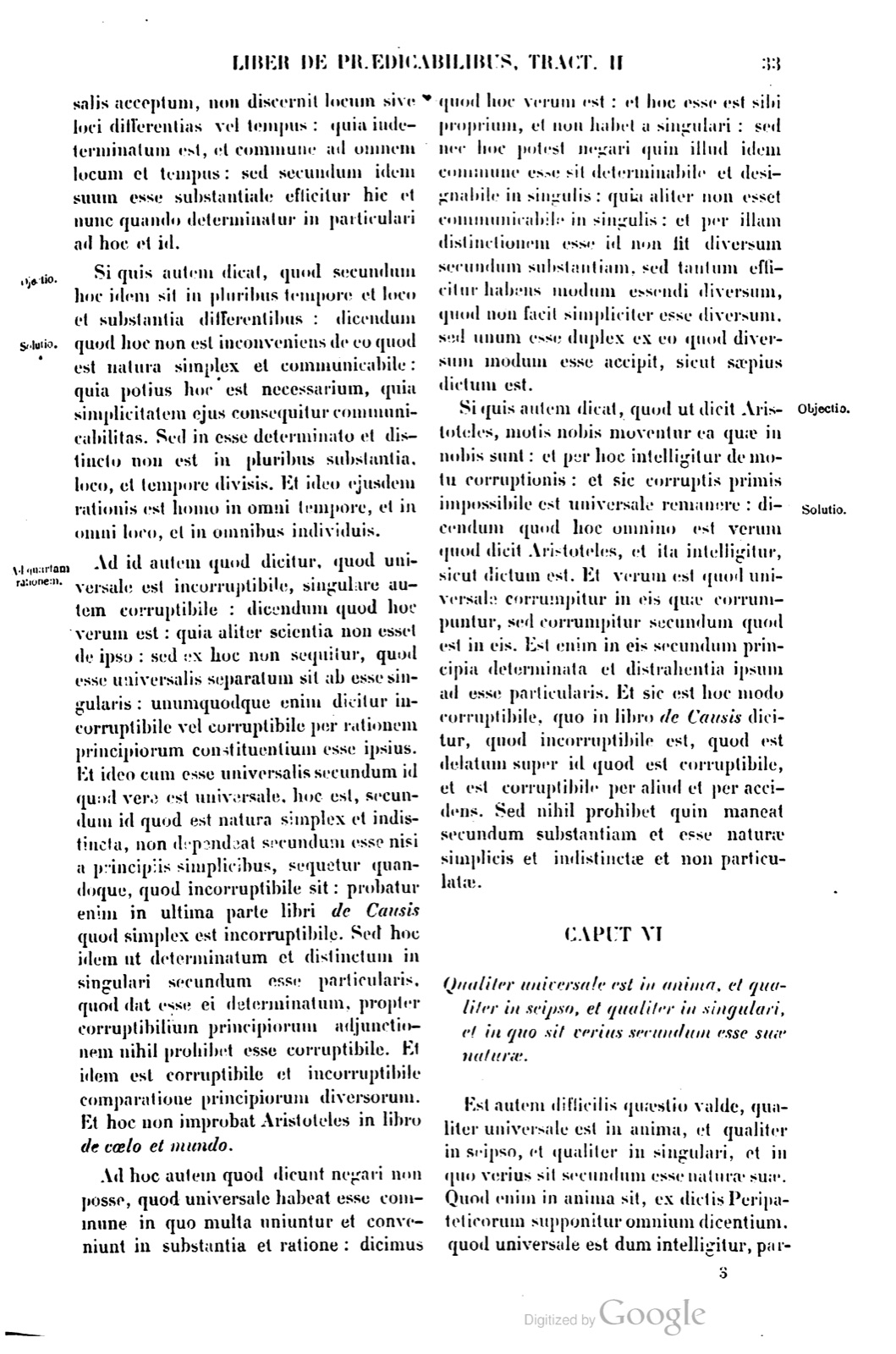
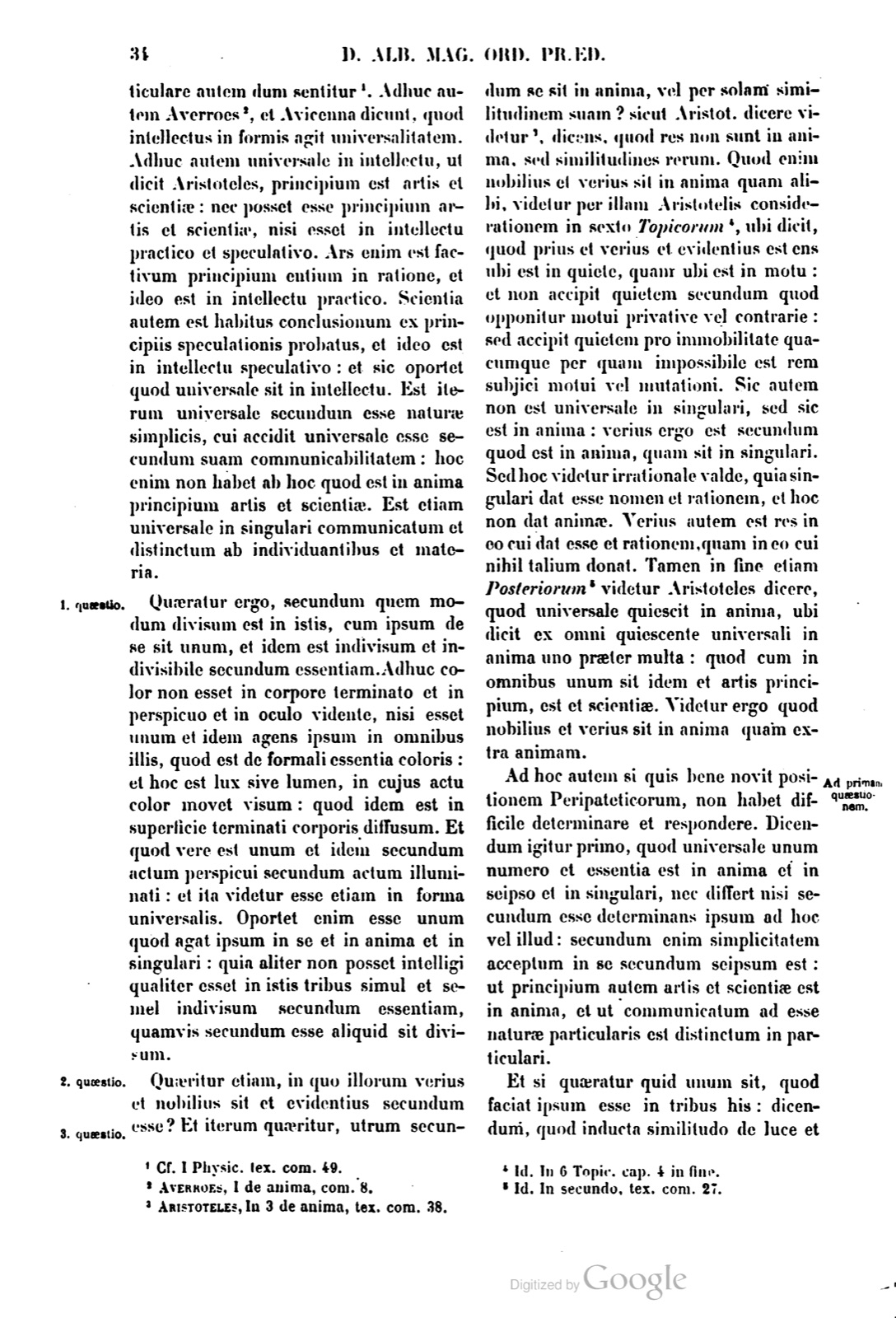
Est autem difficilis quaestio valde, qualiter universale est in anima, et qualiter in seipso, et qualiter in singulari, et in quo verius sit secundum esse naturae suae. Quod enim in anima sit, ex dictis Peripateticorum supponitur omnium dicentium, quod universale est dum intelligitur, particulare autem dum sentitur 1. Adhuc autem Averroes 2, et Avicenna dicunt, quod intellectus in formis agit universalitatem. Adhuc autem universale in intellectu, ut dicit Aristoteles, principium est artis et scientiae: nec posset esse principium artis et scientiae, nisi esset in intellectu practico et speculativo. Ars enim est factivum principium entium in ratione, et ideo est in intellectu practico. Scientia autem est habitus conclusionum ex principiis speculationis probatus, et ideo est in intellectu speculativo: et sic oportet quod universale sit in intellectu. Est iterum universale secundum esse naturae simplicis, cui accidit universale esse secundum suam communicabilitatem: hoc enim non habet ab hoc quod est in anima principium artis et scientiae. Est etiam universale in singulari communicatum et distinctum ab individuantibus et materia.
Quaeratur ergo, secundum quem modum divisum est in istis, cum ipsum de se sit unum, et idem est indivisum et indivisibile secundum essentiam. Adhuc color non esset in corpore terminato et in perspicuo et in oculo vidente, nisi esset unum et idem agens ipsum in omnibus illis, quod est de formali essentia coloris: et hoc est lux sive lumen, in cujus actu color movet visum: quod idem est in superficie terminati corporis diffusum. Et quod vere est unum et idem secundum actum perspicui secundum actum illuminati: et ita videtur esse etiam in forma universalis. Oportet enim esse unum quod agat ipsum in se et in anima et in singulari: quia aliter non posset intelligi qualiter esset in istis tribus simul et semel indivisum secundum essentiam, quamvis secundum esse aliquid sit divisum.
Quaeritur etiam, in quo illorum verius et nobilius sit et evidentius secundum esse? Et iterum quaeritur, utrum secundum se sit in anima, vel per solam similitudinem suam? sicut Aristoteles dicere videtur 3, dicens, quod res non sunt in anima, sed similitudines rerum. Quod enim nobilius et verius sit in anima quam alibi, videtur per illam Aristotelis considerationem in sexto Topicorum 4, ubi dicit, quod prius et verius et evidentius est ens ubi est in quiete, quam ubi est in motu: et non accipit quietem secundum quod opponitur motui privative vel contrarie: sed accipit quietem pro immobilitate quacumque per quam impossibile est rem subjici motui vel mutationi. Sic autem non est universale in singulari, sed sic est in anima: verius ergo est secundum quod est in anima, quam sit in singulari. Sed hoc videtur irrationale valde, quia singulari dat esse nomen et rationem, et hoc non dat animae. Verius autem est res in eo cui dat esse et rationem, quam in eo cui nihil talium donat. Tamen in fine etiam Posteriorum videtur Aristoteles dicere, quod universale quiescit in anima, ubi dicit ex omni quiescente universali in anima uno praeter multa: quod cum in omnibus unum sit idem et artis principium, est et scientiae 5. Videtur ergo quod nobilius et verius sit in anima quam extra animam.
CHAPTER VI.
In what way the universal is in the soul, and in what way in itself, and in what way in the singular, and in which it is more truly according to the being of its nature.
But the question is very difficult, in what way the universal is in the soul, in what way in itself, in what way in the singular, and in which it is more truly according to the being of its nature. For that it is in the soul is presupposed from the sayings of all the Peripatetics, who say that the universal is while it is understood, but the particular while it is sensed 1. Further, Averroes 2 and Avicenna say that the intellect acts universality in forms. Further, the universal in the intellect, as Aristotle says, is the principle of art and science; and it could not be the principle of art and science unless it were in the practical and speculative intellect. For art is the factive principle of beings in reason, and therefore it is in the practical intellect. But science is a habit of conclusions proved from the principles of speculation, and therefore it is in the speculative intellect; and thus the universal must be in the intellect. Again, there is the universal according to the being of a simple nature, to which universal being happens according to its communicability: for it does not have this from the fact that it is in the soul as a principle of art and science. There is also the universal in the singular, communicated and made distinct by individuating things and matter.
Therefore let it be asked according to what mode it is divided in these, since of itself it is one, and the same thing is undivided and indivisible according to essence. Further, color would not be in a terminated body and in the transparent and in the seeing eye unless there were one and the same thing acting it in all those, which belongs to the formal essence of color: and this is light or illumination, in whose act color moves sight; the same thing is diffused in the surface of the terminated body. And what is truly one and the same according to the act of the transparent according to the act of the illuminated; and thus it also seems to be in the form of the universal. For there must be one thing which acts it in itself and in the soul and in the singular: because otherwise it could not be understood how it would be in these three together and at once undivided according to essence, although according to being it is in some way divided.
It is also asked in which of those it is more truly and more nobly and more evidently according to being. And again it is asked whether according to itself it is in the soul, or only through its likeness, as Aristotle seems to say 3, saying that things are not in the soul, but the likenesses of things. For that it is more nobly and more truly in the soul than elsewhere seems from that consideration of Aristotle in the sixth book of the Topics 4, where he says that a being is prior and truer and more evident where it is at rest than where it is in motion; and he does not take rest insofar as it is opposed to motion privatively or contrarily, but he takes rest for any immobility through which it is impossible for the thing to be subjected to motion or change. But the universal is not in this way in the singular, but is in this way in the soul; therefore it is more truly insofar as it is in the soul than it is in the singular. But this seems very irrational, because it gives being, name, and notion to the singular, and does not give this to the soul. But a thing is more truly in that to which it gives being and notion than in that to which it gives none of such things. Nevertheless also at the end of the Posterior Analytics Aristotle seems to say that the universal rests in the soul, where he says, from every universal at rest in the soul, one besides many, which, since it is one and the same in all, is a principle both of art and of science 5. Therefore it seems that it is more nobly and more truly in the soul than outside the soul.
Ad hoc autem si quis bene novit positionem Peripateticorum, non habet difficile determinare et respondere. Dicendum igitur primo, quod universale unum numero et essentia est in anima et in seipso et in singulari, nec differt nisi secundum esse determinans ipsum ad hoc vel illud: secundum enim simplicitatem acceptum in se secundum seipsum est: ut principium autem artis et scientiae est in anima, et ut communicatum ad esse naturae particularis est distinctum in particulari.
Et si quaeratur quid unum sit, quod faciat ipsum esse in tribus his: dicendum, quod inducta similitudo de luce et colore bona est. Et dicendum quod id unum quod in tribus ipsum facit esse, est vis intelligentiae primae, quae causa universi esse est in omnibus: cujus etiam ipsa simplex natura, quae est hoc quod est universale vel illud, contingens radius est. Et quia contactus talis multiplex est secundum diversas naturas ad quas pertingit, ideo universalia multa sunt, reducibilia tamen aliquo modo ad unum, quod causae primae primum causatum est. Hoc autem unum intelligentiae lumen est extensum per omnem naturam et animam, sicut lux solis extendit se per omnem naturam et animam in eo quod est imago ipsius propinqua. Et anima intellectualis facit et operatur et invenit formas suas sub specie et forma luminis, sicut lux solis et colorem facit in perspicuo sive pervio, quem quidem accipit visus per id quod perspicuo componitur ejus organum: accipit tamen in virtute vitae et sensus per hoc quod oculus perspicuum animatum sensitivum et determinatum corpus est: et accipit clarum vel tenebrosum per hoc quod superficies clara est vel tenebrosa. Ita etiam lux intelligentiae primae, quae fons et causa est omnium formarum, facit et invehit formas quas in se quidem acceptas habet simplices et indistinctas, et ideo universales et in simplici lumine constitutas: quae, quia universale est ubique et semper, secundum quod sic sunt, ubique et semper sunt, incorruptibiles sunt et immobiles et innumerabiles. Secundum autem quod ad hoc vel illud sunt terminatae, sic accipiunt diversum modum in esse. Et in anima, quae vitae intellectualis principium est, accipiuntur, ut principia operis vel speculationis: cum talis anima et imago instrumentum sit luminis intelligentiae, in materia sensibili, quae non nisi subjectum operantis intelligentiae est, invehit eas, ut sunt principium esse hujus vel illius singularis. Et ideo una et eadem est essentia in se et in anima et in singulari: sed in anima secundum esse spirituale, in singulari secundum esse materiale et naturale, in se autem in esse simplici.
But to this, if someone knows well the position of the Peripatetics, he does not have difficulty in determining and responding. Therefore one must say first that the universal, one in number and essence, is in the soul and in itself and in the singular, and differs only according to being determining it to this or that: for taken according to simplicity it is in itself according to itself; but as principle of art and science it is in the soul, and as communicated to the being of a particular nature it is distinct in the particular.
And if it is asked what the one thing is which makes it be in these three, one must say that the introduced likeness concerning light and color is good. And one must say that the one thing which makes it be in the three is the power of the first intelligence, which is the cause of universal being in all things; of which also the simple nature itself, which is this universal or that, is a touching ray. And because such contact is multiple according to the diverse natures to which it reaches, therefore universals are many, yet reducible in some way to one, which is the first caused thing of the first cause. But this one light of intelligence is extended through every nature and soul, just as the light of the sun extends itself through every nature and soul in that which is its proximate image. And the intellectual soul makes and operates and finds its forms under the species and form of light, just as the light of the sun also makes color in the transparent or permeable, which sight indeed receives through that by which its organ is composed with the transparent; nevertheless it receives it in the power of life and sense through this, that the eye is a transparent animated sensitive and determined body; and it receives bright or dark through this, that the surface is bright or dark. So also the light of the first intelligence, which is the fount and cause of all forms, makes and brings in forms which, taken in themselves, it has simple and indistinct, and therefore universal and constituted in simple light; these, because the universal is everywhere and always, insofar as they are thus, are everywhere and always, are incorruptible and immobile and innumerable. But insofar as they are terminated to this or that, thus they receive a diverse mode in being. And in the soul, which is the principle of intellectual life, they are received as principles of work or of speculation: since such a soul and image is an instrument of the light of intelligence, in sensible matter, which is only the subject of the operating intelligence, it brings them in as they are the principle of the being of this or that singular. And therefore one and the same essence is in itself and in the soul and in the singular: but in the soul according to spiritual being, in the singular according to material and natural being, and in itself in simple being.
Et quod dicit Aristoteles quod verius esse est in quo est sicut in quiete, dicendum est quod verius esse dicitur dupliciter: est enim verius secundum actum naturae proprium, et verius secundum constituentium proprietatem. Et verius quidem secundum substantialem naturae ipsius actum est in singulari, cui dat esse substantiale et nomen et rationem: qui est proprius et substantialis naturae communis actus. Secundum autem veritatem constituentium illam naturam verius est et in anima et in se, quam in singulari: quia ibi purius est et impermixtius naturae alienae: sicut verius dicitur aurum quod alienae naturae est impermixtius. Et sic intelligitur deducta Aristotelis consideratio in sexto Topicorum. Quod autem in fine secundi Posteriorum deductum est, contra mentem Aristotelis adductum est, quamvis faciat pro ista quaestione confirmanda. Intendit enim ibi Aristoteles universale esse de multis acceptionem per experimentum et memoriam: quod quiescere in anima dicitur, quando sibi acquiescit anima non inveniens instantiam universalis acceptionis.
And concerning what Aristotle says, that being is truer in that in which it is as in rest, one must say that truer being is said in two ways: for there is truer being according to the proper act of nature, and truer being according to the property of the constituents. And indeed according to the substantial act of the nature itself it is more truly in the singular, to which it gives substantial being and name and notion; this is the proper and substantial act of the common nature. But according to the truth of the constituents of that nature it is more truly both in the soul and in itself than in the singular, because there it is purer and less mixed with an alien nature, just as gold is called truer which is less mixed with an alien nature. And thus is understood the consideration of Aristotle brought out in the sixth book of the Topics. But what is brought out at the end of the second book of the Posterior Analytics is brought forward against the mind of Aristotle, although it works for confirming this question. For Aristotle there intends that the universal is an acceptance from many through experience and memory, which is said to rest in the soul when the soul acquiesces in it, finding no instance against the universal acceptance.
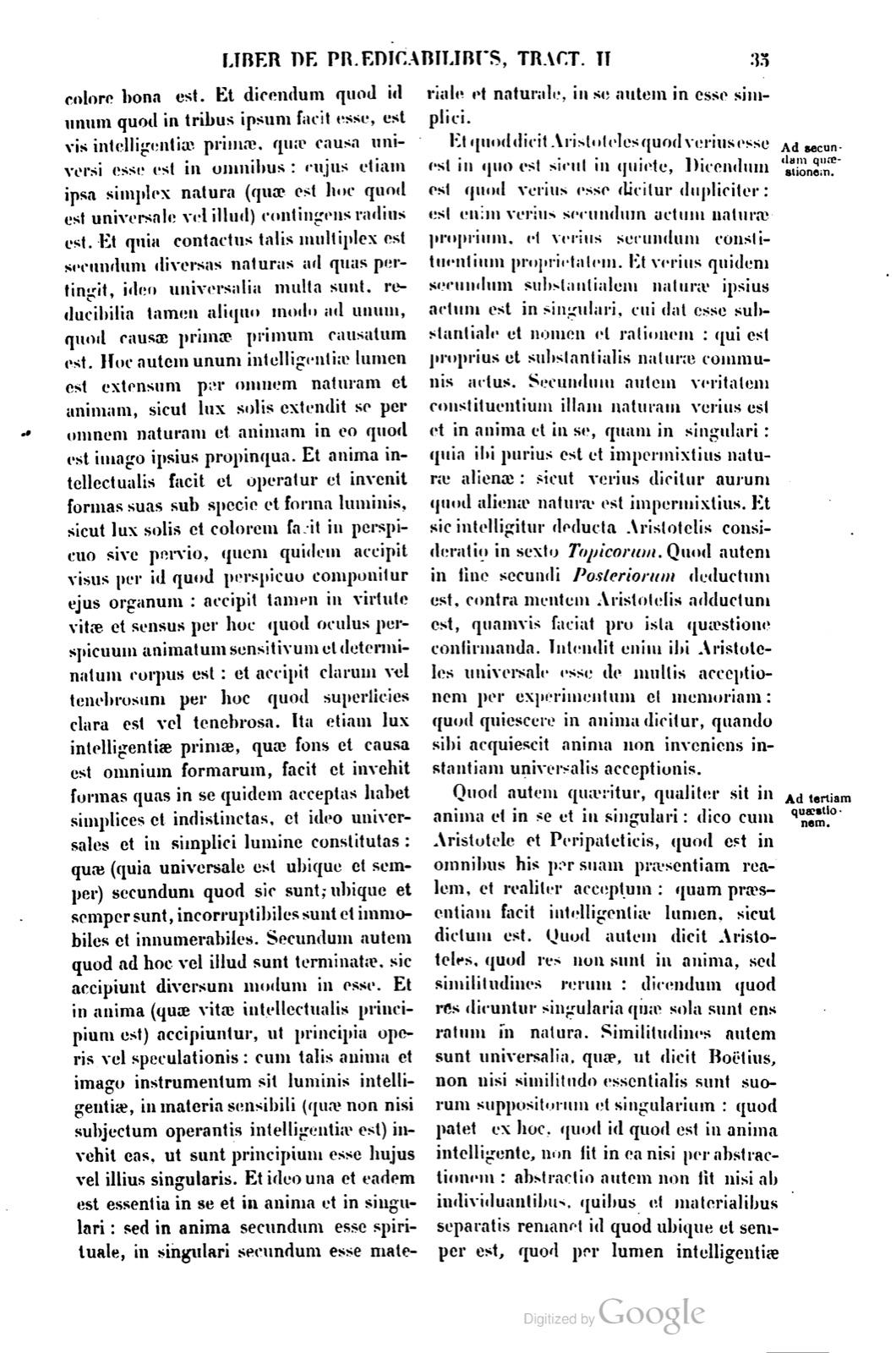
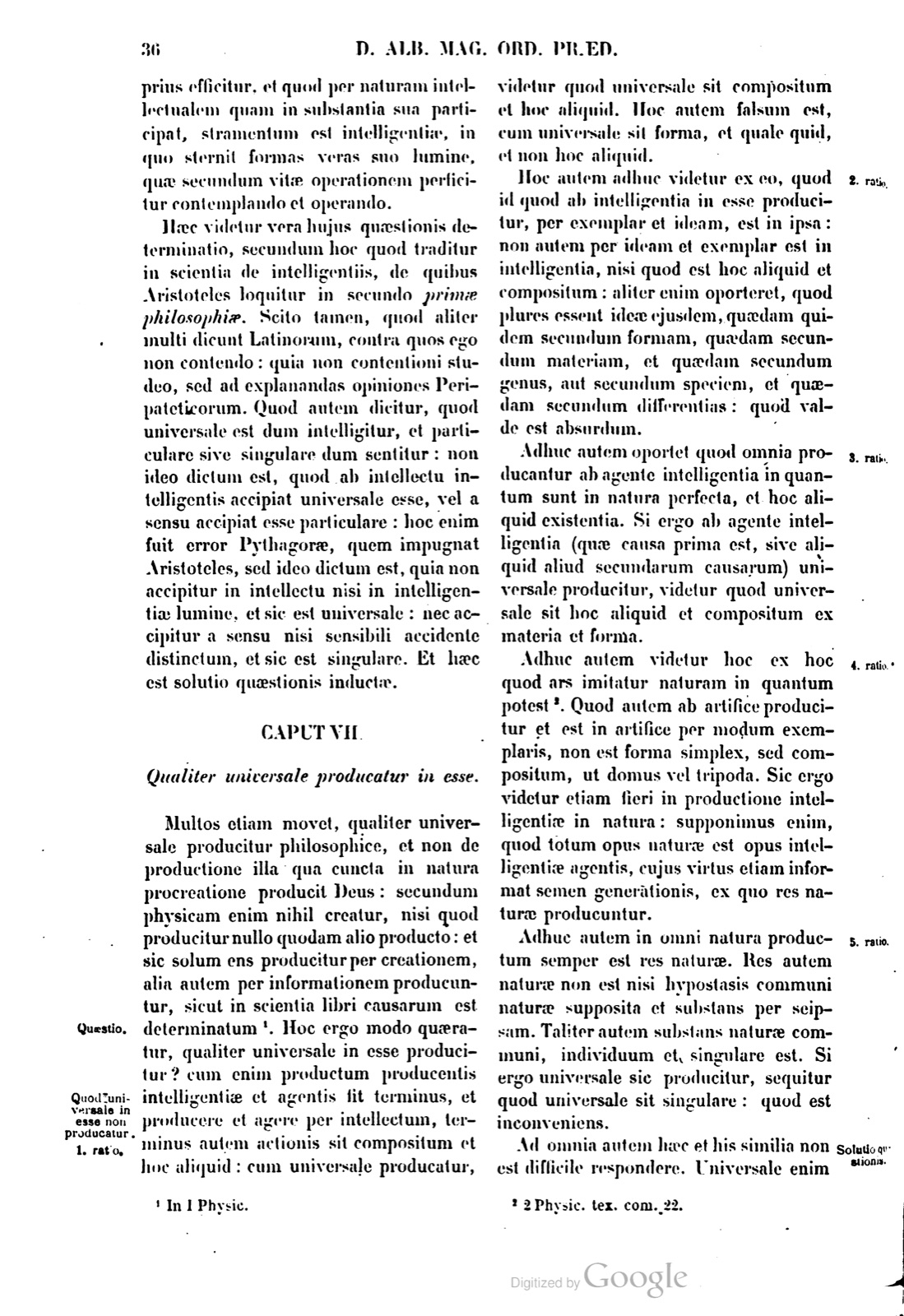
Quod autem quaeritur, qualiter sit in anima et in se et in singulari: dico cum Aristotele et Peripateticis, quod est in omnibus his per suam praesentiam realem, et realiter acceptum: quam praesentiam facit intelligentiae lumen, sicut dictum est. Quod autem dicit Aristoteles, quod res non sunt in anima, sed similitudines rerum: dicendum quod res dicuntur singularia quae sola sunt ens ratum in natura. Similitudines autem sunt universalia, quae, ut dicit Boetius, non nisi similitudo essentialis sunt suorum suppositorum et singularium: quod patet ex hoc, quod id quod est in anima intelligente, non fit in ea nisi per abstractionem: abstractio autem non fit nisi ab individuantibus, quibus et materialibus separatis remanet id quod ubique et semper est, quod per lumen intelligentiae prius efficitur, et quod per naturam intellectualem quam in substantia sua participat, stramentum est intelligentiae, in quo sternit formas veras suo lumine, quae secundum vitae operationem perficitur contemplando et operando.
Haec videtur vera hujus quaestionis determinatio, secundum hoc quod traditur in scientia de intelligentiis, de quibus Aristoteles loquitur in secundo primae philosophiae. Scito tamen, quod aliter multi dicunt Latinorum, contra quos ego non contendo: quia non contentioni studeo, sed ad explanandas opiniones Peripateticorum. Quod autem dicitur, quod universale est dum intelligitur, et particulare sive singulare dum sentitur: non ideo dictum est, quod ab intellectu intelligentis accipiat universale esse, vel a sensu accipiat esse particulare: hoc enim fuit error Pythagorae, quem impugnat Aristoteles, sed ideo dictum est, quia non accipitur in intellectu nisi in intelligentiae lumine, et sic est universale: nec accipitur a sensu nisi sensibili accidente distinctum, et sic est singulare. Et haec est solutio quaestionis inductae.
But as to what is asked, in what way it is in the soul and in itself and in the singular: I say with Aristotle and the Peripatetics that it is in all these through its real presence, and taken really; which presence the light of intelligence makes, as has been said. But as to what Aristotle says, that things are not in the soul, but likenesses of things: one must say that things are called singulars, which alone are ratified being in nature. But likenesses are universals, which, as Boethius says, are nothing except the essential likeness of their supposits and singulars. This is clear from this, that that which is in the understanding soul is made in it only through abstraction; but abstraction is made only from individuating things, and when these and material things have been separated, there remains that which is everywhere and always, which first is effected through the light of intelligence, and which, through the intellectual nature which it participates in its own substance, is the bedding of intelligence, in which it spreads true forms by its light, which is perfected according to the operation of life by contemplating and operating.
This seems the true determination of this question, according to what is handed down in the science concerning intelligences, about which Aristotle speaks in the second book of first philosophy. Know, nevertheless, that many of the Latins speak otherwise, against whom I do not contend, because I do not study contention, but the explaining of the opinions of the Peripatetics. But when it is said that the universal is while it is understood, and the particular or singular while it is sensed, it is not said for this reason, that it receives universal being from the intellect of the one understanding, or receives particular being from sense; for this was the error of Pythagoras, which Aristotle attacks. Rather it was said for this reason, that it is received in the intellect only in the light of intelligence, and thus it is universal; nor is it received by sense except as distinct by a sensible accident, and thus it is singular. And this is the solution of the question introduced.
Notes
- Compare Physics I, text, commentary 49. (Cf. I Physic. tex. com. 49.) ↩
- Averroes, On the Soul I, commentary 8. (Averroes, I de anima, com. 8.) ↩
- Aristotle, in On the Soul III, text, commentary 38. (Aristoteles, In 3 de anima, tex. com. 38.) ↩
- The same, in Topics VI, chapter 4, at the end. (Id. In 6 Topic. cap. 4 in fine.) ↩
- The same, in the second book, text, commentary 27. (Id. In secundo, tex. com. 27.) ↩
If a page does not appear, its photograph has not been uploaded yet.