Volume 1 · pp. 13–14
Chapter VI. On the part of logic which certifies the incomplex, and on the requirements for true definition, its faults, and the modes of definition.
A marker with ≈ is an approximate page boundary, placed by measure of the text; the page photographs remain the authority. In the paired views, clicking a page marker brings that page into view.
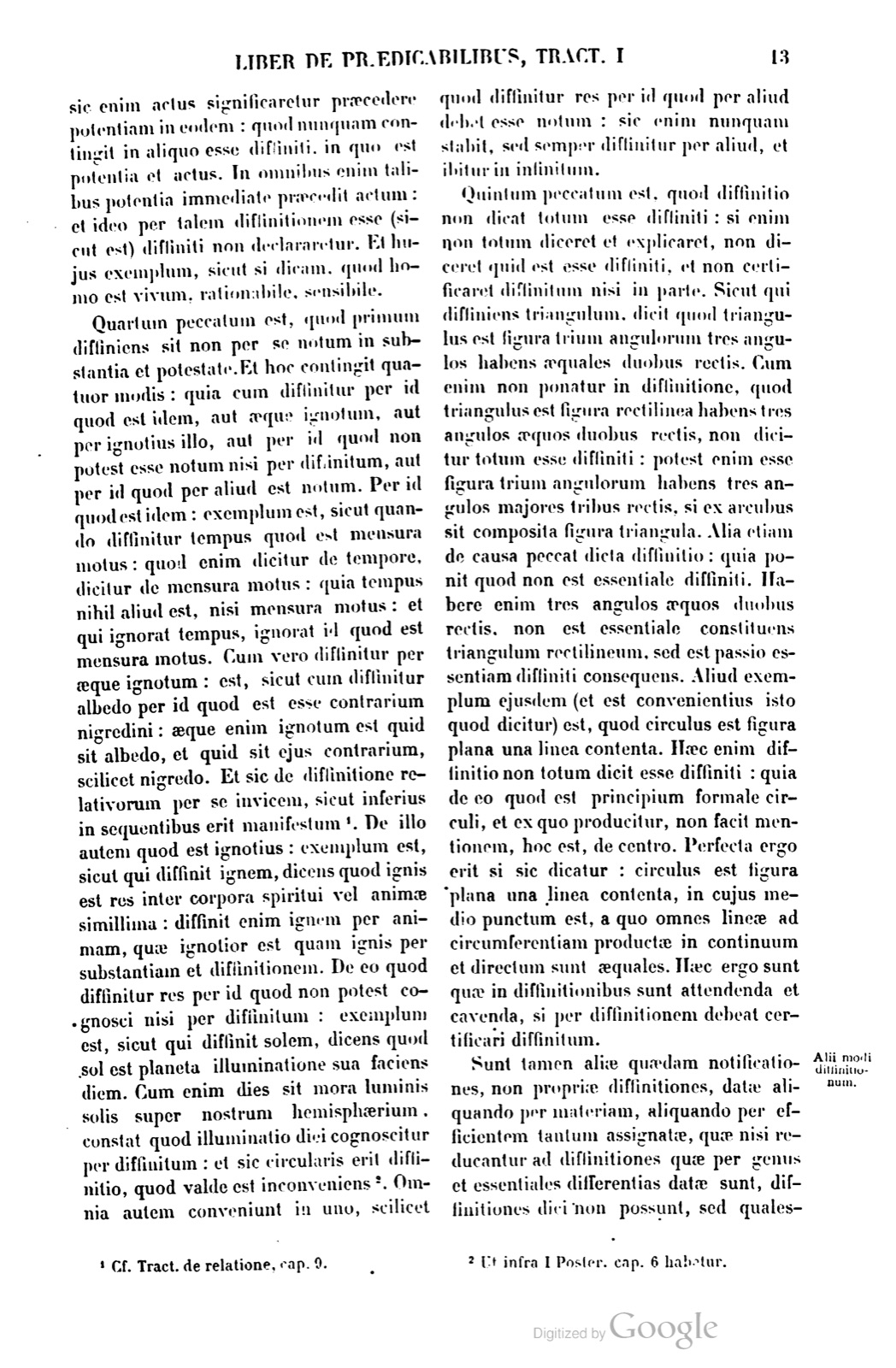
sic enim actus significaretur praecedere potentiam in eodem: quod nunquam contingit in aliquo esse diffiniti, in quo est potentia et actus. In omnibus enim talibus potentia immediate praecedit actum: et ideo per talem diffinitionem esse, sicut est, diffiniti non declararetur. Et hujus exemplum, sicut si dicam, quod homo est vivum, rationabile, sensibile.
Quartum peccatum est, quod primum diffiniens sit non per se notum in substantia et potestate. Et hoc contingit quatuor modis: quia cum diffinitur per id quod est idem, aut aeque ignotum, aut per ignotius illo, aut per id quod non potest esse notum nisi per diffinitum, aut per id quod per aliud est notum. Per id quod est idem: exemplum est, sicut quando diffinitur tempus quod est mensura motus: quod enim dicitur de tempore, dicitur de mensura motus: quia tempus nihil aliud est, nisi mensura motus: et qui ignorat tempus, ignorat id quod est mensura motus. Cum vero diffinitur per aeque ignotum: est, sicut cum diffinitur albedo per id quod est esse contrarium nigredini: aeque enim ignotum est quid sit albedo, et quid sit ejus contrarium, scilicet nigredo. Et sic de diffinitione relativorum per se invicem, sicut inferius in sequentibus erit manifestum 1. De illo autem quod est ignotius: exemplum est, sicut qui diffinit ignem, dicens quod ignis est res inter corpora spiritui vel animae simillima: diffinit enim ignem per animam, quae ignotior est quam ignis per substantiam et diffinitionem. De eo quod diffinitur res per id quod non potest cognosci nisi per diffinitum: exemplum est, sicut qui diffinit solem, dicens quod sol est planeta illuminatione sua faciens diem. Cum enim dies sit mora luminis solis super nostrum hemisphaerium, constat quod illuminatio diei cognoscitur per diffinitum: et sic circularis erit diffinitio, quod valde est inconveniens 2. Omnia autem conveniunt in uno, scilicet quod diffinitur res per id quod per aliud debet esse notum: sic enim nunquam stabit, sed semper diffinitur per aliud, et ibitur in infinitum.
Quintum peccatum est, quod diffinitio non dicat totum esse diffiniti: si enim non totum diceret et explicaret, non diceret quid est esse diffiniti, et non certificaret diffinitum nisi in parte. Sicut qui diffiniens triangulum, dicit quod triangulus est figura trium angulorum tres angulos habens aequales duobus rectis. Cum enim non ponatur in diffinitione, quod triangulus est figura rectilinea habens tres angulos aequos duobus rectis, non dicitur totum esse diffiniti: potest enim esse figura trium angulorum habens tres angulos majores tribus rectis, si ex arcubus sit composita figura triangula. Alia etiam de causa peccat dicta diffinitio: quia ponit quod non est essentiale diffiniti. Habere enim tres angulos aequos duobus rectis, non est essentiale constituens triangulum rectilineum, sed est passio essentiam diffiniti consequens. Aliud exemplum ejusdem, et est convenientius isto quod dicitur, est, quod circulus est figura plana una linea contenta. Haec enim diffinitio non totum dicit esse diffiniti: quia de eo quod est principium formale circuli, et ex quo producitur, non facit mentionem, hoc est, de centro. Perfecta ergo erit si sic dicatur: circulus est figura plana una linea contenta, in cujus medio punctum est, a quo omnes lineae ad circumferentiam productae in continuum et directum sunt aequales. Haec ergo sunt quae in diffinitionibus sunt attendenda et cavenda, si per diffinitionem debeat certificari diffinitum.
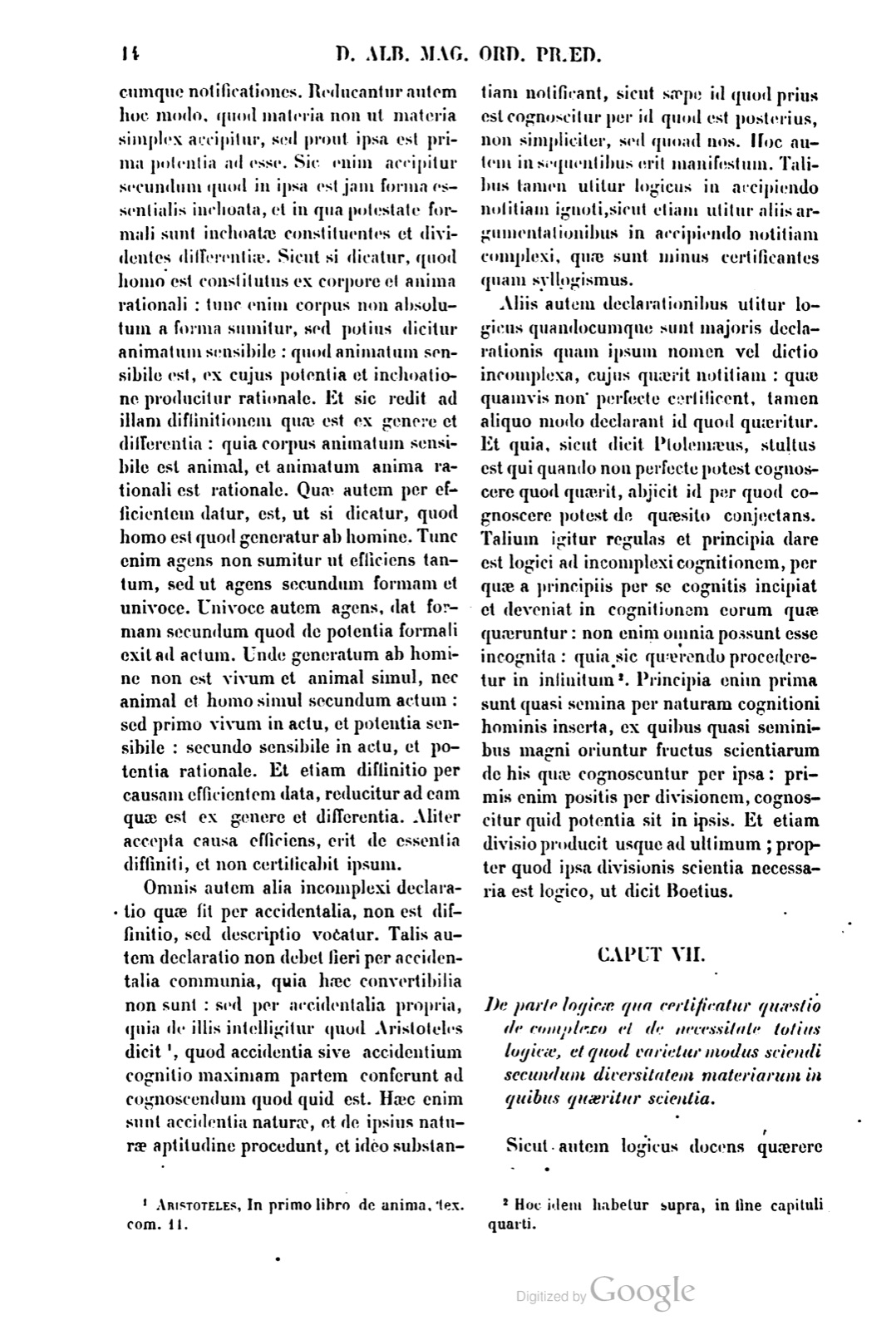
Sunt tamen aliae quaedam notificationes, non propriae diffinitiones, datae aliquando per materiam, aliquando per efficientem tantum assignatae, quae nisi reducantur ad diffinitiones quae per genus et essentiales differentias datae sunt, diffinitiones dici non possunt, sed qualescumque notificationes. Reducantur autem hoc modo, quod materia non ut materia simplex accipitur, sed prout ipsa est prima potentia ad esse. Sic enim accipitur secundum quod in ipsa est jam forma essentialis inchoata, et in qua potestate formali sunt inchoatae constituentes et dividentes differentiae. Sicut si dicatur, quod homo est constitutus ex corpore et anima rationali: tunc enim corpus non absolutum a forma sumitur, sed potius dicitur animatum sensibile: quod animatum sensibile est, ex cujus potentia et inchoatione producitur rationale. Et sic redit ad illam diffinitionem quae est ex genere et differentia: quia corpus animatum sensibile est animal, et animatum anima rationali est rationale. Quae autem per efficientem datur, est, ut si dicatur, quod homo est quod generatur ab homine. Tunc enim agens non sumitur ut efficiens tantum, sed ut agens secundum formam et univoce. Univoce autem agens, dat formam secundum quod de potentia formali exit ad actum. Unde generatum ab homine non est vivum et animal simul, nec animal et homo simul secundum actum: sed primo vivum in actu, et potentia sensibile: secundo sensibile in actu, et potentia rationale. Et etiam diffinitio per causam efficientem data, reducitur ad eam quae est ex genere et differentia. Aliter accepta causa efficiens, erit de essentia diffiniti, et non certificabit ipsum.
for thus act would be signified to precede potency in the same thing, which never happens in any being of a defined thing in which there is potency and act. For in all such things potency immediately precedes act, and therefore through such a definition the being of the defined thing would not be declared as it is. And an example of this is if I were to say that man is living, rational, sensible.
The fourth fault is that the first defining element is not known through itself in substance and power. And this happens in four ways, because a thing is defined either through that which is the same, or through what is equally unknown, or through what is more unknown than it, or through that which cannot be known except through the thing defined, or through that which is known through another. Through that which is the same: the example is as when time is defined as the measure of motion; for what is said of time is said of the measure of motion, because time is nothing other than the measure of motion, and he who is ignorant of time is ignorant of that which is the measure of motion. But when it is defined through what is equally unknown, it is as when whiteness is defined through that which is being contrary to blackness; for it is equally unknown what whiteness is and what its contrary is, namely blackness. And so it is concerning the definition of relatives through one another, as will be manifest below in what follows 1. But concerning that which is more unknown, the example is as one who defines fire, saying that fire is a thing among bodies most similar to spirit or soul; for he defines fire through soul, which is more unknown than fire by substance and definition. Concerning the case in which a thing is defined through that which cannot be known except through the thing defined, the example is as one who defines the sun, saying that the sun is a planet making the day by its illumination. For since day is the stay of the light of the sun over our hemisphere, it is agreed that the illumination of the day is known through the thing defined; and thus the definition will be circular, which is very unsuitable 2. But all agree in one point, namely that the thing is defined through that which ought to be known through another; for in this way it will never stand, but will always be defined through another, and one will go into infinity.
The fifth fault is that the definition does not state the whole being of the thing defined. For if it did not state and explain the whole, it would not state what the being of the defined thing is, and it would certify the defined thing only in part. As one defining triangle says that a triangle is a figure of three angles having three angles equal to two right angles. For since it is not placed in the definition that a triangle is a rectilinear figure having three angles equal to two right angles, the whole being of the defined thing is not stated; for it can be a figure of three angles having three angles greater than three right angles, if the triangular figure is composed from arcs. The stated definition also errs from another cause, because it posits what is not essential to the thing defined. For having three angles equal to two right angles is not the essential constituent of a rectilinear triangle, but is a property consequent upon the essence of the thing defined. Another example of the same, and one more suitable than the one which is stated, is that a circle is a plane figure contained by one line. For this definition does not state the whole being of the thing defined, because it makes no mention of that which is the formal principle of a circle and from which it is produced, that is, of the center. Therefore it will be perfect if it is stated thus: a circle is a plane figure contained by one line, in the middle of which there is a point from which all lines drawn to the circumference continuously and directly are equal. Therefore these are the things which must be attended to and avoided in definitions, if the thing defined ought to be certified through definition.
There are, however, certain other notifications, not proper definitions, sometimes given through matter, sometimes assigned through the efficient cause alone. Unless these are reduced to definitions which are given through genus and essential differences, they cannot be called definitions, but notifications of whatever sort. But they are reduced in this way: matter is not taken as simple matter, but insofar as it is the first potency toward being. For thus it is taken according as in it the essential form is already begun, and in that formal power the constituting and dividing differences are begun. As if it is said that man is constituted from body and rational soul; then body is not taken as freed from form, but rather is called animated sensible body; and this animated sensible body is that from whose potency and beginning rational is produced. And thus it returns to that definition which is from genus and difference, because animated sensible body is animal, and animated by a rational soul is rational. But the definition which is given through the efficient cause is as if it is said that man is what is generated by man. For then the agent is not taken as efficient only, but as agent according to form and univocally. But a univocal agent gives form according as it goes out from formal potency to act. Hence what is generated by man is not living and animal at the same time, nor animal and man at the same time according to act, but first living in act and sensible in potency, and second sensible in act and rational in potency. And also the definition given through the efficient cause is reduced to that which is from genus and difference. If the efficient cause is taken otherwise, it will be of the essence of the thing defined and will not certify it.
Omnis autem alia incomplexi declaratio quae fit per accidentalia, non est diffinitio, sed descriptio vocatur. Talis autem declaratio non debet fieri per accidentalia communia, quia haec convertibilia non sunt: sed per accidentalia propria, quia de illis intelligitur quod Aristoteles dicit 3, quod accidentia sive accidentium cognitio maximam partem conferunt ad cognoscendum quod quid est. Haec enim sunt accidentia naturae, et de ipsius naturae aptitudine procedunt, et ideo substantiam notificat, sicut saepe id quod prius est cognoscitur per id quod est posterius, non simpliciter, sed quoad nos. Hoc autem in sequentibus erit manifestum. Talibus tamen utitur logicus in accipiendo notitiam ignoti, sicut etiam utitur aliis argumentationibus in accipiendo notitiam complexi, quae sunt minus certificantes quam syllogismus.
Aliis autem declarationibus utitur logicus quandocumque sunt majoris declarationis quam ipsum nomen vel dictio incomplexa, cujus quaerit notitiam: quae quamvis non perfecte certificent, tamen aliquo modo declarant id quod quaeritur. Et quia, sicut dicit Ptolemaeus, stultus est qui quando non perfecte potest cognoscere quod quaerit, abjicit id per quod cognoscere potest de quaesito conjectans. Talium igitur regulas et principia dare est logici ad incomplexi cognitionem, per quae a principiis per se cognitis incipiat et deveniat in cognitionem eorum quae quaeruntur: non enim omnia possunt esse incognita: quia sic quaerendo procederetur in infinitum 4. Principia enim prima sunt quasi semina per naturam cognitioni hominis inserta, ex quibus quasi seminibus magni oriuntur fructus scientiarum de his quae cognoscuntur per ipsa: primis enim positis per divisionem, cognoscitur quid potentia sit in ipsis. Et etiam divisio producit usque ad ultimum; propter quod ipsa divisionis scientia necessaria est logico, ut dicit Boetius.
But every other declaration of the incomplex which is made through accidental things is not a definition, but is called a description. Such a declaration ought not be made through common accidental things, because these are not convertible, but through proper accidental things, because concerning these is understood what Aristotle says 3, that accidents or cognition of accidents contribute in the greatest part to knowing what a thing is. For these are accidents of nature, and proceed from the aptitude of that very nature, and therefore make known the substance, just as often what is prior is known through what is posterior, not simply, but with respect to us. But this will be manifest in what follows. Nevertheless the logician uses such things in receiving knowledge of the unknown, just as he also uses other argumentations in receiving knowledge of the complex, which certify less than syllogism.
But the logician uses other declarations whenever they are of greater declaration than the name itself or the incomplex diction whose knowledge he seeks. Although they do not perfectly certify, nevertheless in some way they declare that which is sought. And because, as Ptolemy says, he is foolish who, when he cannot perfectly know what he seeks, rejects that through which he can know by conjecturing concerning the thing sought. Therefore it belongs to the logician to give rules and principles of such things for cognition of the incomplex, through which he may begin from principles known through themselves and come into cognition of the things which are sought. For not all things can be unknown, because thus by seeking one would proceed into infinity 4. For the first principles are like seeds inserted by nature into the cognition of man, from which, as from seeds, great fruits of the sciences arise concerning those things which are known through them. For when first things have been posited through division, it is known what is in potency in them. And division also leads through to the last; for this reason the very science of division is necessary for the logician, as Boethius says.
Notes
- Compare the treatise On Relation, chapter 9. (Cf. Tract. de relatione, cap. 9.) ↩
- As is found below in Posterior Analytics I, chapter 6. (Ut infra I Poster. cap. 6 habetur.) ↩
- Aristotle, in the first book On the Soul, text, commentary 11. (Aristoteles, In primo libro de anima, tex. com. 11.) ↩
- This same thing is found above, at the end of the fourth chapter. (Hoc idem habetur supra, in fine capituli quarti.) ↩
If a page does not appear, its photograph has not been uploaded yet.