Volume 1 · pp. 11–12
Chapter VI. On the part of logic which certifies the incomplex, and on the requirements for true definition, its faults, and the modes of definition.
A marker with ≈ is an approximate page boundary, placed by measure of the text; the page photographs remain the authority. In the paired views, clicking a page marker brings that page into view.
Caput VI. De parte logicae quae certificat incomplexum, et de requisitis ad veram diffinitionem, ejusque peccatis, ac de modis diffinitionis.
Ex his autem quae dicta sunt patet, quod si quis quaerit scire incomplexum quod ignotum est, per id quod non potest sibi esse ignotum, non potest invenire notitiam ejus nisi per diffinitionem vel aliquid aliud quod diffinitionem imitatur incomplexi aliqua declaratione. Hujus autem principia et regulae sunt quinque, et quinque corruptiones. Primum quidem, quod omnia posita in diffinitione sunt substantialia et substantialiter in diffinito existentia: quia diffinitio dicitur id quod omnes fines essentiae diffinit, conjungit et unit, et explicat quae sunt principia diffiniti sive esse diffiniti, scilicet essentiam, potentiam, et ultimum actum complentem esse diffiniti, sicut dicimus animal rationale, mortale, voluntarie mobile, diffinitionem esse hominis. Animal autem secundum quod in se includit corpus animatum sensibile et substantiam, prima potentia est, in qua inchoatum est esse hominis. Haec autem inchoatio per rationale determinata est essentialiter ad actum rationis. Per mortale autem ad speciem est determinatum, praecipue secundum Stoicos, qui calodaemones et cacodaemones animalia rationalia, corpora aerea, et vita immortalia esse dicebant, ut dicunt Themistius et Apuleius. Per hoc autem quod mobile voluntarie dicitur, separatur ab aliis quae apta a natura et phantasia sunt ad motum. Et hoc est primum.
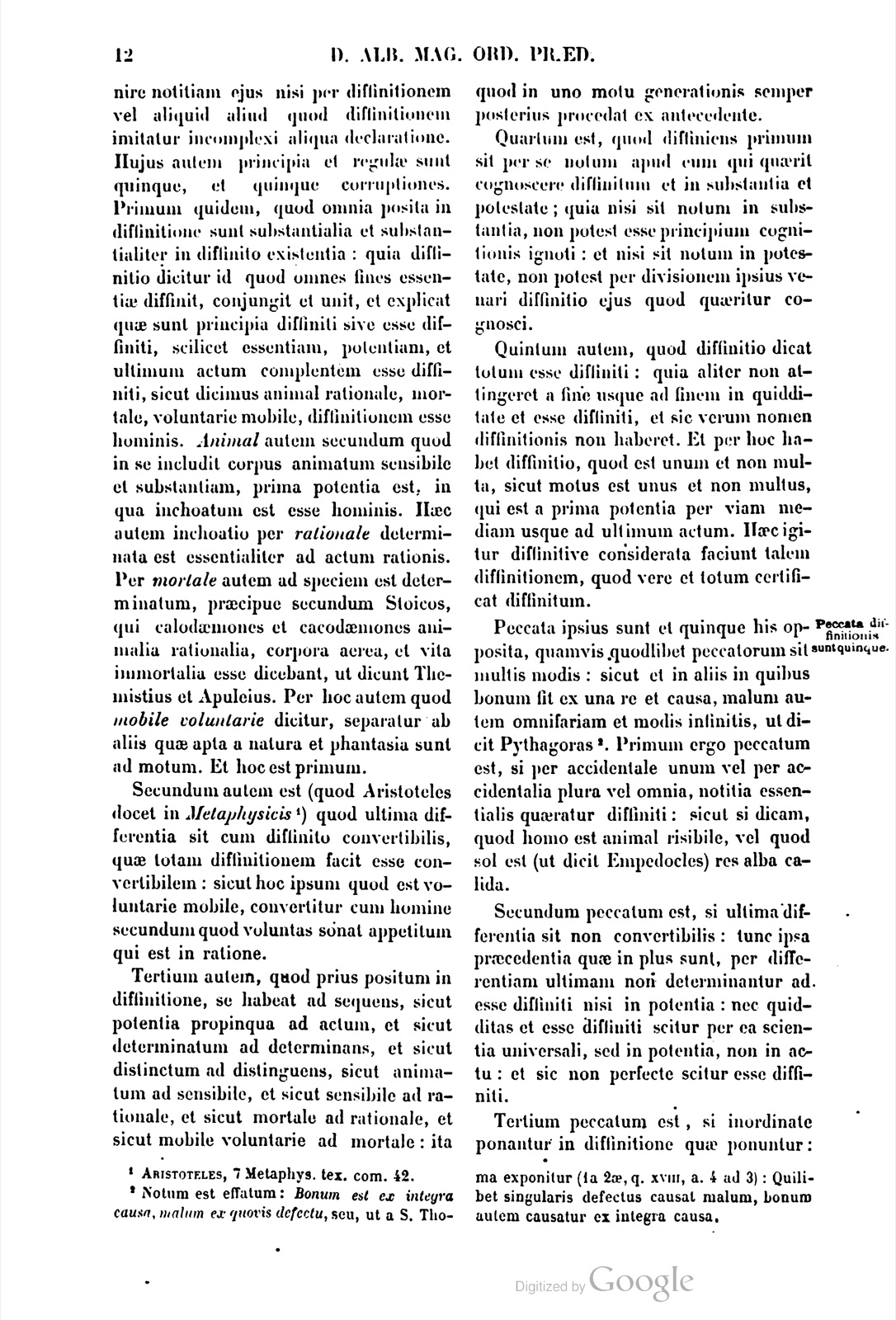
Secundum autem est, quod Aristoteles docet in Metaphysicis 1, quod ultima differentia sit cum diffinito convertibilis, quae totam diffinitionem facit esse convertibilem: sicut hoc ipsum quod est voluntarie mobile, convertitur cum homine secundum quod voluntas sonat appetitum qui est in ratione.
Tertium autem, quod prius positum in diffinitione, se habeat ad sequens, sicut potentia propinqua ad actum, et sicut determinatum ad determinans, et sicut distinctum ad distinguens, sicut animatum ad sensibile, et sicut sensibile ad rationale, et sicut mortale ad rationale, et sicut mobile voluntarie ad mortale: ita quod in uno motu generationis semper posterius procedat ex antecedente.
Chapter VI. On the part of logic which certifies the incomplex, and on the requirements for true definition, its faults, and the modes of definition.
But from the things which have been said it is clear that if someone seeks to know the incomplex which is unknown, through that which cannot be unknown to him, he cannot find knowledge of it except through definition or something else which imitates definition by some declaration of the incomplex. But the principles and rules of this are five, and there are five corruptions. The first is that all things posited in the definition are substantial and existing substantially in the thing defined, because definition is said to be that which defines, joins, and unites all the limits of the essence, and explains what the principles of the defined thing or of the being of the defined thing are, namely essence, potency, and the final act completing the being of the defined thing; as we say that rational, mortal animal, voluntarily movable, is the definition of man. But animal, insofar as it includes in itself animated sensible body and substance, is the first potency in which the being of man is begun. But this beginning is determined essentially, through rational, to the act of reason. But through mortal it is determined to the species, especially according to the Stoics, who used to say that good daemons and evil daemons are rational animals, airy bodies, and immortal in life, as Themistius and Apuleius say. But through the fact that voluntarily movable is said, it is separated from others which by nature and phantasy are apt for motion. And this is the first requirement.
The second, however, is, as Aristotle teaches in the Metaphysics 1, that the ultimate difference be convertible with the thing defined, and this makes the whole definition convertible; as this very thing which is voluntarily movable is converted with man, according as will sounds as an appetite which is in reason.
The third is that what is posited earlier in the definition be related to what follows as proximate potency to act, and as the determined to the determining, and as the distinct to the distinguishing, as animated to sensible, and as sensible to rational, and as mortal to rational, and as voluntarily movable to mortal; so that in one motion of generation the later always proceeds from the antecedent.
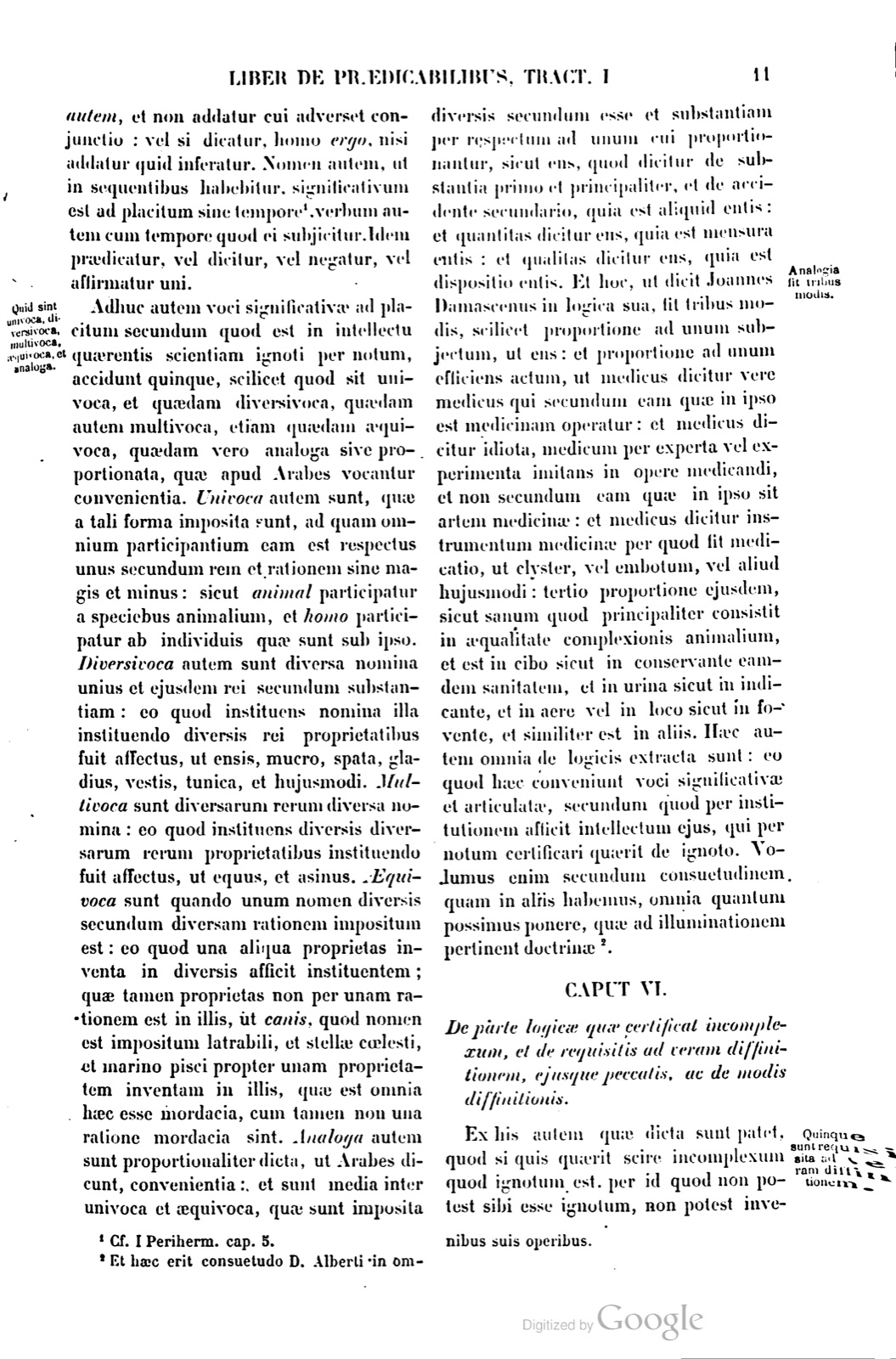
Quartum est, quod diffiniens primum sit per se notum apud eum qui quaerit cognoscere diffinitum et in substantia et potestate; quia nisi sit notum in substantia, non potest esse principium cognitionis ignoti: et nisi sit notum in potestate, non potest per divisionem ipsius venari diffinitio ejus quod quaeritur cognosci.
Quintum autem, quod diffinitio dicat totum esse diffiniti: quia aliter non attingeret a fine usque ad finem in quidditate et esse diffiniti, et sic verum nomen diffinitionis non haberet. Et per hoc habet diffinitio, quod est unum et non multa, sicut motus est unus et non multus, qui est a prima potentia per viam mediam usque ad ultimum actum. Haec igitur diffinitive considerata faciunt talem diffinitionem, quod vere et totum certificat diffinitum.
Peccata ipsius sunt et quinque his opposita, quamvis quodlibet peccatorum sit multis modis: sicut et in aliis in quibus bonum fit ex una re et causa, malum autem omnifariam et modis infinitis, ut dicit Pythagoras 2. Primum ergo peccatum est, si per accidentale unum vel per accidentalia plura vel omnia, notitia essentialis quaeratur diffiniti: sicut si dicam, quod homo est animal risibile, vel quod sol est, ut dicit Empedocles, res alba calida.
Secundum peccatum est, si ultima differentia sit non convertibilis: tunc ipsa praecedentia quae in plus sunt, per differentiam ultimam non determinantur ad esse diffiniti nisi in potentia: nec quidditas et esse diffiniti scitur per ea scientia universali, sed in potentia, non in actu: et sic non perfecte scitur esse diffiniti.
Tertium peccatum est, si inordinate ponantur in diffinitione quae ponuntur:
The fourth is that the first defining element be known through itself to him who seeks to know the thing defined, both in substance and in power; because unless it is known in substance, it cannot be a principle of cognition of the unknown, and unless it is known in power, the definition of that which is sought to be known cannot be hunted out through division of it.
The fifth is that the definition state the whole being of the thing defined; because otherwise it would not reach from limit to limit in the quiddity and being of the defined thing, and thus it would not have the true name of definition. And through this definition has the fact that it is one and not many, just as motion is one and not many when it is from the first potency through the middle way up to the final act. Therefore these things, considered definitorily, make such a definition that it truly certifies the whole thing defined.
Its faults also are five opposed to these, although any one of the faults is in many ways; as also in other things in which good comes from one thing and cause, but evil in every manner and in infinite ways, as Pythagoras says 2. Therefore the first fault is if essential knowledge of the thing defined is sought through one accidental thing, or through several accidental things, or through all accidental things; as if I were to say that man is a laughable animal, or that the sun is, as Empedocles says, a white hot thing.
The second fault is if the ultimate difference is not convertible; then those preceding things which are broader are not determined to the being of the thing defined by the ultimate difference except in potency, nor is the quiddity and being of the thing defined known through them by universal science, but in potency, not in act; and thus the being of the thing defined is not perfectly known.
The third fault is if the things which are posited in the definition are posited in a disorderly way:
Notes
- Aristotle, Metaphysics VII, text, commentary 42. (Aristoteles, 7 Metaphys. tex. com. 42.) ↩
- The saying is known: Good is from an entire cause, evil from any defect whatsoever, or, as it is explained by St. Thomas (First Part of the Second Part, question 18, article 4, reply to 3): Any single defect causes evil, but good is caused from an entire cause. (Notum est effatum: Bonum est ex integra causa, malum ex quovis defectu, seu, ut a S. Thoma exponitur (1a 2ae, q. XVIII, a. 4 ad 3): Quilibet singularis defectus causat malum, bonum autem causatur ex integra causa.) ↩
If a page does not appear, its photograph has not been uploaded yet.