Volume 1 · pp. 8–33
Chapter V. On the division of logic, what its parts are, and concerning a word signifying by convention, what and how it signifies.
A marker with ≈ is an approximate page boundary, placed by measure of the text; the page photographs remain the authority. In the paired views, clicking a page marker brings that page into view.
Caput V. De divisione logicae, et quae sint partes ipsius, et de voce significante ad placitum, quid et qualiter significet.
Divisio autem logicae, et quae sunt partes ipsius, ut dicunt Avicenna et Alfarabius, accipienda sunt ex intentione ipsius. Sicut vero jam ante dictum est, logica intendit docere principia per quae per id quod notum est, devenire potest in cognitionem ignoti. Est autem incomplexum, de quo quaeritur quid sit: aut complexum, de quo quaeritur an verum vel falsum sit. Sciri autem non potest incomplexum de quo quaeritur quid sit, nisi per diffinitionem. Complexum autem, de quo quaeritur an verum vel falsum sit, non potest sciri nisi per argumentationem. Istae ergo sunt duae partes logicae. Una quidem ut doceantur principia per quae sciatur diffinitio rei et quidditas: ita quod per principia illa doceatur quae sit vera rei diffinitio, et quae non, et quae videatur esse et non sit. Alia vero ut doceantur principia qualiter per argumentationem probetur enuntiationis veritas vel falsitas. Et ut doceatur illius argumentationis forma, quantum ad figuram et modum, et quietationem seu complexionem: et ut doceatur ejusdem argumentationis materia. Et ut doceatur quae videatur esse argumentatio, et non sit: eo quod apparentiam aliquam quidem habet, sed veram existentiam non habet. Et ut doceantur cautelae quibus opponens vel respondens per aliquam occasionem impediatur vel commoveatur a conjectu veritatis, vel ad hoc quod perfecte videat veritatem et non divertat ab ipsa.
Sed prima harum partium 1 vel ab Antiquis tradita non est, vel ad nos non pervenit. Hanc etiam partem dicunt Avicenna et Alfarabius ad Arabes non pervenisse. Dicit tamen Aristoteles in plerisque locis hanc causam erroris fuisse Antiquis: quia artem diffiniendi non habebant. Quod autem quidam dicunt hanc tradidisse Aristotelem in sexto Topicorum, frivolum est: ibi enim partem diffiniendi non tradidit, sed docet terminare problema illud quo quaeritur quid insit ut diffinitio. Adhuc autem quidam alii dicunt haec pertinere ad metaphysicam, et Aristotelem hanc tradidisse in septimo et octavo primae philosophiae: sed hoc absurdum est. Aristoteles enim ibi docet quae sint diffinientia tam substantiam quam accidens, et quae sit diffinitio physica, et qualiter diffinitio est unum et non multa, et talia hujusmodi. Sed qualiter diffiniendo respondetur ad quaestionem qua quaeritur quid est res per essentiam et quidditatem, non docet: quia hoc ad logicam pertinet, et non ad primam philosophiam. Patet igitur, quod haec pars nondum ad nos pervenit. Sunt et harum partium subdivisiones quae exequitur logica: de quibus in sequentibus erit tractatus.
Quia autem logica omnia considerat prout sunt in anima sive in intellectu ejus, qui quaerit per notum sibi venire in notitiam ignoti: gratia horum considerat de voce significante ad placitum, et quid et qualiter significet: quod antiquiores Peripatetici, ut dicunt Alfarabius et Algazel, in quinque modis distinxerunt. Primo quidem et principaliter dictio significat id ad quod prima institutione significare est instituta, ut homo hominem, et domus domum, et sic de aliis. Secundo modo significare dicitur quod ex consequenti supponitur in ipsa, sicut domus significat fundamentum et parietem, et quodlibet totum integrale sic significat suas partes integrales et principales. Tertio modo quando res comitatur significationem ipsius: sicut si paries est, fundamentum esse significat, et si tectum est, fundamentum et parietem esse significat. Quarto quando unum est in intellectu alterius, sicut homo significat animal, et significat rationale. Et ad hunc modum reducitur, quod accidens et passio significat subjectum, sicut simus significat nasum, et sicut album significat corpus terminatum, et caetera hujusmodi. Quinto sicut oppositio significat oppositionem, et oppositum significat oppositum: sicut disgregatio albi significat aggregationem nigri, et motus ad centrum frigidi significat motum a centro calidi, et caetera hujusmodi. Et hoc ad logicam pertinet per hoc, quod logica est disserendi scientia: disseri autem non potest, ut dicit Aristoteles 2, nisi detur quod nomina aliquid significant, eo quod non significant infinita. Gratia hujus etiam considerat de communibus et vocibus incomplexis.
Chapter V. On the division of logic, what its parts are, and concerning a word signifying by convention, what and how it signifies.
But the division of logic, and what its parts are, as Avicenna and Alfarabius say, are to be taken from its intention. But as has already been said before, logic intends to teach the principles through which, by that which is known, one can come into cognition of the unknown. Now there is the incomplex, concerning which it is asked what it is, or the complex, concerning which it is asked whether it is true or false. But the incomplex concerning which it is asked what it is cannot be known except through definition. But the complex concerning which it is asked whether it is true or false cannot be known except through argumentation. Therefore these are the two parts of logic. One is that the principles be taught through which the definition and quiddity of a thing may be known, so that through those principles it may be taught what is the true definition of a thing, and what is not, and what seems to be one and is not. The other is that the principles be taught by which the truth or falsity of an enunciation may be proved through argumentation; and that the form of that argumentation be taught as to figure and mode, and quietation or complexion; and that the matter of the same argumentation be taught; and that it be taught what seems to be argumentation and is not, because it indeed has some appearance, but does not have true existence; and that cautions be taught by which the one objecting or responding may, through some occasion, be impeded or moved away from the conjecture of truth, or toward this, that he may perfectly see the truth and not turn away from it.
But the first of these parts 1 either was not handed down by the Ancients, or has not come down to us. Avicenna and Alfarabius also say that this part did not come down to the Arabs. Nevertheless Aristotle says in many places that this was a cause of error for the Ancients, because they did not have the art of defining. But what certain men say, that Aristotle handed this down in the sixth book of the Topics, is frivolous; for there he did not hand down the part of defining, but teaches how to terminate that problem in which it is asked what inheres as a definition. Again, certain others say that these things pertain to metaphysics, and that Aristotle handed this down in the seventh and eighth books of first philosophy; but this is absurd. For Aristotle there teaches what the things defining both substance and accident are, and what physical definition is, and how definition is one and not many, and such things of this sort. But he does not teach how, by defining, one answers the question by which it is asked what a thing is through essence and quiddity, because this pertains to logic and not to first philosophy. Therefore it is clear that this part has not yet come down to us. There are also subdivisions of these parts which logic carries out, concerning which there will be a treatise in what follows.
But because logic considers all things insofar as they are in the soul or in the intellect of the one who seeks through what is known to himself to come into knowledge of the unknown, for the sake of these things it considers the word signifying by convention, and what and how it signifies. The earlier Peripatetics, as Alfarabius and Algazel say, distinguished this in five modes. First and principally, a diction signifies that for the signifying of which it was instituted by first institution, as man signifies man, and house signifies house, and so concerning others. In the second mode, to signify is said of what is consequently supposed in it, as house signifies foundation and wall, and any integral whole thus signifies its integral and principal parts. In the third mode, when a thing accompanies the signification of it; as if there is a wall, it signifies that there is a foundation, and if there is a roof, it signifies that there are a foundation and wall. In the fourth mode, when one thing is in the intellect of another, as man signifies animal and signifies rational. And to this mode is reduced the fact that an accident and a passion signify the subject, as snub signifies nose, and as white signifies a bounded body, and the other things of this sort. In the fifth mode, just as opposition signifies opposition and an opposite signifies an opposite; as the disgregation of white signifies the aggregation of black, and the motion of cold toward the center signifies the motion of hot away from the center, and the other things of this sort. And this pertains to logic through the fact that logic is the science of discussing; but one cannot discuss, as Aristotle says 2, unless it is granted that names signify something, because they do not signify infinite things. For the sake of this, logic also considers common things and incomplex words.
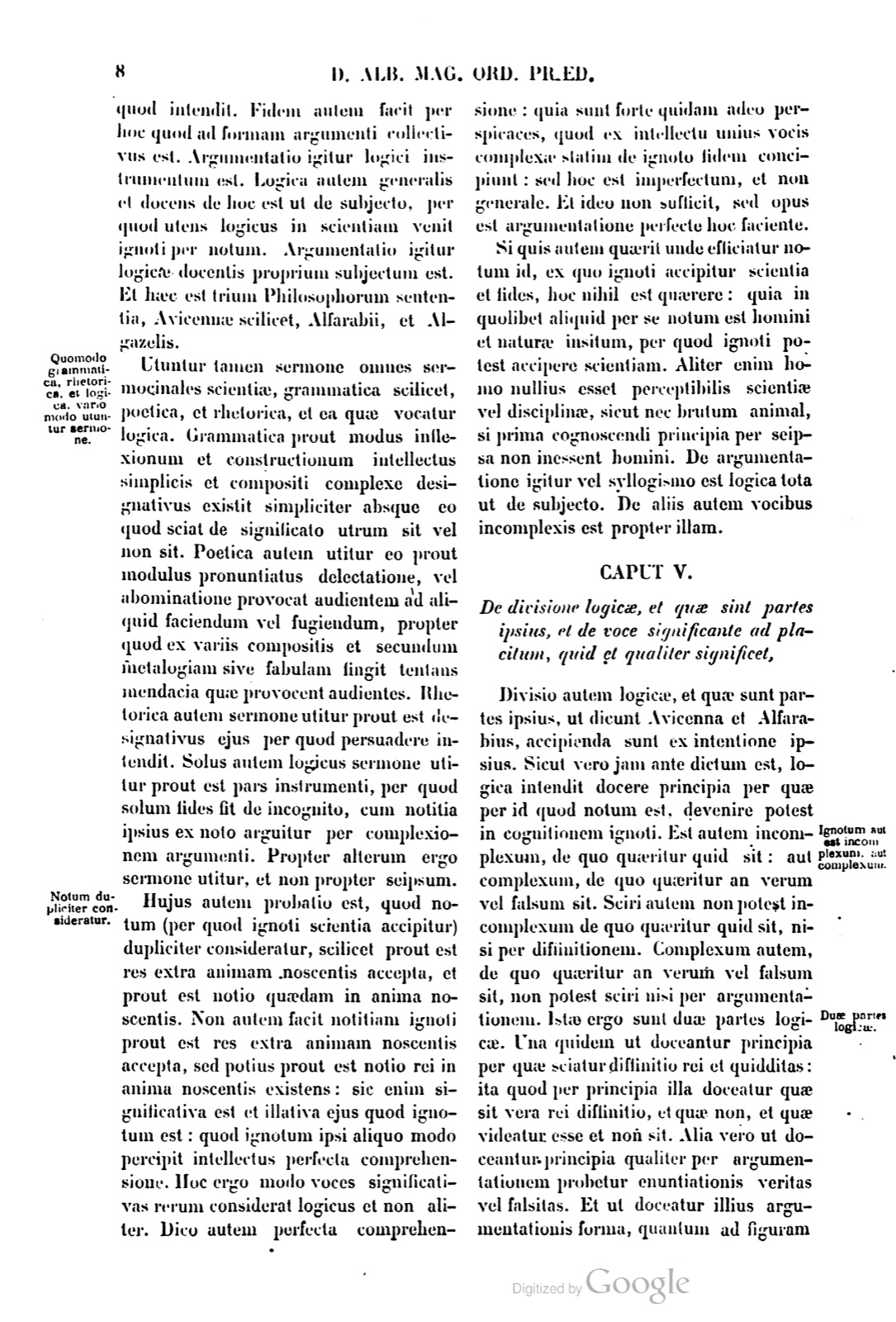
Complexio autem et incomplexio non accidunt rei secundum quod res est, nec etiam voci secundum quod est vox: sed accidunt voci secundum quod refertur ad intellectum simplicem vel compositum. Simplicem autem dico intellectum, qui simplex unius rei est intuitivus. Talis enim intellectus non significatur ad alium, nisi voce sive dictione incomplexa.
Compositum autem dico intellectum, qui accipit rem unam in alia vel ut divisam ab alia: qui intellectus voce incomplexa designari non potest, sed potius complexa: sicut homo est animal, vel homo ambulat, vel homo non est lapis, et hujusmodi. Propter quod diffinientes incomplexum veteres Peripatetici dixerunt, quod dictio significativa ad placitum incomplexa est 3, cujus partes nihil significant de intentione 4 totius: sicut cum dicitur homo, pars ita quae est ho, et pars alia quae est mo, nihil significant de hominis intentione. Quod si etiam nomen aliquod rei unius simplicis sit compositum, sicut Adeodatus, tamen, secundum quod unius simplicis rei nomen est, incomplexa dictio est. Et hoc quod dico Adeo, et hoc quod dico datus, nihil significant de intentione totius nominati per hoc nomen Adeodatus. Complexa autem dictio est, cujus partes aliquid significant de intentione totius, sicut cum dicimus, homo ambulat; et haec dictio homo, et haec dictio ambulat, aliquid significant de intentione hujus complexi, homo ambulat.
Adhuc autem vox secundum quod refertur ad intellectum ejus qui quaerit invenire ignotum per notum, habet quod dividitur in commune, seu universale: et proprium, sive singulare: talium enim nihil accidit ei secundum quod ad rem designatam refertur. Res enim omnes sunt singulares quae cadunt sub sensu et secundum quod constituuntur a natura: et commune quod est in eis, accipitur ab intellectu. Et ideo dicunt Aristoteles 5 et Boetius, quod universale est dum intelligitur, singulare vero dum sentitur. Commune tamen quod est in eis, est tribus modis, scilicet id quod est actu in pluribus, ut homo quod actu divisibile est in plures, ita quod totum est in singulis per naturam et rationem: et id quod actu est in uno, aptitudine vero naturae potest esse in pluribus, sicut hoc commune quod est sol: et id quod nec actu est in pluribus, nec in aliquo vel uno solo, sed aptitudine non repugnat et ratione quin possit esse in multis, sicut eptangulum, si ponimus nihil esse eptangulum secundum actum, tamen secundum aptitudinem est et potest esse in multis. Et ut generaliter dicatur, omne nomen vel dictio, quod imponitur a forma communicabili multis, sive illa forma sit accidentalis, sive substantialis, commune est et universale, sive secundum actum multis communicetur, sive non.
But complexion and incomplexion do not belong to a thing according as it is a thing, nor even to a word according as it is a word, but they belong to a word according as it is referred to simple or composed intellect. But I call a simple intellect that which is the simple beholding of one thing. For such an intellect is not signified to another except by an incomplex word or diction.
But I call a composed intellect that which receives one thing in another or as divided from another; and this intellect cannot be designated by an incomplex word, but rather by a complex one, as man is an animal, or man walks, or man is not a stone, and things of this sort. For this reason the old Peripatetics, defining the incomplex, said that an incomplex diction is a significant diction by convention 3, whose parts signify nothing of the intention 4 of the whole; as when man is said, the part which is ma and the other part which is n signify nothing of the intention of man. But even if some name of one simple thing is composite, as Adeodatus, nevertheless, insofar as it is the name of one simple thing, it is an incomplex diction. And this which I say, Adeo, and this which I say, datus, signify nothing of the intention of the whole thing named by this name Adeodatus. But a complex diction is that whose parts signify something of the intention of the whole, as when we say, man walks; and this diction man, and this diction walks, signify something of the intention of this complex, man walks.
Again, a word, according as it is referred to the intellect of the one who seeks to find the unknown through the known, has this, that it is divided into common or universal, and proper or singular; for none of such things belongs to it according as it is referred to the thing designated. For all things which fall under sense and according as they are constituted by nature are singular; and the common which is in them is received by the intellect. And therefore Aristotle 5 and Boethius say that the universal exists while it is understood, but the singular while it is sensed. Yet the common that is in them is in three modes, namely that which is actually in many, as man, which is actually divisible into many, so that the whole is in each singular by nature and reason; and that which is actually in one, but by aptitude of nature can be in many, as this common thing which is sun; and that which neither actually is in many nor in some one or one only, but by aptitude and reason is not repugnant to being able to be in many, as heptagon, if we posit that no heptagon exists according to act, nevertheless according to aptitude it is and can be in many. And to speak generally, every name or diction which is imposed from a form communicable to many, whether that form is accidental or substantial, is common and universal, whether it is communicated to many according to act or not.
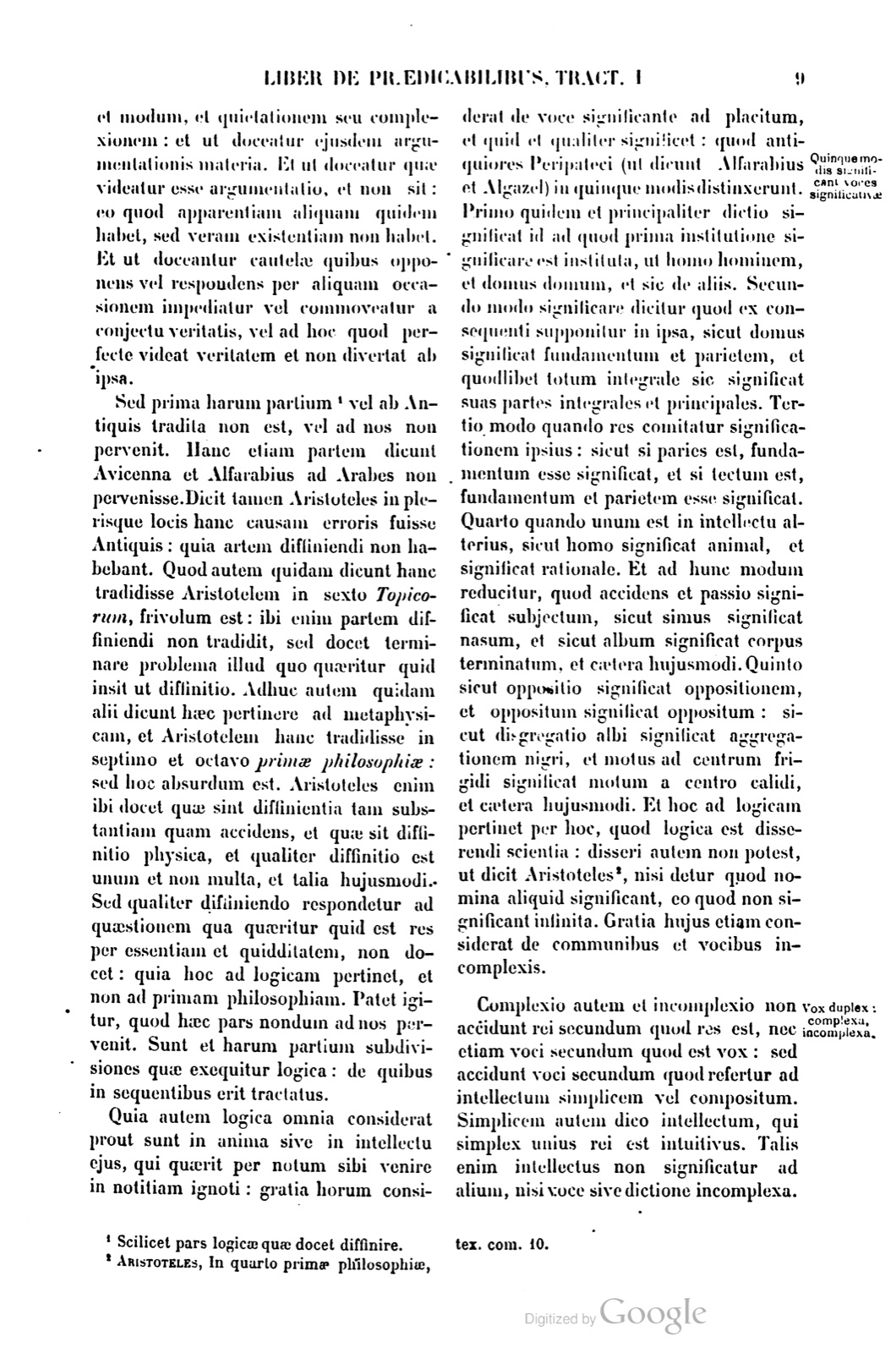
Proprium autem sive singulare est quod imponitur a forma accidentali significante accidentium collectionem quam impossibile est inveniri nisi in uno solo, ut socratitas, vel platonitas: quae ex parentibus subjectis, et loco nativitatis, et aliis hujusmodi, non nisi uni convenire potest, et impossibile est ut in alio reperiatur. Et hoc dupliciter fit: vel enim fit nomine proprio, vel nutu demonstrationis ad hoc singulare, ut cum dicimus, hoc lignum, vel hoc album: hoc enim sic est hoc, quod non potest esse aliud.
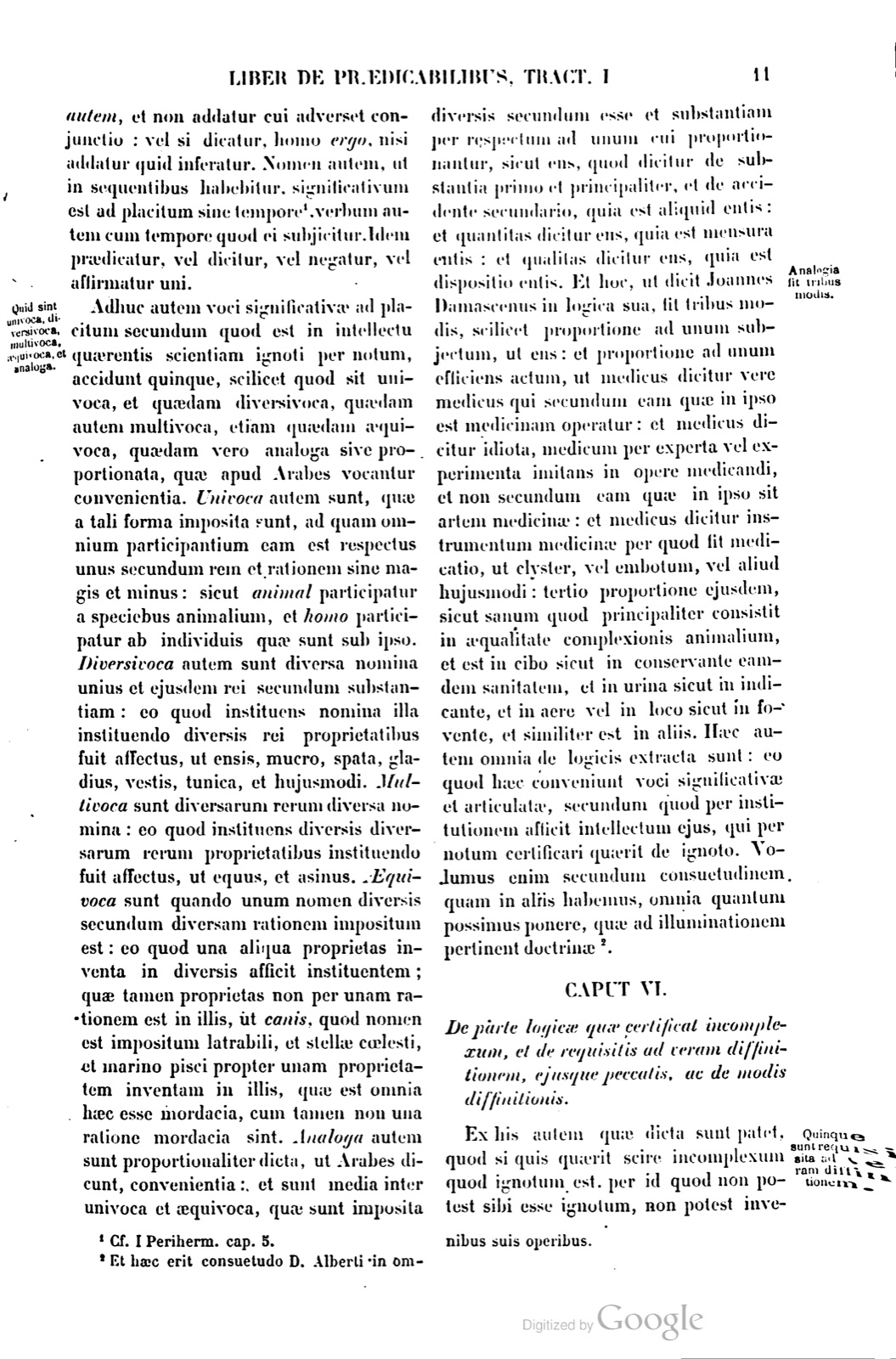
Adhuc dictio sive vox significativa est articulata, non ex hoc quod refertur ad rem designatam, sed ex hoc quod est in intellectu quaerentis scire ignotum per notum: licet etiam quaedam ipsius sit nomen, quaedam autem verbum. Pronomen autem, sicut et nomen suum testatur, vice nominis in supponendo accipitur: et participium cum suppletione verbi substantivi in apponendo vel praedicando supplet vicem verbi: sicut cum dicitur, homo est amans, vel homo amat, vel homo fuit amans, vel homo amavit, vel homo erit amans, vel homo amabit. Caeterae autem partes indeclinabiles sine adjunctis nullum habent intellectum: ut si dicatur, homo est in, non intelligitur nisi addatur in quo sit, ut in domo. Et similiter cum dicitur, homo est supra, et non addatur supra quid; et si dicatur, homo autem, et non addatur cui adverset conjunctio: vel si dicatur, homo ergo, nisi addatur quid inferatur. Nomen autem, ut in sequentibus habebitur, significativum est ad placitum sine tempore 6; verbum autem cum tempore quod ei subjicitur. Idem praedicatur, vel dicitur, vel negatur, vel affirmatur uni.
Adhuc autem voci significativae ad placitum secundum quod est in intellectu quaerentis scientiam ignoti per notum, accidunt quinque, scilicet quod sit univoca, et quaedam diversivoca, quaedam autem multivoca, etiam quaedam aequivoca, quaedam vero analoga sive proportionata, quae apud Arabes vocantur convenientia. Univoca autem sunt, quae a tali forma imposita sunt, ad quam omnium participantium eam est respectus unus secundum rem et rationem sine magis et minus: sicut animal participatur a speciebus animalium, et homo participatur ab individuis quae sunt sub ipso. Diversivoca autem sunt diversa nomina unius et ejusdem rei secundum substantiam: eo quod instituens nomina illa instituendo diversis rei proprietatibus fuit affectus, ut ensis, mucro, spata, gladius, vestis, tunica, et hujusmodi. Multivoca sunt diversarum rerum diversa nomina: eo quod instituens diversis diversarum rerum proprietatibus instituendo fuit affectus, ut equus, et asinus. Aequivoca sunt quando unum nomen diversis secundum diversam rationem impositum est: eo quod una aliqua proprietas inventa in diversis afficit instituentem; quae tamen proprietas non per unam rationem est in illis, ut canis, quod nomen est impositum latrabili, et stellae coelesti, et marino pisci propter unam proprietatem inventam in illis, quae est omnia haec esse mordacia, cum tamen non una ratione mordacia sint. Analoga autem sunt proportionaliter dicta, ut Arabes dicunt, convenientia: et sunt media inter univoca et aequivoca, quae sunt imposita diversis secundum esse et substantiam per respectum ad unum cui proportionantur, sicut ens, quod dicitur de substantia primo et principaliter, et de accidente secundario, quia est aliquid entis: et quantitas dicitur ens, quia est mensura entis: et qualitas dicitur ens, quia est dispositio entis. Et hoc, ut dicit Joannes Damascenus in logica sua, fit tribus modis, scilicet proportione ad unum subjectum, ut ens: et proportione ad unum efficiens actum, ut medicus dicitur vere medicus qui secundum eam quae in ipso est medicinam operatur: et medicus dicitur idiota, medicum per experta vel experimenta imitans in opere medicandi, et non secundum eam quae in ipso sit artem medicinae: et medicus dicitur instrumentum medicinae per quod fit medicatio, ut clyster, vel embotum, vel aliud hujusmodi: tertio proportione ejusdem, sicut sanum quod principaliter consistit in aequalitate complexionis animalium, et est in cibo sicut in conservante eamdem sanitatem, et in urina sicut in indicante, et in aere vel in loco sicut in fovente, et similiter est in aliis. Haec autem omnia de logicis extracta sunt: eo quod haec conveniunt voci significativae et articulatae, secundum quod per institutionem afficit intellectum ejus, qui per notum certificari quaerit de ignoto. Volumus enim secundum consuetudinem quam in aliis habemus, omnia quantum possimus ponere, quae ad illuminationem pertinent doctrinae 7.
But the proper or singular is that which is imposed from an accidental form signifying a collection of accidents which it is impossible to find except in one alone, as Socrateity or Platonity, which from the parents as subjects, and from the place of birth, and from other things of this sort, can belong only to one, and it is impossible that it be found in another. And this occurs in two ways: either it occurs by a proper name, or by a gesture of demonstration toward this singular, as when we say, this wood, or this white; for this is thus this, that it cannot be another.
Again, a diction or significant word is articulated, not from the fact that it is referred to the designated thing, but from the fact that it is in the intellect of the one seeking to know the unknown through the known; although also some of it is a noun, but some a verb. But a pronoun, as its own name also bears witness, is taken in place of a noun in supposing; and a participle with the supplying of the substantive verb, in apposing or predicating, supplies the place of a verb; as when it is said, man is loving, or man loves, or man was loving, or man loved, or man will be loving, or man will love. But the other indeclinable parts without adjuncts have no understanding, as if it is said, man is in, it is not understood unless there is added in what he is, as in a house. And similarly when it is said, man is above, and there is not added above what; and if it is said, however man, and there is not added against what the conjunction sets him, or if it is said, therefore man, unless there is added what is inferred. But a noun, as will be had in what follows, is significative by convention without time 6; but a verb is with the time which is subjected to it. The same thing is predicated, or said, or denied, or affirmed of one.
Again, to a word signifying by convention, according as it is in the intellect of one seeking science of the unknown through the known, five things belong, namely that it is univocal, and some are diversivocal, some multivocal, likewise some equivocal, and some analogous or proportioned, which among the Arabs are called convenient. Univocal things are those which have been imposed from such a form to which there is one relation, according to thing and reason and without more and less, of all those participating in it; as animal is participated in by the species of animals, and man is participated in by the individuals which are under it. Diversivocal things are diverse names of one and the same thing according to substance, because the one instituting those names, in instituting them, was affected by diverse properties of the thing, as sword, point, broadsword, blade, garment, tunic, and things of this sort. Multivocal things are diverse names of diverse things, because the one instituting them, in instituting them, was affected by diverse properties of diverse things, as horse and ass. Equivocal things are when one name has been imposed on diverse things according to diverse reason, because some one property found in diverse things affects the one instituting it; yet that property is not in them according to one reason, as dog, which name is imposed on the barking animal, the heavenly star, and the marine fish on account of one property found in them, which is that all these are biting, although they are not biting according to one reason. But analogous things are things said proportionally, as the Arabs say, convenient; and they are intermediate between univocal and equivocal things, which are imposed on diverse things according to being and substance by respect to one thing to which they are proportioned, as being, which is said of substance first and principally, and of accident secondarily, because it is something of being; and quantity is called being because it is the measure of being; and quality is called being because it is a disposition of being. And this, as John Damascene says in his Logic, occurs in three ways, namely by proportion to one subject, as being; and by proportion to one thing effecting an act, as that man is truly called physician who operates according to the medicine which is in him, and an untrained person is called physician who imitates the physician through experienced things or experiments in the work of healing, and not according to the art of medicine which may be in him, and an instrument of medicine is called physician through which medication is made, as a clyster, or funnel, or another thing of this sort; third, by proportion of the same thing, as healthy, which principally consists in the equality of the complexion of animals, and is in food as in that conserving the same health, and in urine as in that indicating it, and in air or in place as in that fostering it, and similarly is in other things. But all these things have been drawn out from logical matters, because they belong to the significant and articulated word, according as through institution it affects the intellect of him who seeks to be certified concerning the unknown through the known. For according to the custom which we have in other works, we wish to set down, so far as we can, all things which pertain to the illumination of doctrine 7.
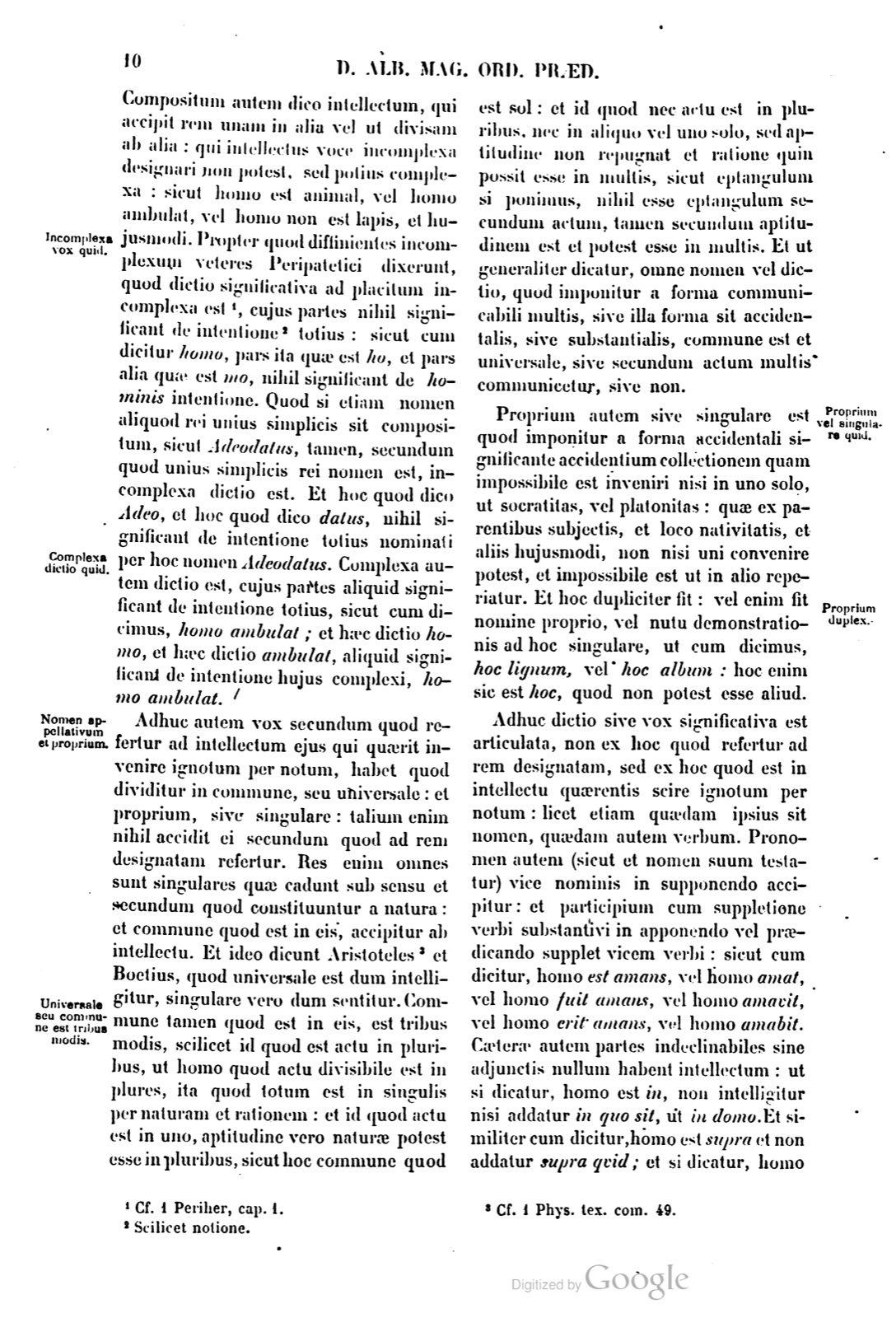
CAPUT V.
Utrum universalia sint separata a sensibilibus, an in ipsis sensibilibus posita?
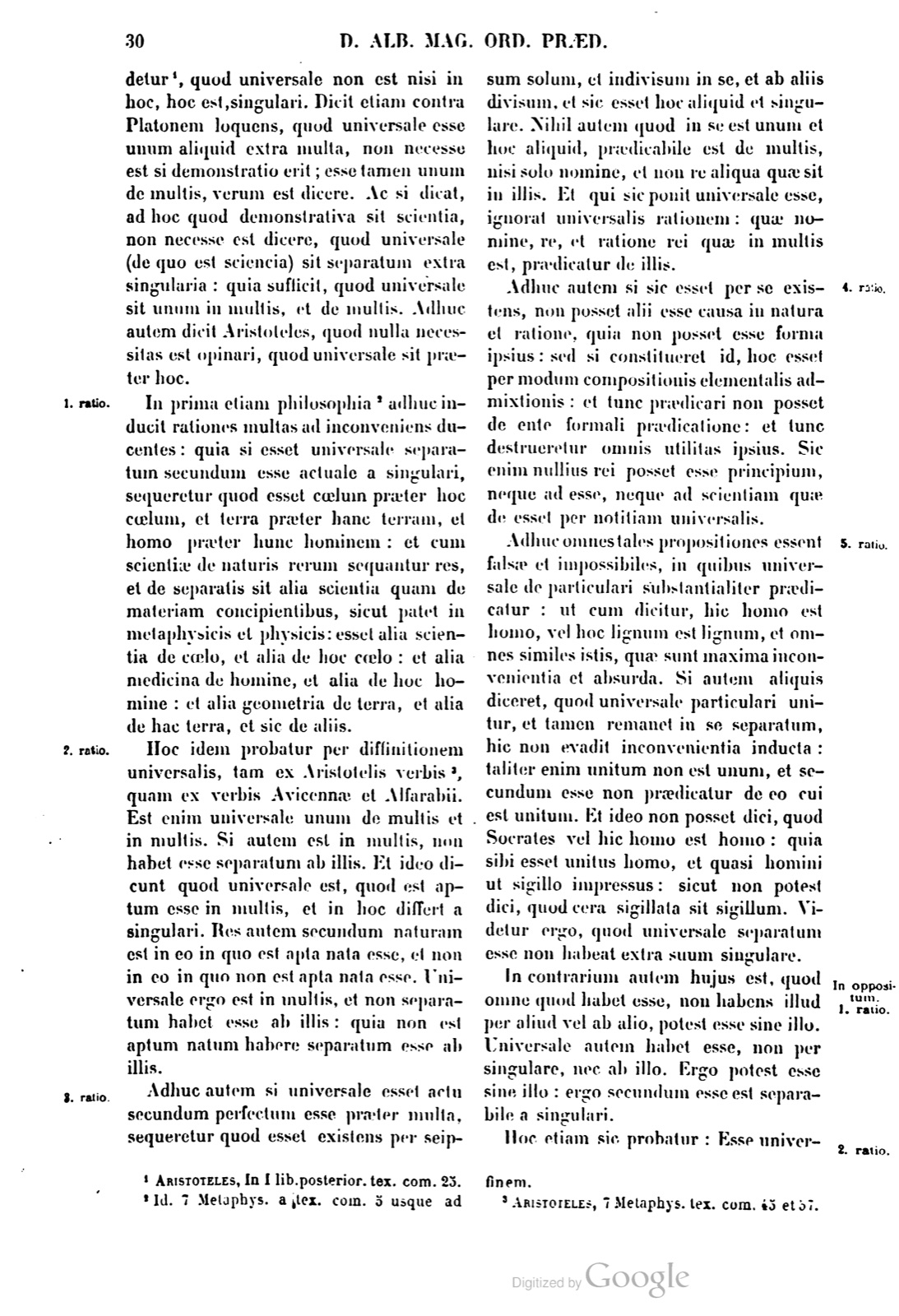
Restat nunc de difficillima quaestione disserere, quam tertiam tangit Porphyrius, utrum scilicet universalia sint separata a sensibilibus, an in sensibilibus sive singularibus posita sint, et ab illis separatum esse non habeant? De hoc autem semper fuit contentio inter Stoicos et Peripateticos. Aristoteles enim ponere videtur universale extra particulare esse non habere: unde in Posterioribus dicere videtur 8, quod universale non est nisi in hoc, hoc est, singulari. Dicit etiam contra Platonem loquens, quod universale esse unum aliquid extra multa, non necesse est si demonstratio erit; esse tamen unum de multis, verum est dicere. Ac si dicat, ad hoc quod demonstrativa sit scientia, non necesse est dicere, quod universale, de quo est scientia, sit separatum extra singularia: quia sufficit, quod universale sit unum in multis, et de multis. Adhuc autem dicit Aristoteles, quod nulla necessitas est opinari, quod universale sit praeter hoc.
In prima etiam philosophia 9 adhuc inducit rationes multas ad inconveniens ducentes: quia si esset universale separatum secundum esse actuale a singulari, sequeretur quod esset caelum praeter hoc caelum, et terra praeter hanc terram, et homo praeter hunc hominem: et cum scientiae de naturis rerum sequantur res, et de separatis sit alia scientia quam de materiam concipientibus, sicut patet in metaphysicis et physicis: esset alia scientia de caelo, et alia de hoc caelo: et alia medicina de homine, et alia de hoc homine: et alia geometria de terra, et alia de hac terra, et sic de aliis.
Hoc idem probatur per diffinitionem universalis, tam ex Aristotelis verbis 10, quam ex verbis Avicennae et Alfarabii. Est enim universale unum de multis et in multis. Si autem est in multis, non habet esse separatum ab illis. Et ideo dicunt quod universale est, quod est aptum esse in multis, et in hoc differt a singulari. Res autem secundum naturam est in eo in quo est apta nata esse, et non in eo in quo non est apta nata esse. Universale ergo est in multis, et non separatum habet esse ab illis: quia non est aptum natum habere separatum esse ab illis.
Adhuc autem si universale esset actu secundum perfectum esse praeter multa, sequeretur quod esset existens per seipsum solum, et indivisum in se, et ab aliis divisum, et sic esset hoc aliquid et singulare. Nihil autem quod in se est unum et hoc aliquid, praedicabile est de multis, nisi solo nomine, et non re aliqua quae sit in illis. Et qui sic ponit universale esse, ignorat universalis rationem: quae nomine, re, et ratione rei quae in multis est, praedicatur de illis.
Adhuc autem si sic esset per se existens, non posset alii esse causa in natura et ratione, quia non posset esse forma ipsius: sed si constitueret id, hoc esset per modum compositionis elementalis admixtionis: et tunc praedicari non posset de ente formali praedicatione: et tunc destrueretur omnis utilitas ipsius. Sic enim nullius rei posset esse principium, neque ad esse, neque ad scientiam quae de esset per notitiam universalis.
CHAPTER V.
Whether universals are separated from sensibles, or posited in sensible things themselves?
It remains now to discuss the very difficult question which Porphyry touches as the third, namely whether universals are separated from sensibles, or are posited in sensible or singular things, and do not have being separated from them. But concerning this there was always contention between the Stoics and the Peripatetics. For Aristotle seems to posit that a universal does not have being outside the particular; whence in the Posterior Analytics he seems to say 8 that the universal is only in this, that is, in the singular. Speaking also against Plato he says that it is not necessary, if there will be demonstration, for the universal to be one something outside many; nevertheless it is true to say that it is one of many. As if he should say that, for knowledge to be demonstrative, it is not necessary to say that the universal, concerning which there is science, is separated outside singulars: because it is enough that the universal is one in many and of many. Further, Aristotle says that there is no necessity to think that the universal is besides this.
In first philosophy also 9 he further introduces many reasons leading to an absurdity: because if the universal were separated according to actual being from the singular, it would follow that there would be heaven besides this heaven, and earth besides this earth, and man besides this man; and since sciences concerning the natures of things follow things, and there is one science of separated things and another of things conceiving matter, as is clear in metaphysics and physics, there would be one science of heaven and another of this heaven, and one medicine concerning man and another concerning this man, and one geometry concerning earth and another concerning this earth, and so with the others.
This same thing is proved by the definition of the universal, both from the words of Aristotle 10 and from the words of Avicenna and Alfarabi. For the universal is one of many and in many. But if it is in many, it does not have being separated from them. And therefore they say that the universal is that which is apt to be in many, and in this it differs from the singular. But a thing according to nature is in that in which it is apt by nature to be, and not in that in which it is not apt by nature to be. Therefore the universal is in many, and does not have being separated from them, because it is not apt by nature to have separated being from them.
Further, if the universal were actually, according to perfect being, besides many, it would follow that it would be existing by itself alone, and undivided in itself and divided from others, and thus it would be this something and singular. But nothing which in itself is one and this something is predicable of many except by name alone, and not by some reality which is in them. And he who posits the universal to be in this way does not know the notion of the universal, which is predicated of them by name, by reality, and by the notion of the thing which is in many.
Further, if it were in this way existing through itself, it could not be for another a cause in nature and notion, because it could not be its form; but if it constituted that other, this would be by the mode of elemental composition of admixture, and then it could not be predicated of the being by formal predication, and then every usefulness of it would be destroyed. For in this way it could be the principle of no thing, neither toward being nor toward the science which would be concerning it through knowledge of the universal.
Adhuc omnes tales propositiones essent falsae et impossibiles, in quibus universale de particulari substantialiter praedicatur: ut cum dicitur, hic homo est homo, vel hoc lignum est lignum, et omnes similes istis, quae sunt maxima inconvenientia et absurda. Si autem aliquis diceret, quod universale particulari unitur, et tamen remanet in se separatum, hic non evadit inconvenientia inducta: taliter enim unitum non est unum, et secundum esse non praedicatur de eo cui est unitum. Et ideo non posset dici, quod Socrates vel hic homo est homo: quia sibi esset unitus homo, et quasi homini ut sigillo impressus: sicut non potest dici, quod cera sigillata sit sigillum. Videtur ergo, quod universale separatum esse non habeat extra suum singulare.
In contrarium autem hujus est, quod omne quod habet esse, non habens illud per aliud vel ab alio, potest esse sine illo. Universale autem habet esse, non per singulare, nec ab illo. Ergo potest esse sine illo: ergo secundum esse est separabile a singulari.
Hoc etiam sic probatur: esse universalis est esse commune aptum natum esse in pluribus et multis communicabile. Hoc autem esse non potest habere a singulari: quia singularia sunt discreta et incommunicabilia. Communicabile ergo esse quod est esse universalis, universale non habet a singulari.
Si forte aliquis dicat, quod ista ratio non probat, quod universale non habeat esse discretum: sed probat quod a singulari destructo remanet esse universalis secundum aliquem modum. Hoc videtur contra Aristotelem esse, qui ponens, quod universale esse habeat in singulari, dicit quod destructis primis impossibile est aliquid aliorum remanere 11. Et hoc secundum rationem inductam destruitur: quia si universale habet esse separatum vel separabile ab esse singulari, universale manebit existente singulari et non existente singulari aequaliter: eo quod suum esse ab esse singularis non dependet aliquo modo, nisi secundum esse in ipso, et non secundum esse simpliciter.
Adhuc autem universale semper est et ubique: particulare autem sive singulare est hic et nunc. Si autem universale est ubique et semper, est alicubi ubi non est singulare: et est aliquando quando non singulare. Quaecumque autem loco et tempore sunt separata, simpliciter et substantialiter secundum esse et subjecta sunt separata. Cum ergo universale et particulare loco et tempore differant sive separata sint, simpliciter secundum esse et subjecta substantialiter separata esse videntur.
Adhuc non potest idem esse intelligi corruptibile et incorruptibile. Universale autem incorruptibile est, singulare vero corruptibile. Non idem erit ergo esse universalis et singularis. Si enim idem esset utrisque esse, sequeretur contradictoria simul esse vera: quia si corruptibile est secundum esse, erit aliquando quando esse non habebit. Probatum enim est de caelo et mundo in primo 12, quod corruptibile necessario aliquando corrumpetur: et tunc non erit incorruptibile, aut semper erit. Ergo aliquod tempus erit, quando id secundum esse et erit et non erit, quod est impossibile.
Further, all such propositions would be false and impossible in which a universal is predicated substantially of a particular, as when it is said, this man is man, or this wood is wood, and all propositions similar to these, which are very great absurdities and incongruities. But if someone should say that the universal is united to the particular and nevertheless remains separated in itself, this person does not escape the absurdities introduced: for what is united in such a way is not one, and according to being is not predicated of that to which it is united. And therefore it could not be said that Socrates or this man is man: because man would be united to him, and as it were impressed upon man as by a seal; just as it cannot be said that sealed wax is a seal. Therefore it seems that the universal does not have separated being outside its singular.
But against this is that everything which has being, not having it through another or from another, can be without that other. But the universal has being, not through the singular nor from it. Therefore it can be without it; therefore according to being it is separable from the singular.
This also is proved thus: the being of the universal is common being, apt by nature to be in several and communicable to many. But it cannot have this being from the singular, because singulars are discrete and incommunicable. Therefore the universal does not have communicable being, which is the being of the universal, from the singular.
If perhaps someone says that this reason does not prove that the universal does not have discrete being, but proves that when the singular has been destroyed the being of the universal remains according to some mode, this seems to be against Aristotle, who, positing that the universal has being in the singular, says that when the first things have been destroyed it is impossible for anything of the others to remain 11. And this is destroyed according to the reason introduced: because if the universal has being separated or separable from the being of the singular, the universal will remain equally while the singular exists and while the singular does not exist, because its own being does not depend in any way upon the being of the singular, except according to being in it, and not according to being simply.
Further, the universal is always and everywhere, but the particular or singular is here and now. But if the universal is everywhere and always, it is somewhere where the singular is not, and it is sometime when the singular is not. But whatever things are separated by place and time are simply and substantially separated according to being and subjects. Therefore since universal and particular differ or are separated in place and time, they seem to be separated substantially simply according to being and subjects.
Further, the same being cannot be understood as corruptible and incorruptible. But the universal is incorruptible, while the singular is corruptible. Therefore the being of the universal and of the singular will not be the same. For if the same being belonged to both, it would follow that contradictories were true at the same time: because if it is corruptible according to being, there will be some time when it will not have being. For in the first book On Heaven and the World it has been proved 12 that the corruptible will necessarily at some time be corrupted; and then it will not be incorruptible, or it will always be. Therefore there will be some time when that according to being both will be and will not be, which is impossible.
Adhuc autem constat, quod universale habet esse in quo multa uniuntur in unum nomen et rationem: quae nomen et ratio dicunt esse diffiniti. Hoc autem esse nullo modo habet in esse singularis. Ergo habet hoc esse separatum ab esse singularis. Cum ergo habet hoc esse: aut habet ipsum secundum quod instrumentum primi agentis est, aut habet hoc secundum quod est in anima per abstractionem ipsum cognoscentem, aut in re ipsa extra agentem et cognoscentem existens. Si dicatur quod habet illud in efficiente, tunc universale non habet esse nisi ideale: et cum praedicatur de singulari, non praedicatur nisi sicut idea: haec autem praedicatio non est substantialis, sed exemplaris tantum, et sic destruitur omnis praedicatio substantialis. Si autem habet in anima apprehendente, tunc relatio universalis ad multa, non est nisi in anima, et non in re, et sic praedicatur nomine, et non re. Et sic universalia non sunt res, sed nomina: quod falsum jam esse ostensum est. Relinquitur ergo quod habent id secundum quod est res in se existens et ab agente et cognoscente et a singulari separata. Ergo esse universalis est separatum ab esse singularis, et e converso. Ex omnibus autem his et similibus videtur quod esse universalis separatum sit substantia, loco, et tempore ab esse singularis.
Ad haec autem non est difficile respondere ei qui bene novit positionem Peripateticorum. Nam per distinctionem esse universalis omnia haec facile determinantur. Est enim esse universalis secundum quod universale est secundum universalitatis rationem, et est esse ejus quod est universale. Similiter esse singularis secundum quod singulare est et secundum singularitatis rationem: et est esse ejus quod est singulare, prout est substantia substans communi naturae. Dicimus ergo, quod esse universalis in eo quod universale, est ratione separatum, et oppositum est illi quod est esse singularis in eo quod singulare est, quamvis non ut in eodem subjecto. Esse autem naturae illius quae universale est, non est separatum ab esse singularis secundum quod est substantia substans illi communi naturae: sed potius esse universalis est esse particularis, et non divisum ab illo. Est enim, sicut diximus, universale secundum esse in particulari: quamvis non sit universale secundum hoc quod est in illo, sed nec commune, nec communicabile, sicut in prima quaestione satis declaratum est. Et nisi sic esset, non esset quaestio nec scientia de aliquo, sicut in primis probatur objectis. Nec est curandum de solutione quam quidam inducunt, scilicet quod universale secundum se habeat esse, sed non habeat esse completum, nisi in particulari: universale enim habet esse completum in hoc, quod omnia habet quae exiguntur ad esse universalis: sicut particulare habet esse completum, quando habet omnia quae exiguntur ad esse particularis.
Further, it is clear that the universal has being in which many are united into one name and notion, which name and notion state the being of the defined thing. But it has this being in no way in the being of the singular. Therefore it has this being separated from the being of the singular. Therefore since it has this being, either it has it insofar as it is an instrument of the first agent, or it has this insofar as it is in the soul through abstraction knowing it, or it has it as existing in the thing itself outside the agent and knower. If it is said that it has that in the efficient cause, then the universal has only ideal being; and when it is predicated of the singular, it is predicated only as an idea. But this predication is not substantial, but only exemplar, and thus every substantial predication is destroyed. But if it has it in the apprehending soul, then the relation of the universal to many is only in the soul and not in the thing, and thus it is predicated by name and not by reality. And thus universals are not things but names, which has already been shown to be false. Therefore it remains that they have it insofar as it is a thing existing in itself and separated from the agent and knower and from the singular. Therefore the being of the universal is separated from the being of the singular, and conversely. But from all these things and similar ones it seems that the separated being of the universal is separate in substance, place, and time from the being of the singular.
But to these things it is not difficult to respond for one who knows well the position of the Peripatetics. For through a distinction of the being of the universal all these things are easily determined. For there is the being of the universal insofar as it is universal according to the notion of universality, and there is the being of that which is universal. Similarly there is the being of the singular insofar as it is singular and according to the notion of singularity, and there is the being of that which is singular, as it is a substance standing beneath the common nature. Therefore we say that the being of the universal insofar as it is universal is separated by reason, and is opposed to that which is the being of the singular insofar as it is singular, although not as in the same subject. But the being of that nature which is universal is not separated from the being of the singular insofar as it is the substance standing beneath that common nature; rather the being of the universal is the being of the particular, and not divided from it. For, as we have said, the universal according to being is in the particular, although it is not universal according to the fact that it is in it, nor common, nor communicable, as was sufficiently declared in the first question. And unless this were so, there would be no question nor science concerning anything, as is proved in the first objections. Nor is attention to be given to the solution which certain people introduce, namely that the universal according to itself has being, but does not have complete being except in the particular. For the universal has complete being in this, that it has all things which are required for the being of the universal, just as the particular has complete being when it has all things which are required for the being of the particular.
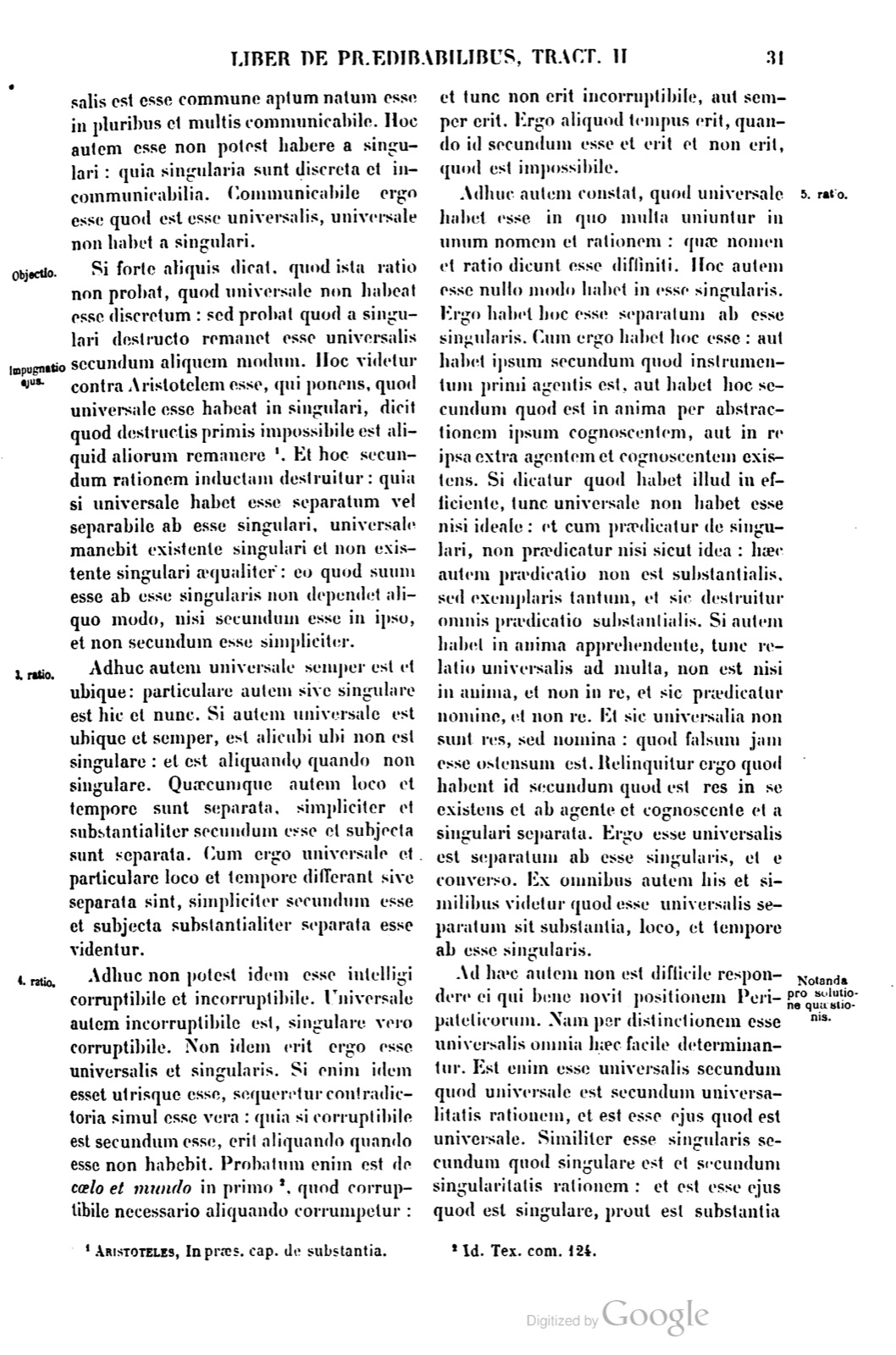
Ad id autem quod primo contra hoc inducitur, dicendum quod omne quod habet esse non per aliud, potest esse sine illo: nisi ita sit, quod esse suum quamvis non sit per aliud, tamen sit in alio cui ipsum est causa esse. Et hoc est esse in alio, sicut pars essentialis ipsius esse secundum quod est in alio: et hoc modo universale sive substantia secunda est in alio: sed per hoc quod est in illo, est particulatum et determinatum. Et ideo esse quidem habet in seipso sed non determinatum et particulatum.
Si autem quaeratur, utrum idem esse sit quod universale habet per se acceptum, et quod habet determinatum et particulatum? Dicendum quod nec idem omnino, nec diversum omnino: sed idem vel unum dupliciter. In substantia enim idem est: duplex autem ut idem et unum indeterminatum et determinatum. Et haec est solutio trium Philosophorum, Avicennae, et Alfarabii, et ejusdem Joannis grammatici apud Arabes nominati: et est vera quia concordat dictis Aristotelis.
Ad id autem quod secundo inducunt, quod aptum natum esse in pluribus non convenit universali secundum quod est in singularibus, concedendum est quod hoc est verum: sed hoc habet natura illa inquantum simplex est et indeterminata. Quanto enim aliquid est simplicius, tanto magis est communicabile multis. Sed dico simplex non per privationem differentiarum, quae conveniunt in esse ipsius, sed per privationem eorum quae determinant et contrahunt ipsum ad hoc esse vel id secundum speciem vel individuum. Sed per hoc non sequitur, quod habeat esse determinatum sive singulare: quia quamvis tale esse non habeat a singulari, tamen non habet nisi in singulari: sicut et commune non habet esse nisi in eo, in quo determinatur et ad esse distinctum contrahitur. Nihil enim est simplex in natura, nisi quod ad esse distinctum est et determinatum, sicut genus non est nisi in speciebus, et species non est nisi in individuis suis.
Ad id autem quod objicitur, dicitur quod objectio non probat, quod universale habeat esse separatum, sed quod remaneat destructis pluribus particularibus concedendum est. Sed quod Aristoteles dicit, quod destructis primis impossibile est aliquid aliorum remanere, intelligitur in esse determinato et distincto in rebus naturae. Sed tamen possibile est remanere in esse naturae simplicis communis et indeterminatae. Si autem quaeritur in quo et ubi manet secundum id esse, hoc in proximo sequenti capitulo declarabitur.
Ad id autem quod dicitur Aristotelem dicere, quod universale est ubique et semper, singulare autem hic et nunc: dicendum quod verum est quod dicit Aristoteles, quod universale in esse universalis acceptum, non discernit locum sive loci differentias vel tempus: quia indeterminatum est, et commune ad omnem locum et tempus: sed secundum idem suum esse substantiale efficitur hic et nunc quando determinatur in particulari ad hoc et id.
To that which is first introduced against this, one must say that everything which has being not through another can be without it, unless it is in such a case that its being, although it is not through another, nevertheless is in another to which it is itself a cause of being. And this is to be in another as an essential part of that being itself insofar as it is in another: and in this way the universal or second substance is in another. But through the fact that it is in that other, it is particularized and determined. And therefore it has being indeed in itself, but not determined and particularized.
But if it is asked whether the being which the universal has taken through itself is the same as that which it has as determined and particularized, one must say that it is neither altogether the same nor altogether diverse, but the same or one in two ways. For in substance it is the same; but it is twofold as the same and one, indeterminate and determinate. And this is the solution of the three Philosophers, Avicenna, Alfarabi, and that same John called the Grammarian among the Arabs; and it is true because it agrees with the sayings of Aristotle.
To that which they introduce second, that aptitude by nature to be in several does not belong to the universal insofar as it is in singulars, it must be conceded that this is true; but that nature has this insofar as it is simple and indeterminate. For the simpler something is, the more communicable it is to many. But I say simple not through the privation of the differences which belong to its being, but through the privation of those things which determine and contract it to this being or that according to species or individual. But through this it does not follow that it has determined or singular being; because although it does not have such being from the singular, nevertheless it has it only in the singular: just as the common has being only in that in which it is determined and contracted to distinct being. For nothing is simple in nature except what is directed to distinct and determined being, just as genus exists only in species, and species exists only in its own individuals.
To that which is objected, it is said that the objection does not prove that the universal has separated being, but that it remains when several particulars have been destroyed, which must be conceded. But Aristotle's saying that, when first things have been destroyed, it is impossible for anything of the others to remain, is understood in determined and distinct being in the things of nature. Nevertheless it is possible for it to remain in the being of simple common and indeterminate nature. But if it is asked in what and where it remains according to that being, this will be declared in the next chapter immediately following.
To that which is said, that Aristotle says that the universal is everywhere and always, but the singular here and now: one must say that what Aristotle says is true, that the universal taken in the being of the universal does not distinguish place, or the differences of place, or time, because it is indeterminate and common to every place and time; but according to the same substantial being of its own it is made here and now when it is determined in the particular to this and that.
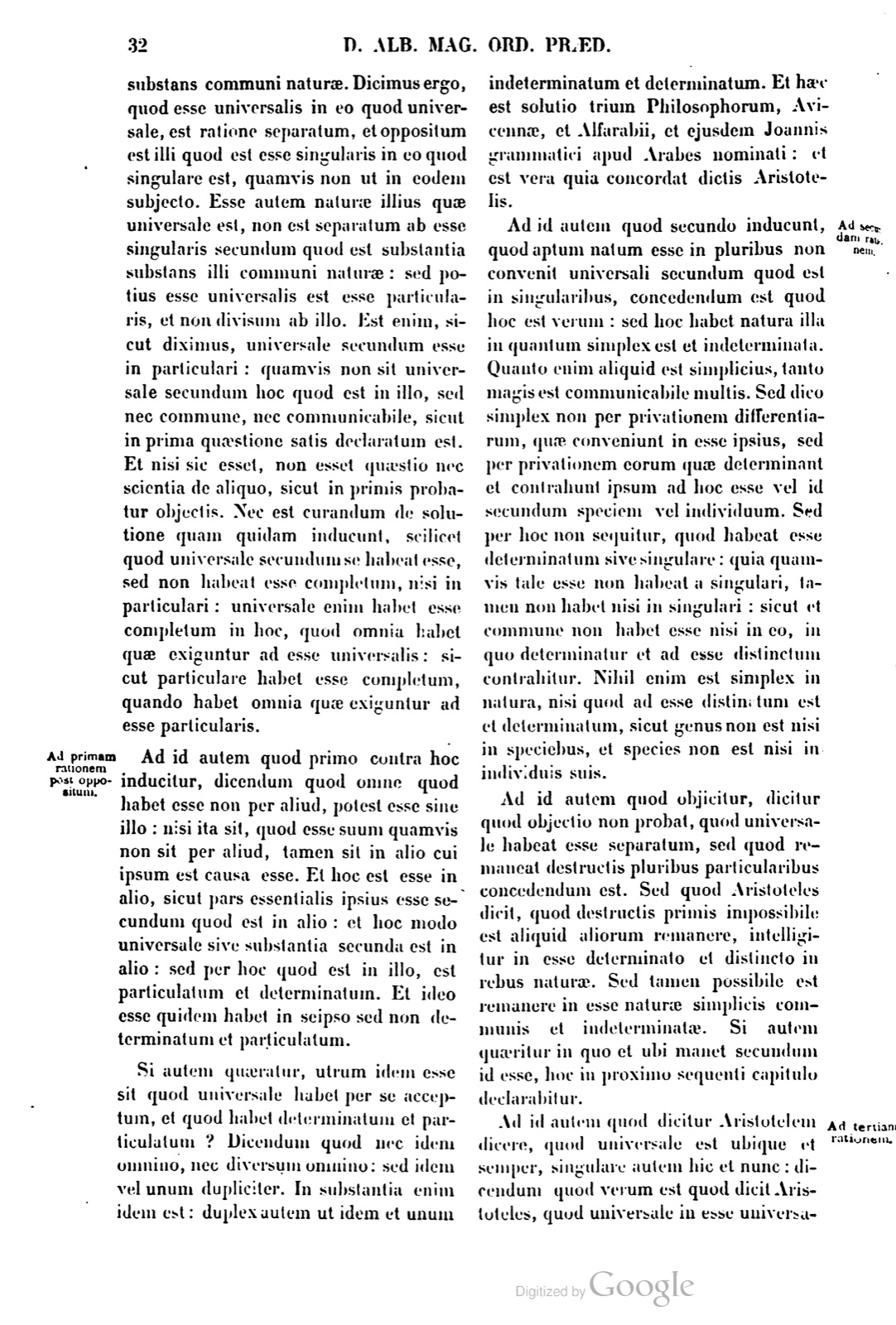
Si quis autem dicat, quod secundum hoc idem sit in pluribus tempore et loco et substantia differentibus: dicendum quod hoc non est inconveniens de eo quod est natura simplex et communicabile: quia potius hoc est necessarium, quia simplicitatem ejus consequitur communicabilitas. Sed in esse determinato et distincto non est in pluribus substantia, loco, et tempore divisis. Et ideo ejusdem rationis est homo in omni tempore, et in omni loco, et in omnibus individuis.
Ad id autem quod dicitur, quod universale est incorruptibile, singulare autem corruptibile: dicendum quod hoc verum est: quia aliter scientia non esset de ipso: sed ex hoc non sequitur, quod esse universalis separatum sit ab esse singularis: unumquodque enim dicitur incorruptibile vel corruptibile per rationem principiorum constituentium esse ipsius. Et ideo cum esse universalis secundum id quod vere est universale, hoc est, secundum id quod est natura simplex et indistincta, non dependeat secundum esse nisi a principiis simplicibus, sequetur quandoque, quod incorruptibile sit: probatur enim in ultima parte libri de Causis quod simplex est incorruptibile. Sed hoc idem ut determinatum et distinctum in singulari secundum esse particularis, quod dat esse ei determinatum, propter corruptibilium principiorum adjunctionem nihil prohibet esse corruptibile. Et idem est corruptibile et incorruptibile comparatione principiorum diversorum. Et hoc non improbat Aristoteles in libro de caelo et mundo.
Ad hoc autem quod dicunt negari non posse, quod universale habeat esse commune in quo multa uniuntur et conveniunt in substantia et ratione: dicimus quod hoc verum est: et hoc esse est sibi proprium, et non habet a singulari: sed nec hoc potest negari quin illud idem commune esse sit determinabile et designabile in singulis: quia aliter non esset communicabile in singulis: et per illam distinctionem esse id non fit diversum secundum substantiam, sed tantum efficitur habens modum essendi diversum, quod non facit simpliciter esse diversum, sed unum esse duplex ex eo quod diversum modum esse accipit, sicut saepius dictum est.
Si quis autem dicat, quod ut dicit Aristoteles, motis nobis moventur ea quae in nobis sunt: et per hoc intelligitur de motu corruptionis: et sic corruptis primis impossibile est universale remanere: dicendum quod hoc omnino est verum quod dicit Aristoteles, et ita intelligitur, sicut dictum est. Et verum est quod universale corrumpitur in eis quae corrumpuntur, sed corrumpitur secundum quod est in eis. Est enim in eis secundum principia determinata et distrahentia ipsum ad esse particularis. Et sic est hoc modo corruptibile, quo in libro de Causis dicitur, quod incorruptibile est, quod est delatum super id quod est corruptibile, et est corruptibile per aliud et per accidens. Sed nihil prohibet quin maneat secundum substantiam et esse naturae simplicis et indistinctae et non particulatae.
But if someone says that according to this the same thing is in several things differing in time, place, and substance, one must say that this is not unfitting concerning that which is a simple and communicable nature, because rather this is necessary, since communicability follows upon its simplicity. But in determined and distinct being it is not in several things divided in substance, place, and time. And therefore man is of the same notion in every time, in every place, and in all individuals.
To that which is said, that the universal is incorruptible while the singular is corruptible, one must say that this is true, because otherwise there would not be science concerning it; but from this it does not follow that the being of the universal is separated from the being of the singular. For each thing is said to be incorruptible or corruptible by reason of the principles constituting its being. And therefore, since the being of the universal according to that in which it is truly universal, that is, according to that in which it is simple and indistinct nature, does not depend according to being except on simple principles, it will sometimes follow that it is incorruptible: for in the last part of the Book of Causes it is proved that the simple is incorruptible. But this same thing as determined and distinct in the singular according to the being of the particular, which gives it determined being, because of the addition of corruptible principles, nothing prevents from being corruptible. And the same thing is corruptible and incorruptible by comparison with diverse principles. And Aristotle does not reject this in the book On Heaven and the World.
To this, however, which they say cannot be denied, that the universal has common being in which many are united and agree in substance and notion: we say that this is true, and this being is proper to it, and it does not have it from the singular. But neither can this be denied, that that same common being is determinable and designable in singulars, because otherwise it would not be communicable in singulars. And through that distinction of being, that being is not made diverse according to substance, but only is made to have a diverse mode of being, which does not make being simply diverse, but makes one being twofold from the fact that it receives a diverse mode of being, as has been said often.
But if someone says that, as Aristotle says, when we are moved those things which are in us are moved, and by this is understood the motion of corruption, and thus when first things have been corrupted it is impossible for the universal to remain: one must say that what Aristotle says is altogether true, and is understood just as has been said. And it is true that the universal is corrupted in those things which are corrupted, but it is corrupted insofar as it is in them. For it is in them according to determinate principles drawing it aside to the being of the particular. And in this way it is corruptible in the mode in which in the Book of Causes it is said that the incorruptible is that which is carried over that which is corruptible, and is corruptible through another and by accident. But nothing prevents it from remaining according to the substance and being of simple, indistinct, and non-particularized nature.
Notes
- Namely the part of logic which teaches how to define. (Scilicet pars logicae quae docet diffinire.) ↩
- Aristotle, in the fourth book of First Philosophy, text, commentary 10. (Aristoteles, In quarto primae philosophiae, tex. com. 10.) ↩
- Compare On Interpretation I, chapter 1. (Cf. 1 Periher. cap. 1.) ↩
- That is, of the notion. (Scilicet notione.) ↩
- Compare Physics I, text, commentary 49. (Cf. 1 Phys. tex. com. 49.) ↩
- Compare On Interpretation I, chapter 5. (Cf. I Periherm. cap. 5.) ↩
- And this will be the custom of D. Albert in all his works. (Et haec erit consuetudo D. Alberti in omnibus suis operibus.) ↩
- Aristotle, in Posterior Analytics I, text, commentary 25. (Aristoteles, In I lib. posterior. tex. com. 25.) ↩
- The same, Metaphysics VII, from text, commentary 5 up to the end. (Id., 7 Metaphys. a tex. com. 5 usque ad finem.) ↩
- Aristotle, Metaphysics VII, text, commentaries 45 and 57. (Aristoteles, 7 Metaphys. tex. com. 45 et 57.) ↩
- Aristotle, in the present chapter on substance. (Aristoteles, In praes. cap. de substantia.) ↩
- The same, text, commentary 124. (Id. Tex. com. 124.) ↩
If a page does not appear, its photograph has not been uploaded yet.