Volume 1 · pp. 6–29
Chapter IV. Concerning what logic is about as its subject?
A marker with ≈ is an approximate page boundary, placed by measure of the text; the page photographs remain the authority. In the paired views, clicking a page marker brings that page into view.
Caput IV. De quo sit logica ut de subjecto?
Cum autem logica sit scientia contemplativa, docens qualiter, et per quae devenitur per notum ad ignoti notitiam, oportet necessario quod logica sit de hujusmodi rationis instrumento, per quod acquiritur per notum ignoti scientia in omni eo quod de ignoto notum efficitur. Hoc autem est argumentatio, secundum quod argumentatio est ratiocinatio mentem arguens et convincens per habitudinem noti ad ignotum de ignoti scientia. Inter species autem argumentationis praecipua est syllogismus. Propter quod quidam dixerunt quod logica tota est de syllogismo et partibus syllogismi 1: determinantes commune subjectum logicae secundum id quod est subjectum principale. Non enim de omnibus fides esse poterit per syllogismum, propter hoc quod discursus syllogisticus non est nisi ab universali universaliter accepto: quod in multis scientiis esse non poterit, ut in rhetoricis. Propterea quod in illis praecipue locales habitudines attenduntur, a quibus per enthymemata concluditur id quod quaesitum est. Cum igitur logica, ut dicit Aristoteles, det omni scientiae modum disserendi, et inveniendi, et dijudicandi quod quaesitum est: oportet quod de tali sit ut de subjecto, quod omnibus in omni aequaliter applicabile est. Sunt autem adhuc quaedam in quibus ex singularibus quaerimus invenire quod ignotum est, sicut in experimentalibus, in quibus utimur vel syllogismo vel inductione ad universale accipiendum, et non possumus uti syllogismo perfecto. Propter quod syllogismus commune subjectum logicae esse non potest. Propter hoc etiam in logicis quae ab Antiquis scriptae sunt, non solum docetur quid syllogismus, et qualiter, et ex quibus sit: sed hic etiam docetur quid argumentatio, et quae partes, et species ejus.
Sunt tamen qui logicam interpretantur idem quod sermocinalem, dicentes logicam generalem idem esse quod sermocinalem scientiam, sub qua dicunt contineri grammaticam, poeticam, et rhetoricam, et eam quam vocant dialecticam. Et ideo dicunt logicae generalis subjectum esse sermonem, prout est designativus rerum quae significantur per ipsum. Quam opinionem impugnat Avicenna 2 dicens, quod sermo de se nihil significat: si enim aliquid de se significaret, semper et apud omnes illud significaret: quod falsum est. Significationem ergo accipit a placito instituentis. Non ergo significat nisi secundum quod conceptus est in intellectu instituentis. Tali autem sermone, secundum quod sic significativus est concepti, utitur homo ad seipsum et ad alium. Propter quod dicit Damascenus, quod in duo dividitur, scilicet in encordialem, hoc est, sermonem interius in mente dispositum, et in eum qui ex signis, qui angelus intelligendo est sui cordis nuntius, quia conceptus cordis nuntiat ad alterum. Propter quod logicus et ad se et ad alterum utitur sermone per accidens, et non per se: quia sine sermone designativo procedere non potest ad notitiam ejus quod ignotum est 3. Ratiocinatione autem utitur per se ad notitiam faciendam ejus quod declaratum est. Propter quod cum logici intentio sit docere ea, per quae per se venitur in notitiam ignoti per quod notum est, logicae subjectum est argumentatio: quia per argumentationem efficitur id quod intenditur.
Chapter IV. Concerning what logic is about as its subject?
But since logic is a contemplative science, teaching how, and through what things, one comes through the known to knowledge of the unknown, it is necessarily fitting that logic be concerned with an instrument of reason of this sort, through which science of the unknown is acquired through the known in every case in which something known is effected concerning the unknown. But this is argumentation, insofar as argumentation is a reasoning arguing with and convincing the mind, through the relation of the known to the unknown, concerning science of the unknown. But among the species of argumentation the chief is syllogism. For this reason certain men said that logic as a whole is concerned with syllogism and the parts of syllogism 1, determining the common subject of logic according to that which is the principal subject. For there will not be credibility concerning all things through syllogism, because syllogistic discourse is only from a universal taken universally; and this cannot exist in many sciences, as in rhetorical matters. The reason is that in those matters local relations are especially attended to, from which, through enthymemes, that which was sought is concluded. Therefore since logic, as Aristotle says, gives to every science the mode of discussing, finding, and judging what has been sought, it must be about such a thing as its subject, something which is equally applicable to all things in every case. Moreover there are some things in which from singulars we seek to find what is unknown, as in experimental matters, in which we use either syllogism or induction for receiving the universal, and cannot use perfect syllogism. For this reason syllogism cannot be the common subject of logic. For this reason also, in the logical writings which were written by the Ancients, there is taught not only what syllogism is, and of what sort, and from what things it is, but here there is also taught what argumentation is, and what its parts and species are.
Nevertheless there are those who interpret logic as the same as sermocinal science, saying that general logic is the same as sermocinal science, under which they say grammar, poetics, rhetoric, and the science which they call dialectic are contained. And therefore they say that the subject of general logic is speech, insofar as it is designative of the things which are signified through it. Avicenna attacks this opinion 2, saying that speech signifies nothing of itself; for if it signified something of itself, it would always and among all people signify that thing, which is false. Therefore it receives signification from the convention of the one instituting it. Therefore it signifies only according as it has been conceived in the intellect of the one instituting it. Man uses such speech, insofar as it is thus significative of what has been conceived, toward himself and toward another. For this reason Damascene says that it is divided into two, namely into encordial speech, that is, speech disposed inwardly in the mind, and into that which is from signs, which in being understood is a messenger of his heart, because it announces the concept of the heart to another. For this reason the logician uses speech both toward himself and toward another accidentally and not through itself, because without designative speech he cannot proceed to knowledge of that which is unknown 3. But he uses reasoning through itself for producing knowledge of that which has been declared. For this reason, since the intention of the logician is to teach those things through which, through themselves, one comes into knowledge of the unknown through what is known, the subject of logic is argumentation, because through argumentation that which is intended is effected.
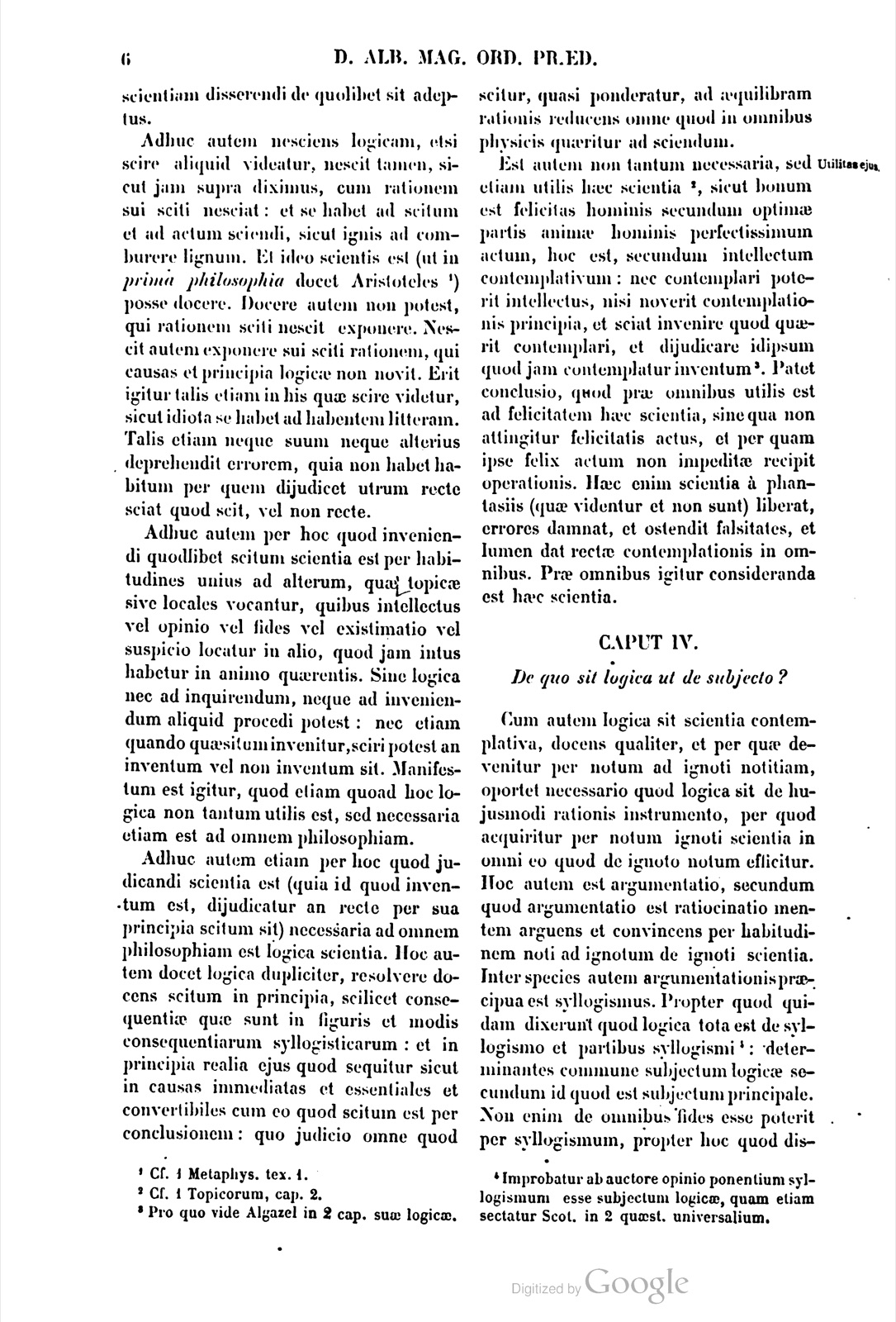
Adhuc sermo incomplexus quamvis designet aliquid apud intellectum simplicem, tamen fidem non facit an aliquid sit vel non sit, quia non aliquid esse significat vel non esse. Non autem venitur ad notitiam ignoti nisi per aliquid, quod de ignoto fidem facit, quod ita sit vel non sit. Sermo igitur incomplexus non potest esse instrumentum per quod de ignoto intellectus ad notitiam deducatur: quod principaliter intendit logicus. Sermo igitur incomplexus non assumitur a logico nisi per accidens, in quantum est pars sermonis complexi, qui est intellectus compositi designativus.
Amplius sermo complexus in eo quod complexus est, nec significat esse vel non esse: si enim hoc esset, omnis sermo complexus rem esse vel non esse significaret: et sic oratio deprecativa, vel optativa, vel subjunctiva, rem esse vel non esse significaret, quod falsum est. Sermo ergo complexus per hoc quod enuntiativus est, rem esse vel non esse significat: per hoc autem quod rem esse vel non esse significat, non habet arguere et fidem facere de enuntiato. Per hoc igitur quod enuntiativus est, non est instrumentum per quod logicus consequatur id quod intendit. Fidem autem facit per hoc quod ad formam argumenti collectivus est. Argumentatio igitur logici instrumentum est. Logica autem generalis et docens de hoc est ut de subjecto, per quod utens logicus in scientiam venit ignoti per notum. Argumentatio igitur logicae docentis proprium subjectum est. Et haec est trium Philosophorum sententia, Avicennae scilicet, Alfarabii, et Algazelis.
Again, although incomplex speech designates something before the simple intellect, nevertheless it does not make faith as to whether something is or is not, because it does not signify that something is or is not. But one does not come to knowledge of the unknown except through something which makes faith concerning the unknown, that it is so or is not so. Therefore incomplex speech cannot be the instrument through which the intellect is led from the unknown to knowledge, which is what the logician principally intends. Therefore incomplex speech is taken up by the logician only accidentally, insofar as it is a part of complex speech, which is designative of composed intellect.
Further, complex speech, in that it is complex, signifies neither being nor non-being; for if this were so, every complex speech would signify that a thing is or is not, and thus a deprecative, optative, or subjunctive utterance would signify that a thing is or is not, which is false. Therefore complex speech, through the fact that it is enunciative, signifies that a thing is or is not. But through the fact that it signifies that a thing is or is not, it does not have the power to argue and to make faith concerning the enunciated thing. Therefore through the fact that it is enunciative, it is not the instrument through which the logician obtains what he intends. But it makes faith through the fact that it is collective toward the form of an argument. Therefore argumentation is the instrument of the logician. But general logic, teaching concerning this, has as its subject that through which the logician using it comes into science of the unknown through the known. Therefore argumentation is the proper subject of teaching logic. And this is the opinion of the three Philosophers, namely Avicenna, Alfarabius, and Algazel.
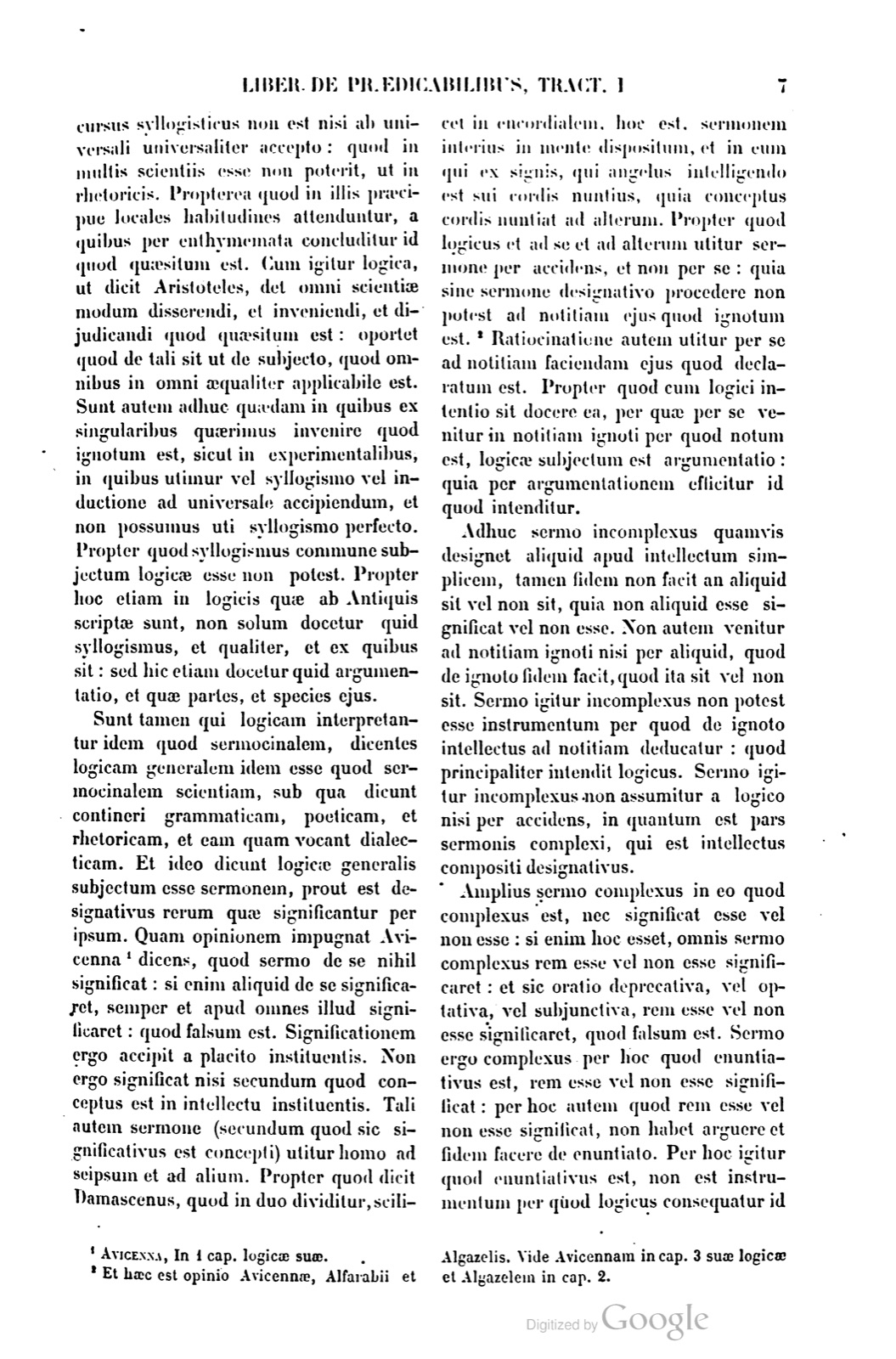
Utuntur tamen sermone omnes sermocinales scientiae, grammatica scilicet, poetica, et rhetorica, et ea quae vocatur logica. Grammatica prout modus inflexionum et constructionum intellectus simplicis et compositi complexe designativus existit simpliciter absque eo quod sciat de significato utrum sit vel non sit. Poetica autem utitur eo prout modulus pronuntiatus delectatione, vel abominatione provocat audientem ad aliquid faciendum vel fugiendum, propter quod ex variis compositis et secundum metalogiam sive fabulam fingit tentans mendacia quae provocent audientes. Rhetorica autem sermone utitur prout est designativus ejus per quod persuadere intendit. Solus autem logicus sermone utitur prout est pars instrumenti, per quod solum fides fit de incognito, cum notitia ipsius ex noto arguitur per complexionem argumenti. Propter alterum ergo sermone utitur, et non propter seipsum.
Hujus autem probatio est, quod notum, per quod ignoti scientia accipitur, dupliciter consideratur, scilicet prout est res extra animam noscentis accepta, et prout est notio quaedam in anima noscentis. Non autem facit notitiam ignoti prout est res extra animam noscentis accepta, sed potius prout est notio rei in anima noscentis existens: sic enim significativa est et illativa ejus quod ignotum est: quod ignotum ipsi aliquo modo percipit intellectus perfecta comprehensione. Hoc ergo modo voces significativas rerum considerat logicus et non aliter. Dico autem perfecta comprehensione: quia sunt forte quidam adeo perspicaces, quod ex intellectu unius vocis complexae statim de ignoto fidem concipiunt: sed hoc est imperfectum, et non generale. Et ideo non sufficit, sed opus est argumentatione perfecte hoc faciente. Si quis autem quaerit unde efficiatur notum id, ex quo ignoti accipitur scientia et fides, hoc nihil est quaerere: quia in quolibet aliquid per se notum est homini et naturae insitum, per quod ignoti potest accipere scientiam. Aliter enim homo nullius esset perceptibilis scientiae vel disciplinae, sicut nec brutum animal, si prima cognoscendi principia per seipsa non inessent homini. De argumentatione igitur vel syllogismo est logica tota ut de subjecto. De aliis autem vocibus incomplexis est propter illam.
Nevertheless all sermocinal sciences use speech, namely grammar, poetics, rhetoric, and the science which is called logic. Grammar uses it insofar as a mode of inflections and constructions exists as simply designative of simple and composed intellect, without its knowing concerning the thing signified whether it is or is not. But poetics uses it insofar as the pronounced measure provokes the hearer, by delight or by aversion, to doing or fleeing something; on account of this, from varied compositions and according to metalogy or fable, it fashions, attempting lies which provoke hearers. Rhetoric uses speech insofar as it is designative of that through which it intends to persuade. But the logician alone uses speech insofar as it is a part of the instrument through which alone faith is made concerning the unknown, when knowledge of it is argued from the known through the joining of an argument. Therefore he uses speech on account of another thing, and not on account of speech itself.
But the proof of this is that the known, through which science of the unknown is received, is considered in two ways, namely insofar as it is a thing taken outside the soul of the knower, and insofar as it is a certain notion in the soul of the knower. But it does not make knowledge of the unknown insofar as it is a thing taken outside the soul of the knower, but rather insofar as it is a notion of the thing existing in the soul of the knower; for thus it is significative and inferential of that which is unknown, which unknown the intellect itself in some way perceives with perfect comprehension. Therefore the logician considers significative words of things in this way and not otherwise. I say with perfect comprehension, because perhaps there are some so keen-sighted that from the understanding of one complex utterance they immediately conceive faith concerning the unknown; but this is imperfect and not general. And therefore it does not suffice, but there is need of argumentation perfectly effecting this. But if someone asks whence that known thing is produced from which science and faith of the unknown are received, this is to ask nothing, because in anything there is something known through itself to man and implanted by nature, through which he can receive science of the unknown. Otherwise man would be perceptive of no science or discipline, just as neither is a brute animal, if the first principles of knowing were not present in man through themselves. Therefore logic as a whole is concerned with argumentation or syllogism as its subject. But it is concerned with other incomplex words on account of that.
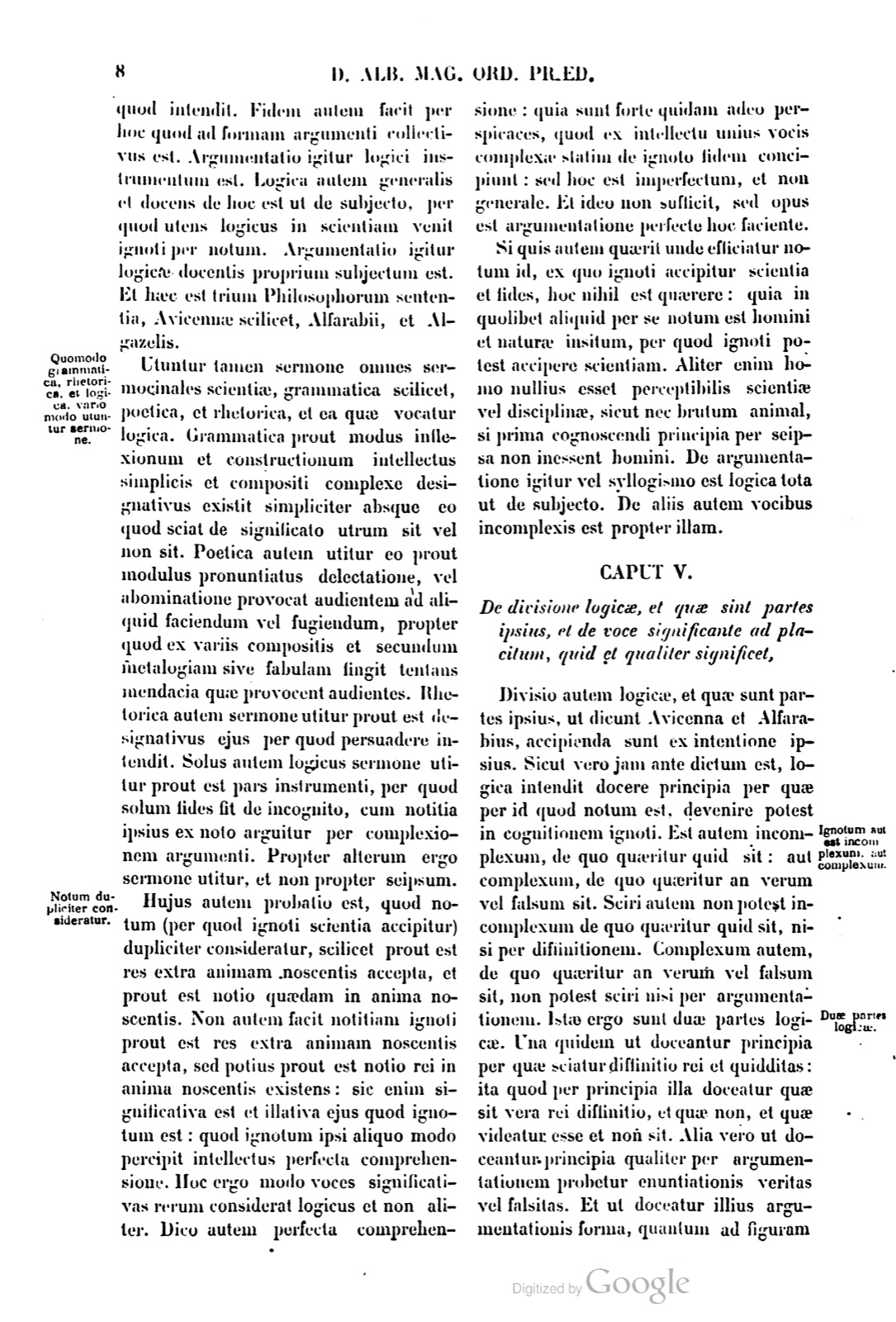
CAPUT IV.
Utrum universalia sint corporalia?
Secunda autem quaestio est, an universalia sint incorporalia vel corporalia? quae ex Platonicis inducta est sicut prima. Dicebat enim Plato mathematicas lineas et superficiem esse separata quaedam, ex quibus corpora mathematica componuntur: sicut omne divisibile ex indivisibilibus dicebat componi, accipiens haec ab Epicureis qui ante philosophari coeperunt. Melissus autem et Parmenides talia dicebant, et quidam alii. Ex mathematicis autem magnis et parvis omnem materialem dicebant constare quantitatem.
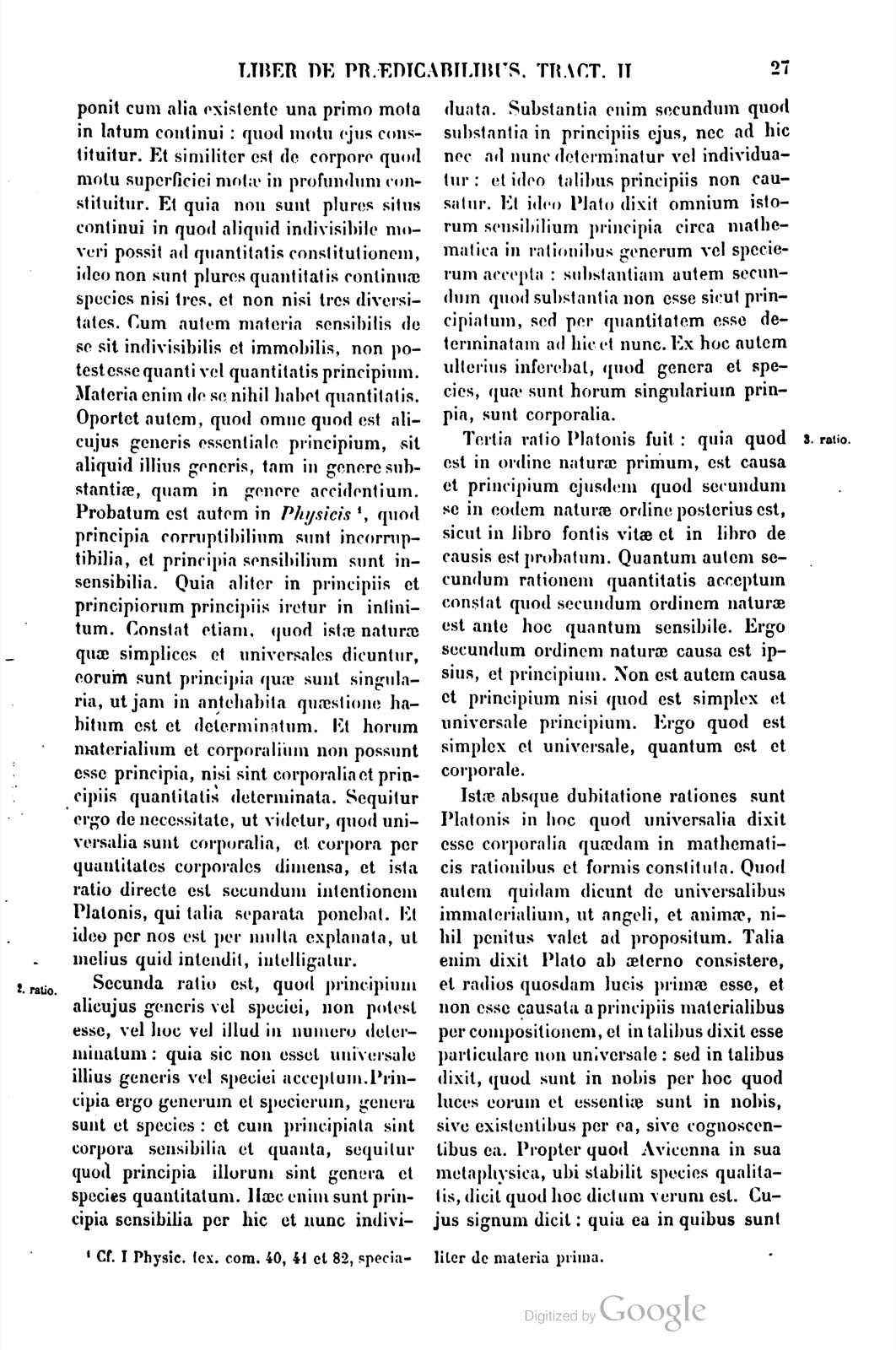
Suae autem opinionis tres potissimas inducebant rationes. Quarum fuit prima, quod videbant, quod substantia tam materia quam forma de se, et secundum quod substantia est, et secundum seipsam accepta, indivisibilis est, sicut expresse dicit Aristoteles 4. Oportet ergo aliud divisibilitatis esse principium indivisibile. Divisibile autem non est nisi quantitas: quantitas autem omnis sive sit discreta, sive continua, non procedit nisi ab indivisibili. Adhuc omnis species quantitatis non procedit nisi ab indivisibili proximo: quia unumquodque genus et species causatur ab aliquibus suis proximis principiis. Corpus enim quod omni modo divisibile est, non potest causari, sicut ex proximo suae constitutionis principio, ab eo quod omni modo est indivisibile sicut punctum, vel ab eo quod uno modo tantum divisibile sicut linea. Sed oportet, quod causetur ab eo quod est pluribus modis divisibile. Sicut superficies quae non est indivisibilis nisi in profundum, sed in latum et longum divisibilis est. Et ex compositione unius superficiei cum alia fit divisibilis in profundum: sicut punctum omni modo indivisibile, compositione puncti cum puncto fit divisibile in longum, recto motu puncti in continuum. Punctum enim est substantia positionem habens, et ideo motu suo in continuum facit lineae positae divisionem. Et similiter est de superficie constituta a linea mota in latum: qui motus lineam componit cum alia existente una primo mota in latum continui, quod motu ejus constituitur. Et similiter est de corpore quod motu superficiei motae in profundum constituitur. Et quia non sunt plures situs continui in quod aliquid indivisibile moveri possit ad quantitatis constitutionem, ideo non sunt plures quantitatis continuae species nisi tres, et non nisi tres diversitates. Cum autem materia sensibilis de se sit indivisibilis et immobilis, non potest esse quanti vel quantitatis principium. Materia enim de se nihil habet quantitatis. Oportet autem, quod omne quod est alicujus generis essentiale principium, sit aliquid illius generis, tam in genere substantiae, quam in genere accidentium. Probatum est autem in Physicis 5, quod principia corruptibilium sunt incorruptibilia, et principia sensibilium sunt insensibilia. Quia aliter in principiis et principiorum principiis iretur in infinitum. Constat etiam, quod istae naturae quae simplices et universales dicuntur, eorum sunt principia quae sunt singularia, ut jam in antehabita quaestione habitum est et determinatum. Et horum materialium et corporalium non possunt esse principia, nisi sint corporalia et principiis quantitatis determinata. Sequitur ergo de necessitate, ut videtur, quod universalia sunt corporalia, et corpora per quantitates corporales dimensa, et ista ratio directe est secundum intentionem Platonis, qui talia separata ponebat. Et ideo per nos est per multa explanata, ut melius quid intendit, intelligatur.
CHAPTER IV.
Whether universals are corporeal?
The second question is whether universals are incorporeal or corporeal, which has been brought in from the Platonists just as the first was. For Plato used to say that mathematical lines and surface are certain separated things, out of which mathematical bodies are composed; just as he said that every divisible thing is composed out of indivisibles, taking these things from the Epicureans who had begun to philosophize earlier. But Melissus and Parmenides and certain others said such things. And from mathematical great and small things they said that every material quantity consists.
But they introduced three especially strong reasons for their opinion. The first of these was that they saw that substance, both matter and form, of itself, and insofar as it is substance, and taken according to itself, is indivisible, as Aristotle expressly says 4. Therefore there must be another indivisible principle of divisibility. But the divisible is nothing except quantity: and every quantity, whether it is discrete or continuous, proceeds only from an indivisible. Further, every species of quantity proceeds only from a proximate indivisible: because each genus and species is caused by some of its own proximate principles. For a body, which is divisible in every way, cannot be caused, as from the proximate principle of its own constitution, by that which is indivisible in every way, such as a point, or by that which is divisible in one way only, such as a line. But it must be caused by that which is divisible in several ways. Such is a surface, which is indivisible only in depth, but divisible in breadth and length. And from the composition of one surface with another it becomes divisible in depth: just as a point, indivisible in every way, by the composition of point with point becomes divisible in length, by the straight motion of a point into a continuum. For a point is substance having position, and therefore by its motion into a continuum it makes the division of a posited line. And similarly it is concerning a surface constituted from a line moved in breadth: that motion composes the line with another existing as one first moved in the breadth of the continuum which is constituted by its motion. And similarly it is concerning a body, which is constituted by the motion of a surface moved in depth. And because there are not more positions of the continuum into which something indivisible could be moved for the constitution of quantity, therefore there are not more than three species of continuous quantity, and not more than three diversities. But since sensible matter is of itself indivisible and immobile, it cannot be the principle of a quantified thing or of quantity. For matter of itself has nothing of quantity. But it is necessary that everything which is an essential principle of some genus be something of that genus, both in the genus of substance and in the genus of accidents. But it has been proved in the Physics 5 that the principles of corruptible things are incorruptible, and the principles of sensible things are insensible. Because otherwise in principles and the principles of principles one would go to infinity. It is also clear that those natures which are called simple and universal are principles of those things which are singular, as has already been had and determined in the preceding question. And they cannot be principles of these material and corporeal things unless they are corporeal and determined by principles of quantity. Therefore it follows of necessity, as it seems, that universals are corporeal, and bodies measured by corporeal quantities; and this reason is directly according to Plato's intention, who posited such separated things. And therefore it has been explained by us through many points, so that what he intends may be better understood.
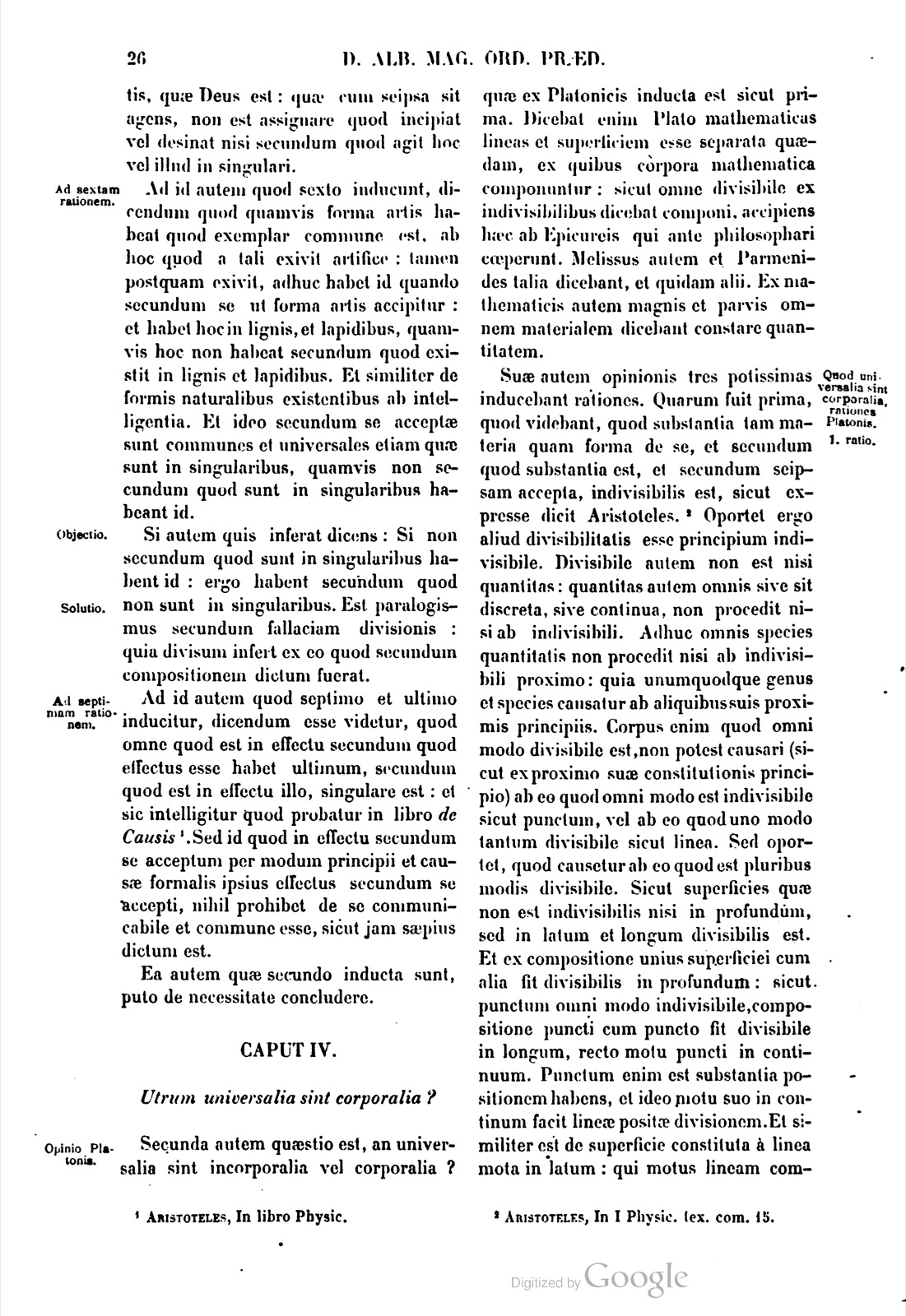
Secunda ratio est, quod principium alicujus generis vel speciei, non potest esse, vel hoc vel illud in numero determinatum: quia sic non esset universale illius generis vel speciei acceptum. Principia ergo generum et specierum, genera sunt et species: et cum principiata sint corpora sensibilia et quanta, sequitur quod principia illorum sint genera et species quantitatum. Haec enim sunt principia sensibilia per hic et nunc individuata. Substantia enim secundum quod substantia in principiis ejus, nec ad hic nec ad nunc determinatur vel individuatur: et ideo talibus principiis non causatur. Et ideo Plato dixit omnium istorum sensibilium principia circa mathematica in rationibus generum vel specierum accepta: substantiam autem secundum quod substantia non esse sicut principiatum, sed per quantitatem esse determinatam ad hic et nunc. Ex hoc autem ulterius inferebat, quod genera et species, quae sunt horum singularium principia, sunt corporalia.
Tertia ratio Platonis fuit: quia quod est in ordine naturae primum, est causa et principium ejusdem quod secundum se in eodem naturae ordine posterius est, sicut in libro fontis vitae et in libro de causis est probatum. Quantum autem secundum rationem quantitatis acceptum constat quod secundum ordinem naturae est ante hoc quantum sensibile. Ergo secundum ordinem naturae causa est ipsius, et principium. Non est autem causa et principium nisi quod est simplex et universale principium. Ergo quod est simplex et universale, quantum est et corporale.
Istae absque dubitatione rationes sunt Platonis in hoc quod universalia dixit esse corporalia quaedam in mathematicis rationibus et formis constituta. Quod autem quidam dicunt de universalibus immaterialium, ut angeli, et animae, nihil penitus valet ad propositum. Talia enim dixit Plato ab aeterno consistere, et radios quosdam lucis primae esse, et non esse causata a principiis materialibus per compositionem, et in talibus dixit esse particulare non universale: sed in talibus dixit, quod sunt in nobis per hoc quod luces eorum et essentiae sunt in nobis, sive existentibus per ea, sive cognoscentibus ea. Propter quod Avicenna in sua metaphysica, ubi stabilit species qualitatis, dicit quod hoc dictum verum est. Cujus signum dicit: quia ea in quibus sunt sive existentibus sive cognoscentibus ea, non recipiunt ea secundum hic et nunc, sed ubique et semper, quantum est de ipsis. Anima enim non est in corpore secundum hic et nunc, nec daemon sive intelligentia, sive etiam angelus, non est in eo in quo est per operationem vel cognitionem ut hic et nunc, sed secundum possibilitatem ejus in quo est, est in eo secundum ubique et semper: quia non habet in eo positionis discretionem. Haec opinio Platonis est.
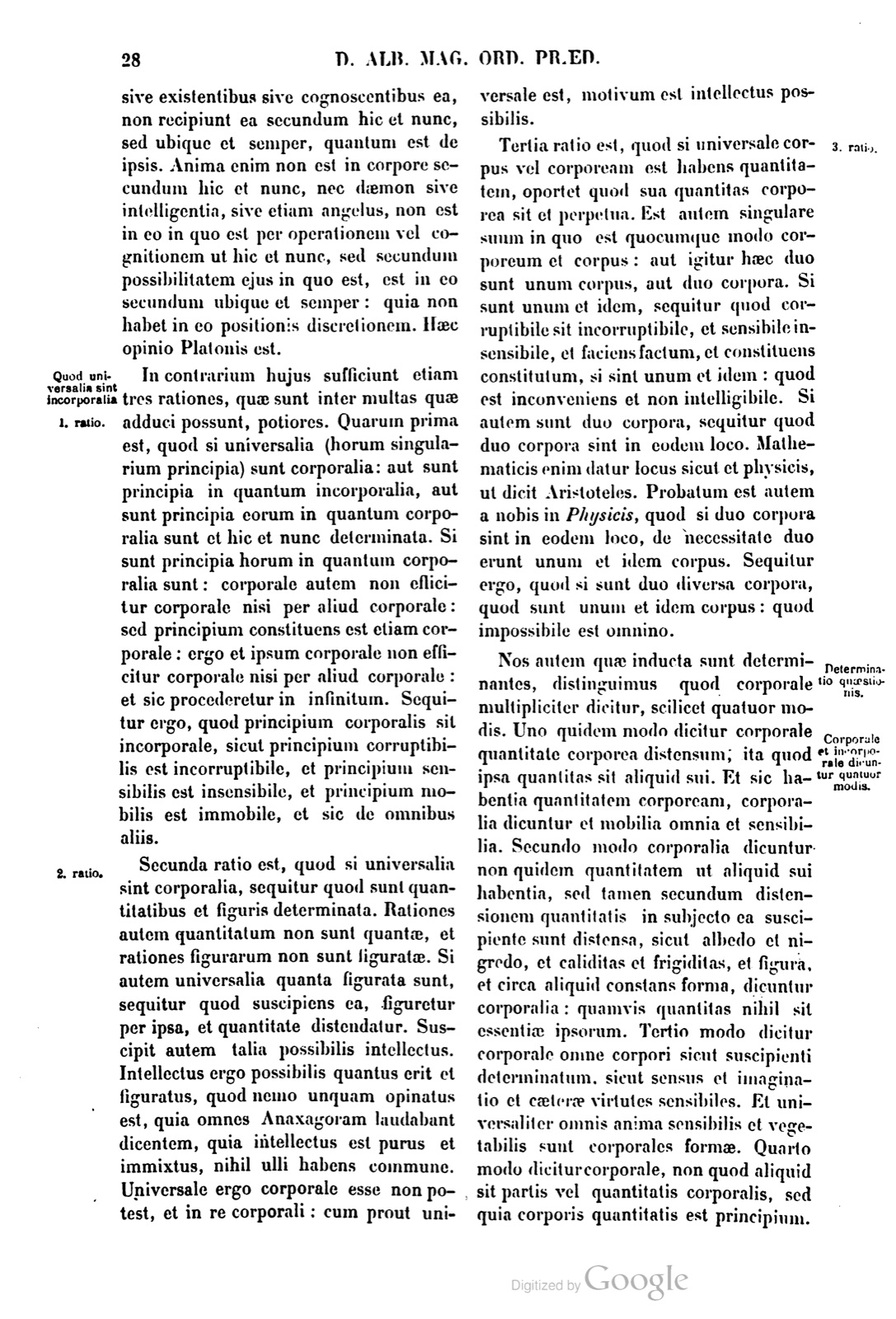
In contrarium hujus sufficiunt etiam tres rationes, quae sunt inter multas quae adduci possunt, potiores. Quarum prima est, quod si universalia, horum singularium principia, sunt corporalia: aut sunt principia in quantum incorporalia, aut sunt principia eorum in quantum corporalia sunt et hic et nunc determinata. Si sunt principia horum in quantum corporalia sunt: corporale autem non efficitur corporale nisi per aliud corporale: sed principium constituens est etiam corporale: ergo et ipsum corporale non efficitur corporale nisi per aliud corporale: et sic procederetur in infinitum. Sequitur ergo, quod principium corporalis sit incorporale, sicut principium corruptibilis est incorruptibile, et principium sensibilis est insensibile, et principium mobilis est immobile, et sic de omnibus aliis.
The second reason is that the principle of some genus or species cannot be either this or that determined thing in number: because thus it would not be the universal of that genus or species taken. Therefore the principles of genera and species are genera and species: and since the things principled are sensible and quantified bodies, it follows that their principles are genera and species of quantities. For these are sensible principles individuated by here and now. For substance insofar as it is substance, in its principles, is determined or individuated neither to here nor to now: and therefore it is not caused by such principles. And therefore Plato said that the principles of all these sensible things are about mathematical things taken in the notions of genera or species; but that substance, insofar as it is substance, is not as what is principled, but is determined through quantity to here and now. From this, moreover, he further inferred that genera and species, which are the principles of these singulars, are corporeal.
The third reason of Plato was: because what is first in the order of nature is the cause and principle of the same thing which, according to itself, is posterior in the same order of nature, as has been proved in the Book of the Fount of Life and in the Book of Causes. But the quantified thing taken according to the notion of quantity is clearly prior according to the order of nature to this sensible quantified thing. Therefore, according to the order of nature, it is its cause and principle. But nothing is cause and principle except what is a simple and universal principle. Therefore what is simple and universal is quantified and corporeal.
Without doubt, these are Plato's reasons in this, that he said universals are certain corporeal things constituted in mathematical notions and forms. But what certain people say concerning universals of immaterial things, such as angels and souls, is of no value at all for the present matter. For Plato said that such things stand from eternity, and are certain rays of the first light, and are not caused by material principles through composition; and in such things he said there is particular, not universal: but in such things he said that they are in us through this, that their lights and essences are in us, whether we are existing through them or knowing them. On account of this Avicenna in his Metaphysics, where he establishes the species of quality, says that this saying is true. He gives as its sign: because those things in which they are, whether the things existing through them or knowing them, do not receive them according to here and now, but everywhere and always, as far as they themselves are concerned. For the soul is not in the body according to here and now, nor is a daemon or intelligence, or even an angel, in that in which it is by operation or cognition as here and now, but according to the possibility of that in which it is, it is in it according to everywhere and always: because it does not have in it a discretion of position. This is Plato's opinion.
Against this, three reasons also suffice, which among the many which can be adduced are the stronger. The first of these is that if universals, the principles of these singulars, are corporeal, they are principles either insofar as they are incorporeal, or they are principles of them insofar as they are corporeal and determined here and now. If they are principles of these insofar as they are corporeal, but a corporeal thing is not made corporeal except through another corporeal thing, and the constituting principle is also corporeal, then that corporeal thing itself also is not made corporeal except through another corporeal thing: and thus one would proceed to infinity. Therefore it follows that the principle of a corporeal thing is incorporeal, just as the principle of the corruptible is incorruptible, and the principle of the sensible is insensible, and the principle of the movable is immobile, and so with all other things.
Secunda ratio est, quod si universalia sint corporalia, sequitur quod sunt quantitatibus et figuris determinata. Rationes autem quantitatum non sunt quantae, et rationes figurarum non sunt figuratae. Si autem universalia quanta figurata sunt, sequitur quod suscipiens ea, figuretur per ipsa, et quantitate distendatur. Suscipit autem talia possibilis intellectus. Intellectus ergo possibilis quantus erit et figuratus, quod nemo unquam opinatus est, quia omnes Anaxagoram laudabant dicentem, quia intellectus est purus et immixtus, nihil ulli habens commune. Universale ergo corporale esse non potest, et in re corporali: cum prout universale est, motivum est intellectus possibilis.
Tertia ratio est, quod si universale corpus vel corporeum est habens quantitatem, oportet quod sua quantitas corporea sit et perpetua. Est autem singulare suum in quo est quocumque modo corporeum et corpus: aut igitur haec duo sunt unum corpus, aut duo corpora. Si sunt unum et idem, sequitur quod corruptibile sit incorruptibile, et sensibile insensibile, et faciens factum, et constituens constitutum, si sint unum et idem: quod est inconveniens et non intelligibile. Si autem sunt duo corpora, sequitur quod duo corpora sint in eodem loco. Mathematicis enim datur locus sicut et physicis, ut dicit Aristoteles. Probatum est autem a nobis in Physicis, quod si duo corpora sint in eodem loco, de necessitate duo erunt unum et idem corpus. Sequitur ergo, quod si sunt duo diversa corpora, quod sunt unum et idem corpus: quod impossibile est omnino.
Nos autem quae inducta sunt determinantes, distinguimus quod corporale multipliciter dicitur, scilicet quatuor modis. Uno quidem modo dicitur corporale quantitate corporea distensum; ita quod et ipsa quantitas sit aliquid sui. Et sic habentia quantitatem corpoream, corporalia dicuntur et mobilia omnia et sensibilia. Secundo modo corporalia dicuntur non quidem quantitatem ut aliquid sui habentia, sed tamen secundum distensionem quantitatis in subjecto ea suscipiente sunt distensa, sicut albedo et nigredo, et caliditas et frigiditas, et figura, et circa aliquid constans forma, dicuntur corporalia: quamvis quantitas nihil sit essentiae ipsorum. Tertio modo dicitur corporale omne corpori sicut suscipienti determinatum, sicut sensus et imaginatio et caeterae virtutes sensibiles. Et universaliter omnis anima sensibilis et vegetabilis sunt corporales formae. Quarto modo dicitur corporale, non quod aliquid sit partis vel quantitatis corporalis, sed quia corporis quantitatis est principium. Et sic punctum dicitur esse corporale. Similiter autem multipliciter dicitur incorporale: quia si unum oppositorum est multiplex, et reliquum. Nullo autem istorum modorum universale est corporale: quia est sicut natura corporis vel corporei, cui per aptitudinem dicendi de multis accidit universale esse: et est incorruptibilis, quia, sicut optime probatum est, aliter motivum intellectus possibilis esse non potest, quia penitus incorporeus et incorruptibilis est. Est enim simplex notio et natura ab omni quantitate distensionis abstracta.
The second reason is that if universals are corporeal, it follows that they are determined by quantities and figures. But the notions of quantities are not quantified, and the notions of figures are not figured. But if universals are quantified and figured, it follows that the one receiving them is figured by them and stretched out by quantity. But the possible intellect receives such things. Therefore the possible intellect will be quantified and figured, which no one has ever supposed, because all praised Anaxagoras when he said that intellect is pure and unmixed, having nothing common with anything. Therefore the universal cannot be corporeal, even in a corporeal thing, since, insofar as it is universal, it is mover of the possible intellect.
The third reason is that if a universal is a body or is corporeal having quantity, its corporeal quantity must also be perpetual. But its singular in which it is, in whatever way, is corporeal and a body: therefore either these two are one body, or they are two bodies. If they are one and the same, it follows that the corruptible is incorruptible, the sensible insensible, the maker made, and the constituting constituted, if they are one and the same: which is unfitting and unintelligible. But if they are two bodies, it follows that two bodies are in the same place. For place is given to mathematical things just as to physical things, as Aristotle says. But it has been proved by us in the Physics that if two bodies are in the same place, of necessity the two will be one and the same body. Therefore it follows that if they are two diverse bodies, they are one and the same body: which is altogether impossible.
But we, determining the things introduced, distinguish that corporeal is said in multiple ways, namely in four ways. In one way something is called corporeal as stretched out by corporeal quantity, so that the quantity itself is also something of it. And thus all things having corporeal quantity, both movable and sensible things, are called corporeal. In a second way things are called corporeal not indeed as having quantity as something of themselves, but nevertheless as stretched out according to the extension of quantity in the subject receiving them, as whiteness and blackness, heat and coldness, and figure, and a form standing about something, are called corporeal, although quantity is nothing of their essence. In a third way everything determined to a body as to a receiver is called corporeal, such as sense and imagination and the other sensible powers. And universally every sensible and vegetative soul are corporeal forms. In a fourth way something is called corporeal, not because it is something of a part or of corporeal quantity, but because it is a principle of the body's quantity. And thus a point is said to be corporeal. But incorporeal is likewise said in many ways: because if one of opposites is multiple, so is the remaining one. In none of these modes is the universal corporeal: because it is as the nature of a body or of a corporeal thing, to which universal being happens through aptitude for being said of many: and it is incorruptible, because, as has been shown very well, otherwise it could not be mover of the possible intellect, because it is utterly incorporeal and incorruptible. For it is a simple notion and nature abstracted from every quantity of extension.
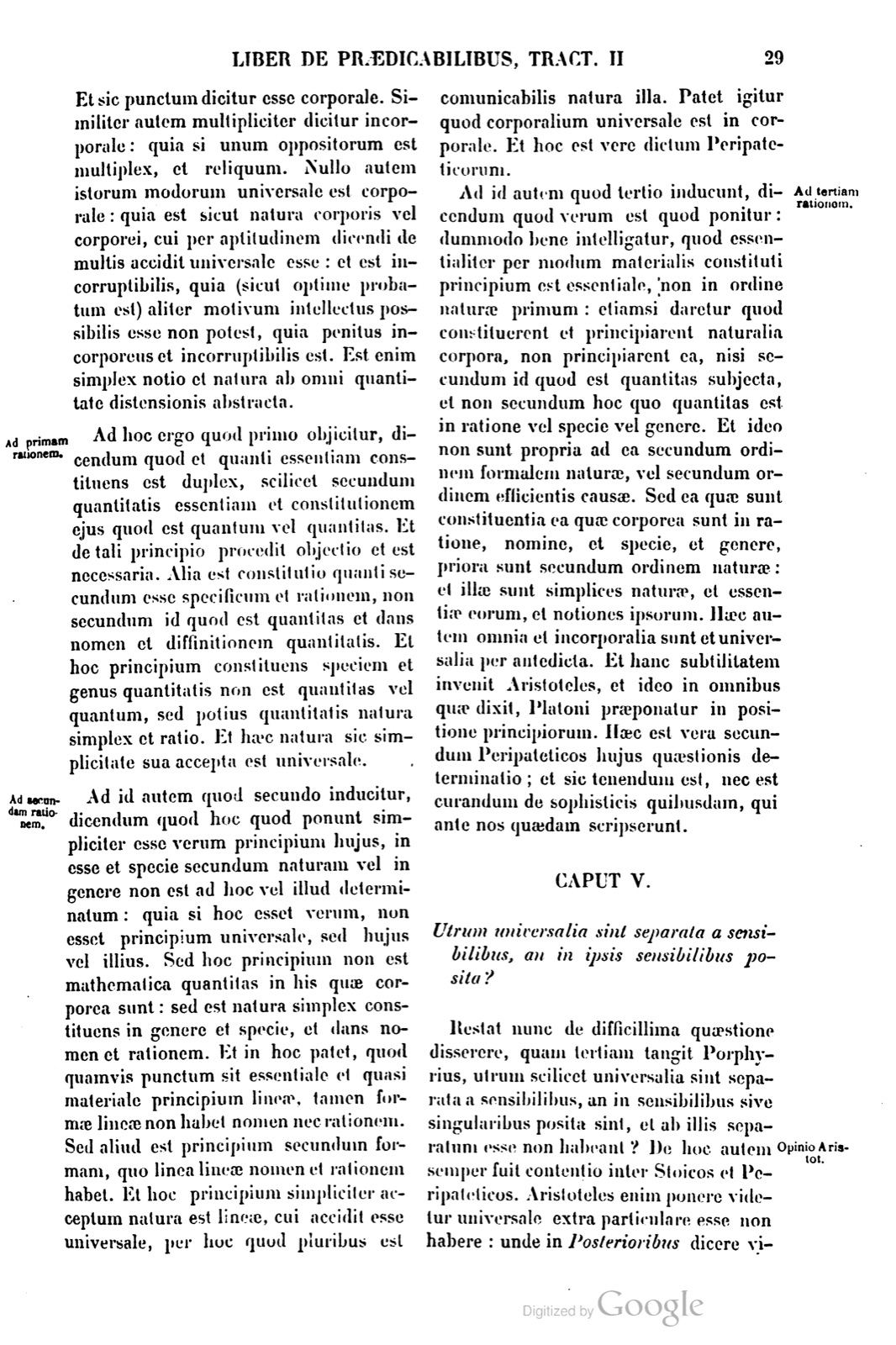
Ad hoc ergo quod primo objicitur, dicendum quod et quanti essentiam constituens est duplex, scilicet secundum quantitatis essentiam et constitutionem ejus quod est quantum vel quantitas. Et de tali principio procedit objectio et est necessaria. Alia est constitutio quanti secundum esse specificum et rationem, non secundum id quod est quantitas et dans nomen et diffinitionem quantitatis. Et hoc principium constituens speciem et genus quantitatis non est quantitas vel quantum, sed potius quantitatis natura simplex et ratio. Et haec natura sic simplicitate sua accepta est universale.
Ad id autem quod secundo inducitur, dicendum quod hoc quod ponunt simpliciter esse verum principium hujus, in esse et specie secundum naturam vel in genere non est ad hoc vel illud determinatum: quia si hoc esset verum, non esset principium universale, sed hujus vel illius. Sed hoc principium non est mathematica quantitas in his quae corporea sunt: sed est natura simplex constituens in genere et specie, et dans nomen et rationem. Et in hoc patet, quod quamvis punctum sit essentiale et quasi materiale principium lineae, tamen formae lineae non habet nomen nec rationem. Sed aliud est principium secundum formam, quo linea lineae nomen et rationem habet. Et hoc principium simpliciter acceptum natura est lineae, cui accidit esse universale, per hoc quod pluribus est communicabilis natura illa. Patet igitur quod corporalium universale est incorporale. Et hoc est vere dictum Peripateticorum.
Ad id autem quod tertio inducunt, dicendum quod verum est quod ponitur: dummodo bene intelligatur, quod essentialiter per modum materialis constituti principium est essentiale, non in ordine naturae primum: etiamsi daretur quod constituerent et principiarent naturalia corpora, non principiarent ea, nisi secundum id quod est quantitas subjecta, et non secundum hoc quo quantitas est in ratione vel specie vel genere. Et ideo non sunt propria ad ea secundum ordinem formalem naturae, vel secundum ordinem efficientis causae. Sed ea quae sunt constituentia ea quae corporea sunt in ratione, nomine, et specie, et genere, priora sunt secundum ordinem naturae: et illae sunt simplices naturae, et essentiae eorum, et notiones ipsorum. Haec autem omnia et incorporalia sunt et universalia per antedicta. Et hanc subtilitatem invenit Aristoteles, et ideo in omnibus quae dixit, Platoni praeponatur in positione principiorum. Haec est vera secundum Peripateticos hujus quaestionis determinatio; et sic tenendum est, nec est curandum de sophisticis quibusdam, qui ante nos quaedam scripserunt.
To this, therefore, which is first objected, one must say that that which constitutes the essence of the quantified is twofold, namely according to the essence of quantity and the constitution of that which is quantified or quantity. And from such a principle the objection proceeds and is necessary. Another is the constitution of the quantified according to specific being and notion, not according to that which is quantity and gives the name and definition of quantity. And this principle constituting the species and genus of quantity is not quantity or quantified, but rather the simple nature and notion of quantity. And this nature, thus taken in its simplicity, is a universal.
To that which is introduced second, one must say that what they posit, that the principle of this is simply true, in being and species according to nature or in genus is not determined to this or that: because if this were true, it would not be a universal principle, but a principle of this or that. But this principle is not mathematical quantity in those things which are corporeal; rather it is simple nature constituting in genus and species, and giving name and notion. And in this it is clear that although a point is the essential and as it were material principle of a line, nevertheless it does not have the name or notion of the form of line. But there is another principle according to form, by which a line has the name and notion of line. And this principle taken simply is the nature of line, to which being universal happens through this, that that nature is communicable to many. Therefore it is clear that the universal of corporeal things is incorporeal. And this is the true saying of the Peripatetics.
To that which they introduce third, one must say that what is posited is true, provided it is understood well: that what is essentially a principle by the mode of a material constituted thing is essential, not first in the order of nature; even if it were granted that they constituted and principled natural bodies, they would not principle them except according to that which is subjected quantity, and not according to this by which quantity is in notion or species or genus. And therefore they are not proper to them according to the formal order of nature, or according to the order of efficient cause. But those things which constitute things that are corporeal in notion, name, species, and genus, are prior according to the order of nature: and those are simple natures, and their essences, and their notions. But all these things are both incorporeal and universal through what has been said before. And Aristotle found this subtlety, and therefore in all the things which he said, he is to be preferred to Plato in the positing of principles. This is the true determination of this question according to the Peripatetics; and thus it must be held, nor should care be taken over certain sophistical men who wrote certain things before us.
Notes
- The opinion of those positing syllogism as the subject of logic is rejected by the author; Scotus also follows this opinion in the second question on universals. (Improbatur ab auctore opinio ponentium syllogismum esse subjectum logicae, quam etiam sectatur Scot. in 2 quaest. universalium.) ↩
- Avicenna, in chapter 1 of his Logic. (Avicenna, In 1 cap. logicae suae.) ↩
- And this is the opinion of Avicenna, Alfarabius, and Algazel. See Avicenna in chapter 3 of his Logic and Algazel in chapter 2. (Et haec est opinio Avicennae, Alfarabii et Algazelis. Vide Avicennam in cap. 3 suae logicae et Algazelem in cap. 2.) ↩
- Aristotle, in Physics I, text, commentary 15. (Aristoteles, In I Physic. tex. com. 15.) ↩
- Compare Physics I, text, commentaries 40, 41, and 82, especially concerning prime matter. (Cf. I Physic. tex. com. 40, 41 et 82, specialiter de materia prima.) ↩
If a page does not appear, its photograph has not been uploaded yet.