Volume 1 · pp. 5–6
Chapter III. On the usefulness of dialectic.
A marker with ≈ is an approximate page boundary, placed by measure of the text; the page photographs remain the authority. In the paired views, clicking a page marker brings that page into view.
Caput III. De utilitate dialecticae.
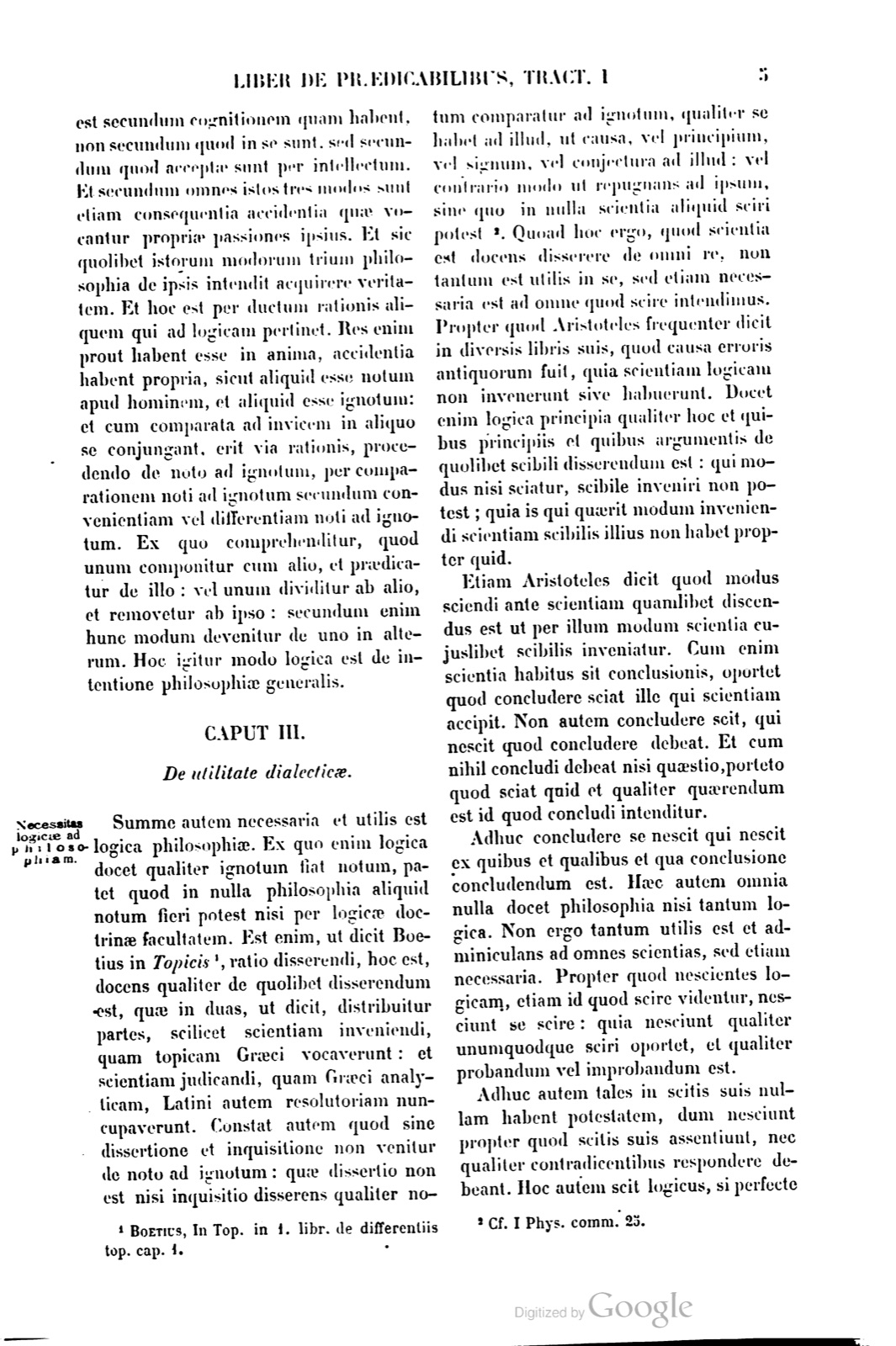
Summe autem necessaria et utilis est logica philosophiae. Ex quo enim logica docet qualiter ignotum fiat notum, patet quod in nulla philosophia aliquid notum fieri potest nisi per logicae doctrinae facultatem. Est enim, ut dicit Boetius in Topicis 1, ratio disserendi, hoc est, docens qualiter de quolibet disserendum est, quae in duas, ut dicit, distribuitur partes, scilicet scientiam inveniendi, quam topicam Graeci vocaverunt: et scientiam judicandi, quam Graeci analyticam, Latini autem resolutoriam nuncupaverunt. Constat autem quod sine dissertione et inquisitione non venitur de noto ad ignotum: quae dissertio non est nisi inquisitio disserens qualiter notum comparatur ad ignotum, qualiter se habet ad illud, ut causa, vel principium, vel signum, vel conjectura ad illud: vel contrario modo ut repugnans ad ipsum, sine quo in nulla scientia aliquid sciri potest 2. Quoad hoc ergo, quod scientia est docens disserere de omni re, non tantum est utilis in se, sed etiam necessaria est ad omne quod scire intendimus. Propter quod Aristoteles frequenter dicit in diversis libris suis, quod causa erroris antiquorum fuit, quia scientiam logicam non invenerunt sive habuerunt. Docet enim logica principia qualiter hoc et quibus principiis et quibus argumentis de quolibet scibili disserendum est: qui modus nisi sciatur, scibile inveniri non potest; quia is qui quaerit modum inveniendi scientiam scibilis illius non habet propter quid.
Etiam Aristoteles dicit quod modus sciendi ante scientiam quamlibet discendus est ut per illum modum scientia cujuslibet scibilis inveniatur. Cum enim scientia habitus sit conclusionis, oportet quod concludere sciat ille qui scientiam accipit. Non autem concludere scit, qui nescit quod concludere debeat. Et cum nihil concludi debeat nisi quaestio, oportet quod sciat quid et qualiter quaerendum est id quod concludi intenditur.
Adhuc concludere se nescit qui nescit ex quibus et qualibus et qua conclusione concludendum est. Haec autem omnia nulla docet philosophia nisi tantum logica. Non ergo tantum utilis est et adminiculans ad omnes scientias, sed etiam necessaria. Propter quod nescientes logicam, etiam id quod scire videntur, nesciunt se scire: quia nesciunt qualiter unumquodque sciri oportet, et qualiter probandum vel improbandum est.
Adhuc autem tales in scitis suis nullam habent potestatem, dum nesciunt propter quod scitis suis assentiunt, nec qualiter contradicentibus respondere debeant. Hoc autem scit logicus, si perfecte scientiam disserendi de quolibet sit adeptus.
Adhuc autem nesciens logicam, etsi scire aliquid videatur, nescit tamen, sicut jam supra diximus, cum rationem sui sciti nesciat: et se habet ad scitum et ad actum sciendi, sicut ignis ad comburere lignum. Et ideo scientis est, ut in prima philosophia docet Aristoteles 3, posse docere. Docere autem non potest, qui rationem sciti nescit exponere. Nescit autem exponere sui sciti rationem, qui causas et principia logicae non novit. Erit igitur talis etiam in his quae scire videtur, sicut idiota se habet ad habentem litteram. Talis etiam neque suum neque alterius deprehendit errorem, quia non habet habitum per quem dijudicet utrum recte sciat quod scit, vel non recte.
Chapter III. On the usefulness of dialectic.
Logic is supremely necessary and useful for philosophy. For from the fact that logic teaches how the unknown becomes known, it is clear that in no philosophy can anything be made known except through the capacity of logical teaching. For, as Boethius says in the Topics 1, it is the reason of discussing, that is, teaching how one must discuss concerning anything whatever, which, as he says, is distributed into two parts, namely the science of finding, which the Greeks called topic, and the science of judging, which the Greeks called analytic, but the Latins called resolutory. But it is agreed that without discussion and inquiry one does not come from the known to the unknown; and this discussion is nothing other than an inquiry discussing how the known is compared to the unknown, how it is related to it, as cause, or principle, or sign, or conjecture toward it, or in the contrary way as repugnant to it; without this nothing can be known in any science 2. Therefore with respect to this, that it is a science teaching how to discuss concerning every thing, it is not only useful in itself, but is also necessary for everything which we intend to know. For this reason Aristotle frequently says in his different books that the cause of the error of the ancients was that they did not find or have logical science. For logic teaches the principles how, and by what principles and by what arguments, one must discuss concerning any knowable thing; and unless that mode is known, the knowable thing cannot be found, because he who seeks the mode of finding science of that knowable thing does not have the on-account-of-which.
Aristotle also says that the mode of knowing must be learned before any science, so that through that mode the science of any knowable thing may be found. For since science is a habit of the conclusion, the one who receives science must know how to conclude. But he who does not know what he ought to conclude does not know how to conclude. And since nothing ought to be concluded except a question, he must know what and how that which is intended to be concluded must be sought.
Again, he does not know how to conclude who does not know from what things, and of what sort, and by what conclusion one must conclude. But no philosophy teaches all these things except logic alone. Therefore it is not only useful and assisting for all sciences, but also necessary. For this reason those who do not know logic, even with respect to that which they seem to know, do not know that they know it, because they do not know how each thing ought to be known, and how it is to be proved or disproved.
Again, such people have no power in the things they know, since they do not know on account of what they assent to the things they know, nor how they ought to answer those contradicting them. But the logician knows this, if he has perfectly obtained the science of discussing concerning anything whatever.
Again, the one who does not know logic, even if he seems to know something, nevertheless does not know it, as we have already said above, since he does not know the reason of what he knows; and he is related to the known thing and to the act of knowing as fire is related to burning wood. And therefore it belongs to one who knows, as Aristotle teaches in first philosophy 3, to be able to teach. But one cannot teach who does not know how to set forth the reason of what is known. But he does not know how to set forth the reason of what he knows who does not know the causes and principles of logic. Therefore such a person, even in those things which he seems to know, will be as an unlettered person is related to one having letters. Such a person also detects neither his own error nor another's, because he does not have the habit by which he may judge whether he knows rightly what he knows or not rightly.
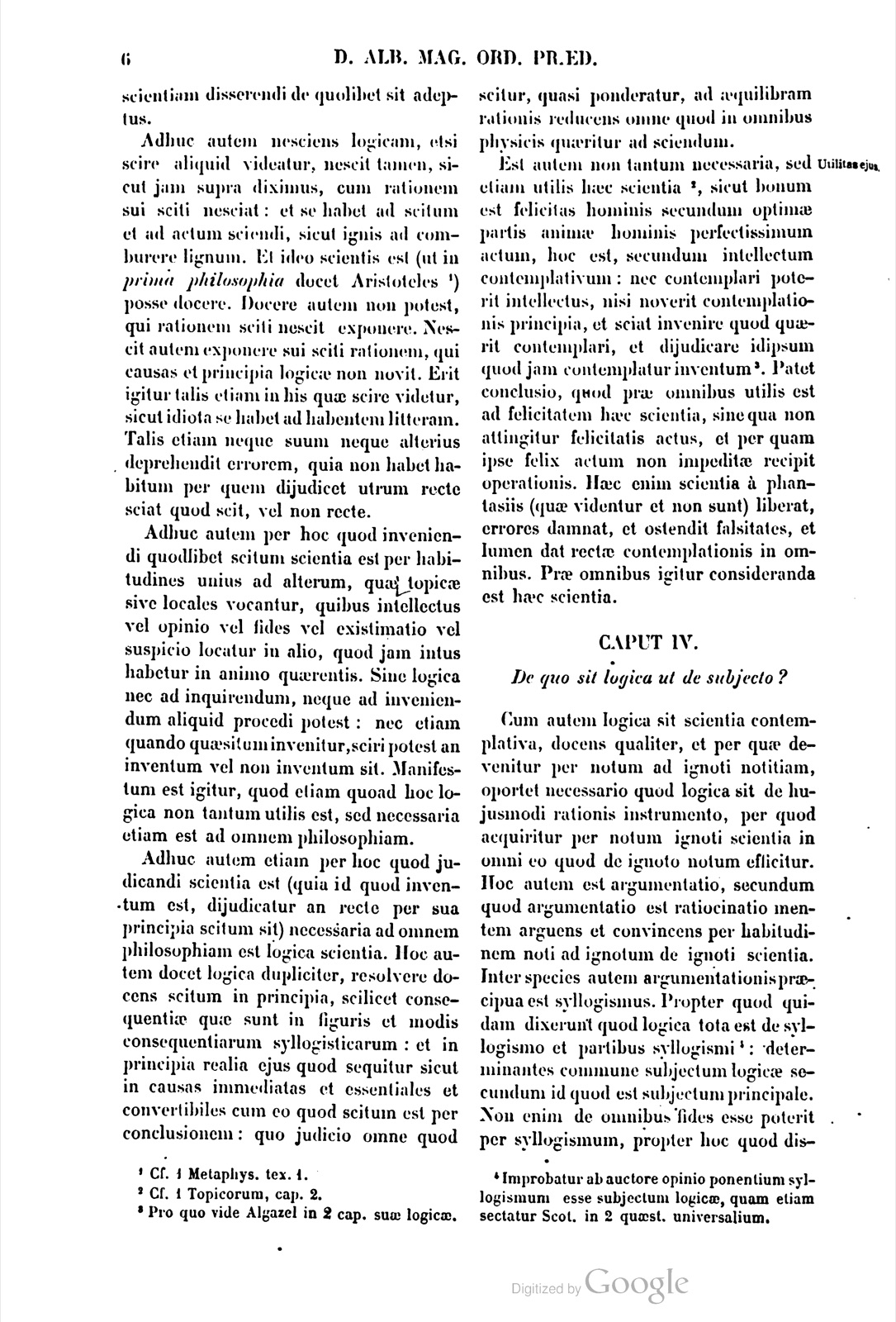
Adhuc autem per hoc quod inveniendi quodlibet scitum scientia est per habitudines unius ad alterum, quae topicae sive locales vocantur, quibus intellectus vel opinio vel fides vel existimatio vel suspicio locatur in alio, quod jam intus habetur in animo quaerentis. Sine logica nec ad inquirendum, neque ad inveniendum aliquid procedi potest: nec etiam quando quaesitum invenitur, sciri potest an inventum vel non inventum sit. Manifestum est igitur, quod etiam quoad hoc logica non tantum utilis est, sed necessaria etiam est ad omnem philosophiam.
Adhuc autem etiam per hoc quod judicandi scientia est, quia id quod inventum est, dijudicatur an recte per sua principia scitum sit, necessaria ad omnem philosophiam est logica scientia. Hoc autem docet logica dupliciter, resolvere docens scitum in principia, scilicet consequentiae quae sunt in figuris et modis consequentiarum syllogisticarum: et in principia realia ejus quod sequitur sicut in causas immediatas et essentiales et convertibiles cum eo quod scitum est per conclusionem: quo judicio omne quod scitur, quasi ponderatur, ad aequilibram rationis reducens omne quod in omnibus physicis quaeritur ad sciendum.
Est autem non tantum necessaria, sed etiam utilis haec scientia 4, sicut bonum est felicitas hominis secundum optimae partis animae hominis perfectissimum actum, hoc est, secundum intellectum contemplativum: nec contemplari poterit intellectus, nisi noverit contemplationis principia, et sciat invenire quod quaerit contemplari, et dijudicare idipsum quod jam contemplatur inventum 5. Patet conclusio, quod prae omnibus utilis est ad felicitatem haec scientia, sine qua non attingitur felicitatis actus, et per quam ipse felix actum non impeditae recipit operationis. Haec enim scientia a phantasiis, quae videntur et non sunt, liberat, errores damnat, et ostendit falsitates, et lumen dat rectae contemplationis in omnibus. Prae omnibus igitur consideranda est haec scientia.
Again, through this, that there is a science of finding any known thing through relations of one thing to another, which are called topical or local, by which intellect or opinion or faith or estimation or suspicion is located in another thing which is already held within in the mind of the one seeking. Without logic one cannot proceed either to inquire into or to find anything; nor, even when the thing sought is found, can it be known whether it has been found or not found. Therefore it is manifest that also with respect to this logic is not only useful, but is also necessary for every philosophy.
Again, also through this, that it is a science of judging, because that which has been found is judged whether it has rightly been known through its principles, logical science is necessary for every philosophy. But logic teaches this in two ways, teaching one to resolve the thing known into principles, namely principles of consequence which are in the figures and modes of syllogistic consequences, and into the real principles of that which follows, as into immediate, essential causes convertible with that which is known through the conclusion; by this judgment everything that is known is, as it were, weighed, reducing to the equilibrium of reason everything that in all physical matters is sought for knowing.
But this science 4 is not only necessary, but also useful, just as the good is the happiness of man according to the most perfect act of the best part of the human soul, that is, according to contemplative intellect. Nor will the intellect be able to contemplate unless it has known the principles of contemplation, and knows how to find what it seeks to contemplate, and to judge the very thing that, once found, it now contemplates 5. The conclusion is clear: before all other things this science is useful for happiness, without which the act of happiness is not reached, and through which the happy person receives the act of operation that is not impeded. For this science frees one from phantasms which seem to be and are not, condemns errors, shows falsities, and gives the light of right contemplation in all things. Therefore this science must be considered before all things.
Notes
- Boethius, On the Topics, in the first book On Topical Differences, chapter 1. (Boetius, In Top. in 1. libr. de differentiis top. cap. 1.) ↩
- Compare Physics I, commentary 25. (Cf. I Phys. comm. 25.) ↩
- Compare Metaphysics I, text 1. (Cf. 1 Metaphys. tex. 1.) ↩
- For this, see Algazel in chapter 2 of his Logic. (Pro quo vide Algazel in 2 cap. suae logicae.) ↩
- Compare Topics I, chapter 2. (Cf. 1 Topicorum, cap. 2.) ↩
If a page does not appear, its photograph has not been uploaded yet.