Volume 1 · pp. 2–5
Chapter II. Whether logic is a part of philosophy?
A marker with ≈ is an approximate page boundary, placed by measure of the text; the page photographs remain the authority. In the paired views, clicking a page marker brings that page into view.
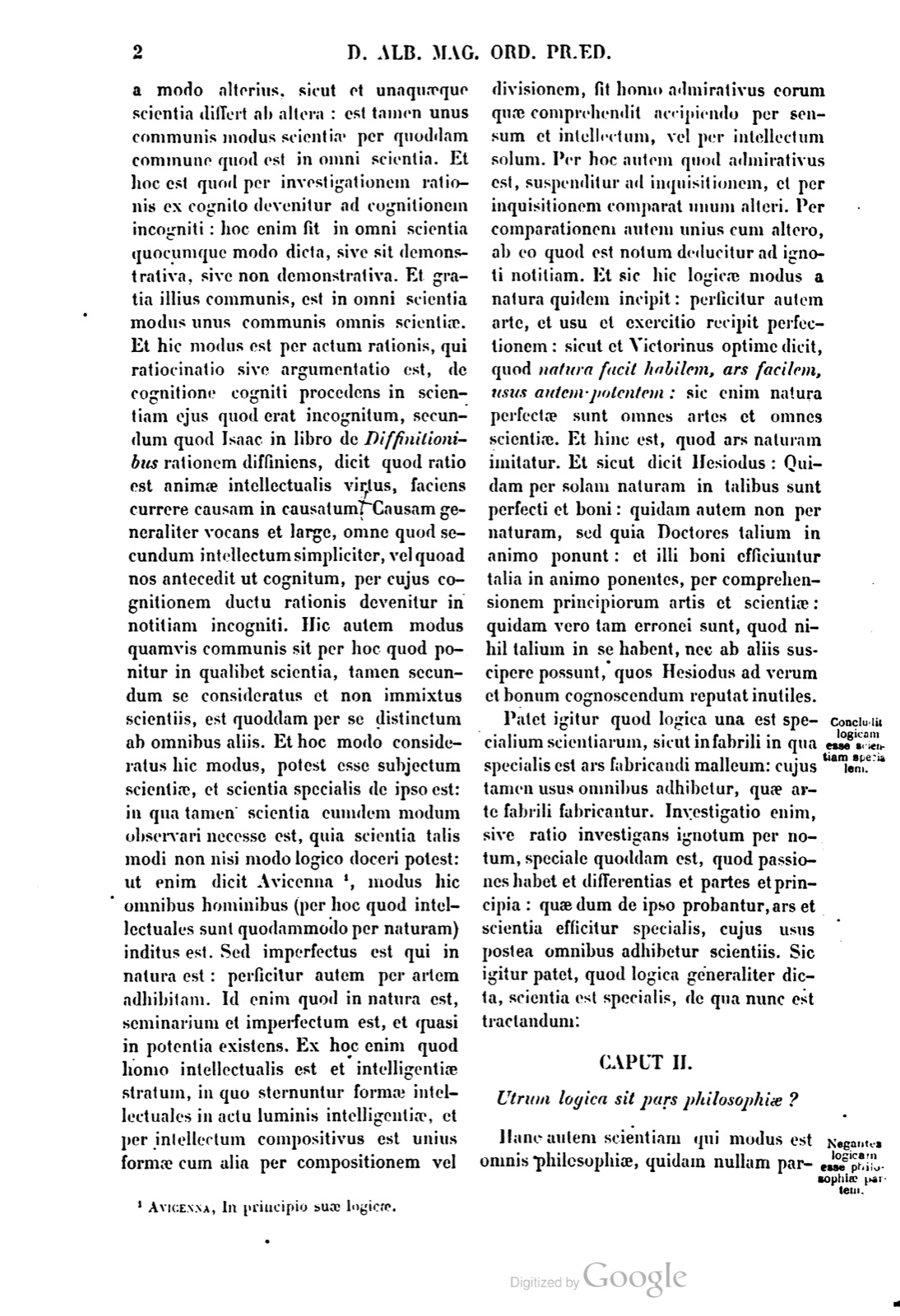
Caput II. Utrum logica sit pars philosophiae?
Hanc autem scientiam, quae modus est omnis philosophiae, quidam nullam partem esse philosophiae contendunt, dicentes non nisi tres esse partes philosophiae, scilicet physicam, mathematicam sive disciplinabilem, et metaphysicam sive divinam. Cum enim diffinitio dicens quid et propter quid medium sit in scientia, et diffinitio non possit variari nisi tripliciter, scilicet quod aut concipiat materiam sensibilem, quae cum motu est et mutatione; aut concipiat materiam intelligibilem, cujus essentia non est cum motu et mutatione secundum rationem, quamvis secundum esse sit in materia quae est cum mutatione et motu, sicut est magnitudo et numerus; aut nec secundum essentiam, nec secundum esse concipiat materiam sensibilem: videtur quod philosophia non habeat nisi tres partes essentiales, sicut et Aristoteles dicere videtur 1. Propter quod nonnulli logicam scientiam sive rationalem, nullam partem dicunt esse philosophiae.
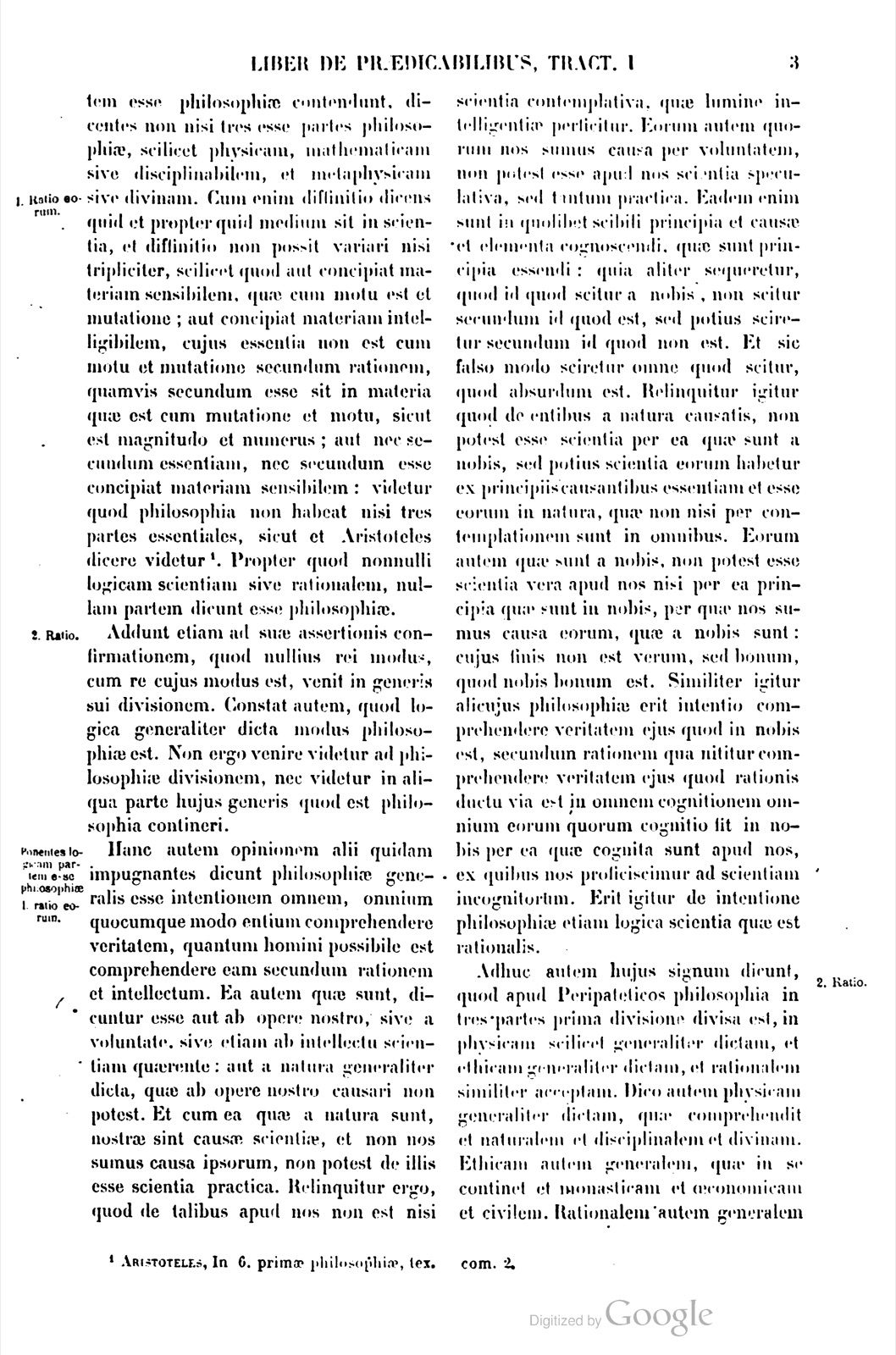
Addunt etiam ad suae assertionis confirmationem, quod nullius rei modus, cum re cujus modus est, venit in generis sui divisionem. Constat autem, quod logica generaliter dicta modus philosophiae est. Non ergo venire videtur ad philosophiae divisionem, nec videtur in aliqua parte hujus generis quod est philosophia contineri.
Hanc autem opinionem alii quidam impugnantes dicunt philosophiae generalis esse intentionem omnem, omnium quocumque modo entium comprehendere veritatem, quantum homini possibile est comprehendere eam secundum rationem et intellectum. Ea autem quae sunt, dicuntur esse aut ab opere nostro, sive a voluntate, sive etiam ab intellectu scientiam quaerente: aut a natura generaliter dicta, quae ab opere nostro causari non potest. Et cum ea quae a natura sunt, nostrae sint causae scientiae, et non nos sumus causa ipsorum, non potest de illis esse scientia practica. Relinquitur ergo, quod de talibus apud nos non est nisi scientia contemplativa, quae lumine intelligentiae perficitur. Eorum autem quorum nos sumus causa per voluntatem, non potest esse apud nos scientia speculativa, sed tantum practica. Eadem enim sunt in quolibet scibili principia et causae et elementa cognoscendi, quae sunt principia essendi: quia aliter sequeretur, quod id quod scitur a nobis, non scitur secundum id quod est, sed potius sciretur secundum id quod non est. Et sic falso modo sciretur omne quod scitur, quod absurdum est. Relinquitur igitur quod de entibus a natura causatis, non potest esse scientia per ea quae sunt a nobis, sed potius scientia eorum habetur ex principiis causantibus essentiam et esse eorum in natura, quae non nisi per contemplationem sunt in omnibus. Eorum autem quae sunt a nobis, non potest esse scientia vera apud nos nisi per ea principia quae sunt in nobis, per quae nos sumus causa eorum, quae a nobis sunt: cujus finis non est verum, sed bonum, quod nobis bonum est. Similiter igitur alicujus philosophiae erit intentio comprehendere veritatem ejus quod in nobis est, secundum rationem qua nititur comprehendere veritatem ejus quod rationis ductu via est in omnem cognitionem omnium eorum quorum cognitio fit in nobis per ea quae cognita sunt apud nos, ex quibus nos proficiscimur ad scientiam incognitorum. Erit igitur de intentione philosophiae etiam logica scientia quae est rationalis.
Chapter II. Whether logic is a part of philosophy?
But certain men contend that this science, which is the mode of all philosophy, is no part of philosophy, saying that there are only three parts of philosophy, namely physics, mathematics or the disciplinary science, and metaphysics or the divine science. For since definition, by saying what a thing is and on account of what, is the middle in science, and definition cannot be varied except in three ways, namely that either it conceives sensible matter, which is with motion and change; or it conceives intelligible matter, whose essence is not with motion and change according to reason, although according to being it is in matter which is with change and motion, as magnitude and number are; or neither according to essence nor according to being does it conceive sensible matter, it seems that philosophy has only three essential parts, as Aristotle also seems to say 1. For this reason some say that logical or rational science is no part of philosophy.
They also add, for confirmation of their assertion, that the mode of no thing, together with the thing whose mode it is, comes into the division of its genus. But it is agreed that logic, generally so called, is the mode of philosophy. Therefore it does not seem to come into the division of philosophy, nor does it seem to be contained in any part of this genus which is philosophy.
But certain others, attacking this opinion, say that the intention of general philosophy is to comprehend the truth of every thing, of all things existing in whatever manner, so far as it is possible for man to comprehend it according to reason and intellect. But the things which are are said to be either from our work, whether from will or even from intellect seeking science, or from nature generally so called, which cannot be caused by our work. And since the things which are from nature are causes of our science, and we are not the cause of them, there cannot be practical science concerning them. Therefore it remains that concerning such things among us there is only contemplative science, which is perfected by the light of intelligence. But of those things of which we are the cause through will, there cannot be speculative science among us, but only practical science. For in any knowable thing the principles and causes and elements of knowing are the same as the principles of being; because otherwise it would follow that what is known by us is not known according to that which it is, but rather would be known according to that which it is not. And thus everything that is known would be known in a false manner, which is absurd. Therefore it remains that concerning beings caused by nature, there cannot be science through those things which are from us, but rather science of them is had from the principles causing their essence and being in nature, which are in all things only through contemplation. But of those things which are from us, there cannot be true science among us except through those principles which are in us, through which we are the cause of those things which are from us; its end is not the true, but the good, which is good for us. Similarly, therefore, it will belong to the intention of some philosophy to comprehend the truth of that which is in us, according to the reason by which it strives to comprehend the truth of that which, by the guidance of reason, is a way into every cognition of all those things whose cognition occurs in us through those things which are known among us, from which we go forward to science of unknown things. Therefore logical science, which is rational, will also belong to the intention of philosophy.
Adhuc autem hujus signum dicunt, quod apud Peripateticos philosophia in tres partes prima divisione divisa est, in physicam scilicet generaliter dictam, et ethicam generaliter dictam, et rationalem similiter acceptam. Dico autem physicam generaliter dictam, quae comprehendit et naturalem et disciplinalem et divinam. Ethicam autem generalem, quae in se continet et monasticam et oeconomicam et civilem. Rationalem autem generalem quae comprehendit omnem modum deveniendi de noto ad ignotum quocumque modo: quod per multa genera probationum fit, ut in sequenti ostendetur. Manifestum est igitur, quod logica aliqua pars est philosophiae.
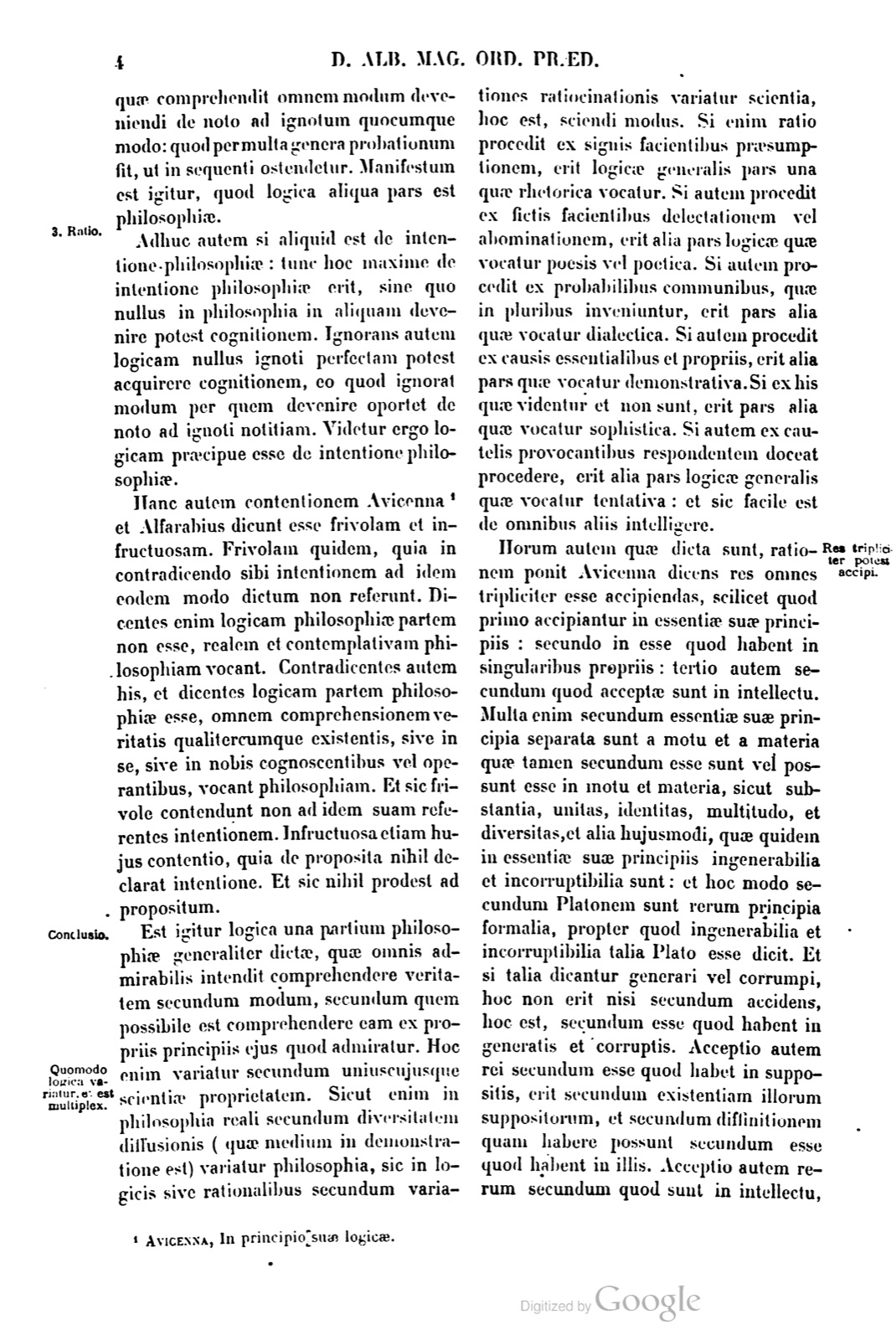
Adhuc autem si aliquid est de intentione philosophiae: tunc hoc maxime de intentione philosophiae erit, sine quo nullus in philosophia in aliquam devenire potest cognitionem. Ignorans autem logicam nullus ignoti perfectam potest acquirere cognitionem, eo quod ignorat modum per quem devenire oportet de noto ad ignoti notitiam. Videtur ergo logicam praecipue esse de intentione philosophiae.
Again they say that a sign of this is that among the Peripatetics philosophy in its first division is divided into three parts, namely into physics taken generally, and ethics taken generally, and the rational science likewise taken generally. I call physics generally so called that which comprehends both natural, disciplinary, and divine science. I call general ethics that which contains within itself monastic, economic, and civil science. I call the general rational science that which comprehends every mode of coming from the known to the unknown in whatever way; and this occurs through many kinds of proofs, as will be shown in what follows. Therefore it is manifest that logic is some part of philosophy.
Again, if something belongs to the intention of philosophy, then this will especially belong to the intention of philosophy, without which no one can come to any cognition in philosophy. But no one who is ignorant of logic can acquire perfect cognition of the unknown, because he is ignorant of the mode through which one must come from the known to knowledge of the unknown. Therefore logic seems especially to belong to the intention of philosophy.
Hanc autem contentionem Avicenna 2 et Alfarabius dicunt esse frivolam et infructuosam. Frivolam quidem, quia in contradicendo sibi intentionem ad idem eodem modo dictum non referunt. Dicentes enim logicam philosophiae partem non esse, realem et contemplativam philosophiam vocant. Contradicentes autem his, et dicentes logicam partem philosophiae esse, omnem comprehensionem veritatis qualitercumque existentis, sive in se, sive in nobis cognoscentibus vel operantibus, vocant philosophiam. Et sic frivole contendunt non ad idem suam referentes intentionem. Infructuosa etiam hujus contentio, quia de proposita nihil declarat intentione. Et sic nihil prodest ad propositum.
Est igitur logica una partium philosophiae generaliter dictae, quae omnis admirabilis intendit comprehendere veritatem secundum modum, secundum quem possibile est comprehendere eam ex propriis principiis ejus quod admiratur. Hoc enim variatur secundum uniuscujusque scientiae proprietatem. Sicut enim in philosophia reali secundum diversitatem diffinitionis, quae medium in demonstratione est, variatur philosophia, sic in logicis sive rationalibus secundum variationes ratiocinationis variatur scientia, hoc est, sciendi modus. Si enim ratio procedit ex signis facientibus praesumptionem, erit logicae generalis pars una quae rhetorica vocatur. Si autem procedit ex fictis facientibus delectationem vel abominationem, erit alia pars logicae quae vocatur poesis vel poetica. Si autem procedit ex probabilibus communibus, quae in pluribus inveniuntur, erit pars alia quae vocatur dialectica. Si autem procedit ex causis essentialibus et propriis, erit alia pars quae vocatur demonstrativa. Si ex his quae videntur et non sunt, erit pars alia quae vocatur sophistica. Si autem ex cautelis provocantibus respondentem doceat procedere, erit alia pars logicae generalis quae vocatur tentativa: et sic facile est de omnibus aliis intelligere.
But Avicenna 2 and Alfarabius say that this contention is frivolous and fruitless. Frivolous, indeed, because in contradicting one another they do not refer their intention to the same thing said in the same way. For those saying that logic is not a part of philosophy call real and contemplative philosophy philosophy. But those contradicting them, and saying that logic is a part of philosophy, call every comprehension of truth, existing in whatever way, whether in itself or in us as knowing or acting, philosophy. And thus they contend frivolously, not referring their intention to the same thing. This contention is also fruitless, because it declares nothing concerning the proposed intention. And thus it is of no profit for the proposed matter.
Therefore logic is one of the parts of philosophy generally so called, which, as entirely wondering, intends to comprehend truth according to the mode according to which it is possible to comprehend it from the proper principles of that which it wonders at. For this varies according to the property of each science. For just as in real philosophy philosophy is varied according to the diversity of definition, which is the middle in demonstration, so in logical or rational matters science, that is, the mode of knowing, is varied according to variations of reasoning. For if reason proceeds from signs making presumption, there will be one part of general logic which is called rhetoric. But if it proceeds from fictions making delight or aversion, there will be another part of logic which is called poetry or poetics. But if it proceeds from common probabilities, which are found in most cases, there will be another part which is called dialectic. But if it proceeds from essential and proper causes, there will be another part which is called demonstrative. If it proceeds from those things which seem to be and are not, there will be another part which is called sophistic. But if it teaches one to proceed from cautions provoking the respondent, there will be another part of general logic which is called tentative; and thus it is easy to understand concerning all the others.
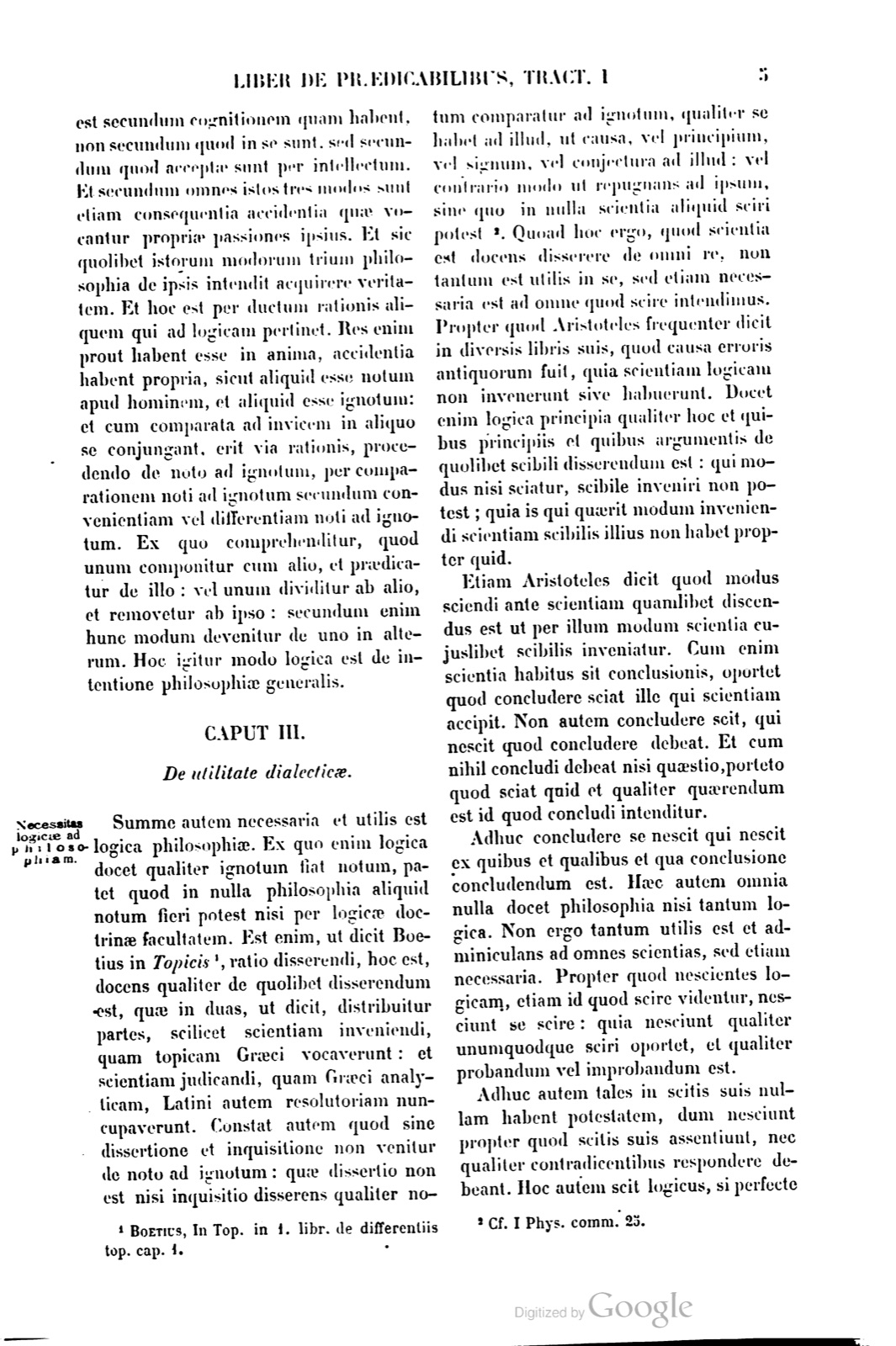
Horum autem quae dicta sunt, rationem ponit Avicenna dicens res omnes tripliciter esse accipiendas, scilicet quod primo accipiantur in essentiae suae principiis: secundo in esse quod habent in singularibus propriis: tertio autem secundum quod acceptae sunt in intellectu. Multa enim secundum essentiae suae principia separata sunt a motu et a materia quae tamen secundum esse sunt vel possunt esse in motu et materia, sicut substantia, unitas, identitas, multitudo, et diversitas, et alia hujusmodi, quae quidem in essentiae suae principiis ingenerabilia et incorruptibilia sunt: et hoc modo secundum Platonem sunt rerum principia formalia, propter quod ingenerabilia et incorruptibilia talia Plato esse dicit. Et si talia dicantur generari vel corrumpi, hoc non erit nisi secundum accidens, hoc est, secundum esse quod habent in generatis et corruptis. Acceptio autem rei secundum esse quod habet in suppositis, erit secundum existentiam illorum suppositorum, et secundum diffinitionem quam habere possunt secundum esse quod habent in illis. Acceptio autem rerum secundum quod sunt in intellectu, est secundum cognitionem quam habent, non secundum quod in se sunt, sed secundum quod acceptae sunt per intellectum. Et secundum omnes istos tres modos sunt etiam consequentia accidentia quae vocantur propriae passiones ipsius. Et sic quolibet istorum modorum trium philosophia de ipsis intendit acquirere veritatem. Et hoc est per ductum rationis aliquem qui ad logicam pertinet. Res enim prout habent esse in anima, accidentia habent propria, sicut aliquid esse notum apud hominem, et aliquid esse ignotum: et cum comparata ad invicem in aliquo se conjungant, erit via rationis, procedendo de noto ad ignotum, per comparationem noti ad ignotum secundum convenientiam vel differentiam noti ad ignotum. Ex quo comprehenditur, quod unum componitur cum alio, et praedicatur de illo: vel unum dividitur ab alio, et removetur ab ipso: secundum enim hunc modum devenitur de uno in alterum. Hoc igitur modo logica est de intentione philosophiae generalis.
But Avicenna gives the reason for the things which have been said, saying that all things are to be taken in three ways, namely, first, that they are taken in the principles of their essence; second, in the being which they have in their proper singulars; third, according as they have been received in the intellect. For many things according to the principles of their essence are separated from motion and from matter, which nevertheless according to being are, or can be, in motion and matter, such as substance, unity, identity, multitude, diversity, and other things of this sort, which indeed in the principles of their essence are ungenerable and incorruptible; and in this way, according to Plato, they are the formal principles of things, on account of which Plato says that such things are ungenerable and incorruptible. And if such things are said to be generated or corrupted, this will be only according to accident, that is, according to the being which they have in generated and corrupt things. But the taking of a thing according to the being which it has in supposits will be according to the existence of those supposits, and according to the definition which they can have according to the being which they have in them. But the taking of things according as they are in the intellect is according to the cognition which they have, not according to what they are in themselves, but according as they have been received by the intellect. And according to all those three modes there are also consequent accidents which are called its proper passions. And thus in any one of those three modes philosophy intends to acquire truth concerning them. And this is through some guidance of reason which pertains to logic. For things, insofar as they have being in the soul, have proper accidents, such as something's being known to a human being and something's being unknown; and when things compared to each other are joined to one another in something, there will be a way of reason, proceeding from the known to the unknown, through comparison of the known to the unknown according to agreement or difference of the known from the unknown. From this it is comprehended that one thing is composed with another and predicated of it, or one thing is divided from another and removed from it; for according to this mode one comes from one thing into another. Therefore in this way logic belongs to the intention of general philosophy.
If a page does not appear, its photograph has not been uploaded yet.