Volume 1 · pp. 1–2
First Book on the Predicables. Treatise I. On the nature of logic. Chapter I. Whether Logic is a special science?
A marker with ≈ is an approximate page boundary, placed by measure of the text; the page photographs remain the authority. In the paired views, clicking a page marker brings that page into view.
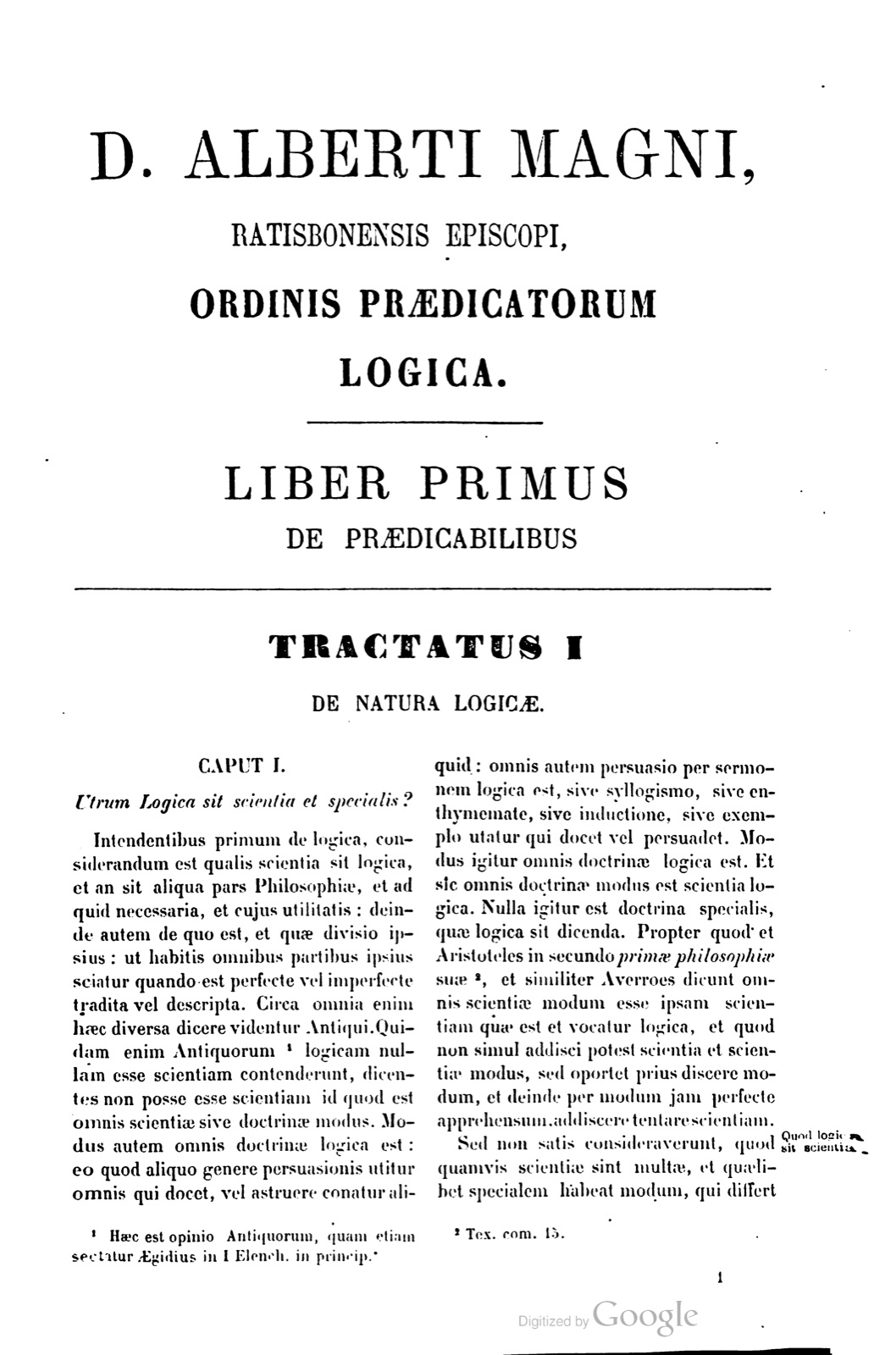
D. Alberti Magni, Ratisbonensis episcopi, Ordinis Praedicatorum, Logica. Liber primus de Praedicabilibus. Tractatus I. De natura logicae. Caput I. Utrum Logica sit scientia et specialis?
Intendentibus primum de logica, considerandum est qualis scientia sit logica, et an sit aliqua pars philosophiae, et ad quid necessaria, et cujus utilitatis: deinde autem de quo est, et quae divisio ipsius: ut habitis omnibus partibus ipsius sciatur quando est perfecte vel imperfecte tradita vel descripta. Circa omnia enim haec diversa dicere videntur Antiqui. Quidam enim Antiquorum 1 logicam nullam esse scientiam contenderunt, dicentes non posse esse scientiam id quod est omnis scientiae sive doctrinae modus. Modus autem omnis doctrinae logica est: eo quod aliquo genere persuasionis utitur omnis qui docet, vel astruere conatur aliquid: omnis autem persuasio per sermonem logica est, sive syllogismo, sive enthymemate, sive inductione, sive exemplo utatur qui docet vel persuadet. Modus igitur omnis doctrinae logica est. Et sic omnis doctrinae modus est scientia logica. Nulla igitur est doctrina specialis, quae logica sit dicenda. Propter quod et Aristoteles in secundo primae philosophiae suae 2, et similiter Averroes dicunt omnis scientiae modum esse ipsam scientiam quae est et vocatur logica, et quod non simul addisci potest scientia et scientiae modus, sed oportet prius discere modum, et deinde per modum jam perfecte apprehensum, addiscere tentare scientiam.
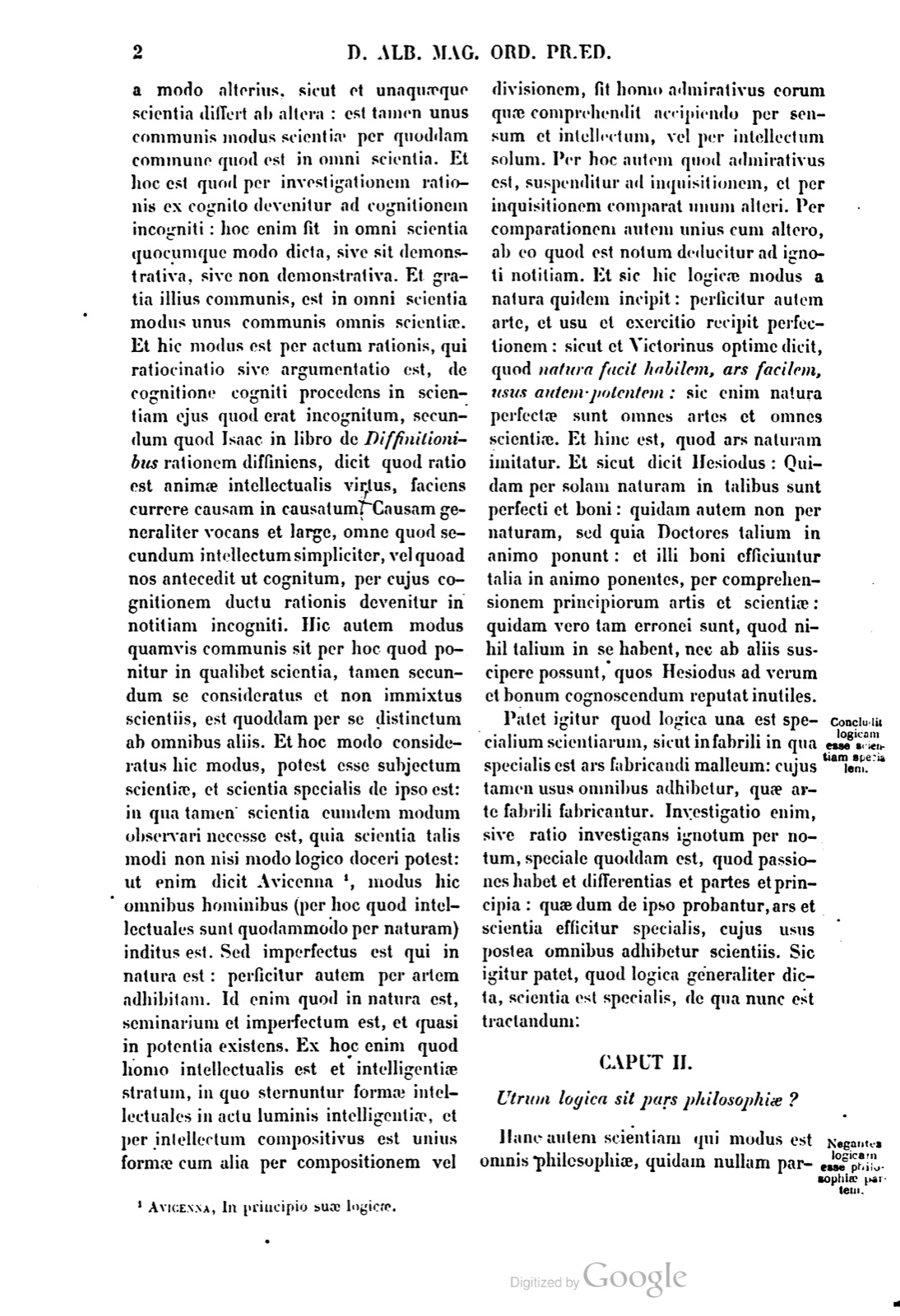
Sed non satis consideraverunt, quod quamvis scientiae sint multae, et quaelibet specialem habeat modum, qui differt a modo alterius, sicut et unaquaeque scientia differt ab altera: est tamen unus communis modus scientiae per quoddam commune quod est in omni scientia. Et hoc est quod per investigationem rationis ex cognito devenitur ad cognitionem incogniti: hoc enim fit in omni scientia quocumque modo dicta, sive sit demonstrativa, sive non demonstrativa. Et gratia illius communis, est in omni scientia modus unus communis omnis scientiae. Et hic modus est per actum rationis, qui ratiocinatio sive argumentatio est, de cognitione cogniti procedens in scientiam ejus quod erat incognitum, secundum quod Isaac in libro de Diffinitionibus rationem diffiniens, dicit quod ratio est animae intellectualis virtus, faciens currere causam in causatum. Causam generaliter vocans et large, omne quod secundum intellectum simpliciter, vel quoad nos antecedit ut cognitum, per cujus cognitionem ductu rationis devenitur in notitiam incogniti. Hic autem modus quamvis communis sit per hoc quod ponitur in qualibet scientia, tamen secundum se consideratus et non immixtus scientiis, est quoddam per se distinctum ab omnibus aliis. Et hoc modo consideratus hic modus, potest esse subjectum scientiae, et scientia specialis de ipso est: in qua tamen scientia eumdem modum observari necesse est, quia scientia talis modi non nisi modo logico doceri potest: ut enim dicit Avicenna 3, modus hic omnibus hominibus, per hoc quod intellectuales sunt quodammodo per naturam, inditus est. Sed imperfectus est qui in natura est: perficitur autem per artem adhibitam. Id enim quod in natura est, seminarium et imperfectum est, et quasi in potentia existens. Ex hoc enim quod homo intellectualis est et intelligentiae stratum, in quo sternuntur formae intellectuales in actu luminis intelligentiae, et per intellectum compositivus est unius formae cum alia per compositionem vel divisionem, fit homo admirativus eorum quae comprehendit accipiendo per sensum et intellectum, vel per intellectum solum. Per hoc autem quod admirativus est, suspenditur ad inquisitionem, et per inquisitionem comparat unum alteri. Per comparationem autem unius cum altero, ab eo quod est notum deducitur ad ignoti notitiam. Et sic hic logicae modus a natura quidem incipit: perficitur autem arte, et usu et exercitio recipit perfectionem: sicut et Victorinus optime dicit, quod natura facit habilem, ars facilem, usus autem potentem: sic enim natura perfectae sunt omnes artes et omnes scientiae. Et hinc est, quod ars naturam imitatur. Et sicut dicit Hesiodus: Quidam per solam naturam in talibus sunt perfecti et boni: quidam autem non per naturam, sed quia Doctores talium in animo ponunt: et illi boni efficiuntur talia in animo ponentes, per comprehensionem principiorum artis et scientiae: quidam vero tam erronei sunt, quod nihil talium in se habent, nec ab aliis suscipere possunt, quos Hesiodus ad verum et bonum cognoscendum reputat inutiles.
D. Albert the Great, bishop of Regensburg, of the Order of Preachers, Logic. First Book on the Predicables. Treatise I. On the nature of logic. Chapter I. Whether Logic is a special science?
For those intending first to treat of logic, one must consider what sort of science logic is, and whether it is some part of philosophy, and for what it is necessary, and of what usefulness; then, however, concerning what it is, and what its division is, so that, once all its parts have been had, it may be known when it has been handed down or described perfectly or imperfectly. For concerning all these things the Ancients seem to say diverse things. For certain of the Ancients 1 contended that logic is no science, saying that that which is the mode of every science or doctrine cannot be a science. But logic is the mode of every doctrine, because everyone who teaches, or tries to establish something, uses some kind of persuasion; but every persuasion by speech is logical, whether the one who teaches or persuades uses syllogism, or enthymeme, or induction, or example. Therefore logic is the mode of every doctrine. And thus the mode of every doctrine is logical science. Therefore there is no special doctrine which ought to be called logic. For this reason Aristotle also in the second book of his first philosophy 2, and likewise Averroes, say that the mode of every science is the very science which is and is called logic, and that a science and the mode of the science cannot be learned at the same time, but that one must first learn the mode, and then, through the mode already perfectly apprehended, try to learn the science.
But they did not consider sufficiently that, although the sciences are many, and each one has a special mode which differs from the mode of another, just as each science differs from another, nevertheless there is one common mode of science through a certain common feature which is in every science. And this is that, through the investigation of reason, one comes from the known to cognition of the unknown; for this occurs in every science, in whatever manner it is so called, whether it is demonstrative or non-demonstrative. And by reason of that common feature there is in every science one common mode of every science. And this mode is through an act of reason, which is reasoning or argumentation, proceeding from cognition of the known into science of that which was unknown, according as Isaac, defining reason in the book On Definitions, says that reason is a power of the intellectual soul, making the cause run into the caused. He calls cause generally and broadly everything which, according to intellect simply, or with respect to us, precedes as known, through the cognition of which, by the guidance of reason, one comes into knowledge of the unknown. But this mode, although it is common through the fact that it is posited in any science, nevertheless, considered in itself and not mixed with the sciences, is something distinct through itself from all others. And considered in this way this mode can be the subject of a science, and there is a special science concerning it; yet in that science it is necessary that the same mode be observed, because the science of such a mode can be taught only by the logical mode; for as Avicenna says 3, this mode is implanted in all human beings insofar as they are in some way intellectual by nature. But what is in nature is imperfect; it is perfected, however, through an applied art. For that which is in nature is seminal and imperfect, and existing as it were in potency. For from this, that man is intellectual and is a substrate of intelligence in which intellectual forms are spread out in the act of the light of intelligence, and through intellect is compositive of one form with another through composition or division, man becomes wondering at those things which he comprehends by receiving through sense and intellect, or through intellect alone. But through the fact that he is wondering, he is suspended toward inquiry, and through inquiry he compares one thing with another. But through comparison of one thing with another, from that which is known he is led to knowledge of the unknown. And thus this mode of logic indeed begins from nature, but is perfected by art, and by use and exercise receives perfection; as also Victorinus says excellently, that nature makes one capable, art makes one ready, but use makes one powerful. For thus all arts and all sciences are perfected by nature. And hence it is that art imitates nature. And as Hesiod says, some by nature alone in such matters are perfect and good; some, however, are not so by nature, but because teachers of such things place them in the mind, and those become good by placing such things in the mind, through comprehension of the principles of art and science; but some are so erroneous that they have none of such things in themselves, nor can they receive them from others, whom Hesiod regards as useless for knowing the true and the good.
Patet igitur quod logica una est specialium scientiarum, sicut in fabrili in qua specialis est ars fabricandi malleum: cujus tamen usus omnibus adhibetur, quae arte fabrili fabricantur. Investigatio enim, sive ratio investigans ignotum per notum, speciale quoddam est, quod passiones habet et differentias et partes et principia: quae dum de ipso probantur, ars et scientia efficitur specialis, cujus usus postea omnibus adhibetur scientiis. Sic igitur patet, quod logica generaliter dicta, scientia est specialis, de qua nunc est tractandum.
Therefore it is clear that logic is one of the special sciences, as in the smith's art there is a special art of making a hammer, although its use is applied to all things that are made by the smith's art. For investigation, or reason investigating the unknown through the known, is something special, which has properties and differences and parts and principles; and when these are proved concerning it, art and science become special, the use of which is thereafter applied to all sciences. Thus, therefore, it is clear that logic, generally so called, is a special science, concerning which we must now treat.
Notes
- This is the opinion of the Ancients, which Aegidius also follows at the beginning of the first book of the Elenchi. (Haec est opinio Antiquorum, quam etiam sectatur Aegidius in I Elench. in princip.) ↩
- Text, commentary 15. (Tex. com. 15.) ↩
- Avicenna, at the beginning of his Logic. (Avicenna, In principio suae logicae.) ↩
If a page does not appear, its photograph has not been uploaded yet.