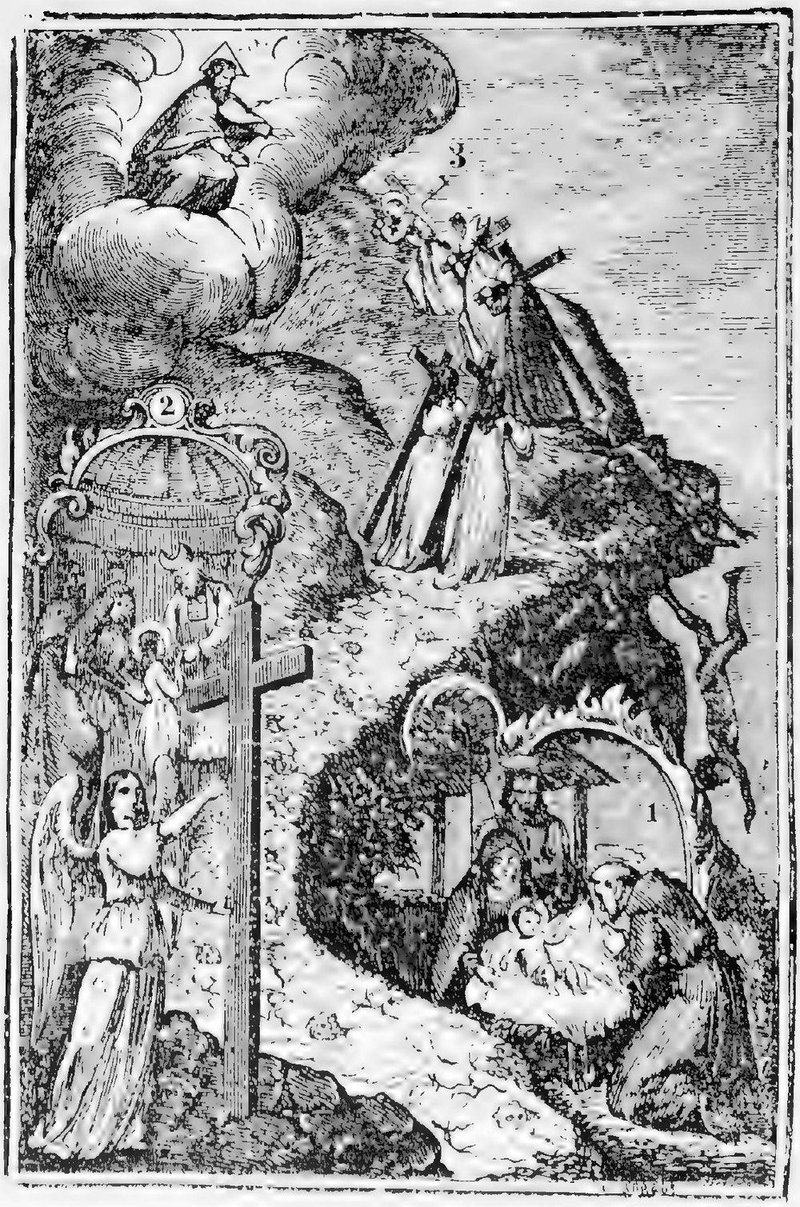
Plate XLV. The evangelical counsels. 1. Jesus, Mary, Joseph and St. Francis. 2. The Presentation of the Virgin. 3. Jesus with the cross, and others following him.
If thou wilt enter into life, keep the commandments (Matt. 19:17). This, my son, is the answer Jesus Christ gave to a young man who had asked him: Good master, what good shall I do that I may have life everlasting? But there are so many obstacles or hindrances in this world that keep one from following steadily the way of the holy commandments, as the prophet David says. So people try to remove or take away these obstacles by practicing the evangelical counsels: voluntary Poverty, perpetual Chastity and perfect Obedience. The obstacles that stand against the keeping of God’s law and the attaining of perfection in this life are, according to St. John, the concupiscence of the flesh, and the concupiscence of the eyes, and the pride of life (1 John 2:16). That is, the love of pleasures, the love of gain and the love of honors. And since the perfection and foundation of the law consists in loving God with all one’s heart, with all one’s soul, with all one’s mind and with all one’s strength, we must try to put away the things that hinder this love. The first is greed for outward goods, and this hindrance is removed by voluntary Poverty. The second is the desire for sensual pleasures, which is curbed by perpetual Chastity. And the third is the disorder of our will, which is corrected by perfect Obedience. These virtues or counsels, to whose observance some bind themselves even by solemn vow, are what I shall explain to you in this lesson with the plate.
The first counsel is voluntary Poverty, as you see in number 1, which shows Jesus with the most holy Virgin, St. Joseph and St. Francis of Assisi. Of Jesus it is written that he began to do and to teach (Acts 1:1), doing before teaching, and here you will see a wonderful way of practicing poverty. Though he is King of heaven and earth and Lord of all things, he is born poor in a manger and dies utterly poor on a cross, after living for thirty-three years without many things. There were times when he had no money to pay the tribute (Matt. 17:26), nor where to lay his head (Matt. 8:20). He was poorer than the little animals and birds, which do not lack shelter or a place to rest. While he practiced this virtue of poverty in a heroic degree, he taught it in his sermons. He kept it always so much in view that it was the first virtue he taught in that wonderful sermon on the mount, when he said: Blessed are the poor in spirit: for theirs is the kingdom of heaven.
The essence of this counsel or virtue consists in being poor in spirit, that is, in having no attachment to the riches of the world even when they abound, as the Prophet teaches us: If riches abound, set not your heart upon them (Ps. 61:11). But this is as hard as walking among honey without some sticking to us, or as stepping into the fire without being burned. That cannot be done except by a wonder, as happened with the bush Moses saw (Exod. 3:2) and with the children of Babylon (Dan. 3). For this reason, though Jesus Christ answered the young man who asked what he must do to be saved, “Keep the commandments”, when he heard him ask about what was more perfect he told him: If thou wilt be perfect, go sell what thou hast, and give to the poor… and come follow me (Matt. 19:21). This teaching of the Redeemer, and the example he gave of this virtue, were so deeply printed on the hearts of the first Christians that among many of them there was no “yours” or “mine”, but all things were common unto them (Acts 4:32). And not a few of those who embraced the Christian religion willingly sold their possessions and handed the price to the Apostles so that they might share it out among the poor. St. Cyprian, St. Basil, St. Jerome and others say that in the early Church many of the faithful made a vow of poverty. St. Francis of Assisi distinguished himself above all in the practice of it and of the other evangelical counsels, and that is why he is placed in the plate.
The second is perpetual Chastity. In number 2 of the plate is the most holy Virgin, who at the age of three was taken to the temple, where she could better keep the angelic virtue of chastity. Knowing how pleasing it is to God, she made a vow to keep it all her life. God himself showed how highly he valued chastity when, wishing to come down from heaven to earth, he arranged that his Precursor should be chaste and chose for his mother a most chaste Virgin. The disciple he loved most earned this preference by his pure chastity. And he himself, made man, was so chaste in words and works that Jewish malice never charged him with the least fault against this virtue. He not only recommended it and urged us to follow it by his works and good example, but also by his words (Matt. 19:12). In imitation of him the Apostles and holy Fathers have done the same, and their example and teaching have produced in the Church of Jesus Christ a great multitude of lilies of purity and chastity of every sex and condition. Be pure and chaste too, my son, and you will see God. Otherwise, if you were impure, you would see only the devil and would be like him, as St. Ambrose says: “He who keeps chastity is an Angel; but he who loses it is a devil.”
The third is perfect Obedience. Number 3 of the plate shows Jesus Christ carrying his cross up the mountain of perfection. He is the model and pattern of all who follow this and the other two evangelical counsels. Up at the very top is the eternal Father, who has all his delight in his beloved Son, who does his most holy will in everything and through everything. All of us, if we want to be saved, must do the same, each according to his state. The faithful in general do so by obeying the precepts of the Lord and of holy Church. Religious bound by solemn vow do so by obeying their respective superiors in all that concerns the holy rule. In this way we shall follow what Jesus Christ tells us: Not every one that saith to me, Lord, Lord, shall enter into the kingdom of heaven: but he that doth the will of my Father who is in heaven (Matt. 7:21). If we want to go after him, we must deny ourselves according to our own state, take up our cross and follow him (Matt. 16:24), as the figures in the plate teach you. Do you see how they carry it, how they suffer and obey, how they go forward and climb the mountain of perfection and eternal glory? In this they imitate Jesus Christ, who was always obedient, not only to his eternal Father but also to his Mother and St. Joseph: et erat subditus illis [and he was subject to them] (Luke 2:51). And he did not stop there. He even obeyed the Jews in the most repugnant things, and to give us a great example he finally obeyed by dying, nailed to a cross, no less. And that is why his Father has so exalted him (Phil. 2:8–9). Happy are those who obey in imitation of Jesus Christ! But woe to those who fail in the obedience to which they are bound! However high they may be, they will fall like Lucifer and like those rebels you see in the plate, who fall into the precipice because of their disobedience. Do not imitate them, my son. Rather, always obey your elders and superiors. Never want to do your own will, and remember that saying of St. Bernard: “If there were no self-will, there would be no hell, for there would be no sins.” Reflect on these evangelical counsels. For if you follow or embrace them, you will go after Jesus Christ, and so you will be perfect, and God will give you eternal glory. Amen.