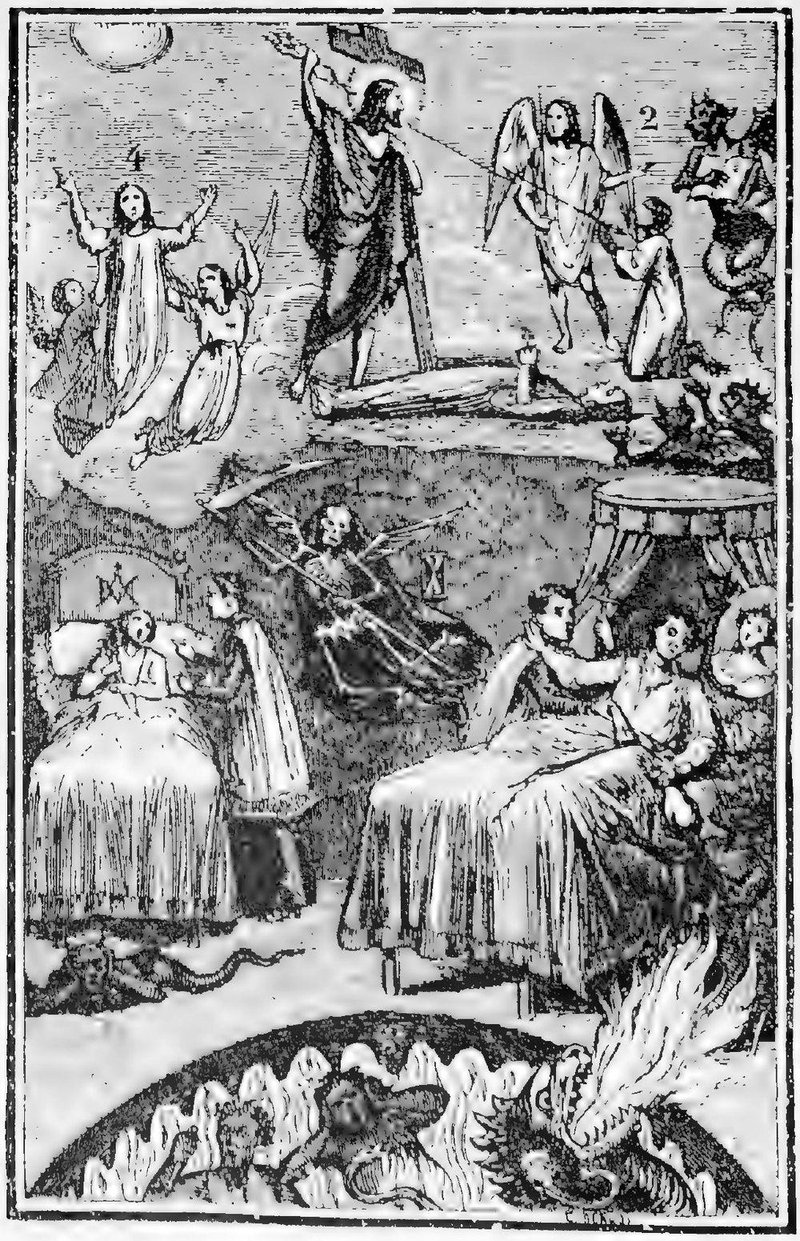
Plate XLIV. The last things, or four last ends of man. 1. The death of the sinner and that of the just man. 2. Jesus judges the sinner’s soul. 3. Hell: despair, obstinacy and eternity. 4. Glory.
In that plate, my son, you will see represented the last things of man: Death, Judgment, Hell and Glory. It is by remembering them always and in all our works that sin will be avoided, as the Holy Ghost teaches us: In all thy works remember thy last end, and thou shalt never sin (Ecclus. 7:40). You cannot look on them as things that do not concern you. For we all have to pass through them, or at least through one of them, speaking of the last two. And do not think the day is very far off: it is nearer than we think.
The first is Death. In number 1 is the image of death, armed with her scythe to strike the fatal blow at these two dying men, because their hour has come. That hourglass beside her represents time. Its sand, slipping down without stopping, tells us that our life is passing and wearing away at every moment. When it is spent, the hour strikes, and… farewell, present life… to eternity!!!
Death is one and the same, or indifferent, in itself. I mean that in itself it is neither good nor bad, as St. John Chrysostom explains. But it is good or bad according as the dying man has lived well or ill. For the proverb says: talis vita, finis ita [as the life, so the end]: death will be as life has been. Look at the plate. Do you see these two dying men? The first kept the commandments of the law of God. He meditated on the life, passion and death of Jesus Christ, received the holy Sacraments often, was very charitable and most devoted to most holy Mary. That is why, as you see, he has the rosary on his breast and the name of this good Mother painted at the head of his bed. That is why he dies most contented and joyful, as you can observe. The priest is encouraging him, and he, embracing the cross of Jesus, gives up his soul gladly to his Creator. See how the Angels carry it to heaven. See too down here how the devil goes off in despair, because he has not been able to have him damned. Quite the contrary happens with that other man. The priest exhorts him and says
that he should put his trust in the intercession of most holy Mary and in the merits of Jesus Christ. But this wretched man always resisted God’s inspirations, and now he resists and despises the voice of the zealous minister. The unhappy man never thought of anything but piling up money and satisfying his brutish appetites. So at the hour of death one devil shows him a purse of money, and another shows him the portrait of the woman who shared his lusts, as the instruments and snares of his damnation. Before, he thought only of eating and drinking daintily, of dressing in luxury and effeminacy, of amusing himself at theaters, dances and the other follies of the world. But alas!… Death comes, and like another rich glutton of the Gospel he is seized by the devils and buried in hell, while the other, like Lazarus, is carried by the Angels to heaven (Luke 16:22). And what I tell you of these two, my son, you must understand and apply to yourself, to me and to all mortals. For either the happy death of the just man or the unhappy death of the wicked awaits us all.
That we must all die is most certain… It is a truth of faith that experience makes plain every day. But are the when, the how and the where as certain? Oh, this uncertainty makes one tremble! When shall I die? Ah, perhaps in the flower of my days, for more die in youth than reach old age. I know my days are numbered and are passing continually like the sand of the hourglass. They may already be ended, but I neither see nor know it. And if they really were ended, my life in this world would end this very instant. How will it come? Another riddle… I do not know whether it will be by illness, a bullet, a stab, poison or a fall. I do not even know whether I shall have time to receive the holy Sacraments. Where shall I die? I do not know this any more than the other. I do not know whether it will be at home or away, at sea or on land. I know where I was born, but not where I shall die. I know I must die once only; but whether death will give me time to prepare is hidden from me. That is why Jesus Christ so earnestly charges us to be always prepared, because death will come when we least expect it (Matt. 24:44).
The second is Judgment. In the plate on page 136 you saw an image of the general judgment, and in number 2 of this one you have an image of the particular judgment. The man you see stretched out here is the corpse of a sinner who has just died. The kneeling figure represents his soul, which is before the supreme judge Jesus Christ. He holds the cross in one hand to make it see the ingratitude with which it has repaid the benefit of the redemption, and in the other thunderbolts to hurl against this ungrateful and sinful soul. The figure on the right represents the Guardian Angel, who is striving to save it. The one on the left is the devil, who, as St. Basil says, is first an accomplice and afterwards the chief accuser. These others are more devils, ready to carry the soul off to hell as soon as the divine Judge has given the sentence of damnation.
All of us, my son, shall appear, or be brought, before the judgment seat of Christ. There our works will be examined, and we shall be given reward or punishment according to what the trial shows. For we must all be manifested before the judgment seat of Christ, that every one may receive the proper things of the body, according as he hath done, whether it be good or evil, says St. Paul (2 Cor. 5:10). This appearing, as well as the examination and sentence, will take place twice, on different occasions. Once when each of us dies, and this is called the particular judgment. And again at the end of the world, when all are together in body and soul, and this is called the general judgment. The first will be hidden, the second public. The first will take place where the body lies, the second in the valley of Josaphat (Joel 3:2). In the first man will be considered and judged as an individual, in the second as a member of the great human family. In the first only the person concerned will know the lot that has fallen to him; in the second all other men will know it too. In the first only the soul, in the second soul and body will receive their due. In the first only the individual will know how justly he has been rewarded or punished. In the second the whole of mankind will know it, for in it God will give public testimony of the uprightness and justice with which he has rewarded the good and punished the wicked. This publicity will bring glory and honor to the just and confusion and shame to the wicked. Ah, my son, if we kept these two judgments before us, would we have the heart to sin? If we considered that the one who is to judge us is that God who knows all things, a judge so upright that he is no respecter of persons, and whom it is impossible to bribe or deceive!… In that terrible and inescapable moment neither riches, nor honors, nor beauty, nor friends, nor relations will be of any use to us. Good works are the only thing that will speak in our favor. If anyone trembles at having to sit examinations before men, ah, with how much more reason should we tremble to think of the examination and judgment we must undergo before God! There we shall be questioned on all the actions, thoughts, words and omissions of our life. And if we come out badly from the examination, we shall be failed for ever!!!
My son, I should like you always to keep before you this counsel of St. Basil: “If you are ever tempted to sin, remember that dreadful judgment Christ will hold, and with this bridle you will hold back your soul.” Would that, like St. Jerome, you remembered the judgment and did what he says: “Whether I eat or drink, whether I study or do anything else, it always seems to me that that terrible trumpet is sounding in my ears, saying: Arise, ye dead, and come to judgment!” See my little book entitled Reflexiones que hace… [Reflections that…].
The third is Hell. In number 3, my son, you will see some unhappy souls cast into hell. Heaped together with other damned souls, they increase one another’s pains by their heat, crowding and stench. Do you see, my son, those three unhappy ones? One stands for obstinacy, another for despair, and the third for the eternity of the pains of the damned in hell. Do you see the one in despair, holding his head in his hands? Do you see this one gripping a dagger so tightly in his fist? He signifies the obstinacy of the damned. The unhappy one with that monster on top of him gives you to understand what a dreadful thing the terrible weight of eternity is.
That God punishes those who die in mortal sin is a truth of faith, shown in many places of holy Scripture. Jesus Christ affirms it several times in the holy Gospel, and to make more impression he gives some examples of it. Natural reason alone is in a way enough to know this truth, as is seen in the pagans, who had an idea of it, though imperfect and wrongly applied. And in truth, is there, or can there be, a well-governed nation in which virtue is not rewarded and crime punished? In all of them crosses of distinction and honor and other decorations have been invented to reward, as well as prisons and punishments to punish. And in the kingdom of God, the source of all justice, should there not be as much, and with still greater uprightness? Now in this world God leaves us free to act well or to act badly. But a day will come when he will call us to account. If we have acted well, he will give us the reward in heaven. But if we have acted badly, he will punish us in hell, which is the place of torments, as the holy Gospel teaches us (Luke 16:28).
These pains and torments of hell are, and must be, eternal. God teaches us this in various places of sacred Scripture (Matt. 25:46), and natural reason in its own way says the same. For it shows us that the punishment must be proportionate to the fault or offense. So, since mortal sin is infinite, as an offense against an infinite God, it deserves an infinite punishment. As the punishment cannot be infinite in intensity, nor in quantity or quality, it must be sought in duration, and this is what we call the eternal pains of hell. Besides, while the sinner lived in this world, Jesus Christ, by a stroke of his mercy, offered him an infinite price, his merits, to pay the infinite penalty incurred by sin, and so be saved. Has the ungrateful soul despised them? Has it chosen to be damned? Then let it remain deprived of the redemption. Since it will continue obstinate in its sin for all eternity, God’s punishments too will be eternal, and he will say to it, as it is written: “You shall know that I am a God who knows how to punish.” And truly it is very just that God should make his justice shine by punishment and rigor in those who would not let his mercy shine by humbling themselves and begging pardon.
So that you may see more clearly the reason and justice with which God acts in punishing the obstinate with eternal pains, I will put to you the following comparison. Suppose a son, instead of obeying his father, took up a stick or a dagger and threatened him with it. Would the father act justly if he would not forgive such a son as long as he did not drop the stick or dagger and humbly ask his pardon? You will say yes, will you not? Well then, the soul of one who dies in mortal sin will remain God’s enemy for an eternity, without ever humbling itself or asking his pardon. For it has reached its end and is in a state in which it cannot change its will. Will God be just in not forgiving it either? You will say yes again. You see, then, that since God is eternal and the soul is eternal, and its obstinacy is eternal, the punishment too must be, and indeed will be, eternal. Ah, my son, God deliver us from falling into those so terrible and eternal pains!… If now you cannot bear a live coal in your hand, or hold your finger in a candle flame for any length of time, how will you be able to bear the coals and flames of hell for a whole eternity? Now a snake or a wild beast frightens you, and the picture of a devil makes you shudder with fear. Ah, what would be the terror and fear that the sight and presence of the devils and the other damned would cause you in hell!…
The fourth is Glory, shown in number 4 of the plate. Do you see, my son, how the Angels are carrying to heaven the soul of that man who has just died in the grace of God? What rejoicing! What happiness! And this for ever!!!… As it is of faith that the wicked will suffer eternally in hell, so it is also of faith that the just will enjoy eternal glory. Cornelius a Lapide, on chapter 7, verse 40, of Ecclesiasticus, says that the great Simeon Stylites left only one written sermon. Besides the letters or characters, it contained two drawings or hieroglyphs. In one were symbolized the anguish of a sinful soul at the hour of death, when it is seized by the devils and cast into the eternal pains of hell. In the other was the joy of a holy soul when it sees itself carried to heaven by the Angels. And he always preached on these points from the pillar on which he lived for seventy years, doing the most rigorous penance. Fix your thoughts, my son, on that eternal happiness prepared for you if you live as a Christian. It is such and so great that St. Paul tells us that eye hath not seen, nor ear heard, neither hath it entered into the heart of man, what things God hath prepared for them that love him (1 Cor. 2:9): the joys and delights that will overflow in the paradise of glory. So love God, my son, and love him truly. Be sure that what I cannot explain to you now you will know by experience there in glory, which I wish you.
Q. How many are the last things, or last ends, of man?
A. Four: Death, Judgment, Hell and Glory.
Q. Why are they called last ends?
A. Because they are the last thing at which we must arrive.
Q. What is it to die?
A. For the soul to be separated from the body.
Q. Can we know at what hour we shall die?
A. By natural means, no.
Q. What do we mean by judgment?
A. Appearing before the judgment seat of Christ, to receive from him the reward or punishment due to our works.
Q. How many judgments are there?
A. Two: particular and general.
Q. What is the particular judgment?
A. The judgment that Christ our Lord makes of each man in particular as soon as he has died.
Q. What is the general judgment?
A. The judgment that Christ our Lord will make of all men at the end of the world.
Q. In the general judgment, will God change the sentence he gave us in the particular judgment?
A. No.
Q. Then why will he subject us to a general judgment?
A. Among other reasons, for the public display of his justice.
Q. Shall we all have to appear in the general judgment?
A. Yes, all without exception.
Q. How shall we appear at the last judgment?
A. Risen in our own bodies.
Q. Will the bodies of the blessed who in life were lame, blind or the like rise with the same defects?
A. Not at all; they will rise most perfect.
Q. How will the wicked rise?
A. Horrible, ugly and abominable.
Q. What will be the cause of the beauty of the good and the ugliness of the wicked?
A. Grace in the one and sin in the other.
Q. And when the judgment is over, what will become of the good?
A. They will go to heaven in body and soul.
Q. And what will become of the wicked?
A. They will be cast into hell in body and soul.
Q. What is hell?
A. A prison, the most terrible and horrible, full of fire and occupied by the devils, where those who die in mortal sin are tormented according to their faults.
Q. What is the glory of heaven?
A. It is a most perfect place or state, in which the just see and enjoy God and possess all goods and happiness, without any mixture of evil and for all eternity.
Q. How many are the endowments of souls in heaven?
A. Three: vision, comprehension and fruition.
Q. In what does vision consist?
A. In seeing God clearly, as the reward of faith.
Q. In what does comprehension consist?
A. In possessing God, the supreme Good, as the reward of hope.
Q. In what does fruition consist?
A. In a supreme joy and gladness the soul feels in seeing and possessing God eternally, as the reward of charity.
Q. Will the bodies of the blessed also have some glory in heaven?
A. Yes, and very great.
Q. In what will this glory consist?
A. In four endowments: impassibility, subtlety, agility and clarity.
Q. In what will the endowment of impassibility consist?
A. In this, that the bodies of the blessed will not be able to suffer any harm or pain.
Q. In what will the endowment of subtlety consist?
A. In this, that the bodies of the blessed will be able to enter any place, however closed it may be.
Q. In what will the endowment of agility consist?
A. In this, that the bodies of the blessed will be able to pass from one place to another with the greatest ease and speed.
Q. In what will the endowment of clarity consist?
A. In this, that the bodies of the blessed will be more resplendent than the sun itself.
Q. Will the glory of the blessed in heaven be equal in all?
A. No; each will have it according to his merits.
Q. Will those who have less glory envy those who have more?
A. No; rather they will rejoice at it.