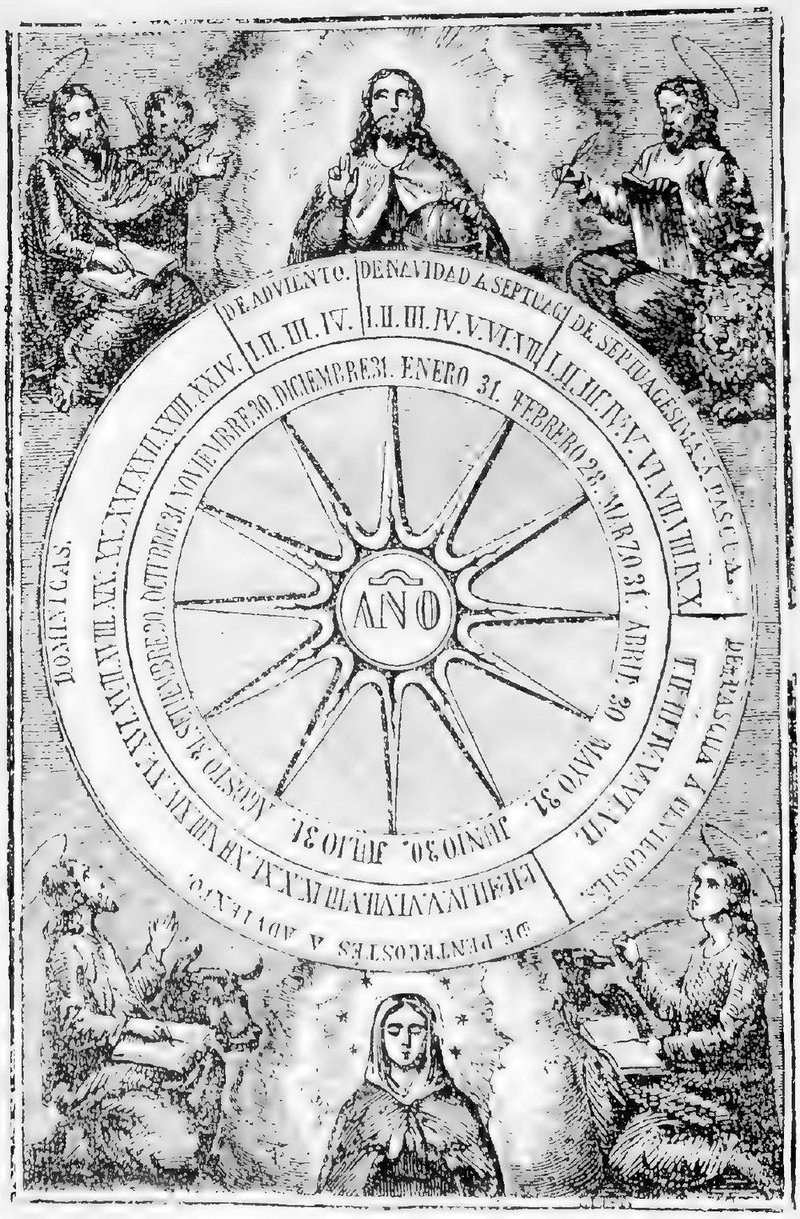
Plate XLVI. Summary. The months and Sundays of the year. Jesus and Mary. The four Evangelists.
Dear child, up to now I have spoken to you about the mysteries of our most holy Christian religion, following the order of the Catechism. Now I shall explain to you, though briefly, how our holy mother the Catholic Church deals with them in the course of the year, setting them before us to consider. She does so that we may be grateful for the very great graces God has granted us, know how to profit by the merits Jesus Christ has gained for us, follow his Gospel, and imitate his virtues, as well as those practiced by the most holy Virgin and the other Saints.
The year, as you see in the plate, has twelve months: January, February, March, April, May, June, July, August, September, October, November and December. Of these some have thirty days, others thirty-one, and February twenty-eight, except in the year we call leap year, when it has twenty-nine. Seven days make a week, and they are called Sunday, Monday, Tuesday, Wednesday, Thursday, Friday and Saturday.
Sunday is a feast day on which we may not work, as I explained to you when dealing with the commandments. Apart from that day one may work on the others, unless it is one of those on which the feast of some special mystery or Saint is celebrated. The Church commands that such days be kept holy by resting from work and hearing holy Mass. On them we give thanks to God for that benefit, consider the wonders, and imitate the virtues that shine out and are recalled to us in the mystery or Saint we are celebrating.
The chief mysteries and feasts of Jesus Christ that the Church celebrates in the course of the year are these:
On the twenty-fifth of March, the Incarnation of the Son of God in the most pure and virginal womb of most holy Mary, by the work of the Holy Ghost, as I explained to you in the seventh lesson of the Creed.
On the twenty-fifth of December, the Nativity of our Lord Jesus Christ, explained in the same lesson.
On the first of January, the Circumcision of the Saviour, when he was given the name of Jesus: see the plate and its explanation above.
On the sixth of January, the Epiphany, or the adoration of the Kings; the baptism of the Redeemer by St. John the Baptist; and the changing of water into wine at the wedding of Cana of Galilee.
On Good Friday the passion and death of the Redeemer are commemorated: see the plate and its explanation above.
On the following Sunday the Easter of the Resurrection of our Lord Jesus Christ is celebrated, as explained with the plate above.
The Thursday forty days after the Resurrection is the day of the Ascension of our Lord Jesus Christ into heaven: see the plate explained above.
The Sunday ten days after the Ascension, and seven weeks after the Resurrection, is the feast of the Coming of the Holy Ghost, as explained with the plate above.
The Sunday immediately after this Pentecost is the feast of the most holy Trinity, a mystery I have explained to you with the plate above.
On the following Thursday, four days after the feast of the most holy Trinity, the feast of the Institution of the most holy Sacrament is celebrated. This solemnity properly belongs to Holy Thursday. But because the Church is then so occupied in considering the mysteries of the Redeemer’s passion, it has been moved to that day: see the plate and its explanation above.
On the third of May the Finding of the holy Cross is celebrated, and on the fourteenth of September its Exaltation, as explained with the plate above.
Feasts of Most Holy Mary
The chief feasts of most holy Mary that holy Church celebrates are these:
The Immaculate Conception of most holy Mary, on the eighth of December.
Her Nativity, on the eighth of September.
Her Presentation in the temple at the age of three, on the twenty-first of November.
The Espousals of most holy Mary with St. Joseph, on the twenty-third of January.
The Annunciation, or Incarnation of the Son of God in the virginal womb of most holy Mary by the work of the Holy Ghost, as explained with the plate above, on the twenty-fifth of March.
The Purification of most holy Mary, Mother of God, and the Presentation of her Son in the temple, on the second of February.
The Sorrows of the most holy Virgin, on the Friday of Passion week and on the third Sunday of September.
The Assumption into heaven, on the fifteenth of August.
There are some others, such as the feasts of Our Lady of Mount Carmel, of the Rosary, of Mercy, of Guadalupe, and so on.
On the other feast days some Saint is commemorated, as is seen in the calendar.
You see that the chief feasts of the year are those of Jesus and of most holy Mary. That is why they are in the plate as the two axes of the sphere. You will also notice in it the four Evangelists, for on all the feasts and Sundays of the year holy Church makes use of their divine writings. Perhaps you will ask me why they are accompanied by these figures. I answer that it is because of their writings themselves. As St. Jerome explains, St. Matthew, speaking of Christ as man, begins to write: The book of the generation of Jesus Christ, the son of David, the son of Abraham. St. Mark begins with the prophecy of Malachias and Isaias. St. Luke begins with the priesthood of Zachary. The first has the look of a man, because of the genealogy. The second has that of a lion, because of the voice of one crying in the desert: Prepare ye the way of the Lord, make straight his paths. The third has that of an ox, because of the priesthood. St. John, like an eagle, flies upward until he reaches the eternal Father, saying: In the beginning was the Word, and the Word was with God, and the Word was God.
In the year there are fifty-two Sundays, divided into five classes: those of Advent; from Christmas to Septuagesima; from there to Easter; from Easter to Pentecost; and from Pentecost to Advent. The Sundays of Advent, those from Septuagesima to Easter, and those from Easter to Pentecost are always the same in number. But the Sundays from Christmas to Septuagesima and from Pentecost to Advent share the rest between them. Each of these two classes has more or fewer according to the date on which Easter is celebrated. Easter must always be celebrated on the Sunday nearest to the full moon of March, and since this Sunday follows the epacts of the moon, the number of these Sundays rises or falls. But as I said, these two classes share them between them. So when there are more Sundays from Christmas to Septuagesima, there are fewer from Pentecost to Advent; and on the contrary, when there are more of the latter, there are fewer of the former.
On all the Sundays of the year holy Church, desiring the good of our souls, explains the holy Gospel to us in order to root out vices and foster good conduct. The Gospel is the same heavenly doctrine Jesus Christ taught, which we must practice to be saved. For he is the way we must follow if we do not want to go astray. He is the truth itself, and as such we must believe him, trying always to keep him in our hearts, if we want to live in him who is the life (John 14:6) and whose words give eternal life (John 6:69). Whoever believes in him with a living faith, that is, a faith quickened by good works, will live eternally in the heavenly homeland. But whoever does not believe will be condemned (Mark 16:16). So, my son, try to listen with attention and devotion to the divine word proclaimed in the holy Gospel by your parish priest and other Catholic preachers. In this you will show that you are of God, as Jesus Christ himself says: He that is of God, heareth the words of God (John 8:47). Hear it, then, and practice what it tells you, and so you will attain the eternal glory I so much wish for you. Amen.
End of the Catechism.
Note. As soon as a Christian is well grounded in this Catechism, he should read: the Compendio histórico de la Religión [Historical Compendium of Religion] by D. José Pintón; the Catechism of Perseverance by Gaume; La Instrucción de la Juventud [The Instruction of Youth]; the Introduction to the Devout Life by St. Francis de Sales; and The Glories of Mary by St. Alphonsus Liguori.