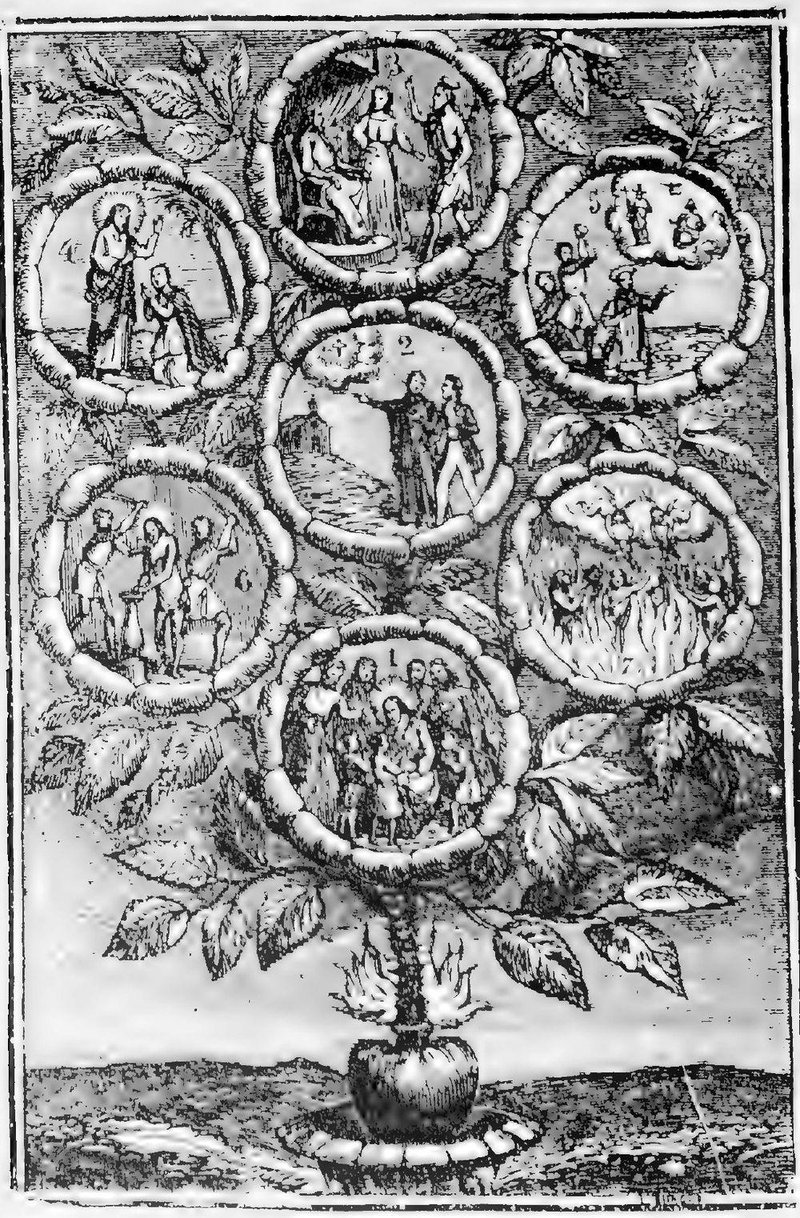
Plate XLIII. The spiritual works of mercy. 1. Jesus teaching. 2. Counsel to a young man. 3. St. John correcting Herod. 4. Jesus comforts the ruler. 5. St. Stephen forgives those who kill him. 6. Jesus suffers. 7. Souls taken out of purgatory.
My son, now that the corporal works of mercy have been explained, order requires that we go on to explain the spiritual works. These far exceed the corporal works, as the soul exceeds the body. And if the corporal works, despite their inferiority, are so praised and rewarded by God, as the holy Gospel shows, how much greater must be the praise and reward he has in store for the spiritual works? So you must know them, and that is why I have decided to make them visible to you by means of this plate, which I shall now explain.
The first of these works of mercy is to teach the ignorant. In number 1 you see Jesus our divine Master caressing and blessing the children, and taking the occasion to teach them what they must know (Mark 10:13–16). This divine Master did not think this occupation unworthy of his person; rather he delighted in it, as being proper to his mission. Can we, then, disdain to busy ourselves in it? If, in imitation of Jesus Christ, we teach Christian doctrine to those who do not know it, shall we not do a work of mercy very pleasing to him? Try, my son, to learn well all that you are taught about your salvation, and when you know it, do as much for those who do not. It is with children especially that you must practice this most excellent work of charity, trying at the same time to see that they are gathered in and do not run wild. For Jesus Christ, who counts as done to his own person what is done to one of the little ones, will reward you as if you had taught and sheltered him himself. You must also take great care not to scandalize any child. For Jesus Christ himself says that he that shall scandalize one of these little ones that believe in me, it were better for him that a millstone should be hanged about his neck, and that he should be drowned in the depth of the sea (Matt. 18:6). So great an evil is scandal, and so much does he hate and punish it! Never, my son, never must we do or say anything that could be an occasion of sin. On the contrary, let us try to live so that our conduct is a continual teaching and practical instruction for the little ones, so that they may afterwards practice it. For that proverb is very true: “What do the young practice? What they see in their elders.”
The second is to give good counsel to one who needs it. In number 2 you will see a holy man guiding a young man with his counsels. By pointing out to him the cross before him and that oratory or little chapel of the most holy Virgin, he gives him to understand that if he wants to be saved he must be devoted to Jesus and Mary. Prudent and wise counsel indeed! Happy will be the one who follows and practices it. Put it into practice, my son, and give it to others too. I promise you that those who are guided by it will be happy eternally in heaven.
The third is to correct one who errs. The seated figure in number 3 represents Herod, the woman beside him Herodias, and the one opposite St. John the Baptist, who is correcting that King for living scandalously with that woman (Mark 6:17–18). You must do the same, and so must everyone: correct one who errs, even if he is a superior. Jesus Christ commands it (Matt. 18:15). Do you not see how St. John corrects Herod though he is a king? But note, my son, that this must be done with much charity and prudence, without failing in respect if he is a superior, and with the manners of a man full of mercy, not with those that overflow with gall. One must seek the amendment of the one who errs, the avoidance of new errors, the salvation of that unhappy person and the glory of God, and in no way revenge. One must look for a suitable place and time to correct, and never do it in public if it can be done in private. The exception is when the offense and error was committed in public and it is judged fitting to correct at once, if only to prevent scandal. But it is especially when you hear blasphemy against the adorable names of God, of Jesus and of Mary that you should try to correct the unhappy man who was so shameless. Do so if you judge prudently that your correction will have good effect and that greater evils will not follow from it. Otherwise, on this occasion as with any other error, it is better to keep silent and show disapproval of what was badly done and said by your face. Or be content with saying: “Ave Maria purísima” [Hail Mary most pure], or “Praised be Jesus Christ”, “Blessed be God”, and so on, and pray to God for them, as the members of the Society of Mary do.
The fourth is to comfort the sorrowful. Number 4 shows you Jesus comforting the ruler who was much afflicted by the illness of a son in his house (John 4:46–53).1 Learn from Jesus to comfort the sorrowful, and he will comfort you in this exile and vale of tears. For he is the God of all comfort (2 Cor. 1:3), and afterwards he will admit you into heaven, where there is no sorrow, pain or weeping, but eternal happiness (Apoc. 21:4).
The fifth is to forgive injuries. Number 5 shows St. Stephen being stoned. Raising his eyes to heaven, he sees the most holy Trinity. Notice up there Jesus Christ at the right hand of God the Father almighty, standing as if to help St. Stephen (Acts 7:55). This Saint calls on God, not asking for vengeance against his enemies, or that God should strike them dead like Nadab and Abiu (Lev. 10:1–2), or that the earth should open and swallow them like Dathan, Core and Abiron (Num. 16:31–33). He asks instead that God forgive them the sin they are committing (Acts 7:59). In this he follows the example of Jesus Christ, who, nailed to the cross, prayed for those who crucified him (Luke 23:34). Imitate Jesus Christ and St. Stephen, my son. Forgive those who injure you. Forgive them always and with all your heart, and ask God to convert them, and never ask for or desire revenge. If you do so, God will forgive you. Otherwise you would never be forgiven by him (Matt. 6:14–15).
The sixth is to bear patiently the failings of our neighbor. In number 6 you will see Jesus being scourged… Oh, with what patience he bears such terrible blows!… He suffers in body, he suffers in honor, and despite his innocence he does not open his mouth to complain. Here, my son, is the one from whom you must learn to bear patiently the failings of your neighbor, however troublesome he may be to you. Do so even when you are innocent and he acts with malice, even when he wounds you in body, in property and in honor. In such cases look at Jesus at the pillar, and if you consider his scourging attentively… ah, will you be able to complain? Will you know how?…
The seventh is to pray to God for the living and the dead. No day must pass, my son, without your asking God and the most holy Virgin to grant you the graces you need. But you must not make this prayer only for yourself. Pray also for your neighbors, for the conversion of sinners, for the perseverance of the just and for the holy souls. Imitate Jesus, who in the garden of Gethsemani prayed three times. The first time, according to St. Augustine, he prayed for the conversion of sinners; the second for the perseverance of the just; and the third for the holy souls in purgatory: Tertio oravit pro animabus purgatorii [The third time he prayed for the souls in purgatory]. Call on the intercession of most holy Mary. So that you may understand how much her mediation is worth, in number 7 you will see the Angels coming down over the flames of purgatory to bring souls out of them, carrying scapulars and rosaries. This also shows the relief the faithful obtain for the souls by prayer and devout practices.
This word purgatory is not much to the taste today of some who boast of being enlightened, while, because they always walk in darkness, they stumble at every step. So that you, my son, may know how to despise the sarcasms and blasphemies of the ungodly, you must know that all that is said against it is the devil’s invention. This common enemy of men follows here the same tactics as besiegers of a town they mean to take by hunger. They not only stop food from being brought in but also pursue those who could supply it. So the accursed one not only lays siege to purgatory, keeping the holy souls from receiving suffrages. He also pursues with the army of the ungodly the faithful who could supply them with alms, prayers and other good works. With the weapons of ridicule, jeers, sarcasm and others of the same kind, the ungodly try to kill their faith. For he knows very well that once faith is extinguished, and charity with it, the souls expiating their sins there will be left without relief in their pains. In this way he kills two birds with one stone, harming both the living and the dead. That is why it is no wonder that the heresy of denying the existence of purgatory has become fashionable.
Do not forget, my son, that when a person commits a mortal sin, he deserves to be punished eternally in hell for it. But when it is duly confessed, that eternal punishment is changed into a temporal one, longer or shorter according to the greater or less sorrow he brought to confession. This punishment must without fail be purged either in this world or in the next, and that is why the place where it is done takes the name of purgatory. A comparison will make it clearer to you. Suppose a subject has committed a crime that deserves the death penalty. Before paying for it on the scaffold, he comes humbly before the monarch to ask pardon. The authority, moved to compassion by his humble confession of the crime, remits the capital punishment and changes it into a temporal one, such as prison or exile, leaving him free to buy it off with money, by himself or through another. So if the criminal pays the sum fixed, whether by himself or through a third party, he will be free at once. Now let us come to our case. The person who by mortal sin had deserved eternal punishment, but because he confessed it duly had it changed into a temporal one, must pay it in this world or in the prison of purgatory. He received this favor from God with the power of redeeming this punishment either by himself, through satisfactory works or indulgences while he lives, or after his death through the alms, prayers, good works and indulgences of the faithful. For in purgatory, being already in a state where it can no longer merit, the soul cannot redeem it by itself. This being so, you will understand, my son, that if that person did not pay or satisfy that punishment himself in this world, and the faithful do not satisfy it for him after his death, he will have no remedy but to pay it in purgatory until the term fixed by divine justice is ended.
From what I have said about the guilt of mortal sin forgiven or changed by means of the sacrament of Penance, you may already have come to see the necessity of the existence of purgatory. Yet I want to make it still clearer to you from the guilt of venial sins. You naturally know, my son, that a just judge must punish the guilty according to the gravity of his offense. Since God is a most just judge, who will judge justices (Ps. 74:3), would he not do as much with us who are guilty? Guilty, yes; for who can boast of not sinning? The faults may be light, if you like. But it is beyond doubt that they keep us from entering heaven, since there shall not enter into it any thing defiled (Apoc. 21:27). In that case, where will the soul go that carries some light stain? Not to hell, for God’s justice would not be just if it punished with equal pains one who committed light faults and one who committed enormous ones. No more would a judge be just who punished in the same way a son who through frailty failed in due respect to his father and one who murdered him in a rage. And let no one tell us that the greater or less intensity of the pains is enough to distinguish the offenses. For besides the difference in intensity there must be a difference in duration. If the punishment were eternal for every kind of offense, though more or less intense, it would then be infinite, and therefore unjust because out of proportion to the offense. So the punishment for venial sins must be temporal. Its payment is what is called purgatory; therefore purgatory exists.
Those who have not made satisfaction in this world must go there to make it. For it would not be just that they should go straight to heaven from the bed of this life’s pleasures, while many others are laid in the bed of pain. Add to this that some die suddenly without being able to do penance. Others die in their sleep, without having made inward acts of sorrow for their faults or acts of love of God. All this proves the necessity of the existence of that place called purgatory. Besides, you know already that this is a dogma of faith, and that we all have the obligation to help our neighbors who are being purged there. So do all you can for the dead, my son, as chaste Joseph did for his father (Gen. 50:1–10), and Judas Machabeus for his comrades in arms (2 Mach. 12:43–46). As Tobias to his son, so I to you, my son, recommend this work of spiritual charity (Tob. 4:18); and do not doubt it, God will reward you abundantly for it in this world and the next.
If you want to see the existence of purgatory proved at greater length, and to learn the means of practicing this spiritual work of mercy, read my little book entitled Socorro a los difuntos [Help for the Dead], which I recommend to you in a special way.
Q. What is the soul?
A. An immortal spirit, created by God in his image and likeness.
Q. How many are the powers of the soul?
A. Three: Memory, Understanding and Will.
Q. Why has God given us understanding?
A. So that we may know him, and think of him and of the things of his service.
Q. Why memory?
A. So that we may remember his law and the benefits we have received.
Q. Why will and free will?
A. So that we may love him, and do with merit what he commands us.
Q. How many are the bodily senses?
A. Five: sight, hearing, smell, taste and touch.
Q. Why has God given us the senses?
A. So that with them we may serve him in all things.
Footnotes
-
Latin regulus. ↩