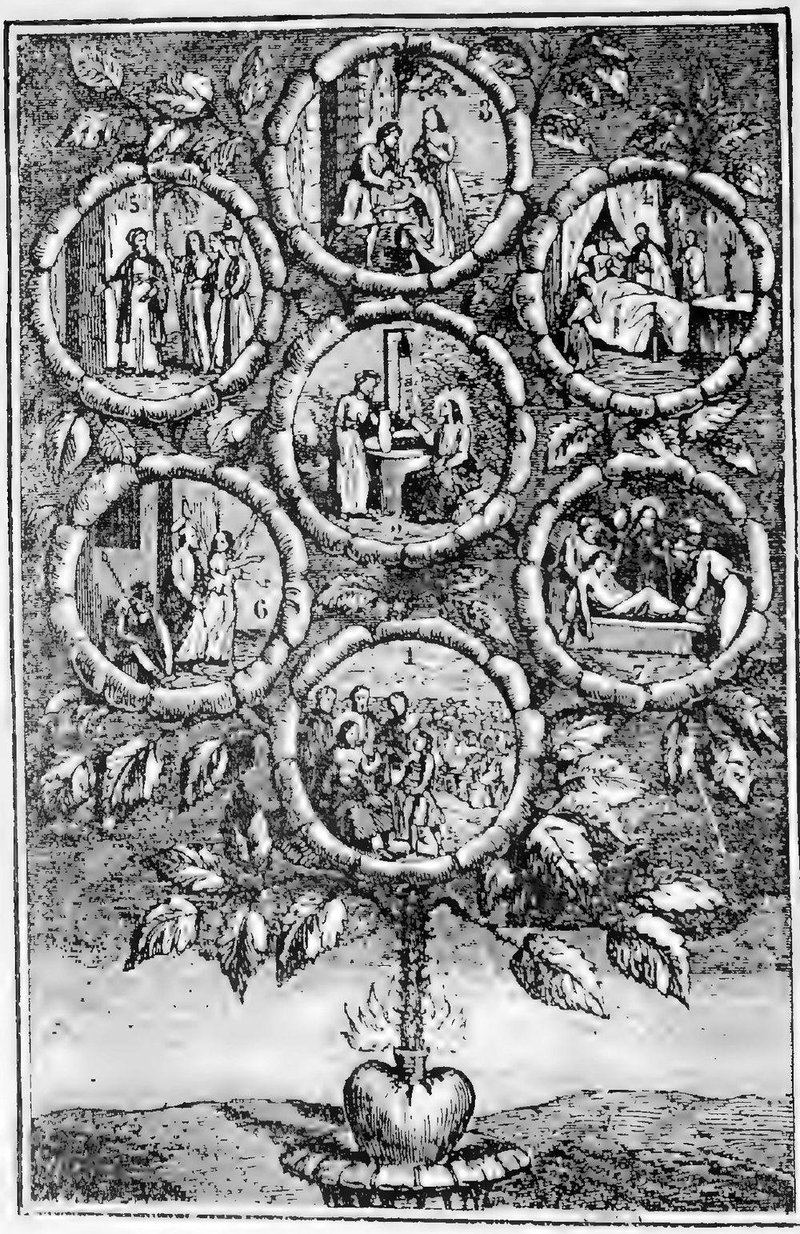
Plate XLII. The corporal works of mercy. A rose bush planted in a heart. 1. Jesus feeds the multitude in the desert. 2. Jesus asks the Samaritan woman for water. 3. Clothing the naked. 4. Viaticum for a sick man. 5. The patriarch Abraham. 6. The Angel leads St. Peter out of prison. 7. The burial of Jesus.
My son, that rose bush springing from a heart, full at once of thorns and of the loveliest and most fragrant roses, is a symbol of the human race. Since Adam sinned, the earth brings forth thistles and thorns for it, according to the sentence God pronounced against him (Gen. 3:18), and so it is full of miseries, as Job says (Job 14:1). Its being planted on a burning heart means that human miseries wound the heart of the charitable person. That heart answers generously with flames of love, and amid the thorns brings out the loveliest and most fragrant roses of Christian charity. That is why these works are called works of mercy, as if to say: miseries that wound the heart, and the heart, moved by them, does works of charity.
You must know, my son, that in consequence of the sin of our first parents, our soul and our body became subject to great misfortunes or unhappiness. So when we relieve the needs or miseries that affect our neighbor’s body, these works of mercy are called corporal. Those by which we relieve the miseries that affect the soul are called spiritual. I shall give you a brief account of them. The corporal works are in the present plate; you will see the spiritual works in the next.
The first of the corporal works is to feed the hungry. In rose number 1 you will see Jesus Christ. He had compassion on the people who had followed him into the desert to hear his divine word and had nothing to eat. So he worked that wonder of multiplying the five loaves and two fishes, with which he fed five thousand men, not counting women and children. After they had been fully satisfied, twelve baskets of food were left over (Matt. 14:15–21). By this wonderful deed Jesus Christ, our divine Master, teaches us that we must relieve our neighbor’s needs and miseries without being held back by fear of making ourselves poor. For almsgiving, instead of being a way of bringing want on ourselves, is a way of increasing our possessions, just as spending wheat in sowing is a way of getting an abundant harvest. Jesus Christ willed to make this plain to us by making the food left over, after those people were satisfied, greater in quantity than what they had before the banquet began.
The second is to give drink to the thirsty. In number 2 you will also see Jesus Christ, who, tired from his journey, comes and sits by the well of Sichar, where the Samaritan woman comes to draw water. Jesus Christ asks her for a drink. She excuses herself, and Jesus Christ says to her: If thou didst know… who he is that saith to thee, Give me to drink (John 4:10)… as if he said: “O woman! If you knew who it is that asks you for water, ah, how differently you would behave!” Try, then, my son, to help the needy without ever excusing yourself. Remember that any poor man represents Jesus Christ. You would not be the first from whom Jesus Christ himself, in the guise of a beggar, asked an alms, as he then asked water of the Samaritan woman. Ah, would you have the heart to refuse Jesus Christ what he himself has given you? Ah, my son! A day will come, the day of judgment, when he will say to the one who has not helped the poor: “I was hungry, I was thirsty in the person of the beggars and the poor. I asked you for food and drink in them, and you refused me… You had money to spare to indulge yourself, to spend on superfluities, to dress in luxury, to amuse yourself, for everything, even for sinning, and you had none to help me… Ah! Depart from me, you cursed, into everlasting fire!” (Matt. 25:41–42).
The third is to clothe the naked. In number 3 you will see some persons doing this work of mercy. A thousand times happy are they! On the day of judgment the Lord will tell them that he accepted it as if it had been done to his own person, and in reward he will clothe them with his glory. But woe to those who spend on fashions and superfluous clothes, and have nothing with which to clothe or cover the flesh of a wretched man! Woe to those who would rather let the moth eat their clothes than help the unhappy man who, half naked, is shivering and almost frozen with cold! Woe, woe to them! When they least expect it, there will happen to them what happened to the rich glutton of whom the Gospel tells us. Because he let poor Lazarus die of hunger while he himself feasted splendidly and dressed in purple, he was buried in the place of torments, in hell (Luke 16:19–24). Do not imitate them, my son. Imitate rather St. Francis of Assisi, who helped the poor so much; St. Thomas of Villanova, who even as a child gave them his very clothes, besides other things. Imitate St. Martin and other Saints, and when you die you will hear Jesus Christ say to you with a smile: Come, ye blessed of my Father, possess the kingdom (Matt. 25:34).
The fourth is to visit the sick and prisoners. In number 4 you will find a sick man whom Jesus Christ visits by means of the sacred Viaticum administered by a priest. In imitation of Jesus Christ you too, my son, must try to visit the sick. For this divine Saviour, as we read in the sacred Gospel, gave sight to the blind, hearing to the deaf and speech to the dumb. He visited the pool, and even raised the dead. And his love, not satisfied with this, instituted the most holy Sacrament, to remain, visit and comfort the sick as viaticum, and to give them strength to undertake the great journey of eternity. He so desires Christians to practice this work of mercy that he will reward them for it as if he had received it himself. Imitate him, I repeat, my son. Visit, comfort and assist the sick as far as you can. If they are poor, so much the better, even if it is in a hospital; and as a reward God will give you glory.
But it is not only the sick who should move us to compassion and mercy, but also poor prisoners. Firstly, it is not always real crimes that have brought them to so unhappy a state, but often slanders or mere suspicions. Secondly, even if they are really guilty, they do not cease for that to be our neighbors and images of God. So they have a claim on our good offices: to give them food they cannot get for themselves, or to bring them to penance and to bear their temporal sentence with Christian resignation so as to avoid the eternal one. We should consider that their state could have been ours if God had not held us by his hand. And finally, Jesus Christ does not disdain to visit them in the Sacrament when, repentant, they have wept over their crime at the feet of one of his ministers. He gives himself to them as viaticum before they go to the scaffold, if public justice condemns them to capital punishment. He does so to make that shameful and bitter moment gentler for them, and afterwards to bring them from the scaffold to heavenly glory. Imitate Jesus Christ, then, my son. Visit them charitably. Set aside what is human in the criminal and love what is divine in him. See that what is done for these unhappy people Jesus Christ also receives as done to his own person. Besides giving you some temporal reward for it, at the hour of your death you will deserve to hear from his sacred lips: I was in prison, and you came to me (Matt. 25:36). And so: “Come, blessed of my Father, possess the kingdom, enter and reign with me eternally.”
The fifth is to harbor the pilgrim. Number 5 shows the patriarch Abraham giving lodging to some pilgrims whom he thought to be men, and who were really Angels of the Lord (Gen. 18). God so valued this work of mercy in Abraham that for it he promised him nothing less than to make him the father of a numerous offspring and to lavish on him an abundance of spiritual and temporal goods. So God rewards works of charity, which are so pleasing to him and to the Angels! The people of the village of Emmaus, too, thought it was a man, a pilgrim, to whom they gave lodging, and in reality it was the risen Jesus Christ himself (Luke 24:13–31). The same happened to St. Gregory, who thought he was giving hospitality to some poor pilgrims and found they were Angels. Happy, yes, are those who busy themselves in such works of charity! For God will give them too an eternal lodging in his heavenly palace.
The sixth is to ransom the captive. In number 6 you will see an Angel leading the apostle St. Peter out of the prison in which Herod held him (Acts 12:6–10). My son, imitate the Angels. Do all you can to set free the imprisoned and captive. Use all the lawful means you can to get them out of so unhappy a state. If you do not succeed, try to comfort them, pray to God for them that he may give them freedom, and exhort them meanwhile to bear their captivity in a spirit of penance. And you must ransom not only bodily captives but also, and with greater reason, spiritual ones: those who through mortal sin are under the slavery and tyranny of Satan. Warn them, exhort them and pray to God for them, that they may leave so unhappy and degrading a state as soon as possible. Do it, my son, and I assure you that the crown of immortal glory you will merit will be great. For you will imitate Jesus Christ, who came down from heaven to earth to redeem and save us all.
The seventh is to bury the dead for the love of God. In number 7 you will see Joseph of Arimathea and Nicodemus burying the dead Jesus Christ (John 19:38–42). Oh, how pleasing to God and to the most holy Virgin such an act of charity must have been! Do as much for your neighbor, my son. Follow the example of those two holy disciples of Jesus and of Tobias (Tob. 1:20–21; 12:12), and as God rewarded them for such works of mercy, so he will give you an abundant reward for them. Do not think from this, my son, that I want you to take up the trade of gravedigger, for I know there will be someone to do it. But I do earnestly ask you to see that the dead are accompanied and buried with the charity and Christian piety due to a body that was the dwelling of a soul redeemed by Jesus Christ, and that is destined to rise one day for glory, if it died in the Lord, as we must believe of a Christian. And one of the most fitting ways of practicing this work of mercy is to receive the holy Eucharist often, with a heart cleansed and renewed by a holy confession. In this way you will imitate Joseph of Arimathea, who gave Jesus his tomb. You too will give him yours if you receive him worthily in holy Communion. For although Jesus is alive in the Sacrament of the altar, he is shown to you there as dead and wishing to be buried in your heart.
My son, I should not have spoken to you sufficiently about these works of mercy if I did not warn you that, to merit eternal life, they must be accompanied by two things. The first is that in doing them we always set before ourselves a right end, or right intention. The second is to be in the grace of God. The right end or intention must be always to please God, or to do it for his greater honor and glory. If we did it out of vanity, to be admired and praised like the Pharisees, we should merit nothing for heaven, for men would have given us our reward in this world, and a paltry one indeed! (Matt. 6:2). Nor will these works profit for heaven those who do them in a state of mortal sin. They will merit some temporal goods, yes, but not spiritual goods in justice. Yet I will not for that reason fail to urge such persons to do them too, to implore the divine mercy and obtain holy grace. Try, then, my son, try to have a right intention in all things, and not to be in mortal sin for a single instant. Always do all the good works you can. For, done in the way I have explained, they will merit for you the praise of God before all men on the day of judgment, and the crown of glory in heaven. Amen.
Q. How many are the works of mercy?
A. Fourteen: seven corporal and seven spiritual. The corporal are these:
The first, to feed the hungry.
The second, to give drink to the thirsty.
The third, to clothe the naked.
The fourth, to visit the sick and prisoners.
The fifth, to harbor the pilgrim.
The sixth, to ransom the captive.
The seventh, to bury the dead.
The seven spiritual are these:
The first, to teach the ignorant.
The second, to give good counsel to one who needs it.
The third, to correct one who errs.
The fourth, to forgive injuries.
The fifth, to comfort the sorrowful.
The sixth, to bear patiently the failings of our neighbor.
The seventh, to pray to God for the living and the dead.
Q. Why are these works called works of mercy?
A. Because by them we relieve with charity the miseries of our neighbor.
Q. Are we obliged to practice these works of mercy?
A. Yes, and often under pain of mortal sin.