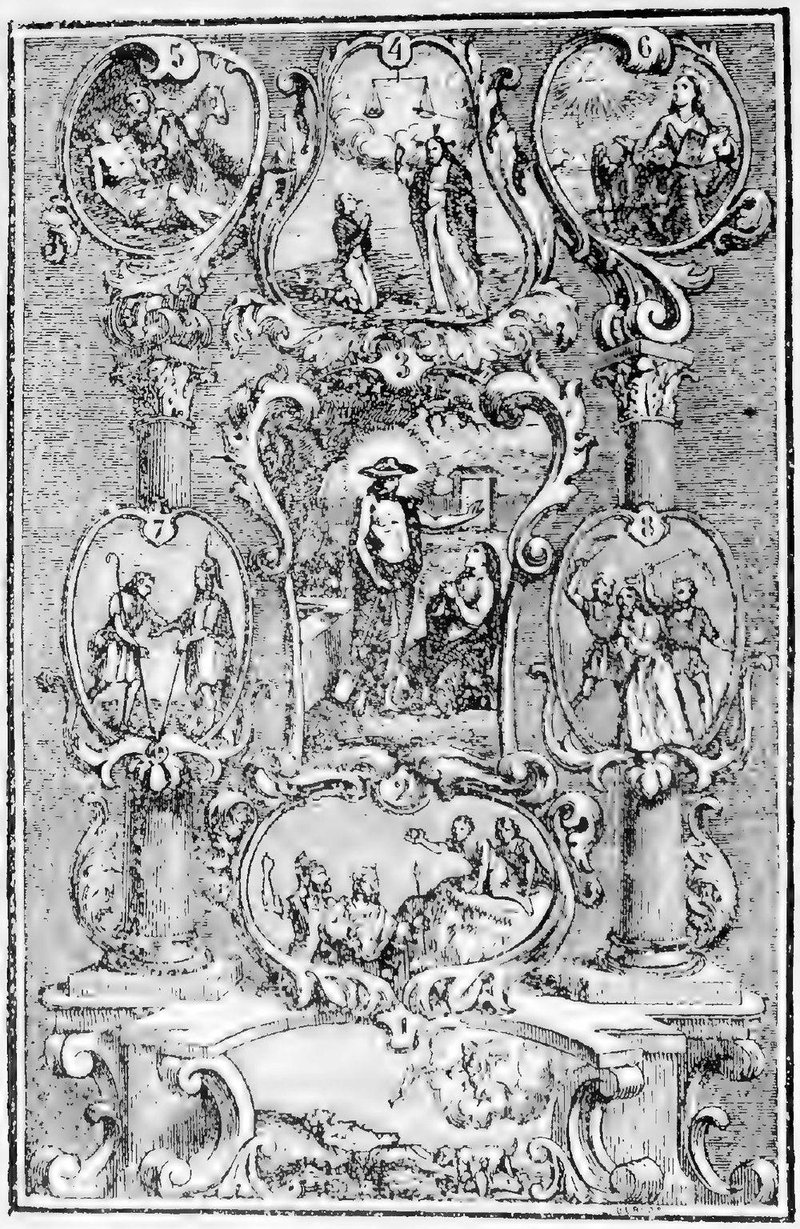
Plate XLI. The beatitudes. 1. Lazarus. 2. David bearing with Semei. 3. Jesus consoling Magdalen. 4. Jesus teaching justice to a young man. 5. The merciful Samaritan. 6. St. John the Evangelist. 7. David the peacemaker with Saul. 8. St. Paul suffering.
My son, this plate shows you the eight beatitudes that Jesus Christ taught us (Matt. 5:3–10). They are certain acts of the virtues and gifts that dispose us in a special way for heavenly beatitude, where the reward corresponding to each of them will be given, as the holy Gospel teaches us. Those who possess them are truly happy and blessed, as far as is possible in this world, as you will see from the brief explanation I am going to give you of each of them.
The first: Blessed are the poor in spirit: for theirs is the kingdom of heaven. In number 1 you will find Lazarus, poor, naked and full of sores, which the dog of the rich glutton is licking (Luke 16:19–31). This poor man neither grumbles nor complains of the hardness of heart of that greedy man. Rather, entirely detached from the things of the world, he loves God alone. So when he died his soul was carried into Abraham’s bosom, and when Christ opened the gates of the kingdom of heaven, he entered to possess it, because he was truly poor in spirit. As this matter is very important, I shall explain it a little more fully so that you are not confused. St. Francis de Sales divided poverty into three kinds. “First, poverty in affection and not in fact, which consists in having no attachment to what one possesses. Second, poverty in fact and not in affection, which consists in not having or possessing goods, but coveting them at the same time. Third, poverty in affection and in fact, which consists in neither desiring nor possessing temporal goods. Of these three kinds,” said the Saint, “the first is excellent, and even the richest and most opulent can practice it. So did Abraham, David and very many other Saints, who amid all their riches and good fortune were poor in affection. They were as stripped of fondness or attachment to riches as they were ready and willing to receive poverty with blessings, praises and thanks to the Lord, had he been pleased to send it to them. The second, which is poverty in fact but not in affection, is unhappy in every way. For it suffers the discomforts of poverty and besides the pain of not having what it longs for. The third, which is poverty in fact and also in affection, is the one recommended in the Gospel. It comes to us either by inheritance or by some reverse of fortune. In either case, if we bear it gladly, blessing God in that state, then we follow in the footsteps of Jesus Christ, his most holy Mother and his Apostles, who we know lived and were always poor.” (So far the Saint, in his Spirit, vol. 1, part 4, ch. 11.)
You see, then, my son, that poverty of spirit, which makes blessed whoever has it, does not consist in lacking the comforts that the world’s riches provide, nor in possessing honors or titles. It consists in not being attached to them. The poor man in fact should live content with God’s will in his want, without envying the rich man. The rich man should use the goods God has entrusted to him as a mere steward, without clinging to them or setting his affection on them. He should always remember that he who gave them can take them away, and that the poor in fact are his brothers, whom he is obliged to help at least with what is beyond the needs of his own state. So a wealthy man can attain this beatitude by possessing his goods without affection or attachment and using them well. And a man in rags and faint with hunger may be deprived of it, because amid the want that is killing him he may not accept God’s will and may have great longings for riches.
From this you see, my son, how much it matters to you not to set your affection on the things here below. Besides shutting you out of the beatitude proper to the poor in spirit, they would be a burden that would occupy you and keep you continually bent under its weight. That is why Jesus Christ said in his Gospel: Where thy treasure is, there is thy heart also (Matt. 6:21). St. John Chrysostom explains these words, saying that “a heart attached to earthly things and riches is incapable of understanding the truths that lead to the kingdom of heaven. It is deaf to the voice of the Lord, who declares blessed the poor in heart and in spirit.” And what is said of riches must be understood of all the other things whose love forces man’s heart, for all of them are included under this name of the treasure where our heart is. Let heaven be the only treasure your desires aim at, and you will be happy. Anxiety and excessive concern for earthly things are the cause of people’s unhappiness. “Usually,” said St. Francis de Sales, “we shall find that we are not poor positively, but only comparatively. If we desire no more than nature asks as necessary, we shall never be poor. But if, going beyond these just limits, we measure our desires by opinion and whim, we shall never be rich. To grow rich in a short time and at little cost, there is no need to pile up riches, but to lessen desires. Let us imitate sculptors, who make their works by chipping and taking away, and not painters, who make theirs by adding and putting on.” Let us not, then, be overanxious about these things. Let us seek the kingdom of God by doing good works, and we shall not lack what is necessary (Matt. 6:33). And if we ever lack something, let us think that, as the doctor obliges the sick man to abstain from food in certain cases because he judges it good for his health, so too God, who knows what is good for us, deprives us of those comforts and makes us feel want, because in his high providence he sees it is useful for our spiritual health. So what matters is to have patience, and to resign ourselves and conform ourselves to his holy will. For in this way and no other we shall be blessed in this world, and afterwards eternally in the next.
The second: Blessed are the meek: for they shall possess the land. Turn your attention to number 2 of the plate, my son. The figure below wearing a royal crown represents King David, and the one higher up Semei, who insults and provokes him with words and stones (2 Kings 16:5–13). The one behind David is the general Abisai. Unable to bear the insults that insolent man was heaping on his lord, he wanted to cut off his head. But the King held him back with the greatest meekness, and with heroic patience bore those injuries in remission of his sins. So, master of himself, he possessed here the land of his own heart, and afterwards the land of glory, or of the living, as David himself says (Ps. 26:13). You must do the same, my son. Be meek and humble of heart in imitation of Jesus Christ and of David, and so you will find rest for your soul in this world and the next (Matt. 11:29). In this world the meek are those who win and possess people’s hearts. In their meekness they bear everything, quarrel with no one, take revenge on no one, are friends of all and forgive all. And forgiven also by God, they are finally placed in glory, where they will enjoy an eternal happiness.
The third: Blessed are they that mourn: for they shall be comforted. In number 3 is Magdalen, who weeps because they have killed the Saviour whom she loved so much. Not finding him in the tomb, she was going in search of him when Jesus Christ himself appeared to her and comforted her (John 20:11–18). Do the same, my son. Weep over the deceitful pleasures and vain amusements of the world. Weep over the follies of men who blindly hurl themselves into every temporal and eternal evil. Weep to see that by the sins committed daily Jesus Christ is crucified again. Weep to see him so little loved and so abandoned in the most holy Sacrament of the altar. Weep, and finally desire to find him, receive him and adore him in the sacred Eucharist; and do not doubt it, you will be comforted. For in this world you will receive him, and in the next you will see him eternally, like Magdalen.
The fourth: Blessed are they that hunger and thirst after justice: for they shall have their fill. The kneeling figure in number 4 represents a young man asking Jesus Christ what he must do to be saved. This divine Master answers him that he must keep the commandments (Matt. 19:16–17). And since these prescribe that each be given what belongs to him, you see painted up there a balance or scales, the symbol of justice; and he is just who keeps the commandments. But this keeping must be accompanied by a strong desire to fulfil them, like the desire for food and drink of the hungry and thirsty. I mean that, as they find all foods good and tasty and eat and drink eagerly, so we too must hunger and thirst to keep the commandments. Then we shall find them sweeter than honey, as David said (Ps. 18:11), and they will be for us a sweet yoke and a light burden (Matt. 11:30). Let us try, then, my son, to have this hunger and thirst for justice, that is, for the holy law. Let us fulfil it with all exactness, and the Lord will fill us here in this world with the sweetness it brings with it, and afterwards fill us with eternal joys and contentment in heaven as the pay and reward of our faithfulness.
The fifth: Blessed are the merciful: for they shall obtain mercy. Number 5 represents a man who, going down from Jerusalem to Jericho, fell among robbers, who robbed him, wounded him and left him half dead. The other figure represents a Samaritan. Though he was an enemy of the wounded man, he forgets his enmity in that case. He lifts him up, bathes his wounds with wine and oil, carries him on his own beast to the inn, and charges the innkeeper to look after him, promising to repay him on his return whatever he has spent on him (Luke 10:30–35). By this parable and charitable action Jesus Christ teaches us in his sacred Gospel how we must help our neighbors, whether friends or enemies. Happy are we if we do so! For we shall obtain mercy from God. He will have compassion on our miseries, forgive us our sins and admit us to his eternal glory. But if on the contrary we were hard of heart toward our fellow men, he would be so with us too, and would not admit us into the kingdom of heaven.
The sixth: Blessed are the clean of heart: for they shall see God. That figure in number 6 represents St. John the Evangelist on the island of Patmos, and the eagle is the symbol of the loftiness of the Gospel he wrote. This Apostle loved God so much, and the purity or cleanness of his heart was so singular, that he had the happy fortune of seeing him in the way that is possible here below. You too, my son, try to love God much and be clean of heart. Be chaste like St. John, and you will see God, if not as he did in this world, at least with him in heaven. But you must understand that, as the clean of heart will see God, so the impure and stained will see the devil, as St. Ambrose says: “He who keeps chastity is like an Angel; but he who is not chaste is like a devil.” Be chaste, then. Love God, and you will see him, and you will be happy for all eternity in heaven.
The seventh: Blessed are the peacemakers: for they shall be called the children of God. Number 7 shows you David the peacemaker, seeking peace with the envious and spiteful Saul (1 Kings 24). You must do the same, my son: always try to live in peace and harmony with everyone. For union and peace are among the things most pleasing to God. When he decided to come into the world, he willed that peace should reign over the whole earth. When he was born, he had it proclaimed by the Angels to men of good will (Luke 2:14). And after he had risen, before ascending into heaven, he always greeted the Apostles with these words: Pax vobis [Peace be to you] (John 20:19). Love it, then, truly. Seek it at the cost of any lawful sacrifice. Live devoutly, and you will enjoy it; and through it you will be called a child of God.
The eighth: Blessed are they that suffer persecution for justice’ sake: for theirs is the kingdom of heaven. In number 8 you will see St. Paul being scourged. Three times he suffered scourging and once he was stoned, and after suffering many other persecutions he finally died a martyr (2 Cor. 11:24–25). But he bore everything with heroic patience and joy, encouraged by his knowledge that these pains here below are very slight compared with the reward reserved for us in heaven because of them (Rom. 8:18). Do the same, my son. Bear patiently the insults, jeers and persecutions of worldly people, without letting their taunts or ill treatment stop you or make you turn back on the road of justice. That is, you must never, for any fear of persecution, break the
commandments of the Lord’s holy law, or give up practicing virtue. Prepare yourself to suffer, my son, if you want to be just, as you should. For a man forewarned is worth two, as the proverb says [Spanish: hombre prevenido vale por dos, roughly “forewarned is forearmed”]. And as the Father St. Gregory says, “the darts we foresee wound less, and we bear the evils of this world with greater patience if we are protected against them by the shield of foreknowledge.” No, my son, whoever wants to live according to the Christian law, or to be just, will never lack persecutions. So says St. Paul in these words: All that will live godly in Christ Jesus, shall suffer persecution (2 Tim. 3:12), as good Christians, whether from the declared enemies of Religion or from bad Christians. Jesus Christ was persecuted, and we shall be persecuted like him if we want to follow him or be his disciples, as he warned us beforehand (John 15:20). But instead of frightening us or making us give up, this should make us glad, because in that case ours is the kingdom of heaven. Let us not be ashamed to confess Jesus Christ before the whole world, and a day will come when he will call us and reward us before his eternal Father and all men, and place us in the heavenly homeland (Matt. 10:32).
Q. How many are the beatitudes?
A. Eight. The first, blessed are the poor in spirit, for theirs is the kingdom of heaven.
The second, blessed are the meek, for they shall possess the land.
The third, blessed are they that mourn, for they shall be comforted.
The fourth, blessed are they that hunger and thirst after justice, for they shall have their fill.
The fifth, blessed are the merciful, for they shall obtain mercy.
The sixth, blessed are the clean of heart, for they shall see God.
The seventh, blessed are the peacemakers, for they shall be called the children of God.
The eighth, blessed are they that suffer persecution for justice’ sake, for theirs is the kingdom of heaven.
Q. Why are these works called beatitudes?
A. Because they are works so perfect that by them we not only merit heaven, but already begin to enjoy the delights of glory.
Q. Who are the poor in spirit?
A. Those who despise the riches and honors of this world.
Q. Who are the meek?
A. Those who restrain anger.
Q. How will the meek possess the land?
A. As masters of themselves.
Q. Who are they that mourn?
A. Those who give up the pleasures of this life, weeping over its vanities.
Q. Who are they that hunger and thirst after justice?
A. Those who earnestly desire to give each one his own and to do God’s will in everything.
Q. Who are the merciful?
A. Those who help all their neighbor’s needs for the love of God.
Q. Who are the clean of heart?
A. Those who avoid sin with all care.
Q. Who are the peacemakers?
A. Those who have peace within and with their neighbors.
Q. Who are they that suffer for justice?
A. Those who, for no persecution or hardship, leave the right road of virtue.