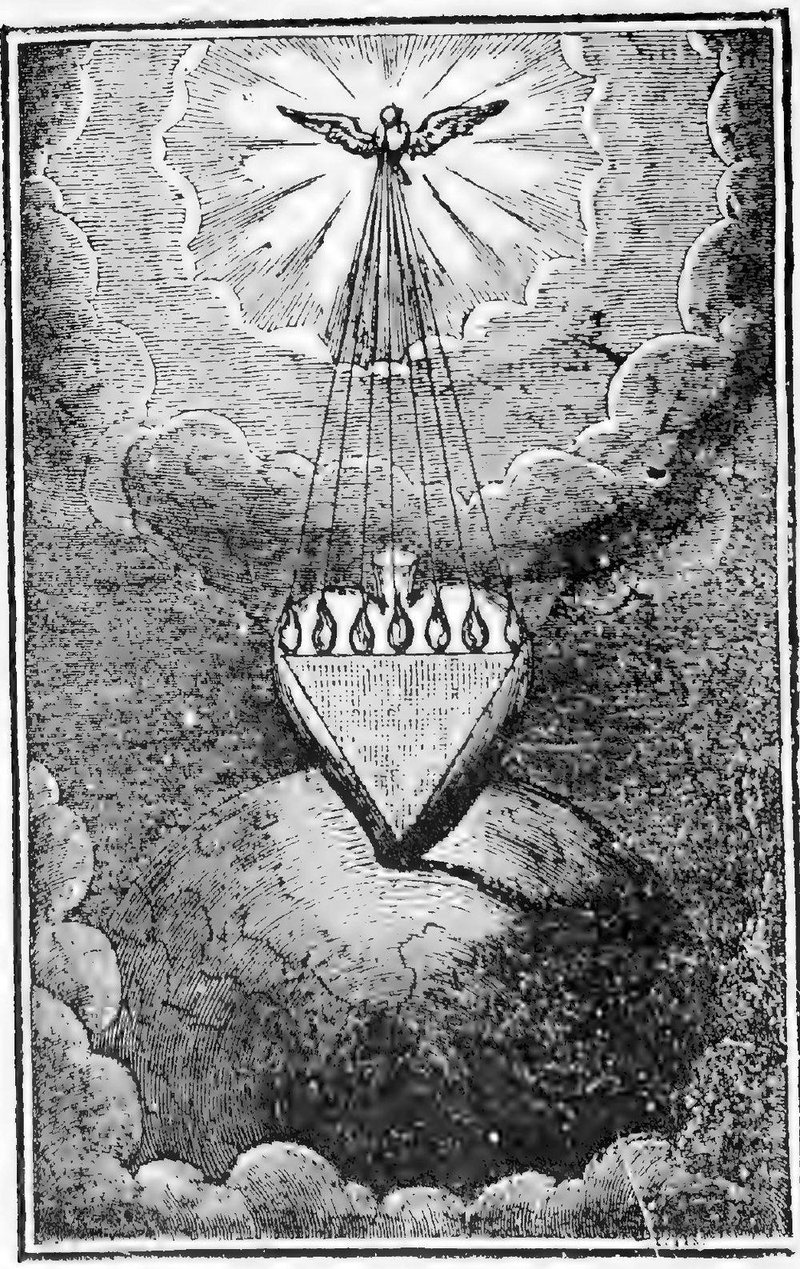
Plate XL. The gifts of the Holy Ghost. The Holy Ghost pouring out his gifts on the soul. The world, from which the heart turns away.
This plate shows the Holy Ghost in the act of pouring out his gifts on a soul, represented by that heart rising above the earth, which is shown by that globe. You know already, my son, that a person in mortal sin is a slave of the devil, hateful to God and the Saints, and deserving of the eternal pains of hell. But you know too that if he has the good fortune to be converted, the whole scene changes in the same instant. There is special joy in heaven (Luke 15:7). God loves him as much as he hated him before. And the three divine Persons of the august Trinity, as Jesus Christ says, come and set their throne in that heart which a little before was the devil’s (John 14:23). So a Christian in the grace of God is the temple of the Holy Ghost, as St. Paul declares (1 Cor. 6:19). This divine Spirit adorns the soul in grace with the jewels of the virtues and enriches it with seven most precious gifts. Because they are special presents or gifts of the love of God, they are called gifts of the Holy Ghost, to whom works of love are attributed. These are the seven gifts: Wisdom, Understanding, Counsel, Fortitude, Knowledge, Piety and Fear of God. They are figured in the seven rays of the plate. Insofar as they are habits or permanent dispositions, everyone in the grace of God possesses them. But not insofar as they are acts, for the Holy Ghost, despite these gifts, leaves man free to act.
My son, the gifts must not be confused with the virtues. God infuses the virtues to perfect man insofar as he is moved by reason, as St. Thomas says. But the gifts serve to dispose him for a higher perfection. They make him readier to follow God’s inspirations and to fulfil his will in everything and through everything by way of love. In this way the soul is carried without the least effort, and almost compelled, according to the degree it has of these gifts, to leave the world and all earthly things. This is shown to you in the plate, in which the heart is above the world and longs only to follow the inspirations of the Holy Ghost. Iron near a magnet seems to forget its natural weight in order to follow it. In the same way the soul, disposed by these gifts, forgets its natural tendency to the things here below and turns to God as to its center and only object.
So that you may value these rich jewels, these heavenly gifts, as you should, and like Solomon prefer them to crowns and scepters (Wis. 7:8), I shall give you a short account of each of them.
Wisdom, the first gift, is a supernatural and very clear light by means of which the understanding knows divine truths, and God himself, in an ineffable way. It does so in such a way that even if all the testimonies and signs of our faith were lacking, the soul would believe them by this light alone. This light serves as a guide to order all its actions according to the law of God, with a gentleness, sweetness and inward joy that surpass all human understanding. The understanding, thus enlightened, passes on its light to the will with so great an impulse that man detaches himself from all the things of earth, judging them unworthy of his love. He consecrates that love at once to God with a clean heart, detached from every earthly affection, lamenting that he was so long in coming to know him. And embracing its object, the soul clings to it with so strong a union and perseverance that I do not hesitate to say with St. Paul that nothing in the world, not even death itself, will be able to separate it (Rom. 8:35–39).
Understanding, the second gift, is a divine light. Adorned with it, the soul’s power of understanding penetrates in a wonderful way the truths of faith and the sovereign perfections of God, and understands the sense of the holy Scriptures. The Doctors of the Catholic Church and other Saints were enlightened with this gift of Understanding. Many of them, though very ignorant in the human sciences, surpassed other men in the divine. Such was St. Ignatius of Loyola, who did not hesitate to say that even if he had had no other knowledge of the mysteries of faith than what the Lord gave him at Manresa, he would gladly shed his blood to defend them. A thousand times happy the man to whom such a gift is granted! For it can be said of him, without fear of contradiction, that he is wiser than all the philosophers of the world.
Counsel, the third gift, is an enlightening of the understanding by which the Holy Ghost makes known what is to be done or left undone, and the way to act in particular cases, in order to attain perfection and eternal salvation. By means of this gift one recognizes the tricks and subtleties of self-love and the wiles of the evil spirit, who sometimes, to deceive more surely, transforms himself into an angel of light (2 Cor. 11:14). By this gift the divine Spirit warns us of the ambushes and snares our enemies set for us, and at the same time gives us all that is useful for coming off victorious in the fight. This enlightening is greater or less according to the degree of union with God. Often the divine Spirit infuses into the soul so great a knowledge of what it tells itself or advises others that it is surer of it than if it saw it with its own eyes or touched it with its own hands.
Fortitude, the fourth gift, is a powerful impulse the Holy Ghost gives to man’s heart to encourage and strengthen it to bear and suffer hard and difficult things for love of virtue or of God. Do not confuse this gift, my son, with fortitude the cardinal virtue. The virtue serves only to overcome difficulties hard in an ordinary degree, which often lie across the road to salvation. But Fortitude, the gift of the Holy Ghost, serves to overcome things extraordinarily hard. We read of this in some anchorites and penitents, and above all in the Martyrs. With this gift lacking and with the virtue of fortitude alone, they would not have overcome so many torments. But strengthened by it, not only robust men but also delicate women and even tender children suffered the most horrible tortures with such constancy and courage that they laughed at the tyrants themselves and at the torments, however cruel.
Knowledge, the fifth gift, is a light the Holy Ghost pours into a person’s understanding. By it he forms a certain and sure judgment about the mysteries of our most holy Religion so as to believe what he ought, and with this knowledge he directs all his actions as to what he must do or leave undone to please God. This gift of Knowledge, says St. Thomas, is a sharing in God’s knowledge. By it man sees clearly the reasons for believing the divine mysteries, and how just and well grounded is the homage we pay to God by faith. Without this gift one walks in darkness, exposed to fall into a thousand errors at every step. This has happened to very many who, lacking it, fell into the greatest heresies, though they were very able in all the sciences.
Piety, the sixth gift, is a ray of divine light that enlightens a person’s understanding and inclines his will to honor God as his most loving Father, and to help his neighbor as the image of God himself. So by this gift he feels an inexpressible joy at seeing himself the son of so great and good a Father, redeemed with his most precious blood, born again in holy Baptism, and fed in the Eucharist with his sacred body and blood. Considering these and other works of love, he cannot help loving him in return and desiring that all men should love and revere him, seeking in everything and with burning zeal the greater honor and glory of God. And he seeks not only this glory of God but also the good of his neighbor, both because he knows God wills it and because his neighbor is an image and likeness of God himself. So he regards his neighbor’s needs as his own, caring even more for him than for himself, like the good mother who forgets herself to attend to the good of her beloved children. That is why the person who has the gift of Piety, forgetting himself in a certain way, exercises himself for his neighbor’s benefit in those works of Christian charity which by another name are called works of mercy.
Fear of God, the seventh gift, is a reverential affection the Holy Ghost stirs in a person’s will, by which he fears to offend God and to depart from him by sinning. St. Thomas distinguishes four kinds of fear: human, servile, initial and
filial. Human fear is the one that makes us offend God to avoid some temporal evil; this is the fear of sinners. Servile fear is the one that obliges man to leave sin and do penance to escape the eternal punishment he deserves for the fault; this is useful and profitable. Initial fear is the one that moves man to begin to love God, partly through fear of punishment and hope of reward, and partly out of regard for the divine Majesty, which he fears to offend by sin. Filial fear, finally, is the one that holds man back entirely from offending God his father. He sees in him infinite reasons for respect, love and obedience, and so fears to displease him and to lose his friendship and grace. Only these last two fears, initial and filial, are gifts of the Holy Ghost, and the more perfect of them is filial fear, since it is born of perfect charity and love of God.
Ah, my son! How highly you should prize these priceless seven gifts of the Holy Ghost! If a present or gift from an earthly king is held in great esteem, how much more should you prize these sovereign gifts of the King of kings and Lord of lords? Do not imitate those unhappy, ungrateful Christians who exchange such sovereign gifts for a vile pleasure or a petty gain. As a result they are left poor and naked, unworthy of heaven and deserving of hell.
Q. How many are the gifts of the Holy Ghost?
A. Seven: Wisdom, Understanding, Counsel, Fortitude, Knowledge, Piety and Fear of God.
Q. What effects do the gifts of the Holy Ghost cause?
A. They dispose us to obey him promptly and to follow the inspirations of God.
Q. How does the gift of Wisdom dispose us?
A. By giving us a higher knowledge, so that we turn away from sin and follow virtue.
Q. How does the gift of Understanding dispose us?
A. By turning the will away from evil and worldly things and guiding it to good and heavenly things.
Q. How does the gift of Counsel dispose us?
A. By directing us to give good counsel and to know how to take it.
Q. How does the gift of Fortitude dispose us?
A. By giving us strength to overcome the difficulties that arise on the road of virtue.
Q. How does the gift of Knowledge dispose us?
A. By teaching us how to escape the snares of this world, leaving what is uncertain for what is certain and sure.
Q. How does the gift of Piety dispose us?
A. By inclining us to revere God as the father of all.
Q. How does the gift of Fear of God dispose us?
A. By making us fear and hate sin because it is an offense and an injury to God our Lord.