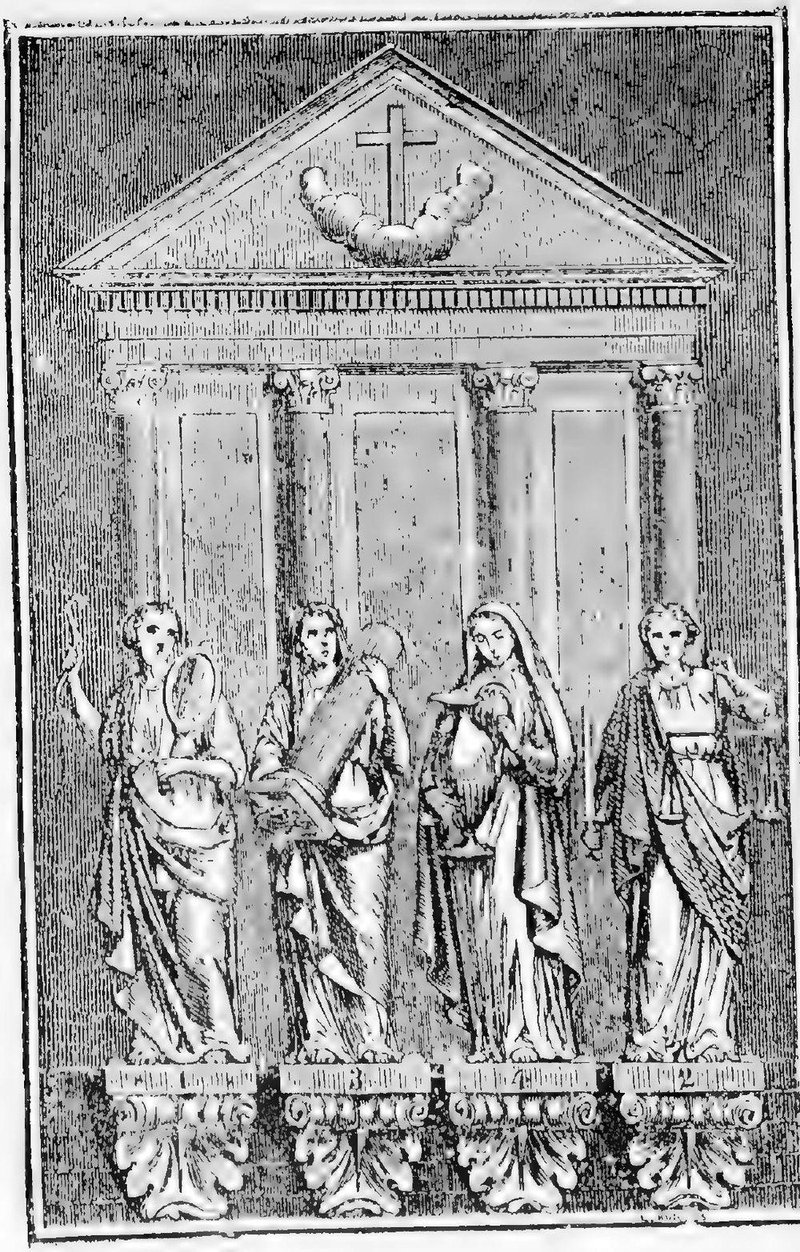
Plate XXXVIII. The cardinal virtues. 1. Prudence. 2. Justice. 3. Fortitude. 4. Temperance.
My son, the four figures in this plate represent the four cardinal virtues: Prudence, Justice, Fortitude and Temperance. They are called cardinal because they are the foundation and support of the other moral virtues. They are leaning against those columns to show that the whole building of the virtues rests and depends on them.
Prudence, shown in figure 1, is a cardinal virtue because it directs reason to decide rightly in what concerns the particular acts of all the virtues. So it shows or tells us what must be done or left undone in any particular business or action in order to act uprightly. She holds a mirror in her left hand. A person uses a mirror to look at himself, to clean off the spots that disfigure him and to put on the adornments he finds lacking. In the same way Prudence is like a mirror that shows each one faithfully the faults he must correct and what he must perfect in himself. In her right hand she holds a serpent. When this reptile finds itself pursued, it abandons its whole body to save its head. So Prudence teaches the Christian to abandon everything, even life, provided he saves the faith. That is why Jesus Christ told us: Be ye wise as serpents (Matt. 10:16). The serpent sheds its skin each year and is renewed. A good Christian should imitate it, trying each year to leave behind his faults and to renew the promises made at Baptism. The serpent, as the most cunning and shrewd animal, moved by the evil spirit, went to Eve to deceive Adam and make him sin in the earthly paradise. So the good Christian, if he wants to obtain the grace of the new Adam, Jesus, must go to the new Eve, Mary. Prudence has three parts, says St. Thomas. The first is to find the means for carrying out the work perfectly, and it is called counsel. The second is to judge rightly how fit the means found are for the present circumstances of the work, and it is called judgment. The third is a command of reason which applies the will to carry out the work in the way it has judged it should be done, and it is called precept [command].
Justice is also a cardinal virtue, because it directs the will to give each one what is his by right. It is the basis of all the virtues that concern our neighbor. It is of two kinds: one is called commutative and the other distributive. Commutative justice secures equality of things between persons in due proportion. It is the one that must be observed in contracts, such as exchanges, purchases, sales, rentals and the like. That is why, if you notice, figure 2 holds a balance or scales in her hand, to signify that each must be given what is his or belongs to him, without harming anyone. Distributive justice deals out rewards or punishments according to each person’s merit or demerit. Insofar as it deals out rewards, such as honors, posts and pensions, according to each one’s merit, it is called remunerative. Insofar as it assigns the punishments due to the guilty, such as prison, exile and death, it is called vindictive [punitive] justice. That is why figure 2, which is Justice, holds in her right hand a sword, besides the balance or scales she carries in her left to show that she weighs and considers well what belongs to each. The sword gives us to understand that, as she gives the reward due to each one’s merit, so she gives the guilty the punishment deserved, once the fault or crime has been established.
My son, in this vale of tears there is never lacking something to draw reason back from acting well and keep it from going by the right road: the fatal consequence of the original disorder! To make it clearer, theologians have reduced these hindrances to two classes. In the first are placed the things that frighten, and in the second those that pervert by delighting. So reason needs two fundamental virtues: one to make it firm and constant against hard and difficult things, and one to rein it in so that it is not carried away by the attraction of pleasant things. Fortitude serves for the first, and Temperance for the second. The first gives vigor to the will to struggle against the harsh and difficult things that meet us at every step in the practice of the virtues. The second preserves and frees us from the pleasures of the senses, which too often stand against the integrity of the virtues.
That is why you will see that figure 3, which is Fortitude, holds a column in her hands. A column bears without giving way all the weight laid on it. So the person endowed with this virtue does not draw back at the sight of the dreadful evils that threaten him. He suffers them with manly courage, without letting himself be overcome by vices, and masters fear, which is a passion powerful enough to conquer our heart. With the help of the Lord’s grace and relying on this virtue of Fortitude, the holy Martyrs overcame the threats and terrors with which tyrants tried to frighten them, and gave their lives for Jesus Christ with valor and constancy.
The other cardinal virtue, which, as I told you, preserves reason from the pleasures of the senses or the attraction of pleasant things, is called Temperance. It consists in a habit that inclines us to moderate concupiscence, chiefly regarding the pleasures that come from food, drink and impure things, and secondarily those of the other senses. That is why you will see that figure 4, which is Temperance, holds a jug in her hands. When a jug is full it will hold no more liquor, however good or choice the one someone wants to pour into it. So the person endowed with this virtue moderates his appetites. He does not exceed in food or drink, or in anything else he may lawfully use, and never lets himself be carried away by disordered pleasure. Some pleasures are more vehement than others and so master a person more or less. But it always belongs to the virtue of Temperance to keep both kinds in check and subject them always to right reason and the law of God.
You have seen, then, my son, how useful and how necessary the cardinal virtues are. So try eagerly to acquire them, and once acquired, keep them. They will preserve your bodily and spiritual health and give you as a result a happy life in this world, and still more in the next. On the contrary, the vices opposed to them would make you unhappy in this life, and in the end an eternal hell would be the reward of your mad follies.
Q. How many are the cardinal virtues?
A. Four: Prudence, Justice, Fortitude and Temperance.
Q. Why are these virtues called cardinal?
A. Because they are the foundation of the other virtues.
Q. What is Prudence?
A. It is a virtue that teaches us the way to act well.
Q. What is Justice?
A. A virtue that inclines us to give each one what belongs to him.
Q. What is Fortitude?
A. A virtue that gives us strength to bear contradictions cheerfully, and not to give way in great trials and dangers, even of death.
Q. What is Temperance?
A. A virtue that gives us strength to avoid excessive, forbidden or dangerous pleasures of the senses.