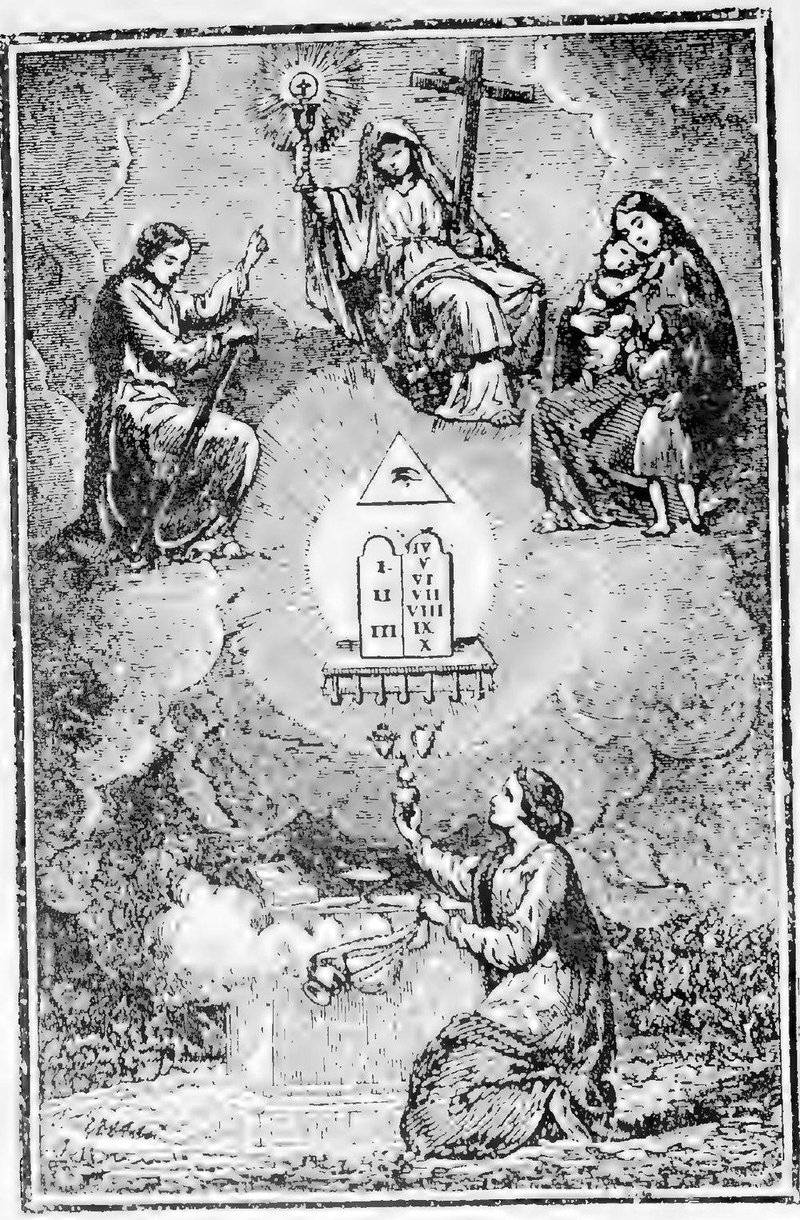
Plate XXXVII. The theological virtues. God one and three. The Law and the Sacraments. Faith, hope and charity. Good works: gold, frankincense and myrrh; the affection and devotion with which they are offered.
Do you see those three figures in the plate, my son? They symbolize the theological virtues, Faith, Hope and Charity, which are indispensably necessary for adults to be saved. That is why I have thought it very important to give you an account of each of them in particular.
That figure with bandaged eyes, holding a chalice in her right hand and a cross in her left, symbolizes Faith. It is a supernatural virtue infused by God into the soul, by which we believe all that God has said and revealed and the Church proposes to us as of faith. The motive or reason why we believe these things is that God, infallible truth, has said and taught them. So we must adhere to all of them, and to each one in particular, with more certainty and assurance of not deceiving ourselves or being deceived than if we saw them with our own eyes. For our eyes can after all deceive us, but God can neither deceive nor be deceived. Man will have the right to find out whether or not God taught what he is asked to believe. But once he has found out that God really said it, he can do nothing else but close his eyes in body and soul and exclaim humbly: “God said it? Then it is as he said. I adhere. I believe firmly on his infallible word. Away with doubts. Whatever is brought against it is sophistry, deceit, error. What is proposed surpasses my knowledge, it is true; but it is no less true that God’s knowledge is infinitely above mine. Away, then, with all examination. I believe with my understanding, and I adhere with all my heart.” So should the wise man reason; so should the humble man be silent. To believe in this way is not to abandon reason but to perfect it, ennoble it and make it godlike.
And how can a man make sure that God taught or revealed a truth? There is a Church, the Catholic Church, the depositary of all the truths God has willed to teach man for his present and future happiness. This Church has been honored by God himself with the gift of infallibility, by which she can neither be deceived nor deceive. Here is man’s point of support. Does he want to know with certainty whether or not God said what is proposed to him? Let him go to the infallible teacher, the Catholic Church, and she will free him from all doubt and make him certain. Is it a learned man who asks and wants to know whether she is really infallible and the depositary of God’s truths? Oh! She is so frank and so loyal that she will at once open her archives and show him her unimpeachable titles. Is it an ordinary man, whose talents, studies or occupations do not allow him to go into titles and details? The mere sight of the Catholic Church’s uninterrupted possession of the right to teach infallibly, without deception, and the adherence and belief of all the faithful, learned or unlearned, of all centuries, in what she teaches, are sufficient guarantee for him to proceed safely and without the least fear of deceiving or being deceived. “O holy Church!” man can and should exclaim amid his wavering ideas, “I greet you with joy. In the midst of the labyrinth of this world, you alone, since you are the pillar and ground of the truth (1 Tim. 3:15), teach me surely how I shall attain my high end or destiny, after leaving me no doubt about my origin, as noble as it is degraded.”
The virtue of Faith has five precepts, three affirmative and two negative. The first affirmative precept is to know the mysteries of faith. The second is to assent to them, adhering to these holy truths with understanding and will. The third is to confess this faith or belief outwardly. As to the first two precepts, I have nothing to point out to you, my son. You know the Christian doctrine and mysteries I have been explaining to you up to now, and I believe you are well persuaded of their truth. For I know that it is enough for you that God, who can neither err nor deceive us, has said and revealed it. And to make sure that God has said it, you have all the motives of credibility one could wish: the prophecies fulfilled, the miracles worked, the spread of the faith, the Martyrs, and others. These convince you how reasonable is the homage you pay to God in believing what you neither see nor understand, his word being enough for you. As to the third precept, outward confession of the faith, you must know that there are five cases in which it binds. 1. When you are questioned about your belief by someone with authority, such as a judge, a tyrant or another commissioned by him; if it is a mere private person, you may evade the question. 2. When the images of Jesus Christ, of the most holy Virgin and of the Saints are profaned before your eyes. 3. When someone is wavering in the faith and you feel you have the courage to confirm him in it. 4. When an adult is to receive Baptism. 5. When certain titles of canonical institution are to be received. The two negative precepts are not to dissent from the faith inwardly and not to deny it outwardly. On no account must the faith ever be denied, even if one must lose reputation, possessions or life. Nor is it enough to keep it inwardly if one denies it outwardly out of some fear, as St. Peter did in the passion of Jesus Christ. Believe, then, my son, believe all the truths of faith, without ever denying any of them inwardly or outwardly. If you believe firmly, and your faith is accompanied by good works, you will be saved; otherwise you will be damned, as Jesus Christ himself assures us in his holy Gospel (Mark 16:16).
That other figure holding an anchor in her hand symbolizes the virtue of Hope. With the finger she raises upward she is telling you to put your trust in God. With the anchor she shows you that on your part you must take the steps necessary to be saved, imitating sailors. When a storm rises they call on God, but they do not forget to cast the anchors, lower the sails and do all they judge useful to save themselves from shipwreck. Hope, then, that God will forgive you your sins, grant you his grace and finally give you glory through the merits of Jesus Christ. But do not forget that you must add your good works to these. So you must pray, flee occasions of sin, frequent the holy Sacraments and take great care to fulfil exactly the duties of your state. Hope, my son, hope in God, who is almighty, goodness itself and all mercy toward sinners. For you must know that, though it is certain that sins have an infinite malice and deserve the pains of hell, it is also true that Jesus Christ, suffering and dying for sinners, acquired infinite and superabundant merits to save them all. But for these merits to profit the sinner, they must be applied to him, just as an effective medicine must be applied or taken by the sick man for him to recover. This application is made to the sinner by means of the sacrament of Penance. Take, then, this and the other medicines at the right time, and you will recover. I mean, frequent this Sacrament and that of the Eucharist, and you will see how the merits of Jesus Christ will profit you.
But I have told you already that they alone are not enough: we must add our good works. In the natural order one must first sow in order to reap, and then God by his providence gives the fitting fruits. In the same way in the order of grace the Christian must sow good works, and then God will let him gather the priceless fruit of glory. What would a farmer who sowed nothing reap in the ordinary course of things? Nothing. So in the ordinary course of grace the Christian who did no good works, or waited to do them out of season, at the hour of death, would gather no fruit of glory.
My son, do good works while God grants you time for it. Never be in sin. Put your trust in God, in the merits of Jesus Christ, in the intercession of the most holy Virgin, the Angels and the Saints, and I assure you that your hope will not be disappointed.
Charity, the third of the theological virtues, is the virtue by which we love God above all things, and our neighbor as ourselves for the love of God. We should look for an infallible sign of whether or not we love God, and here it is. Keeping and fulfilling his commandments exactly, doing all things for his greater honor and glory, and suffering everything for love of him: this is what proves without fear of error that the love of God, or charity, reigns in us (John 14:21). Alas,
my son! Try, yes, try always to love God with all your heart. He is goodness itself, and he has given us countless benefits, creating us and preserving us at every moment. If it were not for the great care with which he watches over us, we should stumble at every step and would already have lost our lives on a thousand occasions. His infinite mercy, without which no one would have been saved, has redeemed us. And finally he has remained in the most august Sacrament of the altar to be our food and to fill us with his graces and benefits. Let us love him, then, and love him much, since he first hath loved us (1 John 4:19).
Let us also love our neighbor for the love of God himself. We should do so because the Lord wills it, and this should be enough for us if we truly loved him. We should do so because our neighbor is the image and likeness of God, redeemed by the blood of Jesus Christ, and because we are brothers. God so desires that we love our neighbor that he did not hesitate to make this livery of love of neighbor the badge of his disciples, by which it might be known who truly are his and who are not (John 13:35). And St. John firmly declares that if anyone says he loves God and hates his brother or neighbor, he is not telling the truth. For it is impossible that he who hates his neighbor, whom he sees, should love God, whom he does not see (1 John 4:20). For this reason the virtue of Charity is symbolized in that other figure, who carries one child in her arm and leads another by the hand. This shows that charity always takes great care for the good of the neighbor, and we know that what is done to one of these little ones is done to God (Matt. 25:40).
Having explained the theological virtues, I shall give you some notion of good works. For when you are asked how many things are necessary to be saved, you answer four: Faith, Hope, Charity and good works. Do you see, my son, that other kneeling figure, who carries a heart in her right hand and the censer in her left? She represents Religion, which prescribes to us the good works we must practice. The burning heart shows us that ours must always be on fire with love of God, and this love is proved by works, as St. Gregory says. Works will be good if they are in keeping with reason and with the law of God. This last is symbolized in the triangle, in the tables of the law and in the sacred book of the Gospels, all of which are there in the center of the plate. For the light of reason is a sharing in the eternal light, as the Prophet teaches when he asks: Who sheweth us good things? and answers: The light of thy countenance, O Lord, is signed upon us (Ps. 4:6–7), which makes them known to us. The tables of the law symbolize the old law, and the book of the Gospels the law of grace. The censer the figure carries in her left hand symbolizes prayer. The incense boat on the table is full of myrrh, symbolizing mortification. And that small open box is full of coins, the symbol of almsgiving. These, my son, are the works that are good and are called good, and they are the ones you should be busy with. But understand and know that they would not be good if you did not do them for the honor and glory of God. That is why those two hearts, the hearts of Jesus and Mary, are beneath the book of the holy Gospels. In the heart of Jesus you are to understand that God is honored, together with the humanity and divinity of Christ. In the heart of Mary you will learn the trust and devotion you owe to this Lady, the Mother of Jesus, who is Daughter of the Father, Mother of the Son and Spouse of the Holy Ghost.
Try, then, my son, to have the three theological virtues, and let them always be accompanied by good works. With this you will be happy in time and in eternity.
Q. How many are the theological virtues?
A. Three: Faith, Hope and Charity.
Q. Why are they called theological?
A. Because they come from God and have God for their object.